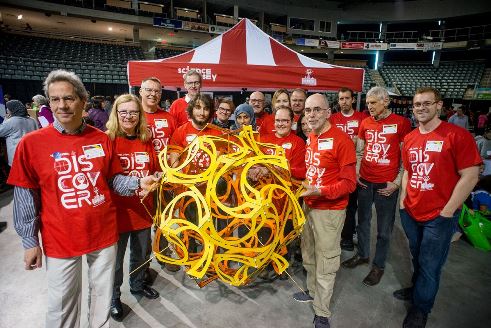
Putting it all together. (Courtesy: Garrett Elliott)
By Michael Banks
A sculpture inspired by the geometry of the neutrino detector at the Sudbury Neutrino Observatory (SNO) has been unveiled at Queen’s University in Kingston, Canada.
SNO, which operated from 1999 to 2006, was located 2.1 km underground in Sudbury, Ontario, and designed to detect neutrinos from the Sun through their interactions with a large tank of heavy water.
A scientific facility designed to foster collaboration in the Middle East is finally open after taking 15 years to build. The Synchrotron-light for Experimental Science and Applications in the Middle East (SESAME) was officially opened yesterday by King Abdullah II of Jordan in a ceremony at the lab’s site near Amman, Jordan. SESAME is a third-generation synchrotron light source and will be used by scientists in the region for a range of experiments from condensed-matter physics to biology.
The synchrotron, which has a relatively small 133 m circumference, features an 800 MeV pre-booster ring that sends a beam of electrons to the main storage ring that in turn boosts their energies to 2.5 GeV – a feat that was first achieved on 27 April – with the particles then producing intense and monochromatic beams of X-rays. Over the past year, construction accelerated with the core storage ring put together with magnets built by the CERN particle-physics lab near Geneva. Initially, two beamlines will be open for users, with more added at a later date.
Harmonic start-up
Swiss physicist Albin Wrulich, who chairs the SESAME Technical Advisory Committee, points out that SESAME is currently undergoing a “conditioning” phase that includes adjusting the pressure and cleaning the surface of the vacuum chamber. “The performance of the machine is excellent,” says Wrulich, adding that the local team did a “fantastic job” constructing the synchrotron. He says that the first two beamlines can now be turned on, making for a “harmonic” start-up.
SESAME has eight members – Cyprus, Egypt, Iran, Israel Jordan, Pakistan, the Palestinian Authority and Turkey – and the synchrotron’s proponents hope that it will foster regional scientific capacity and friendly collaboration among scientists from different countries. Physicist Chris Llewellyn Smith, the former director general of CERN who is ending his eight-year presidency of the SESAME Council today, says that in March SESAME received 55 experiment proposals for the first beamtime. “It shows that SESAME is not going to be underused,” he says. “There is a real demand out there.”
Llewellyn Smith adds that countries in the region whose researchers use SESAME should hopefully consider joining while researchers from countries with synchrotrons should invite regional researchers to join them or instruct local scientists as to synchrotron techniques. “SESAME, in common with all the synchrotrons of the world, will have an open-door policy,” he adds.
Future-proof
SESAME officials are even planning upgrades for the near-future. Wrulich says that there is already interest in upgrading the machine’s booster from 800 MeV to a 2.5 GeV, which would enable the storage ring to sustain a consistently intense beam. The Italian government has also come forward with financial support for a SESAME guest house, and Llewellyn Smith expects the building contract to be finalized soon.
Meanwhile, a European Union programme to support renewable-energy efforts in the Middle East has led Jordan to commit $7m of this aid to build a solar-energy source for SESAME. Llewellyn Smith says this is a breakthrough for SESAME as costs would steeply rise with added beamlines and usage, and expects the solar source, which will be connected to the Jordan grid, to be up and running in early 2018, making SESAME unique in that it will be powered entirely by renewables.
“It is a great satisfaction after many years to see what had really been just dreams or hopes overcome numerous barriers, and here we are,” says Llewellyn Smith. “It is only the end of the beginning, we don’t have all the beamlines we want, we don’t have all the facilities, but the machine is operating and science is about to start.”
A new and faster way of tracking eye movements has been unveiled by researchers in Belgium and the Netherlands. Rather than using high-resolution digital cameras embedded in screens or glasses, the low-cost technology instead detects changes in electric field next to the eye. The team says that it could be used to create eye-tracking systems that are much faster and much cheaper than existing devices.
Tracking the motion of a person’s eyes as they look around has a wide range of applications from medical testing to computer gaming. While conventional systems can locate a person’s gaze, they are not fast enough to track the high-speed motion of the eyes. In particular, it is very hard to follow the eye jumping rapidly from one position to another involuntarily when a scene or object is scanned – what’s known as “saccades”. One solution is to use faster and higher resolution cameras, but that’s a very expensive option.
Naturally electrical
Now, however, Gabriel Squillace and colleagues at the IMEC microelectronics research centre in Belgium and the Holst Centre in the Netherlands have taken a completely different approach by measuring the changes in electrical fields that occur as the eye moves. “Human eyes have a natural electrical potential,” explains Squillace.
The team integrated four electrical sensors developed at IMEC into eyeglasses. Two sensors monitor the eyes’ vertical motion and two sensors monitor their horizontal motion. The team also developed an advanced computer algorithm that translates signals from the sensor into the positions of both eyes. The sensors are also able to measure other aspects of eye activity such as the speed of movement and the frequency and duration of blinks.
Augmented reality
Squillace says that IMEC is now developing commercial devices that can track the position of an eye in real time at a fifth of the cost and four times faster than what’s currently on the market. “IMEC’s ultimate goal is to develop a solution that can track the eye’s most rapid movements, such as saccades, enabling seamless real-time tracking for augmented-reality and virtual-reality applications,” he says.
These devices are now being tested and allow users to interact with screens by moving the cursor with their eyes. Specific blinking patterns can also be used to initiate specific actions such as selecting files, drag-and-dropping icons, and opening and closing software applications.
Tiny ice crystals in Earth’s atmosphere create unexpected flashes of light in images of the planet taken from space. The bright glints were caught by NASA’s Earth Polychromatic Imaging Camera (EPIC) on board the Deep Space Climate Observatory (DSCOVR). Positioned between the Earth and the Sun, EPIC takes almost-hourly images of the sunlit planet. When studying these images, Alexander Marshak, DSCOVR deputy project scientist at NASA’s Goddard Space Flight Center, noticed occasional light flashes appearing over oceans. A closer look revealed these also happened over land, meaning they couldn’t be simply caused by sunlight reflecting off smooth water. Marshak and colleagues turned their attention to another water system on Earth – the ice crystals high in the atmosphere. The researchers catalogued 866 flashes over land between DSCOVR’s launch in June 2015 to August 2016. By calculating angles of reflection and combining with EPIC’s measurements of cloud height, the team concluded that the flashes were caused by sunlight reflecting off horizontally orientated ice crystals in high cirrus clouds (5–8 km). Marshak is now investigating whether the ice crystals are common enough to impact the amount of sunlight passing through the atmosphere, so as to incorporate it into computer models of Earth’s temperature transfers. Detecting similar glints on exoplanets could also provide information about their atmospheres. The work is presented in Geophysical Research Letters.
Quantum drum amplifies microwaves
A new type of electromechanical circuit for microwaves has been created by physicists in Switzerland and the UK. The device comprises a resonant microwave cavity that is coupled to a tiny mechanical oscillator that resembles a drum. The “micro-drum” is 30 μm in diameter and just 100 nm thick. The system is initialized by cooling the micro-drum so that it vibrates in its quantum-mechanical ground state – which is done by scattering microwave photons from the drum, each of which carries away a tiny amount of energy. The drum is coupled to the cavity such that the position of the drum modulates the resonant frequency of the cavity. Conversely, the cavity can affect the motion of the drum by exerting a force on it. As a result of these interactions, energy can be transferred between the drum and cavity. The device has several modes of operation, including one in which the drum is able to absorb microwaves from the cavity – acting as a dissipative reservoir. By tuning the interaction parameters, the device can also be operated as a microwave amplifier that operates just above the quantum limit for noise. In a different regime, the device can be operated as a microwave laser – or maser. Created by László Tóth, Nathan Bernier, Alexey Feofanov and colleagues at École Polytechnique Fédérale de Lausanne and the University of Cambridge, the device is described in Nature Physics. “There has been a lot of research focus on bringing mechanical oscillators into the quantum regime in the past few years,” says Feofanov. “However, our experiment is one of the first which actually shows and harnesses their capabilities for future quantum technologies.”
Scientists map comet’s charged particles
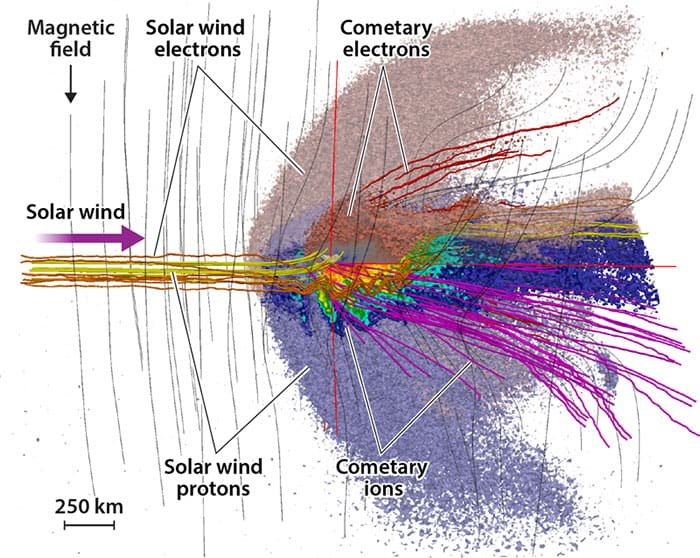
Solar power: simulation result showing the behaviour of various charged particles around the comet 67P/Churyumov–Gerasimenko. (Courtesy: J Deca et al./Phys. Rev. Lett.)
A detailed 3D map of how the solar wind interacts with the 67P/Churyumov–Gerasimenko has been produced by an international team of scientists, who have explained puzzling observations made by the Rosetta mission to the comet. In the above image created by the team, the solar wind of hypersonic charged particles approaches the comet from the left and interacts with the watery halo of the comet. Jan Deca of the University of Colorado Boulder, and colleagues in Russia, Sweden, France and Belgium, used 3D particle-in-cell (PIC) kinetic simulations to study the interaction of four components – electrons and ions in the solar wind, and electrons and water ions in the halo. They found that the interaction between the magnetic-field lines of the solar wind and the comet cause the solar-wind electrons to be deflected around the nucleus of the comet. The heavier solar protons, however, are not deflected as much as the electrons and tend to penetrate the nucleus. Beyond the comet, these protons are neutralized by electrons flowing from the comet. Meanwhile, the solar-wind electrons neutralize some of the water ions that flow from the comet and make up its tail. These charge-exchange processes also transfer momentum from the solar wind to the tail of the comet. Writing in Physical Review Letters, the team describes how it was also able to explain the unexpected existence of two distinct populations of electrons in the halo – warm electrons and hotter suprathermal electrons – which were discovered by Rosetta.
A system of seven rocky exoplanets – recently found to be orbiting the same star – avoid colliding with each because their orbits are highly synchronized, according to computer simulations done by astrophysicists in Canada.
The TRAPPIST-1 system, which astronomers announced in February that they had discovered, is the largest known system of Earth-like exoplanets. Three of the planets appear to be in the habitable zone of the star, which means that they could harbour liquid water and possibly even life.
Since its discovery, however, astronomers have puzzled over how TRAPPIST-1 remains stable. “If you simulate the system, the planets start crashing into one another in less than a million years,” says Dan Tamayo, who works at the University of Toronto’s Centre for Planetary Science. One possibility is that astronomers have been incredibly lucky to see the system before it falls apart – but Tamayo was convinced that there must be a reason why TRAPPIST-1 is stable.
Resonant chain
He therefore joined forces with Matt Russo, Andrew Santaguida and others at Toronto, who began by looking at the sequence of the ratios of the orbital periods of adjacent exoplanets in the system. Astronomers know that this sequence is a “resonant chain”, which means that all of the orbits are synchronized with each other. The exoplanets therefore undergo a highly choreographed and repetitive dance as they travel around the star – and never collide with each other.
“Most planetary systems are like bands of amateur musicians playing their parts at different speeds,” says Russo. “TRAPPIST-1 is different. It’s a super-group with all seven members synchronizing their parts in nearly perfect time.”
The problem, however, is that for such a resonant chain to remain stable for a very long time, the seven orbits must be perfectly aligned. And because astronomers cannot currently measure this alignment to high precision, computer simulations that incorporate this uncertainty suggested that TRAPPIST-1 is unstable.
Supercomputing cluster
Tamayo and colleagues have taken a different approach by looking at how the system formed from a disc of gas and dust and evolved towards its current configuration. Using a supercomputing cluster at the Canadian Institute for Theoretical Astrophysics, the team did a number of simulations that traced the formation and evolution of TRAPPIST-1. In most cases, the system that formed was found to remain stable over a period of 50 million years, which is the longest period of time they were able to simulate.
The team believes that the exoplanets settled naturally into the stable resonant condition during the formation process. “This means that early on, each planet’s orbit was tuned to make it harmonious with its neighbours, in the same way that instruments are tuned by a band before it begins to play,” says Russo.
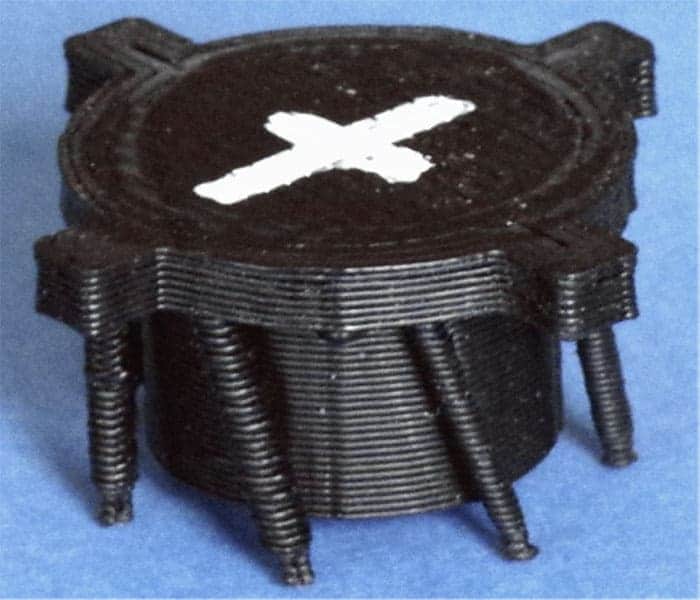
Hop to it: a vibrot jumps and turns. (Courtesy: C Scholz and T Pöschel / Phys. Rev. Lett.)
Hopping vibrots confirm granular gas theory
A theory that describes how a dilute collection of solid grains – such as sand in a sandstorm – behave much like molecules in a gas has been verified experimentally using vibrots. These are specially made cylindrical objects measuring about 15 mm in diameter. They have springy legs that cause a vibrot to rotate when placed on a vibrating table. Christian Scholz and Thorsten Pöschel of Friedrich-Alexander-Universität Erlangen-Nürnberg in Germany placed several hundred vibrots on a vibrating table, where they occupied 60% of the surface area. The vibrots were set in motion and tracked as they moved around the surface. The team measured the velocity distribution of the vibrots and discovered that it is similar to that of a molecular gas with an important exception – there were more vibrots with higher velocities than are seen in a molecular gas. This exception is predicted by granular gas theory, but this is the first time that these high-velocity outliers have been observed in an experiment. The study is described in Physical Review Letters and could help boost our understanding of phenomena as diverse as avalanches and the rings of Saturn.
Galactic neighbours have a magnetic cosmic bridge
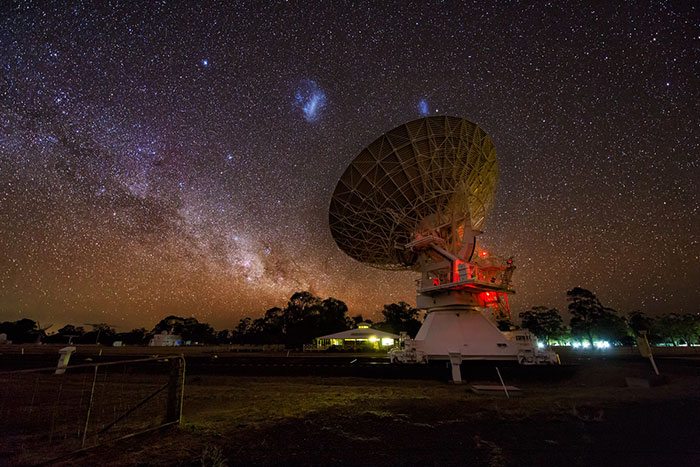
Bridge the gap: gas links the Large (centre left) and Small (centre right) Magellanic Clouds. Pictured above the Australia Telescope Compact Array. (Courtesy: Mike Salway)
The magnetic field associated with the Magellanic Bridge has been mapped for the first time. Spanning 75 thousand light-years, the cosmic bridge is a filament of gas that stretches between the Large and Small Magellanic Clouds (LMC and SMC). These two dwarf galaxies orbit the Milky Way and, at 160 and 200 thousand light-years from Earth, respectively, are our nearest galactic neighbours. Ongoing interactions between the LMC and SMC have created tidal structures, including the Magellanic Stream, the Leading Arm and the Magellanic Bridge. Using radio observations taken by the Australia Telescope Compact Array at the Paul Wild Observatory, researchers have detected the Bridge’s magnetic fields for the first time. Jane Kaczmarek from the University of Sydney in Australia and colleagues studied the radio emissions of distant galaxies that lie beyond the Bridge. “[The Bridge’s] magnetic field then changes the polarization of the radio signal,” explains Kaczmarek. “How the polarized light is changed tells us about the intervening magnetic field.” The phenomenon, called Faraday rotation, indicates that the magnetic field is one-millionth the strength of Earth’s. The researchers argue that the Bridge had no means of generating the detected magnetic field, and they instead suggest it was tidally stripped from the galaxies along with the gas that forms the structure. Kaczmarek and colleagues hope the work, presented in the Monthly Notices of the Royal Astronomical Society, will help provide insights into how galaxies like the Milky Way evolve. “Understanding the role that magnetic fields play in the evolution of galaxies and their environment is a fundamental question in astronomy that remains to be answered,” says Kaczmarek.
Hydrogen-bond strength measured directly
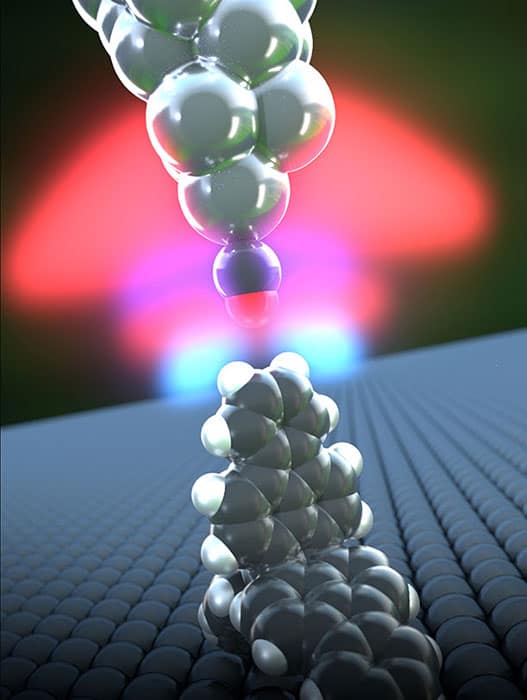
Top tip: AFM measures hydrogen bonds. Artist’s impression of an AFM tip (upper structure) being used to study hydrogen bonds between the tip and a propellane molecule (lower structure). (Courtesy: University of Basel, Department of Physics)
The first direct measurements of the strength of hydrogen bonds in individual molecules have been claimed by an international team of physicists. Unlike chemical bonds, which involve the sharing or transfer of electrons, hydrogen bonds are dipole–dipole interactions between certain molecules containing hydrogen. As well as playing key roles in defining the properties of proteins and nucleic acids, hydrogen bonds are also responsible for the relatively high boiling point of water. Shigeki Kawai of the University of Basel in Switzerland, Adam Foster of Aalto University in Finland an colleagues used an atomic force microscope (AFM) to study hydrogen bonds in molecules called propellanes – which arrange themselves on surfaces such that two hydrogen atoms are pointing upwards. Their AFM tip comprised a single oxygen atom, which was positioned so close to a propellane molecule that a hydrogen bond formed between the oxygen atom and the two hydrogen atoms. Then, the AFM was used to measure the strength of the bond as a function of the separation between the oxygen and hydrogen atoms. The measurements confirmed that the hydrogen bond is much weaker than chemical bonds, but much stronger than van der Waals forces – which is a dipolar interaction that is weaker than hydrogen bonding. The measurements were also in agreement with calculations of bond strength done by members of the team. Writing in Science Advances, the team says that the experimental technique could be used to identify 3D molecules such as DNA and polymers.
You can find all our daily Flash Physics posts in the website’s news section, as well as on Twitter and Facebook using #FlashPhysics. Tune in to physicsworld.com later today to read today’s extensive news story on the Trappist-1 system of exoplanets.
Proton therapy is considered by some as the optimal radiation delivery modality – with the finite range of protons enabling highly conformal dose targeting and reduced dose to normal tissue. Image guidance, using cone-beam CT (CBCT) for example, should increase the accuracy and improve outcomes further. But alongside, recent years have seen the emergence of online MR-guided radiotherapy, promising unparalleled soft-tissue image contrast and the ability to “see what you treat”. In a theatrical debate at last week’s ESTRO 36, speakers considered whether proton-guided photons will be superior to photon-guided protons.
Bas Raaymakers from University Medical Center Utrecht kicked off the debate by presenting the case for MRI-guided photon therapy. The first consideration, he said, is comparison of photons with protons. He described a fierce debate back in 2008 suggesting that in 10 years’ time all radiotherapy will be delivered via protons. “That isn’t going to happen,” he pointed out.
One major obstacle is that protons are so much more expensive. A proton therapy installation starts at Euro 30m, while MR-guided radiotherapy systems cost around €6–10m. “People have asked whether protons are worth the investment,” said Raaymakers. “It is a hard case to make.”
Raaymakers explained that while there are currently 58 operational proton therapy facilities and another 52 on the way, the number of MR-guided radiotherapy systems is also increasing fast. “In a few years’ time, we’ll be at half the number of proton facilities,” he predicted. “We’re already way ahead of the number offering CBCT-guided protons. The ViewRay system has been treating patients since 2014, this is reality right now.”
Another, more pressing problem, Raaymakers suggested, is the high level of uncertainty associated with proton therapy, including uncertainties in range, dose calculation, beam modelling and biology. “In reality, you can’t exploit the Bragg peak because you don’t know exactly where the range ends,” he said, citing the common use of two opposing beams for prostate treatments, rather than daring to hit the tumour with the distal edge. “This is holding back proton progress.”
He also noted that the patients predicted to benefit most from proton therapy are those chosen to be treated. “This is very sensible, but also a sign that protons are not superior to the MR-linac at all, because you have to heavily select patients.”
The second comparison to consider is MRI versus CBCT. “Either you can see virtually nothing prior to beam-on, or you can see everything during treatment. It’s a no brainer,” said Raaymakers. “It’s very hard to see what you need to using CBCT, while MRI can follow all deformations with time and really see what’s going on during delivery.”
Another benefit of MRI is the ability reconstruct delivered dose distributions and, if needed, create a completely new plan each day. This enables margin reduction and, consequently, lower integral dose. “We have better alternatives than just the Bragg peak to reduce the dose,” Raaymakers explained.
Proton promise
Arguing the case for CBCT-guided proton therapy, Tony Lomax from the Paul Scherrer Institute took to the podium. “Proton-guided photons may reduce the margins, but photon-guided protons will reduce the volume of normal tissue receiving mid- to low-doses: the dose bath,” he told the audience. “That bath may be low dose, but it is there and may be more significant than we think.”
Lomax suggested that protons offer “a shower instead of a bath”, and shared a host of examples demonstrating “the benefits of a good shower”. First up, he cited a study comparing 558 proton therapy patients with 558 age-matched proton patients. The second cancer incidence at 10 years was 5.4% for patients treated with protons, compared with 8.6% for those receiving X-ray therapy. This factor-of-two difference mirrors the reduction in bath dose, he noted.
Another study examined paediatric medulloblastoma patients treated with protons or photons Proton therapy significantly reduce adverse effects, resulting in a 2.8-times reduction in hypothyroidism (23% versus 65% for photon irradiation), a 6.3-times reduction in sex hormone deficiency (3% versus 19%) and a 1.4-times reduction in the need for endocrine replacement therapy (55% versus 78%).
Elsewhere, a study of children with brain tumours treated with protons or photons showed that proton therapy can improve quality-of-life (QoL) after treatment. “The health-related QoL was close to that of normal controls for proton patients, while for photon patients it was reduced,” Lomax explained.
To illustrate the adverse consequences of the dose bath, he described some animal studies. For example, irradiating rats’ parotid glands showed that a 1 Gy added dose bath led to 30% reduced parotid flow. Meanwhile, adding a 4 Gy dose bath when irradiating a rat’s spinal cord reduced spinal cord tolerance by 25%.
Lomax also described a study in which the distal edge was employed to spare nearby organs-at-risk. High-dose scanned protons were used to treat 31 paraspinal/retroperitoneal tumours, a malignancy where dose was historically limited by small bowel dose constraints. Despite target doses of more than 70 Gy(RBE), no acute toxicities were observed, with just one patient suffering a grade 1 toxicity. “We’re basically putting no dose into the rest of the bowel so there’s virtually no toxicity,” said Lomax. “This is the power of the shower.”
Likewise, in a study of 222 patients with skull-base chordomas treated with pencil-beam scanned protons, not one brainstem toxicity was seen. “I don’t believe any of these indications would benefit from treatment with the MR-linac,” Lomax noted.
The delegates decide
At this point, the session chairs polled the audience using what chair Joseph Deasy described as an “intensity-modulated voting system”. The audience voted convincingly for photon-guided protons, creating a noise level of 82 dB (as measured by co-chair Jan-Jakob Sonke) compared with 75 dB for proton-guided photons.
But the story doesn’t end there. The speakers returned to the podium to present their rebuttals. Raaymakers emphasized that, right now, the main aim is to deliver conformal dose to target. While a low overall dose is obviously advantageous, if a target lies next to a sensitive organ, then using MRI to reduce margins can give a smaller high-dose area and less dose-limiting toxicities. “First we have to solve the geometric challenge, then bring in the biology,” he said, pointing out that if you can visualize the delivered dose, this can be correlated with toxicities to help understand the biology.
“Clearly there are cases where proton therapy can do a better job; brain and paediatric patients need best the treatment, of course,” Raaymakers concurred. “But we need to treat all cases, we need a general purpose better radiotherapy. MR-guided radiotherapy will be the workhorse.”
“I agree that we need to see the target,” replied Lomax. “But do we need to do MR online?” He pointed out that it is possible to perform MRI offline and create patient-specific motion models. Combining such models with images of a surrogate during treatment enables target motion prediction to within about 2 mm.
“I personally look forward to seeing future clinical results from both proton-guided photons and photon-guided protons, as well as proton-guided protons and even phonon-guided protons and photons,” concluded Lomax. “Let’s come back in 10 years’ time and see where we are.”
A final intensity-modulated vote revealed a change of heart from the audience, with fans of photon-guided protons registering 81 dB and those choosing proton-guided photons reaching 82 dB. Perhaps the future does indeed lie in MR-guided radiotherapy – or maybe its proponents can just cheer louder.
You might find this surprising, but Romania is one of the main reasons I became a journalist. Back in 2006, having recently graduated with a degree in natural sciences, I spent the summer in the Transylvanian city of Brasov, teaching English to school kids. While there, I was talked into writing a few articles about my experiences for the local tourism magazine, Brasov Visitor. To cut a rambling story short, I had a memorable summer and caught the writing bug. Eventually, I landed a job at Physics World, which enabled me to combine my journalistic leanings with my scientific background.
Space radiation has been reproduced in a lab on Earth. Scientists have used a laser-plasma accelerator to replicate the high-energy particle radiation that surrounds our planet. The research could help study the effects of space exploration on humans and lead to more resilient satellite and rocket equipment.
The radiation in space is a major obstacle for our ambitions to explore the solar system. Highly energetic ionizing particles from the Sun and deep space are extremely dangerous for human health because they can pass right through the skin and deposit energy, irreversibly damaging cells and DNA. On top of that, the radiation can also wreak havoc on satellites and equipment.
While the most obvious way to study these effects is to take experiments into space, this is very expensive and impractical. Yet doing the reverse – producing space-like radiation on Earth – is surprisingly difficult. Scientists have tried using conventional cyclotrons and linear particle accelerators. However, these can only produce monoenergetic particles that do not accurately represent the broad range of particle energies found in space radiation.
Now, researchers led by Bernhard Hidding from the University of Strathclyde in the UK have found a solution. The team used laser-plasma accelerators at the University of Dusseldorf and the Rutherford Appleton Laboratory to produce broadband electrons and protons typical of those found in the van-Allen belts – zones of particle radiation caused by Earth’s protective magnetic fields.
After all, radiation in space is one of the key showstoppers for human spaceflight
Bernhard Hidding, University of Strathclyde
Laser to plasma
The accelerator works by firing a high-energy, high-intensity laser at a tiny spot just a few μm2 on a thin-metal-foil target. “The sheer intensity of the laser pulse means that the electric fields involved are orders of magnitude larger than the inneratomic Coulomb forces,” explains Hidding, “The metal-foil target is therefore instantly converted into a plasma.” The plasma particles – electrons and protons – are accelerated by the intense electromagnetic fields of the laser and the collective fields of the other plasma particles. The extent at which this happens depends on the particle’s initial position, resulting in the huge range of energies.
The team studied its plasma particles using electron-sensitive image plates, radiochromic films for protons and scintillating phosphor screens. Then, to prove the lab-made radiation was comparable to space radiation, the team used simulations from NASA. “The NASA codes are based on models as well as a few measurements, so they represent the best knowledge we have,” says Hidding.
Monitoring the damage
The next task was to prove that the system could be used to test the effects of space radiation by subjecting optocouplers to the particle radiation. Optocouplers are common devices that transfer electric signals between isolated circuits. As they are characterized by their current transfer ratio, Hidding and team were able to monitor the radiation-induced degradation by measuring this performance.
The proof-of-concept experiment, described in Scientific Reports, could represent a major breakthrough towards understanding the effects of space radiation without the need to leave Earth. The next step will be to develop a testing standard that can be used to test electronics and biological samples – “After all, radiation in space is one of the key showstoppers for human spaceflight,” Hidding remarks.
Strathclyde’s newly installed laser will also play a key role in future research – “[It is] the highest-average-power laser system in the world today,” says Hiddings. Housed in three radiation-shielded bunkers at the Scottish Centre for the Application of Plasma-based Accelerators (SCAPA), the system will power up to seven beamlines. “The vision is to develop a dedicated beamline for space-radiation reproduction and testing, and to put this to use for the growing space industry in the UK and beyond.”
Carson Huey-You was just 11 years old when he arrived at Texas Christian University to study physics. Now, at the ripe old age of 14, he is about to graduate, according to an article in the Huffington Post. “I knew I wanted to do physics when I was in high school, but then quantum physics was the one that stood out to me, because it was abstract,” says Huey-You. Most American children start high school at age 14, but Huey-You was learning calculus by the time he was three – a subject usually reserved for high school seniors. And precociousness runs in the family because his younger brother Cannan is starting university in September aged 11. The siblings are delightful and interviewed in the above video.