Liquid droplets sprayed onto a stretched film reveal asymmetries in the tension within the film – according to physicists in Canada and France. Rafael Schulman, Kari Dalnoki-Veress and colleagues at McMaster University and ESPCI Paris found that glycerol on an elastic polymer film formed circular droplets when the film is stretched with a tension that is uniform in all directions. However, when the tension is greater in one direction, the droplets form with elliptical shapes. What is more, the long axes of the elliptical droplets point along the direction of highest tension. By measuring the 3D shape of a droplet, the team was also able calculate the local tension of the film. By studying droplets distributed across a film, the researchers were able to measure the stress vector at different points in the material – mapping how shear and boundaries affect stress, for example. The technique is described in Physical Review Letters and could lead to a new non-destructive way of measuring stress.
3D-printing sensitive robot skin
A 3D-printed electronic fabric could allow robots to feel. The “bionic skin” has been developed by Michael McAlpine of the University of Minnesota in the US and colleagues, and is a step towards wearable electronics for human skin. To create the sensing fabric, the team built a customized 3D printer and used specialized “inks” to build the layers of the skin. The resulting structure has a base layer of silicone topped with electrodes and a coil-shaped pressure sensor, all made of conductive silver-silicone ink. A sacrificial layer holds the layers in place while the ink sets and is then washed away in the final manufacturing stage. Unlike conventional 3D-printing materials, the inks used set at room temperature and stretch up to three times their original size. “This is a completely new way to approach 3D printing of electronics,” says McAlpine, “We have a multifunctional printer that can print several layers to make these flexible sensory devices. This could take us into so many directions from health monitoring to energy harvesting to chemical sensing.” The bionic skin, presented in Advanced Materials, could also be applied to surgical robots, giving surgeons a sense of touch while working remotely. The discovery could even lead to printing electronics onto human skin. “While we haven’t printed on human skin yet, we were able to print on the curved surface of a model hand using our technique,” McAlpine says: “We also interfaced a printed device with the skin and were surprised that the device was so sensitive that it could detect your pulse in real time.” The next step for the research is to develop semiconductor inks and print on a human body.
Accelerator institute spins out beam-monitor technology
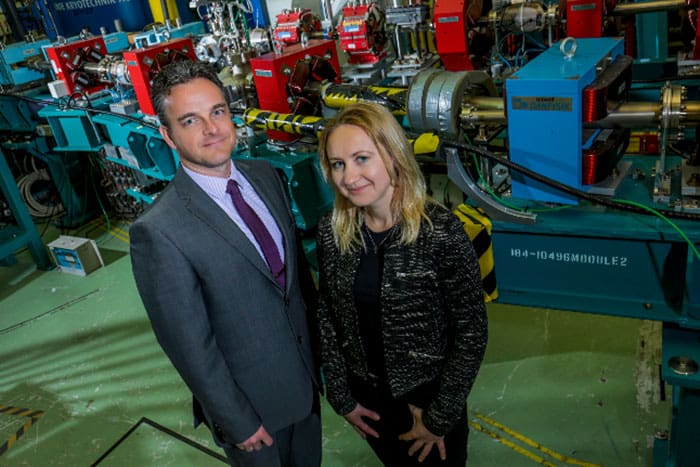
D-Beam’s co-founders Carsten Welsch (left) and Alexandra Alexandrova. (Courtesy: Cockcroft Institute)
A new commercial device for monitoring beam loss in accelerators has been developed by D-Beam, which is a spin-out company from the Cockcroft Institute accelerator centre at the Daresbury Laboratory in the UK. The company was co-founded by Carsten Welsch and Alexandra Alexandrova who are both at the University of Liverpool, which is one of five partners that operate the Cockcroft Institute. The company’s first product is new type of sensor that can monitor the “halo” of particles lost by a beam of particles as it moves through an accelerator. In some cases this loss introduces unwanted noise into experiments, and in some extreme situations beam loss can damage accelerators. The system uses optical fibres fitted with advanced light detectors. Whenever a stray particle crosses a fibre, it creates a light pulse that is recorded with extreme precision – revealing both the time and place in the accelerator where the particle was detected. “Another product we are considering for commercialization is a gas-jet-based monitor that can characterize the profile of the beam, another key feature that needs constant surveillance,” says Welsch. The monitor – which will be deployed in the next upgrade of the Large Hadron Collider at CERN – fires a cold supersonic gas jet shaped across the path of the beam. When the beam particles hit the atoms of the gas, light is generated, which creates a “photograph” of the beam’s profile.
You can find all our daily Flash Physics posts in the website’s news section, as well as on Twitter and Facebook using #FlashPhysics. Tune in to physicsworld.com later today to read today’s extensive news story on creating space radiation on Earth.
Physicists have used interferometry to detect the minute tidal forces acting on individual atoms exposed to a local gravitational field. This allowed them to measure the curvature of space–time on a very small scale and argue that their observations are perhaps “the first of gravity in a quantum-mechanical system”. The team adds that its sensitive apparatus might also improve prospecting for oil and minerals.
Tidal forces arise due to the finite size of gravitating objects. When one body is attracted to another it will experience a larger attractive force on the side nearest the second body than it will on the far side. In the case of the Earth, the oceans nearest the Moon are attracted slightly more to our celestial neighbour than are the oceans on the far side of the planet, causing the former to bulge slightly and create a high tide.
In the latest work, Mark Kasevich at Stanford University in the US and colleagues instead measure the minuscule tidal forces created when single atoms are allowed to fall in the presence of a nearby massive object. They did so to study the effect of space–time curvature on the atoms’ wave functions – tidal forces being directly related to this curvature – with the idea that gravity might conceivably destroy quantum coherence.
Wave–particle duality
The team used an atom interferometer, a device that exploits the principle of wave–particle duality to enable very precise measurements of acceleration. Like an optical interferometer, it involves splitting a particle’s wave function, sending the two halves along different paths and then recombining the separate waves to establish whether or not the waves’ relative phase has changed along the way.
The Stanford group propelled ultracold rubidium atoms up a 10 m-high tube and then fired a precise series of laser pulses at the atoms as they fell back down to Earth. These pulses acted as the equivalent of beam splitters, mirrors and other components in an optical interferometer.
Wave packets of individual atoms were divided such that the two parts travelled inside different interferometers placed 30 cm apart. One of the interferometers was created close to an 84 kg lead mass, and it was the roughly 10 cm-wide partial wave packet that travelled through this device that was monitored for evidence of tidal forces. The other interferometer – beyond the gravitational range of the lead – was instead used as a reference to eliminate the effect of Earth’s gravity and instrumental vibrations.
We were able to establish the fingerprint for tidal forces
Mark Kasevich, Stanford University
By varying the distance between the arms in the first interferometer, the researchers found that the resulting differences in relative phase yielded a quadratic dependence in agreement with the calculated space-time curvature created by the lead mass. “We were able to establish the fingerprint for tidal forces,” says Kasevich.
This is not the first time that atom interferometers have been used to measure space–time curvature. In 2015, Guglielmo Tino of the University of Florence in Italy and colleagues demonstrated the presence of curvature by comparing the accelerations of atoms within three separate clouds placed in the gravitational field of a set of tungsten-alloy masses. But Kasevich says that atoms in different clouds do not exist in a single coherent quantum state. Only by measuring the tidal force across individual wave packets, he says, would it be possible to observe gravity’s destruction of quantum coherence – should that take place in nature.
Coherence preserved
Kasevich says that the results obtained in the current work are “completely consistent” with the preservation of quantum coherence. As to what level of experimental sensitivity might be needed to observe any decoherence, he says that current theory provides little guidance. Most physicists working on theories of quantum gravity, he adds, are interested in the “strong-field limit” characteristic of black holes and other massive objects, in contrast to the very small fields that generate atomic tidal forces. Nevertheless, he believes it is important to make the measurements. “I am an experimental physicist,” he says. “My job is to push physical systems into new domains.”
According to Kasevich, his group’s work is also important technically since it shows how to carry out quantum measurements on the centimetre, as opposed to millimetre, scale. As for applications, he says the group’s apparatus might potentially improve gravity-based searches for oil and other resources. To identify substances with particular densities under the Earth’s surface, engineers generally employ gravimeters that measure the variation in gravitational acceleration from one point to another. But, as Kasevich explains, the equivalence principle dictates that if such devices are used on board helicopters, for example, it then becomes difficult to distinguish between vibrational and gravitational accelerations. This, he says, is not a problem when measuring space–time curvature.
Hard work needed
Kasevich acknowledges that there “is still a lot of work” needed to make a practical version of their instrument – one that “is not a 10 m-high tower located in the basement of a building”. In particular, he says, lasers must have “reasonable power levels and good control over polarization”. But he believes that these challenges can be overcome, arguing that money from UK, European and US schemes in quantum technology can “make these things come to fruition”.
Tino praises the California team, noting the importance of being able to split wave packets over longer distances than previously. “This is a further demonstration of the potential of atom interferometry for the investigation of gravity in yet unexplored systems,” he says. The work is described in Physical Review Letters.
Scientists are aware that many different animals appear sensitive to the Earth’s magnetic field lines. But what is not so well understood are the underlying mechanisms that make navigation possible. In this latest work at Simon Fraser University in Vancouver, researchers have identified particles of magnetite – a ferromagnetic material – within the abdomen of honey bees.
In the podcast, Glester speaks with biologist Veronika Lambinet and physicist Michael Hayden who describe the group’s experiments with bees. They describe studying the reaction of live bees exposed to magnetic fields stronger than the Earth’s field. Another experiment involved placing bee body parts within a superconducting quantum interference device (SQUID) to study the magnetization effects.
Glester also meets with Heather Lampard, a science communicator and beekeeper in Bristol, UK, where Andrew and Physics World are based. Clearly a huge admirer of her stripy friends, Lampard gives a crash course in the science of bees, explaining how they detect plants’ electric fields and why honeycombs are hexagonal-shaped. You can watch Lampard explain how bees produce honey, in this video she produced for the Bristol Nature Channel.
The quantum properties of molecular ions have been controlled by physicists in the US and Germany. Led by Chin-wen Chou of the National Institute of Standards and Technology (NIST) in the US, the researchers determined a molecular-ion’s quantum state by transferring the information to an atomic ion. A calcium ion and calcium-hydride ion are first confined in an electromagnetic trap. The atomic ion is then laser cooled, which also slows the motion of the partner molecular ion. Although the molecular ion is now in its lowest-energy electronic and vibrational states, it still rotates randomly. A pulse of laser light is applied to the molecule at a frequency that targets only one, unique transition in its rotational spectrum. If the molecule does jump into the target state, the system remains motionless. But if it makes the transition, both ions start moving again because energy is returned to their shared motion. This movement can be detected by applying a laser pulse to the atomic ion that changes its internal state, causing it to scatter light that can be detected. Described in Nature, the method is an alternative to laser cooling and controlling molecules, which has proven very difficult to do. “Whatever trick you can play with atomic ions is now within reach with molecular ions,” says Chou. “This is comparable to when scientists could first laser cool and trap atoms, opening the floodgates to applications in precision metrology and information processing. It’s our dream to achieve all these things with molecules.”
Biophysicist to lead Royal Society of Biology
The biophysicist Julia Goodfellow will be the next president of the UK’s Royal Society of Biology (RSB). Currently vice chancellor of the University of Kent and president of Universities UK, Goodfellow did a PhD in biophysics at the Open University Research Unit before embarking on a career in biomolecular science at Birkbeck College, where she served as vice-master and head of the School of Crystallography. She has also served as chief executive of the UK’s Biotechnology and Biological Sciences Research Council and chair of the British Science Association. Goodfellow will succeed the current RSB president Jean Thomas in May 2018 and will become the third president of the society since it was founded in 2009. “I look forward to working with the RSB to help strengthen the bioscience community they have successfully fostered, and ensure we are able to represent their views and priorities in the coming months and years,” says Goodfellow.
Stretchy hologram switches between images
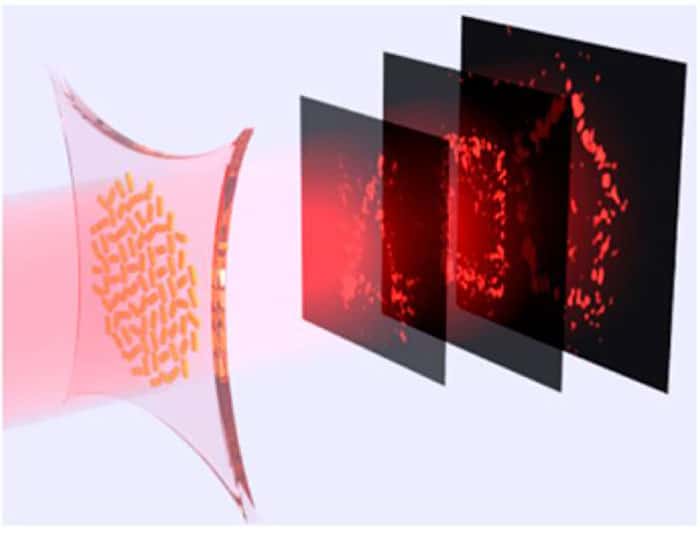
At a stretch: holograms shaped like a triangle, square and pentagram can be made by stretching the same metasurface. (Courtesy: American Chemical Society)
A hologram that switches between multiple images as the material used to generate it is stretched has been unveiled by Ritesh Agarwal and colleagues that the University of Pennsylvania in the US. The system is based on a metasurface, which is a flat, ultrathin material with nanometre-scale features. The team had previously shown that coherent light passing through such metasurfaces can produce colour holograms – 3D images created by the interference of light. Now, Agarwal and colleagues have created a metasurface by embedding gold nanorods in a stretchable film of polydimethylsiloxane (PDMS). Using a computer simulation, the team worked-out the distribution of nanorods that would result in a sequence of different holograms as the film is stretched. In its relaxed state, a pentagon-shaped hologram forms 340 μm away from the film. As the material is stretched the hologram changes shape – changes first becoming a square and then a triangle. The team was also able to switch between a happy-face hologram and a sad face. The new technique could have applications in virtual reality, flat displays and optical communications and is described in ACS Nano.
You can find all our daily Flash Physics posts in the website’s news section, as well as on Twitter and Facebook using #FlashPhysics. Tune in to physicsworld.com later today to read today’s extensive news story on the tidal forces on single atoms.
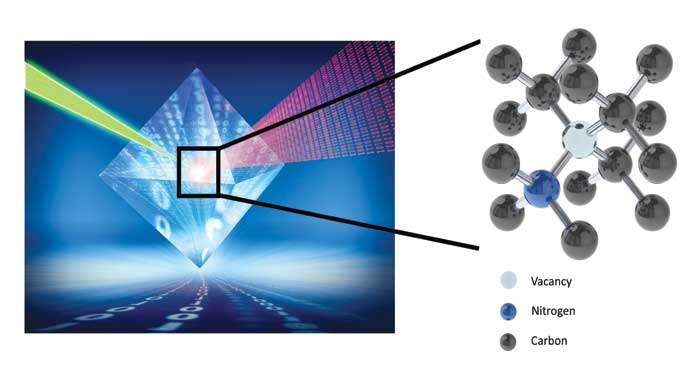
Quantum flaw: a schematic representation of the nitrogen vacancy (NV) defect in diamond. The surrounding lattice of carbon atoms helps to shield the electronic spin state of the NV centre from noise. (Courtesy: Element Six)
In the 20th century many aspects of quantum physics were harnessed into world-changing technologies, including semiconductors, lasers and other now- ubiquitous devices. Throughout this first quantum revolution, however, one key aspect of quantum physics – superposition – has largely remained in the laboratory, a fundamental curiosity rather than a promising feature to be exploited.
However, this is about to change, thanks to several significant initiatives that aim to bring about a second quantum revolution. The key to this revolution’s success will be the ability to “easily” engineer and control quantum bits. We use the word “easily” with caution, because initializing a quantum state and keeping it in a superposition for significant lengths of time is a difficult undertaking. Scientists are exploring many different approaches, using materials as varied as superconductors, synthetic diamonds, cold atoms and quantum dots, and the race is currently wide open. But diamond does have some intriguing advantages, both for quantum computation and for other applications such as magnetic-field sensing. The challenge for our organization, the industrial diamond firm Element Six, has been to support research in this area while also staying true to our core business interests in materials applications.
A useful flaw
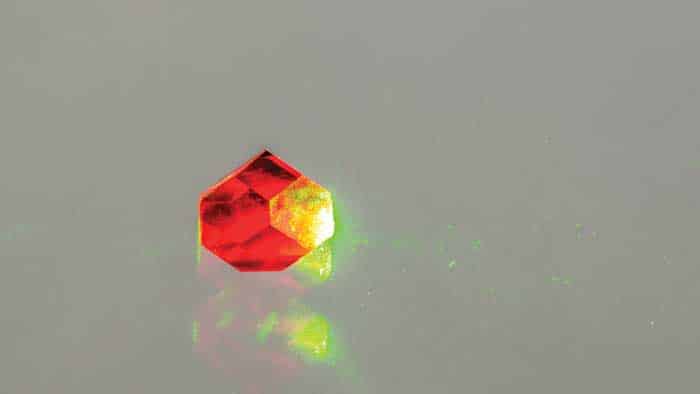
The type of diamond that attracts would-be quantum revolutionaries has a defect in its otherwise uniform lattice of carbon atoms. This defect consists of a single nitrogen atom adjacent to a missing carbon atom, or vacancy. The nitrogen-vacancy (NV) centre has unique optical absorption and emission properties – among other effects, it gives diamond a red-to-pink colouration – and these properties have long been the focus of fundamental research on crystal structures.
In addition to its unusual optical properties, the negative charge state of the NV centre also has an electronic spin, S = 1, in its ground state. Remarkably, the state of this electronic spin can be controlled and read out at room temperature. The reason is that unlike most materials, the crystal lattice in diamond forms a low-noise environment, so fragile quantum properties are not lost and information can be stored and probed for longer time periods. The spin state can be read out by measuring the intensity of light given off by an NV centre as the system is excited by microwave radiation. At the NV centre’s resonance frequency of 2.88 GHz, the spin state will flip from 0 to a +1 or –1, causing a dip in the intensity of red light emitted.
The robustness of this spin state, and the ease of reading it out, make NV diamond a very promising platform for a wide range of quantum technologies, with potential applications in secure communications, computing, imaging and sensing. A recent focus area for the diamond community is the use of NV defects to measure magnetic fields. Thanks to the Zeeman interaction, the gap between the frequencies of the 0 → 1 and –1 → 0 microwave transitions in NV diamond increases as a function of magnetic field. Hence, in the simplest case, one can estimate the magnitude of the magnetic field by exposing the NV centre to a range of microwave frequencies and measuring the separation between the two dips in intensity. Remarkably, a basic measurement of this type can be performed using a single NV centre at room temperature. With multiple NV centres, the geometry of the diamond lattice means that one can make extremely sensitive measurements of the field’s direction as well as its magnitude.
Precision engineering: advances in synthetic diamond manufacturing have made it possible to create diamonds with the right number of NV centres for particular applications. (Courtesy: Element Six)
Raw materials
Of course, numerous technologies for estimating magnetic field already exist. These include superconducting quantum interference devices (SQUIDs), vapour cells, flux-gate sensors and the Hall-effect sensors that constitute the compass in modern smartphones. However, SQUID-based magnetometers must be cryogenically cooled, making them relatively bulky and costly to run, while other sensor technologies require frequent recalibration and offer limited frequency bandwidth for measuring changing magnetic fields. In contrast, NV diamond-based sensors do not need to be recalibrated, have a broad bandwidth and could be incorporated into a lightweight, low-powered device. Critically, NV centres can also be used to construct maps of magnetic field across a surface, thanks to the high spatial resolution provided by a microscopic probe. For these reasons, diamond-based magnetometers have strong potential both as replacements for existing technologies and as the enablers of applications where competing technologies do not yet exist.
For these applications to become a reality, though, we need a ready supply of high-quality NV diamonds. NV centres are rare in natural diamonds, and it is difficult to do much research if you are limited to working with a single sample. At Element Six we have developed methods for growing NV diamond synthetically using chemical vapour deposition (CVD). This process involves filling a microwave chamber with a mixture of hydrogen, methane and nitrogen gas, and heating it to 2500–3000 K to create a plasma. Diamond “seeds” placed in the chamber become the nuclei for new diamonds as carbon atoms from the plasma deposit onto their surfaces layer by layer. The hydrogen stabilizes the surface against forming graphite instead of diamond, while the nitrogen acts as a dopant, making it possible for NV centres to form.
This process is the result of more than 15 years of intensive R&D and it enables us to grow diamond in a controlled and scalable fashion, with a purity far exceeding that of natural diamonds. It also makes it possible to control the number of NV centres. Under high-purity conditions, small numbers of NV centres are produced via the chemistry of the growth process. These isolated vacancies can be probed individually in an experiment, so this type of NV diamond is well-suited for quantum- computation applications. Magnetic- sensing applications require higher numbers of NV centres, and we achieve this by increasing the nitrogen concentration during synthesis and then bombarding the crystal with high-energy electrons to create additional vacancies. Heating the diamond to 800 °C causes these vacancies to migrate through the crystal lattice until they encounter nitrogen atoms; at that point, the structure stabilizes, since the NV centre has a lower potential energy than a separate nitrogen and vacancy.
The value chain
Over the past decade advances in our diamond-making capabilities, coupled with a deepening understanding of the physics of quantum spins in NV diamond, have opened up a wide range of potential applications. Element Six has supported this nascent field by supplying state-of-the-art diamond samples and diamond engineering expertise to external partners, while focusing internally on making further improvements to the material. In recent years, however, we have also become more active in supporting commercial start-ups to allow them to incubate the technology and in helping larger companies assess the applicability of our diamonds to various market opportunities.
The breadth and depth of knowledge needed to appreciate these opportunities is significant. It requires one to consider an entire value chain: a material; a device made from that material; the package surrounding that device; the subsystems and systems the device fits into; and finally the user. As is often the case, the commercial value of this chain is concentrated at the subsystem and system level. But Element Six is a materials company, and we have grown by developing novel materials that address problems across multiple markets and industries. Making devices, let alone complete systems for end users, is not really our speciality. So how can we access the value at the other end of the chain?
Rather than changing our strategic focus, we have instead sought to exploit diamond quantum devices by communicating their “value proposition” to end users. A basic demonstration of the NV centre’s ability to measure magnetic field is not difficult, and a prototype device can be made using remarkably simple components such as off-the shelf diode lasers and photodiodes, and coils of wire to deliver the microwaves to the sample. Packaging all of this together into a robust unit is less trivial, of course; ultimately, the performance of a diamond sensor will depend not only on the material itself and Element Six’s expertise, but also on the stability of surrounding components and the data-processing algorithms used to transform raw measurements of light intensity into an accurate and highly sensitive map of the vector magnetic field. Nevertheless, it is always much easier to convince people of a device’s potential with a demo than with PowerPoint slides.
Another component of our strategy has been to partner with university researchers who are developing diamond-quantum-device technology. This has enabled us to secure some intellectual property (IP) on the physics needed to make working devices – although, crucially, we actively avoided filing patents for the actual applications because we wanted to leave third parties free to develop their own. Our university partners have also been an important bridge between us and potential end users. Making a diamond-based quantum device (or indeed any quantum device) requires knowledge of quantum physics, and since this is an emerging industry most organizations do not yet have that expertise. Combining our IP and materials know-how with their quantum-physics expertise enabled us to start talking to organizations that were actually in a position to develop this technology. In addition, many of the academic groups we work with have produced spin-out companies. We have supported these companies with materials sales and knowledge-sharing, and we anticipate that the applications they develop will be a growth area for Element Six over the coming years.
Potential gems
Diamond quantum technologies are extremely promising, with many applications already at the proof-of-concept stage. These include applications in materials characterization such as nanoscale imaging of the write heads for next-generation magnetic hard drives, and biological imaging. New sensing methods for pressure and temperature, plus the alluring possibility of diamond-based quantum computing, makes this an exciting and productive area.
We foresee that diamond will continue to be used as a tool to aid our understanding of the quantum world. However, the real excitement concerns the possible technologies that this understanding will enable. In late 2016 a group of researchers led by Ron Walsworth at Harvard University, US used NV centres in diamond to study neuron activity in marine worms, measuring the tiny magnetic pulses from single neurons with high spatial resolution. No other existing technology can perform measurements at such high sensitivity and resolution; the maximum spatial resolution of standard MRI scans is about 1 mm3, whereas diamond-based magnetic field sensing could, in theory, give us cellular-level images of chemical processes. We expect that this proof-of-principle experiment will be followed by breakthroughs in our understanding of how the brain works, as well as new diagnostic methods and treatments.
Galileo Galilei, the controversial Italian astronomer, was recently questioned by a US Immigration and Customs Enforcement (ICE) officer. I managed to obtain a transcript of the encounter.
ICE Passport, please. GalileoEccolò. ICE [Flicks through document.] Ah, so you’re a scientist? I’ve heard you scientists are doing work that threatens American interests. G Which work? I’ve upset a few astronomical apple carts, but what makes politicians go ballistic these days is meteorology. ICE Look, your particular academic cranny doesn’t matter. What matters is if your science threatens American jobs, economy and values. G It can’t. Science doesn’t hurt a nation’s interests. It can only stimulate a country’s activity – make it grow. ICE That’s not what the politicians say. G Well, they’re idiots. ICE Do you know who you’re accusing? G Powerful idiots. ICE No, they’re duly elected senators, representatives and members of the executive branch, sworn to defend the country. G Not all elected politicians understand how best to defend the country. If they did, they wouldn’t argue so much. ICE Yes, but they are the law of the land, the ultimate authorities. G You reckon? So why not ask politicians to repair your car, fix your computer or cut out your appendix? It’s because that’s not their skill. Also, it’s way beneath their dignity. Leave that stuff to geeks like me! ICE Well, politicians make the laws. The American constitution says nothing about restricting their authority, or sharing it with science. G That constitution was written almost 250 years ago, at a particular historical moment and for a different audience. Its authors knew that times would change and wrote it flexibly, so it could be adapted to changing realities. Modern politicians should pay attention to the words of founding fathers like Benjamin Franklin, John Adams, Thomas Jefferson and James Madison, who weren’t just amateur scientists but realized that using science to understand nature is essential to effective democracy. In determining the real, they thought, science allows politics to craft the possible. As one of my political friends likes to say, “The founding fathers showed how to create legislation, not to legislate creation!” ICE The safest course is to adhere to the constitution’s literal language. G Oh, really? What about article 1, section 2, paragraph 3, which treats a slave as three-fifths of a person? If today you believed the literal truth of that, you’d be un-American! The constitution only works today if you adapt it to current reality. ICE I’m recording you as denying that the constitution is the supreme law of the land. G What I’m saying is that there are two constitutions, the American constitution and nature’s constitution. Politicians are the authorities for the former, while scientists are the authorities for the latter. These two constitutions – political and natural – cannot conflict. If they appear to conflict, somebody is overstepping their authority. Those who overstep their authority are being un-American. They are violating their oaths of office and endangering the country. If you want to purge America of its enemies, eject the science-deniers. ICE Sorry, Signor Galileo, this country isn’t yet ready for you and your views. Entry denied!
The critical point
Four centuries ago, when science and society were not yet coupled, investigators into nature like Galileo had to develop clever arguments and rhetorical strategies to justify the value of their work and to defend science as being in the national interest in the face of powerful opposition. Today, equally powerful forces are at work seeking to decouple science and society. It is valuable to revisit the original arguments and strategies that Galileo and his colleagues used to see if they can be recast in modern terms.
Galileo relied on a variety of tactics, including drawing attention to key distinctions, exposing concepts that his enemies had used in empty and abstract ways, turning the arguments of his accusers right back at them, and appealing to authority. Galileo also did not refrain from sarcasm, insults and ridicule, nor from declaring his own piety and patriotism while accusing his enemies of lacking the same.
To create the above conversation I started with Galileo’s famous Letter to Christina of 1615. Nominally addressed to the mother of his patron Cosimo II, who had hosted a gathering at which Galileo’s piety had been questioned, it was meant as an open letter to political and theological authorities to lay to rest issues raised by his astronomical work. I kept the basic structure of Galileo’s response, but replaced words like “Bible” or “theologians” with words like “constitution” and “politicians”. Where he wrote some version of “pious”, I wrote some version of “American”. The result forges an argument that remains clear and powerful.
Truth be told, Galileo’s defence didn’t keep him out of trouble, but it was effective in the long run. No single counter-measure will blunt the forces promoting science denial, and all of Galileo’s rich toolkit of tactics will have to be used. A good starting point to find them is to read his original Letter to Christina.
A new technique for making emulsions that does not require the ingredients to be intensively mixed has been unveiled by researchers in Bulgaria and the UK. The gentle nature of the emulsion-making process could make it useful in a number of practical applications involving fragile ingredients such as pharmaceuticals.
Emulsions such as mayonnaise, paint and cosmetic creams are dispersed mixtures of tiny droplets of different fluids that will not mix if simply added together. Oil and water, for example, will only become an emulsion if they are mixed vigorously together and quickly separate when the mixing stops. That is a challenge for manufacturers, who also have to control the size of the droplets, which affects the visual appearance, consistency, texture and even taste of an emulsion.
Too hot to handle
Intensive mixing, which is the conventional industrial process for making emulsions, relies on mechanical shear to break up droplets until they reach the desired size. The problem, according to Stoyan Smoukov of the University of Cambridge, is that this process is extremely inefficient.
As little as 0.1% of the mixing energy goes on creating smaller droplets, with most of the rest of the energy simply heats up the mixture. While heating is fine for some emulsions, it can destroy temperature-sensitive materials such as proteins and other biological materials that are increasingly being used in pharmaceutical emulsions.
Although several techniques for “self-emulsification” without mixing have been developed, none are particularly suited for temperature-sensitive materials. Now, working with researchers at Sofia University, Smoukov has developed a new self-emulsification process that takes advantage of a phase transition that occurs in droplets as the temperature of the mixture changes by only a few degrees around room temperature.
Simple mixture
The team studied a simple mixture comprising water, oil and soap – the latter acting as a “surfactant” that lowers the surface tension between oil and water. The researchers found that when the temperature of the mixture is raised by several degrees, energy from thermal fluctuations causes oil droplets to spontaneously break apart to form smaller droplets. By putting the material through several cycles of heating and cooling, they found that the size of the droplets could be reduced progressively.
Because the process is irreversible, it could provide a new way of creating emulsions from temperature-sensitive ingredients. More fundamentally, Smoukov believes that the system could provide a simple model for understanding how much more complex non-equilibrium systems – including some living organisms – can harness energy from temperature fluctuations.
New research has shed light on a long-standing mystery that has perplexed physicists and chemists for over a century. Solving the secret of the “blue fog” proved to be an intellectual tour de force – and one that could lead to new types of display devices. Find out more by reading this feature article from the April issue of Physics World, written by Oliver Henrich and Davide Marenduzzo, who were involved in the latest work.
An unexplained excess in the number of antiprotons detected by the Alpha Magnetic Spectrometer (AMS) is related to the annihilation of dark-matter particles, according to two independent studies. Dark matter is a mysterious substance that appears to account for most of the matter in the universe. While its existence can be inferred indirectly from a number of different astronomical phenomena, dark-matter particles have never been detected directly. Writing in Physical Review Letters, Alessandro Cuoco and colleagues at RWTH Aachen University in Germany describe how they analysed antiproton, proton and helium cosmic-ray detection rates by AMS – which is located on the International Space Station – and other experiments. They found that the creation of antiprotons by the annihilation of dark-matter particles with masses of about 80 GeV/C2 provided the best explanation for why AMS has detected more antiprotons than expected to be created by conventional astrophysical process. In the same issue of the journal, Ming-Yang Cui of the Chinese Academy of Sciences and colleagues describe an independent analysis of the antiproton excess, which suggests that it is the result of annihilating dark-matter particles with masses in the 40–60 GeV/C2.
Students not choosing science despite extra activities
Science-related extracurricular activities do not encourage students to study science, technology, engineering and mathematical (STEM) subjects at high school, according to a study by Pallavi Amitava Banerjee from the University of Exeter in the UK. Banerjee tracked the educational progress of 600,000 teenagers from the start of secondary school (age 11–12) to A-level examinations (age 18). By using data from the National Pupil Database and activity providers, she examined whether students were more likely to choose STEM subjects for their A-levels if they had taken part in engagement activities such as trips to labs, special practical lessons or visits to STEM centres. Presented in Review of Education, Banerjee highlights that there is little evidence linking the two. For example, the number of students taking physics A-level was 5% for students that had taken part in enrichment activities, compared with 4.3% if they had not. On the other hand, extra activities were slightly more beneficial for children ages 11–14 rather than ages 14–16. “Of course there are many factors which can affect the decisions young people make about the subjects they choose to continue studying at age 16,” says Banerjee. “It is essential for policymakers to consider if whether, if these schemes are not working, perhaps the money could be spent elsewhere. Given the range of schemes being run it is also crucial to understand if any work better than others. Knowing the answer to this could help ensure money is spent on only the highest quality activities.”
CERN completes new linear accelerator
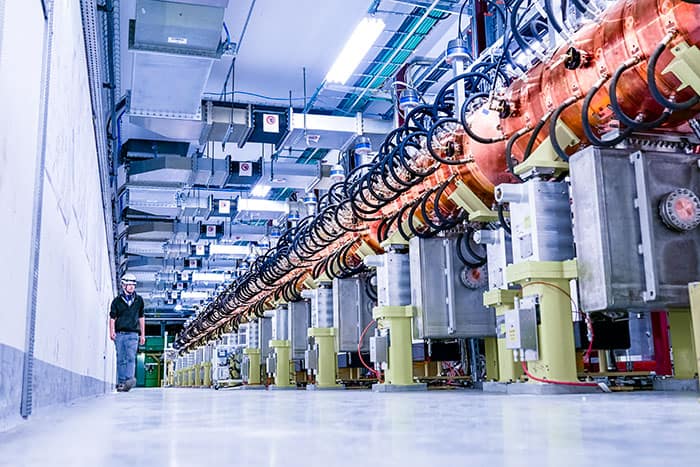
Tunnel vision: CERN has built its first accelerator since 2008 – Linac 4. (Courtesy: M Brice / CERN)
The CERN particle-physics lab near Geneva has built its first accelerator since the completion of the Large Hadron Collider (LHC) in 2008. Linear Accelerator 4 (Linac 4), which is around 90 m long and took a decade to construct, will be used to accelerate beams of negative hydrogen ions to 160 MeV. When Linac 4 is connected to CERN’s accelerator complex at the end of 2019, the 160 MeV beam will then be sent to the Proton Synchrotron Booster, which will accelerate the ions and strip the electrons away, before the resulting protons enter the Proton Synchrotron, the Super Proton Synchrotron and finally the LHC. Linac 4 will now undergo “extensive” commissioning and is expected to replace Linac 2, which has been in operation since 1978. The new accelerator will be part of CERN’s High Luminosity Upgrade, which will see the LHC’s luminosity increase five-fold by 2025.
Australia gains access to ESO telescopes in Chile
Chile bound: Australian astronomers will soon be using the ESO’s Very Large Telescope in Cerro Paranal, Chile. (Courtesy: ESO)
Astronomers in Australia will gain access to European Southern Observatory (ESO) telescopes in Chile in 2018 under a new agreement involving an A$26m payment to the ESO. Australia has also committed to the ongoing funding of the telescopes until 2028 at an average annual rate of A$12m and Australian astronomers and companies will be involved in developing new technologies for the telescopes. Chris Tinney at the University of New South Wales Sydney says: “Australian astronomers have been seeking access to ESO for the past two decades.” Lisa Kewley, who chairs the Australian Academy of Science National Committee for Astronomy, adds: “This is great news for the future of Australian astronomy.” Nobel laureate and Australian National University vice-chancellor Brian Schmidt says access to ESO’s facilities and other infrastructure such as the next-generation Giant Magellan Telescope (GMT) and Square Kilometre Array (SKA) radio telescope is critical to the future of Australian astronomy. Tim de Zeeuw, the ESO’s director general, says: “The ESO community is well aware of Australia’s outstanding instrumentation capability, including advanced adaptive optics and fibre-optic technology.” He adds: “Australia’s expertise is ideally matched to ESO’s instrumentation programme, and ESO Member State institutions would be excited to collaborate with Australian institutions and their industrial partners in consortia developing the next generation of instruments.”
You can find all our daily Flash Physics posts in the website’s news section, as well as on Twitter and Facebook using #FlashPhysics. Tune in to physicsworld.com later today to read today’s extensive news story on how time can be reversed in emulsions.
The first practical source of a randomly polarized stream of single photons has been created by physicists in Japan. The source is based on a negatively charged defect in diamond in which two adjacent carbon atoms are replaced by a nitrogen atom and a vacant lattice site. These “NV centres” have several properties that could make them useful for creating quantum-information systems – including the ability to emit single photons on demand. To date, work on single-photon sources has focused on supplying photons that are in specific polarization states. This is because quantum information can be encoded and transmitted in such polarization states. There are certain applications, however, that would benefit from a stream of photons in which the polarizations of successive photons are truly random and uncorrelated. Now, Keiichi Edamatsu, Naofumi Abe and colleagues at Tohoko University have shown that NV centres with a certain orientation with respect to the diamond lattice will emit randomly polarized photons. Writing in Scientific Reports, the team says that its source could find use as a random-number generator and also for performing tests on fundamental aspects of quantum mechanics.
J/ψ measurement reveals flaw in collision simulations
Jet-setters: the LHCb collaboration has verified an important flaw in the PYTHIA simulation. (Courtesy: CERN)
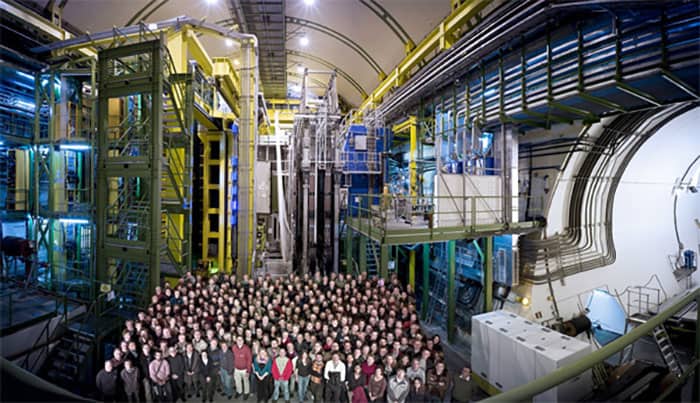
The production of J/ψ mesons in proton collisions in the Large Hadron Collider (LHC) at CERN does not agree with predictions made by a widely used computer simulation. That is the conclusion of physicists working on CERN’s LHCb experiment who have studied the jets of hadrons that are created when protons collide at 13 TeV. These jets contain large numbers of J/ψ mesons, which comprise a charm quark and a charm anti-quark. The LHCb team was able to measure the ratio of the momentum carried by the J/ψ mesons to the momentum carried by the entire jet. It was also able to discriminate between J/ψ mesons that were created promptly by the collision and J/ψ mesons that were created after the collision by the decay of other particles. Analysis of the data reveals that PYTHIA – a Monte Carlo simulation used to model high-energy particle collisions – does a poor job at predicting the momentum carried by prompt J/ψ mesons. The possibility of such a discrepancy had already been identified in theoretical work and has now been confirmed experimentally. The apparent shortcomings of PYTHIA could have a significant effect on how particle physics is done because the simulation is used both in the design of collider detectors and also to determine which measurements are most likely to reveal information about physics beyond the Standard Model of particle physics. The measurement is described in Physical Review Letters.
SETI Institute honours its first fellows
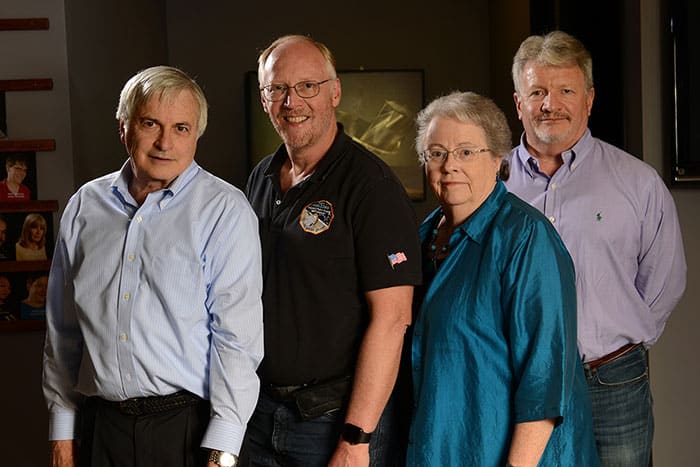
ET searchers honoured for their contribution to science. SETI Institute Fellows Seth Shostak, Mark Showalter and Edna DeVore alongside CEO William Diamond. (Courtesy: Seth Shostak)
The Search for Extraterrestial Intelligence (SETI) Institute has named its first fellows. Seth Shostak, Mark Showalter and Edna DeVore were honoured at SETI’s first annual gala fundraiser for their contributions to scientific research and outreach. Shostak has been with SETI for 26 years as its senior astronomer, overseeing the radio-observing programmes. He also hosts SETI’s radio show and podcast, and is the editor for the institute’s magazine Explorer. Senior scientist Showalter specializes in planetary rings and moons. Over the course of his 12 years at SETI, he has discovered three planetary rings and six moons, including Saturn’s Pan and Pluto’s Kereros and Styx. DeVore is the institute’s director of education and during her 25 years at SETI she also served as acting chief executive for two years. She has led outreach and education projects for NASA missions, including SOFIA and Kepler, and oversees the Research Experience for Undergraduates programme, funded by the National Science Foundation. “Mark, Edna and Seth have distinguished themselves throughout their careers through groundbreaking work and an uncompromising commitment to excellence and innovation,” says William Diamond, who heads the SETI Institute.
You can find all our daily Flash Physics posts in the website’s news section, as well as on Twitter and Facebook using #FlashPhysics.