Brexit panel: left to right are Rolf Tarrach, Ole Petersen, Mark Ferguson and Gail Cardew.
By Hamish Johnston
Here in the UK it’s easy to forget that our exit from the EU could have significant unintended consequences for scientists in the remaining 27 member nations.
Yesterday, I was at a public forum called “Brexit: the scientific impact”, which was held at the Royal Institution in London. While there was much discussion about domestic challenges, the second session – “Brexit: the scientific impact on the EU-27” – provided a fascinating insight into the challenges facing the UK’s neighbours.
A nanoscale “refrigerator” that could cool quantum computers has been developed by scientists in Finland. The team from Aalto University has cooled down a qubit-like superconducting resonator by tunnelling single electrons through a 2 nm-thick insulator. By providing the electrons with too little energy to tunnel directly, the charged particles capture the remaining energy needed from the nearby quantum device, with the loss of energy consequently cooling the device. To switch off the quantum-circuit refrigerator, the external voltage is simply turned off as the device it is cooling cannot provide enough energy to push an electron through the insulator. “I have worked on this gadget for five years and it finally works!” says team member Kuan Yen Tan. Next, the team hopes to apply its refrigerator to qubits, which switch states too much when they become too hot. The researchers also want to lower the minimum temperature and increase the rate at which cooling can be switched on and off. The work is presented in Nature Communications.
Mimicking nature’s vivid colours with transparent particles
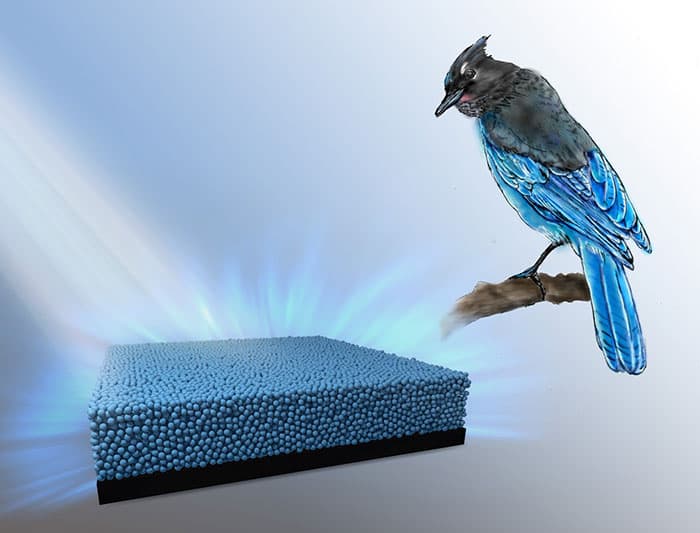
Nature’s blueprint: transparent particles and black backgrounds equal blue. (Courtesy: Yukikazu Takeoka)
Scientists have long known that certain birds and butterflies get their vivid plumage from structures in the wings and feathers that control how light is scattered and reflected, with the “structural colour” often changing depending on the angle with which the animal is viewed. However, the Stellar Jay – a bright blue bird – has underneath the light-scattering structures a layer of black particles that absorb any wavelengths that are scattered towards it, which makes the bird appears blue at all angles. Now, a team led by Yukikazu Takeoka of Nagoya University in Japan has recreated this layering effect. They covered a black plate with layers of transparent, 190 nm silica particles that scatter and reflect the light. By controlling the thickness of the silica, the researchers were able to control the colour intensity – if too thin, the coating was transparent but if too thick, it became white. They found a 1–2 μm-thick layer created bright blue when on a black background, while on glass it was a much less vivid colour. Furthermore, Takeoka and team tested different sized silica particles, which can scatter light to different degrees. The researchers were able to create green using 260 nm particles and purple using 300 nm. The artificial structural colours, presented in Advanced Materials, could be useful for applications where light control is important, such as solar cells or adaptive camouflage.
NASA launches quick-fire solar imager
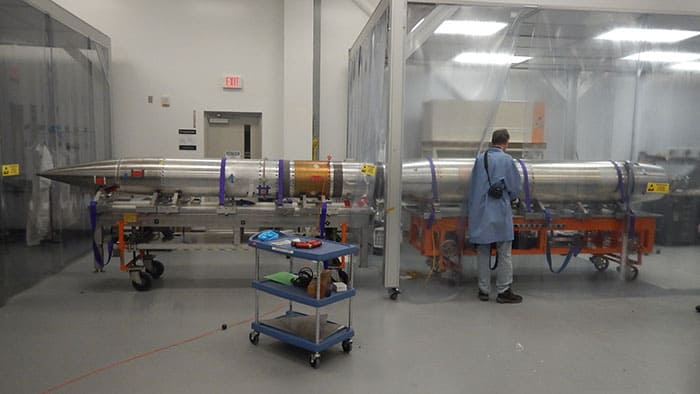
RAISE the rocket: the RAISE payload during testing at the Southwest Research Institute. (Courtesy: Amir Caspi / Southwest Research Institute)
NASA has successfully launched a mission to study the split-second changes that occur at the Sun’s most active regions. The Rapid Acquisition Imaging Spectrograph Experiment (RAISE) was launched by a sounding rocket on 5 May from New Mexico. The rocket travelled around 300 km into the Earth’s atmosphere, during which time the RAISE instrument took images every 0.2 s for five minutes. While there are several missions that continuously study the Sun – such as NASA’s Solar Dynamics Observatory – some areas that rapidly change require dedicated observation. After taking some 1500 images, the RAISE payload parachuted back to Earth where it is now being recovered. This is RAISE’s third flight, following launches in 2014 and 2010.
You can find all our daily Flash Physics posts in the website’s news section, as well as on Twitter and Facebook using #FlashPhysics.
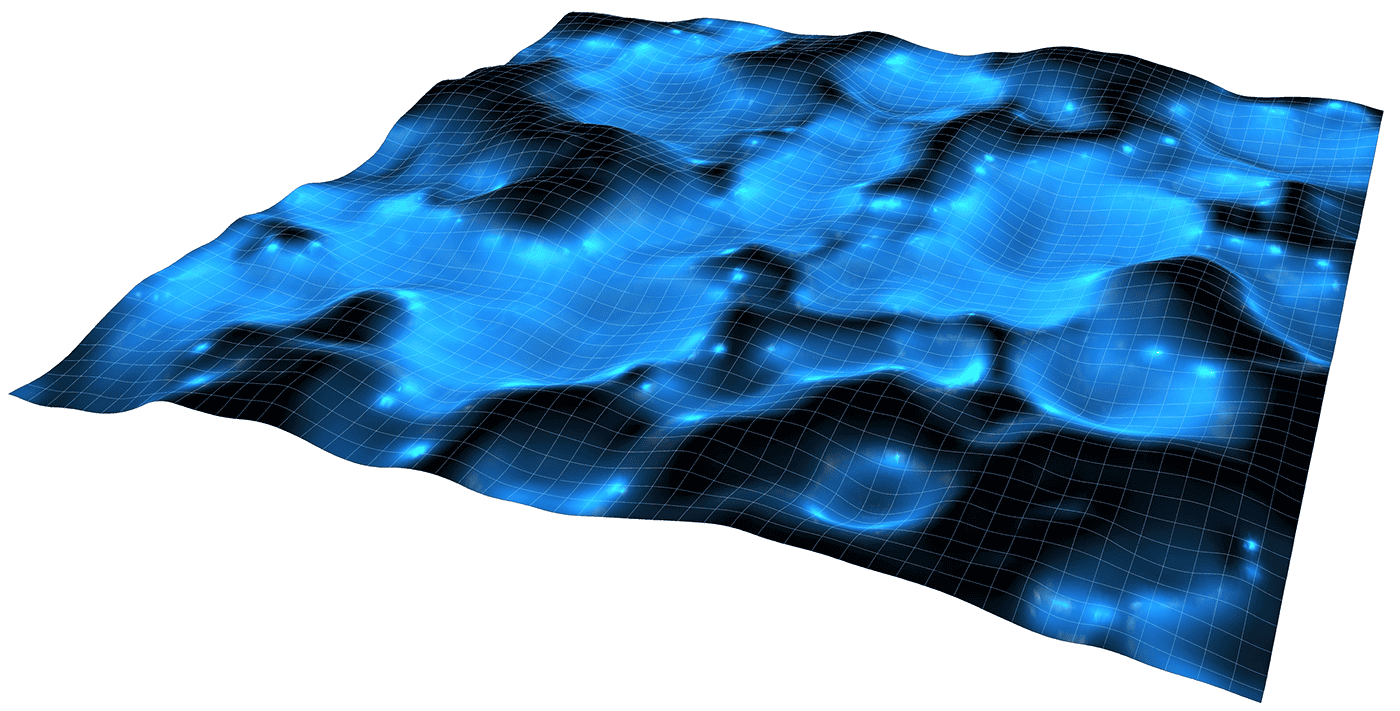
New impressions A visualization of a curved space–time “sea” from the general-relativity simulations carried out by the authors.(Courtesy: James Mertens)
From the Genesis story in the Old Testament to the Greek tale of Gaia (Mother Earth) emerging from chaos and giving birth to Uranus (the god of the sky), people have always wondered about the universe and woven creation myths to explain why it looks the way it does. One hundred years ago, however, Albert Einstein gave us a different way to ask that question. Newton’s law of universal gravitation, which was until then our best theory of gravity, describes how objects in the universe interact. But in Einstein’s general theory of relativity, space–time (the marriage of space and time) itself evolves together with its contents. And so cosmology, which studies the universe and its evolution, became at least in principle a modern science – amenable to precise description by mathematical equations, able to make firm predictions, and open to observational tests that could falsify those predictions.
Our understanding of the mathematics of the universe has advanced alongside observations of ever-increasing precision, leading us to an astonishing contemporary picture. We live in an expanding universe in which the ordinary material of our everyday lives – protons, neutrons and electrons – makes up only about 5% of the contents of the universe. Roughly 25% is in the form of “dark matter” – material that behaves like ordinary matter as far as gravity is concerned, but is so far invisible except through its gravitational pull. The other 70% of the universe is something completely different, whose gravity pushes things apart rather than pulling them together, causing the expansion of the universe to accelerate over the last few billion years. Naming this unknown substance “dark energy” teaches us nothing about its true nature.
Now, a century into its work, cosmology is brimming with existential questions. If there is dark matter, what is it and how can we find it? Is dark energy the energy of empty space, also known as vacuum energy, or is it the cosmological constant, Λ, as first suggested by Einstein in 1917? He introduced the constant after mistakenly thinking it would stop the universe from expanding or contracting, and so – in what he later called his “greatest blunder” – failed to predict the expansion of the universe, which was discovered a dozen years later. Or is one or both of these invisible substances a figment of the cosmologist’s imagination and it is general relativity that must be changed?
At the same time as being faced with these fundamental questions, cosmologists are testing their currently accepted model of the universe – dubbed ΛCDM – to greater and greater precision observationally. (CDM indicates the dark-matter particles are cold because they must move slowly, like the molecules in a cold drink, so as not to evaporate from the galaxies they help bind together.) And yet, while we can use general relativity to describe how the universe expanded throughout its history, we are only just starting to use the full theory to model specific details and observations of how galaxies, clusters of galaxies and superclusters are formed and created. How this happens is simple – the equations of general relativity aren’t.
Horribly complex
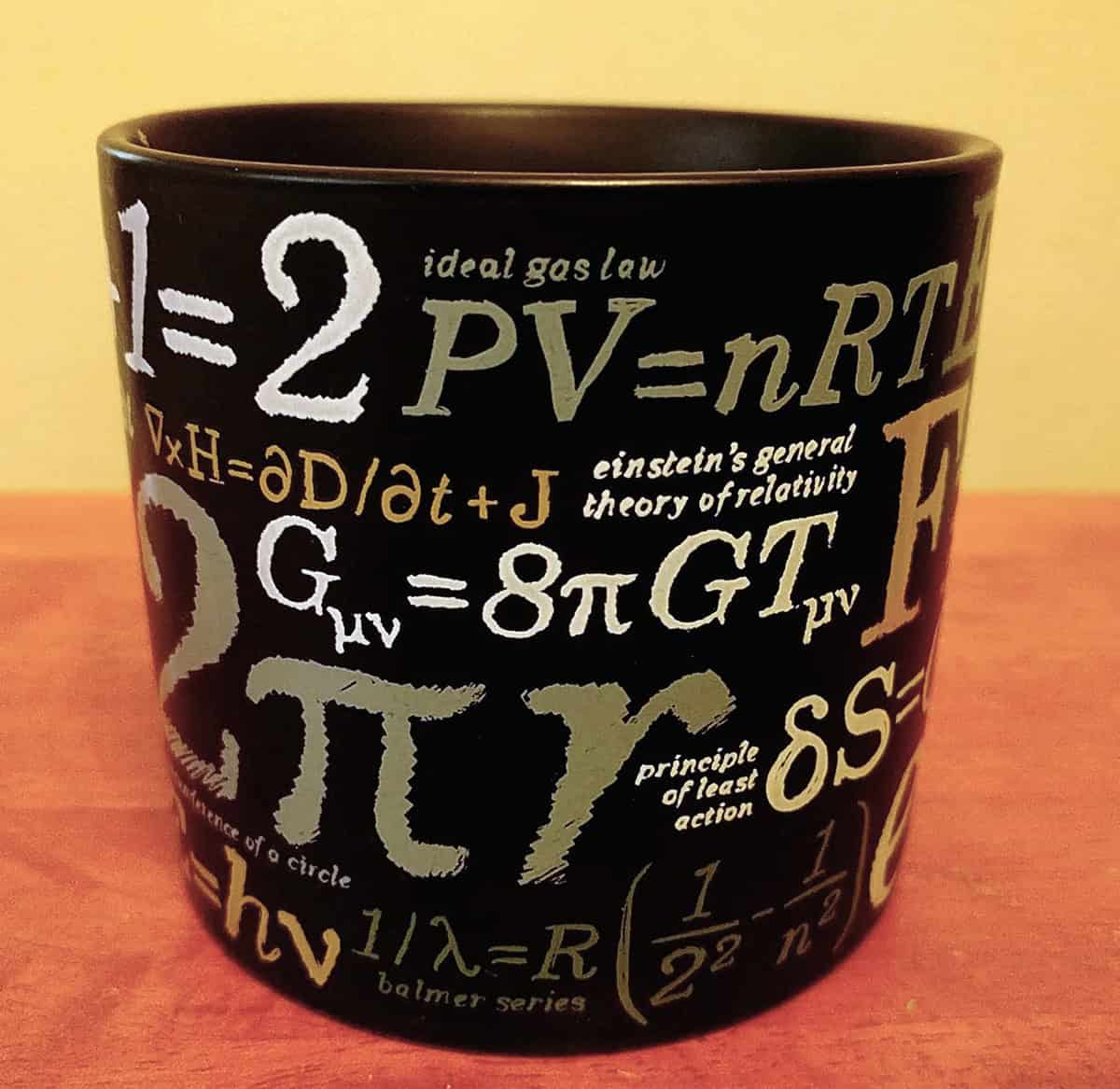
While they fit neatly onto a T-shirt or a coffee mug (see below), Einstein’s field equations are horrible to solve even using a computer. The equations involve 10 separate functions of the four dimensions of space and time, which characterize the curvature of space–time in each location, along with 40 functions describing how those 10 functions change, as well as 100 further functions describing how those 40 changes change, all multiplied and added together in complicated ways. Exact solutions exist only in highly simplified approximations to the real universe. So for decades cosmologists have used those idealized solutions and taken the departures from them to be small perturbations – reckoning, in particular, that any departures from homogeneity can be treated independently from the homogeneous part and from one another.
This “first-order perturbation theory” has taught us a lot about the early development of cosmic structures – galaxies, clusters of galaxies and superclusters – from barely perceptible concentrations of matter and dark matter in the early universe. The theory also has the advantage that we can do much of the analysis by hand, and follow the rest on computer. But to track the development of galaxies and other structures from after they were formed to the present day, we’ve mostly reverted to Newton’s theory of gravity, which is probably a good approximation.
Not at your leisure Einstein’s equations of general relativity might fit on a coffee mug or T-shirt, but solving them is not something you can do quickly. (Courtesy: James Mertens)
To make progress, we will need to improve on first-order perturbation theory, which treats cosmic structures as independent entities that are affected by the average expansion of the universe, but neither alter the average expansion themselves, nor influence one another. Unfortunately, higher-order perturbation theory is much more complicated – everything affects everything else. Indeed, it’s not clear there is anything to gain from using these higher-order approximations rather than “just solving” the full equations of general relativity instead.
Improving the precision of our calculations – how well we think we know the answer – is one thing, as discussed above. But the complexity of Einstein’s equations has made us wonder just how accurate the perturbative description really is. In other words, it might give us answers, but are they the right ones? Nonlinear equations, after all, can have surprising features that appear unexpectedly when you solve them in their full glory, and it is hard to predict surprises. Some leading cosmologists, for example, claim that the accelerating expansion of the universe, which dark energy was invented to explain, is caused instead by the collective effects of cosmic structures in the universe acting through the magic of general relativity. Other cosmologists argue this is nonsense.
Computers are finally becoming fast enough that modelling the universe using the full power of general relativity – without the traditional approximations – is not such a crazy prospect
The only way to be sure is to use the full equations of general relativity. And the good news is that computers are finally becoming fast enough that modelling the universe using the full power of general relativity – without the traditional approximations – is not such a crazy prospect. With some hard work, it may finally be feasible over the next decade.
Computers to the rescue
Numerical general relativity itself is not new. As far back as the late 1950s, Richard Arnowitt, Stanley Deser and Charles Misner – together known as ADM – laid out a basic framework in which space–time could be carefully separated into space and time – a vital first step in solving general relativity with a computer. Other researchers also got in on the act, including Thomas Baumgarte, Stuart Shapiro, Masaru Shibata and Takashi Nakamura, who made important improvements to the numerical properties of the ADM system in the 1980s and 1990s so that the dynamics of systems could be followed accurately over long enough times to be interesting.
Other techniques for obtaining such long-time stability were also developed, including one imported from fluid mechanics. Known as adaptive mesh refinement, it allowed scarce computer memory resources to be focused only on those parts of problems where they were needed most. Such advances have allowed numerical relativists to simulate with great precision what happens when two black holes merge and create gravitational waves – ripples in space–time. The resulting images are more than eye candy; they were essential in allowing members of the US-based Laser Interferometer Gravitational-Wave Observatory (LIGO) collaboration to announce last year that they had directly detected gravitational waves for the first time.
By modelling many different possible configurations of pairs of black holes – different masses, different spins and different orbits – LIGO’s numerical relativists produced a template of the gravitational-wave signal that would result in each case. Other researchers then compared those simulations over and over again to what the experiment had been measuring, until the moment came when a signal was found that matched one of the templates. The signal in question was coming to us from a pair of black holes a billion light-years away spiralling into one another and merging to form a single larger black hole.
General relativity offers at least one big advantage over Newtonian gravity – it is local
Using numerical relativity to model cosmology has its own challenges compared to simulating black-hole mergers, which are just single astrophysical events. Some qualitative cosmological questions can be answered by reasonably small-scale simulations, and there are state-of-the-art “N-body” simulations that use Newtonian gravity to follow trillions of independent masses over billions of years to see where gravity takes them. But general relativity offers at least one big advantage over Newtonian gravity – it is local.
The difficulty with calculating the gravity experienced by any particular mass in a Newtonian simulation is that you need to add up the effects of all the other masses. Even Isaac Newton himself regarded this “action at a distance” as a failing of his model, since it means that information travels from one side of the simulated universe to the other instantly, violating the speed-of-light limit. In general relativity, however, all the equations are “local”, which means that to determine the gravity at any time or location you only need to know what the gravity and matter distribution were nearby just moments before. This should, in other words, simplify the numerical calculations.
Recently, the three of us at Kenyon College and Case Western Reserve University showed that the cosmological problem is finally becoming tractable (Phys. Rev. Lett.116 251301 and Phys. Rev. D93 124059). Just days after our paper appeared, Eloisa Bentivegna at the University of Catania in Italy and Marco Bruni at the University of Portsmouth, UK, had similar success (Phys. Rev. Lett.116 251302). The two groups each presented the results of low-resolution simulations, where grid points are separated by 40 million light-years, with only long-wavelength perturbations. The simulations followed the universe for only a short time by cosmic standards – long enough only for the universe to somewhat more than double in size – but both tracked the evolution of these perturbations in full general relativity with no simplifications or approximations whatsoever. As the eminent Italian cosmologist Sabino Matarese wrote in Nature Physics, “the era of general relativistic numerical simulations in cosmology ha[s] begun”.
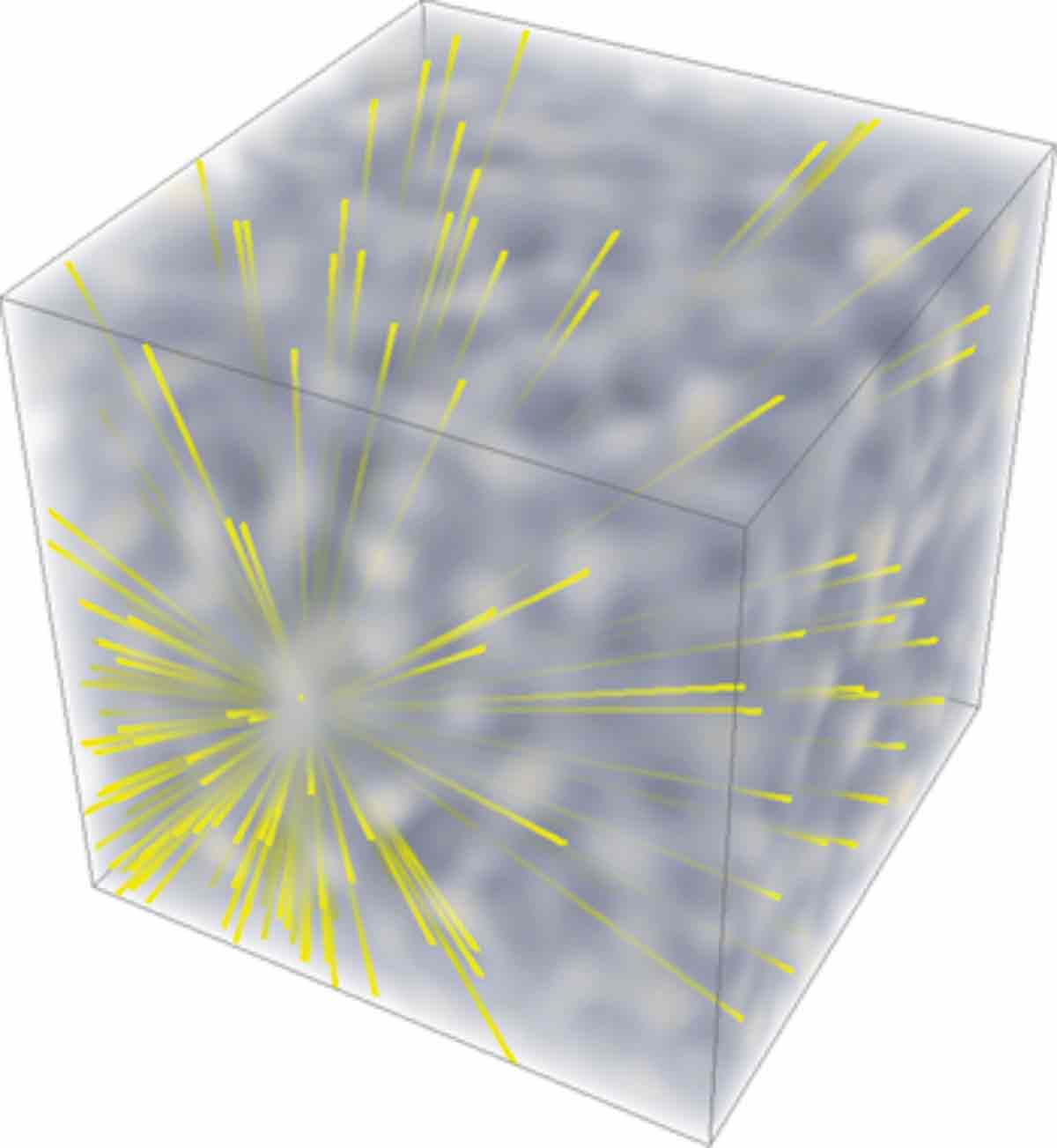
Beam on This simulation takes care of the subtlety of “co-ordinate invariance”, which says the laws of physics should be the same no matter what labels you use for the locations and times of events. It does this by sending beams of light (yellow) towards an observer located somewhere in the universe. (Courtesy: James Mertens)
These preliminary studies are still a long way from competing with modern N-body simulations for resolution, duration or dynamic range. To do so will require advances in the software so that the code can run on much larger computer clusters. We will also need to make the code more stable numerically so that it can model much longer periods of cosmic expansion. The long-term goal is for our numerical simulations to match as far as possible the actual evolution of the universe and its contents, which means using the full theory of general relativity. But given that our existing simulations using full general relativity have revealed no fluctuations driving the accelerated expansion of the universe, it appears instead that accelerated expansion will need new physics – whether dark energy or a modified gravitational theory.
Both groups also observe what appear to be small corrections to the dynamics of space–time when compared with simple perturbation theory. Bentivegna and Bruni studied the collapse of structures in the early universe and suggested that they appear to coalesce somewhat more quickly than in the standard simplified theory.
Future perfect
Drawing specific conclusions about simulations is a subtle matter in general relativity. At the mathematical heart of the theory is the principle of “co-ordinate invariance”, which essentially says that the laws of physics should be the same no matter what set of labels you use for the locations and times of events. We are all familiar with milder versions of this symmetry: we wouldn’t expect the equations governing basic scientific laws to depend on whether we measure our positions in, say, New York or London, and we don’t need new versions of science textbooks whenever we switch from standard time to daylight savings time and back. Co-ordinate invariance in the context of general relativity is just a more extreme version of that, but it means we must ensure that any information we extract from our simulations does not depend on how we label the points in our simulations.
Our Ohio group has taken particular care with this subtlety by sending simulated beams of light from distant points in the distant past at the speed of light through space–time to arrive at the here and now. We then use those beams to simulate observations of the expansion history of our universe. The universe that emerges exhibits an average behaviour that agrees with a corresponding smooth, homogeneous model, but with inhomogeneous structures on top. These additional structures contribute to deviations in observable quantities across the simulated observer’s sky that should soon be accessible to real observers.
Creating codes that are accurate and sensitive enough to make realistic predictions will require us to study larger volumes of space
This work is therefore just the start of a journey. Creating codes that are accurate and sensitive enough to make realistic predictions for future observational programmes – such as the all-sky surveys to be carried out by the Large Scale Synoptic Telescope or the Euclid satellite – will require us to study larger volumes of space. These studies will also have to incorporate ultra-large-scale structures some hundreds of millions of light-years across as well as much smaller-scale structures, such as galaxies and clusters of galaxies. They will also have to follow these volumes for longer stretches of time than is currently possible.
All this will require us to introduce some of the same refinements that made it possible to predict the gravitational-wave ripples produced by a merging black hole, such as adaptive mesh refinement to resolve the smaller structures like galaxies, and N-body simulations to allow matter to flow naturally across these structures. These refinements will let us characterize more precisely and more accurately the statistical properties of galaxies and clusters of galaxies – as well as the observations we make of them – taking general relativity fully into account. Doing so will, however, require clusters of computers with millions of cores, rather than the hundreds we use now.
These improvements to code will take time, effort and collaboration. Groups around the world – in addition to the two mentioned – are likely to make important contributions. Numerical general-relativistic cosmology is still in its infancy, but the next decade will see huge strides to make the best use of the new generation of cosmological surveys that are being designed and built today. This work will either give us increased confidence in our own scientific genesis story – ΛCDM – or teach us that we still have a lot more thinking to do about how the universe got itself to where it is today.
I never realized it until now, but my life was missing a song about Schrödinger’s cat. Well, theoretical physicist, science writer and now singer/song writer Sabine Hossenfelder has come to the rescue with a song about quantum states. This is her second music video done in collaboration artists Apostolos Vasilidis and Timo Alho. The rather cat-chy tune not only includes lyrics about quantum entanglement, Boltzmann brains and the multiverse, but also fits in references to Star Trek and The Matrix. In her BackReaction blog, Hossenfelder says, “If you think this one’s heavy on the nerdism, wait for the next.” We’re looking forward to it!
Molecules containing three atoms have been laser cooled to ultracold temperatures for the first time. The feat was achieved by John Doyle and colleagues at Harvard University in the US, who used a technique called Sisyphus cooling to chill an ensemble of about a million strontium-monohydroxide molecules to 750 μK. The team says the work opens the door to a range of applications, including quantum simulation and precision measurements.
First developed in the late 1970s, the laser cooling of atomic gases to ultracold temperatures has revolutionized the study of the quantum states of matter. Important milestones include the creation of the first-ever Bose–Einstein condensate in the lab in 1995 and the first Fermi–Dirac condensate in 2003. The technique relies on the fact that photons carry small amounts of momentum and – under certain conditions – the repeated absorption and re-emission of photons by an atom can reduce its random motion and hence its temperature.
Degrees of freedom
Laser cooling of molecules – rather than atoms – is complicated by their rotational and vibrational degrees of freedom, which affect how they absorb and emit photons. As a result, the absorption and emission of photons can put the molecules into “dark states” that no longer take part in the cooling process. Despite this and other challenges, however, David DeMille and colleagues at Yale University managed to laser-cool a collection of strontium-fluoride diatomic molecules in 2014.
In this latest work, John Doyle and colleagues at Harvard University have now cooled triatomic-strontium monohydroxide molecules using a method that is named after the doomed Greek hero Sisyphus, who was forced to push a boulder up a hill, only for it to roll down to the bottom and then repeat the task for eternity. Sisyphus cooling involves molecules losing kinetic energy by having to “climb” a hill of potential energy created by a standing wave of laser light.
The atoms reach the “peak” when they spontaneously transition to a state that no longer interacts with the light. At this point, an applied magnetic field puts the atoms back into the original state – ready to climb again. This process is repeated many times, with each cycle reducing the atoms’ kinetic energy – and thus their random motion and temperature too.
Rapid cooling
Key to the success of Doyle’s team is that the cooling was achieved very rapidly – in 100 μs – and only involved about 200 photons interacting with each molecule. This speed is critical as the molecules are therefore less likely to be put into dark states before the cooling finishes.
Writing in Physical Review Letters, Doyle and colleagues say that their technique could also be used to cool larger and more complicated strontium-based polyatomic molecules – for example by replacing the hydroxide with a methyl group. If the technique could be further extended to chiral molecules, it could also be used to investigate why some biological processes favour right- or left-handed molecules.
It should be possible to create a matter-wave tractor beam that grabs hold of an object by firing particles at it – according to calculations by an international team of physicists. Tractor beams work by firing cone-like “Bessel beams” of light or sound at an object. Under the right conditions, the light or sound waves will bounce off the object in such a way that the object experiences a force in the opposite direction to that of the beam. If this force is greater than the outward pressure of the beam, the object will be pulled inwards. Now, Andrey Novitsky and colleagues at Belarusian State University, ITMO University in St Petersburg and the Technical University of Denmark have done calculations that show that beams of particles can also function as tractor beams. Quantum mechanics dictates that these particles also behave as waves and the team found that cone-like beams of matter waves should also be able to grab hold of objects. There is, however, an important difference regarding the nature of the interaction between the particles and the object. Novitsky and colleagues found that if the scattering is defined by the Coulomb interaction between charged particles, then it is not possible to create a matter-wave tractor beam. However, tractor beams are possible if the scattering is defined by a Yukawa potential, which is used to describe interactions between some subatomic particles. The calculations are described in Physical Review Letters.
3D holograms produced from WiFi routers
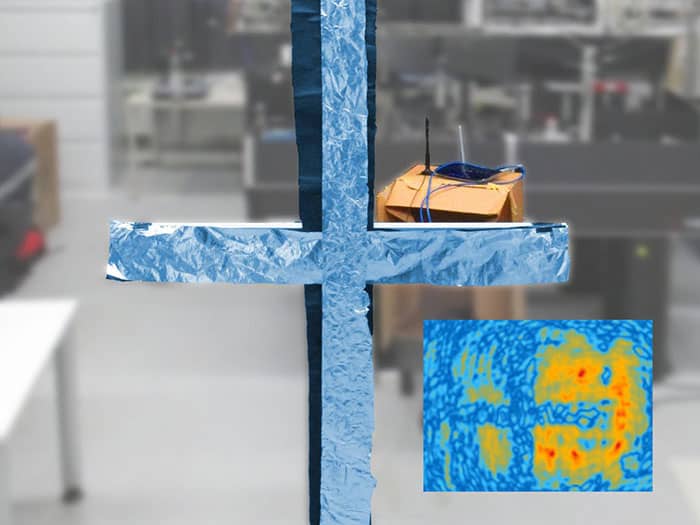
WiFi vision: routers could be used for more than just the internet. A cross made of aluminum foil between the detection antenna and the WiFi router can be reconstructed as a hologram. (Courtesy: Friedemann Reinhard / Philipp Holl / TUM)
Household WiFi routers can be used to produce 3D holograms of rooms. The futuristic imaging process has been developed by Philipp Holl and Friedemann Reinhard of the Technical University of Munich in Germany. Using one fixed and one movable antenna, they measure the distortions in the router’s microwave signal caused by it reflecting off and travelling through objects. The data are then fed through reconstruction algorithms enabling the researchers to produce 3D images of the environment surrounding the router at centimetre precision. The technique is simpler than optical holography, which relies upon elaborate laser equipment, and will have improved resolution when future WiFi technology has increased speed and bandwidth. The research has, however, raised concerns about privacy. “It is rather unlikely that this process will be used for the view into foreign bedrooms in the near future.” Reinhard says to address these worries: “For that, you would need to go around the building with a large antenna, which would hardly go unnoticed.” The method is also limited because microwaves come from so many devices and from multiple directions. Instead, Holl and Reinhard hope the technology, presented in Physical Review Letters, will be applied to recover victims buried under collapsed buildings or avalanches. Unlike conventional methods, it could provide spatial representation of the structures surrounding victims, allowing swifter and safer rescue.
UK nuclear industry outlines “Brexit” priorities
The UK Nuclear Industry Association (NIA) has called on the UK government to work closely with the nuclear industry to avoid a “cliff-edge” scenario after the country leaves the European Atomic Energy Community (Euratom). In its report – Exiting Euratom – the trade association for the UK’s civil nuclear industry, which represents more than 260 companies, outlines six priority areas for negotiations with the European Commission as part of the “Brexit” negotiations. These include agreeing a new funding arrangement for the UK’s involvement in Fusion 4 Energy, which is responsible for providing Europe’s contribution to ITER fusion reactor in France, as well as setting out the process for the movement of nuclear material, goods, people and services post Brexit. The NIA also says that if a new Euratom deal is not agreed by the time the UK leaves the European Union in 2019 then the existing arrangement should continue until a new one is implemented.
You can find all our daily Flash Physics posts in the website’s news section, as well as on Twitter and Facebook using #FlashPhysics. Tune in to physicsworld.com later today to read today’s extensive news story on the laser cooling of triatomic molecules.
Immediately after last year’s announcement that the Laser Interferometer Gravitational-Wave Observatory (LIGO) had seen its first gravitational waves, a lot of the discussion centred on what the discovery meant for general relativity. This was understandable: getting further confirmation of Einstein’s century-old theory was (and is) a big deal. But in the longer term, and as the LIGO detectors notch up a few more observations (they’re currently crunching data on six new candidates), the emphasis will shift away from the waves themselves, and towards what they can tell us about the universe.
The key thing to realize here is that gravitational waves are fundamentally different from other, better-studied cosmic “messengers” that travel to Earth from distant reaches of the universe. Unlike photons, gravitational waves are not impeded by clouds of gas or dust; unlike cosmic rays, they are not deflected by electromagnetic fields. In addition, some of the most dramatic astrophysical events, such as the merger of two black holes in empty space, are “dark” or “silent” to other messengers: these events produce gravitational waves in copious quantities, but not, as far as we know, anything else.
Thousands of people took to the streets of Washington, DC on Saturday 22 April to voice their support for science. Endorsed by more than 200 scientific organizations including the American Physical Society, the March for Science sought to promote the value of science – and scientists – to society. Physicists were among those marching and they explain their reasons in this video report from the day, which also features some of the most memorable outfits and signs.
On the same day, there were there were almost 600 sister events across the globe in support of the March for Science gathering in Washington, DC. One such rally took place in Bristol, UK, where Physics World is produced, which included a range of speakers. Among them was British naturalist and TV presenter Chris Packham, who believes these events can trigger a wider movement to advocate more scientifically informed policy-making. You can hear what Packham had to say, and view highlights from the Bristol event, in the video report below.
Scientists in Greece have devised a new form of biometric identification that relies on humans’ ability to see flashes of light containing just a handful of photons. The technique involves using very weak laser pulses to measure how a person’s sensitivity to light varies across their retina. According to its inventors, such a quantum-based retinal map could provide a more powerful and secure form of identification than is possible with conventional biometrics such as fingerprints or iris scans.
It has been known since the 1940s that humans are able to detect light pulses containing very few photons. However, whether we can actually see single photons is still unclear: one group last year said it had carried out experiments showing this to be the case but others questioned the claim. In the 1940s, Selig Hecht and colleagues at Columbia University in the US showed that variations in our perception of very low light levels are in fact governed by quantum statistics. By exposing several individuals to very dim flashes of light of differing average intensity, they found that the intensity-induced variation in the probability of seeing a flash could be modelled by assuming that the actual number of photons a person sees follows a Poisson distribution.
This result held true across the different people examined, although the specific responses depended on an individual’s value of alpha – a parameter describing the fraction of photons arriving at a person’s eye that are then detected by their retina. Losses caused by absorption or scattering within the cornea, pupil, lens and body of the eyeball, as well as a finite probability of absorption within the retina itself, means that alpha typically varies between 0 and 0.2. This variation led to a series of curves describing seeing probability versus average intensity, whose precise shape depended on alpha.
Unique variations
In the latest work, Iannis Kominis of the University of Crete and colleagues use these variations as the basis of the new biometric scheme. They say that the value of alpha changes by up to a factor of 100 from one point to another on an individual’s retina, while variations between retinas can be up to 50%. As such, they argue that people could be uniquely identified by precisely mapping the variation of alpha across their retinas.
The “alpha map” of a particular individual, who the researchers call Alice, would be created by exposing that person to large numbers of very weak laser pulses. The pulses would have a range of average intensities, and the exercise would be repeated across multiple points on Alice’s retina. For each pulse, Alice would be asked whether or not she saw a flash of light. With the map stored on a secure database, Alice could then be identified by examining a subset of points on her retina. Again, she would be exposed to a series of weak laser pulses and asked on each occasion whether or not she sees the pulse. Only if her answers closely match what would be expected from her map would she be allowed to proceed.
As Kominis and colleagues explain in a preprint uploaded to the arXiv server, Alice must be subject to a sufficient number of yes/no interrogations to limit two types of error as far as possible. One type of error is the “false negative”, which means that Alice is not recognized as herself. The other type is the “false positive”, in which an impostor, known as Eve, successfully fools the system into thinking that she is Alice.
Fifty interrogations
For the scheme to be implemented on a practical timescale, the number of interrogations must be limited. Simply choosing a random subset of points on Alice’s retina would involve 2500 interrogations to reach certain benchmarks – generating a false negative less than once every 10,000 identifications and a false positive less than one every 10 billion. However, by refining their technique in a number of ways – choosing only very low or very high alpha regions on the retina, using Bayesian statistics and employing pattern recognition – the researchers calculated that just 50 interrogations would do the job.
In addition, they assessed how well their scheme would cope if Eve was able to measure the number of photons entering Alice’s eye as well as monitoring her brain activity. Their conclusion: Eve would need to make extremely precise measurements of both the thermal energy dumped in Alice’s eye and the magnetic energy emitted by her head – something that would be very difficult to achieve.
Rebecca Holmes of the University of Illinois in the US praises Kominis and colleagues for having “put a lot of thought into how to optimise” their biometric technique. But she says she is “sceptical” about the scheme’s practicality, pointing out that up to half an hour would be needed just to acclimatize Alice’s eyes to the very dark conditions required. Holmes also disputes the technique’s “quantum” label, arguing that although it involves small numbers of photons, it does not provide a physics-based guarantee of complete security, as quantum cryptography (in principle) can do.
Gigantic X-ray “tsunami” spotted near galaxy cluster
A giant wave of hot gas twice the size of the Milky Way has been discovered using NASA’s Chandra X-ray Observatory, radio observations and computer simulations. The wave is located near the Perseus galaxy cluster – one of the most massive nearby groupings of galaxies that spans 11 million light-years. It is the brightest cluster in terms of X-ray emissions because most of its observable matter is a gas that is so hot (tens of millions of degrees) it only glows with X-rays. Chandra has observed a variety of features in the gas, including a concave “bay” wave. If this structure was a result of bubbles launched by the central galaxy’s supermassive black hole, it would emit radio waves. However, observations by the Karl G Jansky Very Large Array in the US showed no such signal. It also could not be the result of “sloshing” gas as it arcs in the wrong direction. To work out the wave’s origin, Stephen Walker from NASA’s Goddard Space Flight Center in the US and colleagues compared high-resolution observational data with computer simulations of merging galaxy clusters. The resulting simulation begins with a large galaxy cluster (Perseus) that has settled into a “cold” (30 million degrees) central region surrounded by a zone of gas three times hotter. A small galaxy cluster then skirts the larger relative, causing a gravitational disturbance that churns up the gas and creates an expanding spiral of cold gas. Roughly 2.5 billion years later, the gas has spread 500,000 light-years from the centre and massive waves, such as the bay, form and roll at its periphery for hundreds of millions of years before dissipating. In the Monthly Notices of the Royal Astronomical Society, the scientists suggest that the waves are giant Kelvin–Helmholtz waves – which occur when there is a velocity difference at the interface of two fluids, such as wind blowing over water.
First light for European X-ray Free Electron Laser
Light at the end of the tunnel: the European XFEL. (Courtesy: DESY)
The European X-ray Free Electron Laser (European XFEL) in Hamburg, Germany, has achieved first light. Last month, engineers at the facility sent electrons down the facility’s 2.1 km-long superconducting linear accelerator for the first time. After being accelerated, electrons have now been sent through “undulators” to produce X-rays with a repetition rate of one pulse per second. When fully commissioned, the European XFEL will generate pulses of X-rays 27,000 times per second with each pulse lasting less than 100 fs (10–13 s). This will allow researchers to create “movies” of processes such as chemical bonding and vibrational energy flow across materials. Engineers will now continue commissioning the European XFEL – including increasing the facility’s repetition rate – ready for first users in September.
Survey highlights UK–Europe science collaboration
Scientists in the UK have strong collaborations with their European counterparts, according to a survey carried out by the UK National Academies. The Academy of Medical Sciences, British Academy, Royal Academy of Engineering and the Royal Society asked more than 1286 fellows and grant recipients about their international collaborations and mobility. They found that 95% had travelled to Europe and 87% collaborated with their European colleagues, while 58% of respondents had spent a year or more working abroad, 64% of whom went to North America. Meanwhile, a separate survey carried out by the Royal Society of 1285 UK-based scientists found that 72% had trained or worked abroad, while 80% of non-UK national researchers that were working in the UK were from the European Union or North America. The Royal Society survey also reported that women are less likely to work abroad than men. Some 39% of men say they had spent more than three years working outside of the UK compared to 25% for women.
You can find all our daily Flash Physics posts in the website’s news section, as well as on Twitter and Facebook using #FlashPhysics.



 By Margaret Harris