Two major scientific facilities being built in Brazil are facing delays after failing to receive any the funds allocated to them for 2016. The Sirius synchrotron light source and the Brazilian Multipurpose Research Reactor (RMB) have both been hit by federal budget cuts caused by the recent economic slowdown in the country. Any further funding delays could lead to both facilities being put back a number of years.
Sirius, costing $290m, is being built at the Brazilian Synchrotron Light Laboratory (LNLS) in Campinas, some 100 km north-west of São Paulo, and is expected to begin operation in 2018. As a fourth-generation synchrotron light source, it will generate coherent, high-brightness X-rays that scientists will use to study the structure and properties of materials in unprecedented detail.
Critical point
LNLS director Antônio José Roque da Silva says that officials at the synchrotron have not received the money they were promised for 2016 and are still using 2015 funds. Cash for 2016 was expected to be $87.4m, but that has now been cut to $57.7m by the National Congress of Brazil. “Even though this budget is well below our needs, at this moment the critical point is whether we will in fact receive the funds,” says da Silva.
He says it is critical that funding is maintained to allow officials to order equipment. “To keep the planned activities, it is indispensable to receive funds allocated for this year and have the assurance that no new cuts will threaten the $116m [allocated] for 2017,” warns da Silva. “Otherwise it won’t be possible to meet the schedule.” da Silva adds that even if this funding is received, Sirius will still require an additional $76m to make sure it is open by 2018.
Waiting game
The RMB, meanwhile, is located at Iperó, about 130 km east of São Paulo. Costing $500m, the reactor was expected to open this year. By generating radioisotopes, it promises to ensure Brazil does not depend on other countries for supplying radioisotopes for diagnosing and treating cancer. The RMB will also be used for neutron scattering and will carry out irradiation testing for nuclear fuels and materials.
While cash has been spent obtaining the necessary permits for the RMB, including an environmental licence, officials are still waiting for the release of funds to begin construction. RMB’s budget was supposed to be $47.6m from 2014 to 2016, but only $10.6m has so far been allocated. “The prediction was that the reactor would be ready this year, but, in this saga of precarious disbursements and insufficient funds, our time frame will have to be extended,” says RMB technical co-ordinator José Perotta, who is research director at the National Nuclear Energy Commission.
Brazil’s Ministry of Science, Technology, Innovation and Communications maintains that funds for 2016 for Sirius and RMB are “secure”. The ministry says that the cash for next year has been included in the country’s annual budget, although it has yet to be approved by the country’s national congress.
Preprint pioneer: Paul Ginsparg in 2002, long before arXiv received 10,000 papers per month. (Courtesy: MacArthur Foundation)
By Hamish Johnston
Last month the arXiv preprint server received more than 10,000 papers – the first time in the history of the physics paper depository. While arXiv papers are not peer reviewed, they are checked to ensure that they are “of interest, relevance and value” to the scientific community – which arXiv promises to do within 24 h of submission. So how do they do it? Surely someone doesn’t read every word of every paper? The answer can be found in “What counts as science?”, which appears in Nautilus. arXiv was set up in 1991 by the physicist Paul Ginsparg, who explains how the service uses machine learning to sort the wheat from the chaff – something that has attracted controversy.
The giant mirror at the heart of the James Webb Space Telescope (JWST) has been subjected to the first of many rigorous tests before the mission launches in 2018. The mirror is 6.5 m in diameter and has passed a “centre-of curvature test” of its optical properties at NASA’s Goddard Space Flight Center in Greenbelt, Maryland. The tests were done using interferometry to look for tiny imperfections in the shape of the mirror. The mirror will now undergo a large number of mechanical tests that will see it subjected to violent vibrations similar to those it will experience during launch. Then a second centre-of-curvature test will be done. “This is the only test of the entire mirror where we can use the same equipment during a before-and-after test,” explains NASA’s Ritva Keski-Kuha, adding: “This test will show if there are any changes or damages to the optical system.”
Quantum keys distributed over 404 km fibre
A new distance record of 404 km for quantum-key distribution (QKD) on an optical fibre has been achieved by Jian-Wei Pan of the University of Science and Technology of China and colleagues at a number of Chinese universities and research labs. QKD involves two agents – Alice and Bob – exchanging a cryptography key that must be kept secret from an eavesdropper, Eve. This is done by using a quantum-information protocol, which reveals whether Eve has measured information exchanged by Alice and Bob. The team implemented a version of QKD called measurement-device-independent quantum-key distribution (MDIQKD), which was first proposed in 2012 and involves sending out decoy pulses to stop Eve from using loopholes in the original QKD formulation. MDIQKD was performed by encoding quantum information in infrared photos and sending them over 404 km of ultra-low-loss optical fibre. The protocol was also implemented over 311 km of standard optical fibre. As well as doubling the previous record of 200 km, Pan and colleagues were also able to increase the speed of running MDIQKD by a factor of 200 – something that is important for practical implementations of quantum cryptography. The research is described in Physical Review Letters.
Gold 3D nanostructures made using new technique
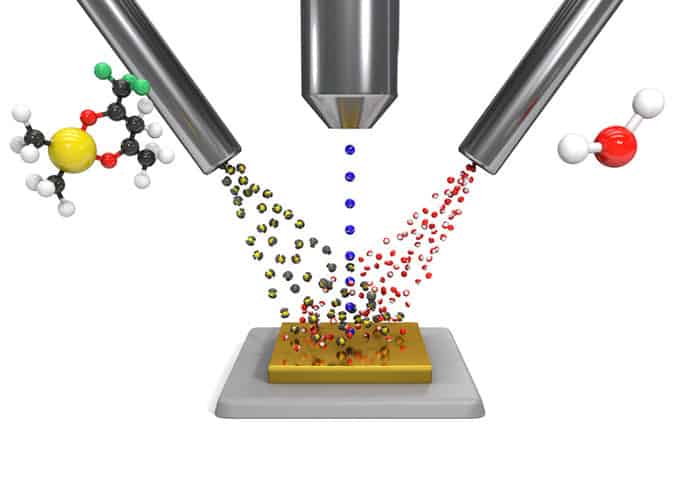
The 3D nanostructures are made by combining molecular beams of a gold-containing organic compound (left) with water (right) in the presence of an electron beam (centre). (Courtesy: Vienna University of Technology)
Tiny 3D gold structures just a few hundred nanometres in size have been created by using a new technique developed by researchers at the Vienna University of Technology in Austria. Gold nanostructures have unique optical and electronic properties that make them potentially useful for a range of applications from biological sensing to optoelectronics. However, existing techniques for creating the 3D nanostructures are expensive and time consuming. Now, Heinz Wanzenböck and colleagues have used a technique called focused-electron-beam-induced deposition (FEBID) to create 3D nanostructures on a germanium substrate. This involves firing an electron beam and two molecular beams at the substrate. One molecular beam is an organic compound containing gold and the other is simply water. Energy from the electron beam liberates the gold from the organic molecules and the water enhances oxidation, which improves the quality of the 3D gold nanostructures. Whereas previous deposition methods created 3D structures that only contained 30% gold atoms (and 70% carbon), this latest technique achieved 91% gold. The method is described in Scientific Reports.
You can find all our daily Flash Physics posts in the website’s news section, as well as on Twitter and Facebook using #FlashPhysics. Tune in to physicsworld.com later today to read today’s extensive news story on funding problems in Brazil.
Significantly more muons appear to be created in cosmic-ray showers than are predicted by models based on data from the Large Hadron Collider (LHC) at CERN. That’s the conclusion of physicists at the Pierre Auger Observatory in Argentina, whose measurements agree with previous hints at a “muon excess” that first emerged more than 15 years ago. The muon excess could mean that the strong interaction is different at collision energies greater than those currently achieved at the LHC.
The Pierre Auger Observatory is an array of 1660 water-filled tanks spread out over an area of 3000 km2. It detects muons created from the decay of low-energy pions in the shower of particles created when a cosmic-ray proton interacts with the atmosphere. Most of these fast-moving muons survive the journey to the ground, where they can be spotted from the Cherenkov light they emit as they travel through the water in the tanks. Four telescopes are also used to spot the fluorescent light in the atmosphere created by the cascade.
Showers that are seen both in the Cherenkov detectors and the telescopes – known as “hybrid events – provide a wealth of information about how the showers occur. The telescope data provide a good measure of how much energy is deposited in a shower, whereas the Cherenkov data tells physicists about how hadrons (such as pions) are created in showers.
Avoiding electrons and positrons
Physicists on the Pierre Auger collaboration have used interaction data gleaned from proton–proton collisions at the LHC to predict how many muons, on average, should be produced by a shower of a given energy. While the cosmic-ray collisions of interest are about 10 times more energetic than LHC collisions, physicists have been able to use LHC data to create models that describe how the muons are produced in the shower, as well as how electrons and positrons are produced. Understanding electron and positron production is important because the Cherenkov detectors also detect these particles and cannot distinguish them from the muons of interest.
The detection rates of muons and electrons/positrons in the Cherenkov detector are a function of where in the sky the showers occur. Events that happen directly overhead a detector will be dominated by electrons and positrons, whereas those arriving from more than 37° from vertical will deposit more muons in the detector. The Pierre Auger data analysed in this latest study contain 411 hybrid events – collected over nine years – that span 0–60°. By looking at the numbers of muons and electrons/positrons detected as a function of shower energy and arrival angle, the team was able to test its LHC-inspired models.
While the numbers of electrons and positrons they detected agreed very well with their models, the muons were wide off the mark. They found that about 33% more muons were detected than predicted by the “EPOS-LHC” model and about 61% more were detected than predicted by the “QGSJet-II-04” model.
Firmer ground
This is not the first time an excess of muons has been spotted. In 2000, physicists working on the HiRes MIA array in Utah detected more muons than expected. Last year, a study of muons from showers nearly horizontal to Pierre Auger detectors also registered more muons than expected. However, this latest study puts the muon excess “on firmer ground”, according to Thomas Gaisser of the University of Delaware, because it involves both Cherenkov and telescope observations.
The research is described in Physical Review Letters, and writing in a commentary piece that accompanies the paper, Gaisser (who is not a member of the Pierre Auger team) highlights two possible explanations for the excess. One is that more collision energy than predicted by the models is going into the production of baryon–antibaryon pairs. The other possibility, according to Gaisser, is that the physics of the strong interaction is different at cosmic-ray collision energies than it is for LHC collisions. However, he points out that further measurements at the Pierre Auger Observatory will be needed to shed further light on the mysterious excess of muons.
CERN’s Large Hadron Collider (LHC) has surpassed its luminosity goals for 2016, delivering 40 inverse femtobarns against a target of 25. For 2016, the LHC was expected to reach a peak luminosity of 1034 cm–2 s –1 , but by the end of the run it was regularly operating 30% above that. The LHC also spent about 60% of its operational time delivering stable beams against a target of 50%. “I can’t overstate the significance of this, because the total number of collisions we deliver to the experiments – the integrated luminosity – determines the capacity they have to carry out the great research that they do,” says Frédérick Bordry, CERN director for accelerators and technology. Now that proton–proton collisions are complete for this year, the LHC will begin a two-week programme colliding lead-ions with protons at energies of 5.02 TeV and 8.16 TeV, respectively. This is the first time the LHC has performed lead-proton collisions since 2013.
Study charts decades of gender bias in astronomy citations
Astronomy papers with women as the first author have received 10% fewer citations than comparable papers with male first authors over the past 65 years. That is one conclusion of a study by Neven Caplar, Sandro Tacchella and Simon Birrer at ETH Zurich in Switzerland, which looked at more than 200,000 papers covering published in 1950–2015. While the difference between male and female citations fell between 1950 and 1990, the disparity has remained at about 6% since 1990. Women first authors also wrote 19% fewer papers than males in the seven years following their first paper. The trio also found that the number of papers with a female first author increased from 5% in the 1960s to 25% today. Writing in a preprint on arXiv, the trio also found that prestigious journals such as Science and Nature had the slowest increases in numbers of female-authored papers over the 65 year period.
Supercomputer nails down axion-mass range
This set of images shows the distribution of the dark matter obtained from a previous numerical simulation carried out by the Virgo Consortium. The distribution was calculated for when the universe was about three-billion years old. The left panel displays the continuous distribution of dark-matter particles. The central panel provides a simplified view of the complex network of dark-matter structure according to the so-called halo model. The right panel highlights the dark-matter halos (shown in yellow) that represent the most efficient cosmic sites for the formation of galaxies. (Courtesy: Virgo Consortium/Alexandre Amblard/ESA)
In yet another attempt to nail down the elusive nature of dark matter, a European team of researchers has used a supercomputer to develop a profile of the yet-to-be-detected entity that appears to pervade the universe. Physicists led by Zoltan Fodor of the University of Wuppertal have predicted the masses of dark-matter candidates called axions using the JUQUEEN (Blue Gene/Q) supercomputer at the Forschungszentrum Jülich research institute in Germany. These hypothetical particles are promising dark-matter candidates that are not described by the Standard Model of particle physics but are predicted by an extension to quantum chromodynamics (QCD). Axions are thought to have exceedingly small masses and could, in theory, be detected directly. “However, to find this kind of evidence it would be extremely helpful to know what kind of mass we are looking for,” says team-member Andreas Ringwald at DESY in Hamburg. “Otherwise the search could take decades, because one would have to scan far too large a range.” The team’s simulations showed that if axions exist, they should have a mass of 50–1500 meV, making them up to 10 billion times lighter than electrons. This would require every cubic centimetre of the universe to contain on average 10 million such ultra-lightweight particles. “The results we are presenting will probably lead to a race to discover these particles,” says Fodor. The team says that within the next few years, it should be possible to either confirm or rule out the existence of axions experimentally. The simulations are described in Nature.
You can find all our daily Flash Physics posts in the website’s news section, as well as on Twitter and Facebook using #FlashPhysics. Tune in to physicsworld.com later today to read today’s extensive news story on the puzzling excess of atmospheric muons.
Could you provide a short entertaining presentation of your research to a non-specialist audience, leaving them feeling both enlightened and inspired? How about trying to do it in a non-native tongue? That’s what several Chinese researchers did on Wednesday evening at the Science Slam event at the European Delegation headquarters in Beijing. The event was part of a day-long communications training workshop aimed at researchers who want to communicate their research to the general public and improve their ability to apply for research grants.
As I walk into the giant Walkers crisp factory on the outskirts of Leicester, UK, the first thing that strikes me is the noise. I hastily insert my bright-pink ear plugs – part of a compulsory outfit that includes a blue over-suit, a hair net and non-slip steel-toe-capped shoes. It’s warm, steamy and smells – as you might expect – like a chip shop. Tall stainless-steel structures, all jiggling or vibrating, fill the brightly lit cavernous space, the size of a football pitch.
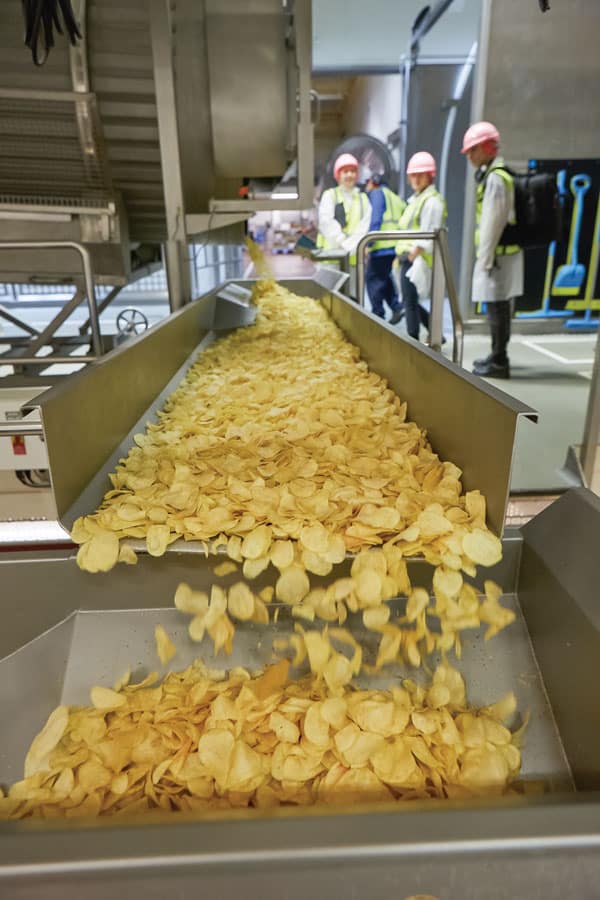
I’m being given a tour of the biggest crisp factory in the world, which every day receives 675 tonnes of potatoes that it turns into five million packets of crisps. My guide is John Bows, a physicist at the multinational snack giant PepsiCo, who researches new processes to improve the production of the humble potato chip. Crisps are a multi-billion-dollar industry worldwide, so the firm – which owns brands such as Cheetos, Doritos, Lays and Walkers – invests in physicists to help get that competitive edge. Even an incremental improvement in production pays off in no time.
I don’t have the faintest idea how physics can be used to improve what is basically frying slices of potato in oil. But Bows’ enthusiasm is infectious and so I’m here with an open mind. I’m intrigued to find out what physics is involved as we make our way around the factory, right from the incoming-potatoes stage to the final packaged product.
Peeled and sliced
We begin at “raw materials – receiving”, where a lorry reverses in, tips its container and pours out a torrent of potatoes. A powerful hose helps them roll and float out into an open flume where they drift away, like some kind of potato water park. No-one wants anything other than potatoes accidentally entering the plant so any floating debris is skimmed off by a “de-wooder”, which is followed swiftly by a “de-stoner”. “Anything heavier, or more dense, than a potato will fall more readily and therefore will go through this tube,” says the on-duty technician, who pulls a lever to reveal what gets sieved out. A load of stones clatter down and I’m surprised to see a few small potatoes too. As Bows explains, the few millimetres near the surface of a potato are more dense than the rest, which means that small potatoes are slightly denser overall than large ones so get discarded here.
Tasty trip. (Courtesy: PepsiCo)
Walkers used to get phone calls years ago from customers complaining about solid non-potato chunks in their crisp packets. The problem was that golf balls would occasionally arrive along with the potatoes, and as these little white spheres happen to have the same density as potatoes, they didn’t get removed with the density-based sorting system. I wondered if this lumpy problem was solved by some clever change in the manufacturing process in the factory, but Bows reveals a much simpler solution: Walkers now only sources potatoes from farms that are well away from golf courses.
Walking to our next port of call I am surprised by the amount of liquid on the floor, as well as the odd mound of foam, and little piles of stray potatoes nestled into the corners of steel platforms. Holding onto a rail, I climb up some steel steps to the next processing stage, where the raw potatoes are peeled in giant metal chambers. Although I can’t see in – the chambers are sealed off – they are making a racket. As Bows explains, a batch of potatoes is being dropped in and spun around in an abrasive circumference for two or three minutes, which removes 90–95% of the peel. “How much is actually removed depends on the potato’s shape – if it’s absolutely spherical we get a good peel removal, but there’s always some left on,” he says. That might sound a bit shoddy, but consumers apparently don’t mind a bit of dark peel around the edges of a crisp. If anything, it makes them perceive the product as being more “natural”.
Talking of colour, Bows says probably the worst thing for consumers is to find a green crisp in their packet. To avoid that scenario, PepsiCo has installed a computerized vision-inspection system, which images each and every peeled potato and discards any that aren’t the right colour. “If you reject here – whole potatoes – it’s more efficient than rejecting green crisps later down the line,” Bows explains. Two lines of cameras face the oncoming stream of potatoes and an array of black rectangular “fingers” flicks any rejects down below. The action is so fast that it’s a challenge to see the fingers move, but we do hear the occasional “dunk!”, followed by the sound of a potato rolling away and falling into a vat below.
Crisps are seasoned in rotating drums. (Courtesy: PepsiCo)
Our next stop is the slicing station, where a technician bends over a squat metal cylinder (without its ends on), roughly 40 cm wide, with the curved edge vertical. Every 90 minutes or less a technician checks – and if necessary replaces – each of eight blades spaced around each cylinder. Blunt blades are a no-no as they cause excess ripping of cells at the potato surface. Beside us, several other slicers are in use. Potatoes drop down into the cylinder, which has a platform at the base spinning at about 200 rpm; this throws the potatoes sideways into the blades, where they get sliced in one go. “There’s actually a tremendous amount of physics going on in here,” says Bows. Since the potato gets cut in a curved profile, the inner and outer surfaces of the slice experience different shear forces. This causes the outer surface to be more fractured and to release more starch.
I can certainly see that going on – the slices are carried away in a flume, this time in an opaque milky-coloured liquid. Bows assures me that all the starch gets recovered at the on-site starch-recovery plant – waste of any resource, including energy and water too, is kept to a minimum. Bows and his team are currently working on how to redesign the slicers to reduce starch loss in the first place. “If you can go from 2% starch loss to 1% starch loss, that’s a big saving in the solids, which translates to heavier chips,” he explains.
Hotting up
Next we go to the warmest part of the production line: the fryer, where the cut potatoes are cooked in hot oil. The frying is hidden from view, taking place in a covered metal chamber several metres long. But Bows first draws my attention to the step just before, where the flume carrying the sliced potatoes turns a corner and fans out into a fishtail shape, depositing the slices onto a conveyor belt about two metres wide. His group is researching how to ensure that the transfer of slices from the flume to the conveyor belt results in the overlapping slices having a uniform mass distribution.
“If you were to watch for a long time, you would see that this isn’t really uniform ‘left-centre-right’ mass distribution,” Bows explains. “And if it’s not uniform here, it’s not uniform going into the fryer.” Higher-density areas of slices within the flyer can lead to soft crisps, where not enough water can escape and the slices don’t reach the optimum temperature. The researchers working on this project have to understand the physics of slices in turbulent liquid so that their models are accurate and can be used to improve the flume and fishtail designs.
After the fishtail, the slices might have 10–15% surface water, the precise amount of which is one of the biggest throughput limitations of the fryer. Another research project at PepsiCo is to understand the surface physics of removing water from a potato slice, and how best to extract it. One method is to fire jets of air at the slices, and vacuum the resulting water droplets away before they can resettle. The team is aiming for a reduction to 8% surface water, pre-fryer.
“There’s a delta-T across the fryer,” Bows says, slipping into language that marks him out as a physicist. “This is one of the control parameters of the texture.” For an ordinary crisp, which is about 10 potato cells wide, temperature is set to about 180 °C at the entrance to the fryer and 160 °C at the exit. The slices are moved through various frying zones using rotating paddles, which serve both to break up clumps, and to submerge buoyant slices that have floated to the top of the oil. As the slices move through the fryer, the starch within them undergoes several phase transitions. The starch passes from its native crystalline state through to a rubbery “melt phase”, and then through glass transition and back to a glassy phase. “If you get the timing of that process right, and if you get the right temperature curve, you get the right texture,” says Bows. “The starch conversion is critical.”
Portion control. (Courtesy: PepsiCo)
To use a continuous fryer – like the ones at Walkers – to make thick, brown and crunchy gourmet-style “kettle chips”, you can simulate the original batch method of kettle-chip manufacture, in which a whole load of potato slices are dunked into a vat or “kettle” of oil, causing the temperature to lower before rising back up again. By changing the time–temperature profile along a continuous fryer so that it starts off hot, cools a little and then gets hot again, the starch is converted at a different rate to give a harder, crunchier bite, matching crisps made using a batch fryer.
As the slices exit the fryer, they still have a high internal vapour pressure, which continues to drive off water vapour. It is only once the internal vapour pressure collapses that oil is sucked into the slices. After this stage, crisps are typically about 30% oil. Walkers crisps use high oleic sunflower oil, which is low in saturated fat.
We now move on to Bows’ favourite device in the Leicester plant: the “Optisort”. This machine is similar to the vision-inspection system that discards whole green spuds, but whereas that machine imaged every individual potato, the Optisort images every single crisp. Considering that there are typically 20–30 slices per potato, the Optisort has to work a lot faster. So before they pass through the device, the crisps are arranged on the conveyor belt in a layer one crisp thick so that every crisp is visible, then sped up by making them fall down a parabolic curve. “The curve’s been designed to accelerate the potato slices, so they fall through at incredible speed,” says Bows. Moving at 3 m/s – about a third of the speed of an Olympic sprinter – I’m mesmerized by the sight of the “singulated” crisps whizzing past. Arrays of cameras photograph every single slice to check they are a nice golden-yellow colour, with green or black slices rejected. The movement is so fast that at first I can’t figure out how the rejects are removed from the stream. Bows then points out a gap about 10 cm wide which the crisps fly over horizontally. Any duds are dispatched downwards with a swift puff of air.
Flavour of the month
So now we have it: the unseasoned PepsiCo crisp. Up until this point I have seen what is a standard process in PepsiCo crisp factories throughout the world, where all that differs is the potato variety. What comes next is for these Walkers crisps to be tailored to the British market. Through a set of double doors, we leave the realm of noisy automated machinery, where we met just two people, and enter a quieter space filled with staff. Noisy vibrations are replaced with the light chatter of factory workers as a power ballad – “Unchained melody” – plays on the radio in the background.
The crisps’ journey continues as they are sent tumbling through giant rotating drums, where a curtain of seasoning powder drops onto them. Bows says that his team looks at physical parameters such as the Froude number – the ratio of inertial to gravitational forces – to optimize the drums so that breakage is minimized but coverage time is maximized. I can smell the seasoning but neither Bows nor I can quite identify it. Wandering around the drum we find several labelled cardboard boxes that solve the mystery: it’s good old cheese and onion, which Bows and I agree is our favourite flavour. We also concur on the worst: prawn cocktail.
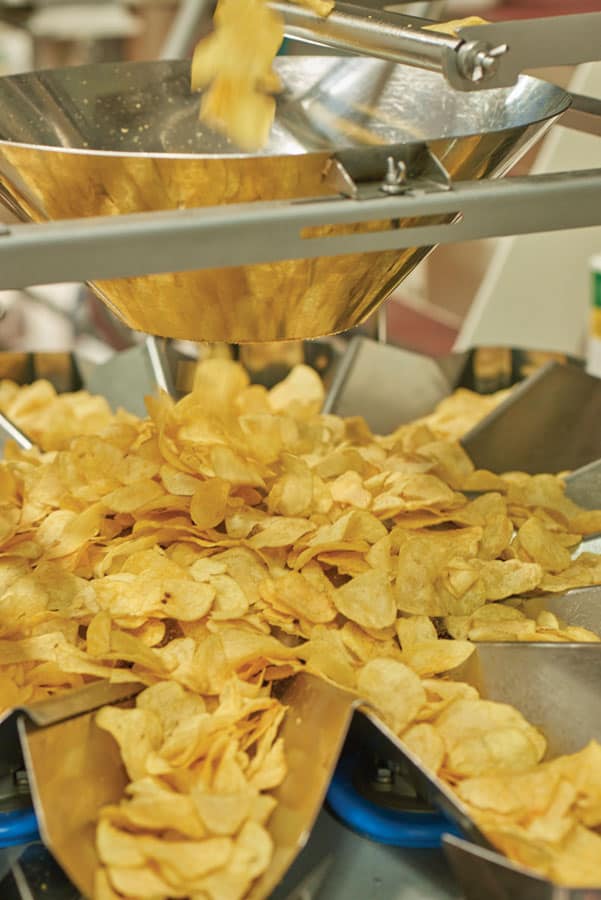
My tour’s still not quite over. I walk up some steps to an elevated platform and am faced with a myriad of circular devices all making a rhythmic clunking noise. It is here that the crisps are weighed and bagged, using a method like nothing I had imagined. At each station, crisps fall from above, onto a metal plate shaped like a 14-petalled flower. Each “petal” funnels crisps into one of 14 hinged buckets or “heads” that are arranged in a circle below. Once every second or more, a couple of these heads – different ones each time – tip their contents into a central vertical shoot that disappears to a lower level. “These heads will take in about four or five crisps at a time, and some combination will be very close to the target weight and dispensed to the bag-maker underneath,” explains Bows. “It’s a purely statistical process.”
Below deck I see indeed that each dumped load corresponds to a bag being filled and sealed. The crisps drop into a tube of packaging material inflated by nitrogen, which feeds downwards at a rate of about a metre every 4 seconds. A heat-sealer and slicer lops off each filled packet at a rate of about 1.6 per second. The packets then fall onto a conveyor belt and go onwards and upwards to be further packaged by robots into multipacks or boxes, and on to the consumer. Another current research project, Bows tells me, is to look into how to reduce the seal from its current width of about 3 mm to 1 mm. “This would save a fortune in packaging material,” he says. Considering the volumes involved at the Leicester factory, those little enhancements would soon add up.
After leaving the factory, as we’re peeling off our hair nets, I have one last question. I’d already committed a faux pas by claiming that my favourite crisp is a cheesy puff – an affronted Bows had reminded me that cheesy puffs aren’t crisps, which by definition are slices of potato fried in oil. But I’m curious to know what happens to that starchy liquid we saw sloshing around at the slicing station. “That starch you recover on site – where does it go?” I ask. “Oh, the starch?” replies Bows. “We make Quavers out of it.” No-one can accuse PepsiCo of letting anything go to waste.
See below for a video interview with John Bows about his career
A group of small crustaceans that live in the twilight zone of the open ocean are coated in nanospheres that reduce the amount of light the crustaceans reflect, biologists in the US have discovered. The spheres, which are smaller than the wavelength of visible light, appear to be bacteria. The researchers believe the coating may help hide the transparent creatures from predators with bioluminescent searchlights.
Hyperiids are a suborder of more than 200 species of marine crustaceans. They inhabit the pelagic zone of the open ocean, from the surface to depths of around 4000 m. The featureless habitat of this twilight zone offers few places to hide from predators, so many of its denizens – including hyperliids – have transparent bodies as a form of camouflage. In the ambient ocean light they are almost invisible.
However, many of the local predator species, such as dragonfish, squid and lanternfish, have bioluminescent searchlights to help them find prey. As these creatures scan their light through the water they can locate these “invisible” animals by the light that reflects off their body surfaces. Such reflections are a particular issue for hard-shelled crustaceans such as hyperiids, because there is a large gradient between the refractive index of their chitin shells and that of seawater – something that results in relatively large amounts of reflection.
Altered refractive index
Researchers at Sönke Johnsen’s sensory biology lab at Duke University, in North Carolina, hypothesized that such hard-shelled creatures would develop surface structures that minimize these reflections by altering the refractive index gradient. Using scanning electron microscopy, they examined seven hyperiid species, representing six families, that ranged in body length from 10 to 100 mm. “They were as distantly related as possible while still being called a hyperiid,” explains Laura Bagge, who led the research.
This is the same idea as the technology used in anti-reflective coatings in eyeglasses
Laura Bagge, Duke University
The team discovered a dense single layer of spheres on the surface of all seven species. These appear to be bacteria and are not identical across the species, ranging in diameter from 52 to 320 nm. To determine whether these spheres affect reflectance, they created optical models of a clean, flat chitinous surface and the same surface covered with monolayers of 52 nm, 110 nm and 320 nm spheres.
At angles of incidence of less than 55° a clean chitinous surface in seawater will reflect between 0.6% and 1% of incident visible light, according to the model. A monolayer of 110 nm spheres had the greatest impact on reflectance, reducing it to less than 0.1% over a broad range of wavelengths and angles of incidence.
Blue-green light
According to the researchers, the nanospheres can reduce the surface’s reflectance of blue-green light (approximately 480 nm wavelength – the most common type of bioluminescence in the ocean) to as little as one hundredth of the uncoated value. In most cases, reflectance was reduced from approximately 1% to less than 0.1% for blue-green light at angles of incidence of less than 45°. The 52 nm spheres were the least effective, reducing the reflectance of wavelengths between 400 and 500 nm to less than 0.5% at angles of incidence of less than 45°.
Bagge explains that the nanospheres reduce reflectance by acting as an intermediate refractive index layer, smoothing out the gradient between the seawater and the animal’s surface. “This is the same idea as the technology used in anti-reflective coatings in eyeglasses, but this type of thin film has never been seen on an animal before,” she says.
Bagge told Physics World that the team is “fairly confident that the spheres are bacteria” and is currently carrying out DNA analysis to confirm this. If they are bacteria, it is not difficult to imagine how this symbiotic relationship evolved. “Hyperiids that were less reflective and less visible due to having just the right size of thin bacterial layer on their surface would have done better at avoiding predators” and the bacteria would have benefited from “colonising a hard surface rather than remaining free-floating.”
How to make a superconductor from a non-superconductor
Calcium-iron arsenide, which is usually not a superconductor, has been made to superconduct by Paul Chu and colleagues at the University of Houston in the US. This was done using an idea first proposed in the 1970s – that superconductivity can be enhanced or even created at the interface between two materials. Chu and colleagues heated calcium-iron arsenide so that it coexists in two different structural phases, neither of which is superconducting. Then the sample is cooled carefully to preserve the two phases. When cooled to below 25 K, the material is a superconductor at the interface between the phases. While this superconducting temperature is too low to be of practical use, Chu believes that the work offers a new direction in the search for more efficient, less expensive superconducting materials. The research is described in Proceedings of the National Academy of Sciences.
Study reveals top Russian physics institutions
A bibliometric study by researchers at the National Research University Higher School of Economics (HSE) in Russia has measured the scientific impact of 39 physics institutions belonging to the Russian Academy of Sciences (RAS). Carried out by HSE sociologists Yuriy Kachanov and Natalia Shmatko, together with Yulia Markova from the American Association for the Advancement of Science, they found that the Joint Institute for Nuclear Research, the Alikhanov Institute for Theoretical and Experimental Physics, the Lebedev Physical Institute – all based in Moscow – and the Ioffe Institute in St Petersburg are the top physics research institutions in the country. The study looked at the number of researchers based at each institution, together with publication statistics. “We were able to prove that big institutions held authority on the global science scene and produced more scientific data, which was highly received by the physics community,” says Shmatko.
Advancing instrumentation at the National Physical Laboratory
Instrumental: the National Physical Laboratory campus in Teddington. (Courtesy: NPL)
A new initiative aimed at strengthening ties between tech firms and the UK’s National Physical Laboratory (NPL) was officially launched last night at the Institute of Engineering and Technology in London. The project, known as NPL Instruments, will see experts at the Teddington-based national measurement institute work closely with companies to develop bespoke instruments, products and related services. At the event, NPL chief-executive Peter Thompson told Physics World that the new business unit would focus on products at a moderate stage of development (equivalent to Technology Readiness Levels 4 and 5) in the areas of advanced manufacturing, environment, health and life sciences, and the digital sector. NPL’s work on instruments tends to be “hidden in plain view”, Thompson told an audience of around 100 lab personnel, industry scientists, engineers and academics at the event, adding that the new business unit is intended to help publicize and expand the lab’s role as an “instrument development partner”. Paul Shore, who leads both the new unit and NPL’s engineering measurement division, gave indoor GPS technologies and “smaller, faster, cheaper” atomic clocks as examples of products where the lab’s existing strengths in measurement and sensing could help to catalyse technical advances. The initiative comes on the heels of a transition period for NPL, which announced in August that it would make up to 50 staff members redundant as part of what Thompson called a “rebalancing” of the 116 year-old lab.
You can find all our daily Flash Physics posts in the website’s news section, as well as on Twitter and Facebook using #FlashPhysics. Tune in to physicsworld.com later today to read today’s extensive news story on bacterial nanospheres.
The first holograms of large objects made using neutrons have been unveiled by physicists in the US and Canada. Unlike conventional holograms produced with laser light, neutron-generated holograms can image the interiors of objects. The researchers say these 3D images could be useful in materials science and could even be used in quantum computers of the future.
Beams of neutrons are a good probe of the internal structure of solid objects because they are able to pass through most materials without being completely absorbed. As a result, neutrons can be used to image the interiors of objects that are too large or to dense to be studied with X-rays – which are much more prone to be absorbed or scattered by matter. Dmitry Pushin, a physicist at the University of Waterloo who led the hologram research, explains: “A heavy metal such as lead is very transparent to neutrons.” Neutrons have also been used to image materials such as hydrogen in fuel cells, which are essentially invisible to X-rays. Because neutrons interact with matter differently than X-rays or other electromagnetic radiation, images constructed with neutrons deliver a different perspective on an object than images constructed with photons.
While scientists have used neutrons to create images for several decades – including tiny holograms on the atomic scale – Pushin’s group is the first to create neutron-generated holograms of macroscopic objects. To make their holograms, the researchers used a beam of neutrons generated by a nuclear reactor at the National Institute of Standards and Technology located in Maryland in the US.
Spiral plate
These neutrons are first split into two beams called the object beam and the reference beam, in analogy to the two laser beams used in conventional holography. The object beam then passes through a 1 cm-thick piece of aluminium known as a spiral phase plate. This increases the orbital angular momentum (OAM) of the beam by a specific amount. The object beam is then recombined with the reference beam to form a 3D interference pattern on a detector. This interference pattern is the hologram image of the spiral phase plate and has a spatial resolution on the micron scale.
Pushin says that using neutron holograms to image the spiral phase plate also provides a new way of visualizing the quantum nature of OAM. The team created holograms of several different spiral phase plates that each increased the neutron beam’s OAM by a different quantity. The holograms’ interference patterns resemble zebra stripes and matched computer simulations. These simulations predicted that the hologram’s interference patterns would branch and fork uniquely, depending on the OAM of the object beam (see figure). Because OAM can be used as a way of storing and transmitting quantum information, the holograms could potentially be useful in quantum-information research such as the development of quantum computers.
Topological materials
Pushin anticipates other applications for neutron holography, including studying the internal structure of new materials. In particular, he says the technique could aid in the discovery of topological conductors and insulators.
The next step, Pushin says, is to create more tools such as diffraction gratings, which can manipulate the shape of the neutron beam in more precise ways. The team also plans to start using neutron holography to characterize new materials.