A tiny carbon nanotube has been inflated and deflated much like a balloon by making small changes to the voltage applied along its length. The work was done by Hamid Reza Barzegar at Umeå University in Sweden, and Alex Zettl at the University of California, Berkeley and could someday be used to create tiny machines and actuators for a wide range of applications. Carbon nanotubes have walls that can be as thin as just one atom. They can be made defect free, which the researchers say could make nanotube-based actuators resistant to mechanical wear and fatigue. Indeed, they we able to inflate and deflate their balloon many times without causing any apparent damage to the nanotube. The research is described in Nano Letters.
Quantum coherence lasts forever, almost
Physicists based in Brazil, Italy, Germany and the UK have shown it is possible to defeat that great enemy of quantum technology: decoherence. The ability of quantum systems to exist in superposition states holds the promise, among other things, of computers that are exponentially faster than today’s classical devices. However, these states are usually destroyed by environmental interference after just a fraction of a second. Physicists can get around this problem by adding additional controls to a system, but doing so uses up huge resources. Quantum error-correction schemes, for example, require multiplying the number of quantum bits (qubits) many times over. In the new work, Gerardo Adesso of the University of Nottingham and colleagues have found that they can delay the onset of decoherence in certain composite systems that do not lose energy to the environment by at least a second – and in principle, they say, indefinitely – without resorting to error correction or other artificial schemes. The trick, they reveal, is to prepare states such that they are observed using a quantum basis that orthogonal to that of the noise source. The researchers observed this “everlasting quantum coherence” in spin systems containing two and four qubits made using nuclear magnetic resonance at room temperature, and they say that such states in future might be used to carry out low-noise magnetometry. Team member Rosario Lo Franco of the University of Palermo adds that plants might exploit a similar scheme in order to maintain the very long coherence times observed when they harvest light. The research will be reported in Physical Review Letters and a preprint is available on arXiv.
Universal census tots up to two trillion galaxies
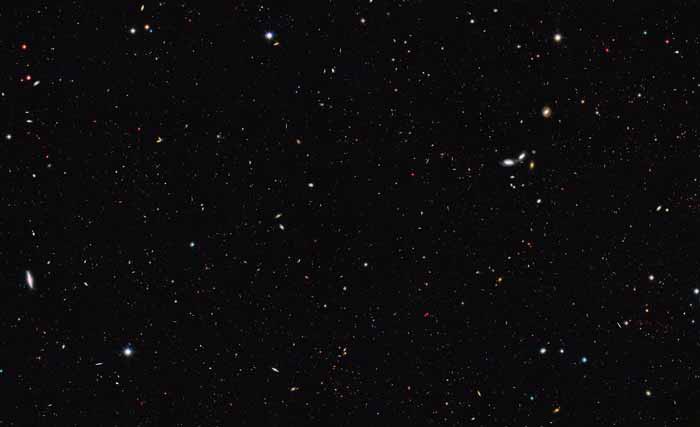
Across the universe: among other data, scientists used the galaxies visible in the Great Observatories Origins Deep Survey (GOODS) to recalculate the total number of galaxies in the observable universe. The image was taken by the NASA/ESA Hubble Space Telescope and covers a portion of the southern field of GOODS. This is a large galaxy census, a deep-sky study by several observatories to trace the formation and evolution of galaxies. (Courtesy: NASA, ESA/Hubble)
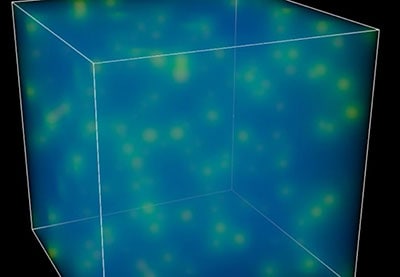
The most accurate cosmic census ever has found that there are many more galaxies in the observable universe as was previously thought. An international team of astronomers, led by Christopher Conselice from the University of Nottingham, UK, used the latest data and images from the NASA/ESA Hubble Space Telescope to estimate that the visible universe contains around two trillion galaxies – some 20 times more than the previously estimated count of 100-200 billion galaxies. “It boggles the mind that over 90% of the galaxies in the universe have yet to be studied. Who knows what interesting properties we will find when we observe these galaxies with the next generation of telescopes,” says Conselice. The team converted Hubble images into 3D images to make accurate measurements of the number of galaxies at different epochs through the evolution of the universe, looking 13 billion years into the past. They found that galaxies are not evenly distributed throughout the universe’s history and that there were 10 times more galaxies per unit volume (albeit relatively small and faint galaxies) when the universe was only a few billion years old. The team also developed new mathematical models that allowed them to infer the existence of galaxies that are too faint or far away to be seen by today’s telescopes. The work is described in the Astrophysical Journal (ApJ830 83)
You can find all our daily Flash Physics posts in the website’s news section, as well as on Twitter and Facebook using #FlashPhysics. Tune in to physicsworld.com later today to read today’s extensive news story on how electron microscopy has been combined with femtosecond spectroscopy.
The laser altimeter for Europe’s first mission to Mercury has been fitted to the Mercury Planetary Orbiter (MPO). Developed by a European team led by the University of Bern in Switzerland, the BepiColombo Laser Altimeter (BELA) is part of the European Space Agency’s BepiColombo mission to Mercury, which is due to launch in April 2018. It’s the first laser altimeter for inter-planetary flight to be built in Europe.
Coupled system
The instrument will measure the topography of Mercury from aboard the MPO, which is one of two spacecraft that will orbit the planet as part of the BepiColombo mission. The MPO is being built by ESA, while the Mercury Magnetospheric Orbiter (MMO) is being built by the Japan Aerospace Exploration Agency (JAXA).
The aim of the BepiColombo mission – Europe’s first to Mercury – is to provide information on the composition, geophysics, atmosphere, magnetosphere and history of Mercury. The two spacecraft will travel to Mercury as part of a coupled system. When they reach Mercury in 2024, the MMO will study the planet’s magnetosphere via an orbit such that it will be 590 km from Mercury’s surface at its closest approach, while the MPO will follow a closer orbit at 480 km and survey the planet’s surface and internal composition.
BELA is one of 11 instruments that will be carried on the MPO. The laser altimeter uses the direct-detection approach. A high-power laser, which was developed by Cassidian Optroniks, a subsidiary of Airbus Defence and Space, based in Germany, will emit 50 mJ pulses with a wavelength of 1064 nm at a frequency of 10 Hz. These will be reflected back from the surface of Mercury and received around 5 ms later by the receiver telescope (RTL). The image is then refocused onto silicon-based avalanche photodiodes – these are based on the photodiodes used on the laser altimeters on NASA’s Mars Global Surveyor spacecraft and MESSENGER spacecraft, which orbited Mercury between 2011 and 2015. The signal from the photodiode is then analysed by an electronics module developed by Swiss technology company RUAG, to determine the time of flight (and therefore range and altitude), the integrated pulse intensity, and its width.
Mirror mirror
The RTL is a two-mirror telescope that was designed and developed by RUAG. Located inside the spacecraft, it needs to cope with temperature ranging from –20 °C to +45 °C without deforming, but also needs to be lightweight. “We decided to build the telescope entirely from beryllium to provide thermal compensation,” says Nicolas Thomas, BELA co-principal investigator, based at the University of Bern. “The 20 cm-diameter system weighs only 600 grams.” The optical surface was produce by diamond-machining copper deposited on the beryllium.
Due to Mercury’s proximity to the Sun, BELA will have to deal with intense heat and sunlight. The RTL is protected by a “baffle unit” that reflects 90% of sunlight striking it. “If we had had a traditional black baffle, not only would it have reached 450 °C, but we would have injected more than 300 W of heat into the spacecraft,” explains Thomas. “The outer (ceramic) ring still reaches 200 °C worst case but the 30 W we now dump to the spacecraft can be handled.” The laser is also protected by a similar but smaller unit developed by the German Aerospace Center, DLR, in Berlin.
Feel the heat
To deal with sunlight reflected from Mercury, both the optics system, which transfers light from the telescope to the photodiodes, and the laser are fitted with interference filters. The filter for the optics system isolates light at a laser wavelength of 1064 nm, while the filter for the laser prevents potentially dangerous light levels reaching the system.
“BELA will contribute a lot to understanding Mercury,” says Thomas, who adds that “Einstein’s studies of the motion of Mercury have been so important to the theory of general relativity. It is nice to think that with this instrument, the University of Bern, where he used to work, can play a leading role in studying this particular planet in detail.”
The $180m Five-hundred-meter Aperture Spherical radio Telescope (FAST) – the world’s largest single-aperture radio receiver – has joined the Breakthrough Listen programme, which launched in July 2015 to look for intelligent life beyond Earth. FAST was completed in September and is located in a natural depression in Guizhou province in southern China. The telescope consists of 4450 reflecting panels with a collection area that is more than twice as big in size as its nearest rival – the 300 m Arecibo telescope in Puerto Rico. FAST will now join the Green Bank Telescope in the US and the Parkes Observatory in Australia in hunting for alien signals, with the three observatories exchanging observing plans, search methods and data. “‘Are we alone?’ is a question that unites us as a planet,” says Yuri Milner, founder of the Breakthrough Initiatives, “And the quest to answer it should take place at a planetary level too. With this agreement, we are now searching for cosmic companions with three of the world’s biggest telescopes across three continents.”
Warm dense matter simulation sheds light on fusion
Warm and dense: simulation of electron density in warm dense matter. (Courtesy: Travis Sjostrom)
A new computer simulation of warm dense matter that could improve laser plasma fusion has been unveiled by physicists in Germany, the US and the UK. The simulations allowed Matthew Foulkes and colleagues at Imperial College London, Christian Albrechts University Kiel and Los Alamos National Laboratory to determine the phase diagram of warm dense matter – which exists in the temperature range between condensed matter and plasma (1000–100,000 K) and is characterized by hot electrons that move around within tightly packed atoms. It is an important step in the process of laser fusion, whereby intense lasers compress and heat a solid target driving the atomic nuclei together until they fuse and release large amounts of energy. As the electrons in the target are heated by the lasers, the target transforms into warm dense matter for just a few microseconds. This fleeting phase can be crucial to achieving fusion because it affects how the nuclei will be further compressed. If this compression is uneven, then significant amounts of fusion will not occur. Understanding the behaviour of the electrons during the warm dense matter phase could help physicists to improve the compression process. The simulations are described in Physical Review Letters and they could also shed light on warm dense matter in astronomy, including the behaviour of Jupiter’s core and the atmosphere of white-dwarf stars.
Theorist trio bag APS prize for particle accelerators
The 2017 Robert R Wilson Prize for Achievement in the Physics of Particle Accelerators has been awarded to theoretical physicists Sekazi Mtingwa of the Massachusetts Institute of Technology, James Bjorken from SLAC National Accelerator Laboratory and Anton Piwinski at DESY. The trio were given the prize “for the detailed, theoretical description of intrabeam scattering, which has empowered major discoveries in a broad range of disciplines by a wide variety of accelerators, including hadron colliders, damping rings/linear colliders, and low emittance synchrotron light sources”. The annual prize is awarded by the American Physical Society and recognizes outstanding achievement in the field of particle accelerators. The $7,500 award will be split between the recipients. According to Fermilab, Mtingwa “is the first African-American scientist to receive a prize from the American Physical Society”. Mtingwa, who now sits on the committee for the African Light Source, penned a Forum article for Physics World earlier this year – “A shining light for African science” – that called for physicists to get behind African plans to build the continent’s first ever synchrotron light source.
You can find all our daily Flash Physics posts in the website’s news section, as well as on Twitter and Facebook using #FlashPhysics. Tune in to physicsworld.com later today to read today’s extensive news story on the first laser altimeter for inter-planetary flight.
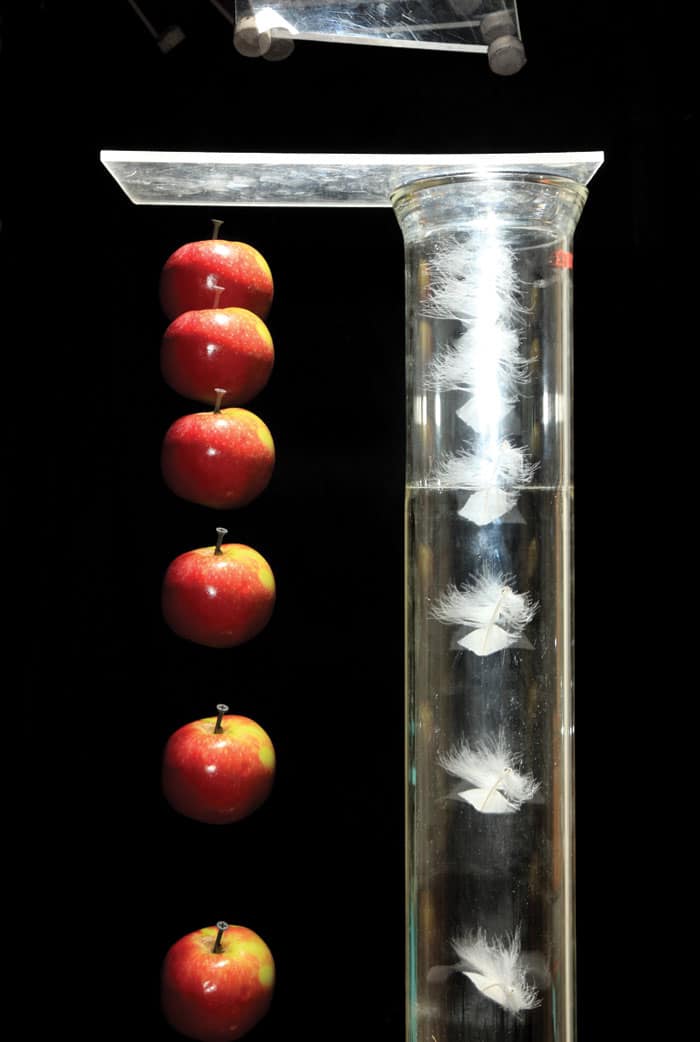
In sync. (Courtesy: Ted Kinsman/Science Photo Library)
What goes up must come down. But does everything come back down at the same time? Galileo said yes. Newton said yes. Einstein said yes. Still, many physicists today secretly believe the answer might be no.
That belief might seem strange. Countless experiments over the years have concluded that two objects dropped from a height will – regardless of their composition – fall to the ground at precisely the same moment, provided they do not suffer disparities in air resistance. Schoolchildren are routinely taught about this “universality of free fall”, often with reference to the famous 1971 video of the US astronaut David Scott standing on the Moon and demonstrating that, in the absence of any air, even a feather and a hammer fall in unison. If the universality is not clear from everyday experience, it is at least implied by Newton’s laws of motion and gravitation, which combine to suggest that the acceleration of a body due to gravity is proportional only to the mass of the planetary object it is being attracted to, not to its own mass. The conclusion would appear irrefutable.
Yet, some violation of the universality of free fall could come in very useful. One of the greatest obstacles to progress in physics is the gaping chasm between the classical world of Einstein’s general theory of relativity, our current best theory of gravity, and the fuzzy, largely microscopic world of quantum mechanics, which accurately describes the other three known forces of nature: electromagnetism; and the strong and weak nuclear forces. A bridge between the two worlds – a quantum theory of gravity – is the neatest theoretical solution, but it has been elusive. Some candidate theories would seem to entail additional forces that, at very fine timescales, create an imbalance in the pull of gravity for different objects. Indeed, the observation of a tiny and hitherto imperceptible difference in acceleration for two falling objects could be the first evidence that general relativity is flawed, ushering in a new paradigm in modern physics.
Before the turn of this century, the best tests of gravitational free fall could find no deviation in the acceleration of two masses to within one part in 10 trillion. But a new host of lab- and space-based experiments promises up to a 10,000-fold increase in this precision, potentially offering the first chance of testing quantum gravity theories. What is more, some experimentalists are presenting new ways to approach tests of free fall – for example, by employing purely quantum systems, or antimatter. The question “Does everything fall back to Earth at the same speed?” may soon have an answer far more accurate than ever before.
An old story
To Galileo, the answer was certainly obvious. Even as a young medical student at the University of Pisa in Italy, in the late 16th century, he argued that all bodies must fall to the ground at the same speed, because otherwise, in a shower of hailstones, large stones would reach the ground before small stones – assuming they all start their fall at the same altitude. This post-Aristotelian logic was famously tested in the (almost certainly apocryphal) story of Galileo dropping two different weights from the top of the Leaning Tower of Pisa.
This retroreflector (left) was put on the Moon by astronauts on the Apollo 11 mission. Astronomers all over the world have reflected laser light off the reflectors to measure precisely the Earth–Moon distance. NASA also uses laser-ranging to track the Lunar Reconnaissance Orbiter 28 times per second (right). (Courtesy: left: NASA Apollo Archive; right: Tom Zagwodzki/Goddard Space Flight Center)
But it was only the better part of a century later with the Newtonian revolution that a mathematical basis for the universality of free fall was established. Combine Newton’s second law of motion (the force on an object is equal to its mass multiplied by its acceleration in the direction of the force) and his law of universal gravitation (gravitational attraction is directly proportional to the product of two gravitating masses and inversely proportional to the square of the distance between them), and you naively find that the acceleration of a gravitating object is proportional to the mass of the object it is being attracted to, not to its own mass. Naively, that is, because the combination of these laws implicitly assumes an equivalence between two types of mass. On the one hand there is inertial mass, which we feel in situations describable by the second law of motion – turning a corner in a car, say – and on the other hand there is gravitational mass, which we feel all the time, being attracted to the surface of the Earth.
This implicit assumption of an equivalence between inertial and gravitational mass was pointed out by the German physicist Heinrich Hertz in the late 19th century. “[The properties] must be thought of as being completely independent of each other,” he wrote, “but in our experience, and only in our experience, appear to be exactly equal. This correspondence must mean much more than being just a miracle”: there must be “a deeper explanation”.
In 1915, within his general theory of relativity, Einstein established what has since become the agreed explanation: space–time. Like Galileo and Newton before him, Einstein accepted that objects travel in a straight line unless a force drives them otherwise. Unlike his predecessors, however, he established that this straight line exists on the fabric of 4D space–time, which is warped by mass. In the vicinity of very massive objects such as our planet, there is a pronounced depression in space–time. Roughly speaking, that means that a straight line in our everyday, 3D Euclidean geometry is bent inwards, towards the centre of the Earth, in much the same way that a straight flight path from London to New York appears on a 2D map to be an arc.
The Micro-Satellite à traînée Compensée pour l’Observation du Principe d’Equivalence, or Microscope, contains two test cylinders (one of which is pictured above right) of different masses that are orbiting Earth in free fall, with their acceleration being measured precisely. (Courtesy: CNES)
In this description, we feel gravity pulling us towards Earth simply because the ground under our feet – or the chair under our bottom – is diverting us from this straight line in distorted space–time. Likewise, we experience inertia when we are pushed from our existing straight line by another force – the grip of car tyres, the blast of a rocket or the sobering contact of an easy-to-miss lamppost.
In short, Einstein showed that inertia and gravity are locally two sides of the same coin: that they are the same is embodied in his “equivalence principle”.
Today, physicists describe three versions of the equivalence principle, of which one is the universality of free fall, or the so-called weak equivalence principle. Another version, known for historical reasons as the Einstein equivalence principle, states that this weak equivalence principle holds whenever and wherever an experiment is carried out. The third version, the so-called strong equivalence principle, states that the Einstein equivalence principle holds even if a mass is large and has substantial internal gravitational interactions.
In general, the equivalence principle can be seen to form the basis for general relativity, which is defined as a “metric” theory – that is, one in which matter behaves according to functions of distance on the fabric of space–time. Quantum mechanics is not a metric theory, and it is therefore widely assumed that any future theory bridging quantum mechanics with general relativity will have to ditch one or more aspects of the equivalence principle. “If you’re looking for a unified theory, you may have to abandon this concept of a metric space–time theory,” says experimental physicist Sven Herrmann of ZARM at the University of Bremen, Germany. “That would mean the equivalence principle was violated.”
Weak principle
One well-established method to test the strong equivalence principle is lunar laser-ranging, which takes advantage of retroreflectors – devices like cat’s eyes that reflect light back to its source – placed on the Moon during the US and Soviet Moon landings. The best results using this technique were reported in the mid-1970s by physicists Irwin Shapiro and Charles Counselman at the Massachusetts Institute of Technology in Cambridge, US, together with Robert King of the US Air Force Cambridge Research Laboratories. They analysed nearly 1400 measurements of the time required for laser light to go from a telescope on Earth to a retroreflector on the Moon and back, and found that the Earth and Moon must be “falling” towards the Sun with exactly the same acceleration, give or take one part in a trillion (1976 Phys. Rev. Lett.36 555). That precision is expected to be bettered soon with new data taken as part of the Apache Point Observatory Lunar Laser-ranging Operation (APOLLO) in New Mexico, US.
At the Bremen Drop Tower in Germany, experiments are performed under a microgravity comparable to one millionth of the Earth’s gravitational force (10–6 g). (Courtesy: ZARM, University of Bremen)
Indeed, it has been bettered already by another tool: the torsion pendulum, which consists of two different masses suspended on a wire. If the Sun’s gravity pulls on the masses differently due to a violation of the universality of free fall, there should be a twist of the pendulum. In 1999 Eric Adelberger and others in the Eöt-Wash group at the University of Washington in Seattle, US, found no such twist to a precision of one part in 10 trillion (1013), setting the current record for tests of the weak equivalence principle (Phys. Rev. Lett.83 3585).
In more than 15 years since this result, the Eöt-Wash group has struggled to improve its experimental precision, though it still hopes to do so by an order of magnitude by cooling its apparatus to near absolute zero. But many experimentalists believe it will prove too difficult to surpass it here on Earth. “It seems to me that a significant improvement in accuracy will only take place in space-based experiments in the future,” says Herrmann. “It’s hard for me to see that a 10–15 experiment will be done on the ground. But, with some clever new ideas, maybe!”
As it happens, this year brings the first possibility of a 10–15 precision from a space-based experiment, namely Microscope, or the Micro-Satellite à traînée Compensée pour l’Observation du Principe d’Equivalence (the drag-compensated micro-satellite for the observation of the equivalence principle), which was launched in April. Developed by the French National Centre for Space Studies (CNES), Microscope contains two cylindrical test masses – one made of the light metal titanium and the other of an alloy of the two heavy metals platinum and rhodium. The cylinders sit concentrically (to have coincident centres of mass) on separate accelerometers, undisturbed by terrestrial sources of noise, such as seismic perturbations.
Being in orbit, the satellite and its contents are in free fall towards Earth, and if general relativity is correct, the two test masses should remain motionless relative to each other. If there is a violation of the weak equivalence principle, however, one of the test masses will experience slightly more free-fall acceleration than the other, and this will be recorded by its accelerometer. Prior to launch, scientists from the French national aerospace centre ONERA, who are responsible for interpreting the Microscope data, claimed that the first results could come in as little as a few months, but so far none have been announced. The CNES is not the only institution hoping to exploit the calmer benefits of space, however. For several years physicists Robert Reasenberg and James Phillips, formerly of the Harvard–Smithsonian Center for Astrophysics in Massachusetts, US, have been developing an experiment designed to fly on a sounding rocket that briefly enters space in free fall. Unlike Microscope, SR-POEM (Sounding-Rocket based Principle Of Equivalence Measurement) has a pair of test masses that are interleaved with each other in order to keep their centres of mass coincident; one of the masses is made of solid aluminium, while the other contains hollow lead inserts. Moreover, SR-POEM has a markedly different system to determine acceleration. Each of the masses forms one end of a triplet of optical cavities, and if either mass moves, its cavities lengthen or shorten. Using a “laser gauge” based on a technique known as Pound–Drever–Hall locking, Reasenberg and Phillips lock the frequency of a separate laser to each cavity, so that if the cavity lengths change due to the acceleration of the test mass, so do the laser frequencies – and frequency can be measured to very high precision.
The physicists plan to measure the acceleration of the test masses towards Earth, with the apparatus pointed up and then – rotating the entire payload – with the apparatus pointed down. “We move the Earth to the other side of the experiment, then do it again,” jokes Reasenberg, who is now based at the University of California, San Diego, in the US. In this way, any spurious accelerations should perfectly cancel out, yielding a signal only if one of the test masses experiences more gravity than the other (2012 Class. Quantum Grav.29 184013). “If it’s not zero, either you’ve got a systematic error, or you’ve discovered a violation of the equivalence principle,” Reasenberg says.
SR-POEM should have an accuracy 100 times greater than Microscope, due to the isolation of the test masses and the acuity of the laser gauges. Reasenberg also reckons it could be done at 10% of the cost, and in as little time as half an hour. But currently there is no funding to realize the experiment as, according to Reasenberg, NASA funds are devoted to the forthcoming James Webb Space Telescope, which is scheduled for launch in late 2018. “I don’t think there’s a good chance of getting funding until the James Webb is launched,” he says.
What goes up, keeps going up?
The good news for Reasenberg and Phillips is that their highly precise system for distance measurement has found its way onto an altogether different test of the equivalence principle – one that investigates antimatter. Believe general relativity, and antimatter should fall to the Earth exactly like matter; but some alternative gravity theories predict it should do the opposite, and “fall” upwards. This kind of antigravity effect could explain why we don’t observe equal quantities of matter and antimatter in our local universe, even though the two types are predicted to have been generated in equal quantities after the Big Bang. Simply put, the two types of matter might have repelled each other, driving all the antimatter into distant regions of the universe. “Maybe clusters of galaxies, or even portions of the universe as big as we can see, are made of antimatter,” says Reasenberg.
The antimatter “free fall” test to which Reasenberg and Phillips are contributing is being led by Daniel Kaplan at the Illinois Institute of Technology in Chicago, US. It involves sending a beam of muonium – a hydrogen-like atom, consisting of an electron orbiting an antimuon – into an atom interferometer, horizontally. The muonium beam is split at a diffraction grating, with each new beam taking a slightly different path before being diffracted again at a second diffraction grating, generating an interference pattern at a third diffraction grating. From the position of this pattern, which can be measured with the help of the third grating, it is possible to work out whether the muonium atoms fall down or up (EPJ Web Conf.95 05008).
One difficulty with this type of experiment comes down to the lifetime of muonium: with a half life of just a couple of microseconds, the window for observing any up or down movement is very small, even if large numbers of particles are employed. The challenge, therefore, is incredibly high precision in the interferometer’s alignment to observe tiny changes in the position of the interference pattern. Kaplan’s group plans to use Reasenberg and Phillips’s laser gauge to ensure that the motion of the third grating is known to within 10 picometres (10–11 m) or so, and calibrate zero acceleration through use of an X-ray beam that has roughly the same wavelength as muonium. “If you found antimatter was falling up, that would be a major discovery,” says Reasenberg. “It changes physics. It changes cosmology.”
The benefit of investigating antimatter is that it provides an alternative way to tackle the equivalence principle, one for which no precise precedent has yet been set. That is also the case with PRIMUS, the Präzisionsinterferometrie mit Materiewellen unter Schwerelosigkeit (precision interferometry with matter waves in zero gravity), which is being funded by the German space agency DLR and is being performed at the 146 m-high drop tower at the University of Bremen by Herrmann as well as Dennis Schlippert and others at the University of Hannover in Germany. It also involves sending atom-waves into an interferometer, but these atoms are in a Bose–Einstein condensate (BEC): they are in the same, lowest quantum state, and behave as a single quantum entity. The speculation is that such a decidedly quantum system could, like antimatter, behave differently when it comes to the universality of free fall. “It might be more sensitive to violation,” says Herrmann, “because it is closer to the boundary between quantum theory and gravity.”
As a matter-wave in an interferometer, a BEC has a phase, although this phase can be altered with exposure to a laser of the right wavelength. In PRIMUS, a BEC is allowed to free fall in the drop tower before being hit by such a laser pulse, which simultaneously splits the quantum entity into two paths (like a diffraction grating) and changes its phase, with the new phase dependent on when and where the laser struck. Farther down the drop tower the BEC is struck by another laser, which recombines the two halves to create an interference pattern. By examining the periodicity of this pattern, it is possible to work out the initial phase change, where it took place, and therefore the acceleration on the BEC due to gravity.
Last year, as a precursor to PRIMUS, Schlippert and colleagues performed a similar free-fall test for two BECs, one made of potassium and one of rubidium, to a precision of one in 10–7 (Phys. Rev. Lett. 112 203002). No violation yet, but the experiments are breaking ground for a different type of test of the equivalence principle. Indeed, Herrmann says that a future version of the PRIMUS experiment may one day find its way into space.
And what if a violation is found? That could well be the first evidence for a theory of quantum gravity – perhaps string theory, in which all fundamental particles are in fact twisted loops that, when expanded, spread into 10 or more dimensions. There are currently no firm predictions of where experimentalists should expect violations of the equivalence principle according to string theory, but some theorists expect them to become visible at precisions greater than 10–13.
Even then, there is the natural caution with which one interprets a single experimental result, particularly when it affects a theory that has proved unshakeable for 100 years. “You don’t topple a major piece of physics like general relativity based on one experiment,” says Reasenberg. “There’s always the possibility that there’s some systematic error nobody thought of, and there’s no physics in it at all.”
Last May the Huffington Post ran a piece entitled “Why physics experiments at the subatomic level may cause ‘unknown unknowns’ to destroy the world”. It was written by Peter Reynosa, a poet and painter from San Francisco, who’s also the author of a dystopian novel about the dangers of rationalism. As an enthusiastic newcomer to the old debate over whether the Large Hadron Collider (LHC) will destroy the universe, Reynosa reckoned the LHC is a monster that is “nightmaring itself into our world”. Though vague on specifics, Reynosa claimed the collider is staging “very dangerous experiments that may cause the world’s destruction”.
To support his claim, Reynosa cited the Bush Administration defence secretary Donald Rumsfeld’s famous phrase concerning “unknown unknowns”, which he originally used in 2002 to defend the invasion of Iraq. The LHC is designed to investigate matter at its fundamental levels. Although we may not think this poses any dangers, there could be, Reynosa claimed, things we don’t know that may cause its operation to trigger “catastrophic repercussions” that will create an “unthinkable horror”.
Bush league
Frightening! But arguments using “unknown unknowns” were dishonest when Rumsfeld first made them to defend the Iraq invasion, and are equally dishonest made against the LHC. Iraq, after all, had nothing to do with the terrorist attack of 11 September 2001, but in its aftermath the Bush administration prepared to invade the country anyway. As a shameless pretext, it cited the possibility Iraq might give terrorists weapons of mass destruction.
At a news conference on 12 February 2002, a reporter asked Rumsfeld what evidence he had. Rumsfeld replied evasively. “There are,” he said, “things we know we don’t know.” Then he added: “But there are also unknown unknowns – the ones we don’t know we don’t know.” Those, he implied, were sufficient to justify invasion. As it turned out, there was no evidence of weapons of mass destruction, and an inspection team that hunted for them came up empty-handed.
Rumsfeld’s use of “unknown unknowns” to justify the decision to invade Iraq is like justifying pulling out a gun and shooting a suspect who shows no sign of ill intent by saying “You never know!” It was a smokescreen to rationalize the already-taken decision. The appeal to “unknown unknowns” uses naked fear-mongering to try to turn a lack of evidence for an action, such as invading Iraq or shutting down the LHC, into a positive reason for proceeding as if there were evidence.
We might call this a Chicken Little argument, as it’s like the children’s fable in which Chicken Little, after getting hit on the head with an acorn, tells the other animals to run because “the sky is falling”. But this new version is a “could-have” Chicken Little argument, for the chicken is claiming the sky is falling because she “could have” been hit by an acorn. The “unknown unknowns” argument is a fallacy.
Two kinds of probabilities
Theoretical physicists who’ve looked into whether heavy-ion collisions can produce “strangelets” or black holes that will consume other forms of matter have concluded that the probability of such events is non-zero. So isn’t there at least minuscule evidence that the LHC is a threat? No, because there are two kinds of probabilities. One – established probability – is based on sound principles and empirical data of frequencies of actual occurrences. This is the probability of coin tosses, winning the lottery, human mortality, the molecular behaviour of gases and so on. We’re sure of the principles and data, and no magical thinking is involved. Established probabilities are reliable guides to the world.
The other kind of probability is fictive or subjective. This is when you assume certain principles and initial conditions and use them to estimate possible outcomes. You don’t know whether all the principles are sound, and you have no data on outcomes from relevant similar experiments. You have no reason to suppose the probabilities reflect the real world, and it would be folly to use them as a guide to action.
We can show this by turning the argument on Reynosa’s own profession. I’m sure someone can concoct a theory of insanity that yields a non-zero probability that poetry and painting can drive individuals to commit mass murder. If there were no empirical data to back up this finding, wouldn’t it be insane and unjust to use it as a reason to ban poets and painters from practising?
The safe working of our scientific, technological and medical infrastructure is highly vulnerable to dishonest unknown unknown arguments. If you use that argument, then it’s easy to claim that cell phones may cause cancer, vaccines autism, and genetically modified organisms disease, and so they should be banned. After all, you never know!
The problem is that those who advance such arguments often have no real interest in public safety but only in self-advancement or special pleading. Politicians and activists exploit such arguments to counter policies they do not want to support. Others use such arguments to sell books or get attention. Media sources lap up such incendiary messages. In my May 2007 column, I called people who seek to advance themselves by sowing unwarranted suspicion “social Iagos”. Iago, the villain in Shakespeare’s Othello, used a handkerchief to cause his boss to doubt his wife; today’s scoundrels use “unknown unknowns”.
The critical point
Arguments that use “unknown unknowns” to promote a particular course of action are harmful in several ways. They can lead to different kinds of harmful and destructive courses of action, such as shutting down accelerators or stopping medications. They can be used to create distrust of legitimate and valuable institutions, such as review committees. Finally, they are harmful in seeking to curtail investigating the dynamics of the world, which is far safer than not investigating it at all.
There are good reasons to get excited by the €2bn European Spallation Source (ESS), which is currently under construction in Lund, Sweden. When the machine’s user programme finally starts in 2023, if all goes to plan, it will be the world’s most intense particle accelerator, generating up to 100 times more neutrons than any of today’s sources. Like a giant microscope, it will allow unprecedented studies into various fields – particularly the science of the everyday, such as plastics, pharmaceuticals, biological matter and nanotechnology. The ESS is a fitting tribute to Europe’s neutron research community, which is estimated to be by far the world’s largest, comprising some 6000 scientists and engineers.
Against this starry-eyed picture, however, a recent report published by the Neutron Landscape Group (NLG) makes for sobering reading, by pointing out that many sources are set to close within a decade. By the mid-2030s, according to the NLG, the best-case scenario is a 30% drop in neutron instrument time, while the worst-case scenario is a 60% reduction. In decades to come the ESS may be a transformative neutron source, but there may not be much of a neutron community left to use it. “The renewal of intermediate neutron sources becomes necessary to maintain a ‘critical mass’ for the neutron user community, otherwise new powerful sources such as the ESS become almost useless,” says Jacques Ollivier, a physicist at the Institut Laue-Langevin (ILL) in Grenoble, France. The ILL itself could close in 2023 unless its partners agree otherwise.
The renewal of intermediate neutron sources becomes necessary to maintain a ‘critical mass’ for the neutron user community, otherwise new powerful sources such as the ESS become almost useless
Jacques Ollivier, Institut Laue-Langevin
Fortunately, there may be ways to plug this neutron deficit. Physicists at the Forschungszentrum Jülich, in collaboration with those at the Laboratoire Léon Brillouin (LLB) in Saclay, France, are exploring the possibility of cheap, scalable neutron sources that could be installed at universities or at national facilities. The technology has already been put into practice outside Europe, for example at Indiana University in the US and at the Japan Collaboration on Accelerator-driven Neutron Sources – a nationwide network of researchers working on neutron-beam technologies and moderators. But the researchers at Jülich and the LLB want to push the technology to its limit, boosting the power output by at least a factor of 100.
Tailored solution
There are currently two main types of neutron source: spallation and reactor. In spallation, charged particles such as protons are accelerated into a heavy-metal target, kicking neutrons from the target’s nuclei. This process, which is employed at various facilities including the ISIS Neutron and Muon Source in Oxfordshire, UK, and which will also be employed at the ESS, is the most efficient, generating some 20 neutrons per incident proton. The second type of neutron source, the fission reactor, involves a single neutron splitting a uranium atom to generate three neutrons, which then split more uranium atoms, provoking a chain reaction. The ILL and the LLB are both reactor neutron sources.
For sociopolitical reasons, new research reactors are deemed unlikely to be built in Europe. But the chances of building further spallation sources in addition to the ESS are slim too – partly because big accelerators themselves are pricey, but also because the intense radiation requires huge amounts of shielding. The ESS’s inner monolith alone will comprise some 2000 tonnes of steel. “[Spallation] is a very efficient process, but it comes with a huge price tag,” says Thomas Brückel, director of the Jülich Centre for Neutron Science.
Brückel’s answer is a compact accelerator source, which accelerates protons or deuterons (bound protons and neutrons) to MeV rather than – in the case of the ESS – GeV energies. Such modest energies mean that the target must be made of a light metal, most likely beryllium. That in turn means a drop in efficiency, with an average of 10 incident protons or deuterons required to generate a single neutron. But the accelerator should be much cheaper and should produce far less unwanted radiation.
There are other benefits too. With less risk of radiation damage, the moderators (which reduce the energy of the emitted neutrons to a usable meV range) and the neutron optics (which guide the neutrons to the instruments) can be placed much closer to the target. That means several moderators can be squeezed around the target, each tailored to the needs of a specific instrument. In bigger spallation sources, where moderators have to be placed metres away from the target, the moderators have to be compromised to suit the needs of several instruments. “If you go to a shoe shop to buy some shoes, you do not buy size 50 so that they fit any feet – you buy shoes that fit your feet,” explains Brückel.
Consider this benefit, says Brückel, and suddenly this inefficient process becomes competitive. It is not better than current medium-flux sources, but he adds that it will be possible to build sources with dedicated beams for instruments “with a price tag that is much lower than what you have nowadays” – as little as €20m, about 100 times less than a new research reactor. “The beauty is that you can downscale it,” he notes.
Indeed, Brückel believes that the compact source could fit on one side of a football pitch, making it a viable prospect for universities as well as national facilities like ISIS. “At university, everybody has an electron microscope, everybody has an X-ray tube,” he says. “But normally university students can’t learn how to work with neutrons and professors can’t do challenging neutron experiments; they have to go to a large-scale facility. And this step, if you don’t have the experience, is huge.” The compact source could be just the ticket to foster the broader neutron community in the run up to the ESS and beyond.
To develop the technology, Brückel and his colleagues are working closely with Alain Menelle and others at the LLB. One of the greatest challenges, Menelle explains, is constructing the targets to produce neutrons effectively. “There are lots of [potential] solutions, [but] we can’t explore them all,” he says. There has already been interest from other institutions, he adds, including ESS-Bilbao in Spain, which is providing in-kind contributions to the ESS in Lund, and the Paul Scherrer Institut near Zürich, Switzerland. Once up and running, the compact neutron source ought to be able to perform neutron imaging, small-angle neutron scattering, powder and single-crystal diffraction, and perhaps other novel techniques; its limitation will be in the use of relatively large samples and an inability to reveal atomic dynamics (in contrast to the ESS).
Menelle’s group is hoping to have a low-flux demonstrator source ready for 2020, paving the way for the initial research version five years later, dubbed the Source compacte de neutrons s’Appuyant sur la technologie des accélérateurs (SONATE). Brückel’s group at the LLB is less ambitious on timescale, hoping to have its prototype ready for 2024 and the research version, the High Brilliance neutron Source (HBS), for 2030 or later. Neither SONATE nor the HBS will therefore plug the imminent deficit created by the closing medium-flux sources, but they could ease the loss – if it happens – of the ILL in the early 2020s.
Whether or not the ILL closes will come down to politics. Next year it will undergo an evaluation by its three major partners – France, the UK and Germany – and the 11 smaller national partners. Already it has undergone some €27m of safety improvements to protect the reactor from floods and other Fukushima-style disasters, but more funds will be needed to prolong its lifetime – cash that few partnered countries want to commit. Yet its loss would have a dramatic impact on the neutron community, making the new breed of sources like the HBS and SONATE all the more necessary.
A new way of trapping and cooling atoms has been unveiled by a team of physicists at the University of California, Los Angeles, in the US. The technique uses a pulsed laser known as a frequency comb and could someday be used to study the quantum behaviour of atoms important to biology and astronomy such as hydrogen, carbon, nitrogen and oxygen. Such atoms cannot be cooled using existing methods because that would require high-power ultraviolet lasers, which are not currently available.
Laser cooling was first demonstrated in 1985 and involves slowing the motion of quantum particles such as atoms until their temperature approaches 0 K. Over the past 30 years, the technique has allowed physicists to make precise measurements on ultracold atoms to study quantum processes and even create quantum-logic devices.
In standard laser cooling, multiple lasers are set up such that their beams intersect on a sample of particles such as rubidium atoms. The lasers’ frequencies are tuned slightly below the resonant frequency of the rubidium. Because of the Doppler shift, this results in light absorption primarily by atoms that are moving toward the beam. Each excited atom then emits light in a random direction, resulting in a net loss of momentum, and the process repeats itself, slowing down the atoms.
Chemically interesting
However, current laser technology limits the types of atoms that can be cooled in this way, according to Andrew Jayich, a team member who has since moved to the University of California, Santa Barbara. For example, laser cooling sodium and rubidium is well established, but it has been impossible so far to laser cool the most common atoms found in living things: carbon, oxygen, nitrogen and hydrogen. This is in part because their relevant atomic transitions are in the ultraviolet, and high-power ultraviolet lasers have proven technically challenging to produce. Consequently, scientists still lack a precise understanding of the quantum mechanics of such atoms. The group’s goal is “to extend laser cooling to these chemically interesting species”, Jayich says.
To achieve this goal, Jayich, Wesley Campbell and Xueping Long investigated the cooling potential of a type of laser called a frequency comb. Unlike the continuous-wave lasers used in standard laser cooling that emit a continuous beam at a well-defined frequency, a frequency comb emits short pulses of light over a broad frequency spectrum. This broad spectrum arises from Heisenberg’s uncertainty principle, which specifies that a short pulse must have a large uncertainty in energy, which translates to a large spread in frequency. The frequency-comb spectrum consists of thousands of evenly spaced discrete peaks that look like the teeth of a comb, hence its name.
The trio used their frequency comb to cool a sample of about 10 million rubidium atoms to about 60 μK, which is comparable to conventional laser-cooling methods. Although rubidium is easily cooled using conventional methods, the team has developed a theoretical model that shows that the frequency comb can also be used to cool atomic hydrogen, antihydrogen, carbon, oxygen and nitrogen. Writing in a commentary on the paper in Physics, John Barry of the MIT Lincoln Laboratory points out that laser cooling of hydrogen and antihydrogen could reveal new insights about star formation.
Intermediate state
Instead of using a single ultraviolet photon to excite an oxygen atom, the frequency comb provides two photons of different frequencies whose energies add up to that of an ultraviolet photon. The first photon, from one comb tooth, excites the atom into an intermediate state. Then the second photon, from another comb tooth, excites it from the intermediate state to its final excited state. The many pairs of teeth that are available in a frequency comb ensure that the laser can provide the necessary energy combinations to make the two-step transitions.
Eric Hudson of UCLA – who was not involved in the research – told physicsworld.com: “To me, the most exciting thing about this work is that it is sort of a paradigm shift in thinking.” He added that the new cooling technique will allow the powerful techniques of atomic, molecular and optical physics to be used to solve important problems in chemistry and biology.
The basics of how a frequency comb works are explained in this video of Paul Williams of the National Institute of Standards and Technology: “What is a frequency comb?”.
Just 5% of US physics bachelor students pursue a career as physics professors, according to a new study by the Joint Task Force on Undergraduate Physics Programs (J-TUPP). The report – Phys21: Preparing Physics Students for 21st Century Careers – found that while physics students are employed in a wide variety of work, they are not going on to become physicists in academia. The 10 strong task force, co-chaired by Paula Heron from the University of Washington and Laurie McNiel from the University of North Carolina, Chapel Hill, has issued a set of recommendations to help students acquire the skills needed when entering the workforce. These include promoting a culture that values non-academic careers as well as providing mentoring and careers advice to students throughout their undergraduate programme to help students acquire the skills needed when entering the workforce. The J-TUPP report was commissioned by the American Physical Society and the American Association of Physics Teachers, and was funded by the National Science Foundation.
Nanoparticles are cooled coherently in 2D
The quantum coherent control of light has been used to reduce the random motion of a tiny nanoparticle in 2D. The experiment has been carried out in Switzerland by Martin Frimmer, Jan Gieseler and Lukas Novotny at ETH Zürich, and involves trapping a silica sphere just 136 nm in diameter at the focus of a laser beam. For small motions about the focus, the particle behaves as a simple harmonic oscillator that can move independently in three directions. The team was able to couple the motions of the particle in the x–y plane, which is the plane perpendicular to the propagation of the laser beam. This was done by modulating the polarization of the laser light so that it rotates in the x–y plane. The coherent cooling process begins by adjusting the laser light to reduce the motion of the particle in the y direction – while allowing it to move freely in the x direction. Then the x–y coupling is switched on, which allows some of the motion in the x direction to be transferred into the y direction, thereby cooling the particle in the x direction. The research, which is described in Physical Review Letters, could be developed to put the particle into the quantum ground state of all its oscillation modes.
Gigantic exoplanet rings rotate in retrograde
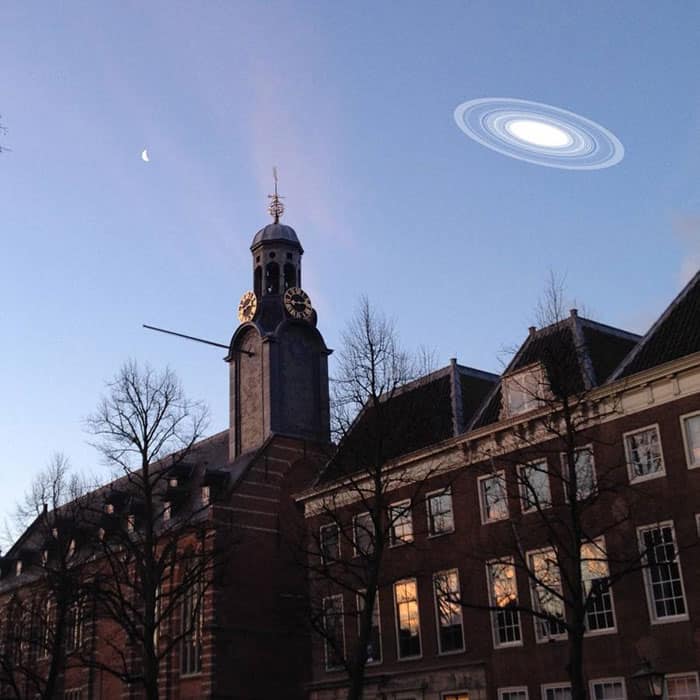
Put a ring on it: artist’s impression of how J1407b would appear in the sky above Leiden if it occupied Saturn’s orbit. (Courtesy: M Kenworthy/Leiden)
Giant rings around an exoplanet could remain stable for more than 100,000 years – but only if the rings orbit in the direction opposite to that of the planet’s orbit around the star. That is the claim made by researchers in Japan and the Netherlands, who last year discovered the exoplanet J1407b with rings more than 100 times larger than those of Saturn. Steven Rieder at RIKEN in Japan and Matthew Kenworthy at Leiden University in the Netherlands focussed their attention on the young, sun-like star J1407 after it underwent a series of strange eclipses in 2007. The researchers realized that the observations could only be explained if the star hosted a planet with a gigantic ring system. The only problem with such a hypothesis was that rings would not be stable for very long because the planet’s very eccentric orbit brings it close enough to its star to disrupt the rings. Now, the duo have carried out simulations and found that the massive ring system can persist for more than 10,000 11 year orbits, as long as the rigs rotate in the direction opposite to the orbit of the planet. Such retrograde rings are not common and the researchers conclude that some kind of catastrophe caused either the planet or its rings to reverse its orbit. Their findings have been accepted for publication in the journal Astronomy & Astrophysics.
You can find all our daily Flash Physics posts in the website’s news section, as well as on Twitter and Facebook using #FlashPhysics. Tune in to physicsworld.com later today to read today’s extensive news story on frequency comb cooling.
Ada Lovelace (1848): considered to be the first computer programmer.
By James Dacey
Today is Ada Lovelace Day (ALD), a day to celebrate the achievements of women in science, technology, engineering and maths (STEM). Named after the 19th-century polymath Ada Lovelace, the annual initiative also seeks to engage with the challenges of attracting more women into STEM careers and supporting career development. Now in its eighth year, the day includes a number of events and online activities.
The day will culminate in a few hours with Ada Lovelace Day Live!, a “science cabaret” event at the Institution of Engineering and Technology in London (18:30–21:30, tickets still available). In what promises to be “an entertaining evening of geekery, comedy and music”, the all-female line-up includes several scientists from the physical sciences. Among them is Sheila Kanani, a planetary physicist and science comedian who is the education, outreach and diversity officer for the Royal Astronomical Society in London.
Liquid droplets have been arranged into 2D arrays by researchers at the University of Bristol in the UK. The droplets contain entangled polymers and are created within a tank of water. A range of different chemicals can be added to the droplets, which could be used to create high-throughput analyses systems for developing new drugs or performing rapid medical diagnostics. The droplet arrays could even be used to study how living cells communicate with each other.
Although arrays of liquid droplets have been made before, previous attempts had involved either using oil-and-water mixtures or evaporating the liquid to create the array on a dry surface. Neither technique is also suitable for supporting water-based chemical reactions, which was a primary goal of Bruce Drinkwater and his team of physicists, engineers and chemists, who developed the new technology.
Coacervation and coalescence
The droplet-forming process begins with an aqueous solution of the polymer PDDA and the biomolecule adenosine triphosphate (ATP). Electrostatic interactions cause these two materials to agglomerate into tiny nanometre-sized droplets by a process of “coacervation”. When a 2D ultrasound standing wave is created in the liquid using piezoelectric transducers, the droplets move to the nodes of the standing wave, where they coalesce and grow until they reach about 50–100 μm in diameter.
The uniformity of the droplets is amazing
Bruce Drinkwater, University of Bristol
The result is a square lattice of identical droplets (see image above). “The uniformity of the droplets is amazing,” says Drinkwater. “I’m convinced this technology will have many applications in the next generation of lab-on-a-chip applications.”
By adjusting the ultrasound signals, the team was able to transform a column of droplets into a solid line of PDDA/ATP and then back again into a column of droplets. The researchers could control the size of the droplets and the spacing between them. They also showed that it is possible to load the droplets with a wide range of substances including proteins, enzymes, DNA and even micron-sized solid particles.
Localized chemistry
In one set of experiments, the team introduced a dye to one side of the tank and watched as the chemical diffuses across the array to create a concentration gradient. Such experiments could be used, for example, to study the effects of different concentrations of a chemical on the contents of the droplets. The team also showed that when several different additives were introduced to different locations of the array, the substances tended to remain localized within a region of droplets. This could be used to create arrays in which different droplets contain different chemicals.
Drinkwater told physicsworld.com that the team is now looking at how to create 3D lattices of droplets using ultrasound. He also says that it is working on making the ultrasonic components of the system more robust to the chemicals used – something that must be done before the system can be commercialized. The team is also looking at how arrays of droplets could be used to simulate how living cells communicate to each other using chemicals. This would involve making the droplets more complicated by creating structures that are analogues to those found in living cells.
Hamish Johnston spoke to Bruce Drinkwater about the physics of ultrasound. You can listen to that conversations and watch a video of an acoustic “tractor beam” here.