The return of supersolids

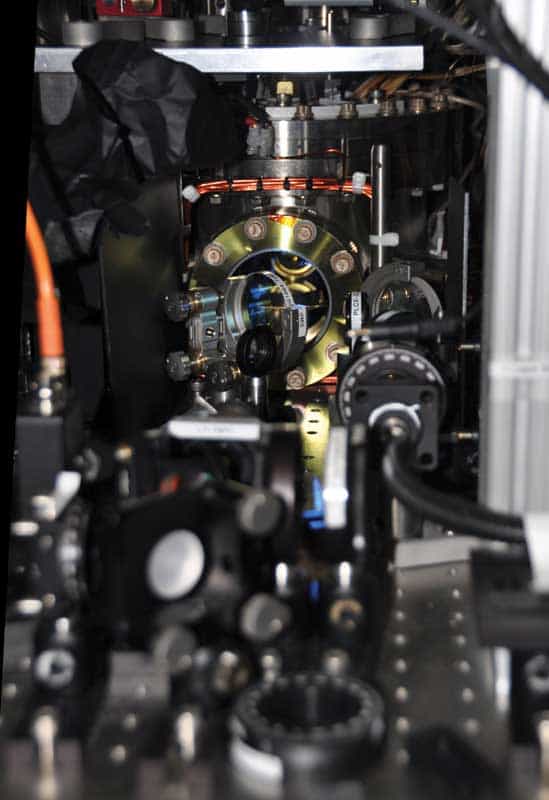
Vacuum chamber

We learn it from a young age: solids hold their shapes; liquids flow. Physical states of matter are mutually exclusive. A solid occupies a particular position in space, its molecules fixed. A fluid assumes the shape of its container, its molecules in constant motion. But a so-called supersolid, a predicted phase of matter that forms only under extreme circumstances, doesn’t follow this idea of order. To describe supersolids is an exercise in contradictions. On the one hand, they form rigid crystalline structures. On the other, theory predicts that part of their mass also acts like a superfluid – a quantum phase of matter that flows like a liquid, but without viscosity. That combination lets supersolids do things that seem unfathomable to the humdrum, room-temperature, Newtonian world, like flow through themselves – without friction.

Although the Russian physicists Alexander Andreev and Ilya Liftshitz first predicted in 1969 that supersolids could form in helium close to absolute zero, definite proof has been hard to come by, and this elusive phase of matter has largely remained entrenched in the world of theory. That may have changed, though: two independent groups of researchers – one at the Massachusetts Institute of Technology (MIT) in the US, and the other at ETH Zurich in Switzerland – recently reported forming supersolids.

Both of the new papers were posted on the arXiv preprint server in October (arXiv:1610.08194; arXiv:1609.09053), though they have not yet been published in peer-reviewed journals. Experts in the field say that so far, the evidence for supersolids looks convincing, with the usual caveats: namely, that more work and replication are needed. Both teams report coaxing supersolids into existence by manipulating a Bose–Einstein condensate (BEC), a bizarre state of matter that forms when bosons are chilled to within a fraction of a degree above absolute zero.

The near-simultaneous reporting of two cases of supersolids, found using different experimental approaches, is exciting not only because supersolids may now join the ranks of exotic, fundamental phases, like superconductivity and superfluidity, but also because the material has travelled a long and at times rocky path from prediction to experimental evidence.

“There are no scoops in science, only a slow construction of truth,” says physicist Sébastien Balibar at the École Normale Supérieure in Paris, who has conducted research on quantum solids and was not involved in the new studies. “Discoveries are very rarely made in one shot.”

A false start

The latest reports weren’t the first from physicists who suspected they’d formed supersolids. In a study published in 2004, Pennsylvania State University physicist Moses Chan, together with his graduate student Eun-Seong Kim, reported extraordinary results from experiments using helium-4, the most abundant isotope of helium on Earth (Nature 427 225). At cold temperatures, helium-4 can be encouraged to form either a solid (at high pressure) or a superfluid (at standard pressure). Experiments in the 1930s showed that helium undergoes a phase transition to become a superfluid at 2.2 K, below which it exhibits spectacularly bizarre behaviour, like flowing up the walls of its container and out down the sides.
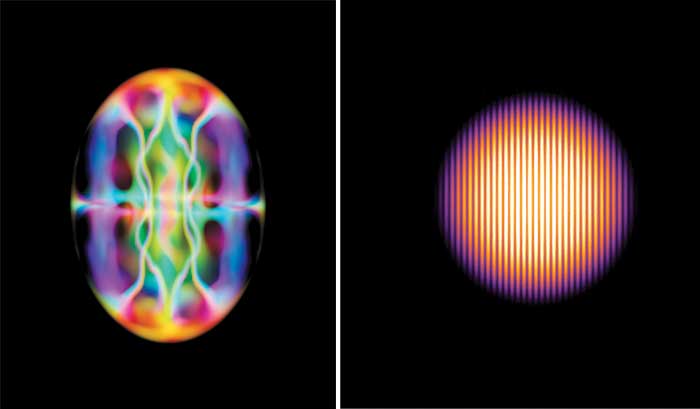
Left: Upright oval-shaped coloured area on a black background. The coloured area is roughly symmetrical about the horizontal and vertical axis, and includes wiggly streaks of orange, purple, blue, pink, green and yellow. Right: Circular coloured image on black background. The coloured circular area consists of 33 vertical lines, with soft edges, which are yellowish white towards the centre, turning to orange and then purple at the edges

Chan and Kim started with solid helium-4. They put the material in a torsional oscillator – a device that rotates in alternating directions – and lowered the temperature. At a sliver of a degree above absolute zero, the rotation of the device increased in frequency, which suggested that the amount of mass that was rotating had decreased. That change was consistent with the 1969 predictions by Andreev and Liftshitz, who hypothesized that some of the helium’s mass would form a superfluid that could flow through the rest of the solid without friction.

Other groups reproduced the experiment and found the same results, exciting the condensed-matter physics community. Still, doubt lingered, and for years, the results from Chan and Kim remained controversial.

One team that set out to reproduce the experiment comprised John Reppy, a physicist at Cornell University in the US, and graduate student Sophie Rittner. In a paper published in 2006, they reported that the frequency uptick was tied to defects in the solid helium. When they warmed the helium and let it cool slowly – a process called annealing that smooths out defects – the signature of supersolidity vanished. Then, in a paper published in Nature in 2007, physicist John Beamish at the University of Alberta, Canada, and his collaborators challenged Chan and Kim’s findings by suggesting that solid helium wasn’t perfectly stiff but instead had some give, a “giant plasticity”. This effect could allow some atoms to slide past each other, mimicking the properties of supersolidity. In later experiments, Beamish’s group worked with Balibar and his colleagues in Paris to better understand this effect, and bolstered the case for the new explanation.

Chan, ultimately, brought this chapter to its close. Reppy had been Chan’s adviser in graduate school, and Chan set out to redesign his own experiment to test alternative ideas about the supersolid state. In a paper published in 2012 and based on a new set-up, he reported finding no increase in rotational frequency – and thus no evidence for supersolids (Phys. Rev. Lett. 109 155301).

“This is a remarkable piece of science history,” says physicist Tilman Pfau, who studies particle interactions in BECs at the University of Stuttgart, in Germany. “The same author that claims something, gets criticized, goes back to the lab, sees he was wrong and writes a paper about it.”

New experiments

While some researchers continue to pursue the formation of supersolids in helium, many other labs have turned to BECs. Albert Einstein first predicted the existence of this state of matter in 1924, based on theoretical work by Indian physicist Satyendra Bose, but it took decades to develop the machinery needed to test the prediction. The first BEC was created in a lab in Colorado, US, in 1995, when physicists used lasers and magnetic fields to trap a clutch of rubidium atoms as the temperature was reduced as much as possible. Just above absolute zero, the individual atoms all began behaving like one giant superatom – a single quantum entity at its lowest energy state.
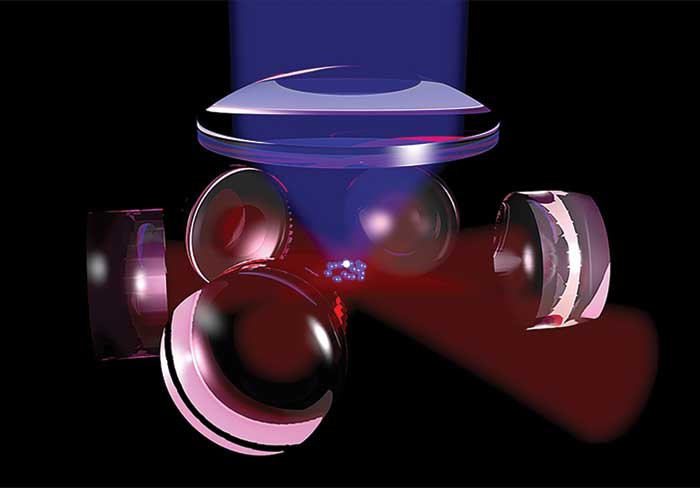
Computer-drawn image of lab equipment, consisting of what look like six lenses all pointing towards a central spot where there are approximately 16 small spheres

Research into the discovery and properties of BECs netted Nobel prizes for physicists Eric Cornell, at the US National Institute of Standards and Technology, and Carl Wieman, then at the University of Colorado Boulder and now at Stanford University, as well as Wolfgang Ketterle at MIT, whose lab is one of the two that has produced new findings on supersolids.

In the two decades since a BEC was first observed, physicists have become adept at finding ways to control every term in the Hamiltonian – the mathematical description of the energy state of the material. It is through tweaking the values of these terms that they’ve been able to probe new fundamental phases of matter, like supersolids.

Physicists often characterize transitions between phases of matter by what kind of symmetry is broken. Liquid water, for example, at the molecular level, looks the same under any transformation. The arrangement of molecules at one place in the liquid looks like the arrangement of molecules at another. But ice is a crystal, which means its structure looks the same only when observed at periodic intervals. So the translational symmetry of the liquid is broken as it becomes a crystal.

Both forming a crystal and forming a superfluid are associated with breaking symmetry; thus, to form a supersolid requires two kinds of symmetry to break simultaneously. First, a superfluid must be formed. An advantage of working with BECs is that it is well known how to make BECs behave like superfluids, making them a natural place to start; another is that physicists know how to vary atom interactions in the material. Second, while this superfluidity is maintained, the superfluid must become regularly ordered into regions of high and low density, like atoms in a crystal. Physicists have posited a variety of ways to stimulate atom interactions that lead to a solid state while maintaining superfluidity, i.e. the long-sought supersolid state.

“Supersolidity is a paradoxical competition between two different and contradictory types of order,” says Balibar. One of those is the order demanded by solidity, where individual atoms line up on a lattice; the other is superfluidity, where the atoms effectively combine, accumulating to the same quantum state. “Atoms in a supersolid should be localized and delocalized at the same time, distinguishable and indistinguishable.”

There may be more than one way to coax a solid from a BEC superfluid. One group that reported its findings in October, led by Tilman Esslinger at ETH Zurich, trapped the BEC at the intersection of crossing lasers, with each laser forming an optical cavity. The interaction of the photons and atoms in the BEC gave rise to self-organization – the hallmark of solidity – even though the material continued to look like a superfluid.

Pfau says the new work “goes clearly beyond” what groups have done before; Balibar, in Paris, says that the results look “convincing” and “the fundamental effect is clearly there”. At the same time, Balibar cautions that although Esslinger’s group claims evidence for spontaneous symmetry breaking, he’d like to see better confirmation. “That’s not totally obvious to me since the period of the supersolid is fixed by the laser wavelength.”

The other group, from Ketterle’s lab at MIT, also used lasers, but with a kind of BEC that takes advantage of the connections between the spin of an atom – an intrinsic quantum property that’s analogous to rotation – and its motion. (Spin–orbit coupling is a physical interaction that underlies many unusual physical phenomena, including topological insulators and some behaviours in superconductors.) The physicists used a laser to transfer some momentum to the atoms in the BEC, which led to the formation of interference patterns. From those patterns emerged tiger-like stripes of alternating density – standing waves – in the material. In its paper, Ketterle’s group reports that this density modulation breaks translational symmetry, the requirement for a solid.

Physicist Thomas Busch, who studies quantum processes in ultracold atomic gases at the Okinawa Institute of Science and Technology, in Japan, says theorists predicted a few years ago that the supersolid stripes should emerge. At the same time, he notes that experimental verification is exciting news to the community.

Neither group explicitly showed that the material could flow through itself, though the papers do offer arguments in favour of superfluidity. Despite past controversies over what is or isn’t a supersolid, Busch says that the vast majority of people will not have a problem calling the entities in the two new studies supersolids. “Figuring out the exact ‘super’ properties of the states created is now an exciting task for the future,” he says.

Beyond supersolids

Finding new states of matter has been a driving force in cold-atom research for decades, and supersolids are the latest bizarre material to join a growing list that already includes things like superfluids and superconductors. For the last two years, Pfau’s group, in Stuttgart, has been exploring quantum ferro­fluids – magnetic droplets that can self-organize out of BECs at low temperature. “Nobody would have thought before [we observed the material in the lab] that this was a stable state of matter,” he says. Last year, in a paper published in Nature, the group reported that quantum ferrofluids can also break translational symmetry, which means they might be a good place to search for other supersolids.

Because scientists have been working with BECs for decades, they’ve figured out a lot about how to tame them and tune them to probe fundamental phases of matter. But they’re just getting started, says Busch. Now they’re looking for ways not only to identify other exotic phases, but also to explore what happens when these strange materials are combined, or how they act under other experimental conditions.

“How do these systems actually behave by themselves? How do they react to external stimulation? What happens if we squeeze them?” Busch likens this era of discovery to what happened in the years after BECs were first discovered, when physicists couldn’t wait to get to know the new condensates better. “The first thing people did [to BECs] was to squeeze them – the stuff you do when you get a new toy.”

In addition, he says, physicists want to study the effects of different long-range interactions and better understand how impurities affect the properties of the materials. Impurities could be critical in finding applications for supersolids. Busch notes that in semiconductor research, impurities added through doping can change the conductivity of a material and make it fit a certain use.

Higher dimensions may also be in store. In the preprint from Ketterle’s group, the researchers note a couple of possible future directions: more characterization of the system, for example, or extending their method to a 2D spin–orbit coupling system. Achieving supersolidity in three dimensions would be another major milestone, but breaking symmetries in three dimensions would be difficult to realize in experiments.

Exotic states of matter, like supersolids, show that under extreme conditions our physical reality behaves in bizarre ways that aren’t easy to explain. “The physics of cold atoms is some kind of simulation of fundamental problems that are well defined, but hard to calculate,” says Balibar. Theory may predict a spectrum of undiscovered properties that emerge in idealized matter, but controlling such strange stuff under extreme conditions is difficult. “Real matter has defects and surface states,” he says, “so our understanding of real matter is far from being complete.”
New metamaterial enhances natural cooling without power input

A new metamaterial film provides cooling without needing a power input. Made out of glass microspheres, polymer and silver, the material uses passive radiative cooling to dissipate heat from the object it covers. It emits the energy as infrared radiation and also reflects solar light. A team at the University of Colorado Boulder (CU-Boulder) in the US developed the material after receiving a $3m federal grant from the US Department of Energy’s Advanced Research Projects Agency-Energy (ARPA-E) in 2015.

Radiative cooling is the natural process through which objects shed heat in the form of infrared radiation. All materials at room temperature emit infrared at wavelengths of 5–15 μm. However, the process is not typically very efficient because it is counteracted by external influences that heat the object, such as sunlight and air currents. Air, meanwhile, absorbs and emits very little radiation with wavelengths 8–13 μm. The Earth cools itself at night by emitting infrared through this “atmospheric window” and into space.

Researchers are therefore interested in engineered materials that can enhance this natural process and cause objects to efficiently emit infrared through the atmospheric window. In theory, such materials could provide a simple way of cooling buildings and heat-generating technologies without the need for power-hungry machines.

Daytime challenge

While night-time radiative cooling materials, including a pigment paint, have been successfully developed, a daytime version has proved challenging. The problem is that the materials absorb sunlight, which quickly exceeds the cooling power and instead heats the surface.

So the challenge for the CU-Boulder researchers was to create a material that both reflects sunlight and also allows infrared emission. They created a thin, flexible material with two layers; a sheet of polymer polymethylpentene containing randomly dispersed silicon-dioxide (SiO2) glass microspheres 8 μm in diameter and a 200 nm-thick silver coating. The combination of the two layers is only 50 μm thick.

Magic film

“The randomized glass-polymer film is the one doing the magic,” explains Ronggui Yang, an author on the paper. The polymer-microsphere film is transparent to the whole solar spectrum but radiates infrared. The broad collective resonance among the microspheres ensures the film is highly emissive of infrared within the atmospheric range of 8–13 μm. This property therefore enhances the naturally occurring radiative cooling. Meanwhile, sunlight travels through the metamaterial and is reflected back by the silver coating, which prevents any solar heating.

The randomized glass-polymer film is the one doing the magic
Ronggui Yang, University of Colorado Boulder

But it is not just the properties of the material that the CU-Boulder group reports in Science. “The key innovation of this work is to produce the designed material at scale using the roll-to-roll process,” explains Yang. The researchers used a roll-to-roll extruder to distribute the microspheres in the polymer and a roll-to-roll sputtering machine to apply the silver coating. This means they are able to produce large amounts of the material in mere minutes. “When produced at scale, we estimate that the material cost is only $0.50 per m2 (yes, 50 cents per square metre), since it can be produced at 100 square metres per minute,” adds Yang.

Midday Sun

Field tests in Boulder, Colorado and Cave Creek, Arizona, revealed that the film’s average cooling power was more than 110 W/m2 over 72 hours. Even in the midday Sun, its average was 93 W/m2. This is roughly equivalent to the electricity generated by a typical solar panel of the same area.

The new material is similar to one produced by a group at Stanford University in 2014, which emitted roughly 40 W/m2 in direct sunlight. The previous design was fabricated using electron evaporation and consisted of seven alternate layers of silicon dioxide and hafnium dioxide. Not only does the new material appear to outperform the old (although testing methods are not directly comparable), it is also easier to make in large quantities.

The glass-polymer sheet has many potential cooling applications. By applying it to a solar-panel’s surface, the film could not only cool the panel but also recover an additional one or two per cent of solar efficiency, because overheating hampers the ability to convert solar energy. “That makes a big difference at scale,” says Xiaobo Yin, another researcher on the project.

But applying the film to buildings is not as simple as putting a layer on the roof. “You cannot just use our material to wrap a building,” explains Yang. This would cool the building in hot summers, but it would also continue cooling on cold nights and during the winter. The team therefore needs to create a thermal system design whereby water is cooled then circulated around the building. This is similar to a hot-water heating system and means the temperature can be controlled.

Works 24/7

“The key advantage of this technology is that it works 24/7 with no electricity or water usage,” says Yang. “We’re excited about the opportunity to explore potential uses in the power industry, aerospace, agriculture and more.”

The next step for the researchers is to create a 200 m2 “cooling-farm” prototype in Boulder. They have also applied for a patent and are working with CU-Boulder’s Technology Transfer Office to explore commercial applications.

She’s the greatest dancer, how to name an element, soccer ball finally orbits Earth


By Hamish Johnston

The award for most bizarre title for a scientific paper goes to psychologist Nick Neave and colleagues at the UK’s Northumbria University and University of Lincoln for “Optimal asymmetry and other motion parameters that characterise high-quality female dance”. The team says it used “a data-driven approach to pinpoint the movements that discriminate female dance quality”. Why, you might ask? “The form and significance of attractive dance, however, has been less well studied, and this limits our understanding of its role in human courtship and partner selection.” The above video is from a previous study by the team about what constitutes a good male dancer.

(more…)

Photons are a drag on the Sun

Sunlight is slowing the rotation of the Sun’s outermost layers by stealing its angular momentum. That is the claim of researchers in the US and Brazil who have studied acoustic waves oscillating through the Sun’s visible surface – the photosphere – to determine how fast the Sun spins at certain depths.

It has been known since the 1980s that the outer 5% of the photosphere rotates more slowly than deeper layers. However, solar physicists do not understand why this slowdown occurs, its total extent and its effect on the Sun’s magnetic dynamo and solar wind.

To solve this puzzle a team led by Ian Cunnyngham and Jeff Kuhn of the Institute for Astronomy at the University of Hawaii has observed acoustic waves at the limb (edge) of the Sun’s disc using the Helioseismic and Magnetic Imager on NASA’s Solar Dynamics Observatory (SDO), which orbits Earth.

Bell ringing

The Sun is ringing like a bell as acoustic waves driven by turbulence crash through the plasma within its interior. The waves themselves, known as p-mode oscillations, have very low frequencies in the region of 3000 µHz and their harmonic patterns form the basis of helioseismology.

Cunnyngham and Kuhn’s team observed the oscillations at the solar limb, where the viewing angle makes it possible to determine how deep in the photosphere each oscillation is, allowing measurements of the rotation velocity at each depth. They found that the greatest amount of braking was occurring in the outer 70 km of the photosphere and that layers closest to the surface were rotating more slowly than deeper layers. This differential rotation could potentially twist localized magnetic field lines, affecting magnetic phenomena such as sunspots, active regions and even the formation of the solar wind.

The upper 70 km of the photosphere is where the Sun starts to turn transparent and photons can finally escape into space as sunlight. It has been a long journey for those photons. Generated by nuclear fusion within the Sun’s core, the photons first enter the dense radiative zone that makes up the inner two-thirds of the Sun’s radius. The photons are repeatedly scattered by atomic nuclei and, after perhaps a million years, they reach the outer third of the Sun, known as the convection layer. Here the temperature is cool enough for atoms to absorb the photons. This couples the atoms and photons as they rise on convection currents. When they reach the outer 70 km, the atoms cool sufficiently to radiate the photons into space.

Shared angular momentum

Because the atoms and photons are coupled, they share angular momentum, but when the photons are released they take some of that angular momentum with them, leaving the atoms in the upper photosphere to rotate more slowly.

“Think about spinning a water hose over your head,” Jeff Kuhn tells physicsworld.com. “The water will leave the hose with tangential velocity and will therefore carry some angular momentum.”

The researchers liken it to the Poynting–Robertson effect, where the orbital motion of dust grains in space is slowed by the pressure they receive from solar photons that are moving tangentially to the grains.

This is a good explanation for a long-standing problem, and a nice example of what someone can do with excellent data and clever ideas
Dean Pesnell, NASA Goddard

According to Dean Pesnell SDO’s Project Scientist from NASA’s Goddard Space Flight Center, it is possible that there are other torques slowing the Sun that have yet to be identified, but until then, “this is a good explanation for a long-standing problem, and a nice example of what someone can do with excellent data and clever ideas”.

The Sun’s photosphere plays host to localized magnetic fields that, through the process of recombination, release energy into the solar corona that drives our physical connection with the Sun.

“We’re looking into how the fields would be twisted up and affect the solar wind,” says Kuhn.

Hotter stars

Deeper down, the rotation of the Sun affects how the solar dynamo generates its magnetic field. The braking effect could also have consequences for hotter stars that produce greater amounts of photons than the Sun. “A very luminous star could have a much larger drag in its outer layers, but it is unclear how this would affect the star’s evolution,” says Kuhn.

The research is described in Physical Review Letters

Flash Physics: MRI pioneer dies, star polluted by ingredients for life, flat lens avoids chromatic aberration

MRI pioneer and Nobel laureate Peter Mansfield dies at 83

The UK physicist and Nobel laureate Peter Mansfield has died at the age of 83. Mansfield pioneered the development of Magnetic Resonance Imaging (MRI) for which he was awarded the 2003 Nobel Prize in Physiology or Medicine together with the US chemist Paul Lauterbur. Mansfield was born in London in 1933 and studied physics at Queen Mary College, London, graduating with a BSc in 1959 and a PhD in 1962. After a stint at the University of Illinois at Urbana–Champaign in the US, where he continued his work in Nuclear Magnetic Resonance (NMR), he moved to the UK’s University of Nottingham in 1964 where he remained for the rest of his career. It was there that he developed the use of NMR to image parts of the body and in 1976 produced the first human NMR image that showed a complete finger with bone, bone marrow, nerves and arteries. Two years later he became the first person to step inside the first whole-body scanner, despite warnings that it could be dangerous. MRI – an application of NMR – has since transformed neuroscience and physiology research by providing detailed images of anatomical structure. Mansfield was knighted in 1993 for his services to medical science and retired in 1994.

White dwarf polluted by ingredients for life

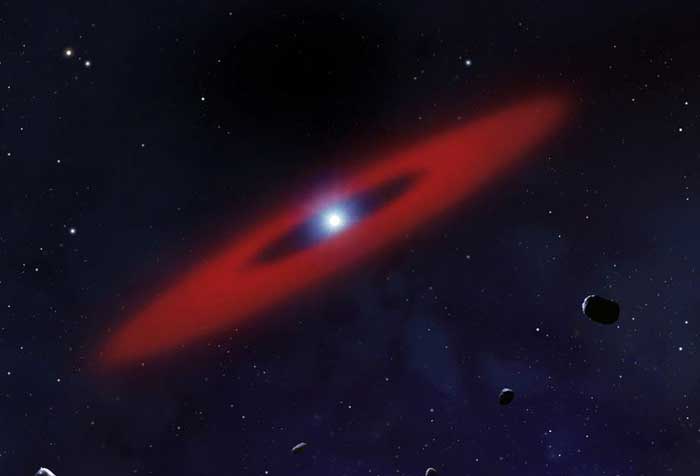
Artist's rendering of a white dwarf surrounded by a ring of debris from a minor planet destroyed by the star's strong gravitational fields

The building blocks of life have been found on a “polluted” white dwarf star 200 light-years away. A collaboration between the European Southern Observatory, the University of California, Los Angeles and the University of Montreal were studying the star WD–1425+540 when they observed nitrogen, carbon and oxygen. This is the first time nitrogen has been detected outside of the solar system. Typically, any heavy elements within white dwarfs are not observable because their strong gravitational pull draws the elements into their interiors. Siyi Xu and colleagues therefore attribute WD 1425+540’s pollution to a relatively recent destruction of a Kuiper Belt-like object. The Kuiper Belt is a ring of debris past Neptune’s orbit that surrounds the solar system. Scientists believe that short period comets from the belt may have delivered water and other molecules to Earth, allowing for life to evolve. In the case of WD 1425+540, Xu and team report in Astrophysical Journal Letters that a minor planet, similar to Kuiper-Belt objects, came very close to the white dwarf after a shift in its orbit. The planet was ripped apart by the star’s strong gravitational fields and the remnants went into orbit. Eventually these spiralled into the star, introducing the heavy elements. The researchers believe the event happened in the past 100,000 years or so which is why they could observe the aftermath. The finding confirms that other planetary systems contain Kuiper Belt-like objects. Impacts between these and rocky planets may mean that they contain the building blocks to life.

Flat lens focuses blue and green light

Illustration showing the flat lens in action

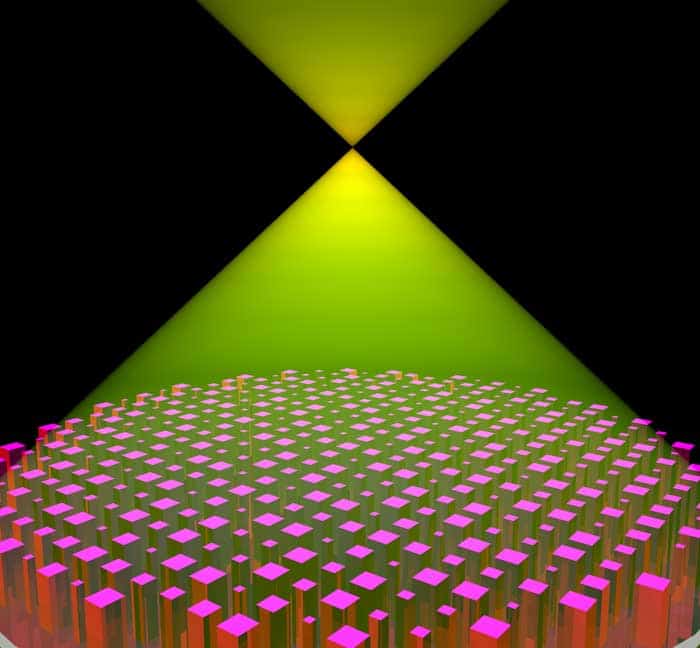
A “flat lens” less than one micron thick that can focus blue and green light has been unveiled by Federico Capasso and colleagues at Harvard University. The lens is an improvement on a similar monochromatic device unveiled by the same group in 2016. The quality of an optical system based on conventional lenses tends to improve with length. This is because multiple curved lenses are needed to correct for chromatic aberration that occurs because light of different colours will take different paths through a simple lens. This causes problems for makers of smartphones and other devices, who want lenses that are as thin, lightweight and simple as possible. In 2016 Capasso’s team unveiled a new type of lens that uses tiny pillars to focus light. The lens could only focus light at one specific wavelength – violet light at 405 nm – which limited its use. All of the nanopillars were of the same shape and size in the 2016 lens – but now the team has shown that a lens made from nanopillars of different sizes can focus blue and green light with wavelengths of 490–550 nm without suffering from chromatic aberration. The lens is made from an array titanium oxide nanopillars that are about 400 nm tall and vary in thickness from 50 to 300 nm. The arrangement, shape, width and height of the nanopillars were all carefully chosen to minimize chromatic aberration for blue and green light. The researchers say that the lens can be made using standard chip manufacturing methods and that early application of the lens could be in imaging, spectroscopy and sensing. The lens is described in Nano Letters.


  • You can find all our daily Flash Physics posts in the website’s news section, as well as on Twitter and Facebook using #FlashPhysics. Tune in to physicsworld.com later today to read today’s extensive news story on the Sun’s rotation.

Decaying atoms feel a tiny frictional force, say physicists

An excited atom decaying in a vacuum experiences a force very similar to friction, according to calculations done by physicists in the UK. At first sight, the result appears to violate Einstein’s equivalence principle. However, the researchers calculate that, in fact, relativity rides to its own rescue, and the mass lost from the atom as it decays to the ground state allows it to lose momentum without slowing down.

Einstein’s special theory of relativity famously says there is no such thing as absolute motion: the laws of physics are the same in all inertial frames of reference. Theoretical physicists Matthias Sonnleitner, Nils Trautmann and Stephen Barnett at the University of Glasgow noticed an apparent contradiction, however, when considering a textbook quantum-mechanics problem.

An excited atom in a vacuum decays to a lower energy state, emitting a photon in a random direction. For simplicity, the problem is normally solved in the rest frame of the atom. In this frame, the magnitude of the photon’s momentum is independent of its direction so, as a photon is equally likely to be emitted in any direction, the expectation values of the photon’s momentum and the atom’s consequent recoil momentum remain constant at zero.

Net force

However, the trio also considered the problem in a frame in which the atom is moving: because of the Doppler effect, a photon emitted in the same direction of travel as the atom would be blue-shifted, having its frequency, and therefore its momentum, increased; whereas a photon emitted in the opposite direction would be red-shifted and have its momentum decreased. The atom would therefore experience a net force proportional to its momentum but in the opposite direction – effectively, it would experience friction from the vacuum.

This appears to violate the principle of relativity because, if the atom’s velocity changed, an observer could measure this change in velocity and use it to determine the absolute motion of the observer’s own frame of reference. Sonnleitner says the trio spent “weeks questioning their sanity”. They later discovered an earlier paper, published on the arXiv pre-print server in 2012, in which Wei Guo of Queens University of Charlotte in North Carolina identified the problem but could not solve it.

The Glasgow researchers eventually realized that, although they had not explicitly included relativity in their calculations, it had nevertheless sneaked in the back door: when an atom emits a photon and decays to a lower energy state, the classic equation E = mc2 shows that its mass must also decrease. Although the decrease is tiny, it is precisely sufficient to compensate for the decrease in momentum, allowing its velocity to stay constant. This only works when a small, often-neglected correction proposed in 1888 by the physicist Wilhelm Röntgen (who won the 1901 Nobel Prize for the discovery of X-rays) is included to accommodate the interaction between the moving atom’s electric dipole and a magnetic field. In this latest research, the magnetic field is associated with quantum vacuum fluctuations. “[Guo’s 2012 paper] dropped the Röntgen term at some point,” explains Sonnleitner. “The Röntgen term is necessary to get the correct change in momentum. Only then do you see that it’s just due to a change in mass and not due to a change in velocity.”

Immeasurably small

Although the researchers considered the simplest possible situation, in which one atom in a vacuum decays by photon emission, the phenomenon is, in principle, applicable whenever an atom absorbs or emits a photon. “If this effect were larger,” says Sonnleitner, “You would see its contribution whenever you tried to cool an atom, for instance.” In practice, however, other influences are much larger in these cases, so the effect is not significant. He adds, “Experiments are getting so, so much better right now that it’s really hard to say that something cannot be measured at all, but at least as far as I’ve seen this one is not feasible yet.”

“This is an interesting conceptual point,” says theoretical physicist Peter Milonni of the University of Rochester in the US. “Maybe this work will lead the way to experiments to probe this conceptual difference between the change in momentum associated with translational motion and the change in momentum associated with the internal energy dynamics – these kinds of things are well known in nuclear physics. Whether it will lead to practical consequences in the theory of laser cooling and trapping, and new ways to trap atoms and so on: I don’t think so, but I could be wrong.”

The research is described in Physical Review Letters.

The February 2017 issue of Physics World is now out

PWFeb17cover-500-ruleBy Matin Durrani

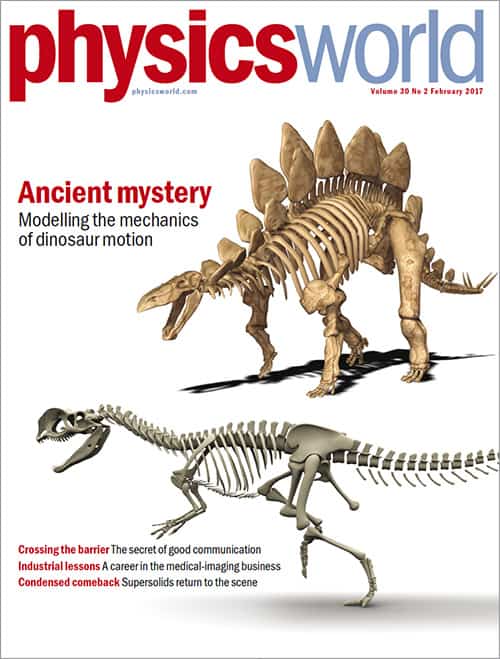
It’s time to check out the February issue of Physics World magazine, where our cover story looks at the physicists studying how dinosaurs moved. The issue is now live in the Physics World app for mobile and desktop, and you can also read the article on physicsworld.com here.

There’s also a great feature about whether supersolids could be making a comeback, while science writer Brian Clegg explains why anticipating people’s questions is the secret to good science communication.

Elsewhere in the new issue, check out why Jules Verne was spot-on with the physics of drones and meet the man who’s been the driving force behind statistical physics meetings.

Remember that if you are a member of the Institute of Physics, you can read Physics World magazine every month via our digital apps for iOS, Android and desktop.

(more…)

2D materials are not so two-dimensional

Stacking order and interlayer interactions in suspended graphene/mono-layer hBN heterostructures can now be detected using a novel scanning transmission electron microscopy (STEM) technique. Such suspended van der Waals heterostructures and the 2D materials required to make them have potential applications as nanomechanical actuators and force sensors to name a few.

STEM obtains structural information about thin samples from the deflection or scattering angle of electrons that pass through. Using a custom-made aperture and a pixelated detector, the University of Vienna team – led by Jannik Meyer – measured not only the intensity of scattered electrons in the medium angle annular dark field (MAADF) (60–200 mrad), but more importantly the lateral deflection of the electron beam at every point of the sample. The resulting imaging technique is highly sensitive to the inclination of the sample and the electron scattering profile is heavily dependent on the stacking regime.

Using a combination of empirical results and density functional theory (DFT) calculations, the researchers then created a pair of simulations of the system. One assumed the flake structure was rigid and flat, and the other – called the relaxed model – accounted for out-of-plane distortions in the crystal structure. The latter of these two models was a markedly better fit to the experimental data.

It is well documented that crystallographically aligned graphene and hexagonal boron nitride (hBN) produces a superlattice Moiré pattern of interference fringes. Meyer and his team also show that these out-of-plane distortions have the same periodicity as the Moiré superlattice.

Graphene on hBN is one of the simplest examples of suspended van der Waals heterostructures. The results provide insights into the interlayer interactions and the effects of suspension, which are important for designing more complicated, multilayer devices.

It can no longer be taken for granted that 2D materials remain two-dimensional when incorporated into a van der Waals heterostructure.

The research is detailed in Nano Letters 10.1021/acs.nanolett.6b04360.

Nuclear diamonds: the ultimate long-life battery?

The proposal comes from a group of researchers at the University of Bristol in the UK, who say they have a practical way of dealing with some of the nearly 95,000 tonnes of radioactive graphite that was used as a moderator in the UK’s nuclear reactors. Applications of such devices could include long-lasting power supplies for pacemakers and even a lightweight power supply for space missions.

Unsurprisingly, this eye-catching research captured the attention of specialist and mainstream media publications alike when it was announced towards the end of 2016. In this podcast, we probe deeper into the science behind the headlines.

The episode is presented and produced by Andrew Glester, a science communicator based in Bristol, who says he takes a “sceptical optimism” to such bold scientific claims. Glester visits the research team at the University of Bristol to find out more about the proposal – its applications, nuclear safety concerns, and the challenges that stand in the way of this idea becoming a practical reality.

Flash Physics: Circuits survive on Venus, electronics powered by stomach acid, Israel tops global R&D spend

Photographs of an integrated circuit before and after testing

Integrated circuits smash survival record in Venusian atmosphere

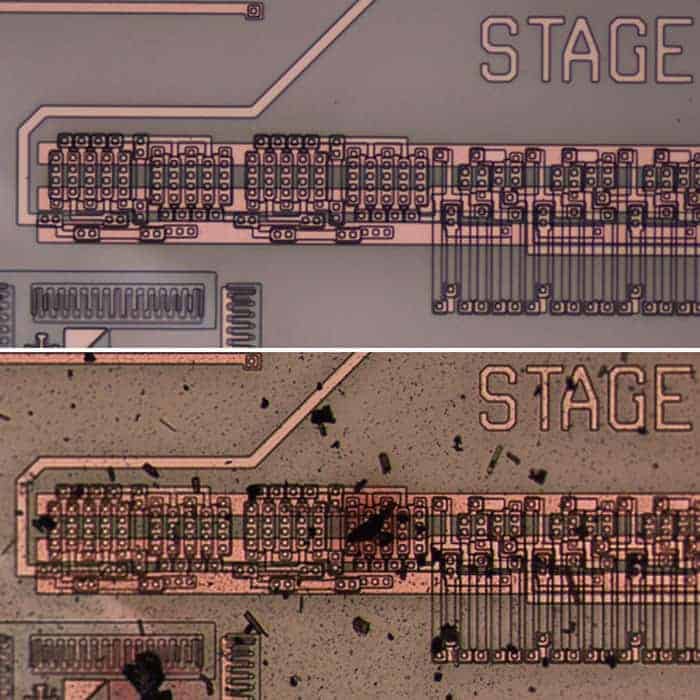
Integrated circuits that could withstand the harsh conditions on Venus for a record-breaking length of time have been built and tested by researchers at the NASA Glenn Research Center in Cleveland, Ohio. Operating a lander on the surface of Venus is a very difficult task because the temperatures there can reach 460˚ C and the pressure of the caustic atmosphere is about 100 times that of Earth’s. This vicious environment quickly destroys electronic circuits – even if they are cocooned in heat- and pressure-resistant vessels – and the best systems have only survived for a few hours on Venus. Creating circuits that can resist the Venusian atmosphere for longer and without the need for heavy and cumbersome shields is the goal of NASA’s Phil Neudeck and colleagues. They have created a new integrated circuit from silicon carbide (SiC), which is an extremely tough, chemically inert and heat-resistant semiconductor. They made two ring-oscillator integrated circuits from SiC junction field-effect transistors and tested them in the Glenn Extreme Environments Rig, which can simulate conditions on Venus. The chips survived for more than 500 h while exposed directly to the harsh environment, with no cooling and no protective chip packaging. “Both integrated circuits still worked after the end of the test,” Neudeck says. The work is described in AIP Advances.

Electronic capsule powers itself with stomach acid

Photograph of the ingestible electronic device

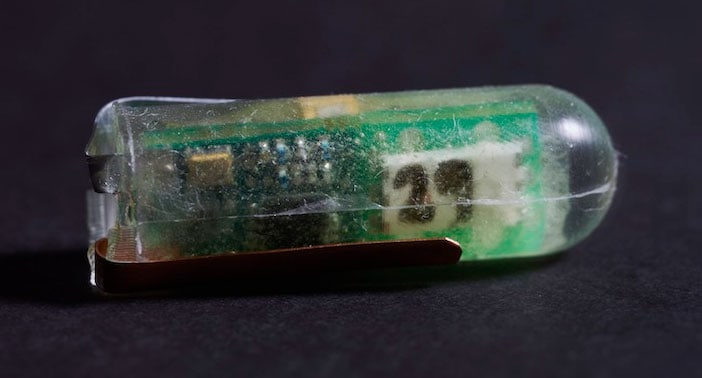
A new ingestible electronic device can harvest energy inside the gastrointestinal (GI) tract, allowing it to monitor temperature over several days. In recent years, the technology behind ingestible electronics has significantly improved. These small devices can take live images of the GI tract, deliver drugs and measure conditions such as pH and temperature. However, powering the devices for more than a few hours remains challenging. Now, a team led by Giovanni Traverso of the Massachusetts Institute of Technology (MIT) and Harvard Medical School has developed a capsule that uses biocompatible galvanic cells. The cells harvest energy from the GI tract by transferring electrons between metallic electrodes and the gastric or intestinal fluid. The process can power the device for several days, allowing it to monitor temperature and send data wirelessly to the researchers. The electronic capsule could be used for diagnosis and treatment, and the team hopes to combine the technology with other sensors. A more detailed report on the work presented in Nature Biomedical Engineering can be found on nanotechweb.org.

Israel tops global R&D spend

Israel put 4.3% of its gross domestic product (GDP) into R&D in 2015, making it the biggest spender – in terms of the percentage of its economic output – of the 35 countries belonging to the Organisation for Economic Co-operation and Development (OECD). Israel just surpassed South Korea, who ploughed 4.2% of the country’s GDP into science, while Japan was third (3.5%). The US, meanwhile, spent 2.8% of its GDP on R&D, with China spending 2.1%. In Europe, Sweden was the highest at 3.3% followed by Austria at 3.1%. The UK, meanwhile, spent 1.7% of its GDP on R&D, below the EU average of 2.1% and the OECD average of 2.4%. The OECD says that there was a slight decline in government R&D budgets in 2015 but businesses increased their contribution by 2.5%, making the private sector responsible for nearly 70% of all R&D spending that year.


  • You can find all our daily Flash Physics posts in the website’s news section, as well as on Twitter and Facebook using #FlashPhysics. Tune in to physicsworld.com later today to read today’s extensive news story on atomic friction.
Copyright © 2026 by IOP Publishing Ltd and individual contributors