To keep your brain cells active over the festive period, we have put together a word puzzle based wholly on articles published in Physics World this year. We have two copies of Astronomy Photographer of the Year: Collection 5 to give away as prizes. Download a PDF of the puzzle here.
This year, its publisher Collins Astronomy has kindly offered us two copies to give away to readers. You just need to complete the festive puzzle in this PDF to be in with a chance of winning. Terms and conditions apply.
How to enter
To enter the competition, download the PDF, complete the puzzle and send it to us by 16 January 2017.
Please include your full name and contact details with your entry.
Send your completed puzzle by post to: Physics World
Temple Circus
Temple Way
Bristol
BS1 6HG
UK
Alternatively, you can fill in the PDF electronically, or scan your completed puzzle, and e-mail it to pwld@iop.org.
Terms and conditions
These terms and conditions apply to all entries to the Physics World Crossword Competition – December 2016, however submitted. Promoter is IOP Publishing Limited (“IOP”) of Temple Circus, Temple Way, Bristol, UK, BS1 6HG. No purchase necessary. All entries must be received by the closing date of 16 January 2017. The winners will be drawn at random from all the entrants who successfully complete the crossword. The draw will take place within 30 days of the closing date. If IOP cannot contact any winner within 90 days of the closing date, it shall have the right to declare their entry void and to draw a new winner. IOP’s decision is final and no correspondence will be entered into. Only one entry per person and entrants must be over 16 and have the right to enter. IOP can change or withdraw these terms without notice and can refuse any entry. No entries allowed from IOP employees or anyone connected with the competition, including their immediate families. Only two prizes. As not all countries in the world accept the legality of competitions, it is the sole responsibility of each non United Kingdom based entrant to ensure that he or she is not breaching any laws of their country of residence by submitting an entry. IOP will not be held responsible for any entrant entering any competitions unlawfully. If in any doubt, the entrant should check with the relevant authorities in his or her country. Delivery costs paid by IOP but any other costs winner’s responsibility. IOP can use winner’s name, location and affiliation for promotion. Personal data will be processed in accordance with Data Protection Act 1998. Terms governed by English law.
“This election is said to have been about rejecting the political establishment. We cannot let that mean rejecting established facts”. So said Rush Holt, chief executive of the American Association for the Advancement of Science, in a powerful recent editorial in its journal Science. Holt – a physicist who served for 16 years as a Democrat in the House of Representatives – has been one of many voices to speak up for the value and integrity of science following the election of Donald Trump as US president.
But as a new year dawns, a worrying time lies ahead for the US physics community as Trump eases climate-change sceptics into positions of power, dismantles environmental rules laid carefully in place by the Obama administration and quizzes Department of Energy officials about their role in climate-change negotiations. It’s not just that funding for science is a low Trump priority; more that he’s likely to ignore scientific evidence in informing policy decisions.
The signs do not look good. Trump has already nominated Scott Pruitt – attorney general of Oklahoma who asserts that scientists disagree about global warming – to head the Environmental Protection Agency, triggering fears that Pruitt may favour the fortunes of the fossil-fuel industry at the expense of the long-term health of the planet. Former Texas governor Rick Perry, meanwhile, has been nominated to replace physicist Ernest Moniz to head the Department of Energy – an organization he once said should be “eliminated”.
Reports also suggest that Republican Representative and climate-change sceptic Thomas Massie is the frontrunner for the key position of presidential science adviser. That role has been held for the last eight years throughout the Obama administration by respected physicist John Holdren. He has been widely admired by the scientific community for issuing advice to government officials on how to remove political interference from science policy-making.
Worryingly, one Trump adviser – James Carafano of the Heritage Foundation – has even called for the axing of the Office of Science and Technology Policy, which is headed by the presidential science adviser. Carafano’s reasoning is that Trump has other sources of scientific advice available to him, though who they are remains unclear. Indeed, the transition team has virtually no-one familiar to the scientific community to whom scientists can relate their concerns and advice.
It will fall to US scientific societies, led by the AAAS and the American Physical Society, to form contacts with the Trump team and ensure science remains on an even keel. But they will have work on their hands and uncertain times lie ahead.
Bumpy times ahead
European blues: Brexit will create continued uncertainty for UK physicists in 2017, whose future participation in European Union programmes is in doubt. (Courtesy: Petr Kratochvil. Public Domain)
Over in Europe, life will not be straightforward for physicists either. Britain’s vote to leave the EU will threaten EU funding for UK physicists and place question marks over the status of EU researchers in the UK – as well as of British physicists working at EU institutions. It’s vital, therefore, that the UK physics community pushes for the UK to remain a full part of EU research programmes – coupled with free movement of individuals – and receives support in that endeavour from European colleagues.
Physics is an international discipline that works best when people can move easily between nations, spreading their experience and skills. However, the rise of anti-immigration sentiment across the continent, typified by the Brexit vote, is likely to lead to further uncertainty for scientists too, especially with national elections due next year in France, Germany and the Netherlands. All eyes will be on whether the physicist-turned-politician Angela Merkel, who has been a solid supporter of science over the last 12 years, can stay on for a fourth term as German chancellor.
The coming year will be a bumpy ride too in South America. Researchers in Argentina have been protesting strongly over recent budget cuts by president Mauricio Macri. Particularly badly hit will be the National Scientific and Technical Research Council, which will see the number of new researchers supported drop to 385 next year, compared to 900 last year. In Brazil, meanwhile, its plans to become an associate member of the CERN particle-physics lab could be scuppered if its €1.1m debt to the Geneva facility doesn’t get paid.
One country where we can be sure physics can go from strength to strength is China, which already publishes about a fifth of all research papers in the world and is building a host of top facilities. Apart from putting the finishing touches to its massive new China Spallation Neutron Source, 2017 will see the country send its first sample-return mission to the Moon. China is also about to launch a satellite to monitor how much greenhouse gas the country is creating. TanSat (Tan means “carbon” in Chinese) is designed to collect more data than existing, similar satellites (GOSAT of Japan and OCO of the US). Keep an eye out for Physics World, which will produce another special report – our third to date – on China next July.
Extreme events
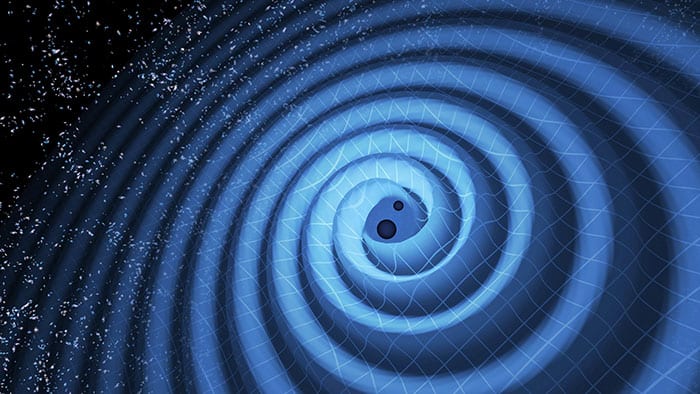
Window on the universe: the discovery of gravitational waves bagged the 2016 Physics World Breakthrough of the Year award, but more thrills are in store. (Courtesy: LIGO/T Pyle)
In astrophysics and cosmology, we’re likely to see more exciting findings from the LIGO collaboration, which not only bagged the 2016 Physics World breakthrough of the year for the first ever detection of gravitational waves but also recently switched on its twin detectors on for its second science run. The Livingston detector now has a 25% improvement in sensitivity, allowing it to spot black-hole mergers at greater distances. The sensitivity of the Hanford detector is similar to the first run, but the power of its laser has been ratcheted up and the detector is more stable, increasing the time the detector is operational.
Over at CERN, particle physicists at the Large Hadron Collider (LHC) are celebrating a successful 2016, having observed more than 6.5 × 10¹⁵ proton–proton collisions at an energy of 13 TeV – greater than in the previous three runs combined. They also achieved a peak luminosity that was regularly 30% above target and recently completed a series of collisions between protons and lead ions. The LHC is currently closed for its annual winter maintenance but will start colliding protons again in March. Whether we find anything beyond the Standard Model of particle physics remains to be seen.
In other developments, the Europe’s Extreme Light Infrastructure – a big-science project based at four sites across the continent – will complete its nuclear-physics facility in Romania, boasting what will be the world’s most powerful laser. The European Space Agency plans to launch its CHEOPS planet-hunting satellite in December. Meanwhile, the spacecraft Cassini-Huygens, which has been orbiting Saturn since 2004, will be retired by being plunged into the planet’s atmosphere on 15 September. Let’s hope there’s no wider symbolism to that particular event.
Trump eclipsed?
A total solar eclipse will pass across much of mainland US in 2017 – the first time that has happened in almost 40 years. (Courtesy: iStock/fotojog)
It’s that time of year when everyone is looking for stories with a Christmassy angle. My colleagues here at IOP Publishing are no exception and they have just put out a press release about some reindeer-related physics. Apparently, hungry reindeer in northern Norway are increasing the albedo of their feeding grounds by eating lots of plants. Albedo is a measure of how much sunlight is reflected back from the surface of the Earth – rather than being absorbed and dissipated as heat – and plays an important role in climate. A worry in the far north is that global warming will lead to greater plant cover – which will reduce albedo and lead to even more warming. Now, it looks like reindeer could help break this cycle. “The effect reindeer grazing can have on albedo and energy balances is potentially large enough to be regionally important,” says Mariska te Beest, from Umeå University in Sweden. “It also points towards herbivore management being a possible tool to combat future warming. Most of the arctic tundra is grazed by either domesticated or wild reindeer, so this is an important finding.”
Here is a great gift idea for a budding young physicist. The quantum computing expert Scott Aaronson has teamed up with the artist Zach Weinersmith to create a delightful comic strip about quantum computing. Inspired by the dreaded “sex talk” that parents give to their children, the comic follows a mother as she shatters several myths about quantum computing that her precocious son has picked up from his peers and the popular media. The strip is called “The talk” and as someone who struggles on a regular basis to understand quantum computing, I found it very useful – and entertaining.
On Monday I had the great pleasure of appearing on the radio programme Love and Science, hosted by the incomparable Malcolm Love. The show is an hour long and I was the only guest, so it was really hard work – but also very enjoyable. We chatted about the Physics World top 10 breakthroughs of 2016 and I got a chance to explain why we chose several of the winners. Love’s programme is broadcast on BCFM here in Bristol and you can listen to Monday’s show by clicking here and then choosing “15:00 – 19/12/2016” under recent broadcasts.
We will be taking a well-earned Christmas break here at Physics World, but we still have a few gems going out over the next week or so. Tune in on 26 December, when you can try to solve our holiday word challenge that is based on physics events that happened in 2016. Then on New Year’s Eve you can amuse your friends with a round-up of humorous stories that have appeared in Physics World.
Normal service will resume on 3 January. If you are taking holidays over the next few weeks, I hope you get a chance to relax and look back over your achievements of 2016 – as well as look forward to what the next year will bring.
A radio receiver based on atomic-scale defects in diamond has been unveiled by physicists at Harvard University in the US and Element Six in the UK. The device uses nitrogen vacancies (NVs) in which two adjacent carbon atoms in a diamond crystal are replaced by a nitrogen atom and an empty lattice site. NVs are useful because they have an electronic spin that is extremely well isolated from the surrounding lattice. An NV will also emit fluorescent light when excited by a laser – and together these properties make NVs very attractive to physicists trying to build quantum computers. To create their receiver, Harvard’s Marko Loncar and colleagues use a green laser to “pump” a collection of NVs into an excited energy state. When a pumped NV is subjected to radio waves, it emits red light, which is then captured by a photodetector and converted into an electrical signal. The system was able to receive a frequency-modulated (FM) signal on a carrier frequency of 2.8 GHz. The receiver could be tuned over a frequency range of 300 MHz by applying an external magnetic field to the NV spins. The team says that “high-quality” audio signals at frequencies up to 91 kHz can be received by its radio. While the team used billions of NVs to create its device, a receiver based on just one NV would emit just one photon at a time – and could be used to convert quantum information from radio frequencies to visible light. Because diamond is a very tough material, Loncar says: “This radio would be able to operate in space, in harsh environments and even the human body, as diamonds are biocompatible.” The receiver is described in Physical Review Applied.
Slovenia moves towards full membership of CERN
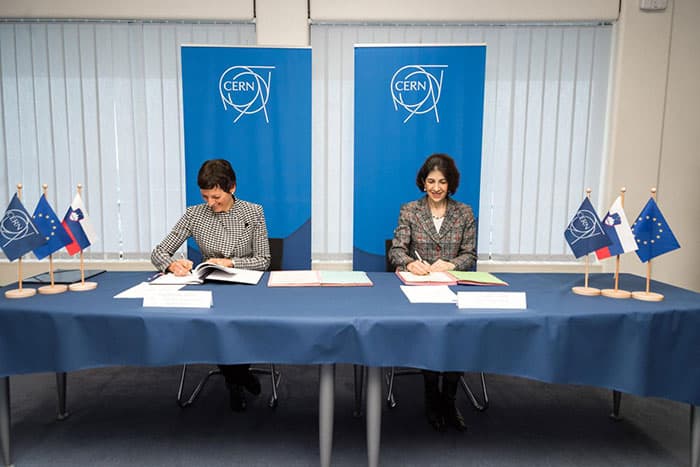
Signed and sealed: Slovenia’s Maja Makovec Brenčič (left) and CERN’s Fabiola Gianotti at a ceremony celebrating the admission of Slovenia to CERN. (Courtesy: CERN)
CERN’s council has voted unanimously to admit Slovenia as an “associate member in the pre-stage to full membership” of the particle-physics lab in Geneva. The move means that the Balkan nation will be able to apply for full membership of CERN in five years. Slovenia applied to be a member of CERN in 2009, and the nation’s physicists have been contributing to CERN long before the country became an independent state in 1991. Slovenian physicists currently work on the ATLAS experiment on the Large Hadron Collider (LHC) and the country hosts a tier-2 data centre for processing data from the LHC. “Slovenia’s membership in CERN will on the one hand facilitate, strengthen and broaden participation and activities of Slovenian scientists (especially in the field of experimental physics), on the other it will bring full access of Slovenian industry to CERN orders, which will help to break through in demanding markets with products with a high degree of embedded knowledge,” says Maja Makovec Brenčič, Slovenian minister of education, science and sport.
First plasma for WEST tokamak in France
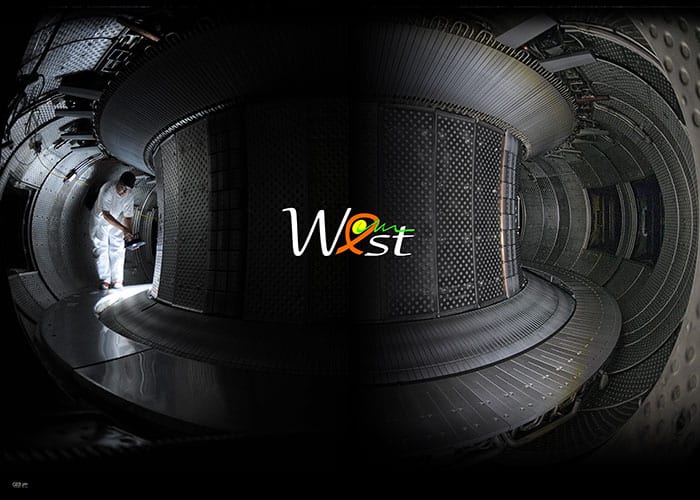
Go WEST: the refurbished tokamak is ready for action. (Courtesy: CEA/C Roux/CEA Cadarache)
The WEST tokamak in Cadarache, France, has confined its first plasma. The facility is a refurbishment of the Tore Supra tokamak, and is designed to test “divertor” technology that is being created for the ITER fusion reactor – which is currently being built at Cadarache. The divertor will sit on the floor of the ITER vacuum vessel and will remove the helium “ash” that is created when hydrogen nuclei fuse in the reactor. The divertor must be able to withstand high fluxes of both heat and particles from ITER’s plasma, which will be heated to several million degrees. The plasma-facing portion of the divertor will be made from thousands of tungsten tiles and WEST will test the performance of different divertor designs under plasma operating conditions. Scientists will also be able to quantify how the divertor will age and be damaged in the harsh plasma environment. Scheduled for completion in 2025, ITER is a collaboration involving China, the EU, India, Japan, Russia, South Korea and the US that aims to demonstrate that nuclear fusion can generate useful energy.
You can find all our daily Flash Physics posts in the website’s news section, as well as on Twitter and Facebook using #FlashPhysics.
In January, we published the final instalment from our “Light in Our Lives” series, which we commissioned as an official media partner with the Internal Year of Light (IYL 2015). Each film in the series told a local story involving light and its applications and how they can affect people’s lives. Transforming Light is a film about the 2015 Day of the Dead celebrations in Mexico City and how a multimedia lightshow blended old traditions with new technologies to spectacular effect. The film was produced by Jorge Benjamín Ruiz Gutiérrez and his team of film-makers at the National Autonomous University of Mexico (UNAM).
Following on from the Light in Our Lives series, we decided to commission another film series for 2016 – this time related to diversity within physics. “Faces of Physics” reveals the working lives of people involved in physics, focusing on the day-to-day activities as much as the applications of their work. Inspiring the Next Generation (above) offers a profile of Ghada Nehmeh, a physics teacher who has brought about innovative changes at the Bronx High School of Science in New York. By creating an interactive environment in her classroom, Nehmeh has significantly boosted the number of female students taking Advanced Placement (AP) physics.
The other films published in this series to date are: Working in Green Energy about renewable energy engineer Samantha Carter; and A HAWC Eye on the Sky about Adiv González Muñoz – an astronomer and timelapse photographer at High-Altitude Water Cherenkov (HAWC) gamma-ray observatory in Mexico. For more stories and analysis about diversity issues in physics take a look at the March special issue of Physics World, which is introduced in this blog post by Physics World editor Matin Durrani.
I mentioned at the start of this article that physics is a diverse subject spanning a range of areas. A good example of this was the July episode of the Physics World podcast, which brought together the unlikely mix of particle physics, Native American storytelling and the evolution of audio recording media. “Bringing Native American voices back to life” profiled a project to restore early 20th century recordings of Native Americans performing songs and stories. The method, based on imaging technologies at particle accelerators, has been developed by Carl Haber of the Lawrence Berkeley National Laboratory (LBNL). Listen to the podcast to hear rare recordings of myths told by Ishi – the last surviving member of the Yahi people of the central Sierra Nevada mountain range in northern California.
Theoretical physics can seem abstract at times and about as far removed from everyday life as one could imagine. But it is also an intellectual pursuit like any other, carried out by people with personalities, opinions and beliefs – people who don’t always agree with each other. The sociological dimensions of theoretical physics were particularly apparent in the so-called “string wars” – a vitriolic debate played out in the 2000s about the scientific validity of string theory. A key player in the string wars was mathematical physicist Peter Woit whose 2006 book Not Even Wrong took string theory’s supposed inadequacies to task. In the September podcast, Peter Woit is in conversation with Physics World reporter Tushna Commissariat 10 years since the book’s release. Woit speaks about controversy sparked by his book and what he thinks needs to happen now in mathematical physics to propel it into the future.
If the complex mathematics of physics is hard to get your head around sometimes, then imagine trying to do it without the ability to see the equations. That is the reality for Aqil Sajjad, a particle physicist at Harvard University in the US, who lost his sight to retina detachments in both eyes when he was a teenager in Pakistan. Sajjad tells his story in the November episode of the Physics World podcast produced by journalist Lucina Melesio. You will hear how Sajjad accesses maths and science concepts using speech-to-text software. When not pondering the nature of the universe, Sajjad is also a keen baseball player and often travels to other US cities with his team the Boston Renegades. Though – as Sajjad explains in the podcast – at heart he prefers cricket.
Physics on your phone
Finally, in this collection of stories celebrating the social aspects of physics, we’d like to draw your attention to the various short videos we’ve been producing for our social media channels. With the proliferation of smart phones and other mobile devices, we know that your viewing habits are changing and that you want to get your physics stories on the go. So we have been producing a number of short videos for our Facebook page, Twitter feed and YouTube channel. They can be enjoyed with or without sound. For instance, the video above provides a guide to NASA’s Juno mission, which arrived at Jupiter in July where it is now investigating this planet from orbit. One of the major scientific goals of the mission is to better understand the origins of this giant planet, providing key information about the origins of the entire Solar System.
Watch out for much more multimedia – including social videos – in 2017.
Love your monster: could the story of Frankenstein’s creation carry a contemporary message? (Courtesy: Courtesy Everett Collection/REX/Shutterstock)
“How,” Mary Godwin asked herself, did I come up with “so very hideous an idea?”
In the summer of 1816, Mary and her lover (soon to be husband) Percy Shelley met Lord Byron in Switzerland. It rained a lot, so rather than hiking as planned they spent time indoors reading ghost stories. At one point Byron suggested they each write their own. At first, Mary had writer’s block, but then recalled a conversation between Percy and Byron about scientific experiments in which researchers caused parts of animals to flinch by applying electricity, which then made them speculate about the principle of life. That night Mary had a dream in which a technician sent a spark into an assemblage of body parts. The thing began to move, and then opened its eyes.
The next day Mary told her companions she had an idea.
Out of control
That’s the story Mary Shelley told of the origin of Frankenstein in her introduction to its second edition (1831). Thanks to two centuries of theatre and film adaptations, most people know the basic plot, which centres on an out-of-control monster built by a well-meaning but careless scientist named Victor Frankenstein. The story is now embedded in our language. The prefix “Franken-”, as in “Frankenfoods” and “Frankenfish”, is often used to create a charged word referring to a terrible thing that should not have been created because it is an unnatural product of rampant consumerism. Frankenwords are catchy, wave a red flag, provoke fear, and seem to endow those who use them with unclouded moral judgement.
But the story that unfolds in Shelley’s novel is not so simple.
In 2014 two humanities scholars at the University of New Mexico published an article in Science and Engineering Ethics (21 1139) that envisioned Victor Frankenstein submitting his research to an institutional review board (IRB), or panel of the sort now mandatory in the US for research involving human or animal subjects. “Had Frankenstein had to submit an IRB proposal,” wrote the authors, “tragedy may have been averted, for he would have been compelled to consider the consequences of his experiment and acknowledge, if not fulfil, his concomitant responsibilities to the creature that he abandoned and left to fend for itself.”
The article cleverly exhibits Frankenstein’s potential for teaching contemporary research ethics. At the same time, though, the article exemplifies the familiar but erroneous way in which the story is understood: as a tale about the creator and the creation. To determine the ethics of the experiment, the authors looked into possible carelessness or ill intent on the part of Frankenstein, and the potential for the creature to do harm.
Numerous adaptations of the story reflect that version too. In the 1931 film Frankenstein, starring Boris Karloff, the creator unwittingly installs an abnormal brain in the creature. The creature, a property destroyer and serial killer, is evil from the start.
Other interpretations, though, blame Victor Frankenstein, the monster’s creator. At one point in Shelley’s story, he calls the monster “my own spirit let loose”. In these psychological interpretations, Victor’s act is motivated by his internal demons, such as the trauma of losing his mother before he leaves for university. “Knowledge is the awareness that Frankenstein is not the monster,” runs a joke. “Wisdom is the awareness that Frankenstein is the monster.”
Certain other interpretations blame Victor’s ambition: to create life in the lab without thinking of the rest of world. Such ecological interpretations, behind “Frankenfood” language, find the monster to symbolize the breakdown of responsible human stewardship of nature.
In a 2011 article in the Breakthrough Journal entitled “Love your monsters: why we must care for our technologies as we do our children”, the French philosopher Bruno Latour proposed that the moral of Frankenstein is that technologies should not be unleashed without human guidance. The scientists who discover things like nuclear fission, for instance, are responsible for its applications. This is a parental interpretation: constantly care for your creations or you’re a bad parent!
But Shelley’s story, read attentively, wrecks such interpretations. She leaves no indication the beast has anything but a normal brain. The creature himself gives a persuasive reason for his behaviour: “I was benevolent and good; misery [his rejection by humans] made me a fiend.” Shelley’s story indeed carries a shockingly contemporary message: the creature is the extreme refugee, unable to assimilate into the country where he’s thrown without his consent, whose inhabitants not only reject but vilify him.
In Shelley’s story, too, Victor’s ambitions are not outlandish but shared by the professors who taught him science in the first place, who seek to “penetrate into the recesses of nature, and show how she works in her hiding places”. Like them, he is thrilled, saying: “None but those who have experienced them can conceive of the enticements of science.”
Nor was the science implausible. “Mary Shelley based Victor Frankenstein’s attempt to create a new species from dead organic matter through the use of chemistry and electricity on the most advanced scientific research of the early 19th century,” writes Shelley’s biographer Anne K Mellor. “Her vision of the isolated scientist discovering the secret of life is no mere fantasy but a plausible prediction of what science might accomplish.”
The critical point
The evil that erupts in Shelley’s story therefore cannot be blamed entirely on electricity, careless scientists, or an out-of-control creation, but also on the climate in which Victor conducts his research. It therefore recalls another contemporary predicament: that of bank employees whose managers instruct them to handle their accounts ethically but who must work in a banking climate with overwhelming incentives not to do so. For physicists and other scientists, Shelley’s story rings an alarm bell, not because of some breakdown in the system – bad behaviour, brains, or breeding – but because nothing broke down.
The first measurement of an atomic transition in an antiatom has been made by researchers working in the ALPHA collaboration at CERN in Geneva. The team measured the frequency of a specific transition in antihydrogen, which consists of a positron (an antielectron) bound to an antiproton. Although the result is no different from that measured in normal hydrogen, the group says that more sensitive versions of its experiment might one day reveal a new matter–antimatter asymmetry in nature.
The transition in question is between the 1s (ground) and 2s (excited) states of antihydrogen. This process could be sensitive to a violation of what is known as charge, parity and time reversal (CPT) symmetry. This states that the behaviour of any physical system remains unaltered under the combined reversal of charge, spatial coordinates and time. Although CPT symmetry has solid theoretical support, experimentalists are nevertheless keen to put it to the test. Its violation, for example, might explain why the universe today appears to consist almost entirely of matter – even though equal amounts of matter and antimatter were thought to have been produced during the Big Bang. "Other symmetries that were thought to be inviolable have been broken before," notes ALPHA spokesperson, Jeffrey Hangst of Aarhus University in Denmark.
ALPHA, like a number of other antimatter experiments at CERN, takes its antiprotons from the lab's Antiproton Decelerator, and then slows down and cools the particles before combining them with chilled positrons from a sodium-22 source. The resulting sub-kelvin atoms of antihydrogen are then trapped – thanks to their tiny magnetic dipole moments – in a potential well created by the careful overlap of several magnetic fields.
Antiatoms drop out
To carry out their spectroscopic measurements, Hangst and colleagues fire a laser beam into the magnetic trap and let it bounce numerous times between two mirrors. The laser's frequency is tuned to roughly half that of the 1s to 2s transition in normal hydrogen. This is because the transition involves the absorption of two photons, and its precise frequency is determined to some extent by the presence of the trapping magnetism. Some of the antiatoms should then be excited and drop out of the trap as a result of one of two mechanisms – either by absorption of a third photon to become ionized, or by having their spin flipped. The researchers then repeat the process with the laser tuned to different frequencies, as well as with no laser at all.
Carrying out the whole procedure 11 times, the group found that on average just under 60% of antiatoms left the trap with the laser tuned to the 1s-2s transition, while no antiatoms (within the bounds of statistical error) dropped out when the laser was tuned to a different frequency or when it was switched off. The researchers say that the antiatoms underwent the transition at the expected frequency and therefore behaved no differently from normal hydrogen.
Although the result does nothing to threaten CPT symmetry, Hangst argues that it testifies to the enormous technical progress that has been made in the field of antiatom research – first in producing atoms of antihydrogen, then in cooling them, and then in trapping them. In particular, his group has recently made progress in two areas. They have trapped significant numbers of antiatoms at the same time – up from about one to around 14 within the past year. They have also created a resonant cavity around the magnetic trap in order to boost the intensity of the laser light to the point where it could interact with the very few antiatoms present.
Opening salvo
ALPHA's achievement has earned praise from other antimatter groups at CERN. Ryugo Hayano of the University of Tokyo and spokesperson of the ASACUSA experiment, describes the research as "a very important milestone", while AEgIS spokesperson Michael Doser says it constitutes the "opening salvo in precision spectroscopic measurements of antihydrogen".
All, however, agree that it will not be easy boosting the precision achieved in the latest work by the roughly five orders of magnitude needed to match the sensitivity already obtained in spectroscopic measurements of ordinary hydrogen. Doser says there will be "many challenges" in doing this, including how to prepare antiatoms at millikelvin temperatures, in order that more of them can be trapped magnetically, and how to better reduce or disentangle the effect of the magnetic fields on the energy levels of the antiatoms. But he adds that ALPHA has been "quite effective at coming up with solutions" to all of the technical problems they have encountered to date.
Hangst says that the collaboration's next step will be to plot the shape of the 1s-2s resonance when the Antiproton Decelerator switches on again next spring. So far he and his colleagues have just made measurements on one side of it.
Pain and delight
Indeed, Gerald Gabrielse of Harvard University in the US, who is spokesperson of the ATRAP experiment, says: "I look forward to the day when either ALPHA or ATRAP eventually traces out a complete 1s-2s resonance lineshape at a significant precision". He adds that his group actually started working towards antihydrogen spectroscopy ten years earlier than did ATHENA (the predecessor to ALPHA), saying that his "parental delight" at the latest work is "only tempered by the pain that I feel in ATRAP not getting the first suggestive result".
However, according to Walter Oelert of Mainz University in Germany, who led the team that produced the first antiatoms, the contest for higher precision remains very much on. "It is by no means clear which collaboration will reach the 10-15 target first," he says, "although ALPHA can celebrate the first step."
Good things come to those who wait. Indeed, it has been almost six years since we initially thought about making an astronomy documentary set in China – and we finally showed it in public last month. The Science of Heaven premiered on 30 November 2016 at my institution, the Kavli Institute for Astronomy and Astrophysics at Peking University. By all accounts, it was very well received. While we are ironing out some final issues before releasing it publicly in early 2017, you can watch the trailer (above).
As science journalists, we are fortunate at Physics World that the stories we cover are often highly visual. Physics and astronomy are full of eye-catching imagery – the scientific results, the technologies and the diverse range of people involved in the scientific endeavour. The images in this collection tell some of the key stories from the world of physics in 2016.
New boss at CERN
Taking the helm: In January Fabiola Gianotti became CERN's new DG. (Courtesy: CERN/Maximilien Brice)
January began with a changing of the guard at the CERN particle-physics lab near Geneva. Italian physicist and former ATLAS spokesperson Fabiola Gianotti became the15th director-general of the lab since it was founded in 1953. On 1 January she succeeded Rolf-Dieter Heuer, who has stepped down after seven years in charge to take up a place on a new seven-member panel that will provide scientific advice to the European Commission. "My priority as CERN director-general will be to expand and maintain CERN's excellence in four areas: science; technology and innovation; education; and peaceful collaboration," Gianotti said. For CERN's flagship experiment, the Large Hadron Collider (LHC) it has been a fairly quiet year in terms of breakthrough science, especially once the "bump" at 750 GeV in data collected by the ATLAS and CMS detectors was confirmed in August to be a mere statistical fluctuation. On the bright side, the LHC itself has performed very well, with the ATLAS and CMS detectors recording 60% more collisions than expected during its proton run from April to the end of October – more than a quadrillion (6.5 × 10¹⁵) collisions, at an energy of 13 TeV.
A historic ripple
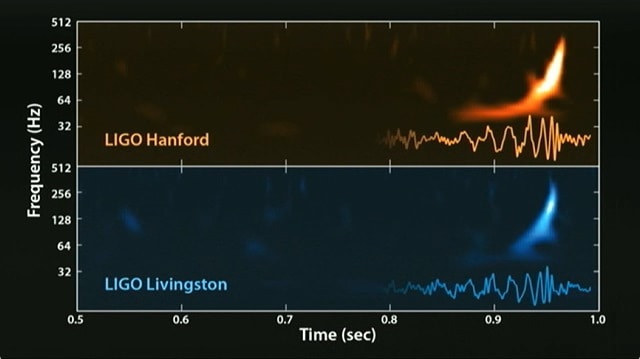
The vital waveform of gravitational-wave event GW150914 showing the inspiral, chirp and ringdown features. (Courtesy: LIGO/Phys. Rev. Lett.116 061102)
The physics story of the year was the LIGO collaboration's announcement on 11 February that it had made the first ever direct detection of gravitational waves. The waves were produced from the collision of two black holes of 36 and 29 solar masses, respectively, which merged to form a spinning, 62-solar-mass black hole, some 1.3 billion light-years away in an event dubbed GW150914. The signal or "chirp" as it became known was detected on 14 September 2015 and was measured by the newly upgraded aLIGO detectors – one in Hanford, Washington, and the other in Livingston, Louisiana. The discovery ends a decades-long hunt for these ripples in space–time, and marks the beginning of the era of gravitational-wave astronomy. It also provides evidence for one of the last unverified predictions of Einstein's general theory of relativity. Not content with grabbing the headlines once, the LIGO collaboration announced in June that it had confirmed a second set of gravitational waves, which had passed through LIGO's detectors on 26 December 2015. For all of these reasons and more, the LIGO collaboration was the clear winner of the 2016 Physics World breakthrough of the year.
Political earthquakes
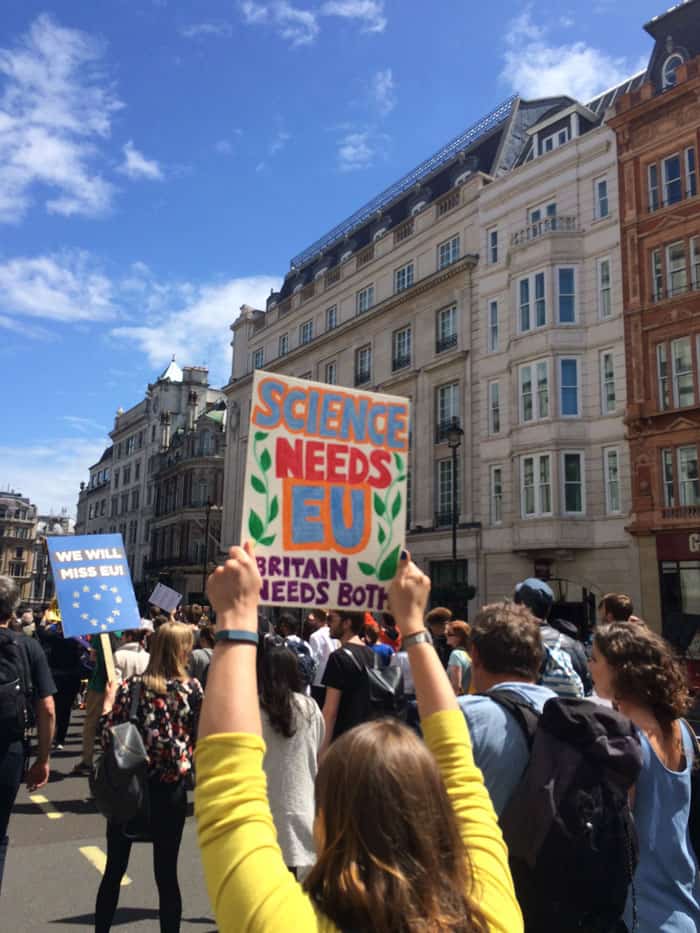
Scientists were among the protestors at the “March for Europe” rally in London on July 2nd. (Courtesy Gautam Dey @Dey_Gautam)
Out there in the world of politics, it is fair to say that developments in 2016 have divided opinion in highly divisive ways. The first political earthquake to strike the Western world occurred on 23 June when the British public voted narrowly in favour of leaving the European Union (EU) in a referendum. 51.89% of voters opted for leave, while 48.11% plumped for remain. The vote was preceded by vitriolic campaigns, with politicians on both sides of the debate being roundly criticized for scaremongering and providing misinformation in some cases. UK science has traditionally done well out of EU funding. The UK's Office for National Statistics estimates that the UK contributed €5.4bn between 2007 and 2013 to research spending in the EU and received back €8.8bn.
The impending Brexit has also cast doubt over the futures of EU citizens working in physics departments across the UK, and over Britons working in Europe. Moreover, question marks remain over the role British scientists will play in European projects once the nation has left the EU. Scientists have been among those frustrated with the lack of information from the British government regarding its Brexit plans (assuming of course they have some plans).On 2 July scientists were among the thousands of people to join the "March for Europe" rally in London, which called for transparency among political leaders to outline their vision for the future of Britain in Europe.
Trump's a comin': What will US science look like under a Trump administration? (Courtesy: donaldtrump.com)
Of course, the second political earthquake to strike the West was the unexpected victory of Donald Trump in the US election. Trump's inauguration is scheduled to take place on 20 January, but many scientists – particularly in the climate science community – are already fearful of what Trump's presidency might bring. Trump of course previously described the concept of global warming as a hoax "created by and for the Chinese in order to make U.S. manufacturing non-competitive". Before even taking office, Trump has selected Scott Pruitt – an outspoken sceptic of climate change – as the next administrator of the Environmental Protection Agency. Meanwhile, Rex Tillerson the chief executive of oil and gas giant ExxonMobil will be Trump's secretary of state while oil drilling proponent Rick Perry will head the Department of Energy. A senior Trump campaign advisor has also indicated that NASA will no longer take on climate projects under a Trump administration.
As with the Brexit campaigns, migration issues played a key role during the US presidential campaign. Trump famously promised to build a wall along the Mexico–US border (to be paid for by Mexico) and to ban Muslims from entering the US. It is too early to say whether the historic outcomes of these two votes will lead to brain drains from the UK and US but that is the fear of some. As 2016 draws to a close, uncertainty is the name of the game.
FAST developments
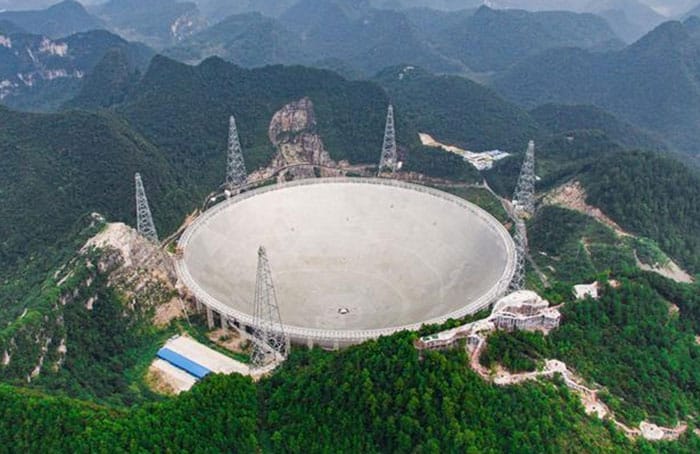
China's FAST radio telescope has joined the search for extra-terrestrial life. (Courtesy: FAST)
Uncertainty is not a word in the official dictionary of the Chinese Communist Party especially when it comes to large-scale construction projects. One of the nation's latest milestones is to boast the world's biggest single-aperture radio telescope – the Five-hundred-meter Aperture Spherical Telescope or "FAST" as it is better known. FAST comprises 4450 reflecting panels, which provide it with a collecting area of 30 football pitches – more than twice as big as the 305 m diameter radio telescope at Arecibo Observatory in Puerto Rico. Located deep in the hills in the south-western province of Guizho, the ¥1.5bn ($180m) telescope saw its first light in September and will cover a frequency range of 70 MHz to 3 GHz. Dark matter investigation and the detection of distant astronomical objects are among the key research areas. In October it was also announced that FAST would be joining the Breakthrough Listen programme, founded by Russian physicist-turned-entrepreneur Yuri Milner. Launched in July 2015, the programme claims to be the most comprehensive, intensive and sensitive search ever undertaken for artificial radio and optical signals.
A rocky neighbour
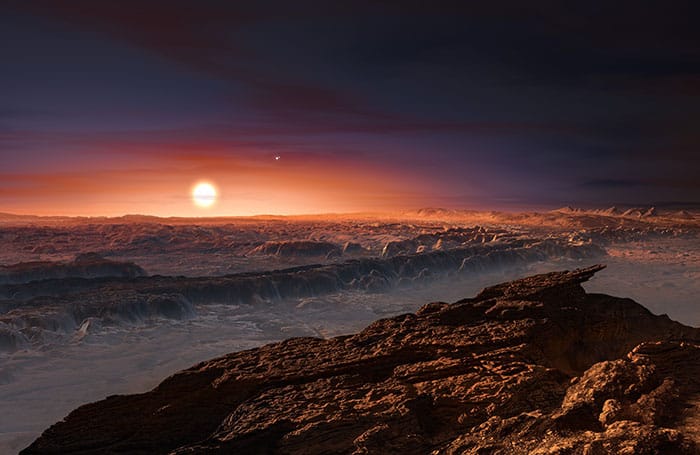
This artist's impression shows a view of the surface of the planet Proxima b orbiting the red-dwarf star Proxima Centauri, the closest star to the solar system. The double star Alpha Centauri AB also appears in the image to the upper-right of Proxima itself. Proxima b is a little more massive than the Earth and orbits in the habitable zone around Proxima Centauri, where the temperature is suitable for liquid water to exist on its surface. (Courtesy: ESO/M Kornmesser)
While Milner and company probe the far reaches of the universe for an alien broadcast, the presence of extra-terrestrial life may be closer to home than we could have imagined. In August the international Pale Red Dot collaboration announced that it had clear evidence of at least one planet orbiting Proxima Centauri, the closest star to the Sun. The exoplanet – dubbed Proxima b – has a minimum mass of about 1.3 times that of the Earth and is therefore most likely a terrestrial planet with a rocky surface, and has a short orbit of around 11.2 days. Our newly found neighbour also lies within its star's habitable zone, meaning that it could, in theory, sustain liquid water on its surface, and may even have an atmosphere.
What will ultimately determine the habitability of the planet – including whether it currently has liquid water on its surface and an atmosphere – depends entirely upon its formation history. According to the researchers, an answer to this question could be sought using a 3.5 m telescope. "This is a planet in our neighbourhood and maybe we will finally send out a probe and take a picture from somewhere other than Earth," said Pale Red Dot member Pedro Amado from the Instituto de Astrofísica de Andalucía in Granada, Spain.
Marooned on a comet
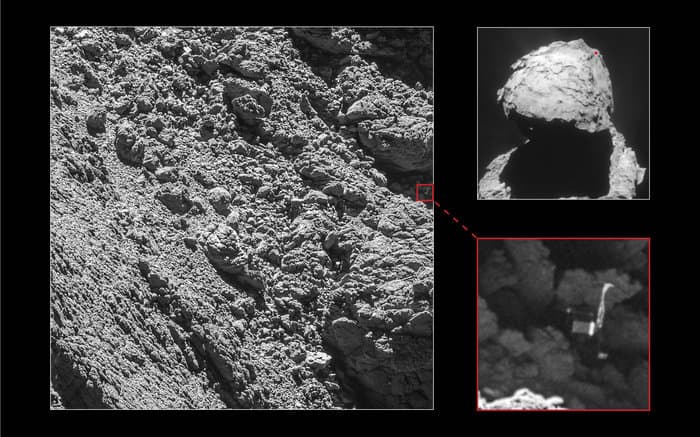
Philae found: OSIRIS narrow-angle camera image of Philae (Courtesy: (Courtesy: Main image and lander inset: ESA/Rosetta/MPS for OSIRIS Team MPS/UPD/LAM/IAA/SSO/INTA/UPM/DASP/IDA; context: ESA/Rosetta/NavCam – CC BY-SA IGO 3.0)
Elsewhere in the universe scientists working on the Rosetta space mission have managed to locate the final resting place of their Philae lander on the surface of comet 67P/Churyumov–Gerasimenko The discovery came nearly two years after the lander was lost as it bounced onto the comet's surface. You have to look very carefully to see Philae in the above images taken by Rosetta's high-resolution camera. The wayward lander is wedged into a dark crack on the comet and the instrument's orientation clearly reveals why establishing communications was so difficult, following its landing on 12 November 2014. The images were taken on 2 September by the OSIRIS narrow-angle camera, as Rosetta came within 2.7 km of the surface.
Nobel for topological trio
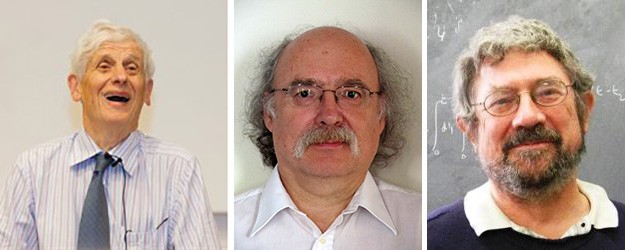
Topological trio: David Thouless (left), Duncan Haldane (centre) and Michael Kosterlitz. (Courtesy: University of Washington; Princeton University; Brown University)
2016 was a great year for David Thouless, Duncan Haldane and Michael Kosterlitz who shared the Nobel Prize for Physics "for theoretical discoveries of topological phase transitions and topological phases of matter". All three winners hail from the UK but have spent much of their professional careers in the US. The science behind this year's prize tied together three concepts in physics and mathematics, namely: topology; quantum phase transitions; and states of matter. The result is what the Nobel committee described as "beautiful mathematical and profound physical insights". Indeed, the laureates' research has laid the theoretical basis for a variety of condensed-matter staples including superconductors and thin magnetic films.
Physics of fullness
Feeling full: functional ingredients could be added to emulsions such as this one. (Courtesy: Shutterstock/hjochen)
Imagine if you could make foods that make you feel full after eating a small portion, sating your hunger and preventing you from overeating. Such a technology could play an important role in the fight against growing rates of obesity and improve the health of millions worldwide. The above image is of an emulsion of oil droplets in water – something that is found in many foods. In "Hungry for solutions" Cait McPhee, who is a biophysicist at the University of Edinburgh, explains how "functional ingredients" could be added to emulsions such as salad dressings to deliver satiety. These ingredients could be developed using soft-matter physics and could be used to create foods that trigger biological processes that lead to sensations of satiety. This article appeared in the November issue of Physics World, which focused on the physics of food.
Shifting ground in Italy
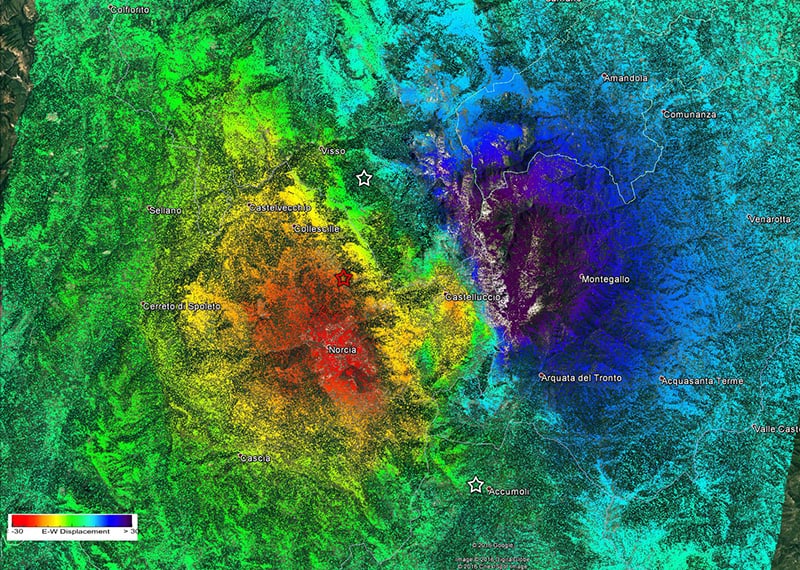
Earth mover: radar map of central Italy showing the effect of the October earthquake. (Courtesy: ESA/CNR- IREA)
On 30 October this year a 6.5-magnitude earthquake struck central Italy – the largest earthquake in the country for over three decades. This image has been made using radar data from the European Space Agency's Copernicus Sentinel-1 satellites and shows the devastating effect of the earthquake. Significant east–west ground displacements are visible in the area hit by the earthquake with an eastwards shift of about 40 cm near Montegallo and a westwards shift of about 30 cm centred in the area of Norcia. As well as these shifts, the satellite detected a vertical displacement, with the ground sinking by 60 cm around Castelluccio but rising by about 12 cm around Norcia. The Italian peninsula is prone to earthquakes due to the continuing collision of the African and Eurasian tectonic plates and central Italy has been hit by smaller earthquakes this year.
Penguin physicist
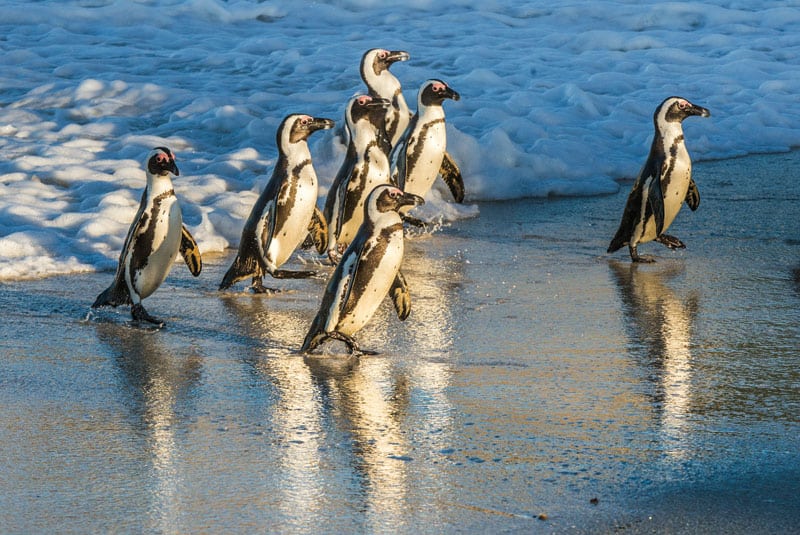
Birds of a feather: African penguins were suffering from being banded (Courtesy: iStock/USO)
What do penguins, polymer physics and pattern recognition all have in common? In this "Penguin physics" feature the polymer physicist Peter Barham explains how a casual conversation with a zookeeper in Australia led to his involvement in the development of new technologies for identifying individual African penguins in biological studies. His first attempt was a new type of plastic flipper identification band to replace metal bands – which appeared to have a negative impact on swimming. Later, he enrolled the help of computer scientists to see if pattern recognition systems could be used to identify birds without the need of any bands.
Barham's is a wonderful tale of a physicist who quite by chance became a penguin biologist. Find about more about his penguin research in this short video:
Half-quantum vortices spotted in superfluid helium-3 at long last
The first observation of half-quantum vortices (HQVs) in superfluid helium-3 has been made by physicists at Aalto University in Finland and the P L Kapitza Institute in Russia. A superfluid vortex is a point-like object around which superfluid flows. The flow is quantized in units of h/m, where h is Planck's constant and m is the mass of the constituent particles of the superfluid. HQVs can occur when the constituent particles are bound pairs of more fundamental particles. This is the case for helium-3, which when cooled forms "Cooper pairs" of atoms which behave collectively as a superfluid that will keep flowing without dissipating energy. The Cooper pairs have both spin and orbital angular momentum and interactions between these two quantities can result in HQVs when the superfluid is in a confined environment. This was first predicted in superfluid helium-3 in 1976 and has been seen in several physical systems including high-temperature superconductors, where pairs of electrons form HQVs. Now, Aalto's Samuli Autti and colleagues have confined superfluid helium-3 in a material called nafen, which contains a forest of aligned strands that are separated by about 35 nm. The helium fills the spaces between the strands and the team creates vortices by rotating the sample around the axis defined by the strands. While they could not see the HQVs directly, they used nuclear magnetic resonance to measure the rotation via a signal generated by the magnetic moments of the helium nuclei. "In the future, our discovery will provide access to the cores of half-quantum vortices, hosting isolated Majorana modes – exotic solitary particles," says Autti. "Understanding these modes is essential for the progress of quantum information processing [and] building a quantum computer." The work is described in Physical Review Letters.
Magnetic switch controls heat
A new magnetic switch that controls the flow of heat has been made by Joäo Ventura and colleagues at the University of Porto in Portugal. At its heart is a cylindrical container that is about three quarters full of a magnetic nanofluid – a substance that contains nanometre-sized magnetic particles and flows in the presence of an applied magnetic field. The side of the container is thermally insulated and the top and bottom are capped with material that is a good conductor of heat. In the off position, the nanofluid absorbs heat from the bottom of the cylinder but most of this heat is unable to pass through the gap at the top. To put the switch in the on position, a magnetic field is applied along the axis of the cylinder. This causes the nanofluid to jump up and come into contact with the top of the cylinder – allowing heat to transfer from the nanofluid to the top of the cylinder. The team made two prototype switches – one with a 1 cm-tall cylinder and the other 3 cm – that were tested with a temperature gradient of 35°C. They found that the smaller switch operated efficiently at switching frequencies of up to 30 Hz, while the larger device started to flag at about 10 Hz. The team was also able to control the temperature of an LED using one of their switches. The device is described in Nano Energy and could someday be used to ensure that fuel cells, solar cells and other devices operate at their optimal temperatures.
UK fusion-energy company gets £10m boost
Major investment: David Kingham of Tokamak Energy (Courtesy: Tokamak Energy)
The UK-based company Tokamak Energy will receive £10m in additional investment from Legal & General Capital and the private investor David Harding. Based in Oxfordshire, the firm is building a compact tokamak fusion reactor with the aim of confining and heating a plasma so that nuclear fusion can occur. According to research published by the company, a facility based on their technology should be capable of delivering 100 MW of electricity, which is about one tenth of the output of a conventional fusion reactor. Tokamak says that its next prototype reactor should be built by March 2017 and that it expects to heat plasmas to 100 million degrees by the end of next year. "The world-class facilities in Oxfordshire and 50 years of solid scientific progress with tokamaks have laid the groundwork for a UK fusion industry, and our latest major investment from UK backers demonstrates further recognition of fusion as the most exciting opportunity available to investors anywhere," said David Kingham, chief executive officer at Tokamak Energy.
You can find all our daily Flash Physics posts in the website's news section, as well as on Twitter and Facebook using #FlashPhysics. Tune in to physicsworld.com later today for our favourite images of 2017.


 For the fifth year in a row, the Royal Observatory Greenwich has produced a beautiful hardback book showcasing the winners of the Astronomy Photographer of the Year competition.