The UK-based company Delta.g has bagged the 2025 qBIG prize, which is awarded by the Institute of Physics (IOP). Initiated in 2023, qBIG celebrates and promotes the innovation and commercialization of quantum technologies in the UK and Ireland.
Based in Birmingham, Delta.g makes quantum sensors that measure the local gravity gradient. This is done using atom interferometry, whereby laser pulses are fired at a cloud of cold atoms that is freefalling under gravity.
On the Earth’s surface, this gradient is sensitive to the presence of buildings and underground voids such as tunnels. The technology was developed by physicists at the University of Birmingham and in 2022 they showed how it could be used to map out a tunnel below a road on campus. The system has also been deployed in a cave and on a ship to test its suitability for use in navigation.
Challenging to measure
“Gravity is a fundamental force, yet its full potential remains largely untapped because it is so challenging to measure,” explains Andrew Lamb who is co-founder and chief technology officer at Delta.g. “As the first to take quantum technology gravity gradiometry from the lab to the field, we have set a new benchmark for high-integrity, noise-resistant data transforming how we understand and navigate the subsurface.”
Awarded by the IOP, the qBIG prize is sponsored by Quantum Exponential, which is the UK’s first enterprise venture capital fund focused on quantum technology. The winner was announced today at the Economist’s Commercialising Quantum Global 2025 event in London. Delta.g receives a £10,000 unrestricted cash prize; 10 months of mentoring from Quantum Exponential; and business support from the IOP.
Louis Barson, the IOP’s director of science, innovation and skills says, “The IOP’s role as UK and Ireland coordinator of the International Year of Quantum 2025 gives us a unique opportunity to showcase the exciting developments in the quantum sector. Huge congratulations must go to the Delta.g team, whose incredible work stood out in a diverse and fast-moving field.”
Two runners-up were commended by the IOP. One is Glasgow-based Neuranics, which makes quantum sensors that detect tiny magnetic signals from the human body. This other is Southampton’s Smith Optical, which makes an augmented-reality display based on quantum technology.
The electrochemical reduction of carbon dioxide is used to produce a range of chemical and energy feedstocks including syngas (hydrogen and carbon monoxide), formic acid, methane and ethylene. As well as being an important industrial process, the large-scale reduction of carbon dioxide by electrolysis offers a practical way to capture and utilize carbon dioxide.
As a result, developing new and improved electrochemical processes for carbon-dioxide reduction is an important R&D activity. This work involves identifying which catalyst and electrolyte materials are optimal for efficient production. And when a promising electrochemical system is identified in the lab, the work is not over because the design must be then scaled up to create an efficient and practical industrial process.
Such R&D activities must overcome several challenges in operating and characterizing potential electrochemical systems. These include maintaining the correct humidification of carbon-dioxide gas during the electrolysis process and minimizing the production of carbonates – which can clog membranes and disrupt electrolysis.
While these challenges can be daunting, they can be overcome using the 670 Electrolysis Workstation from US-based Scribner. This is a general-purpose electrolysis system designed to test the materials used in the conversion of electrical energy to fuels and chemical feedstocks – and it is ideal for developing systems for carbon-dioxide reduction.
Turn-key and customizable
The workstation is a flexible system that is both turn-key and customizable. Liquid and gas reactants can be used on one or both of the workstation’s electrodes. Scribner has equipped the 670 Electrolysis Workstation with cells that feature gas diffusion electrodes and membranes from US-based Dioxide Materials. The company specializes in the development of technologies for converting carbon dioxide into fuels and chemicals, and it was chosen by Scribner because Dioxide Materials’ products are well documented in the scientific literature.
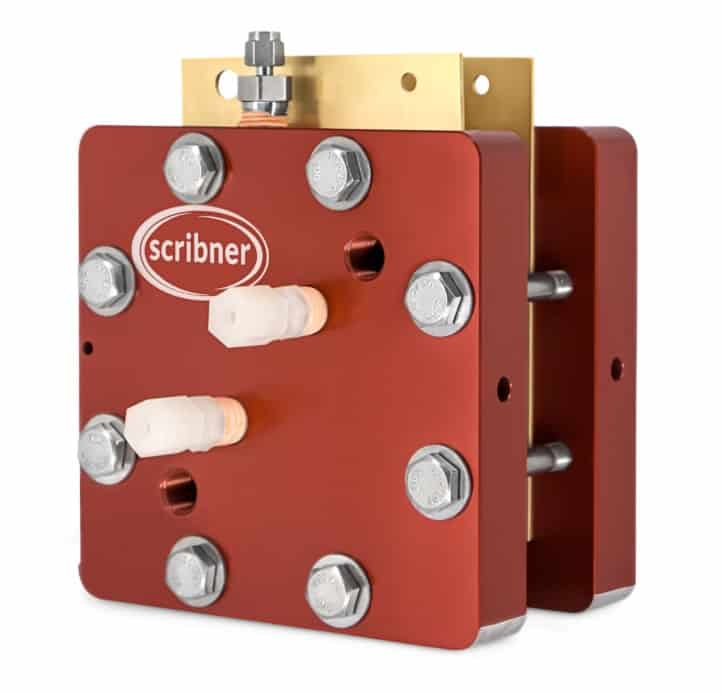
The gas diffusion electrodes are porous graphite cathodes through which carbon-dioxide gas flows between input and output ports. The gas can migrate from the graphite into a layer containing a metal catalyst. Membranes are used in electrolysis cells to ensure that only the desired ions are able to migrate across the cell, while blocking the movement of gases.
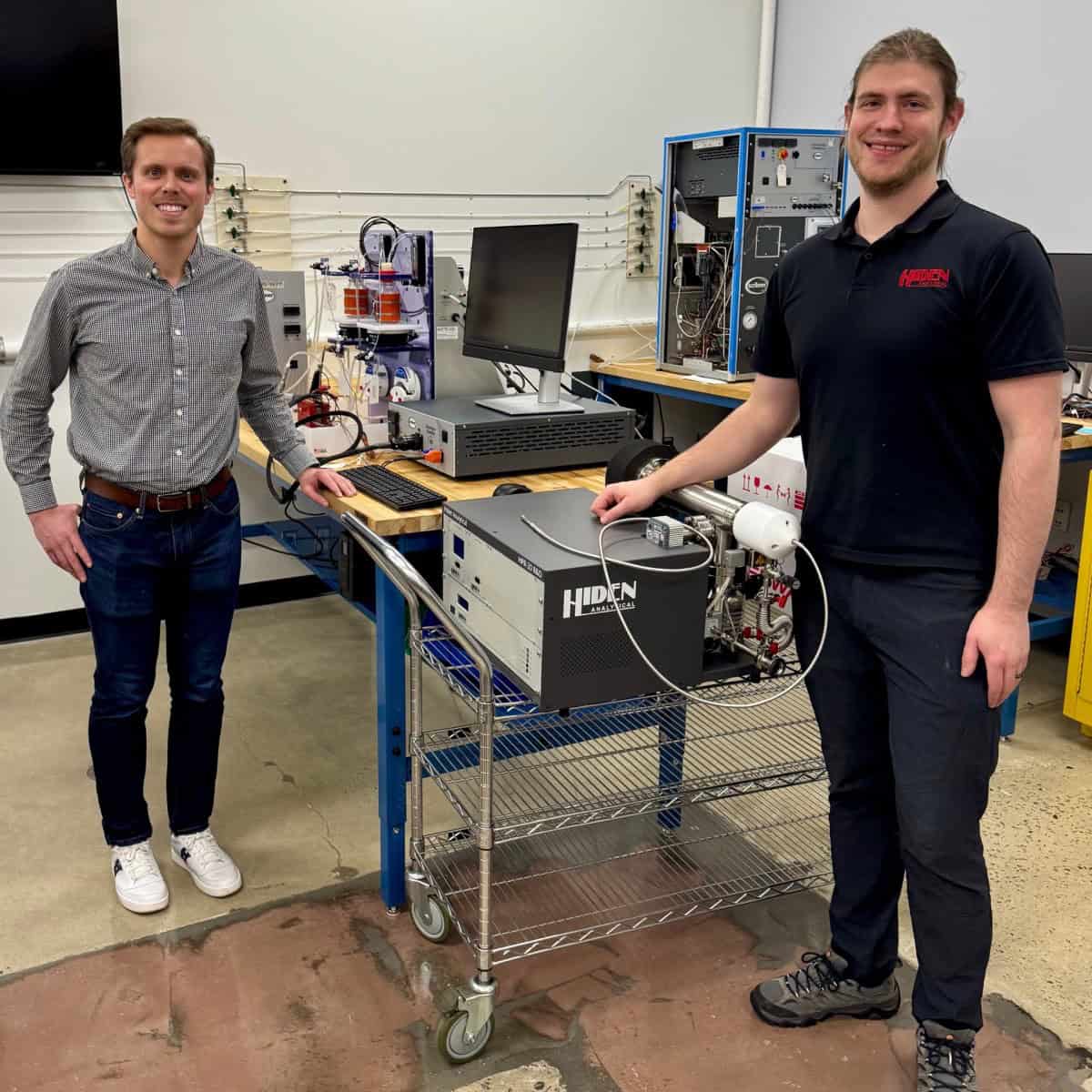
Fully integrated Scribner’s Jarrett Mansergh (left) and Luke Levin-Pompetzki of Hiden Analytical in Scribner’s lab after integrating the electrolysis and mass-spectrometry systems. (Courtesy: Scribner)
The system employs a multi-range ±20 A and 5 V potentiostat for high-accuracy operation over a wide range of reaction rates and cell sizes. The workstation is controlled by Scribner’s FlowCell™ software, which provides full control and monitoring of test cells and comes pre-loaded with a wide range of experimental protocols. This includes electrochemical impedance spectroscopy (EIS) capabilities up to 20 KHz and cyclic voltammetry protocols – both of which are used to characterize the health and performance of electrochemical systems. FlowCell™ also allows users to set up long duration experiments while providing safety monitoring with alarm settings for the purging of gases.
Humidified gas
The 670 Electrolysis Workstation features a gas handling unit that can supply humidified gas to test cells. Adding water vapour to the carbon-dioxide reactant is crucial because the water provides the protons that are needed to convert carbon dioxide to products such as methane and syngas. Humidifying gas is very difficult and getting it wrong leads to unwanted condensation in the system. The 670 Electrolysis Workstation uses temperature control to minimize condensation. The same degree of control can be difficult to achieve in homemade systems, leading to failure.
The workstation offers electrochemical cells with 5 cm2 and 25 cm2 active areas. These can be used to build carbon-dioxide reduction cells using a range of materials, catalysts and membranes – allowing the performance of these prototype cells to be thoroughly evaluated. By studying cells at these two different sizes, researchers can scale up their electrochemical systems from a preliminary experiment to something that is closer in size to an industrial system. This makes the 670 Electrolysis Workstation ideal for use across university labs, start-up companies and corporate R&D labs.
The workstation can handle, acids, bases and organic solutions. For carbon-dioxide reduction, the cell is operated with a liquid electrolyte on the positive electrode (anode) and gaseous carbon dioxide at the negative electrode (cathode). An electric potential is applied across the electrodes and the product gas comes off the cathode side.
The specific product is largely dependent on the catalyst used at the cathode. If a silver catalyst is used for example, the cell is likely to produce the syngas. If a tin catalyst is used, the product is more likely to be formic acid.
Mass spectrometry
The best way to ensure that the desired products are being made in the cell is to connect the gas output to a mass spectrometer. As a result, Scribner has joined forces with Hiden Analytical to integrate the UK-based company’s HPR-20 mass spectrometer for gas analysis. The Hiden system is specifically configured to perform continuous analysis of evolved gases and vapours from the 670 Electrolysis Workstation.
The Scribner CO2 Reduction Cell Fixture (Courtesy: Scribner)
If a cell is designed to create syngas, for example, the mass spectrometer will determine exactly how much carbon monoxide is being produced and how much hydrogen is being produced. At the same time, researchers can monitor the electrochemical properties of the cell. This allows researchers to study relationships between a system’s electrical performance and the chemical species that it produces.
Monitoring gas output is crucial for optimizing electrochemical processes that minimize negative effects such as the production of carbonates, which is a significant problem when doing carbon dioxide reduction.
In electrochemical cells, carbon dioxide is dissolved in a basic solution. This results in the precipitation of carbonate salts that clog up the membranes in cells, greatly reducing performance. This is a significant problem when scaling up cell designs for industrial use because commercial cells must be very long-lived.
Pulsed-mode operation
One strategy for dealing with carbonates is to operate electrochemical cells in pulsed mode, rather than in a steady state. The off time allows the carbonates to migrate away from electrodes, which minimizes clogging. The 670 Electrolysis Workstation allows users to explore the use of short, second-scale pulses. Another option that researchers can explore is the use of pulses of fresh water to flush carbonates away from the cathode area. These and other options are available in a set of pre-programmed experiments that allow users to explore the mitigation of salt formation in their electrochemical cells.
The gaseous products of these carbonate-mitigation modes can be monitored in real time using Hiden’s mass spectrometer. This allows researchers to identify any changes in cell performance that are related to pulsed operation. Currently, electrochemical and product characteristics can be observed on time scales as short as 100 ms. This allows researchers to fine-tune how pulses are applied to minimize carbonate production and maximize the production of desired gases.
Real-time monitoring of product gases is also important when using EIS to observe the degradation of the electrochemical performance of a cell over time. This provides researchers with a fuller picture of what is happening in a cell as it ages.
The integration of Hiden’s mass spectrometer to the 670 Electrolysis Workstation is the latest innovation from Scribner. Now, the company is working on improving the time resolution of the system so that even shorter pulse durations can be studied by users. The company is also working on boosting the maximum current of the 670 to 100 A.
As we celebrate the International Year of Quantum Science and Technology, the quantum technology landscape is a swiftly evolving place. From developments in error correction and progress in hybrid classical-quantum architectures all the way to the commercialization of quantum sensors, there is much to celebrate.
An expert in quantum information processing and quantum technology, physicist Mauro Paternostro is based at the University of Palermo and Queen’s University Belfast. He is also editor-in-chief of the IOP Publishing journal Quantum Science and Technology, which celebrates its 10th anniversary this year. Paternostro talks to Tushna Commissariat about the most exciting recent developments in the filed, his call for a Quantum Erasmus programme and his plans for the future of the journal.
What’s been the most interesting development in quantum technologies over the last year or so?
I have a straightforward answer as well as a more controversial one. First, the simpler point: the advances in quantum error correction for large-scale quantum registers are genuinely exciting. I’m specifically referring to the work conducted by Mikhail Lukin, Dolev Bluvstein and colleagues at Harvard University, and at the Massachusetts Institute of Technology and QuEra Computing, who built a quantum processor with 48 logical qubits that can execute algorithms while correcting errors in real time. In my opinion, this marks a significant step forward in developing computational platforms with embedded robustness. Error correction plays a vital role in the development of practical quantum computers, and Lukin and colleagues won Physics World’s 2024 Breakthrough of the Year award for their work.
Logical minds Dolev Bluvstein (left) and Mikhail Lukin with their quantum processor. (Courtesy: Jon Chase/Harvard University)
Now, for the more complex perspective. Aside from ongoing debate about whether Microsoft’s much-discussed eight-qubit topological quantum processor – Majorana 1 – is genuinely using topological qubits, I believe the device will help to catalyze progress in integrated quantum chips. While it may not qualify as a genuine breakthrough in the long run, this moment could be the pivotal turning-point in the evolution of quantum computational platforms. All the major players will likely feel compelled to accelerate their efforts toward the unequivocal demonstration of “quantum chip” capabilities, and such a competitive drive is just want both industry and government need right now.
Technical turning-point? Microsoft has unveiled a quantum processor called Majorana 1 that boasts a “topological core”. (Courtesy: John Brecher/Microsoft)
How do you think quantum technologies will scale up as they emerge from the lab and into real-world applications?
I am optimistic in this regard. In fact, progress is already underway, with quantum-sensing devices and atomic quantum clocks are achieving the levels of technological readiness necessary for practical, real-world applications. In the future, hybrid quantum-high-performance computing (HPC) architectures will play crucial roles in bridging classical data-analysis with whatever the field evolves into, once quantum computers can offer genuine “quantum advantage” over classical machines.
Regarding communication, the substantial push toward networked, large-scale communication structures is noteworthy. The availability of the first operating system for programmable quantum networks opens “highways” toward constructing a large-scale “quantum internet”. This development promises to transform the landscape of communication, enabling new possibilities that we are just beginning to explore.
What needs to be done to ensure that the quantum sector can deliver on its promises in Europe and the rest of the world?
We must prioritize continuity and stability to maintain momentum. The national and supranational funding programmes that have supported developments and achievements over the past few years should not only continue, but be enhanced. I am concerned, however, that the current geopolitical climate, which is undoubtedly challenging, may divert attention and funding away from quantum technologies. Additionally, I worry that some researchers might feel compelled to shift their focus toward areas that align more closely with present priorities, such as military applications. While such shifts are understandable, they may not help us keep pace with the remarkable progress the field has made since governments in Europe and beyond began to invest substantially.
On a related note, we must take education seriously. It would be fantastic to establish a Quantum Erasmus programme that allows bachelor’s, master’s and PhD students in quantum technology to move freely across Europe so that they can acquire knowledge and expertise. We need coordinated national and supranational initiatives to build a pipeline of specialists in this field. Such efforts would provide the significant boost that quantum technology needs to continue thriving.
How can the overlap between quantum technology and artificial intelligence (AI) help each other develop?
The intersection and overlap between AI, high-performance computing, and quantum technologies are significant, and their interplay is, in my opinion, one of the most promising areas of exploration. While we are still in the early stages, we have only just started to tap into the potential of AI-based tools for tackling quantum tasks. We are already witnessing the emergence of the first quantum experiments supported by this hybrid approach to information processing.
The convergence of AI, HPC, and quantum computing would revolutionize how we conceive data processing, analysis, forecasting and many other such tasks. As we continue to explore and refine these technologies, the possibilities for innovation and advancement are vast, paving the way for transformations in various fields.
What do you hope the International Year of Quantum Science and Technology (IYQ) will have achieved, going forward?
The IYQ represents a global acknowledgment, at the highest levels, of the immense potential within this field. It presents a genuine opportunity to raise awareness worldwide about what a quantum paradigm for technological development can mean for humankind. It serves as a keyhole into the future, and IYQ could enable an unprecedented number of individuals – governments, leaders and policymakers alike – to peek though it and glimpse at this potential.
All stakeholders in the field should contribute to making this a memorable year. With IYQ, 2025 might even be considered as “year zero” of the quantum technology era.
As we mark its 10th anniversary, how have you enjoyed your time over the last year as editor-in-chief of the journal Quantum Science and Technology (QST)?
Time flies when you have fun, and this is a good time for me to reflect on the past year. Firstly, I want to express my heartfelt gratitude to Rob Thew, the founding editor-in-chief of QST, for his remarkable leadership during the journal’s early years. With unwavering dedication, he and the rest of the entire editorial board, has established QST as an authoritative and selective reference point for the community engaged in the broad field of quantum science and technology. The journal is now firmly recognized as a leading platform for timely and significant research outcomes. A 94% increase in submissions since our fifth anniversary has led to an impressive 747 submissions from 62 countries in 2024 alone, revealing the growing recognition and popularity of QST among scholars. Our acceptance rate of 27% further demonstrates our commitment to publishing only the highest calibre research.
As we celebrate IYQ, QST will lead the way with several exciting editorial initiatives aimed at disseminating the latest achievements in addressing the essential “pillars” of quantum technologies – computing, communication, sensing, and simulation – while also providing authoritative perspectives and visions for the future. Our focus collections seek research within Quantumtechnologies for quantum gravity & Focus on perspectives on the future of variational quantum computing.
What are your goals with QST, looking ahead?
As quantum technologies advance into an inter- and multi-disciplinary realm, merging fundamental quantum-science with technological applications, QST is evolving as well. We have an increasing number of submissions addressing the burgeoning area of machine learning-enhanced quantum information processing, alongside pioneering studies exploring the application of quantum computing in fields such as chemistry, materials science and quantitative finance. All of this illustrates how QST is proactive in seizing opportunities to advance knowledge from our community of scholars and authors.
This dynamic growth is a fantastic way to celebrate the journal’s 10th anniversary, especially with the added significant milestone of IYQ. Finally, I want to highlight a matter that is very close to my heart, reflecting a much-needed “duty of care” for our readership. As editor-in-chief, I am honoured to support a journal that is part of the ‘Purpose-Led Publishing’ initiative. I view this as a significant commitment to integrity, ethics, high standards, and transparency, which should be the foundation of any scientific endeavour.
Researchers in Germany report that they have directly measured a superconducting gap in a hydride sulphide material for the first time. The new finding represents “smoking gun” evidence for superconductivity in these materials, while also confirming that the electron pairing that causes it is mediated by phonons.
Superconductors are materials that conduct electricity without resistance. Many materials behave this way when cooled below a certain transition temperature Tc, but in most cases this temperature is very low. For example, solid mercury, the first superconductor to be discovered, has a Tc of 4.2 K. Superconductors that operate at higher temperatures – perhaps even at room temperature – are thus highly desirable, as an ambient-temperature superconductor would dramatically increase the efficiency of electrical generators and transmission lines.
The rise of the superhydrides
The 1980s and 1990s saw considerable progress towards this goal thanks to the discovery of high-temperature copper oxide superconductors, which have Tcs between 30–133 K. Then, in 2015, the maximum known critical temperature rose even higher thanks to the discovery that a sulphide material, H3S, has a Tc of 203 K when compressed to pressures of 150 GPa.
This result sparked a flurry of interest in solid materials containing hydrogen atoms bonded to other elements. In 2019, the record was broken again, this time by lanthanum decahydride (LaH10), which was found to have a Tc of 250–260 K, again at very high pressures.
A further advance occurred in 2021 with the discovery of high-temperature superconductivity in cerium hydrides. These novel phases of CeH9 and another newly-synthesized material, CeH10, are remarkable in that they are stable and display high-temperature superconductivity at lower pressures (about 80 GPa, or 0.8 million atmospheres) than the other so-called “superhydrides”.
But how does it work?
One question left unanswered amid these advances concerned the mechanism for superhydride superconductivity. According to the Bardeen–Cooper–Schrieffer (BCS) theory of “conventional” superconductivity, superconductivity occurs when electrons overcome their mutual electrical repulsion to form pairs. These electron pairs, which are known as Cooper pairs, can then travel unhindered through the material as a supercurrent without scattering off phonons (quasiparticles arising from vibrations of the material’s crystal lattice) or other impurities.
Cooper pairing is characterized by a tell-tale energy gap near what’s known as the Fermi level, which is the highest energy level that electrons can occupy in a solid at a temperature of absolute zero. This gap is equivalent to the maximum energy required to break up a Cooper pair of electrons, and spotting it is regarded as unambiguous proof of that material’s superconducting nature.
For the superhydrides, however, this is easier said than done, because measuring such a gap requires instruments that can withstand the extremely high pressures required for superhydrides to exist and behave as superconductors. Traditional techniques such as scanning tunnelling spectroscopy or angle-resolved photoemission spectroscopy do not work, and there was little consensus on what might take their place.
Planar electron tunnelling spectroscopy
A team led by researchers at Germany’s Max Planck Institute for Chemistry has now stepped in by developing a form of spectroscopy that can operate under extreme pressures. The technique, known as planar electron tunnelling spectroscopy, required the researchers to synthesize highly pure planar tunnel junctions of H3S and its deuterated equivalent D3S under pressures of over 100 GPa. Using a technique called laser heating, they created junctions with three parts: a metal, tantalum; a barrier made of tantalum pentoxide, Ta2O5; and the H3S or D3S superconductors. By measuring the differential conductance across the junctions, they determined the density of electron states in H3S and D3S near the Fermi level.
These tunnelling spectra revealed that both H3S and D3S have fully open superconducting gaps of 60 meV and 44 meV respectively. According to team member Feng Du, the smaller gap in D3S confirms that the superconductivity in H3S comes about thanks to interactions between electrons and phonons – a finding that backs up long-standing predictions.
The researchers hope their work, which they report on in Nature, will inspire more detailed studies of superhydrides. They now plan to measure the superconducting gap of other metal superhydrides and compare them with the covalent superhydrides they studied in this work. “The results from such experiments could help us understand the origin of the high Tc in these superconductors,” Du tells Physics World.
Researchers on the AEgIS collaboration at CERN have designed an experiment that could soon boost our understanding of how antimatter falls under gravity. Created by a team led by Francesco Guatieri at the Technical University of Munich, the scheme uses modified smartphone camera sensors to improve the spatial resolution of measurements of antimatter annihilations. This approach could be used in rigorous tests of the weak equivalence principle (WEP).
The WEP is a key concept of Albert Einstein’s general theory of relativity, which underpins our understanding of gravity. It suggests that within a gravitational field, all objects of should be accelerated at the same rate, regardless of their mass or whether they are matter or antimatter. Therefore, if matter and antimatter accelerate at different rates in freefall, it would reveal serious problems with the WEP.
In 2023 the ALPHA-g experiment at CERN was the first to observe how antimatter responds to gravity. They found that it falls down, with the tantalizing possibility that antimatter’s gravitational response is weaker than matter’s. Today, there are several experiments that are seeking to improve on this observation.
Falling beam
AEgIS’ approach is to create a horizontal beam of cold antihydrogen atoms and observe how the atoms fall under gravity. The drop will be measured by a moiré deflectometer in which a beam passes through two successive and aligned grids of horizontal slits before striking a position-sensitive detector. As the beam falls under gravity between the grids, the effect is similar to a slight horizontal misalignment of the grids. This creates a moiré pattern – or superlattice – that results in the particles making a distinctive pattern on the detector. By detecting a difference in the measured moiré pattern and that predicted by WEP, the AEgIS collaboration hopes to reveal a discrepancy with general relativity.
However, as Guatieri explains, a number of innovations are required for this to work. “For AEgIS to work, we need a detector with incredibly high spatial resolution. Previously, photographic plates were the only option, but they lacked real-time capabilities.”
AEgIS physicists are addressing this by developing a new vertexing detector. Instead of focussing on the antiparticles directly, their approach detects the secondary particles produced when the antimatter annihilates on contact with the detector. Tracing the trajectories of these particles back to their vertex gives the precise location of the annihilation.
Vertexing detector
Borrowing from industry, the team has created its vertexing detector using an array of modified mobile-phone camera sensors (see figure). Gautieri had already used this approach to measure the real-time positions of low-energy positrons (anti-electrons) with unprecedented precision.
“Mobile camera sensors have pixels smaller than 1 micron,” Guatieri describes. “We had to strip away the first layers of the sensors, which are made to deal with the advanced integrated electronics of mobile phones. This required high-level electronic design and micro-engineering.”
With these modifications in place, the team measured the positions of antiproton annihilations to within just 0.62 micron: making their detector some 35 times more precise than previous designs.
Many benefits
“Our solution, demonstrated for antiprotons and directly applicable to antihydrogen, combines photographic-plate-level resolution, real-time diagnostics, self-calibration and a good particle collection surface, all in one device,” Gautieri says.
With some further improvements, the AEgIS team is confident that their vertexing detector with boost the resolution of the freefall of horizontal antihydrogen beams – allowing rigorous tests of the WEC.
AEgIS team member Ruggero Caravita of Italy’s University of Trento adds, “This game-changing technology could also find broader applications in experiments where high position resolution is crucial, or to develop high-resolution trackers”. He says, “Its extraordinary resolution enables us to distinguish between different annihilation fragments, paving the way for new research on low-energy antiparticle annihilation in materials”.
A ceremony has been held today to officially open the Ray Dolby Centre at the University of Cambridge. Named after the Cambridge physicist and sound pioneer Ray Dolby, who died in 2013, the facility is the new home of the Cavendish Laboratory and will feature 173 labs as well as lecture halls, workshops, cleanrooms and offices.
Spanning 33 000 m² across five floors, the new centre will house 1100 staff members and students.
The basement will feature microscopy and laser labs containing vibration-sensitive equipment as well as 2500 m² of clean rooms.
The Dolby centre will also serve as a national hub for physics, hosting the Collaborative R&D Environment – a EPSRC National Facility – that will foster collaboration between industry and university researchers and enhance public access to new research.
Parts of the centre will be open to the public, including a café as well as outreach and exhibition spaces that are organised around six courtyards.
The centre also provides a new home for the Cavendish Museum, which includes the model of DNA created by James Watson and Francis Crick as well as the cathode ray tube that was used to discover the electron.
The ceremony today was attended by Dagmar Dolby, president of the Ray and Dagmar Dolby Family Fund, Deborah Prentice, vice-chancellor of the University of Cambridge and physicist Mete Atatüre, who is head of the Cavendish Laboratory.
“The greatest impacts on society – including the Cavendish’s biggest discoveries – have happened because of that combination of technological capability and human ingenuity,” notes Atatüre. “Science is getting more complex and technically demanding with progress, but now we have the facilities we need for our scientists to ask those questions, in the pursuit of discovering creative paths to the answers – that’s what we hope to create with the Ray Dolby Centre.”
Physicists have succeeded in making neutrons travel in a curved parabolic waveform known as an Airy beam. This behaviour, which had previously been observed in photons and electrons but never in a non-elementary particle, could be exploited in fundamental quantum science research and in advanced imaging techniques for materials characterization and development.
In free space, beams of light propagate in straight lines. When they pass through an aperture, they diffract, becoming wider and less intense. Airy beams, however, are different. Named after the 19th-century British scientist George Biddell Airy, who developed the mathematics behind them while studying rainbows, they follow a parabola-shaped path – a property known as self-acceleration – and do not spread out as they travel. Airy beams are also “self-healing”, meaning that they reconstruct themselves after passing through an obstacle that blocked part of the beam.
Scientists have been especially interested in Airy beams since 1979, when theoretical work by the physicist Michael Berry suggested several possible applications for them, says Dmitry Pushin, a physicist at the Institute for Quantum Computing (IQC) and the University of Waterloo, Canada. Researchers created the first Airy beams from light in 2007, followed by an electron Airy beam in 2013.
“Inspired by the unusual properties of these beams in optics and electron experiments, we wondered whether similar effects could be harnessed for neutrons,” Pushin says.
Making such beams out of neutrons turned out to be challenging, however. Because neutrons have no charge, they cannot be shaped by electric fields. Also, lenses that focus neutron beams do not exist.
A holographic approach
A team led by Pushin and Dusan Sarenac of the University at Buffalo’s Department of Physics in the US has now overcome these difficulties using a holographic approach based on a custom-microfabricated silicon diffraction grating. The team made this grating from an array of 6 250 000 micron-sized cubic phase patterns etched onto a silicon slab. “The grating modulates incoming neutrons into an Airy form and the resulting beam follows a curved trajectory, exhibiting the characteristics of a two-dimensional Airy profile at a neutron detector,” Sarenac explains.
According to Pushin, it took years of work to figure out the correct dimensions for the array. Once the design was optimized, however, fabricating it took just 48 hours at the IQC’s nanofabrication facility. “Developing a precise wave phase modulation method using holography and silicon microfabrication allowed us to overcome the difficulties in manipulating neutrons,” he says.
The researchers say the self-acceleration and self-healing properties of Airy beams could improve existing neutron imaging techniques (including neutron scattering and diffraction), potentially delivering sharper and more detailed images. The new beams might even allow for new types of neutron optics and could be particularly useful, for example, when targeting specific regions of a sample or navigating around structures.
Creating the neutron Airy beams required access to international neutron science facilities such as the US National Institute of Standards and Technology’s Center for Neutron Research; the US Department of Energy’s Oak Ridge National Laboratory; and the Paul Scherrer Institute in Villigen, Switzerland. To continue their studies, the researchers plan to use the UK’s ISIS Neutron and Muon Source to explore ways of combining neutron Airy beams with other structured neutron beams (such as helical waves of neutrons or neutron vortices). This could make it possible to investigate complex properties such as the chirality, or handedness, of materials. Such work could be useful in drug development and materials science. Since a material’s chirality affects how its electrons spin, it could be important for spintronics and quantum computing, too.
“We also aim to further optimize beam shaping for specific applications,” Sarenac tells Physics World. “Ultimately, we hope to establish a toolkit for advanced neutron optics that can be tailored for a wide range of scientific and industrial uses.”
Chatbots could boost students’ interest in maths and physics and make learning more enjoyable. So say researchers in Germany, who have compared the emotional response of students using artificial intelligence (AI) texts to learn physics compared to those who only read traditional textbooks. The team, however, found no difference in test performance between the two groups.
The study has been led by Julia Lademann, a physics-education researcher from the University of Cologne, who wanted to see if AI could boost students’ interested in physics. They did this by creating a customized chatbot using OpenAI’s ChatGPT model with a tone and language that was considered accessible to second-year high-school students in Germany.
After testing the chatbot for factual accuracy and for its use of motivating language, the researchers prompted it to generate explanatory text on proportional relationships in physics and mathematics. They then split 214 students, who had an average age of 11.7, into two groups. One was given textbook material on the topic along with chatbot text, while the control group only got the textbook .
The researchers first surveyed the students’ interest in mathematics and physics and then gave them 15 minutes to review the learning material. Their interest was assessed again afterwards along with the students’ emotional state and “cognitive load” – the mental effort required to do the work – through a series of questionnaires.
Higher confidence
The chatbot was found to significantly enhance students’ positive emotions – including pleasure and satisfaction, interest in the learning material and self-belief in their understanding of the subject — compared with those who only used textbook text. “The text of the chatbot is more human-like, more conversational than texts you will find in a textbook,” explains Lademann. “It is more chatty.”
Chatbot text was also found to reduce cognitive load. “The group that used the chatbot explanation experience higher positive feelings about the subject [and] they also had a higher confidence in their learning comprehension,” adds Lademann.
Tests taken within 30 minutes of the “learning phase” of the experiment, however, found no difference in performance between students that received the AI-generated explanatory text and the control group, despite the former receiving more information. Lademann says this could be due to the short study time of 15 minutes.
The researchers say that while their findings suggest that AI could provide a superior learning experience for students, further research is needed to assess its impact on learning performance and long-term outcomes. “It is also important that this improved interest manifests in improved learning performance,” Lademann adds.
Lademann would now like to see “longer term studies with a lot of participants and with children actually using the chatbot”. Such research would explore the potential key strength of chatbots; their ability to respond in real time to student’s queries and adapt their learning level to each individual student.
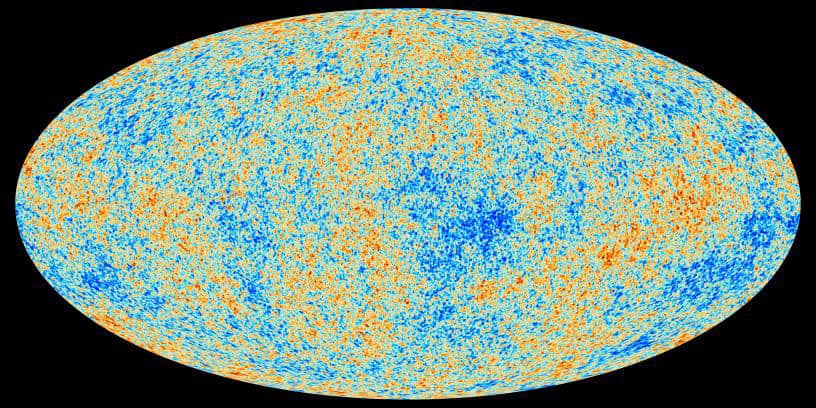
First light The cosmic microwave background, as imaged by the European Space Agency’s Planck mission. (Courtesy: ESA and the Planck Collaboration)
In classical physics, gravity is universally attractive. At the quantum level, however, this may not always be the case. If vast quantities of matter are present within an infinitesimally small volume – at the centre of a black hole, for example, or during the very earliest moments of the universe – space–time becomes curved at scales that approach the Planck length. This is the fundamental quantum unit of distance, and is around 1020 times smaller than a proton.
In these extremely curved regions, the classical theory of gravity – Einstein’s general theory of relativity – breaks down. However, research on loop quantum cosmology offers a possible solution. It suggests that gravity, in effect, becomes repulsive. Consequently, loop quantum cosmology predicts that our present universe began in a so-called “cosmic bounce”, rather than the Big Bang singularity predicted by general relativity.
In a recent paper published in EPL, Edward Wilson-Ewing, a mathematical physicist at the University of New Brunswick, Canada, explores the interplay between loop quantum cosmology and a phenomenon sometimes described as “the echo of the Big Bang”: the cosmic microwave background (CMB). This background radiation pervades the entire visible universe, and it stems from the moment the universe became cool enough for neutral atoms to form. At this point, light was suddenly able to travel through space without being continually scattered by the plasma of electrons and light nuclei that existed before. It is this freshly liberated light that makes up the CMB, so studying it offers clues to what the early universe was like.
Cosmologist Edward Wilson-Ewing uses loop quantum gravity to study quantum effects in the very early universe. (Courtesy: University of New Brunswick)
What was the motivation for your research?
Observations of the CMB show that the early universe (that is, the universe as it was when the CMB formed) was extremely homogeneous, with relative anisotropies of the order of one part in 104. Classical general relativity has trouble explaining this homogeneity on its own, because a purely attractive version of gravity tends to drive things in the opposite direction. This is because if a region has a higher density than the surrounding area, then according to general relativity, that region will become even denser; there is more mass in that region and therefore particles surrounding it will be attracted to it. Indeed, this is how the small inhomogeneities we do see in the CMB grew over time to form stars and galaxies today.
The main way this gets resolved in classical general relativity is to suggest that the universe experienced an episode of super-rapid growth in its earliest moments. This super-rapid growth is known as inflation, and it can suffice to generate homogeneous regions. However, in general, this requires a very large amount of inflation (much more than is typically considered in most models).
Alternately, if for some reason there happens to be a region that is moderately homogeneous when inflation starts, this region will increase exponentially in size while also becoming further homogenized. This second possibility requires a little more than a minimal amount of inflation, but not much more.
My goal in this work was to explore whether, if gravity becomes repulsive in the deep quantum regime (as is the case in loop quantum cosmology), this will tend to dilute regions of higher density, leading to inhomogeneities being smoothed out. In other words, one of the main objectives of this work was to find out whether quantum gravity could be the source of the high degree of homogeneity observed in the CMB.
What did you do in the paper?
In this paper, I studied spherically symmetric space–times coupled to dust (a simple model for matter) in loop quantum cosmology. These space–times are known as Lemaître–Tolman–Bondi space–times, and they allow arbitrarily large inhomogeneities in the radial direction. They therefore provide an ideal arena to explore whether homogenization can occur: they are simple enough to be mathematically tractable, while still allowing for large inhomogeneities (which, in general, are very hard to handle).
Loop quantum cosmology predicts several leading-order quantum effects. One of these effects is that space–time, at the quantum level, is discrete: there are quanta of geometry just as there are quanta of matter. This has implications for the equations of motion, which relate the geometry of space–time to the matter in it: if we take into account the discrete nature of quantum geometry, we have to modify the equations of motion.
These modifications are captured by so-called effective equations, and in the paper I solved these equations numerically for a wide range of initial conditions. From this, I found that while homogenization doesn’t occur everywhere, it always occurs in some regions. These homogenized regions can then be blown up to cosmological scales by inflation (and inflation will further homogenize them). Therefore, this quantum gravity homogenization process could indeed explain the homogeneity observed in the CMB.
What do you plan to do next?
It is important to extend this work in several directions to check the robustness of the homogenization effect in loop quantum cosmology. The restriction to spherical symmetry should be relaxed, although this will be challenging from a mathematical perspective. It will also be important to go beyond dust as a description of matter. The simplicity of dust makes calculations easier, but it is not particularly realistic.
Other relevant forms of matter include radiation and the so-called inflaton field, which is a type of matter that can cause inflation to occur. That said, in cosmology, the physics is to some extent independent of the universe’s matter content, at least at a qualitative level. This is because while different types of matter content may dilute more rapidly than others in an expanding universe, and the universe may expand at different rates depending on its matter content, the main properties of the cosmological dynamics (for example, the expanding universe, the occurrence of an initial singularity and so on) within general relativity are independent of the specific matter being considered.
I therefore think it is reasonable to expect that the quantitative predictions will depend on the matter content, but the qualitative features (in particular, that small regions are homogenized by quantum gravity) will remain the same. Still, further research is needed to test this expectation.
This episode of the Physics World Weekly podcast comes from the Chicago metropolitan area – a scientific powerhouse that is home to two US national labs and some of the country’s leading universities.
Physics World’s Margaret Harris was there recently and met Nadya Mason. She is dean of the Pritzker School of Molecular Engineering at the University of Chicago, which focuses on quantum engineering; materials for sustainability; and immunoengineering. Mason explains how molecular-level science is making breakthroughs in these fields and she talks about her own research on the electronic properties of nanoscale and correlated systems.
Harris also spoke to Jeffrey Spangenberger who leads the Materials Recycling Group at Argonne National Laboratory, which is on the outskirts of Chicago. Spangenberger talks about the challenges of recycling batteries and how we could make it easier to recover materials from batteries of the future. Spangenberger leads the ReCell Center, a national collaboration of industry, academia and national laboratories that is advancing recycling technologies along the entire battery life-cycle.
On 13–14 May, The Economist is hosting Commercialising Quantum Global 2025 in London. The event is supported by the Institute of Physics – which brings you Physics World. Participants will join global leaders from business, science and policy for two days of real-world insights into quantum’s future. In London you will explore breakthroughs in quantum computing, communications and sensing, and discover how these technologies are shaping industries, economies and global regulation. Register now.