UK industry should increase its level of investment in quantum technologies, according to a report compiled by the country’s chief scientific adviser, Mark Walport. The publication – The Quantum Age: technological opportunities – makes 11 recommendations to boost quantum technology in the UK, including a call for the five-year £270m National Quantum Technologies Programme to continue beyond 2018.
The report, which features contributions from government, industry and academic experts, says that increased investment from industry would boost the level of commitment to the programme and help to accelerate commercialization.
Early investor
The UK is among the world leaders in quantum research and technology, currently investing around £60m annually in the field – the fourth largest funder after China, the US and Germany. The National Quantum Technologies Programme, which was launched in 2013, is based around four university-led “hubs”, and is one of the earliest and largest investments in the world.
“The UK is playing a leading role in the research and development of quantum technologies,” says Walport, adding: “Quantum timekeeping, imaging, sensing, communications and computing have the potential to generate a large array of valuable new products and services.”
We cannot afford to fall at the last hurdle – new business creation
Jeremy O’Brien, University of Bristol
“Internationally, other governments and companies are becoming interested in the technology,” Richard Murray, lead technologist for emerging technologies and industries at Innovate UK, who contributed to the report, told Physics World. “So the time is right for the UK to really push forward with the innovation and commercial side of the quantum-technologies programme, as well as continuing to support the science underpinning it, so that we stay ahead of this important new industry.”
In addition to increased industry investment and the continuation of the programme, the report also recommends the setting up of innovation centres, similar to the Fraunhofer institutes in Germany and the Battelle institutes in the US, and improved co-ordination of activities at a national level.
Favourable market
Jeremy O’Brien, director of the Centre for Quantum Photonics at the University of Bristol, who was not involved with the review, told Physics World he is “very pleased” with the report’s findings and recommendations. He adds that if the UK is to remain world-leading, then as well as increasing investment, the government “needs to ensure that legislation and an accessible free market remain favourable” for companies.
“We cannot afford to fall at the last hurdle – new business creation,” says O’Brien. “The government must encourage a new culture among UK venture-capital firms that is welcoming of larger-scale investments in high-risk hardware companies, particularly in quantum technologies. Otherwise we risk falling foul of the old story of invented here and exploited elsewhere.”
Thumbs up – Institute of Physics president Roy Sambles at the 2016 annual awards ceremony
By Matin Durrani
With the winter sun dipping over the horizon late on Tuesday afternoon, I caught the train from Bristol up to London to attend the annual awards dinner of the Institute of Physics (IOP), which publishes Physics World.
The event was held at the Lancaster London hotel a few minutes’ walk from Paddington station. Now, I’m not sure if it was a coincidence, but I found myself seated at dinner next to Farideh Honary, a space physicist from Lancaster University.
On the eighth floor of the psychology department, in a small room with a light-proof door, I’ve spent hours in darkness testing a sensitive instrument – my own eye. During those hours I’ve fallen asleep, forgotten the time of day and found that total darkness doesn’t always look dark. I sometimes see phantom flashes like faraway fireflies, or the static of a television tuned to a vacant station. These are distractions from what I’m looking for: a flash of just a few photons – individual particles of light.
Next door, in a dark room of its own, a delicate apparatus generates the light my eyes are trying to see. This strange light is unlike any natural light source, and it can do things that normal light could never do. To understand how unusual this device is, think of as many different “normal” light sources as you can: light bulbs, light-emitting diodes, lasers, the Sun, the Moon, glowing embers, weird deep-sea fish, the Northern Lights. All emit photons randomly. It’s possible to make them extremely dim, so that on average they emit one photon every second, but there’s always a chance of getting two or three photons instead. There’s no reliable way to get just one photon every time.
But one photon is exactly what I need. The research project I’m working on is a collaboration between psychology and physics, and we’re using the technology of quantum optics to study how the human visual system responds to extremely small amounts of light. In particular, can the eye detect a single photon? If not, how many photons does it need?
Early experiments
Some of the most reliable early experiments on this question were conducted at Columbia University, US, in the 1940s. Austrian-born biophysicist Selig Hecht and his colleagues presented people with dim flashes of light calibrated to different intensities, and asked them if the flashes were visible or not. They determined how often people would say “yes” for each intensity, and with some assumptions about how the number of photons in each flash varied, they estimated that 5–7 photons needed to be detected by the retina for an observer to perceive light. These just-visible flashes actually contained many more than 5–7 photons, because about 90% of the light that hits the human eye is lost before it can be detected, for example via reflections from the cornea.
About 90% of the light that hits the human eye is lost before it can be detected, for example via reflections from the cornea
Across the Atlantic, H A van der Velden and Maarten Bouman were conducting similar experiments in the Netherlands under German occupation, and they estimated that humans could see 1–2 photons. Bouman is said to have jokingly mentioned later that this lower threshold was perhaps due to “the special opportunities for long dark adaptations (thanks to the precautions taken against air raids)”.
These early experiments couldn’t directly measure light detection in retinal photoreceptor cells – something that is possible today. However, they did hint that photoreceptor cells were sensitive to single photons. Hecht knew that his 5–7 photons were spread over an area of the retina containing about 500 photoreceptors, so the cells were probably able to detect single photons, even if it seemed that the observers themselves couldn’t.
By the 1970s, studies of individual photoreceptor cells proved Hecht right. There are two types of these cells: cone cells, responsible for colour vision in daylight, and the more sensitive rod cells, which are used for night vision. In the lab, researchers learned how to extract an individual rod cell from a toad and connect it to an electric circuit. (The toad killing and cell extraction has to happen in darkness – like a grim darkroom photography class – since the dark adaptation necessary to optimize rod cells to function well in low lighting only happens in living animals. This is one reason I prefer working with living human volunteers.)
Humans, toads and other vertebrates have similar rod cells. When light hits a rod, it activates a molecule called rhodopsin, which sets off a chain reaction that changes the current of ions moving in and out of the cell. In the retina, this current alters the release of neurotransmitter chemicals from the cell, allowing it to pass the signal on to other cells. In the lab, researchers were able to show in toad rod cells that this same current creates measurable electric pulses down to the single-photon level.
Now it was certain that rod cells on a lab bench were able to sense single photons. The question remained, however, of whether these tiny signals could make it through the rest of the visual pathway to the brain – in other words, whether humans can perceive individual photons.
Singular source
All the studies of human vision at that time had a fundamental limitation: they weren’t able to make just one photon. It wasn’t until the late 1980s that researchers in the new field of quantum optics invented a way of producing very unusual light: a single-photon source. These devices were developed to research the quantum properties of light, including applications such as quantum cryptography and quantum computers. However, they’re also the perfect tool to finally answer the question of whether humans can see single photons.
About eight years ago, the pieces started to come together. Tony Leggett, a Nobel-prize-winning physicist at the University of Illinois in the US, was interested in one of the great mysteries of physics: why the strange rules of quantum mechanics don’t seem to apply in everyday life. He thought that if humans could see single photons, which are quantum particles, then studying how we perceive them could help to solve the mystery. So he brought together Frances Wang, an interested psychologist, and Paul Kwiat, a pioneer in the field of quantum optics who could design the necessary apparatus.
After they designed the experiment on paper, it was my job to build it. As a new graduate student, I knew little about optics or the human visual system. Quantum mechanics had been my favourite college physics class, so I had joined Kwiat’s quantum information research group – despite not really knowing what to expect. (“What’s it like doing quantum information research?” I remember asking him on the phone before I arrived. “Really cool,” he’d replied.)
1 A single-photon source
(Courtesy: IOP Publishing)
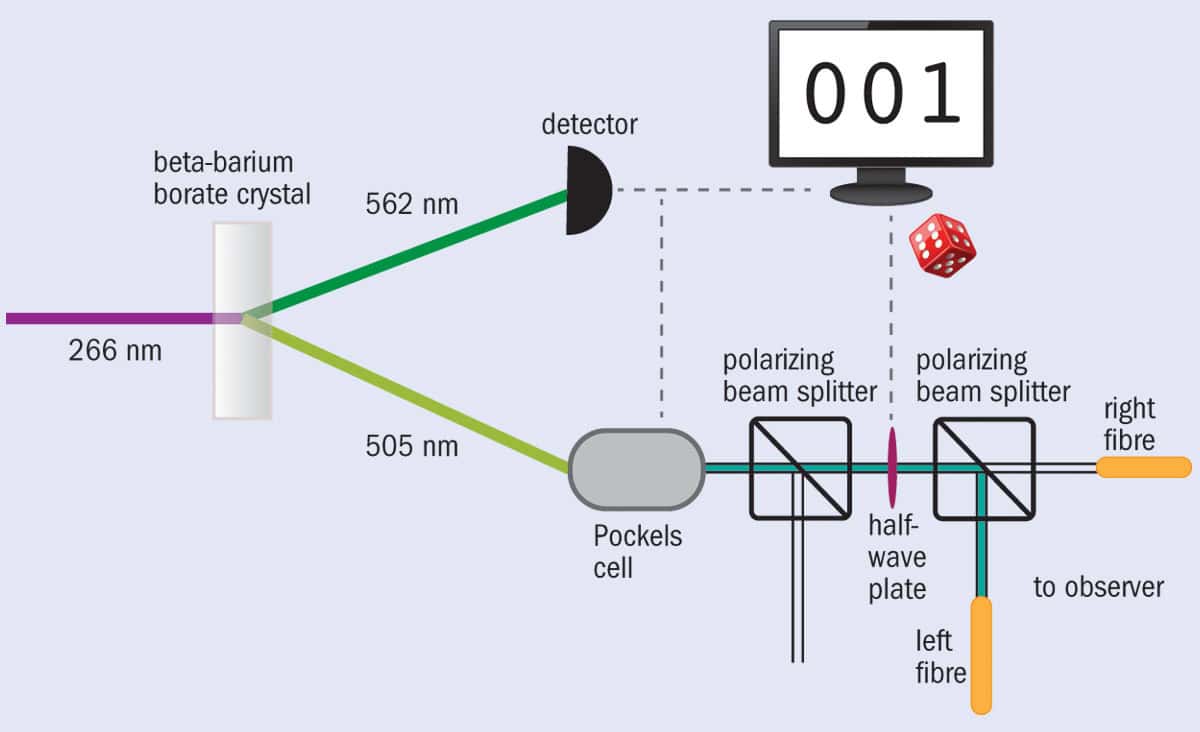
An ultraviolet laser creates pairs of green photons inside a beta-barium borate crystal. When a 562 nm “herald” photon is counted by a single-photon detector, its 505 nm partner must be there on the other side. In case the herald photon is lost (scattered by an optical component or just not detected), a Pockels cell and polarizing beam splitter act as a fast switch that only opens when a herald photon is actually detected. This prevents photons from going to the observer without being counted. By turning the laser off immediately after one cycle, this source can produce exactly one photon. After passing through the switch, the 505 nm photon is directed to either the left or the right optical fibre (the choice is made randomly by a computer) using a half-wave plate and a second polarizing beam splitter, and the fibre carries it to a human observer.
I learned that there’s a simple trick to making just one photon: first make two. Our single-photon source (see figure 1) relies on a crystal of beta-barium borate, which can split one photon into two “daughter” photons through a nonlinear optical effect called spontaneous parametric down-conversion. The split is triggered by quantum vacuum fluctuations, and it only happens for about one in a billion photons. That doesn’t sound like a lot, but when a laser beam with 1016 photons per second passes through the crystal, a stream of photon pairs comes out. The two photons in a pair travel in slightly different directions, so we can collect them into separate optical fibres. One fibre goes straight to a single-photon detector and when it measures a photon, we know that its undetected partner, created at exactly the same time, is there too – in fact, we can send it to a human observer. Rod cells are most sensitive to green light, so we use an ultraviolet laser to create single photons with a wavelength of about 505 nm – a luminous bright green like a traffic signal on a dark road.
Although the crystal is small, the entire single-photon source fills an optical breadboard the size of a workbench and weighs more than 90 kg. Building it required months of carefully placing lenses, tilting mirrors and turning knobs in the dark while watching dim red numbers go up or down. When it was ready, we moved it from the second floor of the physics department to the eighth floor of the psychology department with the help of a pickup truck and my strongest lab mates. I realigned the components and got ready to begin tests with actual human observers.
Each session requires about two hours in total darkness. (I’m lucky to have an endless supply of undergraduate physics student volunteers who will do anything in the name of science.) First, there’s a 30-minute period of dark adaptation to optimize the observer’s night vision. For the first 15 minutes the volunteers just relax in the dark, and for the second 15 they do practice trials. During this time, pupil dilation and chemical changes in the retina make the observer’s eyes at least a million times more sensitive than they are in daylight.
When the observer is fully dark-adapted, they position their head in a chin rest and look straight ahead at a dim red cross hairs. The single-photon source sends a flash of light to one of their eyes, and the light is randomly assigned to appear on either the left or the right side of the cross hairs. The observer’s job is to correctly choose which side the light appeared on – left or right – in 300 repetitions of this task. It does get boring, so we make it a (still pretty boring) game by playing a sound after each trial to tell the observer whether they got the answer right or not: a happy “ta-da!” sound for a correct answer, and a disappointing buzz for an incorrect answer.
Asking the observer to choose left or right instead of just asking “did you see it or not?” is an important feature of our experiment. With random noise in the visual system that can create distracting phantom flashes even in total darkness, it’s hard to be sure you’re seeing the real thing. Single-photon detection might not even be conscious – sometimes I have a hunch that the flash was on the right, without knowing why (and sometimes I’m sure I saw it on the left and I get the “wrong” buzzer – argh!).
But the data don’t lie – if an observer is able to choose left or right with better than 50-50 accuracy and the effect is statistically significant, we know they must have been able to see the light (either that or they’re psychic). We’re still working on collecting enough data, but we plan to use this technique to test once and for all whether humans can see single photons.
We’ve already found that people can see flashes of about 30 photons, and we think only three of those photons actually make it to the retina on average. Like Hecht back in the 1940s, we have to average and estimate with multiple photons, but with single photons we’ll know for sure – either one photon or zero will be detected each time.
In the dark
We’re not the only ones working on experiments like this. In 2016 a Vienna-based group, led by physicist Alipasha Vaziri from Rockefeller University in the US, reported they had demonstrated single-photon vision using a similar single-photon source (Nature Comms7 12172). It was an interesting study that used a clever technique – observers had to judge accurately when a photon arrived instead of where. However, my colleagues and I are concerned that the reported results are ambiguous. That’s because in a key subset of trials (rated “high confidence” by the observers), the average accuracy was so high that it didn’t seem to fit with the rest of the data, and weaker statistical tests were used. We think more convincing proof of single-photon vision is still needed. Whether our concerns turn out to be valid or not, we feel that independent replication is important for a question that has been so challenging to answer.
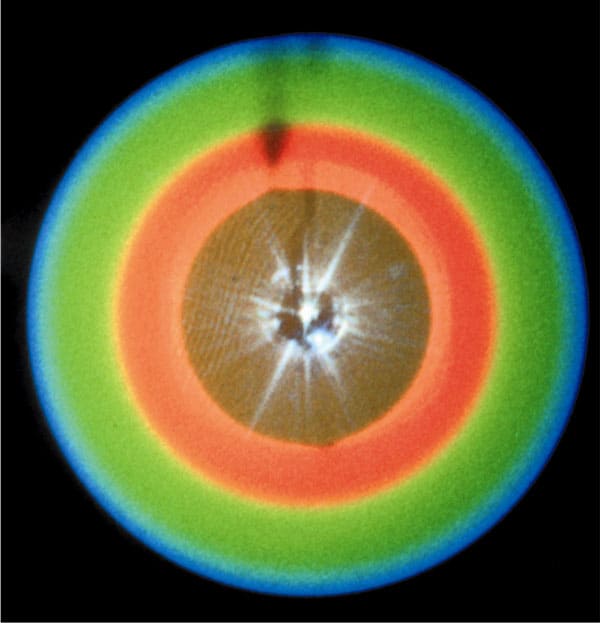
Crystal light A photograph of light generated by spontaneous parametric downconversion. The camera is looking towards the crystal. (Courtesy: NIST/Alan Migdall)
In the meantime, my colleagues and I have studied other aspects of the visual system. By varying the length of very dim flashes of light and the number of photons they contain, we have measured the equivalent of “exposure time” in the eye – the time window during which photons are added up into one larger signal. This is similar to the time that a camera shutter is open, but it’s more complex in the eye – the exposure is adjusted dynamically for different conditions, and can even be affected by a memory of a previous image. For flashes of light that are relatively easy to see, the exposure time is typically one tenth of a second. We found that when only a few photons are present, the eye adds up signals for almost a full second (probably in retinal processing after the photoreceptors), dramatically improving its ability to detect weak flashes.
If the research community does prove that humans are able to see single photons, we might be able to fulfil Leggett’s dream of testing quantum effects through the visual system. Instead of sending a photon to either the left or the right side of the eye, we could send a photon in a quantum superposition of both left and right! How would that look to an observer? Standard quantum mechanics predicts that the photon should collapse to one side or the other too quickly to notice, but no-one knows for sure. We could even use a human observer as a “detector” in a test of nonlocality, the instantaneous “spooky” action at a distance of entangled photons. More than 100 years after Albert Einstein suggested that light was made of particles, we now have the chance to ask these strange new questions.
The Laser Interferometer Gravitational-wave Observatory (LIGO) – a pair of gravitational-wave detectors in Hanford, Washington, and Livingston, Louisiana – have been turned back on following almost a year of upgrades. On 11 February, the LIGO collaboration announced the first-ever direct observation of gravitational waves, which were generated by the collision of two black holes 1.3 billion light-years away. This was followed by the announcement of a second gravitational-wave detection on 15 June, also from merging black holes. The detections were made during LIGO’s first run from September 2015 to January 2016, and since then engineers have been making improvements to the facility’s lasers, electronics and optics. The Livingston detector now has about a 25% improvement in sensitivity, allowing it to spot black-hole mergers at greater distances. The sensitivity of the Hanford detector, meanwhile, is similar to the first run, however the power of the laser has been increased and the detector is more stable, increasing the time that the detector is operational. “Already LIGO has exceeded our expectations, and, like most of the scientific world and beyond, I am excited to see what a more sensitive, upgraded LIGO will detect next,” says National Science Foundation director France Córdova. The detectors are now expected to run for around six months before undergoing further maintenance and upgrades.
Sound could move magnetic domain walls
Sound waves could be used to move magnetic domain walls in ferromagnetic and antiferromagnetic materials – according to calculations done by Se Kwon Kim, Daniel Hill and Yaroslav Tserkovnyak at the University of California, Los Angeles. The effect, which has yet to be verified in the lab, could be used to generate magnetic solitons in insulators and could even find use in racetrack memories that store data in magnetic domain walls. The trio looked at a 1D magnetic wire in which the magnetization tends to point along the direction of the wire. The domain walls, therefore, are regions along the wire where the magnetization rotates out of the direction of the wire to achieve a reversal in the magnetization direction. The trio’s calculations focussed on quantized transverse vibrations – called phonons – that can travel along the wire. These phonons can be circularly polarized (and carry angular momentum) or linearly polarized (carrying no angular momentum). The calculations show that a domain wall can be moved by circularly polarized phonons, which exert a torque on the wall when they encounter it. More surprisingly, the research also suggests that linearly polarized phonons will move a domain wall in an antiferromagnetic wire by simply transferring linear momentum to the wall. The research is described in Physical Review Letters.
Smallest known asteroid is also one of the brightest
Asteroid spotter: the NASA Infrared Telescope Facility was used to study 2015 TC25. (CC BY 2.0/Afshin Darian)
The smallest known asteroid measures just 2 m across and is also one of the brightest near-Earth asteroids ever discovered – reflecting 60% of the sunlight that strikes its surface. Dubbed 2015 TC25, the asteroid was discovered in 2015 by the University of Arizona’s Catalina Sky Survey and has now been studied in great detail by a team led by Arizona’s Vishnu Reddy. The researchers used four Earth-based telescopes to characterize the asteroid and they report their findings in The Astrophysical Journal. Reddy believes that the surface of 2015 TC25 is similar to an aubrite, which is a rare type of highly reflective meteorite. Aubrites consist of very bright minerals, mostly silicates, which formed in an oxygen-free environment at very high temperatures. “You can think of it as a meteorite floating in space that hasn’t hit the atmosphere and made it to the ground – yet,” says Reddy. “It’s especially important to study the physical properties of small near-Earth asteroids because of the threats these objects pose to us,” adds Stephen Tegler of Northern Arizona University, who was also involved with the research.
You can find all our daily Flash Physics posts in the website’s news section, as well as on Twitter and Facebook using #FlashPhysics.
How many different ways are there to explain cutting-edge physics to readers who want to get to grips with the subject? Benjamin Bahr, a quantum-gravity theorist at the University of Hamburg, and experimental particle-physicist Boris Lemmer from the University of Göttingen have hit upon the idea of using cartoons. The pair teamed up with Canadian cartoonist Rina Piccolo to create this series of 76 mini-essays about a range of topics in physics, each illustrated with one large cartoon and several smaller drawings.
The focus in Quirky Quarks: a Cartoon Guide to the Fascinating Realm of Physics is squarely on cosmology, quantum physics and particle physics, with wormholes, tachyons, extra dimensions and other far-out material collected in a chapter dubbed “beyond the boundaries of our knowledge”. The entries are authoritative and clearly written – if a little over-eager – with the cartoons providing a welcome light relief. Disappointingly, though, there is very little on “everyday” physics. Casual readers may also be deterred by the relatively steep price, which is at odds with the book’s “fun” approach.
Back in 2015, the surprise hit of the popular-science world was a slender volume with the English title Seven Brief Lessons on Physics. Written by the Italian-born theorist Carlo Rovelli, and intended as a basic introduction to post-Newtonian physics, the book’s Italian edition sold some 300,000 copies. Rovelli’s follow-up, Reality Is Not What It Seems, is longer and a bit more technical, and unlike its predecessor, it focuses on loop quantum gravity – Rovelli’s main research area and a topic seldom covered in general-audience publications.
The book begins conventionally, with the atomic theories of Democritus and other thinkers from the ancient Greek world, and then (rather regrettably) treats the ensuing 1.5 millennia as if nothing scientific happened whatsoever. After Democritus and Ptolemy, we jump from Copernicus, Kepler and Galileo to Newton, Faraday and Maxwell; and finally Einstein and a coterie of early 20th-century quantum revolutionaries.
Despite this standard-issue structure, the ideas of Democritus and other great scientists of the past are not mere starting points, but touchstones for all subsequent theories, and Rovelli refers back to them regularly throughout the book. His treatment of relativity, and particularly his claim that special relativity is “more difficult to digest than general relativity” (clearly, being a loop quantum gravity theorist does exciting things to one’s digestion), are also unusual. However, Rovelli has a gift for presenting complex ideas in a way that makes them seem intuitive, without diminishing their depth or lustre.
Physicists wishing to grasp the essentials of loop quantum gravity without tangling with its mathematics could not wish for a better guide in the book’s second half, when the subject matter passes from “what…we credibly know about the world, to what we don’t yet know but are trying to glimpse”.
At first glance, it seems as though the tides are just a bit of simple physics – the Moon’s gravity tugs on the oceans, and the Sun has a smaller but similar effect. But why then, do tides in some places rise and fall roughly twice a day, while elsewhere the cycle only occurs once in 24 hours? Why does Canada’s Bay of Fundy have an enormous tidal range of 16 m whereas just 50 km away in the Northumberland Strait the range is a piddling 1.6 m?
These and other questions perplexed some of history’s greatest scientists and in Tide: the Science and Lore of the Greatest Force on Earth, author Hugh Aldersey-Williams explains how we came to understand why the oceans rise and fall, and indeed, how the course of history can turn on the tide. Attacking on an exceptionally high tide, for example, was seen as crucial to the success of the D-day landings in the Second World War. The Allies, he explains, used a mechanical tidal prediction machine designed 1872 by William Thomson (later Lord Kelvin) to calculate the tides along the Normandy coast using a hodge-podge of incomplete information.
The best part of the book though, is Aldersey-Williams’ contemplative description of a complete tidal cycle – from ebb to flood, and back again – that he experienced one warm September day on a lonely creek near the Norfolk coast. “The warming mud that has not seen the Sun for half a day raises a sweet shellfish odour,” he writes, “The seabed is coming to life.”
Using the second law of thermodynamics to explain why dogs pant, how best to get tomato ketchup out of a glass bottle and why Hawaii is so great for surfing, is a pretty unusual approach to understanding physics. Helen Czerski, self-described “bubble physicist” at University College London, TV presenter and author of Storm in a Teacup: the Physics of Everyday Life, wants to make physics accessible to everyone. She takes the science of the everyday – tea sloshing around in a mug, swimming goggles fogging up, bees collecting pollen – to explain basic physics concepts.
Czerski shows how the same physical laws are applicable on astronomical and microscopic scales, as well as to current science topics, such as climate change and medical testing. Even when you know the physics, it can be a revelation to realize that, for example, popcorn pops due to the same gas laws that cause thunderstorms, and it’s fun to take a detour via the short-lived invention of rocket post (yes – that is mail sent by rocket and it really happened, though many letters were blown up during early tests).
The one drawback of this is the brevity of topics. Each one- or two-page example could easily fill a whole chapter, but that would be a very different kind of book. In a friendly, chatty style that includes anecdotes from her personal and professional life, Czerski manages to make spilled coffee fascinating; tree growth astonishing; telecommunications intuitive. She has a comedic flair, including lots of details that are odd or silly, but what really makes this book readable is her evident enthusiasm, and not just for bubbles.
The UK’s Government Communications Headquarters (GCHQ) has, over the last few years, published puzzles that keen members of the public could solve to get noticed by the organization’s recruitment team. What they didn’t let on, though, is that what we’ve seen until now is a mere glimpse of a giant puzzle archive going back decades.
Internally, GCHQ employees have been designing and setting each other puzzles since the 1980s. The mindbenders first took place over the Christmas period, evolving to include an Easter Teaser and even a real-life Treasure Hunt, where about 50 staff descend on a Cotswold town. The GCHQ Puzzle Book is a chunky compendium where readers are introduced to the whole back catalogue, which has remained secret until now.
One puzzle type that stands out as being particularly “meta” is the Puzzle Hunt – a set of pictorial puzzles that don’t come with any questions, so that the solver has to first work out what to do for each part, then after solving them, combine the answers to solve a final puzzle, which itself has no question. Tantalizing too is the “artwork” on the book’s inside cover, which is a collection of higgledy-piggledy letters. Together with the advice that “there may be more questions in the book than those which are immediately obvious”, the artwork looks suspiciously code-like.
There is also an entirely fresh “competition” puzzle to be solved; get in quick as the deadline to enter is 28 February 2017. Keen-eyed readers will spot that Physics World gets a mention. That’s because in 2013, for the 25th-anniversary issue of Physics World, we worked with GCHQ to produce a set of physics-themed puzzles, the first of which is included in the book’s introduction.
What has the US military ever done for us? While it is possible to respond to this question in a number of ways, for Greg Milner the most compelling answer is the time-and-navigation network known as the Global Positioning System. In his book Pinpoint: How GPS is Changing Technology, Culture, and Our Minds, Milner, a US-based science journalist, argues that this constellation of 31 satellites has had a greater impact on human civilization than almost any other development of the past quarter-century.
For readers whose experience of GPS is limited to sat-navs and smartphone mapping apps, this may seem like an overstatement. But as Milner shows, a plethora of other technologies – including crucial ones such as the “synchrophasors” that collect real-time data from electrical grids – also depend on the faint-but-oh-so-precise timing signal that GPS provides.
The importance of GPS is all the more impressive for the recent, accidental and insidious nature of its rise. The modern system was not operational until the 1980s, and its US military sponsors were astonishingly myopic about its potential. One of Milner’s many interviewees notes that when he informed superior officers that the system could tell them their exact location, a typical response was “Why do I need a damn satellite to tell me where I am?” Today, the number of GPS-enabled devices is in the billions, and putting numbers on the technology’s economic value is essentially impossible.
But Milner’s book is no mere gee-whiz success story. Chapters focusing on the system’s vulnerabilities and its usefulness in tracking people raise troubling questions about this apparently benign technology. Moreover, while the evidence for GPS changing the way we think is comparatively weak, the idea itself seems plausible. After all, Milner writes, “What is the world if not a maze through which we all navigate, using the tools and maps…at our disposal?”