Everyone loves physics. And everyone loves animals, right? In the December issue of Physics World magazine, which is now live in the Physics World app for mobile and desktop, University of Bristol physicist Peter Barham explains how he became an expert in penguins, studying the factors that that affect their survival and discovering how to use the spots on African penguins to identify them. You can also read the article here.
Elsewhere in the new issue, you can enjoy our selection of the best books for Christmas, discover how one physicist became a successful contemporary dancer, and find out how to spot single photons with your naked eye.
Don’t miss either the chance to win a copy of Astronomy Photographer of the Year: Collection 5 in our special prize puzzle.
I’m often asked how as a physicist I managed to end up carrying out research on penguins. The answer is it happened through a set of lucky chances driven by my partner’s passion for these animals. When I first met Barbara, it was very obvious that she loved penguins. At first this made my life quite easy as I could always buy her presents she’d appreciate (a book on penguins, a penguin T-shirt or a cuddly penguin). But later in life it got much more difficult – there is a limit to how many penguin-related items are available.
So eventually we started to travel to see penguins in the wild. That led to meeting up with one of the penguin keepers at Taronga Zoo in Sydney who was able to tell us that there would be an international conference about penguins a couple of years later in South Africa. So it was that just over 20 years ago, we took our summer vacation in South Africa so that we could attend the Third International Penguin Conference in Cape Town.
This was my first biological science conference and it made a striking contrast to the physics meetings I had previously attended. It was so polite. No-one offered any criticism of the speakers (even when a rank amateur such as myself could see basic inconsistencies in some talks). If that had happened at one of the polymer-physics meetings I was used to, the speakers would have been eaten alive by some of the old professors in the audience!
Tagging out: flipper bands, which can adversely affect African penguins, have now been superseded by pattern recognition or microchipping as a means of identification. (Courtesy: iStock/dpchages)
So it came as a real shock to me when halfway through the week a full-on row developed among the biologists after the talk given by one of the leading penguin biologists, Bernard Stonehouse (who was the first person to observe the full breeding cycle of the Emperor penguins through an Antarctic winter). He had decided at the last minute not to give his advertised talk (about interactions between tourists and penguins in Antarctica) but instead harangued the assembled penguin biologists about the way they marked penguins using metal flipper bands.
It had been shown a few years earlier that these bands can adversely affect penguins as they increase the birds’ energy requirements significantly. At the previous International Penguin Conference in 1992 it had apparently been generally agreed that alternative marking methods should be found. Stonehouse had noticed nothing had been done and so made a plea for change. He ended his talk by suggesting that one possible solution might be to use modern materials (such as plastics) to make less harmful bands. Once he finished it seemed everyone wanted to have a say, with many opinions about why plastics were unsuitable – or very suitable – materials.
After a few minutes (and some prodding from Barbara) I decided to intervene and admit that I was a polymer physicist and actually knew something about plastics as materials. Before I knew what had happened I was “volunteered” to develop new plastic flipper bands.
Flipping out
Back at the University of Bristol in the UK, I recruited final-year undergraduate project students to develop the equipment we would need to measure the drag from different styles of bands and to start designing new styles from a range of materials. Within a couple of years we had tested a few designs on penguins at Bristol Zoo and were ready to start testing in the wild – so I set about getting funding for such a project, together with friends I had made during the conference working at the University of Cape Town and the South African Department of Environmental Affairs.
We were lucky enough to get funding from Earthwatch, an environmental charity based in the US, which not only provides money but also volunteers to help with data collection. But just as we were about to start the project, disaster struck.
On 23 June 2000 a cargo ship sank between our chosen research site, Robben Island, and another nearby penguin colony on Dassen Island, both of which lie off the coast of South Africa. More than 360 tonnes of viscous fuel oil was spilled, which led to more than half of the penguins breeding on Robben and Dassen islands being oiled. Those that initially avoided the oil were taken 700 km away to Port Elizabeth and released to swim back while the oil spill was being cleaned up, in order to prevent them getting covered in the black stuff. Nearly all the oiled birds were de-oiled and returned to the islands alongside the translocated birds and it was not until they bred the following year (2001) that we could finally get the project under way.
Sticky situation: in 2000 an oil spill near Robben and Dassen Islands, off the coast of South Africa, led to more than half the penguins being oiled. The rescue effort and subsequent penguin research led to some surprising findings. (Courtesy: Rob Crawford)
I soon noticed a number of differences between the ways biologists and physicists design and conduct their research. In biology, research is generally hypothesis driven, while in physics it is more commonly curiosity driven. So we had to design our project to test the hypothesis that the “new” plastic flipper bands had no more effect on the penguins than the “normal” steel bands. To do this we fitted pairs of unbanded penguins with the new bands and compared their breeding success to pairs of penguins fitted with traditional bands. Since all the de-oiled and many of the translocated penguins from the oil spill had been fitted with traditional bands, there was no shortage of “control” birds. But we had to search through the colony to find sufficient numbers of breeding pairs of birds, neither of which were already banded, to fit with the new bands. Then it was just a case of letting the volunteers monitor the nests for a couple of years and seeing whether there were differences in the numbers of chicks raised by the two groups.
Once we had three years of data we were able to start analysing whether the new bands were any good. But once I started looking at the data, I kept noticing inconsistencies and issues that did not seem to make sense. So I adopted a “physics” approach and looked for patterns in the data to see if I could tease anything useful out of them.
Quickly I realized that we had captured some unexpected results that had nothing to do with the bands we were trying to test. We found that the birds that had been de-oiled following the spill in 2000 had lower breeding success compared with birds that had never been oiled. We were then able with one more year of data to show a number of surprising conclusions about the whole rehabilitation process for the penguins. We demonstrated that the translocated birds were breeding as successfully as other birds that had never been oiled. This was important as it confirmed that the idea of translocating unoiled penguins (which was an emergency action taken without knowing whether it would work) had indeed been successful.
Another conclusion from the data was that chicks that had been taken away and hand reared before being released had survived better than naturally reared chicks, and were starting to breed well. This was quite unexpected, as received wisdom at the time was that hand-reared chicks were unlikely to survive at all. The de-oiled birds, meanwhile, were raising no more than half as many chicks as the rest.
Birds of a feather: African penguins go out to sea in the same groups every morning, yet return to their nests in different groups. Why this should be so remains a mystery. (Courtesy: iStock/USO)
These largely unexpected results have led to changes in the priorities for rehabilitation centres around the world. For example, today in a major oil spill, priority is given first to removing clean birds from the area, to prevent them becoming oiled. In cases where it has been established that hand-rearing chicks is feasible, the second priority is given to removing and rearing these chicks. De-oiling oiled birds, meanwhile, is given a much lower priority. Unfortunately for the original research project, the compounding of effects of bands with effects of de-oiling meant that we were not really able to tell how well the new bands were performing.
At the same time, I had wondered why no-one was using the unique spot patterns on African penguin chests as an alternative means of identification – one that required no bands at all. When I discussed this at a meeting on the advisability of banding penguins, I was astonished to find that the biologists did not realize these patterns were unique to each individual. So I went back to Bristol and enrolled the help of our computer scientists to develop a system to extract patterns from photographs or video footage and automatically recognize individual birds.
We managed to develop a working system that uses computer vision technology. The software first identifies penguins in images streamed from a live video camera and then “cuts out” images that contain enough information to extract the spot patterns. These can later be “indexed” by creating the set of all the vectors connecting each spot to every other spot to create a unique identifier. These sets of vectors can then be compared to a database of all the known penguins to identify each individual bird.
We ran this system for three years on Robben Island, noting the patterns of every penguin that passed a fixed camera along one of the main routes they use to come ashore. But generalizing that to any camera at any location has proved a more challenging task, as the lighting conditions greatly affect the ability of the system to recognize penguins and extract spot patterns. Also, as more and more penguins enter the database, it becomes increasingly difficult to test whether a particular pattern is a match for one already in the system but from a different angle or with a spot occluded by some dirt, or whether it is a bird not yet in the system.
We have, however, been able to get some interesting results from this system just by looking for patterns in the data. For example, it seems that penguins going to sea in the mornings tend to do so in the same groups most days – as if they are a group of school children walking to school with their friends. But in the evenings when they return to their nests they seem to do so in different groups. Why this should be so is still the subject of a lot of speculation.
Food focus
A significant advantage of being in a physics department is that undergraduates have to do final-year research projects and are often interested in practical projects – so they can be persuaded to design and make useful instrumentation for field work, usually involving building electronic automatic data-collection systems. For example, one pair of project students created a battery-operated weighing system using a set of commercially available parcel scales combined with a data collection and control system based around an Amicus microprocessor. Importantly, the system is reliable, robust and cheap enough to be used by field biologists. I supervised a Master’s student who put these weighing systems in front of penguin nests along with camera traps, to weigh and identify penguins as they arrived and left the nest.
This sort of system can not only tell us about how much food the adults are bringing their chicks and how well the chicks are growing, but it can also tell us about how the parents partition the effort of raising chicks, for example. But perhaps the most interesting thing it has taught us so far is that the number one factor in determining how many chicks a pair of penguins will raise is just how well fed the adults are right at the start of the breeding process. We found that if the lighter of the two penguins weighs more than 2.4 kg then the pair are very likely to fledge two healthy chicks. But if it weighs less than 2.0 kg they are unlikely to fledge any chicks at all. These results highlight the importance of the availability of food in the non-breeding season, something that had previously been largely overlooked (probably because it is hard to measure).
Physicists often have crazy ideas – one such idea that came up during a meeting with my colleagues at Bristol Zoo was to conduct an experiment to see if we could create a brand new penguin colony. At the time, African penguins, which breed at around 30 islands and two mainland sites around the western and southern coasts of Namibia and South Africa, were doing quite well. But we thought the birds might not do so well in the future, so if we could try and create a colony now, then we would know how to create new colonies from captive-bred birds should it ever become necessary for the survival of the species.
The idea was generally laughed out of court for all sorts of good reasons. A few years later, however, the population of African penguins started to decline rapidly, largely because the fish stocks started to move away from the coastal waters near the islands where the penguins bred. In 2010 the conservation status of the African penguin was re-classified from “vulnerable” to “endangered”. The once-crazy idea of establishing a new penguin colony is now being actively pursued in South Africa and hopefully in the next few years we will see a colony started in an area where fish stocks are holding up well.
Full circle
The current consensus about flipper bands among penguin researchers is that they are not suitable for African penguins (even the recently developed rubber ones which it turned out some penguins managed to remove by themselves!). Instead, birds are identified either at their nests using the unique pattern markings, or by injecting them with microchips, which have no detrimental effects on their behaviour and are relatively easy to read with suitable equipment.
Three years ago I was the chair of the Eighth International Penguin Conference in Bristol and in September this year I was one of the organizers of the Ninth International Penguin Congress in Cape Town, held exactly 20 years after the meeting that first got me involved with penguin research. At that meeting there was a whole session on post-rehabilitation-monitoring research – all triggered from the observations we made accidentally when trying to evaluate flipper bands. So my work has come full circle and although I still consider myself a physicist, I have also become accepted as a real penguin biologist.
See below for a video of Peter Barham explaining how you recognize a penguin in a crowd, as part of Physics World’s 100 Second Science series.
Ghost imaging – a counter-intuitive technique that produces images of an object using photons that have never interacted with it – has been performed for the first time using massive particles. The researchers believe that their new technique of ghost imaging using atoms instead of photons could be used to test fundamental principles of quantum mechanics.
The underlying concept of ghost imaging was first outlined by David Klyshko of Moscow State University in 1988. Pairs of correlated photons with equal and opposite momenta are sent simultaneously down different paths. The object of interest lies in the path of one photon from each pair. This photon may either interact with the object or pass directly to a detector, which records only the time of its arrival. The second photon travels an equal distance to a detector that precisely records both its arrival time and position.
If the photon travelling the first path does not interact with the object, each photon arrives at its detector at exactly the same time. If the first photon interacts with the object, however, it does not reach the detector or is delayed. Crucially, the second detector discards any photons that did not arrive at the same time as a photon hit the first detector. This allows it to build up a “ghost image” of the object in the first path. The technique was first demonstrated experimentally in 1995 by Alexander Sergienko – a former PhD student of Klyshko – and colleagues at the University of Maryland in Baltimore.
Intense atomic source
In principle, the set-up should work perfectly using massive particles such as atoms in place of photons. However, it had never previously been demonstrated because it is difficult to find a source of massive particle pairs that is intense enough to produce an image in a reasonable amount of time and yet has sufficiently precise correlations between particles that the detector can isolate the correlated ones. This is more difficult with massive particles because they travel much more slowly than photons, so the arrival times are less certain.
Now, physicists at the Australian National University in Canberra have solved this problem by splitting a Bose–Einstein condensate of ultracold helium atoms into 12 parts and then colliding the portions together. At each of the 11 collision points, a halo of pairs of scattered, correlated atoms is produced. The researchers allowed the diffracted atoms to fall under gravity, placing a mask in the path of some of the falling atoms and recording only the arrival time of atoms travelling this path. Other atoms had both position and arrival time recorded, and the team combined the information to produce a ghost image of the mask with submillimetre resolution.
Each halo of pairs was scattered with a slightly different momentum and therefore arrived at the detector at a different time, making it possible to correlate the atoms later. “This means that we can increase our data-acquisition rate by more than an order of magnitude,” says team member Sean Hodgman. Nevertheless, producing the image still required three weeks of imaging time.
Atom lithography
The researchers suggest that, with further development, the technique could potentially be used to allow atom lithography, for example, to be monitored and controlled in real time. Hodgman admits he is “sceptical as to whether it will ever actually have an application, but it’s possible”.
The technique could also prove useful for testing the fundamental principles of quantum mechanics with massive particles. In 2012, Anton Zeilinger and colleagues at the Institute for Quantum Optics and Quantum Information in Vienna, Austria, published a proposal to use ghost imaging to test whether or not separated entangled atoms exhibit non-local “Einstein–Podolsky–Rosen” (EPR) correlations between apparently localized properties such as momentum, so that a measurement of one can affect the state of the other. “Measuring EPR correlations with atoms has been a long-term goal of the field, and no one’s managed to come up with a practical scheme,” says Hodgman. Zeilinger’s test cannot be done using the team’s current apparatus but the researchers are working on alternative ways to perform it.
Sergienko, now of Boston University in Massachusetts, is impressed by the researchers’ achievements. “The major interesting feature here is the use of a massive particle,” he says. “To some extent, it’s much more difficult and complex than with photons – maybe that’s the reason people haven’t done it before. These people were able to overcome all the problems and make it work.”
Most of our daily life experiences involve matter subjected to fairly moderate pressures. But once you start to ramp up the pressures some fascinating physics can start to occur, as Shanti Deemyad explains in this video. High pressures can be used to change the density of materials and therefore influence the interactions between atoms. Exotic physical phenomena can occur under these conditions, such as matter changing its form into metastable states – as is seen with the transformation of graphite into diamond.
Deemyad, who is an experimental physicist at the University of Utah in the US, explains some of the different methods for achieving extreme pressures within a laboratory. One of those methods is known as a diamond anvil cell, which can be used to generate pressures as high as those in the Earth’s core. Deemyad shows one of these surprisingly modest-looking devices towards the end of the video.
This video is part of our 100 Second Science series, in which researchers give concise presentations covering the spectrum of physics.
Radioactive waste from nuclear reactors could be used to create tiny diamonds that produce small amounts of electricity for thousands of years. That is the claim at the heart of a proposal from researchers at the University of Bristol in the UK, who say they have a practical way of dealing with some of the nearly 95,000 tonnes of radioactive graphite that was used as a moderator in the UK’s nuclear reactors. The idea is to make the waste less radioactive by removing radioactive carbon-14 nuclei, which are concentrated on the surface of the graphite. The isotope would then be integrated into artificial diamonds. Carbon-14 has a half-life of about 5700 years and decays to non-radioactive nitrogen-14 by emitting a high-energy electron. It turns out that diamond is very good at turning the energy released in the decay into an electrical current – essentially creating a battery that will last for thousands of years. Embedding carbon-14 in diamond is a safe option, say the researchers, because diamond is hard and non-reactive, so it is unlikely that the radioactive carbon will leak into the environment. And because nearly all of the decay energy is deposited within the diamond, the radiation emitted by such a battery would be about the same as that emitted by a banana. The team reckons that a diamond battery containing about 1 g of carbon-14 would deliver about 15 joules per day. A standard 20 g AA battery could sustain this power for about 2.5 years, whereas the diamond battery would last hundreds of years without a significant drop in output. “We envision these batteries to be used in situations where it is not feasible to charge or replace conventional batteries,” says Bristol’s Tom Scott. “Obvious applications would be in low-power electrical devices where long life of the energy source is needed, such as pacemakers, satellites, high-altitude drones or even spacecraft.” The team has already shown that the device could work by placing a non-radioactive diamond next to nickel-63, which emits high-energy electrons.
M G K Menon 1928–2016
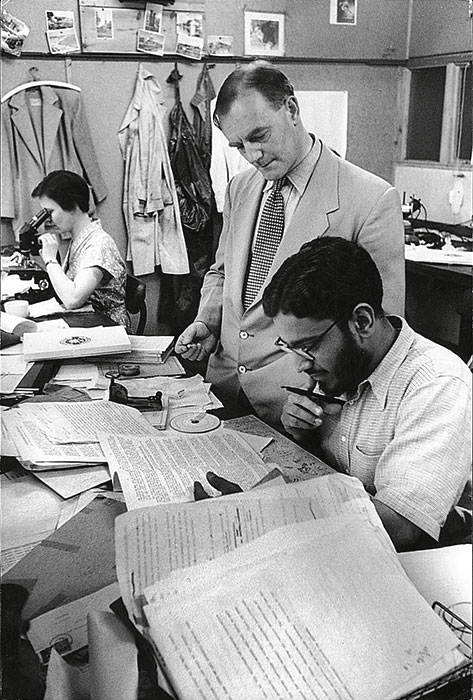
M G K Menon (seated) working with Cecil Powell on cosmic-ray physics at the University of Bristol. (Courtesy: University of Bristol)
The Indian particle physicist and cosmic-ray expert M G K Menon has died at the age of 88. Menon was educated at Jaswant College, Jodhpur, and the Royal Institute of Science in Bombay (now Mumbai), before moving to the University of Bristol in 1953, where he did a PhD in particle physics under the supervision of Nobel laureate Cecil Powell. Two years later, he joined the Tata Institute of Fundamental Research in Bombay, researching cosmic rays before becoming the institute’s director from 1966 to 1975. Later in his career, Menon was appointed to a number of notable policy positions. He became a member of India’s Planning Commission from 1982 to 1989 and was science advisor to Indian prime minister Rajiv Gandhi from 1986 to 1989. In 1989 he became minister of state for science and technology and education, and a year later was elected as a member of parliament.
Four new elements officially named
The International Union of Pure and Applied Chemistry (IUPAC) has officially named four new elements: 113, 115, 117 and 118. Element 113 was discovered at the RIKEN Nishina Center for Accelerator-Based Science in Japan and will be called nihonium (Nh). Nihon is a transliteration of “land of the rising sun”, which is a Japanese name for Japan. Moscovium (Mc) is the new moniker for element 115 and was discovered at the Joint Institute for Nuclear Research (JINR) in Moscow. Element 117 will be called tennessine (Ts) after the US state of Tennessee, which is home to the Oak Ridge National Laboratory, while element 118 will be named oganesson after the Russian physicist Yuri Oganessian, who led the team at JINR that discovered the element. “The names of the new elements reflect the realities of our present time,” says IUPAC president Natalia Tarasova. She adds that the names reflect the “universality of science, honouring places from three continents where the elements have been discovered – Japan, Russia, the US – and the pivotal role of human capital in the development of science, honouring an outstanding scientist – Yuri Oganessian”. The names were proposed in June and then underwent a five-month consultation period before they were approved by the IUPAC Bureau on Monday.
You can find all our daily Flash Physics posts in the website’s news section, as well as on Twitter and Facebook using #FlashPhysics. Tune in to physicsworld.com later today to read today’s extensive news story on creating ghost images with atoms.
Individual photons have been put into a quantum superposition of two different colours by a team of physicists in the US and Germany. Such photons could be useful for connecting different parts of quantum-information networks that operate using differently coloured light.
Superposition is an important concept of quantum mechanics that allows a physical system to be in two or more quantum states at the same time – until a measurement on the system puts it into a specific state. A photon, for example, can be in a superposition of a horizontally polarized state and a vertically polarized state until it passes through a polarimeter.
Information can be encoded into quantum states and then processed in a quantum computer, which uses superposition and other features of quantum mechanics to process information much faster than is possible with conventional computers.
Two-colour states
Normally when physicists think of a photon, it is in a well-defined energy state having a specific colour. However, quantum mechanics allows the photon to be in a superposition of two or more energy states – or colours. In this latest work, Stéphane Clemmen and colleagues at Cornell University, Humboldt-University Berlin and Columbia University have created photons that are “bichromatic” by being in a superposition of two different colours.
The team made the bichromatic photons using a technique called “Bragg-scattering four-wave mixing”. This takes place in a 100 m-long optical fibre that is pumped with two laser beams. When a “red” photon is shone into the fibre, it interacts with the laser light and is put into a bichromatic superposition of the initial red state and a second “blue” state.
The set-up can be adjusted so that the photon emerges from the opposite end of the fibre with an equal probability of being either red or blue when its colour is measured.
Phase proof
Clemmen and colleagues were also able to adjust the relative phase between the red and blue states in the quantum superposition. This allowed them to create photons that were all blue when detected, or all red, or a specific combination of red and blue. This ability to adjust the phase is proof that the photons were in a coherent quantum superposition. The team also showed that to a very high probability, the experiment detects one photon at a time – which means that the researchers are really seeing single photons in a superposition of two colours.
The technique could someday be used to connect quantum devices that operate using different colours of light. Two quantum memories, for example, could be put into a state of quantum entanglement by inputting a bichromatic photon. Such entangled memories would prove useful for a range of quantum-computing and quantum-communication applications. Other potential uses include spectroscopy measurements on living samples such as eyes, which must be done using very low levels of incident light.
Measurements made by the Alpha Magnetic Spectrometer (AMS) on the International Space Station suggest that exotic cosmic rays comprising boron nuclei have rather mundane origins. Astrophysicists divide cosmic rays into two categories: primary and secondary. Primary cosmic rays are produced in supernovae and other violent astrophysical processes, whereas secondary cosmic rays are created when their primary cousins collide with gas atoms in the interstellar medium. The vast majority of carbon-nuclei cosmic rays are thought to be primary in origin, whereas all boron cosmic rays are thought to be secondary in nature. As a result, the ratio of boron-to-carbon cosmic rays (B/C) reaching the AMS should provide a measure of the average amount of interstellar matter that the cosmic rays have passed through. There are several models that predict the shape of the B/C spectrum as a function of energy, but previous balloon-borne measurements of the B/C were not precise enough to decide which model is best. After analysing 80 billion cosmic rays collected over five years, AMS physicists have concluded that a relatively simple model developed in 1941 by the Russian mathematician Andrey Kolmogrov best describes the data. The result is of great interest to physicists studying the apparent excess of cosmic-ray positrons that reach the Earth. These particles were expected to have been created by similar secondary processes as the boron nuclei, but the AMS results could mean that there are hitherto unknown additional astrophysics sources of positrons in the universe. The research is described in Physical Review Letters.
Swiss reject nuclear phase-out
Switzerland has voted to reject an early shutdown of the country’s five ageing nuclear reactors in a referendum held yesterday. Some 54.2% of people voted “No” – on a turn-out of 45% – to phasing out the country’s nuclear plants by 2030. In Switzerland, nuclear power provides around a third of electricity – the second largest source behind hydro. Yet a few months after the Fukushima nuclear disaster in Japan in March 2011, the Swiss government abandoned plans to build new nuclear power plants and reactors. The referendum held yesterday was to decide whether those existing plants should be closed before their expected lifetime comes to an end. The plants are now likely to continue operating well into the 2030s, subject to approval from safety regulators.
Defects allow material properties to be programmed
Researchers at Purdue University in Indiana have unveiled a new type of cellular material with physical properties that can be “programmed” after manufacture. The honeycomb-like structures are made from shape-memory polymers and contain engineered defects that make the materials respond in certain ways to external forces. The programming can be done by heating the material and then applying a force to change its shape. The new shape is then retained when the material cools down. The stiffness of one material, for example, increases by 55% when it is compressed by 5%. “That is pretty impressive because ordinarily you would have to fabricate a new material with at least twice the thickness of the walls to obtain a material with a 50% increase in stiffness,” says Purdue’s David Restrepo. Possible applications of the new materials include acoustic metamaterials that can be tuned to absorb sound at specific frequencies and “stealthy” surfaces that do not reflect radar waves. Other uses, according to the researchers, include protective helmets and car seats that adjust to a driver’s weight. The materials are described in two papers in the International Journal of Solids and Structures.
You can find all our daily Flash Physics posts in the website’s news section, as well as on Twitter and Facebook using #FlashPhysics. Tune in to physicsworld.com later today to read today’s extensive news story on qubits with two colours.
Physicists in Japan have developed a new kind of compact gravitational-wave detector that works by measuring the tiny rotations of two suspended blocks of aluminium. A far cheaper alternative to the more conventional interferometer-based devices, this “torsion-bar antenna” could plug a gap in the gravitational-wave spectrum – between the high-frequency waves observable today from the ground and the lower-frequency radiation potentially detectable in space – so expanding the range of very massive objects that astronomers can study.
Gravitational waves are ripples in the fabric of space–time predicted by Albert Einstein in 1916 and detected directly for the first time last September by the Laser Interferometer Gravitational-wave Observatory (LIGO) in the US. Each of LIGO’s two detectors is a laser interferometer with two 4 km-long arms at right angles to each other. A passing gravitational wave can stretch one arm by a minuscule amount while compressing the other – and these changes can be measured with very high precision.
The LIGO detectors are shielded from terrestrial vibrations by suspending the interferometer mirrors – turning each mirror into a pendulum. As a result, LIGO cannot detect gravitational waves with frequencies below about 1 Hz, which is the resonant frequency of the mirror pendulums. Since heavier astronomical objects emit gravitational waves at lower frequencies, LIGO is only able to study relatively small objects – its first signal having been produced by the merger of two black holes weighing in at about 30 times the mass of the Sun.
Detectors in space
To observe gravitational waves at lower frequencies, many scientists are instead looking to vibration-free space. Among proposed missions is the European Space Agency’s evolved Laser Interferometry Space Antenna (eLISA), which is due to be launched in the early 2030s. This would fire laser beams between free-floating test masses arranged in a triangular formation with arms a million kilometres long, and would target waves with frequencies between about 0.1–100 mHz.
In contrast, Masaki Ando of the University of Tokyo and colleagues aim to detect low-frequency gravitational waves on the ground – at a cost of just a few million dollars. Their detection process involves monitoring the effect of passing gravitational waves on two bar-shaped test masses positioned at right angles to one another and which rotate around a common axis of suspension. Rather than recording a length change, the Japanese group instead measures a tiny relative rotation – the waves would cause one test mass to move in a clockwise direction while sending the other anticlockwise.
It is probably the best concept for a roughly 1 Hz ground-based detector proposed to date
Hartmut Grote, Albert Einstein Institute
In this set-up the resonant frequency is not fixed by the strength of gravity and the length of the suspension – as for a pendulum – but instead by the suspension’s tensional strength, diameter and length, as well as the bar’s moment of inertia. Putting forward their idea in 2010, Ando and co-workers calculated that 10 m-long bars suspended by very narrow, soft wires would have resonant frequencies as low as a few millihertz and could turn through angles as small as 10–17 of a degree. This, say the researchers, would enable them to detect significant numbers of merging intermediate-mass black holes, which can weigh in at up to about a million solar masses.
Prototype built
The researchers have now built a small prototype detector comprising two bars, each 24 cm long. The detector is shielded from vibrations and the researchers used a laser interferometer to achieve angular sensitivities of up to 10–8 of a degree.
The team also showed that its antenna would be able to obtain three independent measurements from each passing gravitational wave – the average of the two bars’ horizontal rotation and both vertical rotations. According to Ando’s colleague Ayaka Shoda of Japan’s National Astronomical Observatory, this increases the chances of detecting a wave in the first place (given that its direction would be unknown) and also provides more information about the wave’s source, such as its location and rate of spin.
Shoda says that the biggest technical challenge in building the full-scale version of the antenna will be developing the cryogenics needed to reduce vibrations in the bars and wire, pointing out that the cryopump, which will be connected to the bars, will itself vibrate. She estimates that reaching design sensitivity could take anywhere between 10 and 20 years, but says that as an intermediate step, they first plan to demonstrate an angular sensitivity of some 10–13 of a degree. At this point, their device could pick up fluctuations in the local gravitational field due, for example, to seismic waves or atmospheric sound waves. Indeed, the researchers say that their technology might one day be used to generate earthquake alerts, given that gravitational effects travel at the speed of light while seismic waves typically travel at just a few times the speed of sound.
Despite the work that still needs to be done on the torsion-bar technology, Hartmut Grote of the Albert Einstein Institute in Hannover, Germany, believes the concept is worth pursuing. “It will take quite a while, plus uncertainties of funding, to get to an astrophysically interesting sensitivity,” he says. “But it is probably the best concept for a roughly 1 Hz ground-based detector proposed to date.”
Also enthusiastic is Jan Harms of the University of Urbino in Italy. He underlines how difficult it will be to remove gravitational noise from observations, noting that ideas for carrying out such screening remain unproven. But he says it is “important to close the frequency gap” between ground-based interferometers and LISA, and believes that the torsion-bar antenna is “one of the most promising concepts” for doing so.
Spin-Hall effect switches insulator’s magnetic state
The magnetization direction of a magnetic insulator has been switched by passing an electrical current through a metal layer adjacent to it. The new switching technique has been developed by Caroline Ross, Geoffrey Beach and colleagues at the Massachusetts Institute of Technology in the US, who describe it in Nature Materials. The technique takes advantage of the spin-Hall effect, whereby an electrical current can generate a spin current that flows in a direction perpendicular to the charge current. In this experiment, the electrical current flows along a layer of platinum that is adjacent to a layer of garnet – which is a magnetic insulator. “The spin current interacts with the magnetic moment of the garnet, exerting a spin torque on it, and this torque is strong enough to switch the garnet’s magnetization,” explains Ross. The technique could be used to write information to magnetic memory devices based on magnetic insulators. Data are currently written to magnetic memories by generating magnetic fields, which is much trickier and expensive to achieve than simply creating an electrical current. “We can also use electric effects to read back the state of the magnetic material, which allows us to make an all-electrical magnetic device,” adds Ross. A longer version of this article appears on nanotechweb.org.
“Big Bell Test” will use human randomness to test quantum physics
Twelve physics labs worldwide will conduct a series of quantum-physics experiments on 30 November with the help of a global army of volunteers. Dubbed the “Big Bell Test“, the event involves members of the public playing an online game that challenges players to create random sequences of binary bits. These numbers will then be used to control experiments that perform Bell tests. These test the idea that two quantum particles such as photons can be in an entangled state in which a measurement on one particle instantaneously affects the other – no matter how far apart they may be. Named after the physicist John Bell – who derived an inequality that quantifies entanglement – Bell tests have proven difficult to do in the lab. This is because practical implementations include one or more “loopholes” whereby non-quantum effects cannot be ruled out as the cause of the observed entanglement. The Big Bell Test aims to use human-generated random numbers to ensure that measurement biases are not introduced into several Bell-test experiments. The event is co-ordinated by the Institute of Photonic Sciences in Barcelona. It begins on Wednesday at 00:00 local time in Brisbane, Australia and ends at 23:59 local time in Boulder, Colorado, US.
Quasiparticles multiplex light
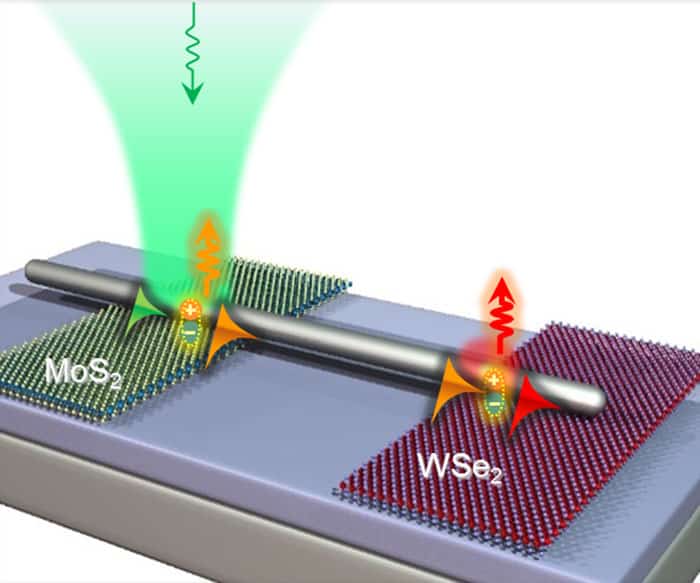
Diagram of how the multiplexer works. Green light is incident at the molybdenum-sulphide side of the device, causing orange and red light to be emitted. (Courtesy: Institute for Basic Science)
An optical device that uses quasiparticles to convert one optical signal into two signals at different colours has been unveiled by Hyun Seok Lee and colleagues at the Institute for Basic Science, in Suwon, Korea. The device comprises two tiny pieces of semiconductor – molybdenum sulphide and tungsten selenide – that are about 2 μm apart and connected by a tiny silver nanowire. The device works by shining green light onto the nanowire at the molybdenum-sulphide side of the device. This creates quasiparticles called surface plasmon polaritons (SPPs) on the silver. The SPPs then create electron–hole pairs in the molybdenum sulphide. These pairs remain bound to each other and are described as quasiparticles called excitons. Eventually, the excitons decay and some of their energy goes into creating orange light, which is emitted from the device. The remaining energy creates new SPPs, which propagate along the nanowire to the tungsten selenide. There the SPPs create more excitons, which then decay to create red light that is emitted from the device. As a result, the device works as a multiplexer that converts green light into orange and red light. The conversion process occurs very quickly and this combined with the tiny size of the device means that it could someday find use in high-speed computers of the future that use light – rather than electrical signals – to process information. The device is described in Nature Communications.
You can find all our daily Flash Physics posts in the website’s news section, as well as on Twitter and Facebook using #FlashPhysics. Tune in to physicsworld.com later today to read today’s extensive news story on a new gravitational wave detector.
Physicists in Germany have created a new optical device that can absorb exactly one photon. They say that this device, which exploits the physical properties of giant micron-sized atoms known as Rydberg atoms, could be used in optical quantum computing networks of the future.
Sebastian Hofferberth of the University of Stuttgart explains that the device first behaves like a dark sunglasses lens, but once it absorbs its first photon it becomes transparent to light. One important application of the device, says Hofferberth, could be to absorb single photons from a quantum network. Another potential application is a precise photon counter, which could be made by putting a number of the devices in series.
Atomic cloud
At the heart of the device is a micron-sized diffuse cloud of rubidium atoms cooled to near-absolute-zero temperature. To make the cloud only absorb a single photon, it is first illuminated with laser light with precisely enough energy to excite the atoms’ outermost electron into the 121st energy level. There the electron is about a thousand times further from the nucleus than it would be in the atom’s ground state. Such atoms have radii of more than a micron and are known as Rydberg atoms.
When a rubidium atom in the cloud absorbs a single photon to become the first Rydberg atom, no other atom can accept another photon from the laser beam. This is because the first Rydberg atom’s outermost electron is so far from its nucleus that it overlaps with all the other atoms in the cloud, changing their electronic structures. “The presence of the first Rydberg atom has such a strong influence that it changes the resonance conditions for all the other atoms,” Hofferberth says, adding “Rydberg atoms can interact with its neighbours about 10 microns away”. Because no other atoms can absorb photons, the cloud becomes transparent.
To verify that only one photon had been captured, the researchers use the fact that the outer electron is loosely bound to the Rydberg atom’s nucleus. “They’re very fragile,” Hofferberth says. So to verify that the cloud only absorbed one atom, he and his colleagues converted the Rydberg atom into a rubidium ion by knocking the outermost electron away. Then, they counted how many rubidium ions were present – and measured only one.
Delicate process
Creating this photon absorber was experimentally difficult, Hofferberth says. While laser cooling and trapping the rubidium atoms is a standard technique, creating the atomic cloud and the single Rydberg atom is still a very delicate process.
The concept behind this single-photon absorber was first proposed in 2011, says Alexey Gorshkov, a physicist at the University of Maryland who has collaborated with Hofferberth in the past, but was not involved in this most recent work. “These guys have implemented it, which is pretty cool,” Gorshkov says. However, he points out that when the device absorbs a single photon, it also distorts the signal of subsequent photons passing through it, which may complicate its use in quantum information applications.
Hofferberth explains that his team’s overarching goal is to create an array of general tools to precisely add, subtract, and control individual photons. “We have now built the most primitive version of such a tool for manipulating light,” he says. “We can subtract exactly one photon.” A similar single photon absorber based on a different physical mechanism was unveiled in 2015 by Barak Dayan and colleagues at the Weizmann Institute of Science in Israel and it is too early to tell which will be a more effective tool. The next step, according to Hofferberth, is to create a device that does the reverse – a collection of atoms that can produce exactly one photon.


 By Matin Durrani