

Palestinian Advanced Physics School is a first

Physicists are gathering in Jenin, Palestine, for the first ever Palestinian Advanced Physics School. The two-day meeting starts today at the Arab American University in Jenin (AAUJ), and aims to boost physics in the region and provide students with an overview of recent research developments. Some 40 Palestinian physics students studying for Master’s degrees at the AAUJ, the universities of Al Quds, An Najah and Birzeit, as well as the Islamic University of Gaza, are expected to attend.

Co-sponsored by the CERN particle-physics lab and the Sharing Knowledge Foundation, the school will include lectures on physics from prominent researchers including Philip Argyres from the University of Cincinnati, John Ellis from King’s College London, and Giorgio Paolucci, scientific director of the Synchrotron-light for Experimental Science and Applications in the Middle East (SESAME) – an international X-ray facility being built near Amman, Jordan. It will also include problem-solving sessions, an applied particle-physics tutorial, as well as a panel discussion about life in academia.

“Physics does not respect borders and international collaborations are the engines of rapid scientific progress,” notes University of Cambridge physicist Stephen Hawking, who is a member of the international advisory board for the school. “I am delighted to see that physics education and research in Palestine continues to grow and strengthen its international connections.”

Boosting science

Science in Palestine is expected to be boosted by a number of recent developments. In December 2015, Palestine signed an agreement with CERN that will let researchers join the ATLAS experiment. Previously, only a handful of scientists had worked at the lab, with some students participating in CERN summer student programmes. Palestine is also a member of SESAME, along with Bahrain, Cyprus, Egypt, Iran, Israel, Jordan, Pakistan and Turkey. The 2.5 GeV synchrotron is expected to come online later this year, and as well as boosting science in the Middle East, it will foster scientific collaboration and better relations in the region.

Enrolment in university education [in Palestine] is more than 10% higher than the average for the Arab region, and half the students are women

Adli Saleh, AAUJ

Yet the school comes at a time when physics in Palestine faces a lack of funding and travel restrictions for students and academics. Universities and other scientific institutions are also suffering from forced closures. “Despite the difficult challenges Palestinians have faced over the past several decades, they made great contributions throughout the region and the world,” says AAUJ physicist Adli Saleh , who is helping to organize the school. “Enrolment in university education is more than 10% higher than the average for the Arab region, and half the students are women, a ratio among the highest in the world.”

“Remarkable drive”

“Despite obstacles and lack of support for fundamental research, we all noticed the remarkable drive to achieve good physics from both professors and students,” says Mario Martone from the University of Cincinnati, who is on the international organizing committee for the school, told physicsworld.com. “[The school] will be a remarkable contribution to provide international support for the growing Palestinian physics programme.”

The school was created by Scientists for Palestine – a newly founded international group that promotes and supports science in Palestine. It is hoped that it will become an annual event, with the group planning other scientific activities in the coming years. “We plan to hold a similar school next year with a focus on condensed-matter physics, establish a mentoring programme for Palestinian students, as well as try to organize activities in Gaza,” adds Martone.
How much weight could Noah’s Ark support?

In the tale from the Old Testament, God spares Noah and his family from the great flood, giving him instructions to construct a vast ark to save a remnant of all the world’s animals. The story’s ending of course is a happy one. In this video, Ollie Youle from the University of Leicester, UK, considers whether such a heavily leaden vessel could really remain afloat. He takes into account a number of factors such as the total number of animal species in the world and the buoyancy forces required to counterbalance the menagerie of animals. Watch the video to find out the answer to his calculations.

This is one of a collection of videos based on student projects from the University of Leicester’s “Physics Special Topics” course, in which students use their physics knowledge to define and answer a quirky or unusual research question. The videos are part of our 100 Second Science series.

Delensing of cosmic microwave background could reveal ancient gravitational waves

Physicists in the UK and the US have shown how to use one kind of diffuse cosmic radiation – the cosmic infrared background (CIB) – to create a better map of potentially very important variations in another – the cosmic microwave background (CMB). The researchers say that their work, which involves reversing the effects of gravitational lensing, will aid in the discovery of inflationary phenomena known as primordial gravitational waves, should they exist.

The CMB is ancient microwave radiation that fills the universe. It was released a few hundred thousand years after the Big Bang when nuclei and electrons combined to form neutral atoms. Although its temperature is almost entirely uniform, it does contain patches that are slightly warmer and cooler (by a few ten-thousandths of a degree) than its mean temperature of 2.725 K. Those fluctuations have been studied in great detail by successively more powerful space observatories. These results provide strong support for the theory of cosmic inflation – which describes a period of the very early universe – and give precise values for the relative abundance of dark matter and dark energy in the universe.

Today, astronomers are very keen to study variations in the CMB’s polarization. In particular, scientists want to detect “B modes”, which are distinctive variations in the direction of the CMB’s polarization axes around hot and cold spots that are neither concentric with the spots nor create radii extending away from them. These B modes would point to the existence of hypothetical primordial gravitational waves, which would reveal exactly when the universe went through its inflationary burst of expansion.

Contamination woes

In 2014, the BICEP2 collaboration announced to great fanfare that it had observed these B modes in data from a radio telescope it operated at the South Pole, but results subsequently released by the European Space Agency’s Planck mission showed that the signal was instead probably due to emission at microwave frequencies from galactic dust. According to Patricia Larsen of the University of Cambridge, future experiments should be able to largely overcome this problem by observing the CMB at multiple wavelengths and thereby filter out the contribution from the dust. But, she says, another, “more fundamental”, problem will remain – contamination of the data by gravitational lensing.

Gravitational lensing occurs when light from a distant source is bent by a nearer, massive object. It has the effect of slightly shifting the relative position of features within the CMB, which can be useful in that it gives information about how structures formed in the early universe. Lensing also turns what is known as E-mode polarization – involving concentric and radial polarization variations – into the B-mode kind, thereby masking B-mode signals from the primordial gravitational waves.

In the latest work, Larsen and colleagues have shown how to significantly reduce this lensing effect using the CIB – infrared radiation generated by galaxies that are so far away that they cannot be resolved individually by telescopes. Such galaxies are at about the right distance to lens the CMB, and therefore the spatial distribution of their infrared emissions should provide a strong indication of how CMB lensing varies across the sky. This information can then be used to subtract the lensing effect from the primordial fluctuations.

Dusty emissions

However, dust in the Milky Way also emits copious amounts of radiation in the infrared. What Larsen and colleagues have done is to take advantage of the fact that dust emission is highly correlated at different infrared frequencies. Using observations made by Planck at two such frequencies, they were able to largely remove the galactic contamination of the CIB.

Unfortunately, the researchers didn’t have access to CMB polarization data with a high enough signal-to-noise ratio for their purposes. However, they did show that they could remove about 20% of the lensing effect from Planck CMB temperature maps – in line with theoretical predictions. Larsen reckons that that percentage could be higher for B-mode measurements, and that more refined “delensing” techniques could become available. “There are potentially better ways of doing this and we will be looking into that,” she says. “But the point is that nobody was confident that you could remove the dust well enough to do this in the first place.”

Marc Kamionkowski of Johns Hopkins University in the US, who was not involved with the current work, agrees that other delensing techniques might prove more powerful in the future. But he says it is important that scientists have for the first time backed up theoretical predictions of delensing with an analysis of real data. “With this paper, these guys have earned bragging rights,” he says.

“Best way forward”

Likewise, Gilbert Holder of McGill University in Canada says that the CIB is probably not correlated closely enough to the distribution of large-scale structure in the universe for this type of delensing to “unlock the full discovery potential of future B-mode searches”. But he believes that the CIB approach is “the best way forward with the current generation of experiments”.

Larsen points out that scientists do not know just how small any B-mode signal could be. But she nevertheless estimates that removing around half of the lensing signal will “roughly double” the chances of detecting primordial gravitational waves. “A lot of money goes into these experiments,” she adds. “So we really need to try and create the best possible chance of detecting the signal.”

A paper describing the research has been uploaded to the arXiv server.

Pokémon physics, photon torpedoes, a neutrino Ghostbuster and more

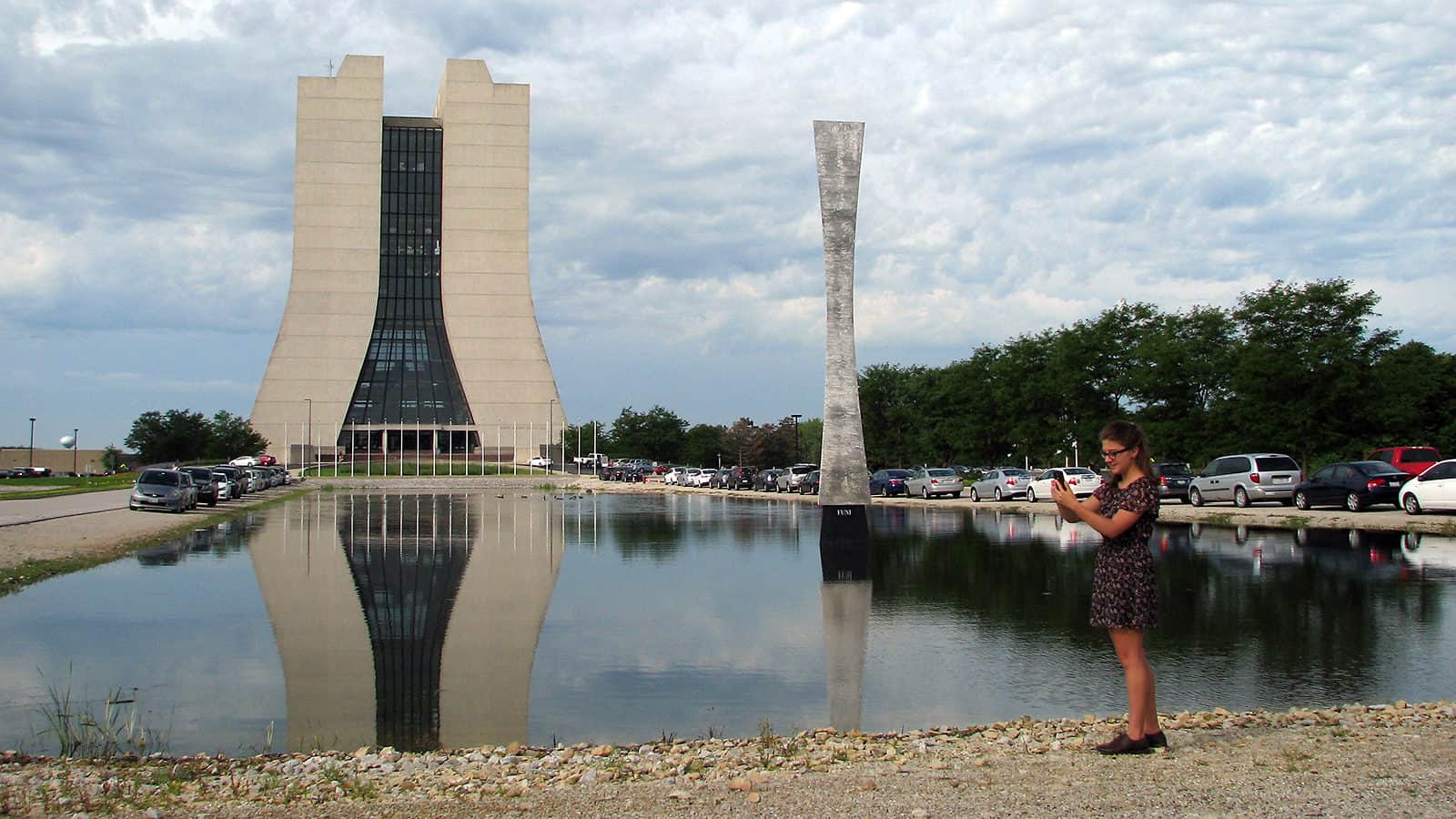
Don’t fall in the water! Pokémon Go arrives at Fermilab (Courtesy: Lauren Biron/Fermilab)

By Michael Banks and Hamish Johnston

The smartphone app Pokémon GO has been all the rage since its recent launch. The augmented-reality game is based on the Nintendo franchise and features players exploring their surroundings while trying to catch as many of the virtual creatures as possible, According to Science, Pokémon have been spotted at a number of science centres including NASA’s Jet Propulsion Laboratory while Symmetry Magazine reports that the game has also infiltrated particle-physics labs such as Fermilab, with scientists seen walking around the lab peering into their phone as they hunt down Pokémon.

(more…)

World’s most sensitive dark-matter search comes up empty handed

No evidence for dark matter has been seen in the final run of the Large Underground Xenon (LUX) dark-matter detector at the Sanford Underground Research Facility in the US. Despite running for 20 months at four times its original design sensitivity, it has seen no signs of the leading dark-matter candidate – weakly interacting massive particles (WIMPs).

“It would have been marvellous if the improved sensitivity had also delivered a clear dark-matter signal,” says Richard Gaitskell, co-spokesperson of LUX. “However, what we have observed is consistent with background alone.”

Dark matter is the name given to the mysterious substance thought to account for about 80% of matter in the universe. It does not appear to interact with light – hence its name – and has never been detected directly. Furthermore, dark matter is not described by the Standard Model of particle physics. Rather, its existence is inferred from astrophysical observations of processes such as galaxy formation and dynamics, which appear to be governed by gravitational forces exerted by dark matter.

Standard Model stand-off

This latest null result puts significant constraints on possible dark-matter candidates such as WIMPS. It also makes it less likely that dark matter will be detected at the Large Hadron Collider (LHC) at CERN. This feeds into fears that particle physicists may be facing the “nightmare scenario” in which the LHC and contemporary experiments such as LUX find no significant evidence of physics beyond the Standard Model.

Despite its elusive nature, the Milky Way is expected to be chock-full of dark matter, and the stuff should be streaming constantly through the Earth. Physicists have built several generations of increasingly sensitive detectors such as LUX to look for the tiny interactions that could occur between dark matter and normal matter. While most detectors have not seen any such interactions, others have reported tantalizing – and sometimes controversial – hints of dark-matter particles.

LUX is buried1500 m under the Black Hills in South Dakota, where the overbearing rock shields its sensitive detectors from cosmic rays and other background radiation. The detector is a 2 m-tall titanium tank filled with 350 kg of liquid xenon that is cooled to –108 °C.

Flashes of light

LUX is designed to detect WIMPs, which should collide occasionally with its xenon atoms. If this occurs, the recoiling atom will create light and some free electrons. The electrons are accelerated by an electric field, creating more light when they reach a thin layer of xenon gas at the top of the tank. Light signals at the collision point and the top of the tank are collected by extremely sensitive light detectors. The energy of the collision can be deduced from the brightness of the light. Requiring two signals from each event makes it easier to discriminate against light created by background radiation.

LUX was installed in 2012 and three months of data were analysed in 2013 – revealing no evidence of dark-matter collisions. Now, the LUX team has analysed data taken from October 2014 to May 2016 – the final run of the experiment. Half a million gigabytes of data have been processed using high-performance computing facilities at Brown University in Rhode Island and the Lawrence Berkeley National Laboratory in California.

Berkeley Lab’s Simon Fiorucci says, “The result is unambiguous data we can be proud of and a timely result in this very competitive field – even if it is not the positive detection we were all hoping for.”

WIMPs “alive and viable”

The LUX null result could help physicists to gain a better understanding of the nature of dark matter because it provides crucial information about what dark matter is not. This allows physicists to hone their dark-matter models by eliminating a large range of possible particle masses and interaction strengths with normal matter. While a null result might sound like bad news for the WIMP model, Gaitskell says that it “remains alive and viable”.

LUX physicists are now scouring their data for evidence of other hypothetical dark-matter particles such as axions and axion-like particles.

Now that LUX has shut down, many of its physicists have turned their attention to the experiment’s successor, the LUX-ZEPLIN experiment. To be built at Sanford, LUX-ZEPLIN will be based on 7000 kg of liquid xenon and is expected to be 70 times more sensitive than LUX when it starts taking data in 2020.

The results were presented yesterday at the Identification of Dark Matter 2016 conference in Sheffield, UK. A PDF of the presentation is available for download.

Bringing Native American voices back to life

The collection is the largest and most diverse early repository of Native Californian music and speech, comprising nearly 3000 wax cylinders with recordings made by anthropologists between 1901 and 1938. Over time, however, the originals and their copies have inevitably degraded, as these materials are prone to imperfections caused by things such as dampness and temperature variations. What’s more, every time you play back the wax cylinders using a stylus you damage them ever so slightly more.

In order to preserve these historic documents and to make them more accessible to Native American communities today, a team at Berkeley is creating digital versions where the audio is enhanced. The team employs a technique known as IRENE, which scans the surfaces of the cylinders to create high-resolution images. Software is then used to interpolate some of the gaps caused by damage to the surface, while also removing unwanted background noises caused by mould and dust. The images are converted into digital audio files to be preserved in digital libraries.

IRENE – standing for Image Reconstruct Erase Noise Etcetera – was developed by Carl Haber of the Lawrence Berkeley National Laboratory (LBNL) who features in the podcast. Haber is an experimental particle physicist who works on the ATLAS experiment at CERN’s Large Hadron Collider where he develops detectors to track particle collision in high precision. Around the turn of the Millennium, Haber became interested in applying his imaging knowledge to the preservation of historic media.

This podcast also includes examples of some of the early uses of IRENE such as bringing to life the oldest known audio recording at the time – a version of the French folk song “Au clair de la lune” recorded in soot on a piece of paper by the French inventor Édouard-Léon Scott de Martinville in 1860. You will also hear the voice of Alexander Graham Bell, recorded on a wax disc in 1885 at the famous Volta lab in Washington DC. This audio clip is part of the Smithsonian’s National Museum of American History’s collection of early experimental sound recordings. It is the only confirmed audio recording of Bell’s voice, which was identified in 2013 by the museum in collaboration with Haber and his LBNL colleague Earl Cornell and Peter Alyea, digital conversion specialist at the Library of Congress, with the help of Indiana University scholar Patrick Feaster.

In the podcast, Dacey visits the university library at Berkeley to see the scanning in action (see the video above). That is where he meets the anthropologist Ira Jacknis who tells the remarkable story of Ishi, who had spent several years alone before wandering into the Californian town of Oroville in 1911. Ishi lived out the remainder of his days at an anthropology museum in San Francisco where he was studied extensively by anthropologists. Aware of the sometimes asymmetric power balance between anthropologists and the people they study, Jacknis explains how the audio restoration project will involve current Native communities. One of the main aims of the project is to provide these communities with access to the recordings, which could provide important insights into their cultural heritage.

Snell’s law for spin waves measured at long last

The first experimental verification of Snell’s law for spin waves has been carried out by an international team of researchers. By imaging the incident, refracted and reflected waves at interfaces in thin ferromagnetic films, the team has shown how the law is different for spin waves as compared to light. According to the researchers, their work is a step forward for the emerging field of “magnonics”, whereby information could be encoded in spin waves.

In optics, Snell’s law predicts the path taken by a beam of light travelling from one medium to another. The formula outlines the relationship between the angles of incidence and refraction, when light or other waves pass through a boundary between two different isotropic media. Passing through such boundaries causes the waves to change their speed, causing reflection and refraction.

Spin boundaries

Spin waves occur in magnetic materials where a disturbance changes the magnetic ordering within the material. These collective excitations can be described as quasiparticles known as magnons and occur in magnetic lattices with continuous symmetry. The field of magnonics aims to use these propagating spin waves to transmit information from one medium to another and store data in nanoscale devices. Therefore researchers developing such devices need to know how these waves will reflect and refract at boundaries.

It is currently a challenge to efficiently manipulate such waves, and understanding Snell’s law could point to new ways of steering magnons. Miniaturization is also a problem because spin waves are currently generated using microwave antennas, which create magnons with relatively long wavelengths. Passing such magnons through different media could offer a way of reducing their wavelength.

Now, Christian Back and Johannes Stigloher at the University of Regensburg in Germany have measured how Snell’s law applies to spin waves. While there have been previous theoretical studies, this is the first experiment that involves the complete imaging of spin waves impinging onto an interface between two media of different thickness.

Back told physicsworld.com that the team’s main aims were to demonstrate spin-wave steering and to study the reduction of wavelength when transmitting a spin wave into a medium with different refractive index. “This may help in reducing the wavelength while keeping the spin wave amplitude large,” he says, adding that “one could imagine a series of ‘thickness steps’ thus steering to more extreme angles while reducing the wavelength for each step.”

Smaller wavelengths

For its experiments, the team used a thin magnetic film – which has two regions with different thicknesses that allow the waves to refract – made up of a nickel-iron permalloy (Ni81Fe19). This material has a particularly low damping for magnetic excitations, and allows the researchers to observe the spin waves as they travel over a large distance. The researchers then use electron beam lithography to pattern a microwave-antenna structure onto the film. This produces time-varying magnetic fields that launch spin waves into the film. The film itself is placed in an external magnetic field, which is aligned in parallel to the antenna, to ensure that it is uniformly magnetized. At the thickness step, all of the spin waves suddenly experience a different dispersion relation – which relates the wavelength of the wave to its frequency – and are refracted and reflected.

The researchers then performed temporally and spatially resolved magnetic imaging to observe the wave propagation, reflection and refraction. “In essence, we record a time-resolved movie of the travelling spin waves,” says Back, explaining that the data are then used to extract the wavelength and the refracted angles of the waves. This is then used to deduce Snell’s law.

The team observed that the spin-waves’ wavelength and amplitude both changed at the step and that reflected and refracted spin waves formed – just as happens with light. But some deviations were also seen that are related to magnetization of the film, the externally applied magnetic field, and dipolar interactions between spins. They found that the angle between the spin waves and the applied magnetic field alters the wave dispersion, making it directionally dependent.

Deviations from the law

“We observe that there are deviations from Snell’s law in optics due to the anisotropic dispersion relation of dipolar spin waves,” says Back. He adds that these deviations become obvious when looking at refracted angles of the spin waves, which increase as a function of the incoming angle to a maximum around 40° and then decreases again. This behaviour is very different from light, which does not see the decrease. By taking all of their observations into consideration, the researchers could develop Snell’s law for spin waves that correctly predicted their experimental observations. “The new ingredient for a magnetic thin film is the highly anisotropic dispersion relation for dipole-exchange spin waves which is at the heart of our observations,” says Back.

Bruce Gaulin at McMaster University in Canada, who was not involved in the study, is impressed with the team’s work. “I think this very quantitative study sets the groundwork for manipulating spin waves in the type of architectures that are likely to be important for applications.” More specifically, Gaulin believes that the research “clearly demonstrates an elegant solution to reducing spin-wave wavelengths on transmission across an interface, and shows just how quantitative an understanding of ‘spin wave optics’ can be”.

The research is described in Physical Review Letters.

Lateral Thoughts: Playing favourites

By Margaret Harris

This is the fourth in a series of blog posts about “Lateral Thoughts”, Physics World’s long-running humour column. Click to read the first, second and third posts.

As the editor in charge of Lateral Thoughts – Physics World’s long-running column of humorous or otherwise offbeat essays on physics – I am sometimes* asked whether I have a favourite. It’s an interesting question, and back in 2014, when I was writing a series of posts for this blog about how Lateral Thoughts had changed over the (then) 25-year history of Physics World, I promised to answer it.

This, however, proved easier said than done. In the weeks that followed my foolish pledge, the Physics World inbox (pwld@iop.org) received a whole series of Lateral Thoughts essays that could have been my “favourite”. One of them, published in May 2014, was John Swanson’s discourse on the quantum nature of the 20:08 train from Bristol Parkway. Another, which appeared in June 2014, contained Chris Atkins’ gloriously straight-faced analysis of the physics of Poohsticks. A third, in July 2014, saw kung-fu expert Felix Flicker explore an unexpected connection between the mathematics of spinors and the art of escaping from an armlock. Then, in August 2014, John Evans pondered various physics-based ways of improving his running – such as refining his aerodynamic profile by developing a beer belly. (Evans, incidentally, went on to write a Lateral Thought on cycling in October 2015, and this month we published his essay on swimming. This means he’s now completed a lateral-thinking triathlon. Congratulations!)

(more…)

Another giant leap

When Neil Armstrong took the first steps on the Moon in July 1969, his soon-to-be-legendary words crossed 230,000 miles of space to reach millions of people around the world: “That’s one small step for [a] man, one giant leap for mankind.” Armstrong’s statement acknowledged that this monumental achievement was not his alone. Those first steps were made possible by the efforts and ingenuity of multitudes that, together, made the rockets and spacecraft that had brought men to another world. And as Nathalia Holt notes in her new book about a group of women working in the American space industry, these technologies weren’t built by men alone.

In Rise of the Rocket Girls: the Women Who Propelled Us, from Missiles to the Moon to Mars, Holt – a research biologist by training – foregrounds the contributions of a cohort of women whose labour was subsumed within the “mankind” of Armstrong’s historic statement, and largely forgotten in popular recollections of the Moon effort. Focusing on the history of the Jet Propulsion Laboratory (JPL) from the mid-1930s (when it was founded by the California Institute of Technology’s “suicide squad” of rocket engineers) through to the present day, Holt builds her narrative primarily on the recollections of the women who worked there as “computers” – a term we now associate with electronic machines but that once described a (usually female) mathematician. By interspersing memories of office hijinks, technical victories and failures, and the personal lives of her subjects, Holt’s narrative conveys a palpable intimacy that reflects the close relationships maintained by this group of women over decades of professional and personal camaraderie.

Holt focuses on her subjects’ participation in (and reactions to) important moments in space history, such as the competition between US military branches to get the first American satellite into orbit and the persistent difficulty in creating a single-stage-to-orbit rocket. In describing these moments, Holt’s literary skill shines brightly. She notes, for instance, that in helping each other work through monumental challenges of physics and engineering, the women computers and their male engineer counterparts at JPL worked like a multistage rocket – segmented but ultimately successful. Milestones in the computers’ lives, from pregnancy and marriage to stillbirth and divorce, serve as signposts to punctuate the successes and failures of the rocket programmes at JPL.

In addition to retelling these personal histories, Rise of the Rocket Girls doubles as a concise, accessible introduction to various scientific and mathematical concepts, from the Coriolis effect to Doppler shift. In an artful meta conceit, Holt traces the history of the electronic computer alongside the history of human computers at JPL. Occasionally, deviations to discuss the rise of Microsoft and Apple or the causes of the Challenger accident, for example, can be a bit tangential. However, as an introduction to the American space and computing industries, Holt’s text covers a massive amount of ground – in spite of a few glaring omissions, such as the end of the Cold War and its impact on the main subjects of this narrative.

Readers should, however, be advised of some critical oversights. Holt misrepresents the range of a rocket as its altitude, and occasionally uses figures that do not correspond to most cited historical records of the launcher in question. And, frustratingly, when the computers discuss working with “data,” we never get a chance to learn more about the data in question – how they were collected, by whom, and what the data actually looked like, which would go a long way towards making the experience of these women real to readers.

At times, the intimacy and accessibility of Holt’s narrative voice becomes a double-edged sword. Basing her book on the recollections of a few, mostly white women, Holt’s narrative voice adopts the vocabulary and perspective of her subjects. For instance, Holt typically describes the JPL computers as “girls”. While this is faithful to the terminology used by both the women and the men with whom they worked, it does not conscientiously critique the infantilizing meaning of this word, both then and particularly now. As a result, Holt unintentionally recapitulates the sexism of computers’ experiences in what otherwise reads as a sympathetic historical narrative. We also see this when Holt physically describes each of the women – often focusing on their beauty or style choices – while eschewing such descriptions of men.

In another troubling aspect of the book, Holt discusses instances in which women left their jobs after getting married or pregnant, either because they were forced to leave, or because they decided to adhere to social norms. Those who did not return to JPL later in life simply disappear from the narrative – an unfortunate literary replication of the very sexism that forced these women from the lab in the first place. A particularly glaring example concerns Janez Lawson, the sole black woman of the group. Her story ends with Lawson leaving JPL largely because racial politics prevented her from living in predominantly white Pasadena – and unlike the other characters, who receive an “ever after” treatment in the final chapter, we never find out what happens to Lawson once she departs the lab. Given that two women of colour factor prominently in the narrative – and several unmentioned women of colour worked as computers at JPL during the Cold War – Holt pays only superficial attention to the compounding effects of race and gender on interpersonal relationships at JPL. The upcoming book Hidden Figures: the American Dream and the Untold Story of the Black Women Mathematicians Who Helped Win the Space Race by Margot Lee Shetterly will likely address this omission.

Perhaps surprisingly, given that this book focuses on the struggles and triumphs of women in a predominantly male institution, Holt barely mentions the women’s movement that took off at the same time as her subjects worked to get rockets off the ground. Her final conclusion, a counterpoint to other Cold War gender histories, makes a bold claim: “While protestors were demanding equal rights for women across the country, the women at JPL had created their own equality. They had formed the lab in their own image, building an environment amenable to women, where their work and contributions were every bit as valued as those of their male counterparts.” Taken at face value, and based on the contented reflections of a small group of women who lived through it, this statement is probably true. However, hindsight typically provides unstable support for sweeping historical arguments. It is likely that not all women who worked in the space industry during this period will agree.

  • 2016 Little, Brown and Company £19.11/$27.00hb 304pp

Web life: Universe Awareness

So what is the site about?

If you’ve ever taken a young child to a planetarium – or remember visiting one yourself when you were younger – you’ll appreciate just how exhilarating it can be to encounter the wonders of the cosmos for the first time. Not all children have access to such opportunities, though, and even those who grow up in rich countries with good local science museums generally visit them only now and then. This is where the Universe Awareness project (UNAWE) comes in. Founded in 2006 by George Miley, an astronomer at the University of Leiden, the Netherlands, UNAWE aims to bring the beauty and grandeur of the universe into the classroom, as a means of inspiring children aged four to 10 and encouraging them to develop an interest in science.

How do they do that?

The UNAWE site is home to a wide range of resources, from videos and posters to a programme called The Awesome Amateur Astronomer that aims to introduce children to “every aspect of astronomy” in 10 steps (Step 1: Observe the night sky). One of the most interesting resources is Space Scoop, a site that hosts kid-friendly news stories about recent astronomy research. The stories are taken from press releases issued by several international astronomy organizations and then rewritten in age-appropriate ways by UNAWE staff members and volunteers.

Who is behind it?

The University of Leiden remains a major partner, and UNAWE has also received substantial support from the European Union through a programme called EU Universe Awareness (which ran from 2011 to 2013) and an ongoing effort, EUSPACE-AWE, that aims to build enthusiasm for space science and engineering. Other collaborators include the European Southern Observatory (which supplies many of the press releases for Space Scoop) and the National Astronomical Observatory of Japan.

Anything else I should be aware of?

Theoretically, Space Scoop is available in 40 languages, from Albanian and Arabic to Vietnamese and Welsh. However, several of the non-English versions appear thinly populated; at the time of writing, the most recent Arabic articles were posted in June 2013 and we couldn’t actually find any Space Scoop articles written in Albanian. Still, it’s possible to read kid-friendly scoops about radio stars in Danish, comets in Farsi and dwarf planets in the central American language K’iche’, among many others.

Can you give me a sample quote?

From a 30 May Space Scoop about a new class of galaxies called “red geysers” that contain supermassive black holes: “Almost everyone is afraid of the dark at some point in their life. Creaking floorboards, rustling curtains or random bumps in the night will fill them with terror. But it’s not the dark itself we find so terrifying, it’s the fear of what is lurking in the dark…But we all know the boogeyman isn’t real, so is there really anything to be afraid of? Maybe not on Earth, but there are monsters hiding in space – they’re called black holes. Black holes form when a massive star dies. Anything that gets too close to a black hole is pulled to it with such a strong force that it has no chance of escape. The monster will gobble it up! To make these monsters even more menacing, black holes are all but invisible. Until they start to feed… Black holes are messy eaters. As it gobbles up material, it is spraying out hot cosmic gas like cookie crumbs…The hot gas is heating up the entire galaxy to the point where it is unable to make new stars.”

Copyright © 2026 by IOP Publishing Ltd and individual contributors