A simple study of how loops of ribbon respond when tightened has revealed a variety of different behaviours, according to physicists in Japan. Their results could help to explain biological phenomena such as how proteins interact with DNA or how pea-tendrils climb.
“The ribbon shape is very common,” says Hirofumi Wada, a physicist at Ritsumeikan University in Japan. Ribbon-shaped phenomena range from helical bacteria to proteins and nanomaterials. “To study many biological problems, we have to understand more deeply the basic properties of ribbon-like objects,” he says.
The experiment performed by Wada and colleagues was straightforward: put a loop in a paper ribbon, clamp it at both ends and pull on the loop to see what happens. “We thought in the beginning that somebody had already done it,” Wada says. “Somebody should have already done it.”
Non-intuitive behaviour
Although a ribbon appears simple, its behaviour is actually considerably more complicated than a 1D wire, explains Julien Chopin of ESPCI in France, who was not involved in the research. Unlike a wire, a ribbon has an extra dimension – its width. While bending a ribbon like a wire is easy, it is difficult to bend it along this extra dimension. Chopin says this extra constraint on the ribbon’s geometry results in complicated, non-intuitive behaviour.
In real life, all filaments have some width, so it is not always clear whether a flat, long filament behaves more like a 1D wire or a 2D ribbon. Wada and his colleagues found the parameter that classified a looped filament as ribbon-like rather than wire-like is the ratio of the filament’s width to the height of the loop.
It’s fun for basically anybody, not just scientists
Hirofumi Wada, Ritsumeikan University
They found that depending on the loop’s initial configuration, pulling on it could result in three different geometrical shapes. The loop could shrink until it formed a “kink”, which creased the paper. The loop could also form two types of twisted shapes called a “helicoid” and a “pop-out”, both of which do not crease the paper. By performing this experiment thousands of times with thousands of paper ribbons, they found which geometrical conditions would result in the crease, the helicoid or the pop-out.
The researchers also discovered that the loop’s behaviour depends only on the geometry of the ribbon and not its material. “However, at the same time, we are not yet sure whether this property is really universally applicable,” says Wada.
Scale models
These macroscopic ribbons serve as a practical scale model for studying the physics of microscopic ribbons. Although they are much larger than structures found in bacteria or nanostructures, paper ribbons are much easier to control and manipulate. “With this kind of macroscopic experiment, you can measure almost anything easily,” Chopin says. “You can build an understanding of microscopic ribbons from them.”
Furthermore, Wada says, paper is cheap. “Also, it’s fun for basically anybody, not just scientists,” he adds. Wada keeps several ribbon-shaped toys in his office, such as a helical rainbow streamer dangling from his office ceiling.
The team’s next step is to try the experiment with different materials to better understand how elasticity affects the pulled-loop’s geometry. The researchers have already begun similar experiments to study loops using rubber bands.
Supernova monitor for Super-Kamiokande observatory
Supernovae are not a common occurrence in our galaxy. While this is most likely a good thing for our continued survival, the Super-Kamiokande neutrino detector in Japan aims at detecting neutrinos that are produced during these super-energetic celestial explosions. Only three or four supernovae happen in our galaxy every century, meaning that researchers want to be prepared for when one of these takes place. Now, a new computer system has been installed at the underground Japanese lab that will monitor local supernovae (relatively speaking) in real time and inform the scientific community of the arrival of neutrinos. “It is a computer system that analyses the events recorded in the depths of the observatory in real time and, if it detects abnormally large flows of neutrinos, it quickly alerts the physicists watching from the control room,” says Luis Labarga Echeverría, a physicist at the Autonomous University of Madrid in Spain and a member of the collaboration. With the new monitoring system, collaboration members will be able to assess the significance of an incoming signal within minutes and see whether it is actually from a supernova within the Milky Way. If it is, they can issue an early warning to all interested research centres around the world, as well as the celestial co-ordinates of the source of the neutrinos. This gives observatories around the globe a chance to point all of their instruments towards the source. Neutrinos are of fundamental interest to physics, while also providing us with invaluable information about the death of stars and the formation of black holes. The research is published in the journal Astroparticle Physics and a preprint is available on arXiv.
Brookhaven technologies bag three 2016 R&D 100 Awards
The US Department of Energy’s (DOE) Brookhaven National Laboratory has bagged three awards at the 2016 R&D 100 Awards, which annually recognize the 100 most innovative technologies and services of the past year. The three award-winning technologies include the hard X-ray scanning microscope with multilayer Laue lens nanofocusing optics (a joint award with DOE’s Argonne National Laboratory), the MoSoy catalyst, and nanostructured anti-reflecting and water-repellent surface coatings. The custom-built X-ray microscope – developed by physicists Evgeny Nazaretski and Yong Chu, and team – has a spatial resolution of better than 15 nm – equivalent to 50,000 times smaller than a grain of sand. The only one of its kind, this microscope is also the recipient of a 2016 Microscopy Today Innovation Award. The MoSoy catalyst is a novel catalyst derived from using olybdenum (Mo) and renewable soybeans (Soy). This catalyst produces hydrogen in an environmentally friendly, cost-effective way, eliminating the need for expensive metal catalysts such as platinum to speed up the rate at which water is split into hydrogen and oxygen. The nanotextured “coatings” or etchings were fabricated at Brookhaven’s Center for Functional Nanomaterials (CFN) – the textured surfaces absorb all wavelengths of light from any angle and also repel water extremely efficiently. “It is an honour for Brookhaven Lab to be recognized as among the institutions where innovative research and development is taking place,” say’s lab-director Doon Gibbs. “Our three winners this year illustrate the wide range of scientific discovery happening at Brookhaven.”
Droplets of quantum liquid spotted in ultracold gas
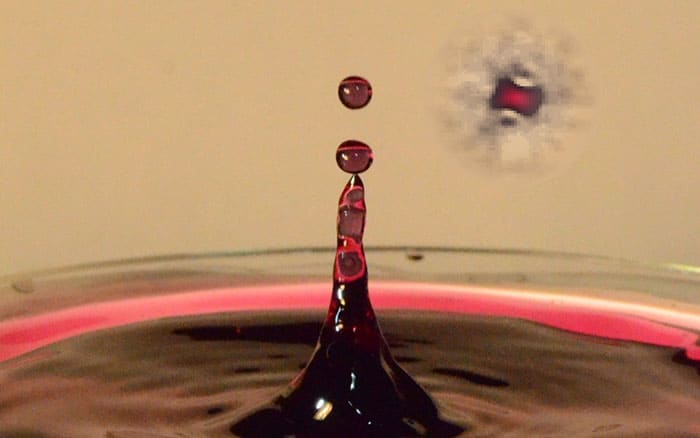
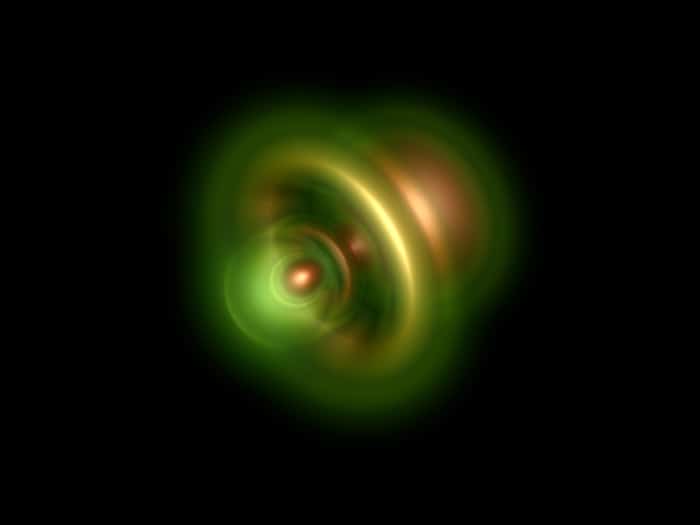
Condensed matter: false-colour image of a quantum droplet (upper right) shown with drops of water (centre). (Courtesy: University of Stuttgart/PIV)
Droplets of a dilute “liquid” have emerged from a gas of ultracold atoms created by Tilman Pfau and colleagues at the University of Stuttgart in Germany. The team cooled dysprosium atoms to a few billionths of a degree above absolute zero. The atoms were trapped using light and magnetic fields, which were fine-tuned to create a repulsive short-range interaction between the atoms. There is also a long-range attractive magnetic interaction between dysprosium atoms, and together these interactions are similar to the forces between molecules in a conventional liquid. Pfau and colleagues found that tiny droplets condensed out of the gas when it was chilled. The droplets contained a few thousand atoms and the researchers found that a minimum number of atoms is required to stabilize a droplet. Describing its work in Nature, the team was also able to use quantum mechanics to calculate the critical number of atoms required to form a droplet – which was 600–800, depending upon the applied magnetic field. Although the droplets have densities that are 10–8 that of liquid_helium droplets, the team says that its droplets could provide insight into much denser quantum liquids and even atomic nuclei.
You can find all our daily Flash Physics posts in the website’s news section, as well as on Twitter and Facebook using #FlashPhysics. Tune in to physicsworld.com later today to read today’s extensive news story on the physics of creasing ribbons.
Active galactic nuclei dims due to starving black hole
Over the past 30 years, astronomers have been studying a distant “active galaxy” that sporadically brightens and dims. Dubbed Markarian 1018, the galaxy has perplexed researchers as it shifts between bright and dim phases, which has rarely been seen before. By observing this galaxy in detail using a variety of telescopes including NASA’s Chandra X-ray Observatory, ESO’s Very Large Telescope (VLT), and others, astronomers have now concluded that the dimming occurs when the supermassive black hole at the heart of the galaxy is deprived of fuel (in the form of infalling matter) to illuminate its surroundings. “Active galactic nuclei” or AGN are some of the brightest objects in the universe and are classified into two types, depending on the light they emit – one type of AGN tends to be brighter than the other. Some AGN have been observed to change once between these two types over the course of only 10 years. But Markarian 1018 has changed type twice – from a faint to a bright AGN in the 1980s and then back to a faint AGN within the last five years. Indeed, during the second change the AGN became eight times fainter in X-rays between 2010 and 2016. The researchers were finally able to show that the active galaxy had faded because the black hole was being starved of infalling material – this also explains the fading of the AGN in X-rays. The lack of fuel could have been caused via interactions with a second supermassive black hole in the system. The research is described in two papers, published in the journal Astronomy and Astrophysics.
Australian and Chinese particle-physics institutes come together
The Australian ARC Centre for Particle Physics at the Terascale (CoEPP) and the Chinese Institute of High Energy Physics (IHEP) have signed a memorandum of understanding to establish scientific exchange, collaboration and co-operation between the two organizations, at a ceremony held in Beijing yesterday. “Today we established the formal collaboration. It will benefit to the development of high energy physics in both countries, especially to the future large science facilities,” says IHEP director Yifang Wang. The agreement hopes to encourage scientists from both institutions to share their expertise and collaborate on a number of initiatives, with a special focus on the planned Circular Electron Positron Collider (CEPC). “This formalization of a partnership with IHEP is a great step for Australia. We share a great many research interests and I look forward to many years of successful collaboration with our colleagues at IHEP,” adds CoEPP director Geoffrey Taylor.
Freestanding graphene made by rapid cooling
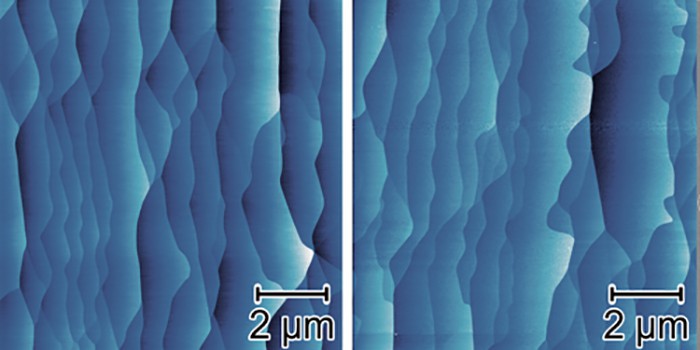
Cold carbon: atomic force microscope images of graphene on silicon carbide before (left) and after rapid cooling. (Courtesy: J Bao et al./Phys. Rev. Lett.)
A new technique for making freestanding graphene has been developed by Wataru Norimatsu and colleagues at Nagoya University in Japan. Graphene is a sheet of carbon one atom thick that has a range of properties that are technologically significant. It can be created by heating a piece of silicon carbide so that silicon atoms are removed from the surface, leaving behind carbon atoms that form graphene. An important shortcoming of this method is that bonds between carbon atoms in the graphene and silicon atoms in the substrate have a detrimental effect on the desired electronic properties of the graphene. Now, Norimatsu and colleagues have come up with a way of breaking the bonds to create freestanding graphene. Silicon carbide is first heated to over 1000 K to create graphene and then the sample is plunged into liquid nitrogen to cool it rapidly to 77 K. Graphene expands when cooled, whereas silicon carbide contracts. This breaks the bonds between the graphene and the substrate, leaving high-quality graphene, as described in Physical Review Letters.
Extending outreach: today is a worldwide celebration of science centres and museums.
By Matin Durrani
Today is not only World Science Day for Peace and Development (come on, don’t tell me you didn’t know) but also the world’s first ever International Science Center and Science Museum Day, which goes by the clunky acronym ISCSMD.
The grandiosely titled day seeks to “create new ways for our institutions to proactively address global sustainability while reaching increasingly diverse audiences”.
Building on UNESCO’s theme of “science for peace and development”, outcomes from the day’s events and discussions will be presented at the Science Centre World Summit 2017 in Tokyo next November.
Oil executive: Harold Hamm is tipped to head the US Department of Energy. (Courtesy: CC BY-3.0/ David Shankbone)
US scientists have responded to the choice of Republican Donald Trump as president-elect with a mixture of astonishment and anxiety. Having anticipated the election of Democrat Hillary Clinton, who was backed by a team supportive of science, researchers now fear a future in which science policy may play a minor role in public affairs.
The most difficult issue for scientists is gauging the position the Trump administration will take on science. “He didn’t say much, if anything, about science during the campaign,” says physicist Neal Lane, a former presidential science adviser who is now a senior fellow at Rice University’s James A Baker III Institute for Public Policy. “Trump has said so many different things, many of them contradictory, that it is not at all clear what he will do.”
That view is shared by physicist Michael Lubell from City College of New York, who is also public-affairs director at the American Physical Society. “We’re looking at a black hole,” he says. “Nobody knows what this guy is going to do – and I’m not sure he does.”
The community’s angst reflects the severity of the scientific issues that Trump faces once he is inaugurated on 20 January. “[He] will confront a broad range of global challenges from addressing climate change and securing our energy future to sustaining investments in scientific research efforts in numerous areas, including medicine,” notes a statement from the American Association for the Advancement of Science (AAAS). Rush Holt, a physicist and former Democratic congressman who is AAAS chief executive, adds that Trump “must be prepared to advance science, technology and education to drive economic progress, innovation and jobs, and to improve people’s lives”.
Little contact
Uncertainty about the incoming administration’s ability to meet those challenges extends to the identity of key members of the Trump campaign. “We tried to make contact with his campaign people on science,” says Lubell. “The only name that surfaced was from a small college in Iowa with a background in economics – and we got no response from him.”
Adding to the scientific community’s concern is that Republicans, some of whom take a sceptical view of certain aspects of science, will control both the Senate and the House of Representatives. “I expect that Trump will defer to the Republican-controlled Congress on priorities for science, which would not bode well for some fields,” says Lane, adding that “even peer review has been attacked” by some House members.
Nobody knows what this guy is going to do – and I’m not sure he does
Michael Lubell, City College of New York
Congress holds the power of the purse and many Republican members want to reduce the national budget deficit by cutting back on spending. President-elect Trump has stated his desire to reduce taxes, increase spending on defence and infrastructure as well as maintain current spending levels on social initiatives. This would leave little cash for discretionary programmes, including support for scientific research. “Many of the things Trump has said he planned to do are very costly,” says Lane. “Conservatives in Congress are not likely to want to raise money through taxation; they’re more likely to reduce revenues. So nondiscretionary spending, including federal research budgets, might be expected to see continued cuts.”
Fox guarding the hen house
One area of science that is almost certain to suffer under the new administration and Congress is climate change. Donald Trump has described global warming as a hoax perpetrated by the Chinese government to harass the US, while many Republicans deny there is a human contribution to global warming. “I’m afraid that our worst fears have been realized,” says climatologist Michael Mann from Pennsylvania State University. “If Trump makes good on his campaign promises and pulls out of the Paris treaty, it is difficult to see a path forward to keeping warming below dangerous levels – it might make it impossible to stabilize planetary warming below an increase of 2 °C.”
The stewardship of science-based government agencies will, of course, depend on the individuals nominated to head them. Again, the Trump campaign has revealed little information, but a few clues have emerged. Harold Hamm, an oil-industry executive from Oklahoma, has emerged as a possible head of the Department of Energy. This appointment, if it happens, would be in contrast to the approach of president Barack Obama who selected senior academics, such as the Nobel laureate Steven Chu, to that position. Indeed, climate-change sceptic Myron Ebell of the Competitive Enterprise Institute, currently heads the Trump transition team for the Environmental Protection Agency – in what Mann describes as “a case of the fox guarding the hen house.”
The most important appointment for the scientific community is that of presidential science adviser, who traditionally heads the Office of Science and Technology Policy (OSTP). “The nation’s incoming president will need to move quickly to appoint a respected scientist or engineer to serve as the next science adviser, to ensure immediate input related to science and technology,” says Holt. “The next science adviser will need to be integrated at the earliest possible stage into the administration’s decision-making process – not just on topics with an obvious science connection such as infectious disease response, but on matters concerning diplomacy, cyber security, agriculture and advanced manufacturing, as well as resilient infrastructure, which also relate to science and technology.”
However, Lubell wonders whether Trump will even appoint one. “He’ll face a problem finding a science adviser, if he wants one,” he says. “No law says the position must be filled and if Trump says ‘we don’t need the OSTP’, Congress won’t fund it.”
Pro-science senators
Yet amid the gloom, analysts still see a glimmer of hope for science. “There are pro-science Republicans and Democrats in the Senate, even some in the House,” adds Lane. While Lubell points to Trump’s campaign catchphrase: Make America Great Again. “The slogan provides an opportunity for him to say we need to claim American leadership in science,” he says. Mann expresses hope that “the world will find a way to move forward in combating climate change even if the US refuses to play an active role”.
US science now enters a new phase and officials say that they must make a case for research to the new administration and the general public. “The community, and especially corporate leaders who are the beneficiaries of the federal support of research in universities and national labs and centres, need to work even harder to get the story out to the public and the elected representatives, whatever their party and whatever their office,” says Lane.
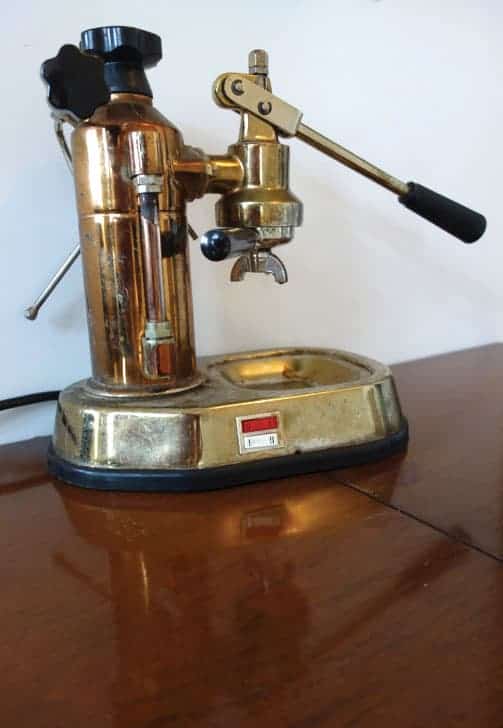
Simple but complex: a Pavoni Europiccola coffee-maker raises all sorts of physics questions. (Courtesy: Robert P Crease)
Peter Stephens pours water into the pressure vessel of my espresso maker, screws on the top, and presses a switch. An experimental physicist at Stony Brook University, he’s dropped by my office to drink coffee and discuss physics. He knows my device well. It was once his; he gave it to me after being appointed associate dean and moving to a larger office with its own coffee maker as a literal perk.
At first glance the Europiccola device – made in Italy by the long-standing Milanese firm La Pavoni – looks like it belongs in a museum of 19th-century physics equipment. About 25 cm big and made of brass, its main feature is a pressure vessel sprouting gauges, tubes, knobs and a manual lever over a bell-shaped attachment. The only hint it’s a 20th-century device is a 110 V electrical cord trailing from the base.
After a minute, the device begins to groan and make soft pops like it’s muttering to itself. When a thin ribbon of steam curls above the safety valve, Stephens announces: “We’re almost ready!” To be sure, he twists the knob on the steamer, which responds by issuing a confident jet. He pumps the lever, pushing a shot of coffee into our cups. An invigorating aroma wafts into the corridor.
“Cheers!” Stephens says as we drink up.
Functioning antique
Coffee is often the fuel of choice for physicists wishing to stay alert to solve a thorny theory or eke out a crucial experimental finding. But most rely on coffee from a pot or vending machine, and it’s a shame not everyone can have a once-popular Pavoni. Mine gets us chatting about the physics of coffee-brewing.
The Pavoni’s main parts are a pressure vessel to heat water, a lever-driven piston and a filter basket. As the water heats, some turns to steam, which drives hot water into the piston chamber mounted on the pressure vessel. Raising the lever pulls up the piston, opening a valve that lets water flow into the chamber. Pressing the lever down forces this water through coffee grounds in the filter basket into one or two cups waiting below.
Yet the Pavoni’s interesting physics, Stephens explains, has nothing to do with Boyle’s law or the bare mechanics of the water flow, but with other aspects of coffee-making. Take the temperature differential between the water in the pressure vessel and the water flowing through the coffee grains. The temperature of the former is about 120 °C, while the optimal temperature of the latter is 91–97 °C. Any cooler and the liquid absorbs the coffee poorly; any hotter and the water burns the grains and makes the coffee taste bitter. The piston cylinder, however, serves as a heat sink, making the water temperature drop.
There’s also interesting physics in how substances get extracted from the coffee grains into the liquid. Coffee beans are made of hundreds of different types of molecule that give the drink its flavour. Brewing an espresso – “quick” in Italian – involves passing water through ground roasted beans. The trick is to extract the tasty flavours and the caffeine, which tend to come out quickest, and leave behind the bitter compounds. It’s a problem that sends Stephens to the blackboard to draw flow diagrams.
Extraction depends on the grains’ size and shape, he explains, as well as the density of their packing, the water temperature and the liquid flow rate. The larger the grains, for instance, the smaller the surface-to-volume ratio, diminishing the percentage of substances absorbed. But if the grains are too fine they turn into a wet paste, slowing the flow.
The Pavoni leaves most such factors to the user: other machines, in contrast, use pods with pre-ground beans, gauges to control the water temperature, and springs or pumps to regulate the water flow. I’ve heard it dismissed as a “functioning antique” doomed to be retired to a user’s storage closet. I kind of get it: a coffee maker shouldn’t act like a finicky experimental facility. But I like that the user is in control of the process rather than it being a matter of inserting pods, adjusting settings and pushing buttons.
The critical point
My Pavoni is neither the simplest nor the most complex home espresso maker. A good account of their history is found in Ian Bersten’s book Coffee Floats, Tea Sinks: Through History and Technology to a Complete Understanding (1993 Helian). Mechanically simplest is the famous stovetop Moka. You pour water in the base, insert a basket with grounds in, screw on an upper chamber and put the whole pot on the stove. Steam drives the hot water up through the grains; it’s flow-up rather than drip-down. I bought my first at a flea market in Rome for about $1 as a grad student and have used it for decades.
Even in this simple device the physics is complicated, as Stephens and I discover (2008 Am. J. Phys.76 558). It hadn’t occurred to us, for instance, that the pressure in the bottom vessel would be anything other than the saturated vapour pressure of the heated water. But because some air is initially present, the rising temperature creates an “overpressure” through plain old PV = Nrt. “The more mechanically simple, the harder to analyse,” Stephens says.
Stephens has to return to the dean’s office before we get round to discussing how to froth milk or roasting and grinding beans. “These are the kinds of things that interest me about the natural sciences,” Stephens says as he leaves. “Exploring the interface between what is readily quantified – pressure, temperature and volume – and complex intangibles like the flavour of a cup of coffee.” I won’t look at a cup of coffee in the same way again.
Feeling full: one way to deliver satiety might be to add functional ingredients to emulsions such as salad dressing, which is made of droplets of oil suspended in water. (Courtesy: Shutterstock/hjochen)
The developed world is getting fatter. In the UK, the incidence of obesity has almost quadrupled in the last 25 years; within the (mostly wealthy) countries that make up the Organisation for Economic Co-operation and Development (OECD), the majority of the population is now either overweight or obese. The reasons for this collective weight gain are manifold, and although sedentary lifestyles and the ready availability of calorie-dense foodstuffs are obvious contributors, they don’t appear to be the whole story. When we eat, our bodies respond with an incredibly complex hormonal process, one that takes into account not just what’s on our plates that day, but also what we have eaten in the past, and how much of it. Unfortunately, the outcome of this response is that, essentially, we train our bodies to get fat – and it doesn’t seem to be easy to train them to become thin again.
As an example, consider the process we use to recognize when we have eaten enough. The sensations of satiety (recognizing that we are full) and satiation (recognizing that we don’t want to eat again yet) stem from external social cues (such as plate size and portion size) and mechanical cues (a full stomach), but also from the response of our metabolism. When our gut detects the presence of fatty acids, sugars, amino acids or the breakdown products of proteins, it releases several known “satiety” hormones. These hormones help make us feel “full”, but the way our body releases them and how our brain reacts to them is complex and not yet fully understood. Our gastrointestinal tract is a complex organ: for example, the taste receptors in our mouths – the ones that enable us to tell whether foods are sweet, salty, sour, bitter and savoury (umami) – are also present in our stomach, small intestine and colon. It is not just our mouths that “taste” our food.
Injecting any of the satiety hormones temporarily decreases calorie intake in both lean and overweight humans, but unfortunately, these hormones are rapidly turned over in the body and the effect does not last to a second meal. Moreover, repeated doses do not lead to weight loss because our complex interconnected hormonal response adjusts to the presence of additional hormones. Thus the satiety hormones themselves probably do not represent good candidates for therapeutics. So what are the alternative prospects for intervention?
One option is to use social cues to promote satiety by, for example, decreasing the portion sizes of packaged foods: unsurprisingly, we eat less when less is available. We could also make foodstuffs denser and chewier, since we eat less when we eat slowly and chew more. However, given our fast-paced lifestyle and the prevalence of food-on-the-go, this may not be a realistic choice. And while we’re being pragmatic, we should also recognize that processed foods aren’t going to disappear overnight.
An alternative option is to re-engineer our food. That may sound extreme, but in some sense, it has already been done: many modern processed foods have been developed in response to consumer desires for creamier, richer, tastier foods. The challenge this time is to create tasty foods that can also deliver triggers for the release of satiety hormones directly to those tissues where they will do most good. This is where soft-matter physics enters, with the development of so-called “functional” foods.
Beyond mere nutrition
Functional foods are foods that offer added physiological effects beyond “normal” nutritional value and taste. Examples include bread, milk and orange juice enriched with vitamins; yoghurt with added “probiotic” bacteria; eggs with increased omega-3 fatty acids; and meat products with added fibrous material to decrease fat content. Functional foods can also make life easier for people with allergies and other health conditions: lactose-free and gluten-free foods are increasingly seen on supermarket shelves. But replacing ingredients in foods with healthier alternatives – or, in the case of satiety-promoting ingredients, adding new ingredients to established recipes – is not always easy. Food formulations are complicated and have often been developed empirically over time, so that removing an ingredient or adding a new one can have unexpected outcomes.
The task of understanding the structures of foodstuffs and food formulations falls squarely within the realm of soft-matter physics: the study of complex fluids containing dispersed structures such as bubbles, colloids, emulsions and/or polymers. The size of these structures ranges from nanometres to microns, similar to the length scale that you can detect on your tongue or in your mouth as you chew. Ice cream, for example, contains air bubbles, emulsions, ice crystals as colloidal particles, and proteins as both polymer and amphiphile (a molecule that has both water-soluble and water-insoluble parts). Chocolate consists of cocoa particles, sugar crystals and protein polymers in a continuous phase of cocoa butter. Beer foam is stabilized by polymeric biomolecular degradation products. And to a soft-matter physicist, pasta is basically just an amorphous carbohydrate in a glassy phase. All of these food formulations are beleaguered with biological complexity, but they are tractable and offer many approaches for delivering new, functional ingredients to the correct part of the body.
One possible approach for delivering satiety-promoting hormones to the gut would be to use emulsions – droplets of one liquid (the “dispersed phase”) suspended in another (the “continuous phase”). Many different processed foods contain emulsions: salad dressings, for example, are oil droplets suspended in a water-rich phase, while butter and margarine are water droplets suspended in an oil-rich phase. The emulsion droplets can be stabilized by amphiphiles (emulsifiers) to prevent coalescence, or they can be suspended in “texture modifiers” that thicken or gel the continuous phase, preventing droplets colliding. As these systems consist of aqueous, oily and amphiphilic phases, they can also accommodate many different functional ingredients to promote satiety, potentially simultaneously. By combining and processing emulsions appropriately it is possible to create a range of textures, from pastes and gels to freely flowing liquids. Some can even be dried and added as a powdered ingredient. Importantly, emulsions can be created from a range of food-grade ingredients using relatively simple and energy-efficient processing methods. Emulsions do have some limitations, however, many of which are encountered during food preparation. High and low temperatures (such as those encountered when cooking, chilling or freezing food), vigorous mixing, and changes in pH can all cause the droplets in emulsions to become unstable. This creates problems for would-be developers of functional foods. If oil-in-water emulsions are destabilized, for example, an oil-rich phase can be formed in or on the foodstuff – an undesirable product behaviour known as “oiling out”. The stability of the emulsion droplets can be improved by coating them with a thin solid surface layer built up from charged polyelectrolytes such as carbohydrate polymers or proteins. This layer can be chosen so as to dissolve or become porous only under certain conditions of pH and/or salt, for targeted release of satiety factors at certain places in the gut.
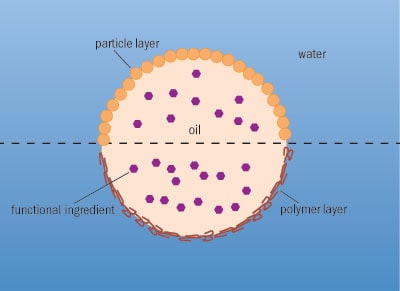
The surface layer does not have to be thin and does not have to be formed from polymer layers: cellulose particles or even smaller emulsion droplets that are themselves stabilized with a surface layer of protein can pack around an emulsion droplet, forming what is known as a Pickering emulsion (figure 1). The use of such emulsions, however, depends on the food: emulsions of this size can be detected in the mouth, and in semi-liquid preparations such as yoghurt, they give an unpleasant gritty consistency.
1 Protect and release Emulsion droplets are often stabilized by small-molecule emulsifiers, but they can also be stabilized by small particles (top) or by biopolymers such as proteins or polysaccharides (bottom). When the droplets are coated in smaller particles, they are known as “Pickering” emulsions. Both particles and polymers create a solid shell around the emulsion, protecting ingredients inside the droplet from environmental degradation. By carefully selecting the shell material, these emulsions can also be designed to release their content only in certain places in the gastrointestinal tract, delivering functional ingredients such as satiety factors to the location where they have the most impact.
A further example of emulsion technology is an emulsion droplet captured within an emulsion – a hierarchical structure known as a “multiple emulsion”. Examples might be oil droplets within a water droplet suspended in an oil continuous phase, or water droplets inside an oil droplet in a primarily aqueous formulation. Multiple emulsions are useful for “trapping” volatile ingredients, preventing them from diffusing out of the food by surrounding them with a medium through which they cannot pass. They are also useful for trapping ingredients that might otherwise taste bitter, by preventing their release in the mouth. Finally, multiple emulsions can protect fragile ingredients from the surrounding environment, preventing unwanted chemical reactions that may lead to food spoilage.
Although emulsions offer many opportunities for encapsulating and delivering functional ingredients, unfortunately the development of functional foods is a little more complicated than simply picking the right emulsion off the shelf. Our body responds differently to emulsion particles of different sizes and compositions. Some studies have shown that smaller emulsion droplets deliver both calories and satiety, while larger ones deliver the calories but with a muted satiating effect. The location where the emulsion is processed within the body also matters: if oily emulsions are unstable in the acidic environment of the stomach, the stomach becomes lined with fat, which seems to decrease satiety. But the breakdown products of fats are satiety-inducing factors themselves. Until we understand this complex interplay between the processing conditions that make emulsions larger or smaller, our enjoyment of the resulting foods in terms of taste and texture, their digestion in our gut, and the subsequent release of satiety hormones, we are trying to hit a moving target.
Protein power
Proteins are also attractive ingredients for food structuring. Compared to fats, they have two important advantages: a lower calorie density and an increased intrinsic satiety. Simple changes in temperature or pH can cause proteins to form filamentous (transparent) or particulate (opaque) gels that can be used to give foods texture. As mentioned above, these texture-modifying gels can be used to prevent or slow the emulsion droplets coalescing, by thickening the surrounding medium. Alternatively, by controlling how proteins stick together through simple changes in temperature and/or pH it is possible to form protein particles that act similarly to emulsions. Like emulsions, these can be used to encapsulate and promote the slow release of satiety-promoting ingredients, while also giving foods a “creamy” texture without the addition of fats or oils.
Similar effects can be achieved with carbohydrate polymers such as starch, cellulose, chitosan, alginate and gums including guar gum and xanthan. Many of these are used to encapsulate bacteria as probiotics; however, careful processing is required to make these capsules resistant to the acid environment of the stomach, which could otherwise destroy the bacteria before they reach the intestine. Many of these polysaccharides are also used as thickening agents, and a number of them cannot be digested, so do not directly contribute to calorie content. Some of these “dietary fibres” are also intrinsically satiety-inducing, perhaps by adding bulk or increasing water content to foods and giving rise to a mechanical feeling of fullness, but possibly by triggering the release of satiety hormones following fermentation in the intestine.
Foods for the future
Re-engineering processed foods to have a lower energy density is, in theory, a relatively straightforward matter: all you need to do is replace high-calorie ingredients (such as fats) with low-energy-density alternatives (such as dietary fibre). However, doing so typically has an impact on consumer satisfaction, as both the taste and texture of the food are affected. Food physics offers the opportunity to get around this dilemma by creating new products that mimic the texture and taste of unhealthy but well-loved foods, with added components that, when released in a controlled fashion at specific sites within the body, improve our feeling of satisfaction. Clever food processing also offers the potential for decreasing the amount of salt and sugar in processed foods, at least where they are added for reasons other than taste or nutrition.
In an ideal world in which processed foods were eaten rarely or not at all, such solutions would not be necessary. However, in a world where 90% of Americans purchase convenience foods and more than 50% of the calorie intake in the UK comes from ultra-processed and energy-dense foods, such advances are clearly desirable. Perhaps clever physics may yet help us stem the developed world’s obesity crisis.
Fresh evidence for a new state of matter called a supersolid has been put forth by two independent teams of physicists. Supersolidity has been a controversial concept whereby some atoms in a solid material are able to form a superfluid at very low temperatures – allowing them to flow ghost-like through the solid without any resistance. While initial observations of supersolidity in solid helium-4 in the 2000s have since been explained in terms of more mundane physics, some physicists believe that supersolids should exist – at least in principle. Now, Wolfgang Ketterle and colleagues at the Massachusetts Institute of Technology in the US and Tilman Esslinger and colleagues of ETH Zürich in Switzerland have created supersolid analogues using ultracold atoms. Both systems comprise Bose–Einstein condensates (BEC), which are already superfluids. The teams used different optical techniques to make the atoms arrange themselves into crystalline structures of high and low density resembling a solid. They then showed that the atoms can flow freely through such crystals, while the regions of high and low density do not move. While these experiments involve dilute gases, rather than actual solids, both studies show that the supersolid state of matter is possible. Both experiments are described in preprints on arXiv.
Perimeter Institute and South American Institute for Fundamental Research launch partnership
Early career: partners meet at the Advancement of Science in South America symposium in Brazil. (Courtesy: Perimeter Institute)
The Perimeter Institute in Canada and the South American Institute for Fundamental Research (SAIFR) based at the São Paulo State University (UNESP) in Brazil, have come together to support exceptional early career physicists. The partnership was launched yesterday in a special ceremony held during the Advancement of Science in South America symposium in Brazil. “Brilliant young people are the lifeblood of this basic field of scientific research, where one breakthrough can literally change the world,” says Perimeter director Neil Turok. “The values that drive Perimeter’s success – the pursuit of ambitious research goals and the promotion of access to excellence for all – align closely with those of SAIFR at UNESP. We see this as an exceptional opportunity to work together and catalyse rising talent throughout South America, while increasing scientific interaction between Canada and the continent.” The partnership programme will develop training programmes for emerging talent at the graduate and postdoctoral levels in South America and provide opportunities for talented students to attend the Perimeter Scholars International (PSI) graduate programme in Canada. It also aims to improve educational outreach in middle and secondary schools in South America and train teachers in the use of Perimeter Institute in-class resources throughout school systems. The partnership will also set up joint scientific conferences between the two institutes, as well as having a shared faculty member – Pedro Vieira – who will divide his time between both institutes.
Photoionization measurement breaks the zeptosecond limit
Electron snapshot: the probable position of the remaining helium electron after photoionization. (Courtesy: M Ossiander/TUM, M Schultze/MPQ)
The laser-induced ejection of electrons from an atom has been measured at a time resolution of several-hundred zeptoseconds. Reinhard Kienberger and colleagues at the Max Planck Institute of Quantum Optics, the Technical University of Munich and Ludwig Maximilians University, all in Germany, fired a 1 as (10–18 s) extreme ultraviolet light pulse at helium atoms, which ejects electrons in a process called photoionization. This is done in the presence of a much longer 4 fs (4 × 10–15 s) infrared laser pulse, which has the effect of accelerating the ejected electron. The kinetic energy of the electron is detected and is a function of the time difference between the peak amplitudes of the two pulses. This time difference can then be used to study the dynamics of how the electron is ejected from the helium atom. This process can take between 5–15 as and Kienberger and colleagues were able to study it at a record-breaking precision of 850 zeptoseconds (850 × 10–21 s). Helium is a relatively simple system, so the measurements should allow physicists to compare theoretical models of photoionization with experimental results. The research is described in Nature.
Republican-candidate Donald Trump’s surprising US presidential victory this morning presents a significant conundrum to the American scientific community. The community has largely supported the Democratic agenda of Hillary Clinton, who declared: “I believe in science.” Trump, in contrast, has called climate change a hoax devised by the Chinese to embarrass the US, has threatened to depart from the Paris agreement on climate change, and has promised to cut back on government regulations that encourage renewable-energy technologies. He has also pledged to bring back the coal industry.
Despite those comments, president-elect Trump’s campaign paid little attention to scientific issues. He did talk of a “commitment to invest in science, engineering, healthcare, and other areas that will make the lives of Americans better, safer, and more prosperous”. He also called for programmes, “such as a viable space effort and institutional research, that serve as incubators to innovation as well as for the advancement of science and engineering in a number of fields”. However, the campaign laid out few concrete examples of a science policy and did not release a list of individuals responsible for science policy.
Checks and balances
The presidency is, though, just one facet of US governance, which incorporates “checks and balances” on executive powers. The American constitution requires the House of Representatives to authorize federal spending, while the Senate must agree to that spending and approve major government appointments, such as the president’s cabinet members and judges.
For the past six years, president Barack Obama has had to deal with Republican majorities in both House and Senate. That American version of cohabitation significantly reduced his ability to carry out his agenda; it also created political deadlock that briefly closed down government operations and reduced the pace of legislation to a crawl.
Republican control
When he takes office in January, however, president Trump will have the advantage that the Republicans control both houses of the legislature. Since a large majority of Republicans in office have denied the connection between human activity and climate change, American participation in efforts to reduce global warming appears doomed. The party’s manifesto also calls for significant cutbacks in support for the Environmental Protection Agency.
That could slash its regulations on fossil fuels and overturn its emphasis on renewable-energy sources. The Obama administration’s proposed financial-year (FY) 2017 budget for the Department of Energy’s programmes on energy efficiency and renewable energy increased by 40% over the FY 2016 figure. That increase now seems moot. On the other hand, Trump has expressed his interest in supporting space travel, which looks positive for NASA’s budget.
Republican domination of government promises other areas of impact. Lamar Smith, the Texas Republican who heads the House Committee on Science, Space and Technology, has frequently taken the National Science Foundation (NSF) to task for its support of sociological science projects. The agency could lose funding for such research, although its support of hard science should survive.
Lost allies
The scientific enterprise may also suffer from the loss of two long-serving Senate Democrats who did not run for re-election: Maryland’s Barbara Mikulski, who has been a strong backer of NASA and other scientific agencies, and Barbara Boxer of California, a powerful supporter of environmental efforts. Even though they were in the minority in government, they had strong influence on decisions. Their successors are both Democrats, but they will lack the power that Mikulski and Boxer had obtained through their political longevity.
President-elect Trump will not necessarily have an easy ride with Congress. Throughout the election campaign he disagreed with several Republican congressional leaders, most notably House of Representatives speaker Paul Ryan. Those disagreements focused on immigration, global trade and the treatment of minorities. But arguments over priorities could wash over into scientific areas.
The transition to president Trump comes at a time when the government-sponsored spending on R&D as a share of the overall R&D funding has fallen. Estimates from the NSF’s Center for Science and Engineering Statistics indicate that business spending represented 69% of the $499bn that the country spent in FY 2015, while the government’s share was 23%, a record low. However, analysts see some indication that the government percentage might have increases in FY 2016, which ended on 30 September.
Advice for the president
As for how president Trump should deal with scientific issues, a report by Rice University’s Baker Institute for Public Policy – headed by the physicist and former presidential science-adviser Neal Lane – recommends a series of actions related to the Office of Science and Technology Policy (OSTP) that the science adviser heads.
The report calls on the president to choose – soon – a nationally respected scientist or engineer as science adviser and to nominate him or her to head OSTP; to direct the presidential personnel office to seek the science-adviser’s advice on filling senior positions in government agencies related to science and technology; and to consult with the science adviser “to quickly appoint a diverse membership” for the President’s Council of Advisors for Science and Technology, and regularly meet with that group.
Whether Donald Trump will take that advice remains to be seen.
A group of scientists in Europe has discovered a new kind of magnetic structure in which nearby atomic spins form a spiral. The results confirm a nine-year-old theoretical prediction of so-called “spiral spin liquids” and also reveal the existence of an unexpected vortex state that could potentially be exploited in ultra-high-density magnetic-storage devices.
In ferromagnets such as iron, the magnetic moments, or “spins”, of the material line up with one another over large distances – because this alignment lowers the energy within the material. In what are known as “frustrated” magnets, in contrast, atomic spins are positioned such that multiple different arrangements of spins can place the system in its lowest energy (ground) state. Spins therefore continually reorient themselves as the system flips from one ground state to another.
“Spin liquids” are frequently found in frustrated magnets, and have intermediate order. The material itself is crystalline, meaning that its constituent atoms sit at well-defined points on a lattice. However, the orientation of those atoms’ spins fluctuates continually, just as the position of atoms and molecules within a liquid changes from one moment to the next. But like the correlations that exist between nearby molecules in water, so neighbouring spins in this type of material also fluctuate collectively.
Angular offset
Although physicists have been observing spin liquids for years, spiral spin liquids have remained unconfirmed experimentally until now. Predicted by Leon Balents of the University of California in Santa Barbara and colleagues in 2007, they require nearby spins to be correlated such that the orientation of an atom’s spin axis is offset from that of its nearest neighbour by a certain angle. The size of that angle fluctuates continually in time, as well as in space.
Oksana Zaharko of the Paul Scherrer Institute (PSI) in Switzerland and colleagues set out to observe a spiral spin liquid in the material manganese scandium thiospinel (MnSc2S4), which is made up of antiferromagnetic manganese ions held in a frustrated structure by ions of scandium and sulphur. The researchers’ challenge was to make a sample that was large and pure enough so that it unambiguously generated the signature of a spiral spin liquid. This is a “spiral surface” in the diffraction pattern created when the material is bombarded with neutrons at low temperature.
To do this they used a slow and painstaking process to grow single crystals of MnSc2S4 and then combined multiple crystals to obtain a measurable signal. Having taken over a year to amass some 30 mg in total, they placed their sample in the Diffuse Scattering Neutron Time-of-Flight Spectrometer (DNS) at the Jülich Centre for Neutron Science in Germany. Then, as they cooled the sample down to just a few degrees kelvin, they found what they were looking for: clear evidence for the spiral surface in the sample’s diffraction pattern.
Unambiguous proof
According to Zaharko this is the first “unambiguous” proof of a spiral spin liquid. She points out that a group led by team-member Alois Loidl of the University of Augsburg had found evidence for the spiral in powdered MnSc2S4 using neutron diffraction as far back as 2005, but says that Loidl’s group found “just a good hint” rather than a clear signal.
However, while the latest data confirm the existence of spiral spin liquids, they do not support a second prediction made by Balents and colleagues nearly a decade ago. This is the somewhat counter-intuitive notion of “order by disorder”, in which a spin liquid collapses to a unique ground state selected by thermal fluctuations. Instead, the team found that the MnSc2S4 became ordered as it was cooled below 2.3 K, which, says Zaharko, was caused by atomic spins coupling with their third nearest neighbours, as well as their nearest and second nearest neighbours.
Balents says he is “very pleased” that his group’s prediction of spiral spin liquids has finally been confirmed by what he describes as a “beautiful” experimental study. He is not concerned about the absence of proof for order by disorder, explaining that “many other perturbations can perform the ground-state selection at lower temperatures” and noting that evidence for this mechanism has in any case been found in a number of other frustrated magnets.
Denser memories
He adds that Zaharko and colleagues have found “exciting” evidence that the spins in MnSc2S4 create a vortex shape when exposed to a magnetic field, something that he and his colleagues did not anticipate in their model. Zaharko says that this finding might in future yield higher-density disk drives, given that vortices measure only about 5 nm across, much smaller than features in today’s leading drives. But she cautions that practical devices will require “huge work in materials science” to increase operating temperatures.