Plugging the deficit in Europe’s neutron supply

There are good reasons to get excited by the 2bn European Spallation Source (ESS), which is currently under construction in Lund, Sweden. When the machine’s user programme finally starts in 2023, if all goes to plan, it will be the world’s most intense particle accelerator, generating up to 100 times more neutrons than any of today’s sources. Like a giant microscope, it will allow unprecedented studies into various fields – particularly the science of the everyday, such as plastics, pharmaceuticals, biological matter and nanotechnology. The ESS is a fitting tribute to Europe’s neutron research community, which is estimated to be by far the world’s largest, comprising some 6000 scientists and engineers.

Against this starry-eyed picture, however, a recent report published by the Neutron Landscape Group (NLG) makes for sobering reading, by pointing out that many sources are set to close within a decade. By the mid-2030s, according to the NLG, the best-case scenario is a 30% drop in neutron instrument time, while the worst-case scenario is a 60% reduction. In decades to come the ESS may be a transformative neutron source, but there may not be much of a neutron community left to use it. “The renewal of intermediate neutron sources becomes necessary to maintain a ‘critical mass’ for the neutron user community, otherwise new powerful sources such as the ESS become almost useless,” says Jacques Ollivier, a physicist at the Institut Laue-Langevin (ILL) in Grenoble, France. The ILL itself could close in 2023 unless its partners agree otherwise.

The renewal of intermediate neutron sources becomes necessary to maintain a ‘critical mass’ for the neutron user community, otherwise new powerful sources such as the ESS become almost useless

Jacques Ollivier, Institut Laue-Langevin

Fortunately, there may be ways to plug this neutron deficit. Physicists at the Forschungszentrum Jülich, in collaboration with those at the Laboratoire Léon Brillouin (LLB) in Saclay, France, are exploring the possibility of cheap, scalable neutron sources that could be installed at universities or at national facilities. The technology has already been put into practice outside Europe, for example at Indiana University in the US and at the Japan Collaboration on Accelerator-driven Neutron Sources – a nationwide network of researchers working on neutron-beam technologies and moderators. But the researchers at Jülich and the LLB want to push the technology to its limit, boosting the power output by at least a factor of 100.

Tailored solution

There are currently two main types of neutron source: spallation and reactor. In spallation, charged particles such as protons are accelerated into a heavy-metal target, kicking neutrons from the target’s nuclei. This process, which is employed at various facilities including the ISIS Neutron and Muon Source in Oxfordshire, UK, and which will also be employed at the ESS, is the most efficient, generating some 20 neutrons per incident proton. The second type of neutron source, the fission reactor, involves a single neutron splitting a uranium atom to generate three neutrons, which then split more uranium atoms, provoking a chain reaction. The ILL and the LLB are both reactor neutron sources.

For sociopolitical reasons, new research reactors are deemed unlikely to be built in Europe. But the chances of building further spallation sources in addition to the ESS are slim too – partly because big accelerators themselves are pricey, but also because the intense radiation requires huge amounts of shielding. The ESS’s inner monolith alone will comprise some 2000 tonnes of steel. “[Spallation] is a very efficient process, but it comes with a huge price tag,” says Thomas Brückel, director of the Jülich Centre for Neutron Science.

Brückel’s answer is a compact accelerator source, which accelerates protons or deuterons (bound protons and neutrons) to MeV rather than – in the case of the ESS – GeV energies. Such modest energies mean that the target must be made of a light metal, most likely beryllium. That in turn means a drop in efficiency, with an average of 10 incident protons or deuterons required to generate a single neutron. But the accelerator should be much cheaper and should produce far less unwanted radiation.

There are other benefits too. With less risk of radiation damage, the moderators (which reduce the energy of the emitted neutrons to a usable meV range) and the neutron optics (which guide the neutrons to the instruments) can be placed much closer to the target. That means several moderators can be squeezed around the target, each tailored to the needs of a specific instrument. In bigger spallation sources, where moderators have to be placed metres away from the target, the moderators have to be compromised to suit the needs of several instruments. “If you go to a shoe shop to buy some shoes, you do not buy size 50 so that they fit any feet – you buy shoes that fit your feet,” explains Brückel.

Consider this benefit, says Brückel, and suddenly this inefficient process becomes competitive. It is not better than current medium-flux sources, but he adds that it will be possible to build sources with dedicated beams for instruments “with a price tag that is much lower than what you have nowadays” – as little as 20m, about 100 times less than a new research reactor. “The beauty is that you can downscale it,” he notes.

Indeed, Brückel believes that the compact source could fit on one side of a football pitch, making it a viable prospect for universities as well as national facilities like ISIS. “At university, everybody has an electron microscope, everybody has an X-ray tube,” he says. “But normally university students can’t learn how to work with neutrons and professors can’t do challenging neutron experiments; they have to go to a large-scale facility. And this step, if you don’t have the experience, is huge.” The compact source could be just the ticket to foster the broader neutron community in the run up to the ESS and beyond.

To develop the technology, Brückel and his colleagues are working closely with Alain Menelle and others at the LLB. One of the greatest challenges, Menelle explains, is constructing the targets to produce neutrons effectively. “There are lots of [potential] solutions, [but] we can’t explore them all,” he says. There has already been interest from other institutions, he adds, including ESS-Bilbao in Spain, which is providing in-kind contributions to the ESS in Lund, and the Paul Scherrer Institut near Zürich, Switzerland. Once up and running, the compact neutron source ought to be able to perform neutron imaging, small-angle neutron scattering, powder and single-crystal diffraction, and perhaps other novel techniques; its limitation will be in the use of relatively large samples and an inability to reveal atomic dynamics (in contrast to the ESS).

Menelle’s group is hoping to have a low-flux demonstrator source ready for 2020, paving the way for the initial research version five years later, dubbed the Source compacte de neutrons s’Appuyant sur la technologie des accélérateurs (SONATE). Brückel’s group at the LLB is less ambitious on timescale, hoping to have its prototype ready for 2024 and the research version, the High Brilliance neutron Source (HBS), for 2030 or later. Neither SONATE nor the HBS will therefore plug the imminent deficit created by the closing medium-flux sources, but they could ease the loss – if it happens – of the ILL in the early 2020s.

Whether or not the ILL closes will come down to politics. Next year it will undergo an evaluation by its three major partners – France, the UK and Germany – and the 11 smaller national partners. Already it has undergone some 27m of safety improvements to protect the reactor from floods and other Fukushima-style disasters, but more funds will be needed to prolong its lifetime – cash that few partnered countries want to commit. Yet its loss would have a dramatic impact on the neutron community, making the new breed of sources like the HBS and SONATE all the more necessary.
Frequency comb traps and cools atoms

A new way of trapping and cooling atoms has been unveiled by a team of physicists at the University of California, Los Angeles, in the US. The technique uses a pulsed laser known as a frequency comb and could someday be used to study the quantum behaviour of atoms important to biology and astronomy such as hydrogen, carbon, nitrogen and oxygen. Such atoms cannot be cooled using existing methods because that would require high-power ultraviolet lasers, which are not currently available.

Laser cooling was first demonstrated in 1985 and involves slowing the motion of quantum particles such as atoms until their temperature approaches 0 K. Over the past 30 years, the technique has allowed physicists to make precise measurements on ultracold atoms to study quantum processes and even create quantum-logic devices.

In standard laser cooling, multiple lasers are set up such that their beams intersect on a sample of particles such as rubidium atoms. The lasers’ frequencies are tuned slightly below the resonant frequency of the rubidium. Because of the Doppler shift, this results in light absorption primarily by atoms that are moving toward the beam. Each excited atom then emits light in a random direction, resulting in a net loss of momentum, and the process repeats itself, slowing down the atoms.

Chemically interesting

However, current laser technology limits the types of atoms that can be cooled in this way, according to Andrew Jayich, a team member who has since moved to the University of California, Santa Barbara. For example, laser cooling sodium and rubidium is well established, but it has been impossible so far to laser cool the most common atoms found in living things: carbon, oxygen, nitrogen and hydrogen. This is in part because their relevant atomic transitions are in the ultraviolet, and high-power ultraviolet lasers have proven technically challenging to produce. Consequently, scientists still lack a precise understanding of the quantum mechanics of such atoms. The group’s goal is “to extend laser cooling to these chemically interesting species”, Jayich says.

To achieve this goal, Jayich, Wesley Campbell and Xueping Long investigated the cooling potential of a type of laser called a frequency comb. Unlike the continuous-wave lasers used in standard laser cooling that emit a continuous beam at a well-defined frequency, a frequency comb emits short pulses of light over a broad frequency spectrum. This broad spectrum arises from Heisenberg’s uncertainty principle, which specifies that a short pulse must have a large uncertainty in energy, which translates to a large spread in frequency. The frequency-comb spectrum consists of thousands of evenly spaced discrete peaks that look like the teeth of a comb, hence its name.

The trio used their frequency comb to cool a sample of about 10 million rubidium atoms to about 60 μK, which is comparable to conventional laser-cooling methods. Although rubidium is easily cooled using conventional methods, the team has developed a theoretical model that shows that the frequency comb can also be used to cool atomic hydrogen, antihydrogen, carbon, oxygen and nitrogen. Writing in a commentary on the paper in Physics, John Barry of the MIT Lincoln Laboratory points out that laser cooling of hydrogen and antihydrogen could reveal new insights about star formation.

Intermediate state

Instead of using a single ultraviolet photon to excite an oxygen atom, the frequency comb provides two photons of different frequencies whose energies add up to that of an ultraviolet photon. The first photon, from one comb tooth, excites the atom into an intermediate state. Then the second photon, from another comb tooth, excites it from the intermediate state to its final excited state. The many pairs of teeth that are available in a frequency comb ensure that the laser can provide the necessary energy combinations to make the two-step transitions.

Eric Hudson of UCLA – who was not involved in the research – told physicsworld.com: “To me, the most exciting thing about this work is that it is sort of a paradigm shift in thinking.” He added that the new cooling technique will allow the powerful techniques of atomic, molecular and optical physics to be used to solve important problems in chemistry and biology.

The research is described in Physical Review X.

  • The basics of how a frequency comb works are explained in this video of Paul Williams of the National Institute of Standards and Technology: “What is a frequency comb?”.

Flash Physics: Industry attracts physics students, particles cooled coherently, planet’s rings rotate ‘wrong way’

Physics students are attracted to industry

Just 5% of US physics bachelor students pursue a career as physics professors, according to a new study by the Joint Task Force on Undergraduate Physics Programs (J-TUPP). The report – Phys21: Preparing Physics Students for 21st Century Careers – found that while physics students are employed in a wide variety of work, they are not going on to become physicists in academia. The 10 strong task force, co-chaired by Paula Heron from the University of Washington and Laurie McNiel from the University of North Carolina, Chapel Hill, has issued a set of recommendations to help students acquire the skills needed when entering the workforce. These include promoting a culture that values non-academic careers as well as providing mentoring and careers advice to students throughout their undergraduate programme to help students acquire the skills needed when entering the workforce. The J-TUPP report was commissioned by the American Physical Society and the American Association of Physics Teachers, and was funded by the National Science Foundation.

Nanoparticles are cooled coherently in 2D

The quantum coherent control of light has been used to reduce the random motion of a tiny nanoparticle in 2D. The experiment has been carried out in Switzerland by Martin Frimmer, Jan Gieseler and Lukas Novotny at ETH Zürich, and involves trapping a silica sphere just 136 nm in diameter at the focus of a laser beam. For small motions about the focus, the particle behaves as a simple harmonic oscillator that can move independently in three directions. The team was able to couple the motions of the particle in the x–y plane, which is the plane perpendicular to the propagation of the laser beam. This was done by modulating the polarization of the laser light so that it rotates in the x–y plane. The coherent cooling process begins by adjusting the laser light to reduce the motion of the particle in the y direction – while allowing it to move freely in the x direction. Then the x–y coupling is switched on, which allows some of the motion in the x direction to be transferred into the y direction, thereby cooling the particle in the x direction. The research, which is described in Physical Review Letters, could be developed to put the particle into the quantum ground state of all its oscillation modes.

Gigantic exoplanet rings rotate in retrograde

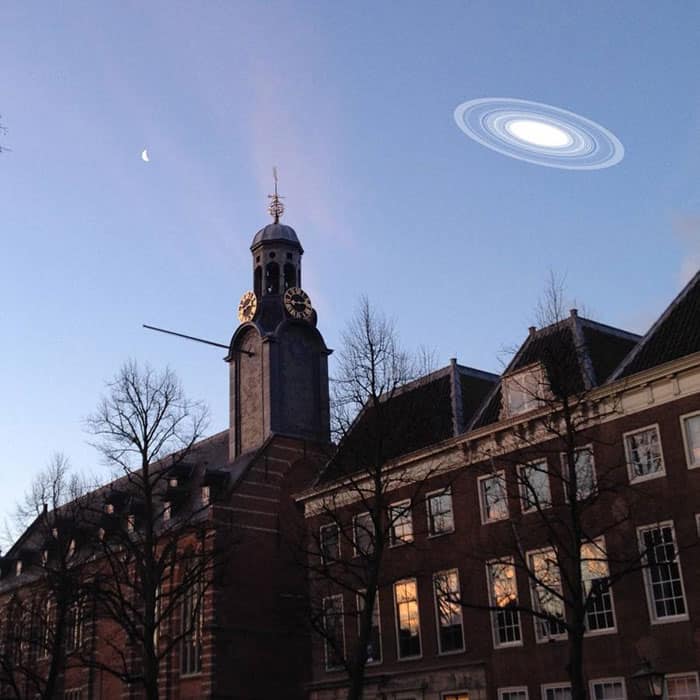
Artist's impression of how J1407b would appear in the sky above Leiden if it occupied Saturn's orbit

Giant rings around an exoplanet could remain stable for more than 100,000 years – but only if the rings orbit in the direction opposite to that of the planet’s orbit around the star. That is the claim made by researchers in Japan and the Netherlands, who last year discovered the exoplanet J1407b with rings more than 100 times larger than those of Saturn. Steven Rieder at RIKEN in Japan and Matthew Kenworthy at Leiden University in the Netherlands focussed their attention on the young, sun-like star J1407 after it underwent a series of strange eclipses in 2007. The researchers realized that the observations could only be explained if the star hosted a planet with a gigantic ring system. The only problem with such a hypothesis was that rings would not be stable for very long because the planet’s very eccentric orbit brings it close enough to its star to disrupt the rings. Now, the duo have carried out simulations and found that the massive ring system can persist for more than 10,000 11 year orbits, as long as the rigs rotate in the direction opposite to the orbit of the planet. Such retrograde rings are not common and the researchers conclude that some kind of catastrophe caused either the planet or its rings to reverse its orbit. Their findings have been accepted for publication in the journal Astronomy & Astrophysics.


  • You can find all our daily Flash Physics posts in the website’s news section, as well as on Twitter and Facebook using #FlashPhysics. Tune in to physicsworld.com later today to read today’s extensive news story on frequency comb cooling.

Highlights from Ada Lovelace Day 2016

By James Dacey

Today is Ada Lovelace Day (ALD), a day to celebrate the achievements of women in science, technology, engineering and maths (STEM). Named after the 19th-century polymath Ada Lovelace, the annual initiative also seeks to engage with the challenges of attracting more women into STEM careers and supporting career development. Now in its eighth year, the day includes a number of events and online activities.

The day will culminate in a few hours with Ada Lovelace Day Live!, a “science cabaret” event at the Institution of Engineering and Technology in London (18:30–21:30, tickets still available). In what promises to be “an entertaining evening of geekery, comedy and music”, the all-female line-up includes several scientists from the physical sciences. Among them is Sheila Kanani, a planetary physicist and science comedian who is the education, outreach and diversity officer for the Royal Astronomical Society in London.

(more…)

Ultrasound creates 2D arrays of droplets

Liquid droplets have been arranged into 2D arrays by researchers at the University of Bristol in the UK. The droplets contain entangled polymers and are created within a tank of water. A range of different chemicals can be added to the droplets, which could be used to create high-throughput analyses systems for developing new drugs or performing rapid medical diagnostics. The droplet arrays could even be used to study how living cells communicate with each other.

Although arrays of liquid droplets have been made before, previous attempts had involved either using oil-and-water mixtures or evaporating the liquid to create the array on a dry surface. Neither technique is also suitable for supporting water-based chemical reactions, which was a primary goal of Bruce Drinkwater and his team of physicists, engineers and chemists, who developed the new technology.

Coacervation and coalescence

The droplet-forming process begins with an aqueous solution of the polymer PDDA and the biomolecule adenosine triphosphate (ATP). Electrostatic interactions cause these two materials to agglomerate into tiny nanometre-sized droplets by a process of “coacervation”. When a 2D ultrasound standing wave is created in the liquid using piezoelectric transducers, the droplets move to the nodes of the standing wave, where they coalesce and grow until they reach about 50–100 μm in diameter.

The uniformity of the droplets is amazing
Bruce Drinkwater, University of Bristol

The result is a square lattice of identical droplets (see image above). “The uniformity of the droplets is amazing,” says Drinkwater. “I’m convinced this technology will have many applications in the next generation of lab-on-a-chip applications.”

By adjusting the ultrasound signals, the team was able to transform a column of droplets into a solid line of PDDA/ATP and then back again into a column of droplets. The researchers could control the size of the droplets and the spacing between them. They also showed that it is possible to load the droplets with a wide range of substances including proteins, enzymes, DNA and even micron-sized solid particles.

Localized chemistry

In one set of experiments, the team introduced a dye to one side of the tank and watched as the chemical diffuses across the array to create a concentration gradient. Such experiments could be used, for example, to study the effects of different concentrations of a chemical on the contents of the droplets. The team also showed that when several different additives were introduced to different locations of the array, the substances tended to remain localized within a region of droplets. This could be used to create arrays in which different droplets contain different chemicals.

Drinkwater told physicsworld.com that the team is now looking at how to create 3D lattices of droplets using ultrasound. He also says that it is working on making the ultrasonic components of the system more robust to the chemicals used – something that must be done before the system can be commercialized. The team is also looking at how arrays of droplets could be used to simulate how living cells communicate to each other using chemicals. This would involve making the droplets more complicated by creating structures that are analogues to those found in living cells.

The research is described in Nature Communications.

  • Hamish Johnston spoke to Bruce Drinkwater about the physics of ultrasound. You can listen to that conversations and watch a video of an acoustic “tractor beam” here.

Flash Physics: Strong summer ice, spying the nearest exoplanet and École Polytechnique degrees in English

Summer ice is stronger, say scientists

Sea-ice structures called “ice ridges” become stronger as the summer progresses, thanks to an influx of less salty water. That’s the conclusion of physicist Aleksey Shestov and colleagues at the University Centre in Svalbard, Norway, who have studied the ridges that form in the Arctic Ocean when ice floes slam together. These ridges extend both above and below the surrounding flat ice. The submerged portion of the ridge is a jumble of ice chunks with pockets of salty water that tend to form in the summer. These water pockets should weaken the ice ridge, but Shestov’s team has discovered that less-salty melt water that pools on the surface of the ice trickles down into the pockets and reduces the salinity of the water in the pockets. Water that contains less salt freezes at a higher temperature than sea water, and this allows the pockets to solidify and strengthen the ridge. “The ice ridge actually consolidates during the summer,” explains Shestov. “It’s still melting, but there is also freezing inside the ridge.” The research could inform how the hulls of ships and other marine structures are designed to withstand ice damage.

Project Blue plans to image our nearest exoplanet neighbour

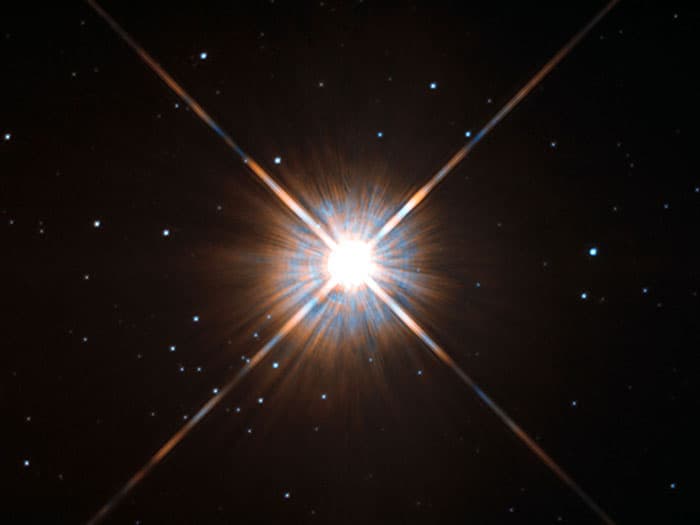
Proxima Centauri as seen by the Hubble Space Telescope

A privately led, non-profit effort known as “Project Blue” plans on taking the first image of our nearest exoplanet neighbour – the recently discovered terrestrial planet that orbits Proxima Centauri, the closest star to Earth. The planet’s existence was confirmed this August and it lies within its star’s habitable zone. This means that the planet could sustain liquid water on its surface, and may even have an atmosphere. Project Blue aims at launching a state-of-the-art exoplanet-imaging telescope into space by 2019 and operating it until 2022. The project takes its name from the celebrated “Pale blue dot” image of Earth taken by the Voyager spacecraft in 1980. It is led by the BoldlyGo Institute, Mission Centaur, the SETI Institute and the University of Massachusetts Lowell. The mission is estimated to cost less than $50m.

French university launches degrees in English

Photograph of international students of the Ecole Polytechnique

One of France’s most prestigious universities – École Polytechnique – is to offer five new graduate degrees that will be taught exclusively in English. The courses, which begin this academic term, break away from traditionally being taught in French and are in energy environment, corporate strategy, metroeconomics, big data for business and “digitized society”. The institution is also launching a new Bachelor degree in mathematics – also taught exclusively in English – that will start in 2017 with applications opening in November. Students on the course, which will be École Polytechnique’s first undergraduate programme, will specialize in mathematics but will also study either computer science, physics or economics.


  • You can find all our daily Flash Physics posts in the website’s news section, as well as on Twitter and Facebook using #FlashPhysics. Tune in to physicsworld.com later today to read today’s extensive news story on ultrasonic droplets.

What could you do with a 50- or 100-qubit quantum computer?

Computers based on quantum processes have the potential to be exponentially more powerful than today’s computers. The processing in classical computing is based on combinations of “bits” that can be in one of two states (0 or 1). In quantum computing the processing is based on quantum bits – or “qubits” – that can be in a superposition of different states at the same time. Creating and sustaining qubits in the real world, however, presents many significant engineering challenges on account of the fragile nature of these systems. The exciting question is of course: what can we do with these machines once we start to create practical quantum computers based on multiple-qubit systems?

In this video, Andrea Morello from the University of New South Wales in Australia addresses this question. Among other possible applications he discusses the idea of using quantum computers to test the very foundations of the theory of quantum mechanics. This video is part of our 100 Second Science series, in which researchers give concise presentations covering the spectrum of physics.

Transforming African astronomy with MeerKAT

Nithaya Chetty

What is the Square Kilometre Array (SKA)?

The SKA will be the world’s largest radio telescope when it comes online in the coming decade. It will consist of thousands of dishes and antennas spread out across Africa and Australasia. The first phase of the SKA, which will be complete around 2023, will see an array of almost 200 dishes built in South Africa covering the bulk of the high- and mid-frequencies of the radio spectrum, while Australia will host over 100,000 low-frequency dipole antennas. The second phase will complete the arrays at both sites and when finished by 2030 the SKA will consist of several thousand high-frequency and mid-frequency telescopes and aperture arrays, along with several million low-frequency antennas.

What is South Africa’s contribution?

South Africa is currently building MeerKAT – a 64-dish mid-frequency array that is located in the Karoo semi-desert region more than 500 km north-east of Cape Town. It is managed by the National Research Foundation (NRF) and when fully operational by the end of 2017 it will be the most sensitive radio telescope of its kind in the world. An additional 133 dishes will be built by the international SKA consortium in South Africa and we will integrate our 64 dishes into the broader array in 2023.

Who is paying for MeerKAT?

MeerKAT is being funded by the South African Department of Science and Technology. South African science minister Naledi Pandor has been instrumental in getting the project off the ground.

What is its current status?

We now have more than 25 dishes bedded down and are beginning to produce scientific results.

We will be discovering objects and studying scientific, astronomical phenomena that we might not have predicted and could not have imagined

Has the telescope made any scientific discoveries yet?

Using just 16 dishes, in June we discovered several hundred new galaxies. So by the time we get to the fully fledged SKA we will be discovering objects and studying scientific, astronomical phenomena that we might not have predicted and could not have imagined. It will be transformational science because the instrument will be so much bigger and more powerful that anything we currently have.

What is the timeline for the rest of the SKA construction?

The various partner governments are still in the process of securing the treaty organization, hosting agreement, funding, procurement and so on. It is still a work in progress and until we have all the partners fully on board I cannot say for sure when the first phase of the SKA will roll out and be fully functional, but this is planned for around 2023. If there is a delay, the NRF will continue to operate MeerKAT as a South African telescope.

How much of South Africa’s science funding is being spent on the SKA?

Funding for science and research infrastructure in South Africa comes primarily from the NRF with an annual budget of ZAR 4bn ($300m). Cash for astronomy, not including the SKA, is about 4.5% of this amount. With money for the SKA included, it is around 27%, with funding being a special allocation from the National Treasury. Once we have finished construction of MeerKAT the operational budget will be around 8% per year of the total capital expenditure.

How are you engaging other African countries?

When we led the site-host bid we involved eight other African partner countries: Botswana, Ghana, Kenya, Madagascar, Mauritius, Mozambique, Namibia and Zambia. SKA instruments will only be built in these countries in the second phase of the SKA, which will begin in 2023. We have begun development in our African partner countries by refurbishing unused telecommunications dishes for single-dish radio astronomy and to start work on an African very-long-baseline interferometry network.

How are you training people for the SKA?

We are very keen to develop our own home-grown talent, and we have put in a huge effort to achieve that for more than a decade now. The annual ZAR 50m SKA human capacity development programme has issued more than 800 grants in the last decade, including for degree-level students and research chairs for established individuals. We have managed to recruit high-profile scientists from around the world to increase our research student supervisory capacity.

How will you define success for the SKA project?

From a South African perspective, it would have to be leading transformational science using the SKA. But of course it goes beyond doing science. I would like to see the SKA project attracting a new generation of children to science, and also stimulating innovation and supporting industry. For a project on this scale you can imagine that the technical innovations – for example in “big data” – are at the cutting edge. We would like those innovations to be done by South African industries so there is potential for commercialization of those technologies.

‘Radical’ new microscope lens combines high resolution with large field of view

A new microscope lens that offers the unique combination of a large field of view with high resolution has been created by researchers in the UK. The new “mesolens” for confocal microscopes can create 3D images of much larger biological samples than was previously possible – while providing detail at the sub-cellular level. According to the researchers, the ability to view whole specimens in a single image could assist in the study of many biological processes and ensure that important details are not overlooked.

Laser-scanning confocal microscopes are an important tool in modern biological sciences. They emerged in the 1980s as an improvement on fluorescence microscopes, which view specimens that have been dyed with a substance that emits light when illuminated. Standard fluorescence microscopes are not ideal because they pick up fluorescence from behind the focal point, creating images with blurry backgrounds. To eliminate the out-of-focus background, confocal microscopes use a small spot of illuminating laser light and a tiny aperture so that only light close to the focal plane is collected. The laser is scanned across the specimen and many images are taken to create the full picture. Due to the small depth of focus, confocal microscopes are also able to focus a few micrometres through samples to build up a 3D image.

In microscopy there is a trade-off between resolution and the size of the specimen that can be imaged, or field-of-view – you either have a large field-of-view and low resolution or a small field-of-view and high resolution. Current confocal microscopes struggle to image large specimens, because low magnification produces poor resolution.

Stitched together

“Normally, when a large object is imaged with a low-magnification lens, rays of light are collected from only a small range of angles (i.e. the lens has a low numerical aperture),” explains Gail McConnell from the Centre for Biophotonics at the University of Strathclyde, in Glasgow. “This reduces the resolution of the image and has an even more serious effect in increasing the depth of focus, so all the cells in a tissue specimen are superimposed and you cannot see them individually.” Large objects can be imaged by stitching smaller images together. But variations in illumination and focus affect the quality of the final image.

McConnell and colleagues set out to design a lens that could image larger samples, while retaining the detail produced by confocal microscopy. They focused on creating a lens that could be used to image an entire 12.5 day-old mouse embryo – a specimen that is typically about 5 mm across. This was to “facilitate the recognition of developmental abnormalities” in such embryos, which “are routinely used to screen human genes that are suspected of involvement in disease”, says McConnell.

Dubbed a mesolens, their optical system is more than half a metre long and contains 15 optical elements. This is unlike most confocal lenses, which are only a few centimetres in length. The mesolens has a magnification of 4× and a numerical aperture of 0.47, which is a significant improvement over the 0.1–0.2 apertures currently available. The system is also able to obtain 3D images of objects 6 mm wide and long, and 3 mm thick.

The high numerical aperture also provides a very good depth resolution. “This makes it possible to focus through tissue and see a completely different set of sub-cellular structures in focus every 1/500th of a millimetre through a depth of 3 mm,” explains McConnell. The distortion of the images is less than 0.7% at the periphery of the field and the lens works across the full visible spectrum of light, enabling imaging with multiple fluorescent labels.

Engineering and design

The lens was made possible through a combination of skilled engineering and optical design, and the use of components with very small aberrations. “Making the new lens is very expensive and difficult: to achieve the required very low field curvature across the full 6 mm field of view and because we need chromatic correction through the entire visible spectrum, the lens fabrication and mounting must be unusually accurate and the glass must be selected very carefully and tested before use,” explains McConnell.

The researchers used the lens in a customized confocal microscope to image 12.5 day-old mouse embryos. They were able to image single cells, heart muscle fibres and sub-cellular details, not just near the surface of the sample but throughout the depth of the embryo. Writing in the journal eLife, the researchers claim “no existing microscope can show all of these features simultaneously in an intact mouse embryo in a single image.”

The researchers also write that their mesolens “represents the most radical change in microscope objective design for over a century” and “has the potential to transform optical microscopy through the acquisition of sub-cellular resolution 3D data sets from large tissue specimens”.

Rafael Yuste, a neuroscientist at Columbia University in New York, saw an earlier prototype of the mesolens microscope. He told physicsworld.com that McConnell and colleagues “have completely redesigned the objective lens to achieve an impressive performance”. He adds that it could enable “wide-field imaging of neuronal circuits and tissues while preserving single-cell resolution”, which could help produce a dynamic picture of how cells and neural circuits in the brain interact.

Video images taken by the mesolens can be viewed in the eLife paper describing the microscope.

Flash Physics: Opportunity Rover goes crater diving, new deputy director of US Department of Energy, underwater transistors

NASA’s Opportunity Rover to drive into crater and explore Mars gully

NASA’s Opportunity Mars Rover, which began yet another extended mission this month, will visit the interior of a crater on Mars and drive down an ancient gully carved out by a fluid (that may have been water) – a first for a Mars rover. Opportunity, which is the longest active rover on Mars, launched on 7 July 2003 and landed on Mars on 24 January 2004, on a planned mission of 90 Martian days, which is equivalent to 92.4 Earth days. “We have now exceeded the prime-mission duration by a factor of 50,” notes John Callas, Opportunity’s project manager. “Milestones like this are reminders of the historic achievements made possible by the dedicated people entrusted to build and operate this national asset for exploring Mars.” Opportunity began its latest extended mission in a part of the western rim of Endeavour Crater – the rover reached the edge of this crater in 2011 after more than seven years of investigating a series of smaller craters. The gully chosen as the next major destination slices west-to-east through the rim about half a kilometre south of the rover’s current location. The Opportunity team will drive the rover down the full length of the gully, onto the crater floor. The second goal of the extended mission is to compare rocks inside Endeavour Crater with the dominant type of rock Opportunity examined on the plains that it explored en route to the current spot.

Steve Binkley takes over as DOE deputy director as Patricia Dehmer retires

Steve Binkley has been appointed as the US Department of Energy’s deputy director for science as of this November, as the current director Patricia Dehmer will retire on 10 November. Binkley – who is currently head of the department’s Advanced Scientific Computing Research programme – will oversee six different research programmes including high-energy physics, nuclear physics, fusion-energy sciences and more, as well as evaluating existing and proposed new facilities. Dehmer has had a long and distinguished career at the department and during her time as the director of the DOE’s Office of Basic Energy Sciences she oversaw a doubling of the programme’s budget and $3bn in major construction projects, including the Spallation Neutron Source, the Linac Coherent Light Source, and the National Synchrotron Light Source II.

N-type electrochemical transistor works underwater

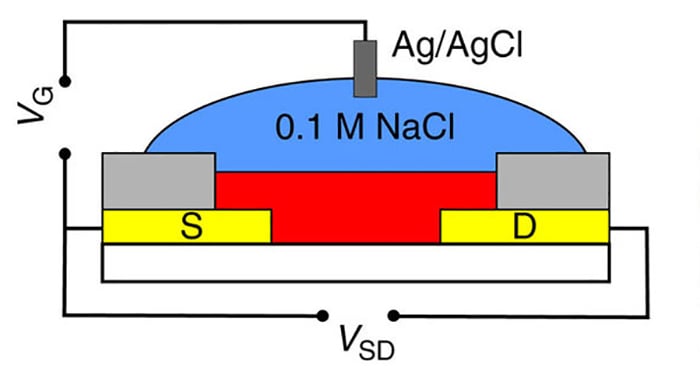
Schematic of the new n-type organic electrochemical transistor

An n-type organic electrochemical transistor (OECT) that works underwater has been created by an international team of researchers. OECTs show great promise as biological sensors because they can convert ionic signals in liquid media into electronic signals. One challenge facing the development of practical sensing devices is that OECTs have been limited to being “p-type” devices based on electrical conduction by holes. If OECTs could also be based on n-type devices that use electrons to conduct electricity, then better and more versatile sensors could be created. The problem, however, is that n-type materials tend to be unstable in water. Now Alexander Giovannitti of Imperial College London and colleagues have created OECTs from a new semiconductor polymer that supports both n- and p-type conduction and is also stable in water. Giovannitti said that the new OECTs “might be able to detect abnormalities in sodium and potassium ion concentrations in the brain, responsible for neuron diseases such as epilepsy”. The OECTs are described in Nature Communications.


  • You can find all our daily Flash Physics posts in the website’s news section, as well as on Twitter and Facebook using #FlashPhysics. Tune in to physicsworld.com later today to read today’s extensive news story on a new type of high-resolution lens for microscopes.
Copyright © 2026 by IOP Publishing Ltd and individual contributors