Real-time diffraction measurements of the changing structure of vibrating iodine molecules have been made by two independent groups of scientists. Phil Bucksbaum and colleagues at Stanford University and the SLAC National Accelerator Laboratory in California used X-ray diffraction to study the molecules, while Markus Gühr and colleagues at Potsdam University, the University of Nebraska and SLAC used electron diffraction. The X-ray experiment was done at SLAC’s Linac Coherent Light Source, which produces coherent X-ray pulses. The iodine molecules were first pumped with a laser pulse, putting some of the atoms in an excited vibrational state. The resultant X-ray diffraction pattern is of the molecule in its ground and excited state – and these two can be separated using mathematical manipulation. Gühr and colleagues did a similar experiment, but using electron pulses from a source also located at SLAC. In both cases, the researchers were able to track the vibrational motions of the atoms on time scales of tens of femtoseconds – essentially creating “molecular movies” of the motions. While measurements on similar timescales can be achieved using very short laser pulses, these studies relied on assumptions about the structure of the molecule – whereas the diffraction studies make no such assumptions. Both studies are described in Physical Review Letters.
Ukraine joins CERN as associate member
Ukraine has become an associate member of CERN following ratification from the country’s parliament. Ukraine and CERN first signed a co-operation agreement in 1993 and now more than 100 scientists from the country work at CERN, including on experiments at the lab’s Large Hadron Collider. Ukraine signed the associate-membership agreement with CERN on 3 October 2013, but it was not completely ratified until later last month. Associate members have no voting rights on CERN Council but take responsibility for a share of the annual budget for the lab – set at a lower limit of about $1m. Associate membership will enable scientists from Ukraine to work at CERN as well as allowing Ukrainian businesses to bid for CERN contracts.
LIGO-India location chosen
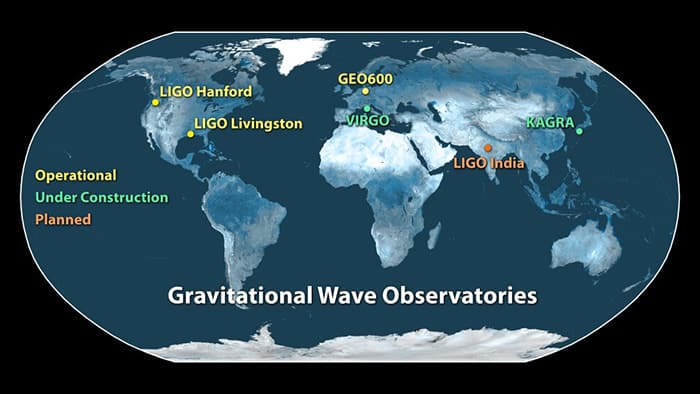
Across the globe: current operating facilities in the global gravitational-wave observatory network include the twin LIGO detectors – in Hanford, Washington, and Livingston, Louisiana – and GEO600 in Germany. The Virgo detector in Italy and the Kamioka Gravitational Wave Detector (KAGRA) in Japan are undergoing upgrades and are expected to begin operations in 2016 and 2018, respectively. LIGO-India has just received its first approval from the government. (Courtesy: LIGO)
You can find all our daily Flash Physics posts in the website’s news section, as well as on Twitter and Facebook using #FlashPhysics. Tune in to physicsworld.com later today to read today’s extensive news story on a gender bias study in geoscience.
Physicists in Australia have made a high-precision sensor that can measure gravitational and magnetic fields at the same time. The device uses an atom interferometer to track the motion of a Bose–Einstein condensate (BEC) in free fall and the researchers say it could improve the search for iron ore, hydrocarbons, diamonds and other minerals.
Geological exploration often involves making local measurements of the Earth’s gravitational field. In a classical sensor, this involves dropping a mirror a certain distance and using light-based interferometry to measure its height at several points during its fall. However, because this approach involves many moving parts it is not well suited to vibrational, noisy environments.
Quantum sensors, on the other hand, use atom interferometry to measure the free fall of cold atoms. Developed over the past decade and now sold commercially, these devices have surpassed the sensitivity of their classical counterparts. However, like classical sensors, they are at the mercy of ambient noise – and particularly stray magnetic fields. According to Nicholas Robins of the Australian National University (ANU) in Canberra, scientists go to great lengths to shield these devices from stray magnetism in order to minimize noise levels.
Two in one
In the latest work, Robins and colleagues at the ANU have made this magnetic sensitivity a virtue and created a quantum sensor that can measure changes in both accelerations due to gravity and those due to magnetic fields. Not only does this provide accurate gravitational data, they say, but it also yields magnetic data that could be very useful for mineral prospecting.
The new technique involves cooling a sample of rubidium-87 atoms to just a few billionths of a degree above absolute zero in order to turn them into a BEC – a state of matter in which all constituent particles share the same quantum state. The BEC cloud of atoms is then placed in a quantum superposition of three magnetic spin states and allowed to fall under the effect of gravity for several metres. During that time, the height of the cloud is measured three times using an atom interferometer, a device that exploits the wave nature of matter to make extremely precise measurements on atoms.
The advantage of using a BEC, explains Robins’ colleague Kyle Hardman, is that the waves of the constituent atoms remain coherent across the full width of the cloud, which is several millimetres across. This makes it easier to achieve the overlap needed between the two paths of the interferometer to achieve a given sensitivity – thereby allowing the device to work in noisier environments.
Spin superposition
However, Hardman says, the device’s real novelty lies in the spin superposition. Because the three spin states are sensitive to magnetic fields in different directions, the BEC cloud will tend to split into three components as it falls. One state feels magnetic fields pointing upwards, causing it to lag behind during free fall, another is immune to magnetic fields, while the third is subject to downward pointing fields, which boosts it acceleration towards the Earth. The relative size of these three components at the interferometer’s output therefore reveals the magnitude and orientation of local magnetic fields.
To put their device to the test, the Australian group’s researchers created a BEC of two million atoms and ran the interferometer continuously for eight hours, dropping a new BEC every 13 seconds. They looked to see whether they could accurately monitor the varying gravitational acceleration of solid Earth tides – the deformation of the Earth’s crust by the tug of the Moon and the Sun. They also varied the height of their interferometer during the measurement period in order to map variations in the ambient magnetic field. The results of those tests, says Hardman, show their sensor to be “a state-of-the-art gravimeter and state-of-the-art magnetic gradiometer”. Indeed, it is able to measure variations in the acceleration due to Earth’s gravity (g) of one part in a billion.
Elegant extension
Florian Schreck of the University of Amsterdam praises the Australian group for its “interesting and significant” research, which, he says, “elegantly extends the capability of atom interferometers to disentangle the influence of gravity, magnetic field strength and magnetic field gradient”. He believes that a portable version of the new sensor “will be interesting for geology and the prospecting of resources”.
That kind of mineral exploration involves loading an accelerometer on to an aircraft or helicopter and then monitoring the tiny changes in gravitational field that occur as the instrument passes over regions of the Earth. Hardman says that adding magnetic measurements into the mix would yield more detailed crustal maps, but maintains that this can only be done properly if a single device measures both the gravitational and magnetic fields. “If you fly two separate machines it is difficult to merge the information,” he says.
Hardman adds that the team hopes to commercialize the technology, but cautions that they must first overcome a significant technical hurdle: how to reduce the time needed to prepare BECs. Currently standing at around 10 seconds, this limits the rate at which they can make measurements and with it the resolution of their mapping. However, he believes they can do better than the roughly 30 years he says it has taken the mining company Rio Tinto to make classical gravimeters operational. “Cold-atom technology is developing very rapidly,” he says.
New imaging technique combines MRI with nuclear medicine
A new technique that combines magnetic resonance imaging (MRI) and nuclear medicine has been developed by physicists in the US. The method uses the fact that the direction that a gamma ray is emitted from a radioactive nucleus is highly dependent on the direction of the nucleus’s magnetic moment. Much like conventional MRI, the technique involves placing the sample in a strong magnetic field that causes the magnetic moments of the nuclei to point in the direction of the field. Then a magnetic pulse causes the moments to wobble, much like a spinning top. In conventional MRI, this wobble is detected by the radio waves emitted by the sample and this provides important information about the local chemical composition within the sample. In this new technique developed by Gordon Cates, Wilson Miller and colleagues at the University of Virginia, the wobble is characterized by measuring the distribution of gamma rays emitted by radioactive nuclei – in this case xenon-131m. The team was able to image a glass container filled with a tiny amount of radioactive xenon gas. However, this took 60 hours to complete – which is far too long for practical imaging applications. If the technique can be improved, then patients could one day ingest a radioactive tracer that would then travel to a tumour or other tissue of interest. Doctors would then be able to use the technique to image the tissue and obtain new types of information about its composition. The research is reported in the Nature.
Polymers mimic evolution of life
An experiment that joins strands of DNA together to create long polymer molecules could shed light on the evolution of life – according to Philipp Zimmer and colleagues at the University of Saarland in Germany. Their experiment begins with a mixture of single-stranded DNA molecules that are divided into a number of samples. The samples are then heated through a number of different temperature steps, which are chosen to correspond to the known melting temperatures of different types of DNA strand. The samples are then cooled and the heating process is repeated over a number of cycles. During these cycles, the string-like molecules break apart and then join back together in a process called ligation. The team focussed on how this process causes the DNA to form polymer strands of different lengths. The researchers found that under certain conditions the system “self-selected” to create strands of a certain length. Furthermore, the process could continue indefinitely, with the polymers constantly self-selecting in response to changes in the heating cycle. The researchers believe that this process of “molecular evolution” could provide an important analogue to the evolution of living organisms – a process that also operates continuously and involves self-selection. In such an analogy, the distribution of polymers of different lengths represents the presence of different types of living organisms in an evolutionary system. The research is reported in the New Journal of Physics.
Inventor of gas laser Ali Javan dies at 89
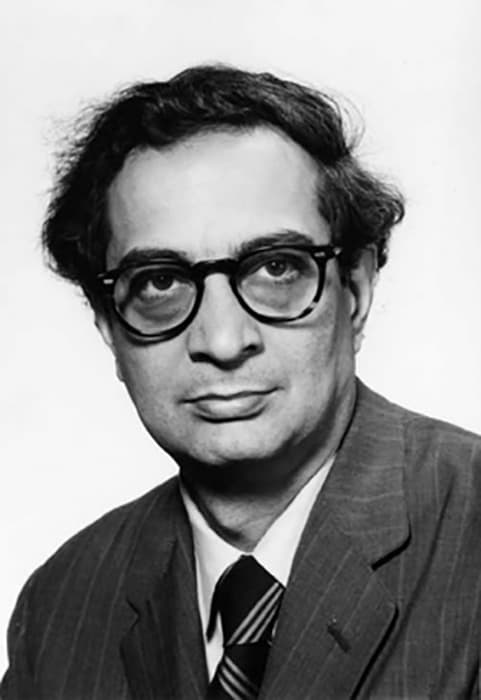
Laser Pioneer: Ali Javan 1926–2016. (Courtesy: MIT)
The physicist and inventor of the gas laser, Ali Javan, has died at the age of 89. The emeritus professor at the Massachusetts Institute of Technology was a pioneer in quantum electronics as well as laser technology. He developed the gas laser in the 1960s while working at Bell Laboratories and the technology has since been used in a wide range of applications, from telecommunications to holography to medical devices. Javan also founded the first large-scale research centre in laser technology in the US. He was the first person to devise a way to accurately measure the speed of light and he also launched the field of high-resolution laser spectroscopy. Born in 1926 in Tehran, Iran, Javan moved to the US in 1949, where he studied and worked at Columbia University with Nobel-prize-winning physicist Charles Townes. Not having received either a bachelor’s degree or a master’s degree, Javan earned his PhD in physics at Columbia in 1954, with Townes serving as his thesis advisor.
You can find all our daily Flash Physics posts in the website’s news section, as well as on Twitter and Facebook using #FlashPhysics. Tune in to physicsworld.com later today to read today’s extensive news story on a new quantum sensor for magnetic and gravitational fields.
A study by physicists at Tel Aviv University in Israel has revealed how some structures act as very efficient shock absorbers to protect the mammalian nervous system. Roy Beck and colleagues have used X-ray diffraction and computer models to study the disordered protein structures that biophysicists know are responsible for absorbing compressive forces in neurone cells. The structures comprise long filaments with protein “tails” sticking out – giving each filament the appearance of a bottlebrush. When subjected to low compressive forces, the filaments are held together in a network by an attractive interaction between the tails. As compression increases, the interaction becomes repulsive and is very effective at absorbing the compressive force. Furthermore, the interaction ensures that the protein filaments remain intact, even after being compressed one twentieth of its original volume. About one half of all human protein structures contain disordered regions and the study – described in Physical Review Letters – could shed light on the biophysics of these systems.
US–Australia sign particle-physics agreement
Coming together: particle physicists at the Fermi National Accelerator Laboratory in the US and the ARC Centre of Excellence for Particle Physics at the Terascale in Australia will deepen their collaboration in particle physics. (Courtesy: Reidar Hahn)
The Fermi National Accelerator Laboratory (Fermilab) and the ARC Centre of Excellence for Particle Physics at the Terascale (CoEPP) have signed an agreement to deepen their co-operation in particle physics. The initiative – dubbed a co-operative research and development agreement – will result in an exchange of scientists, students and technical staff, as well as the labs working together on accelerator R&D, new computational methods and advances in theoretical physics. “We’re glad to deepen our relationship with CoEPP as we move forward into a new era of physics research,” says Fermilab director Nigel Lockyer. CoEPP director Geoffrey Taylor adds that the “welcome alliance” will lead to the development of new techniques, tools and detector technology in particle physics.
Vortices interact in superfluid mixture
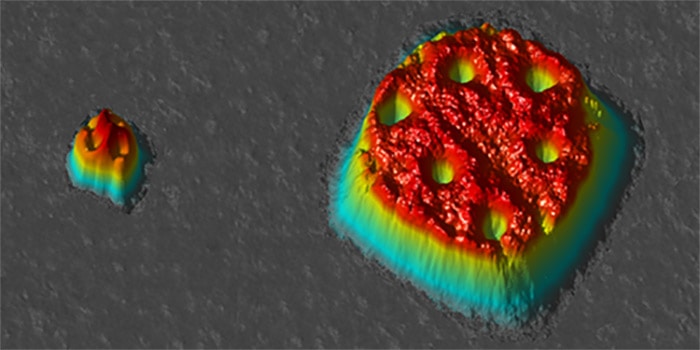
Superfluids in a spin: vortex patterns in a lithium-6 superfluid (left) and a potassium-41 superfluid. (Courtesy: Yu-Ao Chen/University of Science and Technology of China)
Physicists in China have mixed two superfluids together and then watched as vortices created in one superfluid interact with those created in the other superfluid. The work was done by Xing-Can Yao, Jian-Wei Pan and colleagues at the University of Science and Technology of China, who mixed together fermionic lithium-6 atoms with bosonic potassium-41 atoms. Creating such a superfluid mixture is of great interest to physicists trying to simulate superconductors – with fermions and bosons playing the roles of electrons and phonons, respectively, in a superconductor. The team cooled the atoms and then held the resulting superfluid mixture within a disc-shaped optical trap. Then, a rotating laser was used to spin the mixture, which is able to flow without resistance. When the researchers observed the motions of the two different atomic species, they saw two different lattice-like patterns of vortices (see image). They found that the lithium-6 vortices behaved differently in the mixture compared with when superfluid lithium-6 was studied on its own. This suggests that the two superfluids are interacting with each other. The research is described in Physical Review Letters.
You can find all our daily Flash Physics posts in the website’s news section, as well as on Twitter and Facebook using #FlashPhysics. Tune in to physicsworld.com to read about today’s announcement of the Nobel Prize for Physics.
The Nobel Prize for Physics 2016 has been divided, one half awarded to David J Thouless, the other half jointly to F Duncan M Haldane and J Michael Kosterlitz “for theoretical discoveries of topological phase transitions and topological phases of matter”. The prize is worth SEK 8m (£629,000) and will be shared by the winners, who will receive their medals at a ceremony in Stockholm on 10 December.
Speaking to the Nobel press conference via telephone, Haldane said, “I was very surprised and very gratified…It’s only now that there’s a lot of tremendous new discoveries based on this original work…It’s taught us that quantum mechanics can behave far more strangely than we could guess.” In describing his original work, he said “It was really just a toy model demonstration of something…Like most discoveries, you stumble onto them and you just have to realize there’s something interesting there.” Haldane also thanked Nobel prize winner Philip Anderson – his former tutor at the University of Cambridge – for inspiring his unorthodox approach to condensed-matter physics.
British born
David Thouless was born in 1934 in Bearsden, Scotland. He completed his PhD in 1958 at Cornell University in the US. He was professor of mathematical physics at the University of Birmingham in the UK before joining the University of Washington in 1980 – where he is emeritus professor.
Duncan Haldane was born in London in 1951 and completed a PhD at the University of Cambridge in 1978. He is Eugene Higgins Professor of Physics at Princeton University.
Michael Kosterlitz was born in 1942 in Aberdeen, Scotland and studied physics at the University of Cambridge before gaining a PhD at the University of Oxford in 1969. He is Harrison E Farnsworth Professor of Physics at Brown University in Rhode Island. Kosterlitz has previously worked at the University of Birmingham, the Instituto di Fisica Teorica in Turin, Italy and Cornell University.
Of doughnuts and coffee cups
The science behind this year’s prize tied together three concepts in physics and mathematics, namely: topology; quantum phase transitions; and states of matter. The result is what the Nobel committee described as “beautiful mathematical and profound physical insights”. Indeed, the laureates’ research has laid the theoretical basis for a variety of condensed-matter staples including superconductors and thin magnetic films.
Common to the work of Haldane, Kosterlitz and Thouless is the concept of topology. This a branch of mathematics that describes properties that remain unchanged when an object is changed or deformed in a series of steps. An old but popular example of such topological changes is that a doughnut-like shape can be transformed into that of a coffee cup and vice-versa. So topologically speaking, both shapes are identical.
In a classical sense, all matter exists as either a solid a liquid or a gas. A phase transition occurs when matter changes from one form to another, such as liquid water turning to ice. Quantum effects do not normally play a role in these familiar phase transitions because they are washed out by thermal fluctuations. However, at very low temperatures near absolute zero, matter takes on strange new phases and quantum effects become very pronounced. A good example of this is that electrical resistance disappears at temperatures approaching absolute zero; or the spin of a vortex in a superfluid seems to flow forever without slowing down.
Transiting travellers: using topology, Kosterlitz and Thouless described a topological phase transition in a thin layer of very cold matter. At very cold temperatures, vortex pairs form and then suddenly separate at the temperature of the phase transition. This was one of the 20th century’s most important discoveries in the physics of condensed matter. (Courtesy: the Nobel Prize Committee/Royal Swedish Academy of Science)
For a long time, it was believed that any ordered phases would be destroyed in flat 2D systems, even at absolute zero, due to thermal noise – this in turn meant that there could be no phase transitions. But in 1972 Kosterlitz and Thouless overturned that idea by identifying a completely new type of phase transition in such extremely thin layers, where topological defects play a crucial role. As a result, they were able to show that superconductivity or superfluidity can occur in 2D layers at low temperatures. The pair also calculated that the phase transition would occur at relatively high temperatures, above which superconductivity would disappear. According to the Nobel committee, the pair’s work “resulted in an entirely new understanding of phase transitions, which is regarded as one of the 20th century’s most important discoveries in the theory of condensed-matter physics”.
Wandering vortices
This topological change, now known as the KT (Kosterlitz–Thouless) transition, mainly occurs thanks to the configurations of tiny vortices of electronic spins on these 2D surfaces. At low temperatures, the spin vortices are tightly paired and as the temperature rises, the vortices suddenly separate from one another. This triggered a quantum phase transition from one state of matter to another. The KT transition has since been used to study superconductors and superfluids. It has also been applied to phase transitions that occur when a ferromagnetic thin film is cooled below the Curie temperature and the spins line up, giving rise to net magnetization.
Thanks to experimental advances, the early 1980s also saw the discovery of a number of new states of matter that defied explanation. A particular mystery was the 1980 discovery of the “quantum Hall effect” by German physicist Klaus von Klitzing, who won the 1985 Nobel Prize for Physics for that work. The classical Hall effect is based on the appearance of a measurable voltage across the two sides of a metallic sheet with a current passing along its length, which is placed in a strong magnetic field that is perpendicular to the sheet. The Hall voltage appears as electrons drift towards one edge of the sheet.
Quantized steps
The quantum Hall effect is seen in 2D materials. Klitzing studied a 2D conducting layer sandwiched between two semiconductor layers, which was cooled to just above absolute zero and placed in a strong magnetic field. He found that the Hall voltage is quantized at very specific, discrete values. These values appeared to be independent of the material used and did not vary when experimental parameters such as the temperature, magnetic field or the amount of semiconductor impurities in the sample are changed. A large enough change in the magnetic field causes the conductance (which is also quantized) to change in fixed amounts – for example a reduction in the magnetic-field strength initially makes the conductance double, then triple and so on. A comparison of the current in the conductor and the Hall voltage showed that the resulting Hall resistance is h/Ne2, with N being an integer, but why these integer steps took place was unknown.
Thouless found an appropriate solution by proving that these integers were topological in their nature. Indeed, he showed that understanding the collective behaviour of the electrons in the conducting thin-film layer was crucial and that the material could be thought of as a topological quantum fluid. In such a fluid, the conductance is described via the electrons’ collective motion, and that their topology means that phase-transitions would occur at fixed steps.
Mind the gap
Around the same time, Haldane was studying the properties of chains of magnetic atoms and how symmetry comes into play. Haldane claimed that magnetic chains would have fundamentally different properties depending on whether the magnetic atom was even or odd – i.e. has an integer or half-integer spin. He showed that even (integer) chains are topologically ordered (and inversion-symmetry remains unbroken), while odd (half-integer) chains are not topological (and inversion symmetry is broken).
Indeed, in 1988 Haldane worked out that there is a spin gap in the excitation spectrum for integer spin-chains, whereas half-integer spin-chains have a gapless excitation spectrum. At the time, Haldane’s reasoning was questioned, but it has since been experimentally verified. The work has also helped to forge links between statistical mechanics, quantum many-body physics and high-energy physics – fields that now boast a large shared toolkit of theoretical techniques.
Today, condensed-matter physics regularly studies a variety of topological phases in 2D and 3D materials, as well as topological insulators, superconductors and metals. Indeed, these materials are thought to be at the frontline for potential uses in the next generation of electronic devices. Watch our 100 Second Science video below to learn more about such applications.
The cover story in the October 2016 issue of Physics World magazine – now live in the Physics World app for mobile and desktop – reveals the inside story of how military labs are opening up their research facilities to the world. You can read the article here too.
The October issue also looks at how breakthroughs in physics really occur – is it flashes of insight or just long, hard graft? – and examines why we could finally find discrepancies in the “equivalence principle” that inertial and gravitational mass are the same.
Don’t miss either the ding-dong over China’s plans to build a new collider, our interview with Nithaya Chetty on transforming South African astronomy, or Robert P Crease’s Critical Point column on the danger of “unknown unknowns”.
The negative refraction of electrons in graphene has been seen for the first time in experiments done by physicists in the US. The work represents an important advance in the fabrication of graphene electronic devices, and could lead to new applications of graphene such as low-power transistors.
Negative refraction can occur when light or other waves cross an interface between two different materials. The term “negative” is used when the direction of the light is bent in the opposite direction to that which occurs for conventional materials such as glass and water. Negative refraction is a property of some artificial metamaterials and can be used to bring diverging rays back to a focus – allowing for the creation of a perfect lens. First proposed by the Russian physicist Victor Veselago in 1968, various types of negative refraction materials have subsequently been produced and the concept has been applied to the design of invisibility cloaks. However, actually making practical metamaterials has proven to be very difficult.
In principle, it should be much easier to achieve negative refraction with electron waves in a semiconductor. For electrons in a solid, the equivalent quantity to the optical index of refraction is the Fermi wave vector. This intrinsic property points in the same direction as the electron flow in an n-type semiconductor – in which charge is carried by electron flow. In a p-type semiconductor, however, charge is carried by positive “holes” and the wave vector points in the opposite direction. At the interface between an n-type and a p-type semiconductor (a “p–n junction”), the Fermi wave vector therefore changes sign and negative refraction should result.
Too much reflection
In practice, however, no one has been able observe negative refraction at a p–n junction. The main reason is that in conventional semiconductors with an energy gap between the valence and conduction bands, an electron has to gain or lose energy to traverse a p–n junction. The result is that the vast majority of electrons are reflected at the junction rather than being transmitted across and therefore refracted.
Graphene is a sheet of carbon just one-atom thick and it has no band gap. Therefore p–n junctions made from graphene should be much more transparent to electrons than those made from other semiconductors. Nevertheless, previous attempts to see negative refraction in graphene have failed. In search of an explanation for this failure, Cory Dean of Columbia University and colleagues modelled electron transmission across the p–n boundary in graphene. They concluded the likely culprit was the atomic-scale roughness at the interface that is the result of conventional lithographic processes used to make the junctions.
“Say you shine a focused laser beam onto a piece of glass, you can see that it refracts and measure the change of direction quite easily,” explains Dean. “Now imagine that you take a piece of sandpaper and scuff the surface of the glass, the beam will get dispersed.”
Flaky solution
To get around this problem, the team fashioned a junction using the natural edge of a graphene flake. They attached multiple electrodes to both sides of the junction. By injecting the electrons on one side and placing the junction in a variable transverse magnetic field, they controlled the angle at which electrons approached the boundary. They then used the voltage on the electrodes on the other side to work out where the electrons had ended up after crossing the junction. By comparing their measurements with computer models, they obtained clear evidence of negative refraction.
The team believes that its findings could lead to several practical applications. Dean says that, in principle, the ability to bring a diverging electron beam back to a focus at one of two points could form the basis of an electronic switch. Such a switch could be operated using very small amounts of energy, and this could be used to boost the efficiency of electronic devices. Dean also suggests that some of the parallels with optical applications of negative-refraction materials – such as cloaking – could be exploited in practical devices: “I don’t think it’s too crazy to think that we could apply some of those same concepts to electrical devices in ways that just haven’t been thought about because the technology just hasn’t been there,” he says.
Theoretical Physicist Carlo Beenakker of Leiden University in the Netherlands is impressed by the work: “The big technical advance is that they’ve been able to make very thin, very abrupt p–n junctions,” he says. “That, by itself, could have very far reaching implications because we know p–n junctions have all kinds of electronics applications.” He is more sceptical about the usefulness of perfect lensing with electrons: “If you have an electronic device, you have a big ohmic contact and shoot in electrons from all directions, and they come out with all directions at the other side,” he says. “We don’t use angular resolution in semiconductor devices, probably because it’s not a robust way to operate a device.”
Weather nanoparticle-infused coatings to study ecological impact
In an attempt to study the ecological and health-related consequences of nanoparticles released into the environment, researchers at the National Institute of Standards and Technology (NIST) have subjected a commercial nanoparticle-infused coating to a weathering process. The technique offers an accelerated way to study the effects of weathering from ultraviolet radiation as well as simulated rainwater. To study the effects of weathering, the team exposed multiple samples of a commercially available polyurethane coating containing silicon-dioxide nanoparticles to intense UV radiation for 100 days inside the NIST SPHERE (Simulated Photodegradation via High-Energy Radiant Exposure) – one day inside the SPHERE was equivalent to 10 to 15 days outdoors. For the “NIST simulated rain,” the researchers used filtered water that was converted into tiny droplets, sprayed under pressure onto the individual samples, and then the run-off – with any loose nanoparticles – was collected in a bottle. The team found that humidity and exposure time are contributing factors for nanoparticle release, which may be useful in designing future studies to determine potential biological impacts. The research is published in the Journal of Coatings Technology and Research.
Alice keeps a secret for 24 hours
Information encoded into an optical signal has been kept secret for 24 hours by a team of physicists at the University of Geneva in Switzerland. The work is a demonstration of the “bit-commitment” protocol whereby one party (Alice) creates a binary number and keeps it secret from the world until an agreed time when it is revealed to another party (Bob). An important feature of the protocol is that Bob can verify that the value of the number has not been tampered with while it was being kept secret. The process involves Alice and Bob each having two agents that they alone control. Alice’s secret number is mixed with a series of random numbers, with the results exchanged back and forth between the agents. The encryption algorithm is such that Bob can only determine the value of Alice’s secret after the final round of exchanges is complete – and he can also work out if anyone has clandestinely changed its value. Last year, several members of the Geneva team managed to keep Alice’s secret for 2 ms by performing six information exchanges over 131 km of fibre. Now, Anthony Martin and colleagues have boosted that time to 24 h. While the separation between parties was shorter in this latest work (7 km), they achieved five billion exchanges of information over the 24 hour period. The team points out that it could extend this time to a year using a 10,000 km separation. The research is described in Physical Review Letters, and one possible application is tamper-proof voting, whereby a ballot could be kept secret until it was time to count
European XFEL appoints new chairperson
Looking ahead: Robert K Feidenhans’l was appointed the new chairman of the management board of European XFEL GmbH. He has served as a Danish delegate to the European XFEL Council and was chairman of the Council from 2010 to 2014. Currently, he is director of the Niels Bohr Institute at the University of Copenhagen. (Courtesy: European XFEL)
Physicist Robert Feidenhans’l has been appointed chairperson of the management board of the European X-ray Free Electron Laser (XFEL). The research facility is currently being built in Hamburg, Germany, and when complete next year it will generate X-ray beams 30,000 times per second, with each pulse lasting less than 100 fs (10–13 s) that will allow researchers to create “movies” of processes such as chemical bonding and vibrational energy flow across materials. The facility’s management board has five members including the chairperson, an administrative director, as well as three scientific directors. Feidenhans’l, 58, is currently head of the Niels Bohr Institute at the University of Copenhagen, Denmark, and will join the European XFEL on 1 January 2017. He will succeed Massimo Altarelli, who has been at the head of the board since it was founded in 2009, and will now retire. “I am delighted to see the European XFEL, to which I devoted all my efforts over many years, in excellent hands,” says Altarelli, adding that Feidenhans’l is “an eminent X-ray scientist, with huge prestige in the scientific community and with vast experience in the management of large research organizations, including international ones. I am sure he will lead the facility to outstanding success in its operation phase”.
You can find all our daily Flash Physics posts in the website’s news section, as well as on Twitter and Facebook using #FlashPhysics. Tune in to physicsworld.com later today to read today’s extensive news story on the optical behaviour of electrons in graphene.
On a dreary, nondescript September morning in 1933, the Hungarian physicist Léo Szilárd stood by the roadside in central London waiting for traffic lights to change so that he could cross. As he stepped off the kerb, “time cracked open before him and he saw a way to the future, death into the world and all our woe, the shape of things to come”.
That’s how Richard Rhodes describes Szilárd’s epiphany, in the opening of his magisterial history The Making of the Atomic Bomb (1986), of how nuclear fission might be unleashed in the world. Szilárd saw that a chain reaction involving the emission of neutrons, discovered only a year earlier by James Chadwick, might sustain the fission process of atomic nuclei and enable the liberation of atomic energy. HG Wells had already imagined this scenario in his prescient novel The World Set Free (1914), in which he coined the term “atomic bomb”.
Szilárd was in England as a Jewish refugee from Nazi Germany. His vision of a nuclear chain reaction became an experimental possibility when, five years later, scientists in Germany discovered spontaneous fission in uranium. That prompted Szilárd and Albert Einstein to write to US president Franklin D Roosevelt warning of the danger of a German atomic bomb and urging an American effort to develop one.
All the elements needed for a theory of sustained nuclear fission were in place by 1933, but it took a flash of insight to unify them in Szilárd’s mind. That happened not as he sat thinking in a laboratory office, but during the most mundane and innocuous circumstance.
It seems this is commonly the case for “breakthrough” moments, when scientists suddenly see how to solve a problem or to weave ideas productively together. You can’t arrange for these insights; there’s no magic formula. But given that scientific progress often depends on them, it’s odd that they are so rarely discussed. It’s as if a determination to present science as an objective enterprise driven by some systematic method creates a nervousness about admitting to the uncontrollable, almost numinous manner in which insight often arrives.
That’s why a workshop called the Physics Imagination Retreat, held at the University of Cambridge, UK, in late June, convened by the Imagination Institute and led by University of Pennsylvania psychologists Martin Seligman and Scott Barry Kaufman, was so unusual – and so revealing. Here a handful of leading physicists discussed how they conceptualize their research and how they find answers to problems. To judge from their testimony and that of others, these answers sometimes really do arrive in eureka moments.
It seems likely that at least some famous “eurekas” are the retrospective inventions of scientists or their biographers
That notion of sudden, complete resolution of a scientific problem has been challenged as a model of how science really works. Sure, eureka moments make for a catchy narrative in popular-science histories, but doesn’t science more often advance through hard graft rather than flashes of inspiration?
It seems likely that at least some famous “eurekas” are the retrospective inventions of scientists or their biographers. Close inspection of the notebooks of Louis Pasteur led historian of science Gerald Geison to question the story reported by the French physician’s son-in-law of how Pasteur discovered molecular chirality (handedness). The son-in-law’s story goes that, having separated by hand crystals of opposite chirality and found that they rotate polarized light in opposite directions, Pasteur rushed into the corridor shouting “Tout est trouvé!” – all is found. But he probably didn’t; the realization came to him more gradually. And while we’ll probably never know the whole truth about Newton’s falling apple, it’s very likely that the story was embellished, if not entirely fabricated, by the great man himself.
However, perhaps the pendulum has swung too far the other way. It seems clear that many scientists do, like Szilárd, have these abrupt insights. And possibly they are especially prevalent in theoretical physics, where problems and their solutions are often rather abstract and mathematized, and much of the work goes on inside the researcher’s head rather than relying on some decisive experimental result.
Can we hope to understand how such eureka moments come about? There’s unlikely to be any recipe for producing them, or even any unifying way of comprehending them. But to judge from the evidence of the Cambridge gathering, there do seem to be similarities and resonances: clues to how imagination does its work in physics. Here are some of them.
The moment of clarity
Michael Berry, a theoretical physicist at the University of Bristol, UK, who has made important discoveries in fields ranging from quantum chaos to classical optics, describes moments of insight as “claritons”, the “elementary particle of sudden understanding” – which he jokingly refers to as his sole contribution to particle physics. He warns of the corollary: that anticlaritons also exist, “a too-frequent unwanted arrival that annihilates yesterday’s clariton”.
Berry was struck by a clariton in 1985 “during a long journey in January, when it was so cold that ice formed on the inside of the windows of the usually overheated German train”. The clariton, he says, was suddenly seeing that there must be a connection between quantum mechanics, chaos and prime numbers.
“This was very soon after I had started to understand the already-conjectured connection between the arrangement of quantum energy levels in systems that are classically chaotic and the universal statistics of numbers called eigenvalues generated by random matrices,” he says. “The understanding was why the universality occurs, and where and how it breaks down.” His clariton was that the Riemann zeta function, a mathematical function related to the disposition of prime numbers, fits precisely into this mathematical framework. “Why suddenly then?” Berry wonders. “I don’t know.” What process generates a clariton?
Collaboration
Berry feels that most claritons involve an apprehension of connections between ideas or problems. And those in turn often arrive through talking. “My claritons often came during or very shortly after conversations with colleagues,” he says, “triggered by an off-hand remark that suddenly revealed connections between two or more of my scientific preoccupations that had previously existed separately in my mind.”
This stimulation from colleagues seems central to several such experiences. Polymer scientist Tom McLeish of Durham University, UK, described one at the Cambridge gathering. He and his collaborators had been working for many years with an experimental group in Germany that had obtained some odd-shaped neutron-scattering plots from polymer liquids. McLeish had been discussing their interpretation with a colleague, but was getting nowhere.
“So we’d just given up,” he says. “My colleague said goodbye to my secretary as he stood at the door. Then he turned round and looked at me – and we both said: ‘Free ends!’ When you make a polymer network you cross-link chains at random points, and there are always some dangling chain ends left over. We both realized in the same instant that these samples must have a significant concentration of these ‘semi-free’ segments, able to adopt any orientational configuration just like totally free chains. We somehow saw into the structure of the material immediately and deeply.”
“Sometimes something in the unconscious is actually doing better than our conscious thinking, and at some later point that gets kicked upstairs,” McLeish suggests. “That can be triggered internally when ready, or externally by some unconnected event.”
This meeting of minds isn’t always quite so magical. Sometimes it simply entails one researcher hearing something useful from someone who didn’t even know it was valuable. Michael Cates, a theoretical condensed-matter physicist at Cambridge (and the current occupant of Newton’s old chair of Lucasian Professor of Mathematics), describes the kind of conversation he has sometimes been involved in: “A says to B: ‘Do you think you could solve problem X with the method I’ve just come up with?’ B responds: ‘Hmm, yes. That should be possible. And if so I can also solve problem Y with it.’ Then A says: ‘What?! You mean my method solves problem Y? That’s unbelievable, I’ve been thinking about Y for three years and never got anywhere with it. It’s a really important problem,’ and B never had any inkling of that.”
Intuition
Several moments of realization attested by physicists invoke a conviction about the truth of a solution even before the technical proofs are worked through. The researchers sense that, having arrived at the “right” answer, they can fill in the details at their leisure. “I share the experience reported by several people, that the clariton is often the beginning of the solution of a problem rather than the fully formed solution,” says Berry. “Nevertheless, it is usually accompanied by the powerful conviction that analysis will demonstrate that it is right (anticlaritons notwithstanding).”
This was the case for mathematical physicist Andrew Parry of Imperial College London when he was working on a thorny problem in condensed matter: the theory of critical wetting, or how the shapes of fluid films that wet a solid surface change with temperature. For years this field had been plagued by a discrepancy between what seemed like the best available theory and the results of computer simulations.
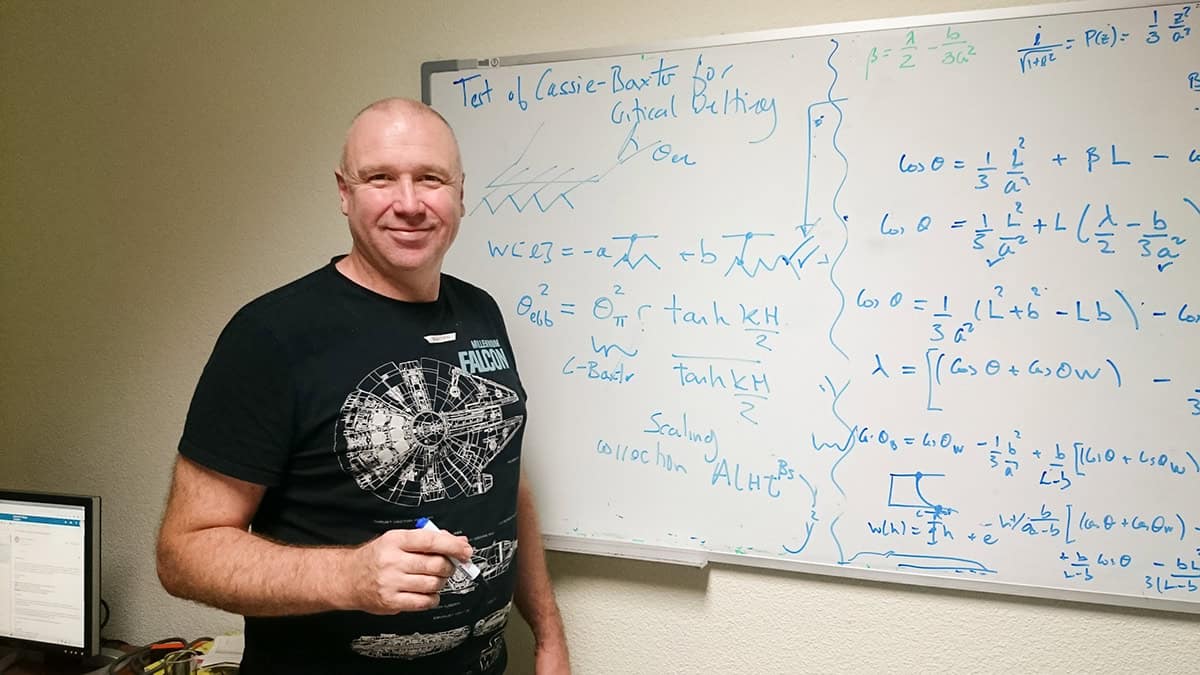
Am I dreaming? Mathematical physicist Andrew Parry of Imperial College London was on holiday in Mallorca when a visual language – with which he could finally solve a years-long discrepancy in the field of critical wetting – came to him in dreams. (Courtesy: Carlos Rascon)
“The solution came to me partly as a guess, then a few weeks later fully in a dream,” says Parry. “While on holiday with my collaborator in Mallorca, I woke up and knew the answer. I knew where to start, where to rest in the middle and where to end in my proof – even though it didn’t yet exist.” He found the solution unfolding almost outside his volition, even though it involved many hours and pages of calculation.
“The three papers we wrote are about 300 equations long, yet almost all of them I knew beforehand as soon as I woke from my sleep that day in the Spanish sun,” he says. Not without some trepidation for fear of ridicule, he describes the experience as the closest he can imagine to a spiritual revelation, in which he became a mere vehicle for the emergence of a deep and beautiful truth. “I felt I’d come across something much bigger and more important than me,” he says. “I was in awe of it.”
It is a bit like pattern recognition: I develop a feeling I need to find a certain pattern, a certain structure, and then the pieces fall into place
Jon Keating
Mathematical physicist Jon Keating of Bristol has had the same experience of sensing an answer before actually proving it. “Sometimes I have an idea, or hear something new, and I have a strong sense that this will solve my problem, long before I go through the details. I’m not always right of course! But I have been right, and that does feel magical. It is a bit like pattern recognition: I develop a feeling I need to find a certain pattern, a certain structure, and then the pieces fall into place.”
“It is quite common that one recognizes the whole pattern as the right one without having to check the details,” he says. “Jigsaw puzzlers will know this feeling.”
Preparation
This role of intuition in science needn’t be seen as something entirely mysterious. Pasteur famously extolled the way that “fortune favours the prepared mind”. He was thinking of how happy experimental accidents may lead to new understanding, but purely theoretical breakthroughs too depend on having penetrated a problem deeply enough to spot the answer when it arrives.
Keating says that this preparation may involve an almost obsessive dwelling on a particular issue or set of questions. “I tend to have a number of pet problems that I keep in my head for a long time,” he says. “Every time I hear something new, I try it out on my problems. I know these problems so well that I tend to have a feeling as to what is needed to solve them, or rather why previous lines of attack have failed.”
Visual language Andrew Parry’s diagrams allowed him to express his problem in a new way. (Courtesy: Andrew Parry)
This isn’t just a question of thinking hard and long about a problem, but also of finding the right way to express it – a way that enables connections to become apparent. “It is frequently about finding the right formulation or realizing what pattern to look for, and also frequently about asking the question in the right way,” says Keating.
That was the key to Parry’s breakthrough on critical wetting. Rather than the pages of clunky maths he’d been wrestling with, he suddenly saw how to express the interactions between the liquid–vapour and liquid–solid interfaces in terms of pictures akin to Feynman’s celebrated diagrams for dealing with forces between fundamental particles. “It was the invention of this new [visual] language, which I just woke up with one day and could speak, that was so powerful,” he says. “Each time I got stuck, a new part of the language would just pop into my head and allow me to convert it into a new expression and to carry on with the manipulation. I felt I’d had a glimpse of the book of nature.”
In dreams
I used to be rather sceptical about the idea that scientists find answers in dreams. These occurred too often in 19th-century accounts to seem plausible: August Kekulé drowsing in front of a fire and seeing the ring structure of benzene as a snake swallowing its tail, or Dmitri Mendeleev dreaming of the correct arrangement of playing cards annotated with elemental symbols to construct his periodic table.
But as Parry attests, it seems that these things really do happen. At the Cambridge meeting, John Pendry of Imperial described such an experience from his early days as a scientist. “I had a very tricky problem in my PhD thesis: there were some trajectories in the complex plane that someone else had postulated. The sign of some derivative changed and this trajectory was normally a loop, and everybody drew a loop.” But this didn’t solve the problem. Then – “Suddenly it came to me in a dream: what happened was the loop twisted and it was two loops. The twisting meant that the change of sign was explained. It was just there in the morning.” Shades of Kekulé, to be sure.
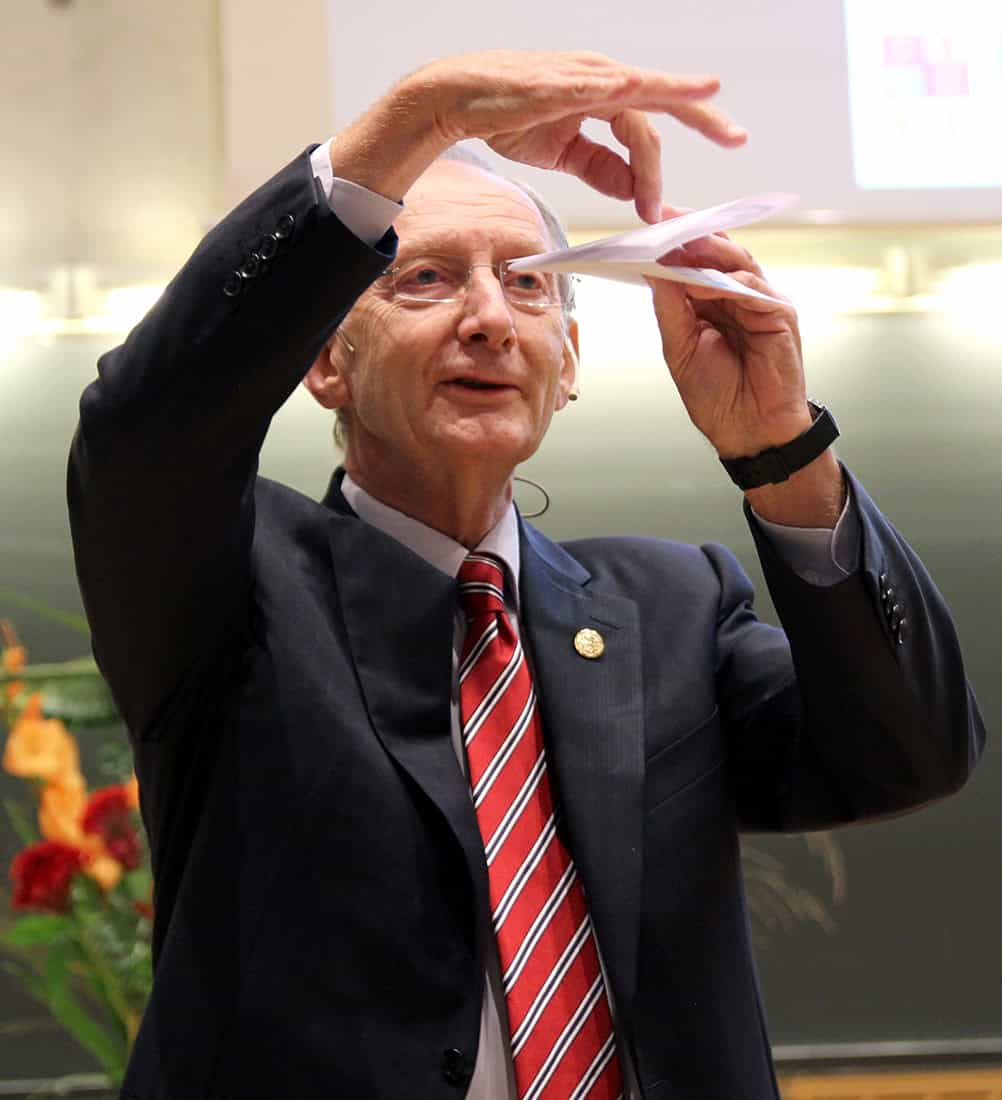
Bedtime brainwaves John Pendry of Imperial College London reasons that dreaming of a solution to a problem makes sense, as your brain continues working on the same thing you’ve been thinking about during the day. (CC BY Per Henning/NTNU)
That sort of thing is not unusual, Pendry says. “A lot of people keep a notebook by the bed, for when they wake up and something is in their head. You go to bed, you’ve worked on the problem all day, you’re tired but the data is up there, and somehow your brain sorts it out.”
Sometimes these dream-stories can be uncanny. McLeish says that he was once trying to figure out, with the same colleague involved in his “corridor” insight, some of the complex morphologies that can arise in the de-mixing of binary fluid mixtures. “We could compute the patterns by simulation, but needed ways of quantifying them through relevant figures of merit,” he says. “In particular the topological quantity escaped us – think of it as the ‘density of holes’. We got nowhere.”
“Then one night I had a dream in which the space was partitioned into small cubes and all possible topological states of each cube enumerated, depending on how dividing surfaces crossed the sides and edges. It turned out that one could then endow this set of primitive cubes with a numbering system that would be additive in calculating the topological invariant of the whole structure.”
Excited by this realization, McLeish rushed in to see his colleague the next morning. “He greeted me by saying ‘Oh, I was just on my way to see you – I had this weird dream last night that if we divided the structure into little cubes…’.”
If you read that in history books, would you believe it?
Searching for answers
What might you learn from all this, the next time you’re stuck on a problem and desperately seeking inspiration? In the end, the advice is probably not very surprising or spectacular. Talk to a friend or colleague. Take a walk. Have a sleep. Anything, it seems, but simply trying to think harder. Stop telling yourself that you should be smarter, and give your unconscious a chance (it’s pretty smart too).
Chinese Taoists have a term for it: wu wei, “not acting”. If there really is a Tao of Physics, perhaps that’s where to find it.
Back in 2014 the physicist Stephen Hawking hit the headlines by warning that artificial intelligence (AI) “could spell the end of the human race”. Like many of Hawking’s policy pronouncements, this one had a mixed reception. But is artificial intelligence actually something to be afraid of? In her short but information-dense book AI: Its Nature and Future, Margaret Boden, a cognitive scientist at the University of Sussex, UK, attempts to give readers the information they need to form their own opinions.
At the outset, she introduces the five major “types” of AI and explains how these different branches have interacted (and sometimes clashed) with each other over the discipline’s relatively short history. Broadly speaking, Boden explains, AI researchers are either interested in life, or they are interested in mind. Those in the former group tend to work on the cellular automata, dynamical systems or evolutionary programming strains of AI, while those in the latter group are drawn to studies of artificial neural networks or the logic-based “classical AI” championed by Alan Turing and his later disciples.
Developing any kind of general AI system (that is, one that can react in a human-like way to a wide variety of situations and problems, and not just be really good at, say, playing chess) will, Boden argues, almost certainly require a combination of these approaches, and probably additional ones as well. As for the chances of super-human AI emerging, Boden places herself on the sceptical end of the spectrum. In an insightful final chapter that also touches on the emerging field of AI ethics, she argues that while the so-called “singularity” (the point at which machines become more intelligent – whatever that means – than humans) may be possible in theory, it is effectively never going to happen in practice.
2016 Oxford University Press £12.99/$18.95hb 156pp




 By Matin Durrani