Back in 2014 the physicist Stephen Hawking hit the headlines by warning that artificial intelligence (AI) “could spell the end of the human race”. Like many of Hawking’s policy pronouncements, this one had a mixed reception. But is artificial intelligence actually something to be afraid of? In her short but information-dense book AI: Its Nature and Future, Margaret Boden, a cognitive scientist at the University of Sussex, UK, attempts to give readers the information they need to form their own opinions.
At the outset, she introduces the five major “types” of AI and explains how these different branches have interacted (and sometimes clashed) with each other over the discipline’s relatively short history. Broadly speaking, Boden explains, AI researchers are either interested in life, or they are interested in mind. Those in the former group tend to work on the cellular automata, dynamical systems or evolutionary programming strains of AI, while those in the latter group are drawn to studies of artificial neural networks or the logic-based “classical AI” championed by Alan Turing and his later disciples.
Developing any kind of general AI system (that is, one that can react in a human-like way to a wide variety of situations and problems, and not just be really good at, say, playing chess) will, Boden argues, almost certainly require a combination of these approaches, and probably additional ones as well. As for the chances of super-human AI emerging, Boden places herself on the sceptical end of the spectrum. In an insightful final chapter that also touches on the emerging field of AI ethics, she argues that while the so-called “singularity” (the point at which machines become more intelligent – whatever that means – than humans) may be possible in theory, it is effectively never going to happen in practice.
2016 Oxford University Press £12.99/$18.95hb 156pp
Shrouded by forest in the southern Ural mountains, the Russian city of Ozersk offers its residents a peculiar mix of nuclear dystopia and domestic bliss. The birthplace of the Soviet nuclear-weapons programme remains a closed city, but in City 40, the Iranian-born US filmmaker Samira Goetschel and her film crew take you behind the barbed-wire fences for an unauthorized glimpse of what it was – and still is – like to live there.
Using archive footage, the 73-minute documentary (now available on Netflix in many countries) first shows how the city was created in 1945 around the Mayak nuclear plant. Then codenamed “City 40”, Ozersk was patterned on the US city of Richland, Washington, which housed the workers who produced plutonium for the “Fat Man” bomb detonated over Nagasaki, Japan. In both cities, citizens were lavished with higher-than-average salaries, along with good-quality housing, healthcare and education systems. Indeed, the most remarkable aspect of City 40 is the window it offers on the everyday lives of Ozersk residents, who were known to outsiders as the “chocolate people” during the Soviet era on account of the abundance of luxury foods available there. In one scene we see agile youths back-flipping in a park; in another we see citizens attending a theatre performance.
Meanwhile, we learn from local journalists and nuclear scientists that residents of the city suffer from high rates of cancer, with many lives cut short or damaged due to radiation-related health issues. The contrast is both uneasy and surreal. The film’s central character is a local human rights lawyer, Nadezhda Kutepova, who has long campaigned to open up the city to the outside world. At the documentary’s conclusion, we learn that since her final interview, Kutepova was accused of industrial espionage and plotting against the Russian nuclear industry, and that she and her four children have been granted political asylum in France. This, of course, raises some troubling questions about the ethics of documentary film-making, but as viewers it is hard to second-guess the relationship that developed between the film-maker and her contributors. We are, however, left with one glaring reality: City 40 may no longer be a state secret, but Russia will not be inviting the outside world for an authorized tour any time soon.
Like most people, we at Physics World seldom give much thought to what lies beneath city streets. For the past few months, however, the view from our office has been dominated by road works, and observing the fluorescent-jacketed contractors as they rip up existing pipes and cables and install new ones has given us a fresh appreciation for the city’s hidden infrastructure. Readers in search of similar insights (but without the constant rumble of heavy machinery outside their workplace) would do well to pick up a copy of Laurie Winkless’s book Science and the City: the Mechanics Behind the Metropolis. In it, Winkless, a physicist and writer based in London, UK, delves into the structures that define modern cities and the services that make them tick, from soaring skyscrapers to subterranean sewers.
Written in a chatty, informal style (at one point, Winkless refers to herself as “your friendly science guide”), the book is divided into chapters that focus on different components of city life, including electricity, water, roads and communication. Winkless is not, however, solely interested in explaining cities as they are now. She is also keenly attuned to the ways they may change in the future, and for physicists, this is likely to be the most appealing aspect of the book. Winkless’s scientific background is in thermoelectric devices that harvest waste heat and transform it into electricity, but thanks to conversations with experts in other fields, her book is dotted with numerous short, snappy accounts of the latest developments in a wide variety of “green” technologies.
Some of these technologies may never make it out of the lab, while others will, in Winkless’s judgment, “remain a toy for environmentally friendly millionaires”. A few, though, may already be on their way to a city near you. Both Dubai and the Chinese city of Qingdao launched pilot projects for hydrogen-powered trains in 2015. And those noisy construction workers outside Physics World’s office? They’re installing charging plates for a new hybrid-electric bus service.
The European Space Agency’s (ESA’s) seminal, 12-year-long Rosetta mission has concluded, as the probe made a controlled crash into the Ma’at region of comet 67P/Churyumov–Gerasimenko today. The agency confirmed the conclusion of the mission as the signal from Rosetta was lost upon impact at 11:19 GMT. Rosetta continued to take data and make measurements during its final descent, focusing on several “active pits” from which a number of the comet’s dust jets originate. During its drop, the orbiter studied the comet’s gas, dust and plasma environment very close to its surface, and took high-resolution images. All of the information has been relayed to Earth, and Rosetta researchers will now begin to dig through the last of the mission data.
“Rosetta has entered the history books once again,” says Johann-Dietrich Wörner, director general of ESA. “Today we celebrate the success of a game-changing mission, one that has surpassed all our dreams and expectations, and one that continues ESA’s legacy of ‘firsts’ at comets.”
Bumpy start
Rosetta’s mission first began more than a decade ago, when the spacecraft was launched in 2004. Its target was comet 67P/Churyumov–Gerasimenko, whose 6.5-year elliptical orbit around the Sun takes it from beyond Jupiter to between the orbits of Mars and Earth. Rosetta’s voyage included three gravity-assisted flybys of Earth and one of Mars. While en route to 67P, the spacecraft made detailed observations of two other asteroids – Šteins and Lutetia – revealing previously unknown information such as their core structures. Rosetta then spent nearly 31 months in hibernation before the researchers sent a signal waking it up in early 2014 – the year of its “rendezvous” with the comet, which was achieved that August.
In November 2014, the Rosetta team made history as they were the first not only to have a spacecraft orbit a comet, but also to land on one after their Philae probe touched down successfully on the surface. But this landing did not come without its problems. One of the probe’s thrusters malfunctioned and a harpoon that should have locked it to the surface could not lock on. As a result, the lander bounced and its final landing place was less than ideal. Philae found itself in the shadow of a crater, with not enough light hitting its solar panels. Despite this, the lander used all of its on-board devices and instruments for about 60 hours and managed to complete all of the planned observations before it entered hibernation mode on 15 November. It was then “woken up” nearly a year later as the comet approached the sun and recorded more data.
Collision course
The team only spotted Philae from Rosetta earlier this month, and the “final resting place” of the lander can be seen in images taken by Rosetta’s high-resolution camera. The images showed the tiny lander wedged into a dark crack on the comet and its orientation clearly reveals why establishing communications was so difficult, following the 2014 landing. The images were taken on 2 September by the OSIRIS narrow-angle camera, as Rosetta came within 2.7 km of the surface. Communications with Philae were officially turned off at the end of July this year, to save energy for the orbiter to run until today.
As Rosetta descended today, ESA scientists were busy monitoring the comet during the drop and retrieving data. For example, the orbiter’s Comet Pressure Sensor (COPS), found that the gas pressure around the comet’s nucleus was increasing as it descended. Also, some of the active pits in the target region had previously been spotted having intriguing, lumpy, metre-sized structures. The Rosetta team believe these could be the signatures of early cometesimals that agglomerated to create the comet in the early phases of solar system formation. “With the decision to take Rosetta down to the comet’s surface, we boosted the scientific return of the mission through this last, once-in-a-lifetime operation,” says current mission-manager Patrick Martin.
Rubber-duck
Data from the Rosetta mission have already provided a host of new insights into comets and their make-up. “One of the big surprises was the shape of our duck,” says project manager Matt Taylor, referring to the fact that the comet’s nucleus is made up of two distinct segments joined by a “neck”, giving it a “rubber-duck”-like appearance. The team now believe that the two lobes formed independently and later joined in a low-speed collision in the early days of the solar system.
Some of the earliest measurements of the levels of hydrogen isotopes on the comet have showed that much of the water it holds is heavy water. That is, the ratio of deuterium to hydrogen in the comet is much greater than the ratio found on Earth. This was a crucial finding, as it disproved the suggestion that comets supplied Earth with majority of its water.
Other measurements focussed on 67P’s coma, shape, composition, temperature, nucleus and surface features. These revealed a textured, dynamic comet that was covered in sand-dunes and ripples, spewing out jets of material. The team also discovered that the small rock has no global magnetic field. Another major discovery, only revealed earlier this year, is that the comet contained the amino acid glycine – a key building block of life. Numerous organic compounds were also detected, both by Rosetta from orbit and by Philae on the surface. These finding suggested that critical ingredients for life may indeed have been delivered to Earth by comets, rather than being created on our planet. It also suggests similar comets could also have delivered life elsewhere in the universe.
“Just as the Rosetta Stone, after which this mission was named, was pivotal in understanding ancient language and history, the vast treasure trove of Rosetta spacecraft data is changing our view on how comets and the solar system formed,” says Taylor. “Inevitably, we now have new mysteries to solve. The comet hasn’t given up all of its secrets yet, and there are sure to be many surprises hidden in this incredible archive. So don’t go anywhere yet – we’re only just beginning.”
The Rosetta comet landing was named the Physics World 2014 Breakthrough of the Year. Watch the video below to hear from Rosetta Mission manager Fred Jansen.
The first week of October is nearly upon us and the question on almost every physicist’s lips is “who will win this year’s Nobel Prize for Physics?”. The people’s favourite for 2016 seems to be the physicists who pioneered the LIGO gravitational-wave detectors. In February 2016 LIGO researchers announced that they had made the first ever detection of a gravitational wave – from two merging black holes. A few months later, a second detection was announced.
Normally, Nobel nominations are closed in January so it’s possible that LIGO missed the boat. However, both the first and second detections were actually made in 2015 – with the results subsequently published in 2016. So the LIGO pioneers could have been nominated before the deadline as the collaboration already knew it had detected gravitational waves. It’s all pure speculation, of course, as each year’s deliberations are kept top secret for 50 years.
So who could be claiming the prize for LIGO? Three people favoured by pundits are Rainer Weiss, Kip Thorne, and Ronald Drever. Drever and Weiss played crucial roles in designing and building LIGO, whereas Thorne calculated what gravitational waves would look like to the detector.
While few doubt that the trio is deserving of the prize, some commentators are calling for a collective prize given to the thousands of physicists working on LIGO. This could be a better reflection of how big physics is done, but there is no precedent for such a group prize.
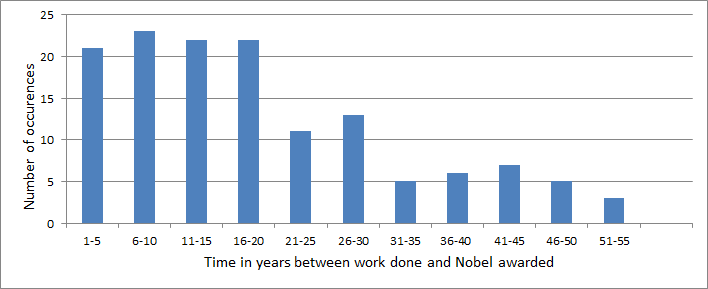
Lagging behind: it can take a long time to win a Nobel prize. (IOP Publishing/Hamish Johnston)
The popularity of a LIGO prize got me wondering how common it was for a Nobel to be awarded just one year after a discovery. I delved into the vast archive of material on the Nobel Foundation website and produced the above histogram. It shows the frequency of time gaps between when a discovery was made and when the physics prize was awarded. I’d like to add a disclaimer that deciding exactly when the work was done is subjective, and often near impossible if the award is given for a body of work. So my data might not agree exactly with those of others, but I think it shows the general trend that most awards are given within 20 years of the work being done.
As far as I can tell, there are three instances when a physics Nobel was awarded a year after the work was done. The first was the 1957 award, which was given to Chen Ning Yang and Tsung Dao Lee for formulating a theory of parity violation for the weak interaction. The theory was proposed and verified experimentally in 1956.
The second is the 1984 prize, which went to Carlo Rubbia and Simon van der Meer for the 1983 discovery of the W and Z bosons at CERN. The final one-year gap involves the discovery in 1986 of the first high-temperature superconductor which won Georg Bednorz and Alexander Müller the 1987 Nobel.
So it is certainly possible that LIGO could feature in this year’s prize, if the nomination was made early enough.
At the other end of the scale, I reckon that there are three physics prizes that were awarded more than 50 years after the research was done. The first is the 1986 prize, which was shared by Ernst Ruska who was then 79 years old. Ruska won for his work on electron optics done in 1933. The other two were shared in 2003 by Alexei Abrikosov and Vitaly Ginzburg for independent work done in the early 1950s on superconductors and superfluids.
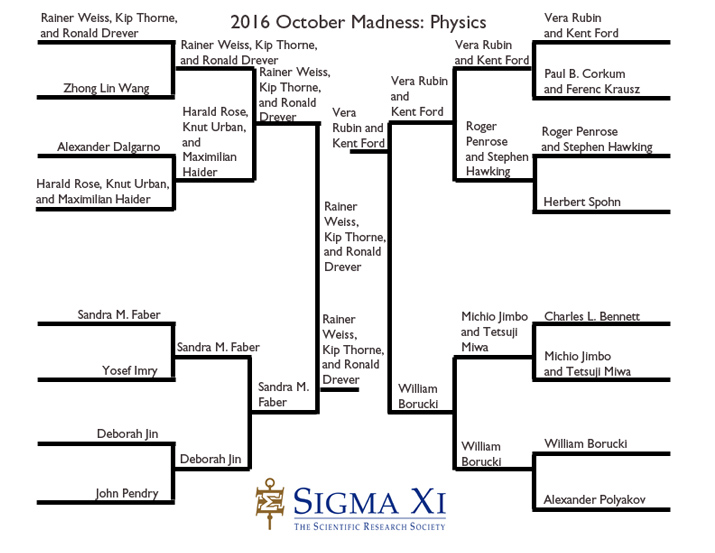
Personally, I think this year the award will go to Weiss, Thorne, and Drever – but I have never actually got a prediction right. If not them, I think we could see a prize for Michael Berry and Yakir Aharonov for their work on quantum topological and geometrical phases. If you’d like to get a good idea of who else could be in the running, check out this tournament-style chart that pits various superstar physicists against each other.
Please let us know who you think will win by leaving a comment below.
The Energy Technologies Institute (ETI) has called on the UK government to develop a policy framework to support the construction of small modular nuclear reactors. In its report, the ETI – a public-private partnership between companies and the UK Government that was founded in 2007 – says that the UK government has a “crucial” role to play in fostering investor confidence. If that is successful, the report notes that the first small modular reactor could be in operation by 2030. Small modular reactors are a type of nuclear fission reactor that have an output of less than 500 MW and could be used in remote locations.
Surface dewetting observed at long last
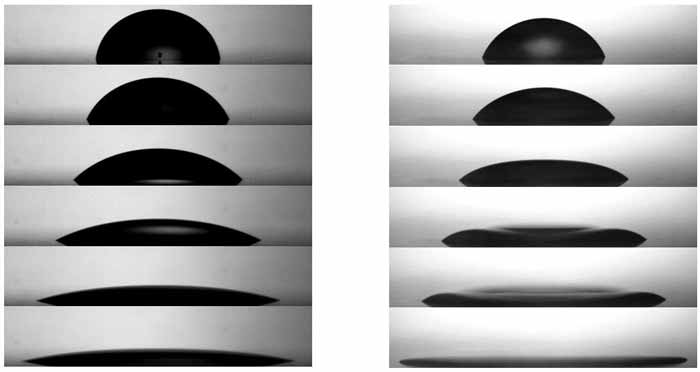
Lip service: the time sequence on the left runs from top to bottom and shows the wetting process. The time sequence on the right runs from bottom to top and shows the formation of a lip during the dewetting process. (Courtesy: Northumbria University)
The process of dewetting – whereby a thin film of liquid on a surface spontaneously forms bead-shaped droplets – has been observed directly for the first time by researchers at Northumbria University and Nottingham Trent University in the UK. The team used a technique called “dielectrowetting” to force a liquid to coat (or wet) a hydrophobic surface that is initially covered by a droplet. This involves applying an electric potential to a circular pattern of electrodes below the surface, which pulls the liquid downwards until it spreads over the surface to create a flat disc. The team then switched off the electric potential to observe dewetting, which they found is not simply wetting in reverse. While wetting involved a droplet flattening like a pancake (see image), dewetting began with a raised lip forming at the outer edge of the disc. This lip then moved inward at a constant speed until the disc has transformed into a droplet. According to Carl Brown of Nottingham Trent, theory and computer simulations both suggest that “the liquid tends to adopt the closest local equilibrium shape it can during dewetting”. He adds, “This explains the smooth rim shape which survives for most of the process”. Northumbria’s Glen McHale says the research could “spark a new line of research and lead to breakthroughs involving the use of liquids, such as better coatings and more effective self-cleaning surfaces”. The research is described in Science Advances.
D-Wave previews 2000-qubit processor
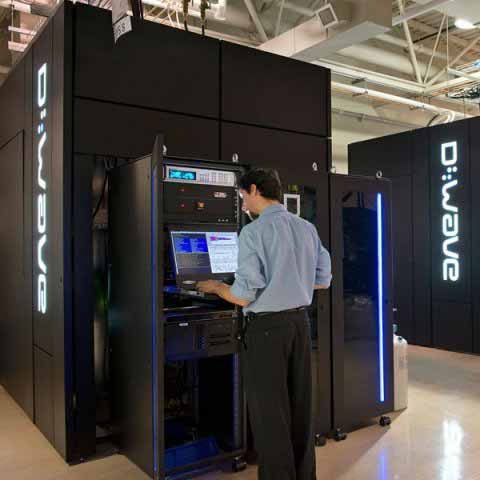
Black box: D-Wave’s superconductor-based qubits are isolated from the environment inside a large black box. (Courtesy: D-Wave Systems)
A computer comprising 2000 superconducting quantum bits (qubits) has been previewed by Canada-based D-Wave Systems. The new system has twice as many qubits as the firm’s previous model – the D-Wave 2X. The company claims that improvements to the new device’s control systems will allow it to run 1000 times faster than the D-Wave 2X and solve a broader range of problems. D-Wave has already sold previous versions of its systems to Lockheed Martin and to Google. However, the D-Wave devices are controversial: some physicists report that they outperform conventional computers on certain specialized calculations, while others say that they do not actually perform quantum calculations at all.
You can find all our daily Flash Physics posts in the website’s news section, as well as on Twitter and Facebook using #FlashPhysics. Tune in to physicsworld.com later today to read today’s extensive news story on the Rosetta comet mission.
The US Federal Trade Commission (FTC) – an independent agency of the US government – has filed charges against the open access publisher OMICS Group. It accuses the publisher of misrepresenting its journals to attract submissions, hiding publication fees ranging from hundreds to thousands of dollars, and making misleading claims about the conferences it organizes.
The FTC is seeking a permanent injunction against OMICS and is also seeking monetary relief, which could include refunds of money paid by researchers. OMICS, which is based in India and has offices in the US and Europe, publishes more than 700 online journals, including a number of physics titles such as the Journal of Physical Chemistry & Biophysics and the Journal of Astrophysics & Aerospace Technology.
The complaint, filed in the US district court in Nevada, also names the president and director of OMICS, Srinubabu Gedela, and two affiliated companies, iMedPub and Conference Series, as defendants. They deny all the allegations.
Undisclosed fees
In a statement, Jessica Rich, director of the FTC’s Bureau of Consumer Protection, says that “the defendants in this case used false promises to convince researchers to submit articles” and “then held that work hostage over undisclosed publication fees.”
According to the FTC, OMICS falsely claims its journals follow rigorous peer-review practices and are indexed by academic databases, such as PubMed Central or MEDLINE. The FTC also says that the firm lists prominent academics as journal editors without their agreement.
The FTC adds that OMICS also states that its journals have high impact factors, but that the publisher fails to make it clear that it calculates its own impact factors, rather than using Thomson Reuters’ widely accepted standard. “In many instances, consumers only discover that their articles will not be peer reviewed and that they owe fees ranging from several hundred to several thousands of dollars after the defendants inform them that their articles have been approved for publication,” the FTC states.
Blocking publication
“Consumers’ attempts to withdraw their articles are frequently rejected, thereby preventing them from publishing in other journals,” says Rich. According to the FTC, OMICS also attracts researchers to conferences – which can cost more than $1000 to attend – with false claims of appearances by high-profile academics.
Following a request for comment, Gedela sent Physics World a link to a letter published in response to the FTC allegations. The six-page letter concludes by dismissing the accusations as “baseless” and accusing the FTC of “favouring some subscription-based journals publishers who are earing billions of dollars rom scientists literature [sic]”.
In the letter, they also note that they “hope” that the FTC understands their “service and contributions to make the scientific and health-care information open access”, adding that they have “answered all the allegations as well as provided further information”. The letter calls on the FTC to drop all proceedings and warns that OMICS may seek “damages for loss of repute and malicious prosecution”.
The density of ordinary matter in rotating disc galaxies can be explained without the need of dark matter, according to Mordehai Milgrom of the Weizmann Institute in Israel. The observed rate at which galaxies rotate is much greater than expected if only the gravitational pull of ordinary visible matter were holding them together. The extra gravitational glue provided by invisible dark matter is the conventional explanation for this discrepancy. However, in 1983 Milgrom proposed modified Newtonian dynamics (MOND) as an alternative explanation that eschews dark-matter altogether. Instead, MOND modifies Newtonian mechanics such that fast-moving stars in the outer regions of a rotating galaxy experience a greater gravitational tug than slower-moving stars in inner regions. Writing in Physical Review Letters, Milgrom has derived a new modified version of MOND that tries to explain the recent discovery of a strong relationship between the density of visible matter in disc galaxies and the density of matter required to keep the galaxies together. Milgrom says this modified version of MOND “agrees very well” with galaxy-density data and he points out that dark-matter theories cannot explain the density relationship.
US fusion boss steps down
Stepping down: Stewart Prager is to take a year’s sabbatical before continuing research in fusion energy and plasma physics at the Princeton Plasma Physics Laboratory. (Courtesy: Elle Starkman/PPPL Office of Communications)
Stewart Prager, the head of the Princeton Plasma Physics Laboratory (PPPL) in New Jersey, has stepped down after eight years in the lab. Prager is the sixth director of the PPPL and joined the lab in late 2008 after a long career at the University of Wisconsin. The PPPL is operated by Princeton University and the lab operates the National Spherical Torus Experiment, which recently completed a $94m upgrade. However, the facility recently encountered a problem when a magnetic coil failed last month, which could knock it out of action for a year. Prager will now continue research in fusion energy and plasma physics at the PPPL after taking a year’s sabbatical.
University faces $115,500 fine for lab explosion
Facing fines: the University of Hawaii has been fined $115,500 for ‘serious’ safety violations. (Hawaii Natural Energy Institute)
The University of Hawaii has been fined $115,500 (£88,500) to address safety failures that led to an explosion on 16 March at the university’s Manoa campus. The incident happened when postdoc Thea Ekins-Coward was mixing different gases at the Hawaii Natural Energy Institute. A static discharge caused an explosion that led to Ekins-Coward losing an arm as well as almost $1m in damages to the lab. The Hawaii Occupational Safety and Health (HIOSH) agency has now cited the university for 15 “serious” safety violations, including a lack of personal protective equipment and a failure to ensure that safety practices were followed. The university is now requesting an “informal conference” with HIOSH to “clarify the citations and discuss adjustments of the citations”.
You can find all our daily Flash Physics posts in the website’s news section, as well as on Twitter and Facebook using #FlashPhysics. Tune in to physicsworld.com later today to read today’s extensive news story on an open-access publisher being accused of misrepresenting it journals.
What can be done to increase the number of women in physics? This question keeps committees busy and researchers funded, but the solution seems as elusive as squaring the circle. Four years ago, however, I did my bit: I transitioned from male to female. As this also meant that the number of men in physics was simultaneously reduced by one, it was, as they say in football, a “six-pointer”.
I hasten to add that I didn’t transition in order to improve the male-female ratio among physicists; that really would have been a remarkable thing to do. However, it did mean that when my wave function collapsed into the F state, I was able to conduct some controlled social observations in my work as a teacher. I’m the same person and I’m doing the same job, but in a different gender role. After a degree, PhD and postdoctoral research I trained as a teacher in the mid-1990s. I’ve been teaching physics in secondary schools ever since, and the women-in-physics question has long played into my department’s desire to increase the uptake of students taking A-level physics. We have been very successful in attracting boys but, whatever we try, the gender ratio has never strayed much from 4:1; if only the girls would sign up in equal numbers we really would be able to justify those glistening new laboratories that currently we can only dream about.
So, on 20 December 2012, the students in my school were sent home with letters to their parents informing them of an imminent and major change in my personal circumstances. Three weeks later they returned to school bright and eager, but probably with more than physics on their minds when they waited outside my lab. It was all very simple, I told them. Sir becomes Miss, he becomes she and – er – Dr Hayton becomes Dr Hayton. I knew that PhD would come in handy one day. From there life would go on pretty much as normal, as long as we all stood up straight (sometimes my classes even laugh at that joke).
The reaction from the students was wonderful. For two days I thought I had suddenly cracked the knotty problem of pupil indiscipline, as the corridor would fall silent as I walked around the school. However, the novelty value was short-lived and 48 hours later the same corridors were full of active children engaged in their conversations, oblivious to my presence as I passed them by. My relationship with my students reverted rapidly to what I had fostered over the years. It seemed that little had changed. My job was to teach them physics and their job was to learn. Or rather, their job was to try and get me to do as much of their learning as they could get away with. Theory was taught, questions were answered, experiments were done and written up, and attempts by students to sidetrack me from my lesson plans were successfully deflected. Or, at least, they were no more successful than previously. My gender role seemed irrelevant to any of this.
Some things were certainly different though. For 20 years my first lesson for Year 10 students on static electricity has involved me rubbing a balloon on my hair, leaping onto the front desk and placing the balloon on the ceiling, all in one sweeping dramatic movement. In January 2013 I taught two classes in Year 10. The first lesson passed without incident, which was good because I have never admitted the “leaping on the bench” bit to Health and Safety. The following day the other class sat in the same place as I geared up for a repeat performance. For some now forgotten reason, however, I had chosen to wear a skirt that day rather than trousers. I was already well into my run-up when I realized that the activity needed to be replanned as a matter of urgency. The class had to make do with the balloon being stuck to the wall on the other side of the room.
Some activities have definitely got better. I now join the other long-haired people on the styrofoam platform when the Van de Graaff generator comes out, and jewellery can be very useful when demonstrating magnetic and non-magnetic materials. Much of mine, it seems, is fabricated from mild steel rather than more precious materials. But in other respects I miss things that I took for granted. Moving heavy trolleys with dodgy wheels is more of a struggle as I have lost upper body strength and I have first-hand experience of the different way that men and women can be perceived when they open their mouths in meetings. I hasten to add that children seem remarkably free of the prejudices that seem to trouble some folks of my generation about women when it comes to physics and engineering.
But does having a female teacher in years 10 and 11 help girls decide whether to take A-level physics? After four years the answer seems to be “probably not”. Changing my gender role seems to have had no more effect than other strategies that I have employed over the years. What seems to be more important is good teaching, high expectations, a willingness to engage with our students and a love of our subject. But these things attract boys as well, and seemingly in greater numbers. Maybe we should congratulate ourselves for that? In any case, I can sense a sigh of relief from my male colleagues: none of you need to take this particular plunge for the sake of physics.
Readers are invited to submit their own Lateral Thoughts. Articles should be 900–950 words, and can be e-mailed to pwld@iop.org
Azimuth is an interesting hybrid. In part, it’s the personal blog of John Carlos Baez, a mathematical physicist at the University of California, Riverside, whose current research focuses mainly on network theory. But it’s also the official blog of something called the Azimuth Project, which Baez set up “to create a focal point for scientists and engineers interested in saving the planet, and make clearly presented, accurate information on the relevant issues easy to find…we want to make it easy for any scientist or engineer to understand the whole problem and understand specialist literature in many subjects outside their particular domain of expertise”.
Who is it aimed at?
The site’s hybrid nature makes its readership hard to pigeonhole. The posts on the environment tend to be written for a general audience, in keeping with the Azimuth Project’s goal of promoting interdisciplinary working. The mathematical posts, in contrast, are often rather technical in nature, and most readers will reach a point where they can go no further. That said, even if you don’t manage to stick with Baez all the way to the end of a lengthy series of posts on (say) large finite ordinal numbers, you are guaranteed to come away having learned something fascinating, and he also provides plenty of links to help interested readers get up to speed.
What are some sample topics?
Over the past few months, Azimuth’s focus has been decidedly mathematical. Indeed, in a summer 2016 series of posts about topological crystals, Baez laments that he feels “a bit guilty putting so much work into this paper when I should be developing network theory to the point where it does our planet some good”. However, he goes on to observe that he needs “a certain amount of beautiful pure math to stay sane”, and with current environmental trends looking so un-beautiful (a recent Azimuth post on coral reefs is particularly sobering), it’s hard to begrudge him the pleasures of his topological retreat.
Can you give me a sample quote?
From a May 2016 post about an extremely long mathematical proof of the Boolean Pythagorean triples problem: “In the 1980s the mathematician Ronald Graham asked if it’s possible to colour each positive integer either red or blue, so that no triple of integers a,b,c obeying Pythagoras’ famous equation: a2 + b2 = c2 all have the same colour. He offered a prize of $100. Now it’s been solved! The answer is no. You can do it for numbers up to 7824…but you can’t do it for numbers up to 7825. To prove this, you could try all the ways of colouring these numbers and show that nothing works. Unfortunately that would require trying [a number that takes up an entire computer screen] possibilities. But recently, three mathematicians cleverly figured out how to eliminate most of the options. That left fewer than a trillion to check. So they spent two days on a supercomputer, running 800 processors in parallel, and checked all the options. None worked…This is one of the world’s biggest proofs: it’s 200 terabytes long! That’s about equal to all the digitized text held by the US Library of Congress. There’s also a 68-gigabyte digital signature – sort of a proof that a proof exists – if you want to skim it. It’s interesting that these 200 terabytes were used to solve a yes-or-no question, whose answer takes a single bit to state: no.”