In a conversation with Physics World’s Tami Freeman Krausz talks about his research into using ultrashort-pulsed laser technology to develop a diagnostic tool for early disease detection. He also discusses his collaboration with Semmelweis University to establish the John von Neumann Institute for Data Science, and describes the Science4People initiative, a charity that he and his colleagues founded to provide education for children who have been displaced by the war in Ukraine.
On 13–14 May, The Economist is hosting Commercialising Quantum Global 2025 in London. The event is supported by the Institute of Physics – which brings you Physics World. Participants will join global leaders from business, science and policy for two days of real-world insights into quantum’s future. In London you will explore breakthroughs in quantum computing, communications and sensing, and discover how these technologies are shaping industries, economies and global regulation. Register now and use code QUANTUM20 to receive 20% off. This offer ends on 4 May.
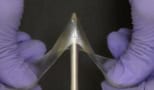
Researchers at Linköping University in Sweden have developed a new fluid electrode and used it to make a soft, malleable battery that can recharge and discharge over 500 cycles while maintaining its high performance. The device, which continues to function even when stretched to twice its length, might be used in next-generation wearable electronics.
Futuristic wearables such as e-skin patches, e-textiles and even internal e-implants on the organs or nerves will need to conform far more closely to the contours of the human body than today’s devices can. To fulfil this requirement of being soft and stretchable as well as flexible, such devices will need to be made from mechanically pliant components powered by soft, supple batteries. Today’s batteries, however, are mostly rigid. They also tend to be bulky because long-term operations and power-hungry functions such as wireless data transfer, continuous sensing and complex processing demand plenty of stored energy.
“To overcome these barriers, researchers led by the Linköping chemists Aiman Rahmanudin and Saeed Mardi decided to rethink the very concept of battery electrode design.” Instead of engineering softness and stretchability into a solid electrode, as was the case in most previous efforts, they made the electrode out of a fluid. “Bulky batteries compromise the mechanical compliance of wearable devices, but since fluids can be easily shaped into any configuration, this limitation is removed, opening up new design possibilities for next-generation wearables,” Rahmanudin says.
A “holistic approach”
Designing a stretchable battery requires a holistic approach, he adds, as all the device’s components need to be soft and stretchy. For example, they used a modified version of the wood-based biopolymer lignin as the cathode and a conjugated poly(1-amino-5-chloroanthraquinone) (PACA) as the anode. They made these electrodes fluid by dispersing them separately with conductive carbon fillers in an aqueous electrolyte medium consisting of 0.1 M HClO4.
To integrate these electrodes into a complete cell, they had to design a stretchable current collector and an ion-selective membrane to prevent the cathodic and anodic fluids from crossing over. They also encapsulated the fluids in a robust, low-permeability elastomer to prevent them from drying up.
Designing energy storage devices from the “inside out”
Previous flexible, high-performance electrode work by the Linköping team focused on engineering the mechanical properties of solid battery electrodes by varying their Young’s modulus. “For example, think of a rubber composite that can be stretched and bent,” explains Rahmanudin. “The thicker the rubber, however, the higher the force required to stretch it, which affects mechanical compliancy.
“Learning from our past experience and work on electrofluids (which are conductive particles dispersed in a liquid medium employed as stretchable conductors), we figured that mixing redox particles with conductive particles and suspending them in an electrolyte could potentially work as battery electrodes. And we found that it did.”
Rahmanudin tells Physics World that fluid-based electrodes could lead to entirely new battery designs, including batteries that could be moulded into textiles, embedded in skin-worn patches or integrated into soft robotics.
After reporting their work in Science Advances, the researchers are now working on increasing the voltage output of their battery, which currently stands 0.9 V. “We are also looking into using Earth-abundant and sustainable materials like zinc and manganese oxide for future versions of our device and aim at replacing the acidic electrolyte we used with a safer pH neutral and biocompatible equivalent,” Rahmanudin says.
Another exciting direction, he adds, will be to exploit the fluid nature of such materials to build batteries with more complex three-dimensional shapes, such as spirals or lattices, that are tailored for specific applications. “Since the electrodes can be poured, moulded or reconfigured, we envisage a lot of creative potential here,” Rahmanudin says.
The first strong evidence for an exoplanet with an orbit perpendicular to that of the binary system it orbits has been observed by astronomers in the UK and Portugal. Based on observations from the ESO’s Very Large Telescope (VLT), researchers led by Tom Baycroft, a PhD student at the University of Birmingham, suggest that such an exoplanet is required to explain the changing orientation in the orbit of a pair of brown dwarfs – objects that are intermediate in mass between the heaviest gas-giant planets and the lightest stars.
The Milky Way is known to host a diverse array of planetary systems, providing astronomers with extensive insights into how planets form and systems evolve. One thing that is evident is that most exoplanets (planets that orbit stars other than the Sun) and systems that have been observed so far bear little resemblance to Earth and the solar system.
Among the most interesting planets are the circumbinaries, which orbit two stars in a binary system. So far, 16 of these planets have been discovered. In each case, they have been found to orbit in the same plane as the orbits of their binary host stars. In other words, the planetary system is flat. This is much like the solar system, where each planet orbits the Sun within the same plane.
“But there has been evidence that planets might exist in a different configuration around a binary star,” Baycroft explains. “Inclined at 90° to the binary, these polar orbiting planets have been theorized to exist, and discs of dust and gas have been found in this configuration.”
Especially interesting
Baycroft’s team had set out to investigate a binary pair of brown dwarfs around 120 light–years away. The system is called 2M1510 and each brown dwarf is only about 45 million years old and they have masses about 18 times that of Jupiter. The pair are especially interesting because they are eclipsing: periodically passing in front of each other from our line of sight. When observed by the VLT, this unique vantage allowed the astronomers to determine the masses and radii of the stars and the nature of their orbit.
“This is a rare object, one of only two eclipsing binary brown dwarfs, which is useful for understanding how brown dwarfs form and evolve,” Baycroft explains. “In our study, we were not looking for a planet, only aiming to improve our understanding of the brown dwarfs.”
Yet as they analysed the VLT’s data, the team noticed something strange about pair’s orbit. Doppler shifts in the light they emitted revealed that their elliptical orbit was slowly changing orientation in an apsidal precession.
Not unheard of
This behaviour is not unheard of. In its orbit around the Sun, Mercury undergoes apsidal precession, which is explained by Albert Einstein’s general theory of relativity. But Baycroft says that the precession must have had an entirely different cause in the brown-dwarf pair.
“Unlike Mercury, this precession is going backwards, in the opposite direction to the orbit,” he explains. “Ruling out any other causes for this, we find that the best explanation is that there is a companion to the binary on a polar orbit, inclined at close to 90° relative to the binary.” As it exerts its gravitational pull on the binary pair, the inclination of this third, smaller body induces a gradual rotation in the orientation of the binary’s elliptical orbit.
For now, the characteristics of this planet are difficult to pin down and the team believe its mass could lie anywhere between 10–100 Earths. All the same, the astronomers are confident that their results now confirm the possibility of polar exoplanets existing in circumbinary orbits – providing valuable guidance for future observations.
“This result exemplifies how the many different configurations of planetary systems continue to astound us,” Baycroft comments. “It also paves the way for more studies aiming to find out how common such polar orbits may be.”
Researchers in Singapore and the US have independently developed two new types of photonic computer chips that match existing purely electronic chips in terms of their raw performance. The chips, which can be integrated with conventional silicon electronics, could find use in energy-hungry technologies such as artificial intelligence (AI).
For nearly 60 years, the development of electronic computers proceeded according to two rules of thumb: Moore’s law (which states that the number of transistors in an integrated circuit doubles every two years) and Dennard scaling (which says that as the size of transistors decreases, their power density will stay constant). However, both rules have begun to fail, even as AI systems such as large language models, reinforcement learning and convolutional neural networks are becoming more complex. Consequently, electronic computers are struggling to keep up.
Light-based computation, which exploits photons instead of electrons, is a promising alternative because it can perform multiplication and accumulation (MAC) much more quickly and efficiently than electronic devices. These operations are crucial for AI, and especially for neural networks. However, while photonic systems such as photonic accelerators and processors have made considerable progress in performing linear algebra operations such as matrix multiplication, integrating them into conventional electronics hardware has proved difficult.
A hybrid photonic-electronic system
The Singapore device was made by researchers at the photonic computing firm Lightelligence and is called PACE, for Photonic Arithmetic Computing Engine. It is a hybrid photonic-electronic system made up of more than 16 000 photonic components integrated on a single silicon chip and performs matrix MAC on 64-entry binary vectors.
“The input vector data elements start in electronic form and are encoded as binary intensities of light (dark or light) and fed into a 64 x 64 array of optical weight modulators that then perform multiply and summing operations to accumulate the results,” explains Maurice Steinman, Lightelligence’s senior vice president and general manager for product strategy. “The result vectors are then converted back to the electronic domain where each element is compared to its corresponding programmable 8-bit threshold, producing new binary vectors that subsequently re-circulate optically through the system.”
The process repeats until the resultant vectors reach “convergence” with settled values, Steinman tells Physics World. Each recurrent step requires only a few nanoseconds and the entire process completes quickly.
The Lightelligence device, which the team describe in Nature, can solve complex computational problems known as max-cut/optimization problems that are important for applications in areas such as logistics. Notably, its greatly reduced minimum latency – a key measure of computation speed – means it can solve a type of problem known as an Ising model in just five nanoseconds. This makes it 500 times faster than today’s best graphical-processing-unit-based systems at this task.
High level of integration achieved
Independently, researchers led by Nicholas Harris at Lightmatter in Mountain View, California, have fabricated the first photonic processor capable of executing state-of-the-art neural network tasks such as classification, segmentation and running reinforcement learning algorithms. Lightmatter’s design consists of six chips in a single package with high-speed interconnects between vertically aligned photonic tensor cores (PTCs) and control dies. The team’s processor integrates four 128 x 128 PTCs, with each PTC occupying an area of 14 x 24.96 mm. It contains all the photonic components and analogue mixed-signal circuits required to operate and members of the team say that the current architecture could be scaled to 512 x 512 computing units in a single die.
The result is a device that can perform 65.5 trillion adaptive block floating-point 35 (ABFP) 16-bit operations per second with just 78 W of electrical power and 1.6 W of optical power. Writing in Nature, the researchers claim that this represents the highest level of integration achieved in photonic processing.
The team also showed that the Lightmatter processor can implement complex AI models such as the neural network ResNet (used for image processing) and the natural language processing model BERT (short for Bidirectional Encoder Representations from Transformers) – all with an accuracy rivalling that of standard electronic processors. It can also compute reinforcement learning algorithms such as DeepMind’s Atari. Harris and colleagues have already applied their device to several real-world AI applications, such as generating literary texts and classifying film reviews, and they say that their photonic processor marks an essential step in post-transistor computing.
Both teams fabricated their photonic and electronic chips using standard complementary metal-oxide-semiconductor (CMOS) processing techniques. This means that existing infrastructures could be exploited to scale up their manufacture. Another advantage: both systems were fully integrated in a standard chip interface – a first.
Given these results, Steinman says he expects to see innovations emerging from algorithm developers who seek to exploit the unique advantages of photonic computing, including low latency. “This could benefit the exploration of new computing models, system architectures and applications based on large-scale integrated photonics circuits.”
In this episode of Physics WorldStories, writer Kevlin Henney discusses his new flash fiction, Heisenberg (not) in Helgoland – written exclusively for Physics World as part of the International Year of Quantum Science and Technology. The story spans two worlds: the one we know, and an alternate reality in which Werner Heisenberg never visits the island of Helgoland – a trip that played a key role in the development of quantum theory.
Henney reads an extract from the piece and reflects on the power of flash fiction – why the format’s brevity and clarity make it an interesting space for exploring complex ideas. In conversation with host Andrew Glester, he also discusses his varied career as an independent software consultant, trainer and writer. Tune in to hear his thoughts on quantum computing, and why there should be greater appreciation for how modern physics underpins the technologies we use every day.
The full version of Henney’s story will be published in the Physics WorldQuantum Briefing 2025 – a free-to-read digital issue launching in May. Packed with features on the history, mystery and applications of quantum mechanics, it will be available via the Physics World website.
The image accompanying this article is Werner Heisenberg in 1933 (Credit: German Federal Archive with posterised version by James Dacey/Physics World) CC-BY-SA 3.0
On 13–14 May, The Economist is hosting Commercialising Quantum Global 2025 in London. The event is supported by the Institute of Physics – which brings you Physics World. Participants will join global leaders from business, science and policy for two days of real-world insights into quantum’s future. In London you will explore breakthroughs in quantum computing, communications and sensing, and discover how these technologies are shaping industries, economies and global regulation. Register now and use code QUANTUM20 to receive 20% off. This offer ends on 4 May.
Mathematical genius Emmy Noether, around 1900. (Public domain. Photographer unknown)
In his debut book, Einstein’s Tutor: the Story of Emmy Noether and the Invention of Modern Physics, Lee Phillips champions the life and work of German mathematician Emmy Noether (1882–1935). Despite living a life filled with obstacles, injustices and discrimination as a Jewish mathematician, Noether revolutionized the field and discovered “the single most profound result in all of physics”. Phillips’ book weaves the story of her extraordinary life around the central subject of “Noether’s theorem”, which itself sits at the heart of a fascinating era in the development of modern theoretical physics.
Noether grew up at a time when women had few rights. Unable to officially register as a student, she was instead able to audit courses at the University of Erlangen in Bavaria, with the support of her father who was a mathematics professor there. At the time, young Noether was one of only two female auditors in the university of 986 students. Just two years previously, the university faculty had declared that mixed-sex education would “overthrow academic order”. Despite going against this formidable status quo, she was able to graduate in 1903.
Noether continued her pursuit of advanced mathematics, travelling to the “[world’s] centre of mathematics” – the University of Göttingen. Here, she was able to sit in the lectures of some of the brightest mathematical minds of the time – Karl Schwarzschild, Hermann Minkowski, Otto Blumenthal, Felix Klein and David Hilbert. While there, the law finally changed: women were, at last, allowed to enrol as students at university. In 1904 Noether returned to the University of Erlangen to complete her postgraduate dissertation under the supervision of Paul Gordan. At the time, she was the only woman to matriculate alongside 46 men.
Despite being more than qualified, Noether was unable to secure a university position after graduating from her PhD in 1907. Instead, she worked unpaid for almost a decade – teaching her father’s courses and supervising his PhD students. As of 1915, Noether was the only woman in the whole of Europe with a PhD in mathematics. She had worked hard to be recognized as an expert on symmetry and invariant theory, and eventually accepted an invitation from Klein and Hilbert to work alongside them in Göttingen. Here, the three of them would meet Albert Einstein to discuss his latest project – a general theory of relativity.
Infiltrating the boys’ club
In Einstein’s Tutor, Phillips paints an especially vivid picture of Noether’s life at Göttingen, among colleagues including Klein, Hilbert and Einstein, who loom large and bring a richness to the story. Indeed, much of the first three chapters are dedicated to these men, setting the scene for Noether’s arrival in Göttingen. Phillips makes it easy to imagine these exceptionally talented and somewhat eccentric individuals working at the forefront of mathematics and theoretical physics together. And it was here, when supporting Einstein with the development of general relativity (GR), that Noether discovered a profound result: for every symmetry in the universe, there is a corresponding conservation law.
Throughout the book, Phillips makes the case that, without Noether, Einstein would never have been able to get to the heart of GR. Einstein himself “expressed wonderment at what happened to his equations in her hands, how he never imagined that things could be expressed with such elegance and generality”. Phillips argues that Einstein should not be credited as the sole architect of GR. Indeed, the contributions of Grossman, Klein, Besso, Hilbert, and crucially, Noether, remain largely unacknowledged – a wrong that Phillips is trying to right with this book.
Phillips makes the case that, without Noether, Einstein would never have been able to get to the heart of general relativity
A key theme running through Einstein’s Tutor is the importance of the support and allyship that Noether received from her male contemporaries. While at Göttingen, there was a battle to allow Noether to receive her habilitation (eligibility for tenure). Many argued in her favour but considered her an exception, and believed that in general, women were not suited as university professors. Hilbert, in contrast, saw her sex as irrelevant (famously declaring “this is not a bath house”) and pointed out that science requires the best people, of which she was one. Einstein also fought for her on the basis of equal rights for women.
Eventually, in 1919 Noether was allowed to habilitate (as an exception to the rule) and was promoted to professor in 1922. However, she was still not paid for her work. In fact, her promotion came with the specific condition that she remained unpaid, making it clear that Noether “would not be granted any form of authority over any male employee”. Hilbert however, managed to secure a contract with a small salary for her from the university administration.
Her allies rose to the cause again in 1933, when Noether was one of the first Jewish academics to be dismissed under the Nazi regime. After her expulsion, German mathematician Helmut Hasse convinced 14 other colleagues to write letters advocating for her importance, asking that she be allowed to continue as a teacher to a small group of advanced students – the government denied this request.
When the time came to leave Germany, many colleagues wrote testimonials in her support for immigration, with one writing “She is one of the 10 or 12 leading mathematicians of the present generation in the entire world.” Rather than being placed at a prestigious university or research institute (Hermann Weyl and Einstein were both placed at “the men’s university”, the Institute for Advanced Study in Princeton), it was recommended she join Bryn Mawr, a women’s college in Pennsylvania, US. Her position there would “compete with no-one… the most distinguished feminine mathematician connected with the most distinguished feminine university”. Phillips makes clear his distaste for the phrasing of this recommendation. However, all accounts show that she was happy at Bryn Mawr and stayed there until her unexpected death in 1935 at the age of 53.
Noether’s legacy
With a PhD in theoretical physics, Phillips has worked for many years in both academia and industry. His background shows itself clearly in some unusual writing choices. While his writing style is relaxed and conversational, it includes the occasional academic turn of phrase (e.g. “In this chapter I will explain…”), which feels out of place in a popular-science book. He also has a habit of piling repetitive and overly sincere praise onto Noether. I personally prefer stories that adopt the “show, don’t tell” approach – her abilities speak for themselves, so it should be easy to let the reader come to their own conclusions.
Phillips has made the ambitious choice to write a popular-science book about complex mathematical concepts such as symmetries and conservation laws that are challenging to explain, especially to general readers. He does his best to describe the mathematics and physics behind some of the key concepts around Noether’s theorem. However, in places, you do need to have some familiarity with university-level physics and maths to properly follow his explanations. The book also includes a 40-page appendix filled with additional physics content, which I found unnecessary.
Einstein’s Tutor does achieve its primary goal of familiarizing the reader with Emmy Noether and the tremendous significance of her work. The final chapter on her legacy breezes quickly through developments in particle physics, astrophysics, quantum computers, economics and XKCDComics to highlight the range and impact this single theorem has had. Phillips’ goal was to take Noether into the mainstream, and this book is a small step in the right direction. As cosmologist and author Katie Mack summarizes perfectly: “Noether’s theorem is to theoretical physics what natural selection is to biology.”
Sending an email, typing a text message, streaming a movie. Many of us do these activities every day. But what if you couldn’t move your muscles and navigate the digital world? This is where brain–computer interfaces (BCIs) come in.
BCIs that are implanted in the brain can bypass pathways damaged by illness and injury. They analyse neural signals and produce an output for the user, such as interacting with a computer.
A major focus for scientists developing BCIs has been to interpret brain activity associated with movements to control a computer cursor. The user drives the BCI by imagining arm and hand movements, which often originate in the dorsal motor cortex. Speech BCIs, which restore communication by decoding attempted speech from neural activity in sensorimotor cortical areas such as the ventral precentral gyrus, have also been developed.
Researchers at the University of California, Davis recently found that the same part of the brain that supported a speech BCI could also support computer cursor control for an individual with amyotrophic lateral sclerosis (ALS). ALS is progressive neurodegenerative disease affecting the motor neurons in the brain and spinal cord.
“Once that capability [to control a computer mouse] became reliably achievable roughly a decade ago, it stood to reason that we should go after another big challenge, restoring speech, that would help people unable to speak. And from there – and this is where this new paper comes in – we recognized that patients would benefit from both of these capabilities [speech and computer cursor control],” says Sergey Stavisky, who co-directs the UC Davis Neuroprosthetics Lab with David Brandman.
Their clinical case study suggests that computer cursor control may not be as body-part-specific as scientists previously believed. If results are replicable, this could enable the creation of multi-modal BCIs that restore communication and movement to people with paralysis. The researchers share information about their cursor BCI and the case study in the Journal of Neural Engineering.
The study participant, a 45-year-old man with ALS, had previous success working with a speech BCI. The researchers recorded neural activity from the participant’s ventral precentral gyrus while he imagined controlling a computer cursor, and built a BCI to interpret that neural activity and predict where and when he wanted to move and click the cursor. The participant then used the new cursor BCI to send texts and emails, watch Netflix, and play The New York Times Spelling Bee game on his personal computer.
“This finding, that the tiny region of the brain we record from has a lot more than just speech information, has led to the participant also being able to control his own computer on a daily basis, and get back some independence for him and his family,” says first author Tyler Singer-Clark, a graduate student in biomedical engineering at UC Davis.
The researchers found that most of the information driving cursor control came from one of the participant’s four implanted microelectrode arrays, while click information was available on all four of the BCI arrays.
“The neural recording arrays are the same ones used in many prior studies,” explains Singer-Clark. “The result that our cursor BCI worked well given this choice makes it all the more convincing that this brain area (speech motor cortex) has untapped potential for controlling BCIs in multiple useful ways.”
The researchers are working to incorporate more computer actions into their cursor BCI, to make the control faster and more accurate, and to reduce calibration time. They also note that it’s important to replicate these results in more people to understand how generalizable the results of their case study may be.
A new all-electrical way of controlling spin-polarized currents has been developed by researchers at the Singapore University of Technology and Design (SUTD). By using bilayers of recently-discovered materials known as altermagnets, the researchers developed a tuneable and magnetic-free alternative to current approaches – something they say could bring spintronics closer to real-world applications.
Spintronics stores and processes information by exploiting the quantum spin (or intrinsic angular momentum) of electrons rather than their charge. The technology works by switching electronic spins, which can point either “up” or “down”, to perform binary logical operations in much the same way as electronic circuits use electric charge. One of the main advantages is that when an electron’s spin switches direction, its new state is stored permanently; it is said to be “non-volatile”. Spintronics circuits therefore do not require any additional input power to keep their states stable, which could make them more efficient and faster than the circuits in conventional electronic devices.
The problem is that the spin currents that carry information in spintronics circuits are usually generated using ferromagnetic materials and the magnetization of these materials can only be switched using very strong magnetic fields. Doing this requires bulky apparatus, which hinders the creation of ultracompact devices – a prerequisite for real-world applications.
“Notoriously difficult to achieve”
Controlling the spins with electric fields instead would be ideal, but Ang Yee Sin, who led the new research, says it has proved notoriously difficult to achieve – until now. “We have now shown that we can generate and reverse the spin direction of the electron current in an altermagnet made of two very thin layers of chromium sulphide (CrS) at room temperature using only an electric field,” Ang says.
Altermagnets, which were only discovered in 2024, are different from the conventional magnetically-ordered materials, ferromagnets and antiferromagnets. In ferromagnets, the magnetic moments (or spins) of atoms line up parallel to each other. In antiferromagnets, they line up antiparallel. The spins in altermagnets are also antiparallel, but the atoms that host these spins are rotated with respect to their neighbours. This combination gives altermagnets some properties of both ferromagnets and antiferromagnets, plus new properties of their own.
In bilayers of CrS, explains Ang, the electrons in each layer naturally prefer to spin in opposite directions, essentially cancelling each other out. “When we apply an electric field across the layers, however, one layer becomes more ‘active’ than the other. The current flowing through the device therefore becomes spin-polarized.”
A new device concept
The main challenge the researchers faced in their work was to identify a suitable material and a stacking arrangement in which spin and layers intertwined just right. This required detailed quantum-level simulations and theoretical modelling to prove that CrS bilayers could do the job, says Ang.
The work opens up a new device concept that the team calls layer-spintronics in which spin control is achieved via layer selection using an electric field. According to Ang, this concept has clear applications for next-generation, energy-efficient, compact and magnet-free memory and logic devices. And, since the technology works at room temperature and uses electric gating – a common approach in today’s electronics – it could make it possible to integrate spintronics devices with current semiconductor technology. This could lead to novel spin transistors, reconfigurable logic gates, or ultrafast memory cells based entirely on spin in the future, he says.
The SUTD researchers, who report their work in Materials Horizons, now aim to identify other 2D altermagnets that can host similar or even more robust spin-electric effects. “We are also collaborating with experimentalists to synthesize and characterize CrS bilayers to validate our predictions in the lab and investigating how to achieve non-volatile spin control by integrating them with ferroelectric materials,” reveals Ang. “This could potentially allow for memory devices that can retain information for longer.”
Most of us have heard of Schrödinger’s eponymous cat, but it is not the only feline in the quantum physics bestiary. Quantum Cheshire cats may not be as well known, yet their behaviour is even more insulting to our classical-world common sense.
These quantum felines get their name from the Cheshire cat in Lewis Carroll’s Alice’s Adventures in Wonderland, which disappears leaving its grin behind. As Alice says: “I’ve often seen a cat without a grin, but a grin without a cat! It’s the most curious thing I ever saw in my life!”
Things are curiouser in the quantum world, where the property of a particle seems to be in a different place from the particle itself. A photon’s polarization, for example, may exist in a totally different location from the photon itself: that’s a quantum Cheshire cat.
While the prospect of disembodied properties might seem disturbing, it’s a way of interpreting the elegant predictions of quantum mechanics. That at least was the thinking when quantum Cheshire cats were first put forward by Yakir Aharonov, Sandu Popescu, Daniel Rohrlich and Paul Skrzypczyk in an article published in 2013 (New J. Phys.15 113015).
Strength of a measurement
To get to grips with the concept, remember that making a measurement on a quantum system will “collapse” it into one of its eigenstates – think of opening the box and finding Schrödinger’s cat either dead or alive. However, by playing on the trade-off between the strength of a measurement and the uncertainty of the result, one can gain a tiny bit of information while disturbing the system as little as possible. If such a measurement is done many times, or on an ensemble of particles, it is possible to average out the results, to obtain a precise value.
First proposed in the 1980s, this method of teasing out information from the quantum system by a series of gentle pokes is known as weak measurement. While the idea of weak measurement in itself does not appear a radical departure from quantum formalism, “an entire new world appeared” as Popescu puts it. Indeed, Aharonov and his collaborators have spent the last four decades investigating all kinds of scenarios in which weak measurement can lead to unexpected consequences, with the quantum Cheshire cat being one they stumbled upon.
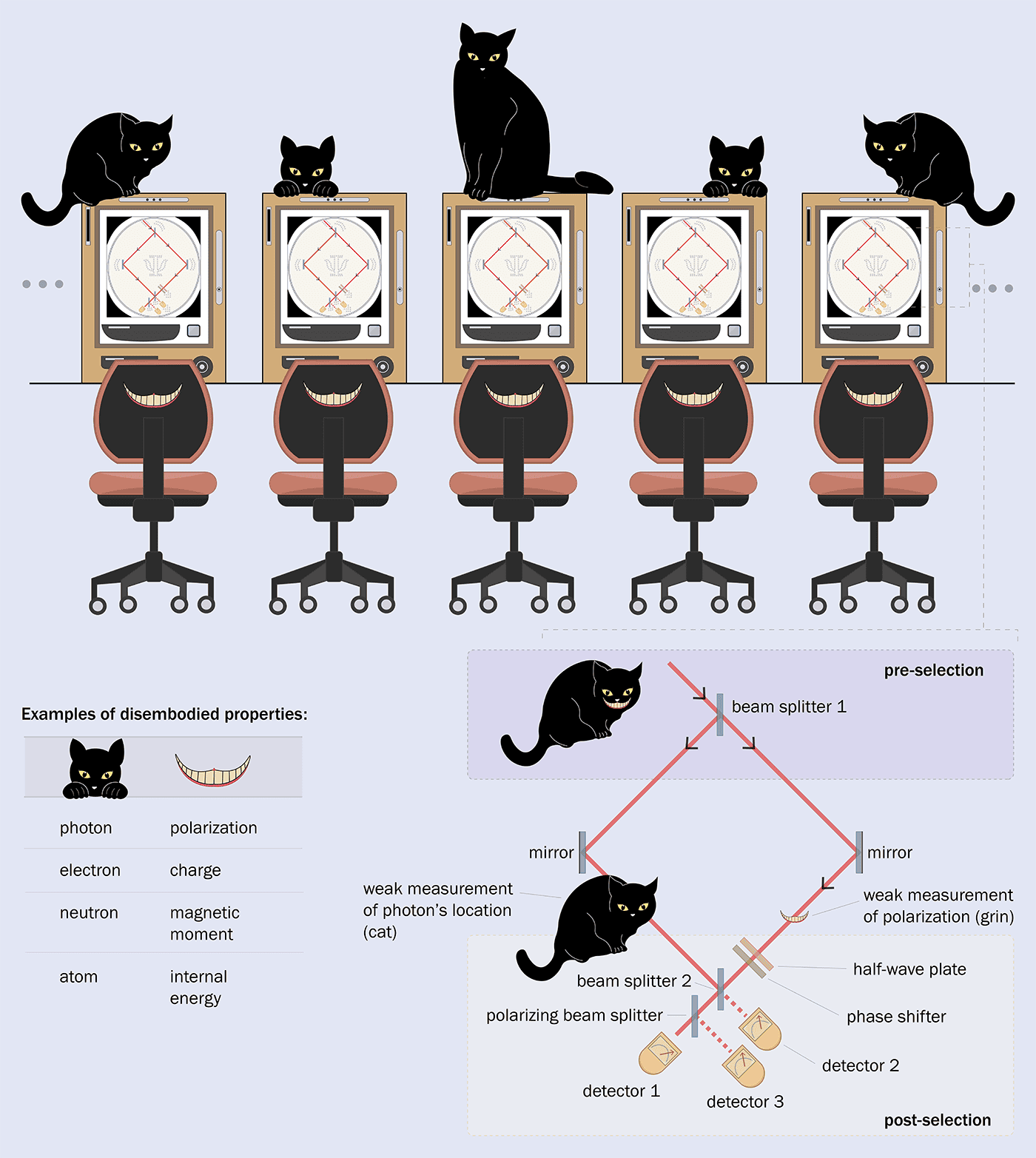
In their 2013 paper, Aharonov and colleagues imagined a simple optical interferometer set-up, in which the “cat” is a photon that can be in either the left or the right arm, while the “grin” is the photon’s circular polarization. The cat (the photon) is first prepared in a certain superposition state, known as pre-selection. After it enters the set-up, the cat can leave via several possible exits. The disembodiment between particle and property appears in the cases in which the particle emerges in a particular exit (post-selection).
Certain measurements, analysing the properties of the particle, are performed while the particle is in the interferometer (in between the pre- and post-selection). Being weak measurements, they have to be carried out many times to get the average. For certain pre- and post-selection, one finds the cat will be in the left arm while the grin is in the right. It’s a Cheshire cat disembodied from its grin.
The mathematical description of this curious state of affairs was clear, but the interpretation seemed preposterous and the original article spent over a year in peer review, with its eventual publication still sparking criticism. Soon after, experiments with polarized neutrons (Nature Comms 5 4492) and photons (Phys. Rev. A94 012102) tested the original team’s set-up. However, these experiments and subsequent tests, despite confirming the theoretical predictions, did not settle the debate – after all, the issue was with the interpretation.
A quantum of probabilities
To come to terms with this perplexing notion, think of the type of pre- and post-selected set-up as a pachinko machine, in which a ball starts at the top in a single pre-selected slot and goes down through various obstacles to end up in a specific point (post-selection): the jackpot hole. If you count how many balls hit the jackpot hole, you can calculate the probability distribution. In the classical world, measuring the position and properties of the ball at different points, say with a camera, is possible.
This observation will not affect the trajectory of the ball, or the probability of the jackpot. In a quantum version of the pachinko machine, the pre- and post-selection will work in a similar way, except you could feed in balls in superposition states. A weak measurement will not disturb the system so multiple measurements can tease out the probability of certain outcomes. The measurement result will not yield an eigenvalue, which corresponds to a physical property of the system, but weak values, and the way one should interpret these is not clear-cut.
Quantum Cheshire cats are a curious phenomenon, whereby the property of a quantum particle can be completely separate from the particle itself. A photon’s polarization, for example, may exist at a location where there is no photon at all. In this illustration, our quantum Cheshire cats (the photons) are at a pachinko parlour. Depending on certain pre- and post-selection criteria, the cats end up in one location – in one arm of the detector or the other – and their grins in a different location, on the chairs.
To make sense of this in a quantum sense, we need an intuitive mental image, even a limited one. This is why quantum Cheshire cats are a powerful metaphor, but they are also more than that, guiding researchers into new directions. Indeed, since the initial discovery, Aharonov, Popescu and colleagues have stumbled upon more surprises.
In 2021 they generalized the quantum Cheshire cat effect to a dynamical picture in which the “disembodied” property can propagate in space (Nature Comms12 4770). For example, there could be a flow of angular momentum without anything carrying it (Phys. Rev. A110 L030201). In another generalization, Aharonov imagined a massive particle with a mass that could be measured in one place with no momentum, while its momentum could be measured in another place without its mass (Quantum8 1536). A gedankenexperiment to test this effect would involve a pair of nested Mach–Zehnder interferometers with moving mirrors and beam splitters.
Provocative interpretations
If you find these ideas bewildering, you’re in good company. “They’re brain teasers,” explains Jonte Hance, a researcher in quantum foundations at Newcastle University, UK. In fact, Hance thinks that quantum Cheshire cats are a great way to get people interested in the foundations of quantum mechanics.
Physicists were too busy applying quantum mechanics to various problems to be bothered with foundational questions
Sure, the early years of quantum physics saw famous debates between Niels Bohr and Albert Einstein, culminating in the criticism in the Einstein–Podolski–Rosen (EPR) paradox (Phys. Rev.47 777) in 1935. But after that, physicists were too busy applying quantum mechanics to various problems to be bothered with foundational questions.
This lack of interest in quantum fundamentals is perfectly illustrated by two anecdotes, the first involving Aharonov himself. When he was studying physics at Technion in Israel in the 1950s, he asked Nathan Rosen (the R of the EPR) about working on the foundations of quantum mechanics. The topic was deemed so unfashionable that Rosen advised him to focus on applications. Luckily, Aharonov ignored the advice and went on to work with American quantum theorist David Bohm.
The other story concerns Alain Aspect, who in 1975 visited CERN physicist John Bell to ask for advice on his plans to do an experimental test of Bell’s inequalities to settle the EPR paradox. Bell’s very first question was not about the details of the experiment – but whether Aspect had a permanent position (Nature Phys.3 674). Luckily, Aspect did, so he carried out the test, which went on to earn him a share of the 2022 Nobel Prize for Physics.
As quantum computing and quantum information began to emerge, there was a brief renaissance in quantum foundations culminating in the early 2010s. But over the past decade, with many of aspects of quantum physics reaching commercial fruition, research interest has shifted firmly once again towards applications.
Despite popular science’s constant reminder of how “weird” quantum mechanics is, physicists often take the pragmatic “shut up and calculate” approach. Hance says that researchers “tend to forget how weird quantum mechanics is, and to me you need that intuition of it being weird”. Indeed, paradoxes like Schrödinger’s cat and EPR have attracted and inspired generations of physicists and have been instrumental in the development of quantum technologies.
The point of the quantum Cheshire cat, and related paradoxes, is to challenge our intuition and provoke us to think outside the box. That’s important even if applications may not be immediately in sight. “Most people agree that although we know the basic laws of quantum mechanics, we don’t really understand what quantum mechanics is all about,” says Popescu.
Aharonov and colleagues’ programme is to develop a correct intuition that can guide us further. “We strongly believe that one can find an intuitive way of thinking about quantum mechanics,” adds Popescu. That may, or may not, involve felines.
India must intensify its efforts in quantum technologies as well as boost private investment if it is to become a leader in the burgeoning field. That is according to the first report from India’s National Quantum Mission (NQM), which also warns that the country must improve its quantum security and regulation to make its digital infrastructure quantum-safe.
Approved by the Indian government in 2023, the NQM is an eight-year $750m (60bn INR) initiative that aims to make the country a leader in quantum tech. Its new report focuses on developments in four aspects of NQM’s mission: quantum computing; communication; sensing and metrology; and materials and devices.
Entitled India’s International Technology Engagement Strategy for Quantum Science, Technology and Innovation, the report finds that India’s research interests include error-correction algorithms for quantum computers. It is also involved in building quantum hardware with superconducting circuits, trapped atoms/ions and engineered quantum dots.
The NQM-supported Bengaluru-based startup QPiAI, for example, recently developed a 25-superconducting qubit quantum computer called “Indus”, although the qubits were fabricated abroad.
Ajay Sood, principal scientific advisor to the Indian government, told Physics World that while India is strong in “software-centric, theoretical and algorithmic aspects of quantum computing, work on completely indigenous development of quantum computing hardware is…at a nascent stage.”
Sood, who is a physicist by training, adds that while there are a few groups working on different platforms, these are at less than 10-qubit stage. “[It is] important for [India] to have indigenous capabilities for fabricating qubits and other ancillary hardware for quantum computers,” he says
India is also developing secure protocols and satellite-based systems and implementing quantum systems for precision measurements. QNu Labs – another Begalaru startup – is, for example, developing a quantum-safe communication-chip module to secure satellite and drone communications with built-in quantum randomness and security micro-stack.
Lagging behind
The report highlights the need for greater involvement of Indian industry in hardware-related activities. Unlike other countries, India struggles with limited industry funding, in which most comes from angel investors, with limited participation from institutional investors such as venture-capital firms, tech corporates and private equity funds.
There are many areas of quantum tech that are simply not being pursued in India
Arindam Ghosh
The report also calls for more indigenous development of essential sensors and devices such as single-photon detectors, quantum repeaters, and associated electronics, with necessary testing facilities for quantum communication. “There is also room for becoming global manufacturers and suppliers for associated electronic or cryogenic components,” says Sood. “Our industry should take this opportunity.”
India must work on its quantum security and regulation as well, according to the report. It warns that the Indian financial sector, which is one the major drivers for quantum tech applications, “risks lagging behind” in quantum security and regulation, with limited participation of Indian financial-service providers.
“Our cyber infrastructure, especially related to our financial systems, power grids, and transport systems, need to be urgently protected by employing the existing and evolving post quantum cryptography algorithms and quantum key distribution technologies,” says Sood.
India currently has about 50 educational programmes in various universities and institutions. Yet Arindam Ghosh, who runs the Quantum Technology Initiative at the India Institute of Science, Bangalore, says that the country faces a lack of people going into quantum-related careers.
“In spite of [a] very large number of quantum-educated graduates, the human resource involved in developing quantum technologies is abysmally small,” says Ghosh. “As a result, there are many areas of quantum tech that are simply not being pursued in India.” Other problems, according to Ghosh, include “modest” government funding compared to other countries as well as “slow and highly bureaucratic” government machinery.
Sood, however, is optimistic, pointing out recent Indian initiatives such as setting up hardware fabrication and testing facilities, supporting start-ups as well as setting up a $1.2bn (100bn INR) fund to promote “deep-tech” startups. “[With such initiatives] there is every reason to believe that India would emerge even stronger in the field,” says Sood.