Giant two-atom molecules are the size of bacteria

Enormous two-atom molecules about the size of ordinary bacteria have been made by two chemists in Switzerland. Comprising two caesium atoms, each “macrodimer” is about 1 μm in length – which is almost 10,000 times larger than common diatomic molecules such as oxygen. Although macrodimers were first spotted in 2009, this time the scientists were able to study the molecules more directly. They were also able to flesh out the existing theory describing these short-lived molecules and predict which types would have longer lifetimes. This allowed them to create macrodimers that could last about 1 μs before breaking apart into ions.

The macrodimers are so large because their constituent atoms are also huge – with each atom having an outermost electron that is excited into a far-flung atomic orbital. These are known as Rydberg atoms, and at room temperature they only exist for a very short time. This is because the outer electron is so weakly bound to the rest of the atom that collisions from nearby particles can easily knock it out of the atom. To minimize these collisions and extend the lifetime of the Rydberg atoms so molecules could be made, Heiner Saßmannshausen and Johannes Deiglmayr of the Swiss Federal Institute of Technology (ETH) in Zurich, Switzerland, created Rydberg atoms at extremely low temperatures.

They began with a diffuse cloud of caesium atoms that had been laser-cooled to below 40 μK. The average separation between atoms in the cloud was about 1 μm. The duo then used pulsed laser light to excite a small fraction of the caesium atoms into Rydberg states in the 44th energy level. Then they pulsed the gas cloud with a second laser, which had a photon energy slightly less than that required for caesium’s transition to the 43rd energy level. That difference in energy is equal to the binding energy of the macrodimer. That is the amount of energy that two caesium atoms in the 43rd and 44th energy levels would lose by joining together as a macrodimer.

Ions of distinction

This pulse excited pairs of atoms simultaneously into a state in which the two atoms behaved collectively as a molecule. To confirm that it had indeed created macrodimers, the team looked for the caesium ions that formed when the huge molecues break apart. The researchers found that these ions have distinctive properties that are predicted by a macrodimer model, which allowed the duo to conclude that they had indeed made the giant molecules.

The orbital overlap is basically zero

Heiner Saßmannshausen, ETH Zurich

The atoms in the micron-sized molecule interact with each other via van der Waals forces. This is a relatively weak interaction that arises when the outer electron of one atom deforms the shape of the other atom via electrostatic forces. This deformity can result in either attraction or repulsion between the two atoms, depending on the distance between them. This exotic molecular “bond” is different from the usual bonds that hold molecules together, such as covalent and ionic bonds, in which atoms in close proximity share or give up electrons to each other. “In our case, the atoms are really completely separated,” Saßmannshausen says. “The orbital overlap is basically zero.”

“This is a great achievement,” says Robin Côté, a theoretical physicist at the University of Connecticut, who was part of the team that first predicted the existence of macrodimers in 2002. This latest work expands on that prediction, which was based on a much simpler model.

Quantum gold mine

Côté says the work heralds a gold mine of new quantum-mechanical phenomena on a different scale. “The fact that these macrodimers exist is amazing,” he says. “It’s amazing that quantum mechanics is relevant between objects a micron apart. This is a new type of molecule that you could not observe under normal conditions.”

Côté and collaborators are already on to the next step: modelling a three-atom micron-scale molecule. In 2013, they published a paper predicting the existence of these macrotrimers, still yet to be created in the lab. In addition, he says that because macrodimers provide a new way to control two atoms at once, they could be used in quantum-information applications. “What’s next? Who knows?” he says. “There’s plenty of possibilities. Whenever you get a new toy, there are plenty of interesting new things to think about.”

The macrodimers are described in Physical Review Letters.

  • There is much more about the fascinating world of Rydberg atoms in this feature article by Keith Cooper: “The rise of Rydberg physics“.

Nuclear power’s ups and downs

Photo taken from the bottom of a cooling tower, with red and orange machinery in the foreground, steep grey walls, and a circle of clear blue sky, into which a small puff of cloud is escaping

As the First World War began, the British foreign secretary Sir Edward Grey reportedly declared “The lamps are going out all over Europe.” Judging by recent predictions of a gap between the UK’s supply of electricity and future demand, perhaps we should replace “Europe” with “Britain”. Nuclear power stations provide more than 20% of the UK’s electrical generation capacity, but most will close by the mid-2020s; only one new nuclear power station has been ordered since 1980; and plans to build more are still not finalized. The reasons for the ambivalent attitude to nuclear power are a combination of technology, politics and economics. In his book, The Fall and Rise of Nuclear Power in Britain, Simon Taylor – from the University of Cambridge’s Judge Business School – concentrates mainly on the latter.

Taylor begins by reviewing the period between 1945 and 2002, which he calls “the years of hope and disappointment”. During this period governments dithered and plans for future nuclear power stations grew and diminished. The claims of nuclear proponents – mainly scientists and engineers developing the plants – were highly optimistic, and cost estimations were confused by somewhat dubious accounting methods (for example, R&D costs were ignored). Indeed, government plans were initially determined more by the UK Atomic Energy Authority (UKAEA) than by the Central Electricity Generating Board, which was much more sceptical even though two of its heads were ex-UKAEA chairpersons. This should, perhaps, have been a warning sign.

The problems for the UK nuclear industry can be traced to the decision, after the Second World War, to develop air-cooled, graphite-moderated piles to produce plutonium for nuclear weapons. The UK had also been considering the possibility of nuclear-generated electricity, since politicians were told that coal was becoming scarce (after it was found to be more plentiful, the arguments moved from economics to security and diversity of supply). So, when the plutonium piles were found to be less efficient than hoped, the supposed coal shortage and the desire for nuclear weapons came together, leading to the birth of the Magnox reactor programme.

These CO2-cooled, graphite-moderated reactors used natural uranium fuel and operated successfully for decades: the last closed in December 2015. However, they were “developed” over the years, which, as Taylor notes, “reduced the chance of economies of scale”, as different designs were built by different consortia on different sites. Most of them overran both in time and cost. Following on were the advanced gas-cooled reactors (AGR), which were CO2-cooled, graphite-moderated but used enriched fuel and are the main type in use in the UK today.

A major problem was that the UK chose not to pursue what was, by the 1970s, rapidly becoming the global design choice: the light-water reactor (LWR). This US-developed design uses low-enriched fuel and either pressurized water or boiling water as both coolant and moderator, and US economic power meant the UK’s gas-cooled designs lost out in global competition. The last AGRs were ordered in the late 1970s, and by then the UK’s nuclear industry was already beginning to look very fragile: even in 1965 there were warnings that AGRs were not the economic choice.

As Taylor shows in the book, these problems came to a head in the 1980s, when the Conservative government privatized the electricity generation industry, exposing the nuclear sector’s financial and operational weaknesses. Only one new nuclear power station, the pressurized-water reactor at Sizewell B (Britain did, at last, catch up with global thinking on design), was planned and built in this period; it was supposed to have been the first of 10. Several attempts to privatize nuclear power stations ended with the government retaining responsibility for the Magnox reactors and, later, rescuing the privatized British Energy, which operated the AGRs. Also, in the early 1990s, the price of coal was artificially increased to protect its industry, meaning “nuclear had to bear the cost”. The extent of coal’s influence on nuclear power, in terms of availability, political influence, economics and now carbon emissions, is an intriguing theme running through the book.

The Labour governments that followed from the late-1990s were initially rather circumspect about nuclear power, partly due to ministers who saw it as a threat to Labour’s traditional coal industry base. However, by 2005 increasing pressure to reduce greenhouse gases and fossil fuel use produced a change of heart. A series of policy decisions (including, significantly, the Climate Change Act of 2008, which required a steady decrease in carbon emissions) led to the next stage: new nuclear power.

Taylor concentrates on the economic and political activities from 2002 through to 2015, when his book was completed. During this period the path for new nuclear power stations was eased somewhat via changes to planning controls and siting decisions. A system for private companies to submit designs to regulatory bodies before offering them to the operators was also introduced, reducing commercial risks. These designs were of foreign origin, though, because in this period the UK ceded control of its nuclear power industry to other countries. In particular, British Energy was sold to EDF, which is about 85% owned by the French government.

Although the government’s mantra has long been “no subsidies”, events such as the 2008 financial crash and the meltdown at Japan’s Fukushima Daiichi reactor made this impractical. To date, EDF’s plan to construct European pressurized-water reactors (EPRs – the only new design with UK regulatory approval) has received several government financial guarantees, including a guaranteed price for electricity for 35 years; government debt guarantees on construction loans; and indemnity against future policy changes. These are subsidies by other names, and required EU approval; their costs will be borne by consumers. Even with such support, EDF’s project still needed additional financing from Chinese partners. As part of the deal, these companies will receive assistance in getting regulatory approval for a Chinese-designed LWR. Similar guarantees will, no doubt, be expected by the two other potential operators, HORIZON and NuGen, which are also foreign owned and considering different designs, respectively a Japanese boiling-water reactor and a US pressurized-water reactor, assuming regulatory approval is granted.

Given all these difficulties, it is natural to consider whether alternative power sources could take nuclear’s place. But while Taylor expresses some doubts about the costs of nuclear power stations, dubbing EDF’s EPR “the world’s most expensive power station”, he finds the alternatives wanting.

His closing comment that “reliable sources of low-carbon power…[are needed]…that avoid dependence on foreign gas and which offer heat and light on a cold, still winter’s night” is worth repeating. Nuclear power is the only proven, low-carbon technology that can do this, but it needs government help. Since the book was written, new threats to EDF’s plans have surfaced. EDF and the French government seem supportive – albeit with a few dissenters, including EDF’s financial director, who resigned in March because he believed the project could jeopardize the company’s future. However, the final decision to build has still not been made and it will not occur until September at the earliest after a consultation with the French unions. All three potential new-build operators are targeting the mid-2020s for first operation.

Taylor’s book is an excellent summary of the technological, economic and political tribulations of nuclear power in the UK up to 2015. If I have one quibble it’s in the title: “fall and rise” hardly does justice to the rollercoaster ride that has been the history of nuclear power in the UK.

  • 2016 UIT Cambridge £19.99pb 256pp

Rocky planet found in habitable zone around Sun’s nearest neighbour

In a breakthrough discovery, clear evidence of at least one planet orbiting Proxima Centauri, the closest star to our Sun, has been found by the international Pale Red Dot collaboration. The exoplanet – dubbed Proxima b – has a minimum mass of about 1.3 times that of the Earth and is therefore most likely a terrestrial planet with a rocky surface, and has a short orbit of around 11.2 days. Our newly found neighbour also lies within its star’s habitable zone, meaning that it could, in theory, sustain liquid water on its surface, and may even have an atmosphere. The team suggests that the system may even contain another larger exoplanet that is much further away, or smaller companion planets, but the evidence for these is currently not conclusive.

Proxima Centauri was first spotted in 1915 by the Scottish astronomer Robert Innes, and is a red-dwarf star that is merely 4.2 light-years away from the Sun, in the constellation of Centaurus. It is too dim to be seen with the naked eye and lies relatively close to the bright Alpha Centauri binary star system. Thanks to its proximity to us, we can clearly resolve the star’s angular diameter, which is about one-seventh that of the Sun, while the star’s mass is about an eighth of the Sun’s.

Planets ahoy

Red dwarfs are small, cool, main-sequence stars, usually with a surface temperature of less than 4000 K. They abound in our galaxy, but are often difficult to observe, thanks to their low luminosity. But they are the most common stars in our stellar neighbourhood and at least 20 out of 30 of our nearest neighbours are red dwarfs. Of these stars, many are known to host exoplanets, and previous studies have found that almost 40% of red dwarfs have a “super-Earth”-class planet – with masses that are between 2 and 10 times that of the Earth – orbiting in the star’s habitable zone.

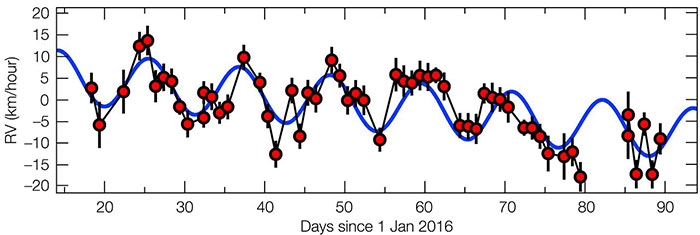
One of the methods currently used by astronomers to detect potential exoplanets is known as the “radial-velocity technique”, where they pick up tiny shifts in the wavelength of starlight caused by the presence of an exoplanet. These changes are derived from shifts in the parent-star’s spectral lines caused by the Doppler effect. While this method works very well for enormous planets in close orbit to the stars, it is extremely hard to pick up Earth-sized planets. Fortunately, red dwarfs are so small that their “wobble” is much easier to detect with our current technology.

Although there have been hints of a possible exoplanet in orbit around Proxima Centauri for the past 15 years, the signal was not convincing enough and appeared to have some strange deviations. We still do not fully understand the dynamics of red dwarfs and how they change over different timescales, and as a result, researchers could not tell for sure if the previously detected signals from Proxima Centauri were truly from a planet or due to some variability introduced during the star’s 88 day rotation, such as by a star spot, which also introduces a wobble.

Planetary signal?

Since 2013, the Pale Red Dot campaign has worked towards getting enough clear observations to tell for sure if the star hosted a planet. A way to do this was to carry out a long and continuous observational study of the star, and earlier this year, the team carried out a study of the star using the European Southern Observatory’s High Accuracy Radial velocity Planet Searcher (HARPS) spectrograph at the La Silla Observatory in Chile, together with three other telescopes around the world.

According to project co-ordinator Guillem Anglada-Escudé, from Queen Mary University in the UK, such a long observing mode is normally not allowed by ESO for a variety of reasons. But after a lot of “convincing” by the collaboration, they were allowed to study the star for 20 minutes every night for a two-month period, from 19 January to 31 March 2016.

Plot showing the 'wobble' of Proxima Centauri, from data taken in 2016

To ensure that the signal was in no way a false one created by Proxima Centauri, which is an active star, the team also carefully monitored its changing brightness during the campaign using telescopes at the San Pedro de Atacama Celestial Explorations Observatory in Chile and the Las Cumbres Observatory global network.

According to team-member Pedro Amado from the Instituto de Astrofísica de Andalucía in Granada, Spain, this continuous monitoring of at least five cycles of the stellar signal was crucial for the conformation. By analysing the 2016 data together with Doppler measurements collected by two ESO telescopes between 2000 and 2014, the team can confirm the existence of at least one planet in orbit around our neighbouring star.

Flashy star

The observations showed that Proxima Centauri approaches and recedes from the Earth at around 5 km/h and the pattern regularly repeats with a period of 11.2 days. By analysing the Doppler shifts, the researches determined that the planet has a minimum mass of 1.3 times that of the Earth and orbits Proxima Centauri at a distance of about 7 million kilometres – only five per cent of the Earth–Sun distance. The researchers deduce that the planet is terrestrial thanks to its Earth-like mass. It is also most likely tidally locked, but whether it has a synchronous rotation – i.e. the same side is always in the light or dark, like our Moon – is impossible to tell.

Although Proxima b orbits much closer to its star than Mercury does to the Sun, its parent star is much fainter than ours. This means that Proxima b lies well within the habitable zone around the star and has an estimated surface temperature that would allow the presence of liquid water. Despite the temperate orbit of Proxima b, the conditions on the surface may be strongly affected by the ultraviolet and X-ray flares from the star – far more intense than the Earth experiences from the Sun. But, according to team-member Ansgar Reiners at the Institut für Astrophysik, Universität Göttingen in Germany, this does not exclude the existence of an atmosphere, looking at the activity of the star today.

What will ultimately determine the actually habitability of the planet – including whether it currently has liquid water on its surface and an atmosphere – depends entirely upon its formation history. If the planet formed far away from the star and then migrated into its current orbit, it would have contained lots of water. On the other hand, it will be a dry planet, such as Venus or Mercury, if it formed close by, or so the researchers speculate.

Amado points out that we have “unmatched observing opportunities” as the exoplanet is so close to us and can, in theory, be resolved by a 3.5 m telescope. Actually being able to pick up enough light from it is another challenge that telescopes such as the ELT could attempt. “This is a planet in our neighbourhood and maybe we will finally send out a probe and take a picture from somewhere other than Earth,” hopes Amado.

The discovery is described in Nature.

Why do we need synchrotrons to study superconductors?

Superconductors conduct electricity with zero resistance below a critical temperature (Tc), leading to all manner of exciting applications. One of the dream scenarios is to discover a material that superconducts at room temperature. So-called “high-temperature superconductors” do exist but their transition point is still significantly below 0 °C. One of the factors hindering this research field is that we still have a very limited understanding of how high-temperature superconductors function.

In this video, Mark Dean of the Brookhaven National Laboratory (BNL) in New York explains how this endeavour can be aided by the bright X-rays produced at synchrotron facilities. Presenting from the beamline at the National Synchrotron Light Source II (NSLS-II), Dean introduces his own research on oxygen- and copper-based superconductors. He is investigating a mysterious weak ordering of electrons that occurs in these materials when they superconduct.

This video is part of our 100 Second Science series, in which researchers give concise presentations covering the spectrum of physics.

Magnetic bacteria target hard-to-treat tumours

Bacteria that respond to magnetic fields and low oxygen levels may soon join the fight against cancer. Researchers in Canada have done experiments that show how magneto-aerotactic bacteria can be used to deliver drugs to hard-to-reach parts of tumours. With further development, the method could be used to treat a variety of solid tumours, which account for roughly 85% of all cancers.

Cancer cells in a growing tumour consume large amounts of oxygen and parts of the tumour will become starved of oxygen – or hypoxic. It is notoriously difficult to deliver tumour-destroying drugs to these hypoxic regions using conventional pharmaceutical nanocarriers, such as liposomes, micelles and polymeric nanoparticles.

Now, a team led by Sylvain Martel of the NanoRobotics Laboratory at the Polytechnique Montréal – including researchers at McGill University – has developed a method that exploits the magnetotactic bacteria Magnetoccus marinus (MC-1) to overcome this problem.

Tiny compass needles

A MC-1 bacterium has a chain of magnetic nanoparticles that acts like a microscopic magnetic compass needle. The bacteria live in saltwater estuaries in the northern hemisphere, where they use the Earths’s geomagnetic field to point them towards deeper water with low oxygen concentrations. The microbes do this because they thrive where oxygen concentrations are low. Indeed, the oxygen levels found in hypoxic regions of a tumour – about 0.5% – are perfect for MC-1.

The researchers created an artificial environment to allow these bacteria to migrate towards the hypoxic regions of tumours in live mice with colorectal cancers. “We first produce a weak magnetic field pointing towards the tumour to guide drug-loaded bacteria and make them swim towards the tumour (a process called magnetotaxis),” says Martel. “Once inside the tumour and sufficiently close to the hypoxic zones, we remove the magnetic field to allow the bacteria to use their internal oxygen sensors (aerotaxis) and follow the decreasing oxygen gradient in the tumour until they reach the 0.5% oxygen level.”

These bacteria can be used as general transport vehicles to carry a huge variety of therapeutic agents, such as various drug molecules, radiotherapeutic agents, stem cells and immunotherapeutics. “In the short term, we will be using our technique to study how it can enhance cancer treatment,” says Martel. “The possibilities are vast, since all therapeutic agents for treating solid tumours share a common problem – the effective delivery to the site of treatment.”

Therapeutic agents

Looking further into the future, the researchers say they would like to look into the efficacy of various therapeutic agents that are delivered using their new technique. They also hope to collaborate with other research groups around the world.

In the next few months the team will begin to develop medical protocols based on the technique. Also planned is the implementation of mathematical models to improve how magnetic fields are used to guide the bacteria. They will also continue doing studies of the safety of the technique, which Martel says “are encouraging so far”.

The new technique is described in Nature Nanotechnology.

The monk and the multiverse

Robert Grosseteste was born sometime around the year 1170. By the time he died in 1253, he had gained a reputation as one of the leading scholars and philosophers of his age. However, some modern researchers have gone even further, calling him “the most brilliant scientist you’ve never heard of”.

“One idea he’s very famous for is a theory for the physical origin of the universe that, believe it or not, starts with a flash of light and expands out with a giant rapidly moving sphere – it’s a big bang theory of the universe,” says Tom McLeish, a physicist at Durham University.

McLeish is a member of the Ordered Universe Project, an interdisciplinary group of scientists and historians who are re-examining Grosseteste’s writings and, in many cases, “translating” his ideas into a modern mathematical form. This process has led the group in some unexpected and fruitful directions. For example, while the details of Grosseteste’s “big bang” are not compatible with modern theories – like other ancient and medieval scholars, he believed that the Earth was at the centre of the universe – McLeish notes that “physicists love playing with alternate realities and counterfactuals and toy models”. And as it turns out, analysing Grosseteste’s equations poses some interesting computational problems.

In this podcast, you’ll hear from McLeish and other members of the Ordered Universe Project, including:

  • medieval historian Giles Gasper on who Grosseteste was and the difficulties of reading early copies of his works;
  • physicist Brian Tanner on putting Grosseteste’s ideas into modern mathematical form, and on the differences between observing natural phenomena and conducting experiments;
  • psychologist Hannah Smithson on Grosseteste’s ideas about colour and the rainbow, and what they tell us about how people perceive the world around them.

What atomic-layer deposition could do for energy and the environment

Tools are useful when they meet all the demands of a particular objective, and invaluable when they continue to meet requirements that are ever evolving over time. Atomic-layer deposition (ALD) was already a useful tool for thin films in the 1980s, although commercial applications were then limited to electroluminescent displays. By the 1990s, use of ALD was making inroads into the microelectronics industry, but it was not until the end of that decade that the great match between the fabrication requirements in nanotechnology and the precision and control the technique can achieve became apparent.

Interest in the technique was confirmed in the early 2000s, when the American Vacuum Society began an international conference series on ALD. Since then, more than 1200 research papers, 80 reviews and two books have been published on ALD in nanotechnology. Some of the latest research using this technique to make devices for energy and environmental applications have appeared in a recent focus collection of the journal Nanotechnology from IOP Publishing, which also publishes Physics World.

ALD is a variant of the widely used technique of chemical-vapour deposition (CVD), in which a thin film is grown on a substrate by exposing it to one or more volatile gases – known as precursors – that react or decompose on the substrate to produce a required structure. The big difference with ALD is that the precursors are never present at the same time. Instead, ALD involves exposing the surface of a material to atoms of the chemicals to be deposited in separate stages and then clearing the excess between each stage.

In each of these stages, the precursor molecules react with the surface in a self-limiting way, which means that the reaction stops when all of the reactive sites on the surface are consumed. As a result, the amount of material that can be deposited on the surface after a single exposure to all of the precursors (a so-called ALD cycle) is governed by the nature of the precursor–surface interaction. By varying the number of cycles, researchers can therefore grow materials uniformly and with high precision on arbitrarily complex and large substrates.

In a paper published in the late 1990s exploring how ALD might be useful in nanofabrication (Nanotechnology 10 19), Mikko Ritala and Markku Leskelä of the University of Helsinki list the merits this tweak introduces. These include “accurate and simple film-thickness control, sharp interfaces, uniformity over large areas, excellent conformality, good reproducibility, multilayer processing capability and high film qualities at relatively low temperatures”. These attributes have proved particularly valuable for attempts to improve the efficiency and scalability of alternative-energy technologies.

Coating electrolytes on 3D structures

Many of the processes key to energy harvesting and storage devices are improved by the increased surface area that 3D structures bring. For lithium-ion batteries, a higher surface area means higher energy and power densities, as well as space to accommodate the addition and removal of lithium ions, which can introduce mechanical strain during use. Researchers studying lithium-ion batteries are therefore increasingly looking towards solid state as opposed to liquid electrolytes to avoid risks of leakage and corrosion, with sophisticated coating techniques to add electrolyte and counter-electrode layers to complex 3D nanostructures therefore being in high demand.

ALD not only provides pinhole-free coatings of solid-state electrolytes on 3D electrode structures, but it also lets researchers tailor the coating thickness, which can significantly improve performance. As Tsun-Kong Sham and Xueliang Sun and colleagues at the University of Western Ontario in Canada point out (Nanotechnology 25 504007), “It is expected that the lithium-phosphate thin films prepared by ALD can find potential applications as solid-state electrolytes for 3D all-solid-state micro lithium-ion batteries, which, as an emerging area, deserves more extensive investigation in the coming future.”

Supercapacitors are a particularly attractive energy resource in nanoelectronics, where space is at a premium. As with research on lithium-ion batteries, the advantages of 3D structures with solid-state electrolytes have been noted. Writing in the Nanotechnology focus collection (26 064002), Giuseppe Fiorentino, Frans Tichelaar and their colleagues at Delft University of Technology in the Netherlands report on supercapacitors made from carbon-nanotube bundles as high-aspect-ratio electrodes that can improve the capacitance by a factor of five. The electrode is coated with aluminium-oxide as the electrolyte, followed by titanium-nitride as the counter electrode. As Fiorentino’s team points out, the work is not only “the first known example of large-scale manufacturable nanostructured capacitors”, but also provides useful insights for coating such high-aspect-ratio nanostructures.

Solar energy panels

Electrochemical cell structures can also take on elaborate hierarchical forms, as demonstrated by Xudong Wang and colleagues at the University of Wisconsin-Madison and the Forest Products Laboratory in the US. They have combined ALD and cellulose nanofibres to produce extensively branched structures for photo-electrochemical water splitting. Such a 3D titanium-dioxide fibre-nanorod heterostructure offers, they say, “a new route for a cellulose-based nanomanufacturing technique, which can be used for large-area, low-cost and green fabrication of nanomaterials as well as their utilizations for efficient solar-energy harvesting and conversion”.

As for solar-energy harvesting, ALD is already a well-entrenched technique in the field, and has been used to coat the inverse opals and other 3D structures often employed to reduce the distances that charge carriers must travel to reach electrodes. In the focus collection of Nanotechnology (26 064001), Alfred Iing Yoong Tok and colleagues at Nanyang Technological University in Singapore and the University of New South Wales in Australia review the application of ALD in solar-power technologies, focusing on its use for surface passivation, surface sensitization and band-structure engineering.

The potential for lateral confinement

As well as providing an excellent tool for coatings, ALD offers great potential for controlled lateral confinement. This aspect is the subject of detailed scrutiny in the catalysis work of Marcel Verheijen at Philips Innovation Services and Eindhoven University of Technology in the Netherlands. Coating thickness is still key for catalysis performance, as demonstrated by Ai-Dong Li and colleagues at Nanjing University in China. However, as the work by Verheijen and his colleagues in the group of Wilhelmus Kessels at the university identifies, ALD can also help with size matters. In a study of four ALD processes for the preparation of nanoparticle catalysts made from platinum and palladium, they identify the potential for size control, as well its dependence on process conditions (Nanotechnology 27 034001).

It is the ability to accommodate innovation that makes atomic-layer deposition so invaluable

It is perhaps the ability to accommodate innovation that makes ALD so invaluable. The use of plasmonic metamaterial absorbers has only really gained notice in the past few years, and ALD is already proving invaluable for work exploring the essential mechanisms in these systems, too. Xin Chen and colleagues at the Shanghai Institute for Technical Physics, for example, exploit ALD control over dielectric layers in order to distinguish between different plasmon modes. “We have demonstrated inversed plasmonic metamaterial absorber architectures with a tuneable ALD spacer layer, and thus identified the contributions of the gap plasmon and the interference-enhanced local surface plasmon resonance to the superior absorption in a step-by-step manner,” they say.

It is typical of science to break down problems into manageable pieces that can be tackled step by step. By breaking down deposition to an atomic level with step-by-step, self-limiting stages, ALD mirrors this approach and in so doing seems to provide a multipurpose tool for a diverse range of applications.

  • The Nanotechnology focus collection on energy and environmental applications of atomic-layer deposition is available at this link.

Optical link connects atomic clocks over 1400 km of fibre

The time kept by atomic clocks in France and Germany has been compared for the first time using a new 1400 km optical-fibre link between labs in Paris and Braunschweig. Hailed as the first comparison of its kind made across an international border, the link has already shown that two of the most precise optical atomic clocks in Europe agree to within 5 × 10–17. The link is the first step towards a European network of optical clocks that will provide extremely stable and precise time signals for research in a number of scientific fields including fundamental physics, astrophysics and geosciences.

An optical atomic clock works by keeping a laser in resonance with an electronic transition between energy levels in an atom or ion – with the “ticks” of the clock being the frequency of the laser light. As with any clock, it is important to be able to compare the frequencies of two or more instruments to ensure that they are working as expected. Comparisons are also important for basic research, particularly for testing the fundamental physical laws and constants that are involved in the operation of atomic clocks.

Both of the clocks are based on the same optical transition in strontium atoms, which are held in optical lattices created by laser light. The clock at the LNE-SYRTE laboratory in Paris operates at an uncertainty of about 4.1 × 10–17 and the clock at the PTB Braunschweig laboratory at 1.8 × 10–17.

Gravitational shift

If they were side by side, the clocks would tick at exactly the same frequency. However, there is a 25 m difference in the elevation between the two locations, which means that the Earth’s gravitational field is not the same for both clocks – causing them to tick at slightly different frequencies. This gravitational redshift was confirmed by the link, which can detect differences in elevation as small as 5 m.

The link comprises two commercial-grade optical fibres that run between Paris and Braunschweig. The route is not the shortest distance between the two clocks, but rather takes a significant southward detour via Strasbourg on the French–German border. For every 1020 photons that begin the journey, only one would arrive at its destination. This 200 dB attenuation is compensated for by 10 or so special amplifiers along the route. The German portion of the link runs 710 km from Braunschweig to Strasbourg and is dedicated to connecting the clocks. The French portion, however, uses 705 km of an active telecommunications link that also carries Internet traffic. As a result, two different approaches were needed to amplify the clock signals on either side of the border.

Second connection

The optical clock at PTB Braunschweig is already linked to the Max Planck Institute for Quantum Optics (MPQ) in Garching near Munich. This is done via a 920 km pair of optical fibres, and researchers at the MPQ plan to use the clock signal to make extremely precise spectroscopy measurements. A further expansion of this network would provide researchers in other labs in Europe with access to high-precision clock signals.

Applications could include measuring a fundamental physics constant in several different locations – to confirm that the value of the constant is indeed constant. Other possible uses include precision measurements in spectroscopy that look for evidence of physics beyond the Standard Model and making very precise measurements of the shape and density of the Earth.

The construction and testing of the link are described in Nature Communications.

A horrific nightmare scenario at CERN, surfer wins SUSY bet, and meet the father of the Super Soaker

Surf's up: Garrett Lisi when he is not winning bets with Nobel laureates (Courtesy: CC BY-SA 3.0/Cjean42)

By Hamish Johnston

The “nightmare scenario” of particle physics has a new meaning thanks to a bizarre video that appears to have been made by some scientists at CERN. The video seems to have been filmed at night at CERN’s main campus in Geneva and depicts an occult ceremony in which a woman is stabbed. While the video appears to be a spoof and there is no indication that anyone was actually harmed in its making, CERN officials are rightly concerned that such violent scenes were filmed on their premises. “CERN does not condone this type of spoof, which can give rise to misunderstandings about the scientific nature of our work,” a spokesperson told Agence France-Presse.

(more…)

UK Atomic Energy Authority gets a new chief executive

The UK fusion scientist Ian Chapman has been named as the next chief executive of the UK Atomic Energy Authority (UKAEA). On 1 October Chapman will succeed Steve Cowley, who has been head of the authority since 2009 and will become president of Corpus Christi College at the University of Oxford.

As head of the UKAEA, Chapman will lead the UK’s magnetic confinement fusion research programme at the Culham Science Centre in Oxfordshire. He will oversee the upgrade of the Mega Amp Spherical Tokamak, which is set to be ready in 2017, as well as the operation of the Joint European Torus (JET) – one of the world’s largest nuclear fusion devices. He will also lead the UKAEA’s other activities at Culham, including the recently opened Materials Research Facility, the RACE robotics centre and the Oxford Advanced Skills apprentice training facility.

With an MSc in mathematics and physics from Durham University, Chapman began working at Culham in 2004 while completing a PhD with Imperial College London. In 2014 he was named head of tokamak science at Culham and then became fusion programme manager a year later. Aged just 34, Chapman will be one of the youngest chief executives of a major research facility. “While I am young, I am also experienced,” he says. “I hope my profile means that fusion, and its huge potential to give the world cleaner energy, will get noticed.”

Broad portfolio

Chapman comes into the job at a crucial time for UK research following the country’s vote to leave the EU, which will be tricky to manage for Culham. The European Consortium for the Development of Fusion Energy – jointly run by 26 European member states and Switzerland – funds JET’s experiments. Cash for this is secure until 2018, but what happens after then is unknown. But Chapman told Physics World that he is confident about Culham’s future. “Science is an international endeavour,” he says. “I am positive for the future as we have a broad portfolio of activities.”

Indeed, the experiments carried out at JET will be crucial to the success of the ITER fusion experiment currently being built in Cadarache, France, when it turns on in the coming decade. While Chapman calls ITER “the most important experiment mankind has ever done”, he admits it is a “big challenge, with a lot of difficulties”. Yet he hopes that his appointment will inspire the next generation of scientist and engineers to make a success of the device. “It is my personal ambition to deliver fusion,” he adds.

Chapman’s appointment is backed by Culham’s outgoing boss. “Ian has risen quickly for good reason: he is a world-class scientist, a thoughtful manager, and a strategic thinker of the first order – astonishing in one so young,” says Cowley. “Culham is a precious UK asset and I am pleased that it will be in such good hands.”

Copyright © 2026 by IOP Publishing Ltd and individual contributors