A genetically engineered tissue that can be electrically excited by light has been developed by researchers in the US. The team believes its new material could be used as a simple model of the heart, allowing information about electrical malfunctions such as arrhythmias to be gathered. It could also lead to the development of biological computers that could be interfaced with the natural world.
The human heart is an extremely complex tissue, and when things go wrong with it, doctors and scientists often struggle to determine the causes of specific symptoms and devise appropriate treatments. Researchers are therefore trying to create simplified model systems for the heart to gain a better understanding of how it functions. A simplified model of the heart can be produced using electrically coupled cells, so that a change in the electrical potential of one induces a change in the potential of its neighbours. This allows electrical waves to propagate through the tissue – just as they do in a beating heart.
In this latest research, biophysicist Adam Cohen and colleagues at Harvard University based their model on human embryonic kidney cells. Such cells are not normally electrically excitable, and Cohen says they formed a “blank slate” for the study. The researchers edited the cells’ genomes so that the cells developed four ion channels – pores that can open or close to allow specific ions in or out of the cell, altering its electrical potential. First, they added a potassium-ion channel present in the heart to allow positive potassium ions (K+) out of the cell and lower the resting electric potential. Second, they added a sodium-ion channel – also present in the real heart – that opens when the potential increases. This allows sodium ions (Na+) into the cell, creating a runaway increase in voltage.
Red and blue light
In equilibrium, the K+ channel holds the potential down, keeping the Na+ channel closed, and the cells stay negatively charged. However, an increase in applied voltage will open the Na+ channel, triggering a voltage spike that opens the Na+ channels of neighbouring cells and sends an electrical pulse like a heartbeat through the tissue. Finally, they added two light-responsive-ion channels that they had developed previously. One of these channels raises a cell’s potential in response to blue light, while the other creates a voltage-dependent fluorescence in response to red light. Together, these allowed the team to trigger and image the electrical waves in the tissue culture.
The researchers then measured various properties of their tissue culture, which revealed a few surprises. “If you drive a real heart too fast, it can go into an arrhythmia, where it starts to beat erratically,” explains Cohen. “No matter how fast we paced them, we were never able to trigger arrhythmias in these cells. There are elaborate feedback mechanisms that allow the heart to adapt to changes in demand, and it’s actually those feedbacks gone awry that lead to arrhythmias.” The researchers are now planning to add in other ion channels “one at a time”, to learn about their individual contributions.
Circulating waves
In addition to modelling the heart, the researchers showed that electrical circuits could be created and reconfigured dynamically in the tissue. After firing once, the Na+ channels are not re-armed until after the light is turned off, so permanently illuminating a region with blue light makes it unexcitable. Rings of excitable tissue could sustain continuously circulating waves in either direction for more than 1000 cycles. The waves could easily be stopped with blue light, however, before being launched in the opposite direction – thereby forming a rudimentary cellular memory.
In the future, more complex logical operations could be implemented using the tissue cultures, and these could be used to perform complex bioelectrical computations. However, the clock speed of such cellular computers would be limited to about 100 Hz by the recovery time of the cells – which is millions of times slower than standard computers. The researchers also point out that the tissues could be used in environmental sensors that detect the presence of specific chemicals. “One could put ion channels into these cells that are activated by different things one might want to sense in the environment,” says Cohen.
Gil Bub of the University of Oxford in the UK describes the work as “important”. “It’s a very nice reductionist approach with a tremendous amount of power for figuring out what specific [ion] currents are responsible for what types of behaviour,” he says. “The potential downside is that you don’t necessarily know what currents and what feedback loops are there in the intact system.” He says these kinds of experiments will be most useful if performed in tandem with experiments on the real heart.
A few weeks ago I was in Germany for the 66th Lindau Nobel Laureate Meeting, where I moderated a “press talk” about migration and science. This was essentially a panel discussion that involved two chemistry Nobel laureates – Martin Karplus and Daniel Shechtman – and two early-career physicists: Winifred Ayinpogbilla Atiah from Ghana and Ana Isabel Maldonado Cid from Spain.
Images of relativistic electrons trapped in graphene quantum dots have been taken by physicists in the US and Japan. The ability to confine and control electrons in such a way could play an important role in developing graphene-based nanoscale devices and could also provide a better understanding of these exotic “Dirac fermions”.
Graphene is a honeycomb lattice of carbon atoms just one atom thick that was first isolated in 2004. It has a number of unique electronic properties, many of which come from the fact that it is a semiconductor with a zero-energy gap between its valence and conduction bands. Near where the two bands meet, the relationship between the energy and momentum of charge carriers (electrons and holes) in the material is described by the Dirac equation and resembles that of a photon. These bands, called Dirac cones, enable these charge carriers to travel through graphene at extremely high speeds approaching that of light. This extremely high mobility means that graphene-based electronic devices such as transistors could be faster than any that exist today.
Tunnelling problems
Despite the material’s many useful properties, there are still many challenges facing researchers trying to create graphene-based devices. One problem is related to the fact that the behaviour of charge carriers in graphene is governed by Klein tunnelling – a counter-intuitive effect in which relativistic particles can pass through a potential barrier with 100% probability. Because graphene’s charge carriers behave like relativistic particles, Klein tunnelling is therefore predicted to exist in potential barriers (p–n junctions) fabricated in the material.
“This exotic behaviour, albeit very interesting, makes trapping and controlling graphene’s charge carriers very difficult,” explains team-member Jairo Velasco Jr of the University of California, Berkeley, and the University of California, Santa Cruz. “It is, however, important for us to be able to map the behaviour of these Dirac fermions at p–n junction boundaries, to explore Klein tunnelling physics in the carbon material and to better control and confine the electrons in it.”
The researchers, led by Michael Crommie, created circular p–n junctions in graphene by positioning the tip of a scanning tunnelling microscope (STM) about 2 nm above the surface of a graphene sample while applying a voltage pulse to the tip. “While doing this, we also apply a constant voltage on a silicon slab that is below the graphene, but separated from it by a silicon-oxide capping layer and a boron nitride (BN) flake,” says Velasco. “The intense electric field emanating from the STM tip ionizes defects in the BN region directly beneath the tip and the released charge migrates through the BN to the graphene. This leaves behind a space-charge build-up in the BN that screens the electric field from the silicon slab.”
Mapping wavefuctions
The next step is to take an image of the Dirac fermions in the graphene sample. “To do this, we position our STM tip about [0.1 nm] above the graphene surface,” continues Velasco. “This allows us to measure a tunnelling current between the suspended STM tip and the graphene surface.” This measurement is a direct probe of the quantum-mechanical wavefunction of electrons in the carbon material. By moving the STM tip to different lateral positions on the sample, this allows the team to build-up an image of how the wavefunction varies inside and outside the circular p–n junction (see figure).
Until now, obtaining direct images of electron wavefunctions in graphene had been notoriously difficult. This was because the systems in which researchers were trying to observe them – lithographically patterned structures, graphene edges and chemically synthesized graphene islands, for example – contained too many defects.
Mark Fromhold of Nottingham University in the UK, who was not involved in this work, says that defects are “often problematic in solid-state devices because they produce unwanted electrical or optical behaviour. But in this beautiful new experiment, the Crommie group has shown how defects can be used, together with a scanning probe, to overcome a major challenge in graphene physics, namely how to stop electrons leaking through p–n junctions by Klein tunnelling. Not only did the researchers manage to confine the electrons in a quantum dot created in the graphene layer, but they were also able to directly map both the resulting energy-level spectrum and the corresponding quantum wavefunctions.”
Quantum dots
According to Velasco and colleagues, the techniques developed in this work could now be used to study more complicated systems as well, such as multiple quantum dots with arbitrary geometries. “This is because the graphene circular p–n junctions we made (which can be considered as quantum dots too) are fully exposed, and so we can directly access them with real-space imaging probes,” Velasco says. “This is completely different to conventional semiconductor quantum dots, which are generally inaccessible.”
The team, reporting its work in Nature Physics, says that it now also plans to investigate bilayer graphene, which hosts massive Dirac charge carriers. “These charge carriers are expected to completely reflect upon impinging on a p–n junction barrier, independent of the barrier width.”
The same issue of Nature Physics also contains a paper by Christopher Gutiérrez of Columbia University and colleagues who have also obtained images from electrons trapped in a graphene quantum dot.
Before setting off to the International Space station (ISS) for six months, UK astronaut Tim Peake revealed that one of the meals he would miss most is the classic British roast dinner. So what better way to celebrate the 44 year old’s safe return to Earth last month than to create a portrait of him made from his favourite nosh? Designed by UK “food artist” Prudence Staite for the Hungry Horse pub chain, the culinary creation took 20 hours to make – you can watch a timelapse video of it being created above. The finished portrait weighed in at 12 kg and says “Welcome Home Tim”. Hungry Horse has even offered Tim and his family free roast dinners for life.
Officials behind the proposed Thirty Meter Telescope (TMT) are considering new locations for the $1.4bn facility, and expect to decide whether to opt for a new site early next year. The TMT is due to be built on Hawaii’s Mauna Kea mountain but, following protests from local residents, its building permit was revoked last December by the state’s Supreme Court. New locations that are being considered include Baja California in Mexico, the Canary Islands and Chile, as well as locations in India and China.
The TMT board had chosen Mauna Kea, which already hosts 13 other telescopes, as the observatory’s site in July 2009. Over the following six years, the organization received a series of necessary approvals and permits. However native Hawaiians, who regard the Mauna Kea summit as sacred – and who had previously objected to the growth in the number of telescopes there – carried out a protest at the telescope’s ground-breaking in October 2014.
Six months later, following further demonstrations, Hawaii governor David Ige announced a temporary postponement of the project. Then last December, the Hawaiian Supreme Court invalidated the TMT’s building permit, ruling that the State Board of Land and Natural Resources had not followed due process when it was approved. The court then remanded the case back to the board.
Looking for plan B
TMT managers began to consider other sites for the telescope in January. “The TMT’s board of directors decided to study other potential sites while the contested case takes its course in Hawaii,” says TMT spokesperson Scott Ishikawa. “We need a reasonable plan B, should the Hawaii option not be feasible in a timely fashion.”
Hawaii is still an option but we are very actively looking at alternatives
Fiona Harrison, Caltech
A key factor in the search for different locations is that construction of the TMT is planned to begin in April 2018 with completion in 2022. “It’s no secret that the TMT project is looking at alternatives, driven by schedule considerations; if you stretch the project out, the cost will go up,” Fiona Harrison, a physicist at the California Institute of Technology and member of the TMT International Observatory’s board of governors, told Physics World. “Hawaii is still an option but we are very actively looking at alternatives. We’ll be culling down [the list of sites] to a few options over the summer.”
Despite the uncertainty over the site, work is still continuing on the TMT. Fengchuan Liu, TMT deputy project manager, told SPIE’s Astronomical Telescopes + Instrumentation 2016 conference in Edinburgh last week that the uncertainty around the site has not delayed work on the telescope’s design and related issues. “The team is not sitting idle,” he says. “We are making progress and spending each dollar wisely.” He adds that a decision on a new site will be made “by early 2017”.
Still “first choice”
According to Ishikawa, the Hawaii site is still “first choice”, and the process to reapply for the permit is already under way. The case for Hawaii was strengthened by the addition last month of the TMT International Observatory (TIO) to the TMT organization as an applicant for the permit. Formed in May 2014, the TIO consists of the California Institute of Technology, Japan’s National Institutes of Natural Sciences, the National Astronomical Observatories of the Chinese Academy of Science, the regents of the University of California, as well as organizations from India and Canada.
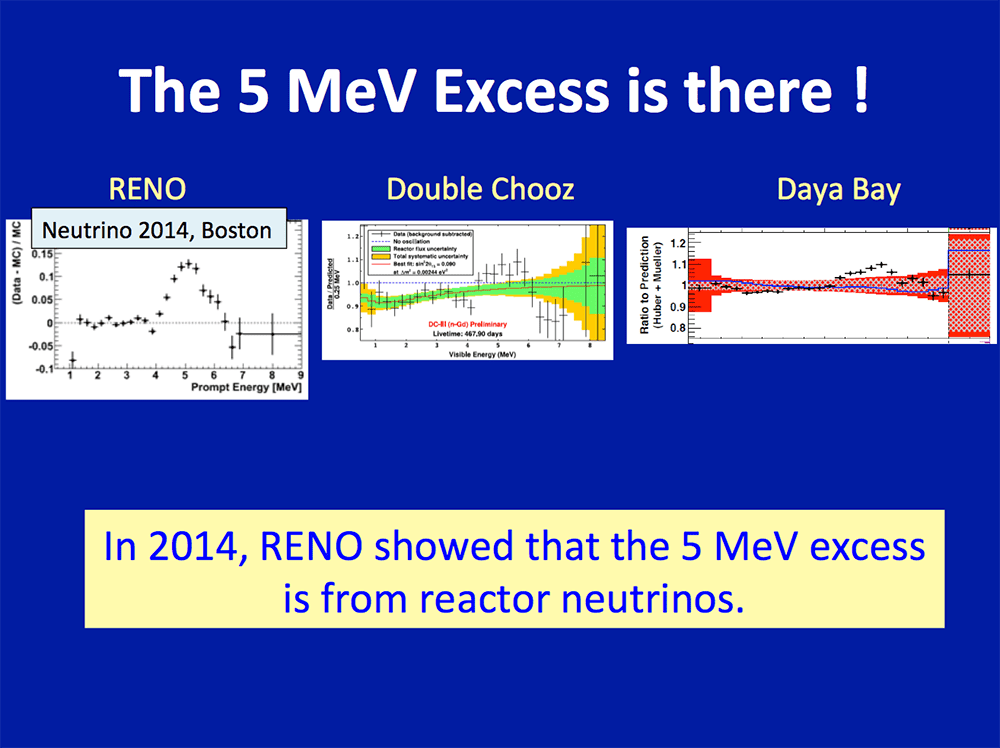
Triple bump: the 5 MeV bump data presented by K Joo at the Neutrino 2016 conference. (Courtesy: RENO Collaboration)
By Tushna Commissariat
A final mystery that was mentioned at the Neutrino 2016 I attended in London this week was yet another unexpected “bump” in data at 5 MeV, measured while monitoring the neutrino flux from nuclear power plants. Starting with the RENO experiment in 2012, it was spotted by the Double Chooz experiment in 2014 and finally by the Daya Bay neutrino experiment earlier this year. While the initial signal was not of high enough statistical significance, it has now held up over time and more measurements.
More data are definitely needed in the quest for the sought-after sterile neutrino. That much was clear as more than 10 different global neutrino detectors announced at the Neutrino 2016 conference in London that they have found no evidence for the slippery particle’s existence. The sterile neutrino is a hypothetical and much-debated fourth type of neutrino that would contribute mass, but only interact with the other three “active neutrinos”, making it that much more difficult to detect. In the video above, Physics World features editor Louise Mayor explains why researchers are so keen to nail down this particle, should it exist, as it may single-handedly explain some of the biggest mysteries in physics today, including dark matter.
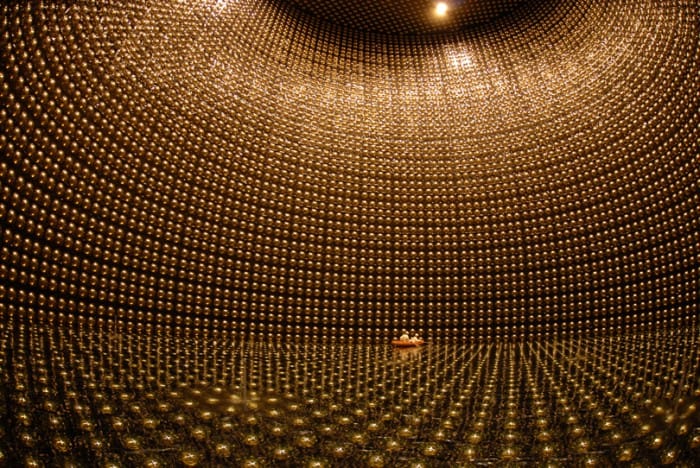
Deep trap: Inside the Super-Kamiokande neutrino detector. (Courtesy: T2K Collaboration)
By Tushna Commissariat
As you may have read, earlier this week I was at Neutrino 2016 – the 27th International Conference on Neutrino Physics and Astrophysics – in London. Although I was only at two days of the week-long conference, I still have neutrinos on my mind. A whole host of experiments presented various data and updates. Indeed, the researchers presenting the latest results from the Tokai to Kamioka (T2K) experiment in Japan and the NOvA Neutrino Experiment at Fermilab in the US had some interesting things to say.
T2K collaborator Hirohisa Tanaka, from the University of Toronto in Canada, revealed that the experiment’s most recent data seem to support earlier hints that there may be different oscillation probabilities for neutrinos and antineutrinos. If these data hold up, then it would have big consequences – the standard model of neutrino physics says that these two oscillation rates should be the same so as not to violate charge–parity (CP) symmetry. According to the collaboration, their observed “electron antineutrino appearance event rate is lower than would be expected based on the electron neutrino appearance event rate, assuming that CP symmetry is conserved”.
Imagine a world where three “suns” set one after another on some evenings, but at other times of the year there is always daylight. That is what it would be like on HD 131399Ab, which is a newly discovered planet four times as massive as Jupiter that orbits in a system of three stars. Spotted by an international team of astronomers using the SPHERE instrument on the Very Large Telescope in Chile, its very existence challenges current theories of how planetary systems form and evolve.
Astronomers have discovered more than 3000 planets orbiting stars other than the Sun, and the nearby universe is expected to harbour vast numbers of such extrasolar planets (exoplanets). So far, the exoplanets that we know about range from rocky bodies several times more massive than Earth to gas giants that dwarf Jupiter. HD 131399Ab is the first exoplanet to be discovered by the European Southern Observatory’s SPHERE instrument, which saw first light in 2014 and is designed to detect the extremely faint infrared light coming directly from distant exoplanets. Detecting light from an exoplanet is an extraordinarily difficult task, which is why most earlier discoveries of exoplanets were made by measuring their effect on light from their companion stars.
HD 131399Ab was spotted by Kevin Wagner and Daniel Apai of the University of Arizona, along with astronomers in the US, Germany and France. The team was astounded to find the planet in a very wide orbit around one of the stars (called A), with the two bodies separated by about 50 astronomical units (AU). This is a much larger orbit than any planet in the solar system – the furthest Neptune gets from the Sun is about 30 AU. The other two stars (B and C) are bound together in a binary system that is about 300 AU from A. Star A is the largest in the system, weighing in at about 1.8 solar masses, whereas B is slightly smaller than the Sun and C is about 0.6 solar masses. The system is about 300 light-years away from Earth.
Stable or unstable?
HD 131399Ab’s very wide orbit around A – which the team has calculated takes 550 Earth years to complete – came as a big surprise because astronomers had believed that such an orbit in a three-star system would be unstable. The team created a computer model of the system to try to understand why it holds together. “Our computer simulations showed that this type of orbit can be stable; but if you change things around just a little bit, it can become unstable very quickly,” explains Apai. The team also believes that the exoplanet may not have formed in its current orbit. One possibility is that HD 131399Ab once circled two stars but its orbit was disrupted by gravitational interactions with another unseen exoplanet or with the stars in the system.
Although the simulations do not provide a complete description of the motions of the exoplanet and its three stars, it gives enough information for Wagner to paint a vivid picture of one possible scenario. “For about half of the planet’s orbit, which lasts 550 Earth years, three stars are visible in the sky; the fainter two are always much closer together, and change in apparent separation from the brightest star throughout the year,” he says. “For much of the planet’s year, the stars appear close together, giving it a familiar night-side and day-side, with a unique triple sunset and sunrise each day.”
Midnight sun
Wagner explains, however, that this day–night cycle does not last for the entire HD 131399Ab year. “As the planet orbits and the stars grow further apart each day, they reach a point where the setting of one coincides with the rising of the other – at which point the planet is in near-constant daytime for about one-quarter of its orbit, or roughly 140 Earth years,” he says.
Despite the huge distance between HD 131399Ab and star A, the temperature on the surface of the planet is expected to be about 850 K (580 °C) despite being so far from its star. This could be related to the exoplanet’s youth – it is estimated to be just 16 million years old. In comparison, the Earth has been around for about 4.5 billion years.
“It is not clear how this planet ended up on its wide orbit in this extreme system, and we can’t say yet what this means for our broader understanding of the types of planetary systems out there, but it shows there is more variety out there than many would have deemed possible,” Wagner says. “What we do know is that planets in multi-star systems are much less explored, and potentially just as numerous as planets in single-star systems.”
As one of the oldest forms of natural science, astronomy has enjoyed a long and dramatic history. However, it was not until the early 1600s that the entire discipline was kicked into high gear by Galileo’s adoption of the telescope as a scientific instrument. No longer bound by the resolving power of the human eye, astronomers had finally attained the freedom to search the night skies for the wandering motion of the faintest stars. The door to the discovery of additional planets that orbit the Sun had been cracked open.
In terms of sheer numbers, efforts to expand the solar system’s planetary album have yielded rather unimpressive results. Over the last four centuries, only two planets that were not known to ancient civilizations have been found. The discovery of the first of these planets, Georgium Sidus (now known as Uranus), was announced by William Herschel at the time of the American Revolutionary War, in 1781. This finding simultaneously marked the beginning and the end of purely astronomical detection of planets in the solar system. Indeed, the revelation of the next planet would rely more on celestial mechanics than on a telescope.
Soon after Herschel’s announcement of Uranus, astronomers began to compute its orbital motion and flirt with the idea that an additional, more distant object could gravitationally perturb its trajectory. Among the first astronomers to lead this charge was Anders Johan Lexell. In a set of compiled astronomical tables published in 1821, which included accidental observations of Uranus that predated its formal discovery, Alexis Bouvard (then director of the Observatoire de Paris) noted that Uranus was indeed deviating from its predicted path. Without discounting the possibility of spurious data, Bouvard joined Lexell in speculating that the irregularities in Uranian motion could be caused by an additional planet.
It would take more than two decades before the promise of Bouvard’s data came to fruition. In a parallel set of calculations completed in 1846, John Couch Adams and Urbain Le Verrier independently predicted the existence of Neptune. Although the computed orbital period and mass of the putative Neptune exceeded the real values by a significant margin, the calculations gave the correct location in the sky. Then, in a remarkable feat of observational confirmation of theoretical results, Neptune was spotted by Johann Galle on the first night of his observational campaign later that same year.
Once the ability to deduce the presence of an additional planet using orbital irregularities had been demonstrated, a number of contemporary mathematicians attempted to derive the existence of even more distant objects using existing data. As a result, by the early 1900s there was no shortage of hypothetical planets beyond Neptune. One particularly notable prediction was Percival Lowell’s famed Planet X hypothesis, which led to the accidental discovery of Pluto in 1930 (see “Our new view of Pluto”, July 2016, pp40–43 in print).
In the end, it was unmanned spaceflight that killed Planet X. Following Voyager 2’s 1989 encounter with Neptune, the planet was recognized to be a fraction of a per cent less massive than previously thought. Like a Rubik’s cube snapping into its orderly configuration, this small change cleansed the solar system’s astronomical charts of any irregularities, and erased the theoretical need for Planet X. As history shows, the claims of additional planets following Neptune’s discovery had more to do with erroneous interpretation of the observational data than anything else. Every time the observations seemed to call for the introduction of another planet, further analysis revealed that the apparent anomalies could be fully reconciled within the framework of the known solar system.
The first discoveries of icy debris beyond the orbit of Neptune, now collectively known as the Kuiper belt, conformed to this narrative well. As observational surveys began to expose the intricate dynamical structure of the Kuiper belt, it became increasingly clear that virtually every Kuiper belt object’s orbital evolution could be explained through gravitational interactions with Neptune. While some objects are currently locked into orbital resonances with Neptune, others show signs of having been tethered by its gravitational pull in the past. Hence, at the turn of the 21st century, the large-scale architecture of the solar system showed no signs of abnormality whatsoever.
Kuiper belt clues
The solar system in 2016 tells a very different story. Over the course of the last 15 years, observational mapping of the Kuiper belt has revealed a simple, fundamental fact: the orbital arrangement of the most distant bodies in the Kuiper belt is incompatible with an eight-planet solar system.
The first real hint that the solar system still has some tricks up its sleeve came in 2003, when a team of astronomers led by Mike Brown discovered Sedna, a Kuiper belt object (KBO) unlike any other. Whereas most known KBOs have orbital periods not too different from the approximately 250-year period of Pluto, Sedna requires more than 11,000 years to complete its journey around the Sun. Another impressive feature of Sedna’s orbit is its staggering ellipticity. At its furthest from the Sun, Sedna swings out to almost 1000 astronomical units (where one astronomical unit is the mean Earth–Sun distance, roughly 150 million kilometres).
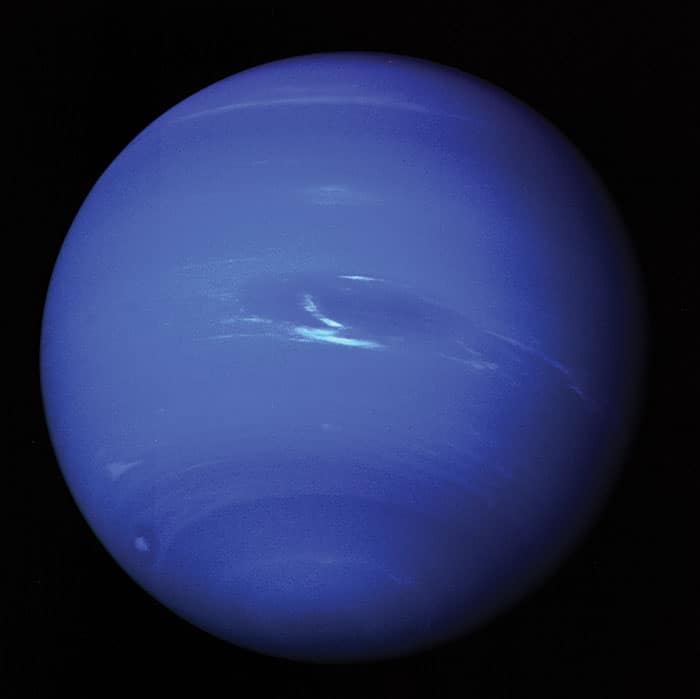
Data-led discovery To date, Neptune (pictured here by Voyager 2) is the only planet in our solar system to have been predicted by theory and later confirmed by direct observation. (Courtesy: NASA)
The truly remarkable thing about Sedna, however, is that its orbit is not elliptical enough. Most KBO orbits appear to physically hug the orbit of Neptune. That is because – due to gravitational potential being conservative – any small object that has been sent on a highly elliptical trajectory by Neptune must come back to its point of origin, i.e. the orbit of Neptune. Sedna’s orbit represented the first true exception to this rule: even at its closest approach to the Sun, Sedna remains more than twice as far away from the Sun as Neptune. As a result, Sedna’s origin posed somewhat of a mystery. A body that never experienced direct interactions with Neptune could not have been placed on its orbit by Neptune alone.
In a paper detailing Sedna’s discovery, Brown, Chad Trujillo and David Rabinowitz speculated on the various scenarios that could potentially account for the genesis of its strange orbit, including a scenario where an undiscovered Earth-mass planet lurks beyond the orbit of Neptune (2004 Astrophys. J.617 645). Around the same time, Brett Gladman and Collin Chan independently discussed the possibility of a rogue planet shaping some features of the Kuiper belt. A similar viewpoint was adopted by yet another researcher, Rodney Gomes, in Brazil. In some sense, the discussion mirrored the Lexell–Bouvard speculation of the early 1800s, in which close examination of Uranus had given clues to the existence of Neptune. Clear echoes of a distant perturbing body were beginning to emerge.
Sedna’s loneliness as an outlier finally came to an end in 2014, when Trujillo and Scott Sheppard discovered a second Sedna-like object, 2012 VP113 (Nature507 471). With a perihelion distance (a body’s closest distance to the Sun) even larger than that of Sedna, 2012 VP113 confirmed that these objects are not outliers: they are members of a separate, detached population of KBOs. It was with this very paper in hand, and a facial expression showing a combination of excitement and concern, that Mike Brown walked into my office two years ago.
Gravity of the situation
“Have you seen how weird this is?” Mike asked, pointing to figure 3 in Trujillo and Sheppard’s paper. Here the authors note that all KBOs with orbits with perihelion distances beyond Neptune and with periods longer than 2000 years tend to cluster in their argument of perihelion. (The argument of perihelion is a bizarre parameter: it is the angle between the point at which an orbit intersects the ecliptic plane while travelling from south to north on the sky and the point of closest approach to the Sun. Taken at face value, a collection of similarly inclined orbits that cluster in the argument of perihelion would trace out a cone-like structure.) Not swaying from tradition, Trujillo and Sheppard had speculated that this clustering could be due to an unseen, few-Earth-mass planet, with a circular orbit and a period equal to that of 2012 VP113. However, the authors simultaneously acknowledged that such a planet could not, in fact, explain the data adequately.
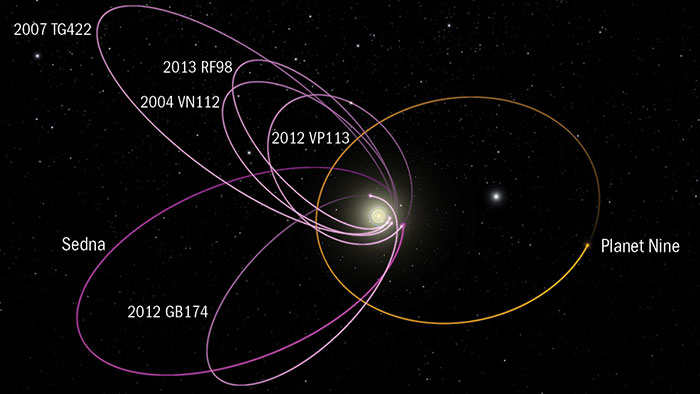
Intrigued, Mike and I examined the data ourselves. The clustering pointed out by Trujillo and Sheppard emerged on the computer screen. However, to our surprise, this clustering was not alone – other orbital co-ordinates were grouped as well. Immediately, it was clear that the clustering of the argument of perihelion is only part of the full picture. A closer look at the data showed that six objects that occupy the most expansive orbits in the Kuiper belt (including Sedna and 2012 VP113) trace out elliptical paths that point into approximately the same direction in physical space, and lie in approximately the same plane.
Mike and I were genuinely perplexed. Could the confinement of the orbits be due to an observational bias, or perhaps to mere coincidence? Will any theory aimed at explaining these observations suffer the same fate as Lowell’s Planet X hypothesis (i.e. the need for it disappears once more accurate observations are made)? Thankfully, the probability of the observed alignment being fortuitous can be assessed in a statistically rigorous manner, owing to the large size of the comparison sample (i.e. other KBOs that are found at a similar radial distance to our objects of interest). The probability that the alignment is a fluke clocked in at only 0.007%. Not a great gamble.
Could this orbital alignment be a relic of an encounter with a passing star during the solar system’s infancy? An application of simple mean-field perturbation theory showed that if allowed to evolve under the gravitational influence of Jupiter, Saturn, Uranus and Neptune, these objects’ orbits would become randomly oriented on timescales much shorter than the multi-billion-year lifetime of the solar system. So the dynamical origin of the peculiar structure of the Kuiper belt cannot be outsourced to the distant past – something is holding the orbits together right now.
Having quadruple-checked our results, we sat on my couch and stared silently at each other. The gravity of the situation began to sink in. Could it truly be that after 170 years of false alarms and non-detections, we had stumbled upon actual evidence that the solar system’s planetary catalogue is incomplete? We got to work.
Glimpse of hope
Our progress was initially anything but rapid. Coming from observational and theoretical backgrounds respectively, Mike and I don’t always speak the same language, and would spend hours arguing profusely, only to later realize that we are in fact, saying the exact same thing. Then there were all the calculations that did not pan out. Ideas crowding our outtakes reel range from models where the self-gravity of the Kuiper belt itself keeps the observed structure intact, to a scenario where the orbit of a distant planet cradles the orbits of KBOs from the outside, maintaining the same average orientation. Each hypothesis failed when confronted with the data.
Last summer brought our first glimpse of hope. We were running a series of evolutionary numerical experiments, starting off each time with a randomized disc of planetary building blocks, or “planetesimals”. We placed these objects in eccentric, Neptune-hugging orbits that were allowed to evolve under the gravitational influence of a distant perturber, which we dubbed “Planet Nine”. We began to notice that groups of planetesimals emerged in orbits that were co-linear and spatially confined. Intriguingly, this would occur only if Planet Nine was chosen to be about 10 times more massive than the Earth, and to reside on a highly eccentric orbit. More unexpectedly, the confined orbits would cluster in a configuration where the long axes of their orbits are anti-aligned with respect to Planet Nine.
1 Peculiar arrangement Kuiper belt objects that have periods in excess of 4000 years have highly elliptical orbits that cluster in physical space. This peculiar orbital arrangement can be explained by the existence of Planet Nine beyond Neptune. (Courtesy: Robert Hurt, IPAC/Caltech)
At first glance, this outcome was puzzling. If the trajectories of the KBOs intersect the orbit of the perturbing planet, wouldn’t the objects have been scattered away at some point over the past few billion years? It turns out that the answer can be summarized in one word: resonance. Just as the overlapping orbits of Pluto and Neptune are protected from close encounters by a clockwork-like orbital period ratio of 3:2, the confined orbits of the distant Kuiper belt glean long-term stability from resonances with Planet Nine. However, the latter picture is somewhat more complex: the resonances at play are exotic and interconnected, yielding orbital evolution that is fundamentally chaotic. In other words, perturbed by Planet Nine, the distant orbits of the Kuiper belt remain approximately aligned, while changing their shape unpredictably on million-year timescales.
Surprising and unforeseen results continued to accrue. Upon a cursory examination of the simulation data, we noticed that gravitational torques exerted onto the Kuiper belt by Planet Nine would induce long-period oscillations in the perihelion distances of the confined KBOs. This naturally generated detached orbits, such as those of Sedna and 2012 VP113. Suddenly, the origins of these objects became abundantly clear: they are regular KBOs that have been pulled away from their original locations by Planet Nine. Moreover, the evolutionary calculations suggested that if we were to revisit the Kuiper belt in a hundred million years, objects like Sedna and VP would once again look like conventional, garden-variety KBOs, while some of the more typical objects would now be in detached orbits.
Finally, there was a weird, crazy twist. In every simulation that produced a synthetic Kuiper belt that resembled the real one, the model also consistently generated orbits that were nearly perpendicular to the plane of the solar system. Given that there is virtually no other way to produce such extreme inclinations in the solar system, we thought that this would be a strong prediction: if such objects were ever discovered, they would constitute tangible evidence for the existence of Planet Nine.
Planet Nine falls into place
Caught up in our attempts to understand the dynamics of the simulations, we had forgotten to check the actual data. Then, on a sunny afternoon in October, we plotted the observed catalogue of objects on top of our model’s predictions to see if, by any chance, highly inclined bodies of the type our simulations predicted had been discovered since we last checked. And there they were – five objects, accidentally detected by a near-Earth asteroid survey, exactly where our model predicted them to be. Once again, Mike and I sat in our seats and stared at each other in silence, allowing reality to slowly sink in.
For the first time in our joint scientific journey, we realized that Planet Nine is really out there. The theoretical model did not just explain the peculiar clustering of the orbital angles. It tied together three, seemingly unrelated aspects of the Kuiper belt into a single, unified picture: physical alignment of the distant orbits; generation of detached objects such as Sedna; and the existence of a population tracing out perpendicular orbital trajectories. As far as merits of a dynamical model go, it is difficult to ask for more. However, it is simultaneously important to keep in mind that until Planet Nine is caught on camera, it remains a theoretical prediction.
Fortunately, the prospects of confirming Planet Nine observationally are not as dim as the planet itself. Given our model’s best estimates, Planet Nine has an apparent magnitude of 24–25 and currently lies in the vicinity of Orion’s shield. Detecting its parallactic motion is well within the capabilities of the Subaru Telescope on Mauna Kea in Hawaii, and multiple groups have already set out on the observational hunt. It may take years, but I, for one, am confident that we will one day wake up to learn that solar photons that reflected off Planet Nine’s frigid surface have landed onto the aperture of a terrestrial telescope.