The ITER fusion reactor currently being built in France will achieve its “first plasma” in 2025, five years later than previously planned. The decision has been announced by the ITER Council, which also said that the project has so far successfully achieved all of its milestones on time or ahead of schedule. The decision to delay the project comes after French nuclear-physicist Bernard Bigot, former head of France’s Alternative Energies and Atomic Energy Commission, was brought in as ITER director-general in 2015 to shake up the organization and draft a credible schedule. Independent assessments of ITER, however, question whether the 2025 target can be met.
Expected to cost tens of billions of euros, the ITER fusion reactor is under construction in Cadarache, which is about 70 km north-west of Marseille. The project aims to show that it is technically feasible to get usable amounts of energy from a controlled fusion reaction. With the first plasma now expected in 2025, the first experiments using “burning” fusion fuel – a mixture of deuterium and tritium (D–T) – will have to wait until 2032.
Cash injection
Earlier this year, it was revealed that ITER managers were pushing for the five-year delay and had asked for an additional cash injection of €4.6bn. While the delay has been granted, the project’s seven partners – China, the EU, India, Japan, Russia, South Korea and the US – have announced they are unlikely to raise the additional finances. This means that completion of the project could slip even further beyond 2025, a worry that was expressed earlier this year in a report from the US Department of Energy (DOE) entitled “US Participation in the ITER Project”.
The DOE report and an independent assessment of ITER led by Albrecht Wagner, former head of the DESY particle-physics lab in Germany, have both pointed out that the new ITER schedule contains no contingency for unexpected complications. The DOE report says that 2025 for the first plasma and 2032 for D–T operations “are not realistically achievable”. To achieve the 2025 date, the DOE estimates that the US would need to spend $4.65bn, with annual contributions rising to $275m. More realistic, the DOE states, is for ITER to have its first plasma in 2028, at a cost for the US of $4.76bn and a maximum annual payment of $250m.
Technically feasible
Despite identifying “significant technical and management risks” with ITER, the DOE has recommended that the US should remain a partner in ITER until at least 2018 – at which point it will reassess its involvement. The report also states that ITER is the best way of demonstrating a sustained burning plasma and that the project is technically feasible.
A proposal for a gravitational-wave detector made of two space-based atomic clocks has been unveiled by physicists in the US. The scheme involves placing two atomic clocks in different locations around the Sun and using them to measure tiny shifts in the frequency of a laser beam shone from one clock to the other. The designers claim that the detector will complement the LISA space-based gravitational-wave detector, which is expected to launch in 2034.
Gravitational waves are ripples in the fabric of space–time that are created when masses are accelerated. In February of this year, the LIGO collaboration announced the first-ever direct detection of gravitational waves – from the merger of two black holes – using a pair of kilometre-sized interferometers in the US. Just last week, a second detection was announced by LIGO from a different black-hole merger.
Now, Shimon Kolkowitz and Jun Ye of JILA in Colorado have joined forces with Mikhail Lukin and colleagues at Harvard University to come up with a proposal for detecting gravitational waves using two space-based atomic clocks. Each device would be an optical-lattice atomic clock, which is an extremely precise timekeeper that uses the frequency of an atomic transition to measure time. The atoms are trapped within a 1D optical lattice that is a standing wave created by reflecting laser light from a mirror. This is a very effective way of shielding the atoms from external noise that can degrade clock performance.
Locked lasers
Each satellite will also contain an ultra-stable laser, the light from which will be fired from one satellite to the other and vice versa. Optical systems aboard the satellites will lock the two lasers to a single frequency, essentially creating a single laser operating at a single frequency.
When a gravitational wave propagates through the solar system it will cause a periodic, relative motion between the satellites, bringing them closer together, then farther apart, and then closer together again. This motion will result in a Doppler shift of the laser light as it travels between the spacecraft – with the frequency of the light increasing slightly when the satellites move together and decreasing slightly when the satellites move apart.
In the proposal, this motion will be detected by using the atomic clock in one satellite – called “A” – to measure the frequency of its outgoing laser light. The atomic clock at satellite B will then measure the frequency of the incoming laser light from A. Because the atomic clocks are identical, any difference in the frequencies measured at A and B could only be caused by a gravitational wave – assuming that all other relative motions of the satellites have been reduced to an appropriate level. “It’s these small periodic shifts in the laser frequency that we hope to detect,” says Kolkowitz.
Narrow-band detection
Unlike LISA, which will be able to detect gravitational waves over a relatively wide band of frequencies (0.03–100 mHz), the proposed atomic-clock detector will be narrow-band in nature and will work best for signals at around 3 mHz. While this alone offers no real benefit over LISA – which also has its maximum sensitivity in the millihertz range – Kolkowitz says that the narrow operational “window” of the detector can be shifted along, from 3 mHz to as high as 10 Hz, without significant loss in sensitivity. This tuning could be done by adjusting the process whereby the atomic clocks measure the laser frequencies.
This could prove to be very useful, because much of the tuneable range falls outside of the capabilities of both LIGO and LISA . This means that the gravitational waves from a binary black-hole merger could be first detected by LISA several years before the merger occurs – when the black holes are radiating gravitational waves at millihertz frequencies. As time progresses towards the merger, the frequency of the gravitational waves will increase and move beyond LISA’s operational band. “Using our detector’s tunable narrowband mode, you could continue to detect and track the gravitational waves all the way up to the point when they would become visible to LIGO,” says Kolkowitz.
Clocks on board
Kolkowitz and colleagues believe that their design could be integrated into the LISA spacecraft. “We hope that our proposal offers some motivation to consider putting optical lattice atomic clocks on board,” he says. Kolkowitz also points out that a network of such clocks in space would allow physicists to perform new tests of fundamental laws of nature and searches for unknown physics.
Tim Sumner of Imperial College London works on LISA, and thinks that it is highly unlikely ESA would want to go with a completely new technology/implementation at this stage. Instead, he thinks an atomic-clock-based gravitational-wave detector could be considered for a future mission.
The proposal is described in a preprint on the arXiv server.
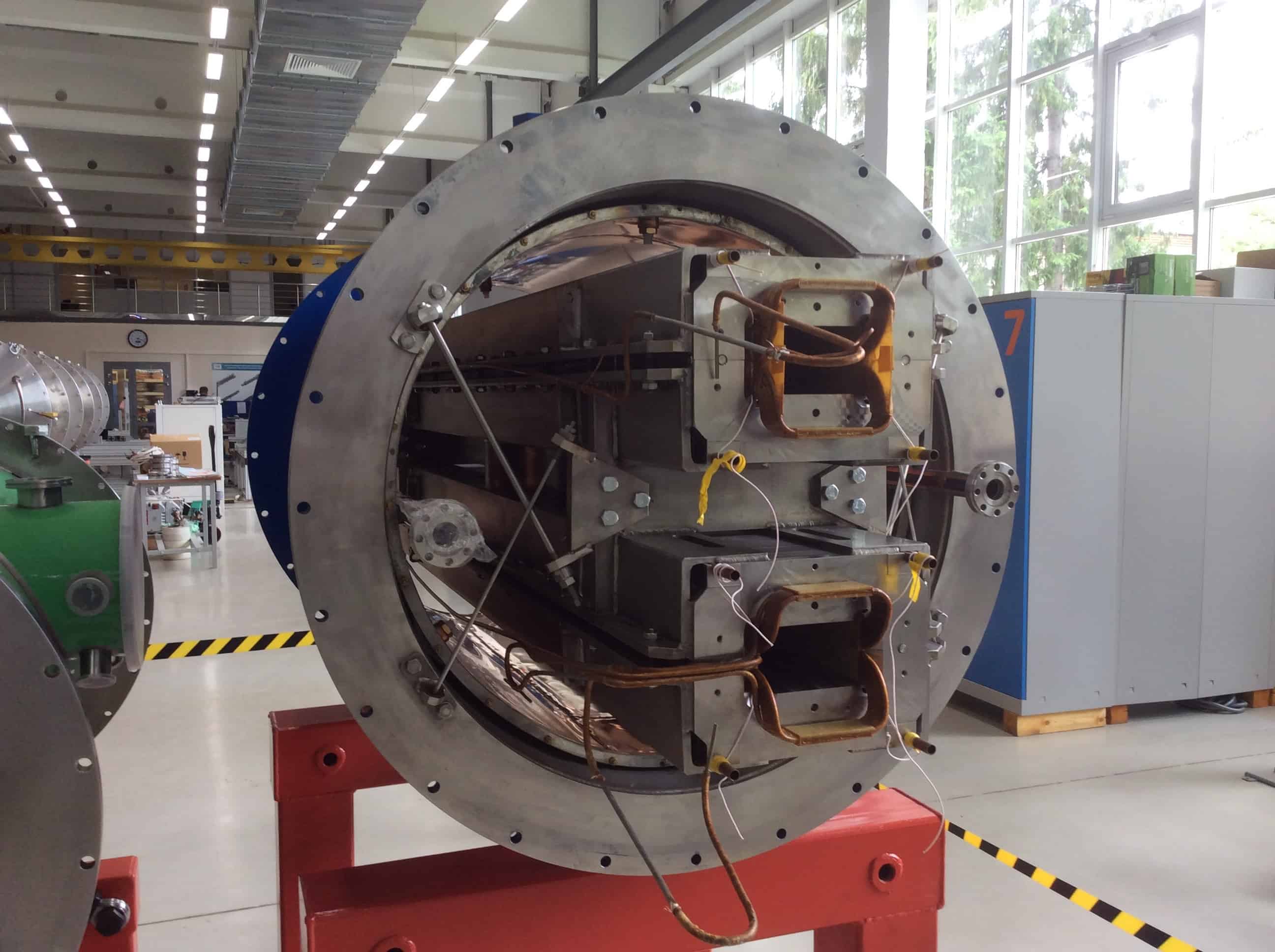
Zero resistance: the JINR is building superconducting magnets for both its new NICA facility and the FAIR heavy-ion collider being constructed at GSI Darmstadt.
By Susan Curtis
When our visit was running two hours behind schedule by lunchtime, I knew it was going to be a mind-expanding day. And there was certainly plenty to discover at the Joint Institute of Nuclear Research (JINR) in Dubna, some 120 km north-west of Moscow.
An international research centre bringing together 18 member states, the JINR has been in the news for its discovery of new superheavy elements (SHEs). According to Andrei Popeko, deputy director of the JINR’s Flerov Laboratory for Nuclear Reactions, all of the last six elements were first synthesized at the laboratory’s U400 cyclotron, in most cases using samples prepared at Oak Ridge National Laboratory in the US. The JINR is now building the world’s first SHE factory that will boost production efficiency by a factor of 50, which will allow the lab’s scientists to investigate the chemical properties of these short-lived elements.
Our ability to store and access data has grown rapidly during the 21st century. The Internet is increasingly bringing all forms of information technology to everyone’s fingertips, making life faster, more informative and more connected than ever. However, with individuals and organizations generating ever-larger datasets, we desperately need more efficient forms of data storage that have high capacity, low energy consumption and a long lifetime.
Despite immense technological progress over the past few decades, it is still difficult to store lots of information securely over even relatively short timescales of 100 years. Data stored in traditional magnetic systems, such as tapes and hard disks, have to be transferred every couple of years to prevent them being lost as the drives start to wear out. As for conventional optical discs such as CDs and DVDs, they might last a few decades before the reflective layer starts to corrode or the disc material itself breaks down. The third main technique for data storage – solid-state devices based on semiconductors, which underlie flash and solid-state drives – provides an even shorter lifespan of barely 10 years because transistors become unreliable after a number of program/erase cycles.
Preserving history
The explosion in digital information is a record of 21st-century civilization, but we risk losing this data as current storage technologies fall short in capacity and lifetime.
Recently, researchers have made promising progress towards a high-capacity optical memory that lasts not decades but perhaps billions of years. Based on ultrafast laser-induced nano-gratings fabricated in fused quartz, our team at the University of Southampton in the UK has been able to demonstrate a novel “5D” optical memory that promises essentially limitless data storage. The technology, which emanated from work done under the framework of the EU’s Femtoprint project, was first experimentally demonstrated in 2013 and has since been used to record major documents including the King James Bible, Newton’s Opticks and the Universal Declaration of Human Rights.
CDs only have two dimensions in which to store information: tiny pits on the CD surface that either reflect or do not reflect laser light to convey the 1s and 0s of binary data in a single layer of plastic. In DVDs, data are stored by burning pits on multiple layers, adding a third storage dimension. In contrast, 3D optical-storage techniques potentially allow us to write thousands of “layers” in a single monolithic disc without adding a single physical layer.
Birefringent bits 5D data storage has been used to store the Universal Declaration of Human Rights in a region measuring 1 mm in diameter and 30 microns deep (white spot in centre of disc). (Courtesy: ORC/University of Southampton)
3D optical storage was first demonstrated 20 years ago by physicists at Harvard University in the US using femtosecond laser pulses to deliver a precise energy to a glass substrate in a tightly confined volume (Opt. Lett.21 2023). Normally in a single memory cell or voxel only one bit of data can be stored, but nonlinear optical effects allow the cell dimensions to be shrunk by a factor 10, therefore increasing capacity.
The latest developments in 3D optical memory have enabled a feature size below 100 nm with an equivalent capacity of approximately 10 TB per disc by using a dual-beam technique named super-resolution photoinduction-inhibition nanolithography (Opt. Lett.36 2510). This technology could let us break the diffraction barrier, and in 2013 was used by a team in Australia to achieve feature sizes down to 9 nm, offering a capacity of up to 30 TB per disc (Nat. Commun.4 2061). For comparison, a standard DVD has a capacity of just 4.7 GB.
To increase the data capacity of optical storage, there is the potential of storing more than one bit in a single voxel using multiplex technology. During the past few years, several parameters such as polarization, wavelength, space and fluorescence have all been trialled to act as the additional dimensions for optical data storage. Various materials have also been implemented for multidimensional data storage, such as silver clusters embedded in glass and gold or silver nanoparticles. The recently developed 5D optical-storage technique, in contrast, uses birefringence as an extra degree of freedom – the property of a medium whereby its refractive index varies depending on the polarization and direction of incident light. Birefringence generated by the orientation and size of optical nano-gratings offers two extra dimensions, thus providing much higher storage capacities.
Surprise discovery
The discovery of 5D optical data storage was serendipitous. Our group, led by one of the present authors (PK), had been collaborating with a group at Kyoto University in Japan for the previous decade exploring what happens when intense light fields produced by powerful short-pulsed lasers strike certain materials. Although the original aim was to study the light–matter interaction and other fundamental optical phenomena, in 1999 the team realized that a self-assembled nanostructure in silica glass was being formed by a tightly focused linearly polarized beam.
First observed microscopically in 2003 using fixed, focused femtosecond laser pulses, these self-assembled nanostructures – measuring roughly 20 nm across – are among the smallest embedded structures ever produced by light (Phys. Rev. Lett.91 247405). Despite several hypotheses to explain the physics of the peculiar self-organization process, the formation of the nanostructures remains under debate. However, once the extraordinary stability and optical properties of anisotropic femtosecond laser direct-written structures were identified in 2006, it turned out that this unusual phenomenon would be useful for multiplexed data storage.
The first demonstration of storing visual information in five dimensions was in 2010 (Adv. Mater.22 4039), marking the first step towards practical nanograting implementations. The following year the technique found applications in commercial polarization converters, and by 2012 it had started to hit the headlines. The Telegraph newspaper dubbed it “Superman” memory, and Hitachi announced 3D glass data storage that will last for millions of years. Following the high public and scientific interest, in 2013 our group demonstrated the first ever digital data recording. Since then, a number of different types and volumes of data have been stored.
Although there have been several promising alternative attempts to develop long-term and high-capacity data storage that lasts for millions or billions of years, many of these – such as DNA storage, silicon-nitride/tungsten-based media and microscopically etched/electroformed nickel plates – are expensive and too slow to be practical. 5D optical memory, in contrast, is far superior, especially when applied to fused silica, which has a high chemical and thermal stability. The lifetime of 5D memory is 1020 years at room temperature, indicating unprecedented stability among all techniques (Phys. Rev. Lett.112 033901). In addition to the benefits of multiplexing, 5D optical data based on nanogratings can also be erased and rewritten – two key features when considering data storage.
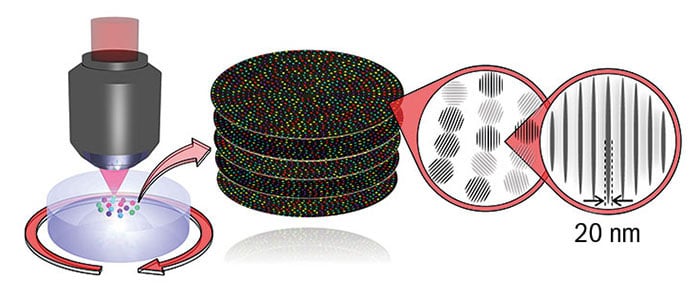
The current data-writing system is not much different from that found in CD or DVD drives. Ultrashort laser pulses with a wavelength of 1030 nm are focused inside a spinning glass disc and the position, power and polarization of each pulse are simultaneously modulated depending on the encoded information – leaving a trace of pits with different optical characteristics. Reading the data is more complicated because it requires a microscope-based birefringence measurement system, but we are now working on how to solve this problem.
Increased capacity
Our 5D technology has so far only been demonstrated in a laboratory setting. The main bottleneck is its slow writing speed (roughly 100 bit/s), but we are striving to increase the rate and to develop a microscope-free readout drive. This requires a high-speed polarization controller and industrial-grade disc drives, and we are currently looking for potential partners and investors. A number of large organizations that need to archive lots of data, including Microsoft, Sony and Warner Bros, have already contacted the group. Libraries, hospitals and governments could benefit from our approach, too. With support from investors, commercial 5D data storage could be achieved within several years.
Another vital step is to drastically increase the capacity of the storage. By recording data with tighter focusing optics and shorter wavelength light, it is possible to achieve a spatial (3D) densification similar to that in Blu-ray discs, involving a pit size of less than 200 nm. Combined with the fourth and fifth dimensions provided by birefringence, which allow a single pit to store eight bits (one byte) of information as opposed to one, it would be possible to achieve an unprecedented capacity of hundreds of terabytes in a single 12 cm-diameter disc. Perfecting 5D storage technology would therefore be a major step towards preserving the digital age for future generations.
Laser-written nano-gratings add extra dimensions
(Courtesy of the authors)
The optical structures required for 5D information storage are produced by femtosecond laser-assisted micromachining, whereby short pulses of intense laser light are fired at a glass substrate where they lead to nonlinear absorption. If they have high enough intensity, linearly polarized femtosecond laser pulses interacting with fused silica create self-assembled nanostructures with stripe-like oxygen deficient regions about 20 nm across and oriented perpendicular to the incident-beam polarization (see figure, showing a magnified region of a device containing pits with different orientations and strengths).
The subwavelength periodicity of these nanostructures behaves as a uniaxial anisotropic material where the optical axis is parallel to the direction of laser polarization. Since the optical anisotropy (called “form birefringence”) is of the same order of magnitude as positive birefringence in crystalline quartz, the perpendicular components of the light possess different propagation constants. This changes the way light travels through the glass, thus modifying its polarization, which can then be read by a combination of an optical microscope and a polarizer similar to that found in Polaroid sunglasses to represent multi-bit information.
Laser-induced form birefringence in silica glass has already been exploited to fabricate numerous polarization-sensitive optical elements, ranging from diffraction gratings to polarization and optical vortex converters, and is now being applied to data storage (see main text). However, the physics of the self-organization that leads to the formation of the nanostructures remains a mystery.
This event once again involved the collision and merger of two stellar-mass black holes, and since the “Boxing Day binary” is still on my mind, this week’s Red Folder is a collection of all the lovely images, videos, infographics and learning tools that have emerged since Wednesday.
LIGO physicist and comic artist Nutsinee Kijbunchoo has drawn a cartoon showing that while the researchers were excited about the swift second wave, they were a bit spoilt by the first, which was loud and clear – and could be seen by naked eye in the data. The black holes involved in the latest wave were smaller and a bit further away, meaning the signal was fainter, but actually lasted for longer in the detectors.
Laser beams encoded with orbital angular momentum (OAM) have been sent a record-breaking 143 km between two islands in the Canaries. Done by physicists based in Austria, this distance is 50 times further than their own previous record for transmitting such “twisted light”. The team says that the results show that it should be possible to encode data using the orbital angular-momentum states of light for both classical and quantum communications, including the transmission of data to and from satellites.
Light possesses two types of angular moment. The familiar phenomenon of polarization is related to the spin angular momentum. OAM, on the other hand, causes a light beam’s wavefront to twist around the direction of propagation, creating a vortex in the middle of the beam. Because the degree of twistedness can in principle take on any value, encoding a beam with OAM can multiply the information-carrying capacity of any fixed-bandwidth classical communication channel many times over. In quantum communications, such encoding would enable each photon to carry more than one quantum bit (qubit) of information, so making the exchange of secret keys more robust against eavesdropping and noise.
Interference problems
A major challenge, however, is to send these twisted beams over significant distances. One approach is to use fibre-optic cables, but it is hard to prevent different OAM modes overlapping with one another as they travel along the cable, and the record distance stands at 1.1 km. The alternative is transmission through the air, but there the problem is turbulence. This causes slight changes to air’s refractive index, which results in interference between different modes.
In 2012 researchers at the University of Southern California sent laser beams with four different twists through about a metre of air. Then, two years later, Anton Zeilinger and colleagues at the University of Vienna and the Institute for Quantum Optics and Quantum Information sent a beam carrying 16 OAM configurations from a tower in the capital of Vienna to a receiver 3 km away. Meanwhile, researchers in Italy and Sweden have demonstrated free-space OAM transmission using radio waves.
Rings of light
In the latest work, Zeilinger’s group has increased the transmission distance to a whopping 143 km. The researchers did so by modulating the phase of a green laser beam sent from the roof of the Jacobus Kapteyn Telescope on the island of La Palma to the Teide Observatory on neighbouring Tenerife. By using the white wall of the observatory as a screen and then imaging the wall with a camera, the researchers were able to distinguish the intensity patterns of beams with different degrees of twist – in each case, a ring of green light surrounding a dark patch of a certain size. In the same way, they could also image beams made from the superposition of two states with equal but opposite twist.
The group carried out its observations over 10 nights in April last year, using a neural network to identify the OAM modes responsible for each intensity pattern recorded. To check the accuracy of their transmitted signals, they used superimposed beams of a given twist with a varying phase difference between the two components. That varying phase difference translated into specific orientations of the lobes in the intensity patterns. The researchers found that their neural network identified the correct orientation about 80% of the time.
Zeilinger and co-workers also used their set-up to encode and decode a short message: “Hello World!”. They represented each letter in the message via three successive beam configurations, with each configuration being one of four different phase settings. In fact, the neural network got the message slightly wrong: it actually read out “Hello WorldP”. But the researchers explain that the error amounted to just one bit out of 72.
Smoke signals
They also point out, however, that the transmission was extremely slow. To improve the accuracy of their message, they recorded five one-second-long exposures for each beam configuration. Adding in the pauses between exposures then led to a total transmission time of 271 s. As Zeilinger and colleagues note, that’s comparable to the speed of smoke signalling.
However, they say that in this demonstration, speed was not of the essence. What mattered instead was showing that the different OAM modes survived the trip. They point out that they were able to do so without using any adaptive optics to compensate for the effects of turbulence. However, they did have to discard results from four of the 10 nights because of strong turbulence or other bad weather. But they say that the transmission quality can be “improved substantially” by adding an adjustable mirror to the laser optics and using suitable software to operate the mirror on the basis of turbulence data obtained from a second laser beam.
The researchers believe that the scheme could be used both to multiplex classical messages and to distribute quantum entanglement of OAM modes. In addition, they point out that because the atmosphere has an effective depth of about 6 km, OAM states sent between the Earth and orbiting satellites using the current scheme should not be significantly degraded by turbulence.
The research is described in a preprint uploaded to the arXiv server.
Millionaire former chief technology officer of Microsoft Nathan Myhrvold is at loggerheads with a group of NASA astrophysicists over the latter’s ability to accurately measure the properties of tens of thousands of asteroids in the solar system. Myhrvold, who has a physics PhD but is not an asteroid expert, accuses NASA scientists of making serious errors when analysing data from the Wide-field Infrared Survey Explorer telescope (WISE), but has in turn been accused of many errors himself.
Under scrutiny is work carried out by Amy Mainzer of the Jet Propulsion Laboratory in California and other members of the NEOWISE project. In a paper published in 2011, Mainzer and colleagues reported the diameters of more than 100,000 main belt asteroids observed by WISE following its launch in 2009. The researchers worked out the diameters by inputting the asteroids’ brightness measured by the telescope at each of several infrared wavelengths, as well as the known solar flux, into the “near-Earth asteroid thermal model”, claiming to obtain results with errors below 10%.
Accuracy overestimated
Myhrvold criticizes this research in a 110 page paper, initially uploaded to the arXiv server in May and then re-posted twice following revisions. Among other things, he takes Mainzer and colleagues to task for failing to account for Kirchhoff’s law of thermal radiation when analysing sunlight reflected from the asteroids. What is worse, he says, the researchers significantly overestimated the accuracy of their results – by around a factor of three. In particular, he maintains that they copied the diameters for more than 100 of the asteroids from other, more accurate, sources, including radar measurements and the results from spacecraft that have visited asteroids.
In a “simple guide” he wrote to explain his position to non-experts, Myhrvold says that the presumed copying could have been caused by a computer bug. But he argues that “deliberate fraud or misconduct” cannot be ruled out. “I have no way to know whether this happened,” he writes. “I certainly hope it did not. But it would be unwise not to consider the possibility that it was deliberate.”
‘Silly analysis’
Edward Wright, an astrophysicist at the University of California, Los Angeles, and principal investigator of WISE, maintains that the NEOWISE team simply quoted the best diameter values available, and adds that the accuracy of the modelled values was established in an earlier “calibration” paper. He argues, in fact, that Myhrvold grossly overestimated the diameters of some of the asteroids, and that in some cases he confused diameter for radius. “There is no instance of fraud,” he says. “But there is an instance of silly analysis on the part of Myhrvold.”
Wright’s comments echo a statement issued by NASA on 25 May, which referred to “fundamental errors” by Myhrvold and which pointed out that his paper had still to undergo peer review (it has been submitted to the journal Icarus). “All of the published NEOWISE team papers providing their results have endured the peer-review process,” the statement says. “NASA is confident that the processes and analyses performed by the NEOWISE team are valid and verified and stands by its data and scientific findings.”
Myhrvold, who is chief executive of the company Intellectual Ventures, has previously pointed out errors in studies that looked at the growth rate of dinosaurs. His interest in asteroids reportedly came about after he was approached by the non-profit B612 Foundation to provide funding for its Sentinel asteroid telescope. Although he declined, he was inspired to compare Sentinel with a number of other proposed new telescopes, including the Near-Earth Object Camera put forward by Mainzer, one of five projects currently competing for $500m of NASA funding, and the ground-based Large Synoptic Survey Telescope, which has received backing from Microsoft’s Bill Gates.
Calculated efforts: Matin Durrani (far left) in conversation with staff at the Beijing Computational Science Research Center, including Hai-Qing Lin (third left). (Courtesy: Mingfang Lu)
By Matin Durrani in Beijing, China
The last couple of days in the Chinese capital have been unusually damp and cool for the middle of June. Today, however, dawned sparklingly sunny as I headed off with my colleague Mingfang Lu from the Beijing office of the Institute of Physics, which publishes Physics World, to the Beijing Computational Science Research Center (CSRC) on the outskirts of the city.
Located on a shiny new software park, this sleek, five-storey building opened in March last year and looks just how you might expect the headquarters of IKEA to be – all minimalist corridors, big glass windows and the odd work of art dotted around. There’s even a fitness room in the basement. It’s currently got 43 full-time faculty, a third of whom are physicists, making this 45,000 m2 building – roughly the size of seven football pitches – seem remarkably sparse.
In February gravitational waves flooded the global public consciousness, thanks to the announcement that the Advanced LIGO detectors – two supersensitive space–time microphones – had picked up the distortions in space and time produced when two black holes collided more than a billion years ago. This marked the first direct detection of gravitational waves, just under 100 years after Einstein predicted their existence.
For all but a handful of experts and onlookers, this announcement must have come out of nowhere. In reality, the LIGO experiment was conceived 40 years ago, and as we learn in Janna Levin’s Black Hole Blues, its subsequent history was often tortuous, with grand dreams, deep science and enough cursing-and-spitting drama to sustain the very worst of daytime soaps.
Levin’s book was written before the big discovery, and apart from an epilogue added after she was apprised of the detection last December (two months after it happened), it reads as a teaser-trailer for the breakthrough we used to dream of. She sketches out LIGO’s colourful history interspersed with a personal tour of key locations. Along the way we are treated to evocative portraits of black holes spiralling into each other, neutron stars sweeping out their lighthouse beams and supernovae exploding.
The focus is on three of LIGO’s prime movers: Rai Weiss, Kip Thorne and Ron Drever. Three plus one: there is an interlude for Joe Weber, who claimed to have detected a gravitational wave back in 1969. He is unanimously described as “tragic”. His tragic flaw: he refused to accept that his claims were wrong. It did not kill him (although a man crushed under his own bar detector would not be out of place in this wild story), but it destroyed his reputation. The epithet “tragic” also hangs over Drever. Described at one point by Weiss as “off the wall” and by everyone as “impossible”, he was eventually shunted from the centre of the project. Anyone with a passing knowledge of LIGO history, waiting to hear about the guy who was locked out of his own lab, will not be disappointed. They will not, however, take much pleasure in the drama. Levin paints all of the characters sympathetically. They are all brilliant. It was their human qualities that made them strive so hard to build LIGO, and it was the same qualities that brought them down.
For the human story, I fully recommend Levin’s book. It is much shorter than Harry Collins’s definitive Gravity’s Shadow (~900 pages, plus sequels), and more enjoyable than Marcia Bartusiak’s dry and somewhat premature Einstein’s Unfinished Symphony, which was published in 2003. Levin limits the narrative to a small cast of characters (with Weiss as her chief hero), and as much as that might rankle the 1000+ other scientists involved in the LIGO, Virgo and GEO projects (myself included), her choice captures the essence of the story and keeps it moving. And it is a story worth telling, at the very least for those 1000 scientists. The vast LIGO and Virgo collaborations were formed after Levin’s main historical account ends, and most of their members will know little of this history, beyond rumours of a few of the “highlights”.
Another wise choice for a popular account is the tourist treatment of the experiment itself. We are given a sense of its size, its complexity and the raw detail of a massive working apparatus – there is a lot of talk of mouldy air in the tunnels and pesky varmints to be cleaned out of the vacuum tube. Laborious attempts to explain power recycling, multi-stage suspensions and null streams belong elsewhere. LIGO is an incredible human endeavour, and Levin captures the human labour involved.
Nonetheless, I would have preferred a more thorough book, twice as long, twice as tight and more fully researched. In the slim six pages of notes at the back, I count interviews with fewer than 20 people. Levin’s account of Weiss’s early career is based entirely on his own words, drawn from interviews and liberal quotations from the California Institute of Technology’s Oral Histories archive. (Now that is a resource I can wholeheartedly recommend.) It’s the usual story: I wasn’t very good, I didn’t know what I was doing, I was very lucky. Would his professors and fellow students say the same? We don’t hear from them. This “Aw shucks, I dunno how I got this Nobel prize” stuff is standard fare in a scientist’s self-mythologizing, but a historian (or even a scientist moonlighting as a historian) should do better.
The focus on LIGO also contorts the history. We are already well into the beginnings of the painful Rai–Kip–Ron collaboration in the 1980s before we hear about Joe Weber’s detection claim from 1969; at this point, the narrative skips back 15 years. Observations of the Hulse–Taylor pulsar in the 1970s confirmed that gravitational waves exist – surely a key point in the case for building a gravitational-wave detector – but are described only after Levin writes about a crucial National Science Foundation presentation in 1983. This is messy and confusing.
Levin is a theorist, and revels in the romance of black holes tearing their way through space–time. She works hard to wrest striking imagery from the science. I expect I’ll steal a few phrases for my next public talk, but by the end of the book the black-hole mallets beating the drum of space–time had begun to beat the prose purple, and I had to retreat to a comforting stream of actual numbers to recover. (Among these, I note that the black holes in the binary we observed did not orbit “very nearly at the speed of light”. They barely reached a fifth of it.)
The first detection of gravitational waves marks the beginning of a new era in science, and its history is already one of transformations: from table-top experiments to kilometre-long observatories, and from individual scientists to crowded collaborations. But it is far from over, and while Levin’s account is fun, the topic deserves more. Reading this history, it seems that the miracle is not that LIGO worked, but that it was built at all. How did these apparently bumbling dreamers pull it off? We only get a glimpse of the answer. It is too soon to expect a truly great book on LIGO, a counterpart to James Gleick’s Chaos (also the tale of an emerging field), or Kai Bird and Martin Sherwin’s American Prometheus, or even a proper insider account, such as Jon Butterworth’s Smashing Physics on the story of the Higgs. I look forward to reading such books. In the meantime, Black Hole Blues will do.
Hot on the heels of their revolutionary, first ever direct observation of gravitational waves announced in February this year, the LIGO and Virgo collaborations have identified a second gravitational-wave event in the data from the Advanced Laser Interferometer Gravitational-wave Observatory (aLIGO) in the US. The observation was made on 26 December 2015, just three months after the first gravitational-wave event was detected on 14 September 2015.
Gravitational waves are ripples in the fabric of space–time, and like the first detection, this latest signal was generated by the collision of two black holes. This time the black holes weighed in at 14 and 8 solar masses and merged to form a single, spinning 21-solar-mass black hole, some 1.4 billion light-years (440 Mpc) away. The collision and subsequent merger released approximately one solar mass of energy, which was radiated away as gravitational waves.
The so-called “Boxing Day event” is officially dubbed GW151226. In October 2015, LIGO recorded another possible event, dubbed LVT151012, which was below the threshold for an official detection. LIGO has therefore detected three events in the four months of observation since it was upgraded to aLIGO. This kicks off the era of gravitational-wave astronomy, and researchers can now begin to constrain predictions about the population of black holes in the universe.
At a press conference held today at the AAS conference in San Diego, LIGO spokesperson Gabriela González said “We are very proud of this being the beginning of gravitational-wave-astronomy. It takes a lot of people, physics and engineering to build these exquisite instruments…and they detected these gravitational waves very clearly.”
Black holes aplenty
Indeed, LIGO changed our view of the universe from its first observation in September. LIGO scientists had expected that binary neutron-star mergers would be one of the first systems that they would detect gravitational waves from. To date, these mergers have not been seen, while black-hole mergers – which were thought to be rare – have instead been detected.
Furthermore, the observed mergers have all involved stellar-mass binary black holes. This is surprising because theories previously suggested that such stellar-mass binaries would either not form at all or, if they did, would be too far apart to merge within the age of the universe. LIGO’s detections have now shown that the opposite is true, and that the rate of binary-black-hole mergers is higher than expected – between six and 400 per cubic gigaparsec per year.
B S Sathyaprakash – a physicist at Cardiff University in the UK and a member of the LIGO collaboration – told physicsworld.com that the masses of the two black holes observed in GW151226 are more typical of what they expected for those that form via the evolution of massive stars. “With this system, we widen the debate about formation channels of binary black holes.” Commenting on the great distance to the merger, he says, “The distance to this system is about 70 to 80% of the maximum distance up to which we can confidently detect such systems,” adding that it was “not too surprising [that] our second detection comes from close to the horizon distance of our sensitivity; we survey a greater volume of space at that distance and so [there is] a greater chance of seeing an event.”
The masses of the black holes were smaller than those detected in the first event, which means that the signal was much weaker and was not as immediately visible to the human eye in the data as the September event was. On the other hand, the smaller masses meant that this signal lasted for longer in the detector, and was quickly flagged by LIGO’s online analysis systems and algorithms as a candidate gravitational wave. This occurs because lower-mass systems merge at higher frequencies than systems of larger masses. Heavier systems end up merging more quickly than lighter ones as their orbits quickly reduce, as they emit more radiation.
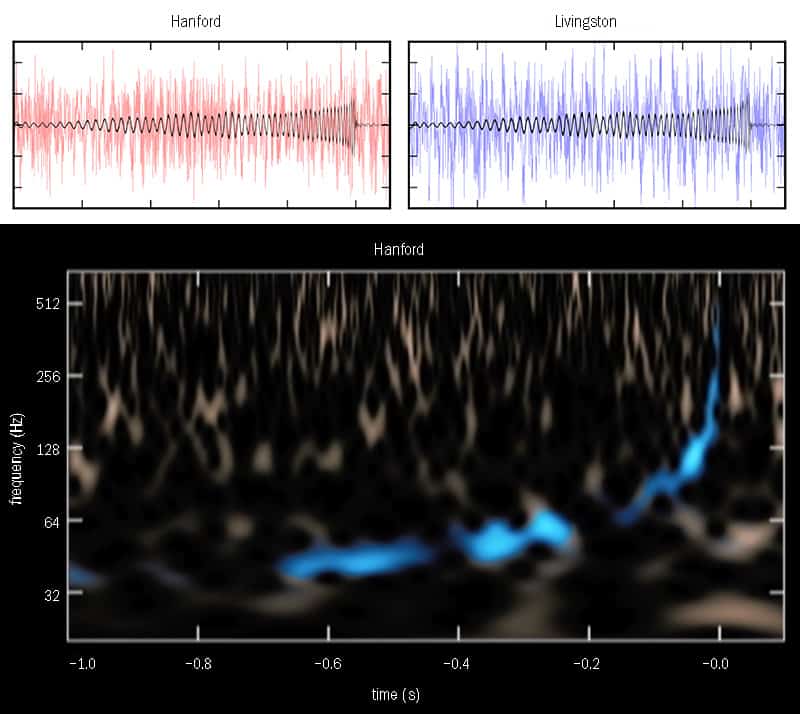
Ringing up The top two panels show gravitational-wave signal GW151226 in Hanford (left in red) and Livingston (right in blue). The black waveform in each panel is the best-match gravitational-wave template for the signals. The bottom panel shows how the frequency of the gravitational wave at Hanford increased with time. (Courtesy: LIGO/Physical Review Letters)
“This makes some intuitive sense when considering that the size of the black hole is directly proportional to the mass; the larger black holes will merge before they can get close enough to have high frequencies,” explains LIGO scientist Amber Stuver. Although the signal from the December event was not as strong as the first one (which involved masses that were about three times bigger) the statistical significance of the signal was comparable at 5.3σ, because it lasted for longer in the detector – nearly 1 s.
The latest signal was picked up within 70 s of it hitting LIGO’s detectors in December, and was instantly recognized as a good candidate. “I happened to be awake when the trigger came and a bunch of us got together on a teleconference and talked about it for a couple of hours. It was a fantastic Boxing Day present,” says Sathyaprakash.
The signal itself was composed of 55 gravitational-wave cycles that were produced as the two black holes spiralled towards one another. Because the orbital frequency of a system is half the frequency of the wave, the LIGO scientists know they observed about the last 27 orbits before merger. (To read more about the characteristic waveform of gravitational-wave events, including the inspiral, chirp and ringdown features, see “Ligo detects first ever gravitational waves – from two merging black holes”.)
Although only one solar mass of energy was radiated away in the GW151226 event – compared with the three solar masses in the first event – Stuver says that the fraction of mass radiated away in all three detections was nearly the same, up to about 5% of the total mass of the system. This suggests that the merger process for black holes is similar and any differences arise mainly due to differences in mass.
Another contributing factor that could affect the merger process is if either of the original black holes in the binary are spinning – if the spins are aligned, then more energy will be released and vice-versa. In the latest discovery, the LIGO researchers were able to tell that one of the companions had a spin parameter of at least 0.2 – this corresponds to a black-hole rotational speed of a tenth of the speed of light. All of the final black holes formed in the merger were spinning (Kerr) black holes – the spin of the final GW150914 black hole is around 0.7.
Sense and sensitivity
aLIGO’s detectors are currently being upgraded following the first run, further increasing its sensitivity and stability, before a planned engineering run that will begin next month. “Any new or persisting issues will be addressed and tested again before the next observing run, currently scheduled for the fourth quarter this year,” explains Stuver. “We are also very much looking forward to the Advanced Virgo detector [in Italy] joining the search sometime during the next LIGO observing run. This will greatly increase our ability to extract information about the gravitational-wave source from the signal, especially the location in the sky,” she adds.
Indeed, with three or more geographically separate detectors, researchers should be able to nail down where the signal originates from more clearly. Currently, aLIGO can only assay that a signal came from a general area of the sky, mainly by measuring how long it takes a gravitational wave to travel between the two detectors.
With these detections under its hat and an expected rate of one to two detections per month in the next run, it is fair to say that gravitational-wave astronomy is really taking off. “So many years of work by hundreds of scientists has gone into this search, and we are seeing clear evidence that not only do our detectors work, but there may be more things out there to see than we previously thought,” says Stuver.
Sathyaprakash agrees, adding that future detectors and observations will help us to “understand the formation and growth of black holes throughout cosmic history, which could shed some light on a long-standing riddle: when and how did monstrous black holes we now find at centres of most galactic nuclei form and grow?”