Balloon bursts approach the speed of sound

Bursting balloons is good fun, but there is also some fascinating physics lurking in how the fabric of the balloon is ripped apart. Two physicists in France have studied the bursting process using a high-speed camera, and have discovered that there is a critical point in the inflation of a balloon beyond which it will create beautiful flower-like patterns when it bursts. The research could boost our understanding of how materials fail when subjected to high degrees of stress.

The French artist Jacques Honvault is famous for his high-speed photographic images, including a spectacular shot of a balloon fragmenting just after it is popped. This flower-like image fascinated the physicist Sébastien Moulinet of the École Normale Supérieure in Paris, because the fragmentation pattern is very similar to the patterns of cracks that can form when a material such as glass is struck by a hammer.

Blowing bubbles

To try to understand why these patterns occur, Moulinet and Mokhtar Adda-Bedia made balloons by forcing air into a latex membrane that is stretched over a circular aperture – a process akin to blowing a soap bubble. They then filmed the rupturing process at 60,000 frames per second using a high-speed camera (see video and image).

In some of their experimental runs, the balloons were filled to a relatively low internal air pressure and then pierced with the tip of a scalpel. In these cases, the slit made by the blade simply expanded as the balloon burst, leaving a piece of latex with just one slit in it.

Y-shaped cracks

Things changed dramatically, however, when the balloons were inflated to (or near to) the pressure at which they would burst spontaneously. In these cases the initial slit began to expand but then would suddenly split into two cracks that move off at angles to create a “Y” shape. These cracks would then undergo a similar division, and the process continued until the balloon was shredded into a number of finger-like pieces.

To understand the bursting process, the researchers looked at balloons made of latex of four different thicknesses and also varied the degree to which the balloons were inflated – the latter being related to the tension in the latex membranes. They found that the crucial parameter is the stress within the material – the ratio of the tension to the thickness of the latex. When the stress is above a critical value of about 1.8 MPa, the balloon will fragment. Below this critical value, the balloon will come apart in a single slit.

Speed of sound

Moulinet and Adda-Bedia believe that at low stress values the crack moves relatively slowly through the material, relieving stress as it goes. Higher stress values, however, correspond to faster crack-propagation speeds. The physicists believe that the critical stress value corresponds to the crack moving at its maximum speed. This was measured to be about 570 m/s, which the two physicists say is probably the speed of sound in the latex membranes. Because the crack can move no faster, the stress is relieved by creating two cracks.

Moulinet told physicsworld.com that he was “happy and amazed to be able to reproduce Honvault’s bursting balloon in the lab”. He also points out that the study could help scientists to understand how materials fail under stress. Moulinet and Adda-Bedia are now taking a closer look at how the cracks divide, and in particular the angles between the cracks.

The study is described in Physical Review Letters.

How can we find life on distant planets?

Over the past two decades, astronomers have discovered a veritable glut of planets orbiting stars other than our Sun. Thanks to the way we have detected these exoplanets, many of them are so-called hot Jupiters – being significantly larger than the Earth and orbiting close to their parent stars. But exoplanet discoveries are now coming thick and fast, and we are starting to discover planets that are increasingly more Earth-like and orbiting their stars closer to the “Goldilocks zone” where it is possible for liquid water to be maintained.

In this short explainer video, the astronomer Sara Seager of the Massachusetts Institute of Technology (MIT) explains how we can look for some of the telltale signs of life on these planets. She explains that by examining the starlight coming from their planetary systems, we can infer some of the constituents of the exoplanet atmospheres by looking for signatures within the spectra. The study of planetary atmospheres in this way will be greatly enhanced by the instruments aboard the James Webb Space Telescope (JWST), which is set for launch in 2018.

Seager spoke in more depth about the search for life beyond the Earth in the July edition of the Physics World podcast series. Our next podcast – available later this month – is an interview with the astrobiologist Lewis Dartnell, who talks about what life beyond the Earth might actually be like.

Portable brain scanner allows PET in motion

A wearable brain-scanning device that will provide high-resolution images of the whole brain, while the subject is moving about and performing everyday activities, is being developed by researchers in the US. The new approach – called ambulatory microdose positron emission tomography (AMPET) – miniaturizes positron emission tomography (PET) technology, such that it fits onto a helmet that’s worn during scanning.

Clinical brain imagers currently require a trade-off between motion and resolution. Large, bolted-to-the-floor devices – for techniques such as PET, magnetic resonance imaging (MRI) and magnetoencephalography (MEG) – provide high-resolution images but require the participant to remain completely still. Meanwhile, approaches such as electroencephalography and near-infrared spectroscopy can be used with a moving subject, but have low spatial resolution and cannot visualize important structures such as the hippocampus and amygdala deep within the brain.

“Standard PET scanners in hospitals utilize large photomultiplier tubes; but recent advances in material science have led to the development of detectors using silicon photomultiplier (SiPM) technology, which is orders of magnitude more compact,” says Julie Brefczynski-Lewis, from the West Virginia University (WVU) Centers for Neuroscience. Brefczynski-Lewis and colleagues built a ring of SiPM detectors that go around the head and are now in the process of developing this into a wearable PET scanner.

Portable PET

Stan Majewski, the original principal investigator on the project, explained that the team’s motivation for developing the portable PET brain scanner lay both in the challenge and the assumption that improved instruments will offer new opportunities. Following the development of such technology for rats – wearable Rat-Cap PET imagers – built at Brookhaven National Laboratory, and the development of the so-called PET-Hat in Japan, where the patient is in an upright position, but still has to remain motionless, Majewski’s “vision was to free the patient/subject and make him/her stand or even walk within a limited space”.

Initial simulations of the device showed that the helmet scanner offers more than a 400% increase in sensitivity over a conventional whole-body PET scanner. AMPET also requires a much lower radiation dose than conventional scanners. “The detectors are close to the head and thus capture more photons,” says Brefczynski-Lewis, who presented the team’s work at the recent Neuroscience 2015 annual meeting.

“We have already demonstrated that we can reconstruct images from this close geometry using 10–25% of the dose used for standard PET,” she adds. “Low dose has advantages both in reducing radioactivity exposure – making longitudinal scans, purely research scans and scans using young populations more feasible – as well as allowing detection of lower concentration targets like rarer neuron types and ligands with a low binding efficiency.”

Applications abound

Last year, the WVU team and its collaborators were awarded $1.5m through the newly set up BRAIN Initiative from the National Institutes of Health. While still in the prototype stage, AMPET has a wide variety of potential research and clinical applications, including studies of balance, physical therapies, natural social interactions and virtual reality, as well as disorders such as stroke, Alzheimer’s and Parkinson’s disease, multiple sclerosis and traumatic brain injury.

“Imagine imaging a savant while painting or a chess master in action: we might be able to tap into the mechanisms behind these super abilities,” says Brefczynski-Lewis. “Clinically, we may better understand why people with autism react differently to social situations and this may inform diagnosis and therapies. Moving forward, we’ll be talking with researchers and clinicians working in stroke rehabilitation, Parkinson’s disease and balance disorders, as well as neuroscientists who study social, cognitive and emotional processes, to determine how such a scanner could be used and what features are most necessary.”

“I was excited to discover that the system can potentially assist with early diagnosis of Alzheimer’s by combination with virtual reality,” adds Majewski. “Apparently, the earliest signs of Alzheimer’s are not seen in the memory loss but in the loss of navigational skills. Well-controlled navigational tests in the virtual-reality environment, correlated with functional/molecular images of the brain obtained at low radiation dose with our upright high-resolution PET imager, can be really revolutionary.”

Between the lines

A survivor’s story

The properties of a good memoir are simple, yet elusive: the author needs to have something to say, and they need to be able to say it. In A Singularly Unfeminine Profession, the physicist Mary K Gaillard displays both qualities in abundance. As one of the leading theorists of her generation, she was both a participant in and a witness to the events that produced the Standard Model of particle physics. Moreover, as one of the field’s very few women, Gaillard has a vitally important story to tell about the swamp of sexism she had to slog through to get there. The book covers her entire career, but it focuses particularly on her time at CERN in the 1960s and 1970s. During this period, Gaillard made her name by predicting (with Ben Lee and Jon Rosner) the mass of the charm quark, but she also faced pervasive discrimination – something that initially surprised her when she arrived in Europe as a PhD student. In the US, she writes, “while many members of the physics community implicitly or explicitly expressed scepticism as to my ultimate survival in the field, there was no question of being refused the chance to try, and judgement on achievement was essentially objective”. Not so in 1960s France, where one academic after another declined to serve as her PhD adviser, offering a cavalcade of excuses and putdowns that Gaillard may have forgiven, but certainly hasn’t forgotten. Later, as her reputation grew, her position at CERN nevertheless remained irregular and (for the most part) unpaid. Well into the 1990s, she claims, the lab was simply “not ready” to hire a woman as a senior staff scientist. Have things changed? Gaillard agrees that they have – but not uniformly, and not as much as they should.

  • 2015 World Scientific £16.00pb 200pp

Scarce resources

The world’s entire supply of platinum, melted down, would barely fill a swimming pool. Other elements are rarer still: all the Earth’s promethium, for example, would fit in the palm of a child’s hand. These and other exotic denizens of the periodic table are the subject of Rare: the High-Stakes Race to Satisfy Our Need for the Scarcest Metals on Earth. In it, science writer Keith Veronese offers an accessible (though US-centric) overview of the key issues surrounding these scarce but industrially important metals. Briefly, mining them is tricky; removing them from conflict-ridden countries is tricky and morally dubious; and recycling them is tricky, messy and energy intensive. But while there’s a lot of interesting material in Rare, it’s seldom explained in much depth, and the number of minor scientific inaccuracies is worryingly high. Ultimately, this is an important topic that deserves a better book.

  • 2015 Prometheus Books /$25.00hb 270pp

X-ray visions of the past, undead physics, stargazing cruises and more


By Tushna Commissariat

Peering into a small 17th century metallic box, without damaging its contents, is no mean feat. But thanks to the use of synchrotron radiation, scientists at the European Synchrotron Radiation Facility (ESRF) in Grenoble were able to “see” inside one, using a technique known as synchrotron X-ray phase contrast micro-tomography. They were also able to create a 3D reconstruction of clay medals concealed within the very fragile and badly oxidized box, which was discovered on the archaeological site of the Saint-Laurent church, and is now at the archaeological museum of Grenoble (MAG). Take a look at the video above to see what the box held. You can also learn more about the researcher’s tomography technique in an article of ours.

Tomorrow is Halloween, so we hope you have your physics-themed pumpkins carved and out on your doorsteps. For some spooky reading this week, take a look at Davide Castelvecchi‘s “Zombie physics: 6 baffling results that just won’t die” story over on the Nature News website. In it, he lists six “undead” results – things that physicists just can’t seem to prove or disprove – including long-running disagreements over certain dark-matter results, hemispheric inconsistencies and spinning protons. Let us know what you think are some of the most undead physics results that should be laid to rest, in the comments below. And while you are at it, make sure to look at today’s creepy edition of Fermilab Today to read about the rise of the zombie accelerator and the “The cult of the Tev.”

(more…)

Leading universities form funding ‘clique’

A study of successful physical-sciences grant proposals in the UK has found that a small number of universities obtain the vast majority of funding, forming a “clique”. The study, by mathematicians in the UK and Italy, looked at networks between institutions and between principal investigators on grant proposals. They discovered that funding was “highly skewed”, with around half of all grants given to just 8% of both institutions and principal investigators. More than 90% of all funding was awarded to just 20% of institutions.

Vito Latora of Queen Mary University of London and colleagues examined more than 43,000 projects funded between 1985 and 2013 by the UK’s Engineering and Physical Sciences Research Council (EPSRC). The researchers found that the institutions receiving the most funding formed a “rich club” that allowed them to diversify their collaborations and occupy “brokerage positions” between otherwise disconnected institutions. “A network exhibits rich-club behaviour if the nodes with the largest number of links – the dominant elements of the systems – tend to be connected to each other, forming tightly interconnected communities,” says Latora.

The study found that the number of citations among an institution’s researchers and its h-index – a link between the quantity and impact of research papers – increased relative to the number of years an organization spent in the rich club, indicating a rise in the quality. The number of research areas carried out at an institution was also found to increase relative to the number of years in the rich club, indicating an increase in the breadth of research.

Three universities – Imperial College London and the universities of Cambridge and Manchester – showed a marked deviation in their h-index scores, however, outperforming other institutions. These organizations also showed an increased performance when total funding was compared with the number of years in the rich club, suggesting their outstanding funding profiles enabled them to generate high-quality papers.

The researchers say that the notion that a clique of institutions controls the majority of resources is not entirely unfavourable. “Arguably, those elite affiliations that have successfully become very rich seemed to have produced in both the variety of research, and unmistakably in quality,” the researchers claim. Latora points out that other well-funded institutions, which might have less capacity to expand, “have consistently benefited from their association with the elites through the rich core”.

EPSRC director Lesley Thompson told physicsworld.com that it was aware that the majority of its funding was going to a core group of institutions, but “this is the outcome of funding proposals received and judged primarily on excellence by peer review”. She says that the 12 universities that EPSRC classifies as its “framework universities” (which receive nearly 60% of its funding) fluctuates over time, “as do those institutions in the group we call ‘strategic universities’, who hold a further 20% of our portfolio”. Thompson adds that EPSRC looks for high-impact research “wherever it is found in UK universities – we currently fund excellent research in 102 universities and other academic institutions across the UK“.

Ellen Hazelkorn, director of the Higher Education Policy Research Unit at Dublin Institute of Technology, says that the results match a similar analysis carried out in the European Union. “What we see is not only a consolidation of research performance in a smaller number of institutions, but also a regressive transfer of resources into a smaller number of elite institutions,” she says. “There are both inevitable and negative consequences; the quality of the research and the quality of the research environment is incredibly important, and small institutions without sufficient critical mass and success are less likely to be able to provide this.” Hazelkorn adds that by concentrating research in a small number of institutions, people may be ignoring high-quality research being carried out by a wider group of institutions in niche areas.

The research is published in PNAS.

The November 2015 issue of Physics World is out now

Whether it’s the shortest wavelength, the lightest particle, the highest pressure or the brightest beam, there’s something intrinsically appealing about pushing boundaries to break records and establish new limits of what’s physically possible. Reaching new extremes is healthy for science too, spurring researchers to outperform rivals in the quest for grants, kudos or new jobs.

The November 2015 issue of Physics World, which is now out, covers three frontier-busting research endeavours. We kick off by looking at a human-made extreme: the search for the blackest materials ever produced – a tale that’s had a dark side of its very own. Next, we examine how physics techniques are unravelling the secrets of tough lifeforms that exist in some of the most extreme environments on Earth. Finally, we go beyond Earth to a cosmic extreme: magnetars – a special kind of rotating neutron star that are the strongest magnets in the universe.

If you’re a member of the Institute of Physics (IOP), you can get immediate access to this article in the digital edition of the magazine on your desktop via MyIOP.org or on any iOS or Android smartphone or tablet via the Physics World app, available from the App Store and Google Play. If you’re not yet in the IOP, you can join as an IOPimember for just £15, €20 or $25 a year to get full digital access to Physics World.

Physics World November 2015 cover

For the record, here’s run-down of the rest of the issue.

• Neutrino pioneers bag Nobel prize – Arthur McDonald and Takaaki Kajita share the 2015 Nobel Prize for Physics for discovering that neutrinos change flavours and therefore have mass, as Hamish Johnston reports

• Cooking Bacon – Few people have been as vilified as the philosopher, statesman and scientist Francis Bacon, argues Robert P Crease

• Nobel physics laureate migration – The movement of talented researchers across international borders has been the lifeblood of physics for more than a century. In these infographics, Hamish Johnston delves into the archives to discover which countries have gained the most physics Nobel laureates, and which have suffered the worst brain drains

• Fifty shades of black – Creating dark materials that prevent reflections has become hot competition recently, with Guinness World Records having to keep revising the darkest substance yet created. But depending on who’s asking, the best black may not be the blackest black, as Jon Cartwright discovers

• Surviving at the extremes – Wherever we look on Earth, even in the most inhospitable places, we find life. But how do organisms manage to survive such difficult conditions? Lorna Dougan explains how physicists are helping to unravel the properties of “extremophile” life

• The strongest magnets in the universe – On 27 December 2004 a blast of intense radiation overwhelmed NASA’s Swift telescope and Europe’s Integral craft. As Liz Kruesi explains,  the light came from a star with the most powerful magnetic field ever seen

• Trafficking in big ideas – Arthur I Miller reviews Genius at Play: the Curious Mind of John Horton Conway by Siobhan Roberts

• A dark day for dinosaurs – Pete Edwards reviews Dark Matter and the Dinosaurs: the Astounding Interconnectedness of the Universe by Lisa Randall

• Fostering innovation – A cluster of independent consultancies has helped make Cambridge a hot spot in the UK’s hi-tech economy. Andrew Baker-Campbell describes what it’s like to be a part of this growing industry

• Once a physicst – Kevin Hollinrake, member of parliament for Thirsk and Malton, Yorkshire, UK

• Ant-Man and the quantum realm – Spiros Michalakis on his role as a Hollywood consultant

Horsing around with some innovative physics

By Margaret Harris

Imagine you’re a veterinarian and a trainer asks you to take a look at a horse. The animal, a champion showjumper, is limping slightly but there is no obvious injury. Exploratory surgery would probably do more harm than good, and the alternative – magnetic resonance imaging (MRI) – isn’t risk-free either. You’d need to put the horse under a general anaesthetic, and you know horses don’t react well to that; in fact, around 0.5% suffer serious injuries while coming round afterwards. And that’s assuming you can even find a scanner big enough to fit a horse. What do you do?

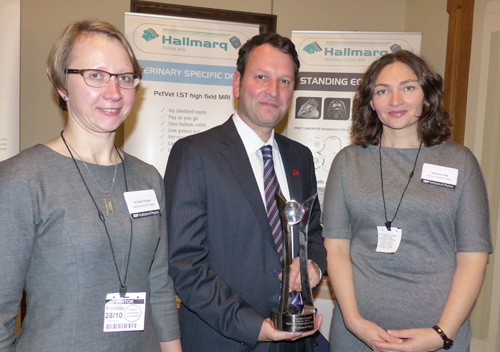
This might sound like a fairly niche dilemma, but for Hallmarq Veterinary Imaging it has become the basis for a thriving business – a business, moreover, that has just won an IOP Innovation Award for the successful application of physics in a commercial product.

At the awards ceremony – which took place last night in the Palace of Westminster, London, just down the hall from the House of Commons chamber – I caught up with Hallmarq’s operations and technical director, Steve Roberts. After sketching out the scenario of the veterinarian and the injured horse, Roberts, a physicist, explained that Hallmarq’s MRI scanner fits around the horse’s leg. This means that equine patients can simply be led into it, sedated but conscious. Sophisticated error-correction and image-processing software helps the scanner compensate for the horse’s movement, and in 15 years of operation, Roberts estimates that veterinarians have used Hallmarq’s machines to scan more than 60,000 horses.

(more…)

Sonic tractor beam can manipulate objects in mid-air


A device that uses sound waves to levitate, rotate and move objects in multiple directions has been developed by researchers in the UK and Spain. The “tractor beam” uses an array of miniature loudspeakers to create acoustic holograms that can manipulate objects in mid-air. Although they cannot propagate the vacuum in space to move spaceships and asteroids, sonic tractor beams could have a wide range of practical uses, such as moving delicate objects on a production line or transporting tiny drug capsules and microsurgical instruments through living tissue.

The work was inspired by research done by Mike MacDonald and colleagues last year, which showed that it is possible to pull an object with sound waves – the work featured in Physics World‘s top 2014 breakthroughs.

Bruce Drinkwater of the University of Bristol, who is one of the lead researchers in the current work, says that MacDonald and colleagues “did a really nice experiment showing you could get these attractive forces in acoustic systems. They had an array of loudspeakers, a bit like ours, and were able to apply a force to a specially shaped mass. We have gone from there and turned it into something that you could call a working stable tractor beam.”

Acoustic fields

Although acoustic levitation has been demonstrated before, it required particles to be enclosed by acoustic elements, while single-sided levitators have only managed to exert lateral or pulling forces, or required the use of an acoustic lens. The new device uses a grid of 64 off-the-shelf speakers (originally made for parking sensors) controlled by a programmable array of transducers. The transducer array – developed by Ultrahaptics, a spin-out company from the University of Bristol – creates haptic feedback in mid-air.

“When we realized we could use this equipment to create any acoustic field, we thought maybe we can create tractor beams,” says Drinkwater. The array creates acoustic shapes out of high-pressure ultrasound waves that can surround and trap objects. By carefully controlling the output of the speakers, the acoustic holograms can be adjusted to hold objects in mid-air and rotate and move them. The team created three different acoustic shapes – tweezers, a vortex that traps objects at its core, and a cage. Polystyrene particles ranging in diameter from 0.6 to 3.1 mm were controlled by the array, and it was strong enough to hold the spheres and counteract gravity from any direction.

Flexible devices

The tractor beam uses ultrasound at 40 kHz with a wavelength of about a centimetre. But Drinkwater plans to work on increasing the frequency and reducing the wavelength so that smaller particles can be manipulated. This could open up the possibility of using the technique for medical applications. An acoustic tractor beam could, for example, be used to move capsules into an exact location in the body and then blast them open to release drugs, or to manipulate tiny surgical instruments inside the body.

“This is a great paper, which shows a lot of acoustic-trapping techniques that are common in optical trapping but less so in acoustics,” says MacDonald. “As the paper says, all of the acoustic beams produced, and the manipulations achieved, could be done before, but usually with less flexible devices.” MacDonald told physicsworld.com that his original device was capable of producing all of the beams described in the new work, “but was made for focused ultrasound surgery. That means that although our device was already being used clinically, it was very expensive and less easily programmed.” He adds that the new approach is more flexible through the use of a programmable array.

The work is published in Nature Communications.

Can physics reveal the secrets of Egypt’s pyramids?

By James Dacey

“Just because a mystery is 4500 years old doesn’t mean it can’t be solved.” That is the tagline of a major new project to uncover the secrets of Egypt’s pyramids without damaging a single stone.

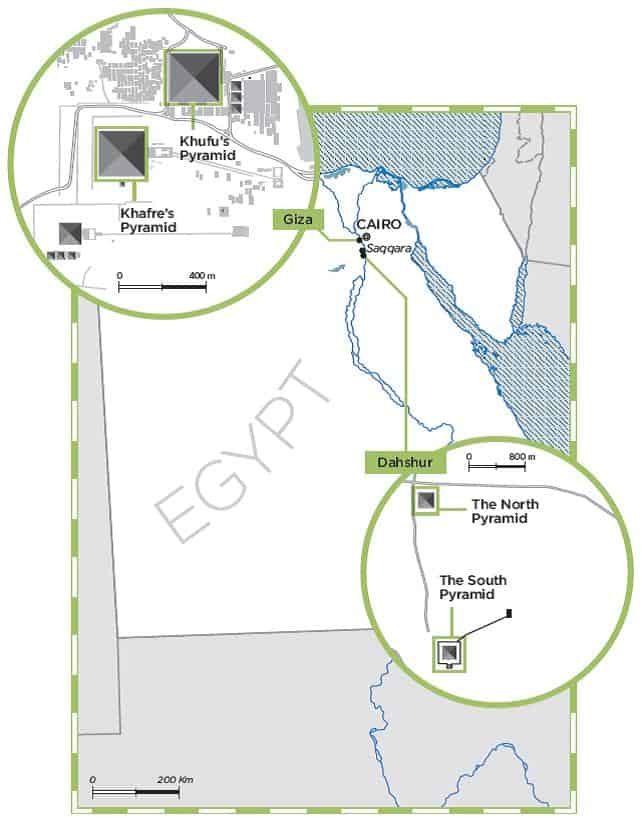
Scan Pyramids – launched by the Egyptian Ministry of Antiquities – will deploy an arsenal of non-invasive technologies to probe the structure of four pyramids from Egypt’s Fourth Dynasty (from 2575 BC to 2465 BC). On the Giza plateau, about 20 km south-west of Cairo, it will study the Pyramid of Khafre, along with the Pyramid of Khufu, aka the “Great Pyramid of Giza”, the oldest of the Seven Wonders of the Ancient World. Meanwhile, on the site of Dahshur, around 40 km south of the Egyptian capital, it will investigate the North and South pyramids. (Click to expand the map.)

Despite their global fame and familiarity, these ancient monuments still hold many mysteries. Chief among them is the question of how the ancient Egyptians managed to build these huge edifices. The Great Pyramid of Giza was originally 150 m tall and weighed 5 million tonnes, yet it was constructed in just 25 years. Egyptologists also believe that these pyramids could be concealing hidden chambers, which could house tombs and secret treasures.

(more…)

Copyright © 2026 by IOP Publishing Ltd and individual contributors