Enrichment The Jewish storytelling ritual Seder can teach us about perspective and experience. (Courtesy: iStock/alaincouillaud)
Passover, held this year on 22–30 April, celebrates the liberation of the Jews from slavery in Egypt. I’m an outsider to this (and any) religion, but the Passover holiday fascinates me for its storytelling. On its first or second night (usually), participants engage in a ritual known as Seder, which involves narrating the story of Exodus and then enjoying a meal. The narrative is based on a script called the Haggadah, which in Hebrew means “telling”. The Haggadah is not a sacred text but the prompt for an informal and participatory story that comes in many versions, from solemn and serious to playful and even irreverent.
The way the Haggadah presents the story has ingenious aspects that, I think, transcend any strictly religious context. These aspects even help to frame a recent controversy about the history of science.
Out of Egypt
The everyday practice of science involves much casual storytelling, from recaps at the beginning of talks and in the first paragraphs of many articles to the shortcuts colleagues give each other about why things are done this way rather than that. These informal narratives are not complete in all their details, nor do they need to be. They’re a way of reminding people of what’s important, making sure they are alert and fresh. A good history of science adopts a more comprehensive approach but can have, I think, the same ambition.
Last year, however, the Nobel-prize-winning physicist Steven Weinberg sparked a controversy about history of science. In his book To Explain the World, Weinberg wrote that he was seeking to tell “how science progressed from its past to its present” from the perspective of a “modern working scientist”. His explicit desire was to judge “the past by the standards of the present” rather than to understand the past on its own terms as historians typically do. Weinberg’s approach was like looking at the history of architecture in anticipation of today’s buildings and codes.
Several historians of science sharply criticized Weinberg’s book, and Weinberg was equally firm in answering them. His rebuttals included an article in the New York Review of Books and a talk he gave in a session about his book, which I helped organize, at this year’s March meeting of the American Physical Society. The dispute raises deep questions about the purpose of science history. Should it be primarily about how technical features of today’s science emerged? Should it focus on earlier forms of science and how these evolved? Or can history of science have some other end, such as to make its audience – scientists and non-scientists alike – alert to the practice and meaning of science?
I know it’s crude, but here’s where Seder helps frame the issues. Weinberg’s view is that the story of Exodus should be told backwards from the viewpoint of the Promised Land, where life – tweaked, perhaps – is as good as it gets. For some of his critics, the story should be told from the perspective of participants starting in Egypt onwards. Yet another possibility is that the story should be oriented neither by life in Egypt nor the Promised Land, but should serve to put us more on alert to the present, helping us see in it possibilities for what may still lie ahead. The merits of these three possibilities depend on the needs and interests of the audience.
I find Seder instructive for another reason as well. At one point, the unfolding story halts for a moment of reflection as the participants consider four questions about the meaning of the story. Being Jewish, evidently, is more than a matter of beliefs, rituals or even birth within a group whose history includes the Exodus. It means belonging to a community whose members are in danger of forgetting that story and who therefore periodically refresh their awareness of it, making that historical experience part of the current moment. Telling the story changes the tellers, aiming to enrich them by seeking to make them more humble and agile in responding to the present.
One might say, similarly, that being a scientist is less a matter of accepting a set of beliefs, using techniques and instruments, or even of having a university degree – and more about being flexible enough to re-examine the assumptions and concepts you’ve inherited in the light of experience. It’s a flexibility of mind you can nurture by exposing yourself to examples, too numerous to mention, from science history.
The critical point
Seder’s storytelling contains yet another radical element. At one point, the Haggadah stages an imagined conversation between the participants and four children who don’t get what’s happening, and it has the participants hear and respond to the children. The children misunderstand in different ways: a wise child who wants to understand the story better; a wicked child who denies its relevance; an ignorant child who doesn’t know what’s going on; and a simple and apathetic child who can’t pose questions well. However crudely, the Haggadah thus requires participants to grapple with scepticism, ignorance and indifference towards the very community whose struggles and continued existence are being celebrated.
I find this a helpful reminder of how to communicate science to often sceptical, ignorant or uninterested politicians or members of the public. Calling such people dumb, wicked, ideological and stupid, however tempting, guarantees more resistance and opposition. A powerful way of getting through to such people is through the history of science by retelling – whether formally, informally, seriously, playfully or irreverently – how and why today’s scientists do what they’re doing.
“A year here is a really really long time,” says astronaut Scott Kelly in an interview (watch the video above) that he did on board the International Space Station (ISS) just a month before he returned to Earth in March this year. The retired astronaut is talking about the very real effects of spending a long period in space, specifically citing both the physical effects as well as the “psychological stress” involved. “During my time in orbit, I lost bone mass, my muscles atrophied and my blood redistributed itself in my body, which strained my heart. Every day I was exposed to 10 times the radiation of a person on Earth, which will increase my risk of developing a fatal cancer for the rest of my life. Not to mention the psychological stress, which is harder to quantify and is perhaps as damaging,” he says.
The comments were part of the announcement of his upcoming memoir, Endurance: My Year in Space and Our Journey to Mars, which will be published later this year. Despite the damming tone, Kelly is still a staunch supporter of manned spaceflight and missions such as those to Mars, he just has a much clearer view on the realities involved. Read more about his announcement over at the GeekWire website.
It is a crisp winter day on the Mexico City campus of the National Autonomous University of Mexico (UNAM). A clear blue sky creates a pleasing contrast with the dark rocks on which the entire campus, as well as the surrounding Pedregal residential area, is built. The black and grey lava fields were spewed 1700 years ago by the neighbouring Xitle volcano, and as I make my way towards a white, two-storey building – all concrete, glass and steel – it looks under the dazzling Sun like a UFO has just landed on the ancient volcanic rock.
The starship is the new Centre for Complexity Science (Centro de Ciencias de la Complejidad, or C3), and as for its approach it might as well have come from another planet. The tradition at UNAM is for staff to have tenured faculty positions with little sideways mobility; indeed, scientists can end up staying in the same research institution and keeping the same office for decades. The C3 adopts a different model – that of the Santa Fe Institute in New Mexico, which is the world-leading powerhouse of complexity. Temporary positions and offices are offered to visiting professors, in fields ranging from physics and computer science, to history and anthropology. “There are no nameplates on the doors,” says C3 co-ordinator Alejandro Frank, a nuclear physicist turned complexologist, who about a decade ago decided to break free of the confinement of the nucleus. “For years I was stuck at 10–15 m,” he says. Complexity offered a portal to a wider variety of scales.
Real-world applications Complexity science has been used to study subjects as diverse as the 2009 swine flu outbreak in the Mexico City region. (Courtesy: CC BY Eneas De Troya)
The latest addition to UNAM’s research community is all about flow and adaptability, as opposed to the rigidity common in other scientific fields, which Frank says he wants to avoid. “We need to be able to summon multidisciplinary groups of academics in short order to respond to crises,” he says, recalling the H1N1 swine influenza pandemic of 2009 that brought Mexico to a standstill when health officials recommended that people stay at home to avoid contagion. Frank feels that the scientific community’s response to the crisis might have been nimbler had information flowed more freely between scientists in different fields and institutions. The C3’s flexibility and inclusiveness are intended to change that.
Symbolic location
While the C3 building is new, the centre itself is more mature, having already existed virtually for 10 years as a research community that began with some 25 members. Meetings, when necessary, were held in rented quarters at UNAM’s Faculty of Engineering, where the complexity theorists were eyed with suspicion. Eventually, Frank managed to get the attention of the then university chancellor José Narro, who offered to underwrite the construction of a purpose-built facility.
Once the funding had been agreed, the next step was for Frank to find an appropriate spot on campus for the building. The Pedregal lava fields are home to diverse fauna and flora, and large swathes of university-owned land are protected by the UNAM Wildlife Reserve. Frank’s search around the campus for land on which to build the new centre was therefore limited to non-reserve grounds. He found a spot between the Universum Science Museum, the performing arts complex and the humanities research district. “That is the place I wanted,” says Frank, “at the crossroads between science, the arts and the humanities.” He was delighted to find this symbolic location given how multidisciplinary complexity is.
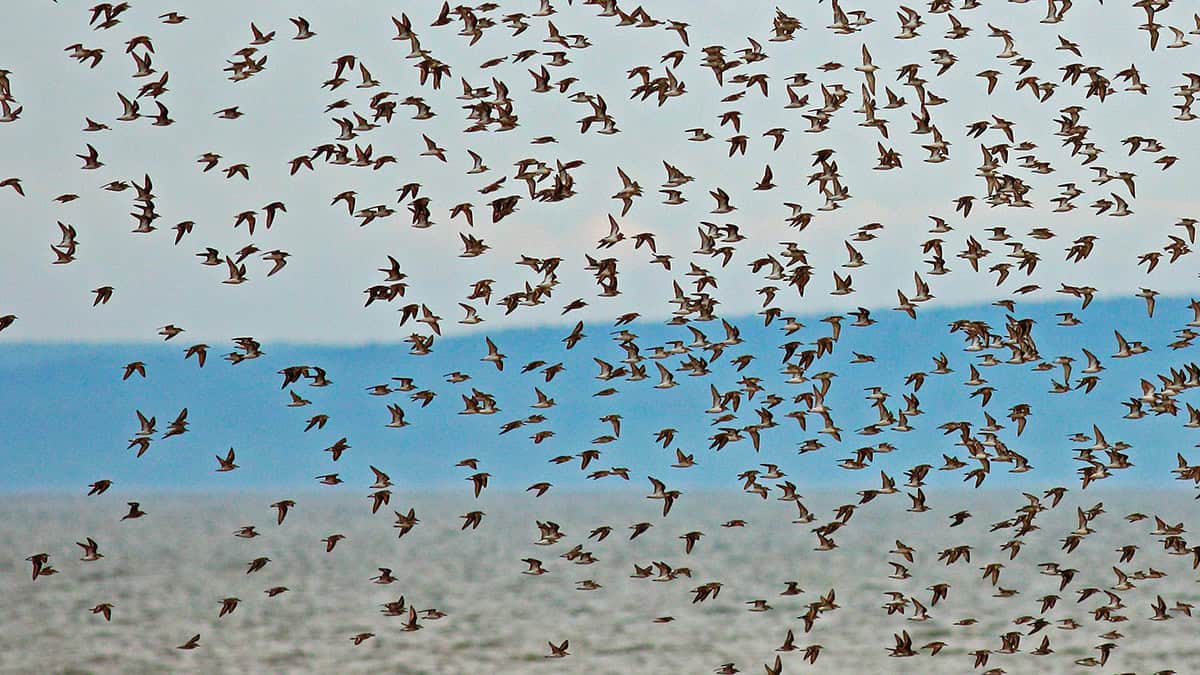
All for one The group behaviour of birds – such as during murmurations – can be studied as a complex system. (Courtesy: iStock/jamieroach)
There is a reason for this multi-faceted nature. “What is the difference between regular scientific problems and complex problems?” asks Frank rhetorically. “It’s like comparing the nucleus of an atom with a pond in the jungle.” While the nucleus is relatively simple and everything in it takes place at the same scale, in the pond entities at different scales are interacting – plankton, mosquitoes, fish, insects and mammals, for example. If some toxic matter were dumped into the pond, it might only affect the plankton directly; however, changes to the plankton would in turn cascade to affect the wildlife and the whole system would be altered. “The essence of a complex system is the connection between these different scales, so you need specialists in each,” says Frank. “Multidisciplinarity emerges naturally from the multi-scaled nature of the problems.”
The new building opened in October 2015. The complexity nomads finally had a home. During the ceremony, chancellor Narro joked: “I think Alejandro Frank misunderstood me when I said it was time to go from the virtual to the concrete!”
Collective phenomena
Since the early 20th century, scientists have increasingly recognized that real-world problems, as opposed to textbook problems, are often not amenable to the spherical-cow reductionism still emphasized in traditional science education (the joke is that a physicist begins a calculation by saying “consider a spherical cow”). A good example occurred late last year, when a tropical storm approaching the shores of western Mexico turned overnight into a category 5 hurricane that threatened to devastate the towns of Manzanillo and Puerto Vallarta. A reductionist approach to the problem of understanding, predicting and controlling hurricanes might begin by treating the storm as an isolated bunch of gas and water molecules in collision, perhaps applying statistical mechanics to allow for the fact that there really are a lot of molecules. The complications of mass and energy exchange with the environment could be worked in later as perturbations. However, no amount of persistence along this path will explain the surprisingly explosive growth of Hurricane Patricia and its subsequent quick demise, to say nothing of its erratic trajectory. A hurricane is more than the sum of its molecules. It is not merely complicated: it is complex.
In a recent paper in PLOS ONE (10.1371/journal.pone.0130751), a C3 team characterizes complex systems as “those in which the agents or elements that compose the system interact nonlinearly and in such a convoluted way that it is impossible to describe the behaviour of the system in terms of the simpler behaviour of its components”. This is a good description for many phenomena: the weather, the Internet, market crashes, turf wars between gangs, epidemics, social organization in humans and in animals, and even city traffic. They all exhibit an interplay between their component parts that goes far beyond the relatively simple, large-number behaviour statistical mechanics describes.
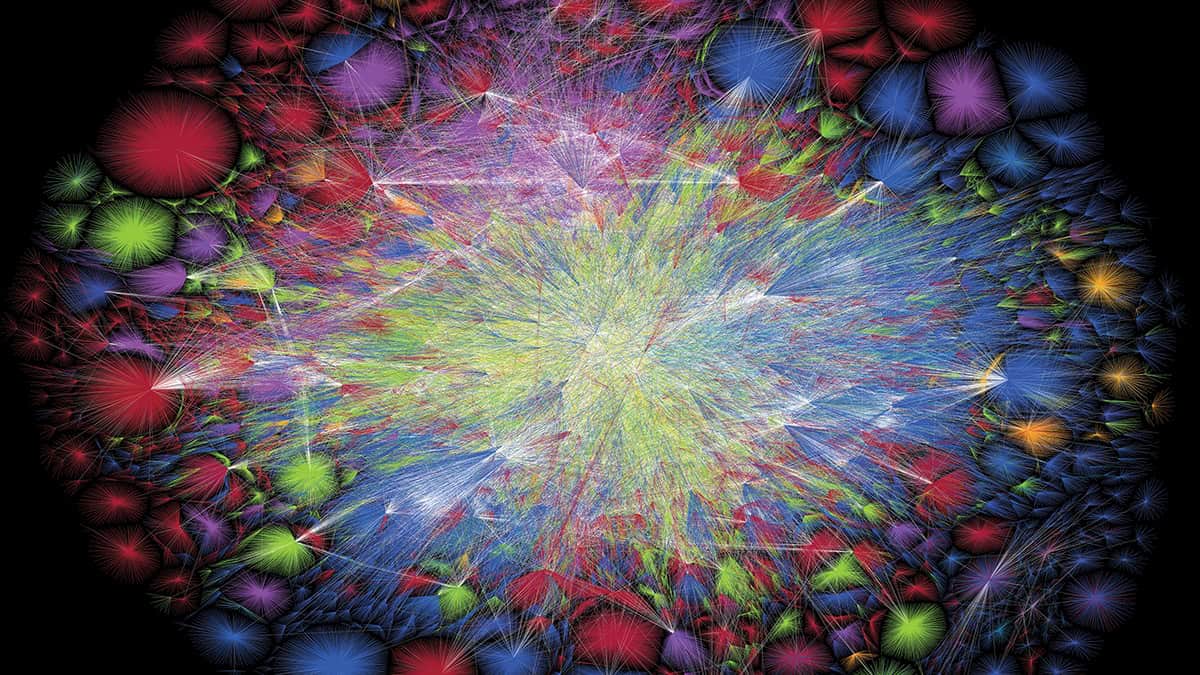
Many levels Visualization of the routing paths of the Internet in 2015. Complexity science can be used to describe phenomena such as this that cover multiple scales. (Courtesy: Barrett Lyon/The Opte Project)
This manifestation of collective phenomena that are impossible to predict from the individual behaviour of the parts – such as the direction in which a swarm will next turn – is called emergence. While reductionism fails when things get convoluted and nonlinear, complexity theory can describe these simple universal patterns of a higher order. An ocean wave is an emergent property of water molecules. Thoughts emerge from the firing of millions of neurons. Even the economy emerges from our individual financial decisions. Complex systems naturally self-organize – a bit like an ant colony (or a research centre), where order does not come from any one individual actually calling the shots, but materializes from the synergy of the group.
Close to the edge
Another idea from complexity theory is that the really interesting phenomena happen at the boundary between order and chaos. Science journalist John Horgan explains in an article published in June 1995 in Scientific American (272 32): “The basic idea is that nothing novel can emerge from systems with high degrees of order and stability, such as crystals. On the other hand, completely chaotic systems, such as turbulent fluids or heated gases, are too formless. Truly complex things – amoebae, bond traders and the like – appear at the border between rigid order and randomness.” This means there is a Goldilocks zone with just the right mix of organization and turmoil. Systems poised in this dynamical sweet spot are said to be “critical” in much the same way as water near the freezing point.
Back at the C3, scientists are bringing this concept to bear on cardiac disease and diabetes, two important health issues in Mexico. “All living things tend to criticality. This is their equilibrium,” says Frank, paraphrasing Stuart Kauffman, one of the founding fathers of the field.
As to why criticality can be a good for living things, consider the heart. It has two opposing functions: body tissues need nutrients constantly, so the heart better be robust and dependable, which requires order and rigidity. But the environment is constantly changing, so the heart also has to be adaptable. “It’s not a Swiss watch. It needs flexibility,” says Frank, who, together with others at C3, is working to identify early warnings of imminent catastrophe in everything from heart disease and epilepsy, to volcanic eruptions and earthquakes, which are also a concern in Mexico.
The heart’s criticality, or lack thereof, can be seen in time series plots of the heartbeat. Any cardiologist worth their salt can glean lots of information about a patient’s heart from a regular electrocardiogram (ECG), which plots cardiac electrical activity against time. Now researchers are looking at graphs not of the oomph of each beat, but of the heart’s changing rhythm. This is easily visualized in time series, in which what is plotted are changes in the interval between successive heartbeats. Time series are a measure of how well the cardiac muscle beats time – so too are their power spectra, which do to a graph what a prism does to light: separate it into its component frequencies.
“I once showed these graphs to a bunch of cardiologists,” recounts Frank, who presented three different versions: one was flat, another wandered up and down randomly, and yet another fluttered gently up and down like a butterfly. “I asked which of them belongs to a healthy patient. They had no idea,” he says. It turns out that a rigid, metronome-like beat is a sign of disease, while a healthy heart beats to a jazzier, more free-flowing rhythm. “The flat graph belonged to a patient with heart failure; the heartbeat was too constant, [with] no flexibility to adapt. The randomly varying graph indicated fibrillation: the patient was on the brink of death. The fluttering graph showed a heart that was neither too rigid, nor too chaotic” – a heart snuggled in the critical sweet spot.
“Living things tend naturally to criticality,” Frank insists, and deviations from it signal that something has gone awry. “We have proposed a project with the National Institute of Medical Science and Nutrition to gather data on patients about to undergo different procedures (stent surgery, or after a heart attack), to see if the procedure restores criticality.” (For more on using physics techniques to analyse heart rates, see “Revealing the network within”, February pp29–31).
In the paper published in PLOS ONE (of which Frank is a co-author), the team expresses confidence in the wide applicability of these ideas. “All these transitions display characteristic signals that in principle are independent of the particularities of the system. In other words, the dynamics of the systems near critical points exhibit universal properties.” And these properties could be rallied to identify warning signs of impending heart attacks, earthquakes, volcanic eruptions, and even diseases such as cancer and diabetes.
Building for complexity
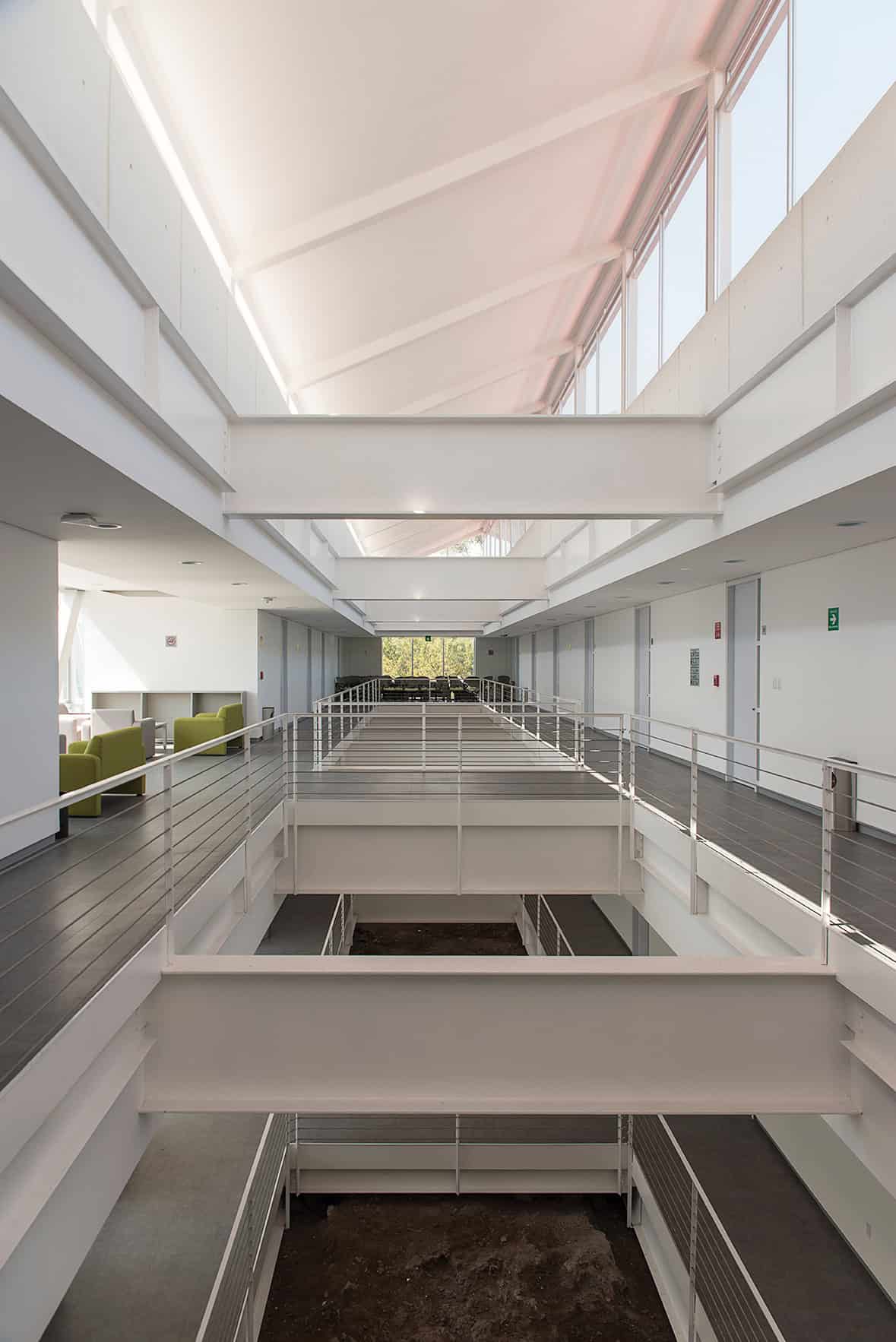
Change and choice The C3 building, designed by the firm Francisco Serrano y Asociados, is built to embody collaboration and adaptability. (Courtesy: Jaime Navarro Soto)
It is perhaps appropriate that the very building that houses the C3 should embody the principles and philosophy of complexity science. Architects Susana García Fuertes and Francisco Serrano designed a dynamic workspace with reconfigurable walls so that spaces can be easily adapted to the needs of the projects being pursued at any moment. Following the trend of “social buildings” that encourage occupants to interact, García Fuertes and Serrano distributed cosy sitting areas for spontaneous meetings throughout the C3. The spirit of collaboration is reflected in the openness created by the almost complete absence of columns and load-bearing walls. This is thanks to a visible exoskeleton of steel cross beams supporting the structure.
Sustainability was another concern. “It was important that the building not touch the ground, that it respect this wonderful, rocky soil,” says García Fuertes. “So there are few points of contact with the ground and the structure seems to float.” Hence the impression of a spaceship that has just touched down.
The inner walls of the building are coated with a special paint that effectively turns them into giant whiteboards. Researchers chatting in the corridors can use markers to draw sketches, write equations or generally adorn the walls with whatever strikes their fancy. “We want the decoration to emerge,” says Frank. At the time of writing, the walls of the UFO remain a blank page, waiting for the first scribblings from the C3 community.
A group of 35 Nobel laureates, including 16 physicists, has called on world leaders to reduce the use of highly enriched uranium (HEU) in naval nuclear propulsion and research reactors. In a letter addressed to national leaders at last week’s Nuclear Security Summit in Washington, the laureates call for “serious technical studies” to transition naval reactors to using low-enriched uranium (LEU). They also call for a road map for converting or shutting down research reactors that use HEU, as well as the development of non-radioactive alternatives – such as cobalt-60 and caesium-137 – for use in medicine and research.
More than 90 research reactors have been converted to LEU or closed down in the past 40 years. The US has also been reducing its stocks of HEU, which is defined as uranium with 20% to 90% concentration of the uranium-235 isotope. According to the US government, the country’s stocks of HEU fell from 740.7 tonnes to 585.6 tonnes between 1996 and 2013. The latter amount includes around 500 tonnes for national security, such as the production of nuclear weapons and naval propulsion, 44.6 tonnes of spent nuclear reactor fuel, as well as 41.6 tonnes that could be reduced to LEU or disposed of as low-level waste.
Regardless of these steps, the laureates urge “serious technical studies” to investigate moving to LEU fuels for naval nuclear propulsion as well as “strongly” recommending governments devote more resources to addressing the remaining HEU-fuelled reactors over the next decade. Burton Richter, who shared the 1976 Nobel Prize for Physics and instigated the letter together with the president of the Federation of American Scientists, Charles Ferguson, told physicsworld.com that almost all research reactors should be convertible to LEU. “Some might not be,” he adds. “But the world can live without them.”
Richter regards the non-military uses of HEU as the more serious risk of falling into the wrong hands. “I’m less worried about the naval-reactor HEU than the civilian HEU because military reactors have a lot more security,” he told physicsworld.com. “The amounts are much higher on the military side, but so is the security.” Indeed, in their letter, the 35 laureates warn that the threats of nuclear and radiological terrorism “cross national boundaries” and will require collaboration between nations to prevent an incident from happening. “We urge [national leaders] to devote the necessary resources to make further substantial progress in the coming years to real risk reduction in preventing nuclear and radiological terrorism,” they add.
The laureates also praise the progress made by governments and companies in developing ways of treating cancer and blood disorders by using other techniques that do not rely on highly radioactive sources.
Long-lived spin coherence in proteins found in the eyes of migratory birds could explain how the creatures are able to navigate along the Earth’s magnetic field with extraordinary precision. This is the finding of researchers in the UK and Germany, who have created a new realistic model of cryptochrome proteins that is based on advanced simulations of nuclear and electron spins. The team also provides an explanation for how the avian magnetic compass has been optimized by evolution.
Every year, migratory birds navigate thousands of kilometres between their breeding and wintering grounds with remarkable accuracy. It has been known for a long time that this is, in part, due to their ability to detect the direction of the Earth’s magnetic field, with research showing that some birds can detect the direction of field lines with an error of 5° or less. However, scientists do not have a good understanding of the biological mechanisms that make this magnetic sense possible.
Free radicals
One of the most popular theories is based on the idea that incoming photons excite light-sensitive proteins called cryptochromes in the retina of a bird’s eye. This results in an electron being transferred between two molecules within the protein. The two resulting free-radical molecules each have an unpaired electron but, because they were produced simultaneously, the spins of the two electrons are correlated. The two electron spins form a coherent quantum state that is affected by weak external magnetic fields, such as the geomagnetic field. This interaction affects the chemical reactivity of the free-radical molecules and ultimately the signals that they send to the brain.
While this sounds plausible in theory, no one has explained exactly how this process allows the Earth’s magnetic field to be measured to within 5° precision. Indeed, when people have calculated how the magnetically sensitive chemical reactions in the retina may respond to the direction of a weak magnetic field, they have found that “you can vary the direction of the field by many degrees without greatly changing the output signal,” explains Peter Hore of the University of Oxford.
More nuclear spins
To address this shortcoming, Hore and colleagues at Oxford and the University of Oldenburg in Germany built a more realistic model of the molecules involved. Most previous research has modelled “simple radicals containing a single nuclear spin”, but “the radicals in cryptochromes have many nuclear spins – 10 or 15 in each of the two radicals,” Hore explains. “What we have done is to model something much more realistic, putting in many more nuclear spins, with realistic couplings to the electron spins.” They also assumed that the spin coherences of the paired radicals are much longer lived than in previous models.
The team found that when the spin coherence times in its model were set to be longer than a few microseconds, there was a marked “spike” in the yield of the signalling state produced by spin-selective reactions of the radical pairs. As the spin lifetime is prolonged from 1 μs toward 100 μs, the spike emerges, strengthens and narrows. According to the researchers, such a feature could provide birds with directional information with sufficient precision to explain their navigational behaviour.
While the exact chemical signal produced in birds is unknown, Hore says that it is almost certainly a form of the cryptochrome protein that has a different shape. This difference in shape allows the protein to have different interactions with other proteins, and this starts the neural signalling process. The long-lived spin coherences provide enough time “for the interconversion of the singlet and triplet states of the radical pairs, and therefore the yield of the signalling state, to respond sensitively to the direction of the geomagnetic field”, Hore explains. Radical pairs that do not go forward to the signalling state revert to the original protein structure.
Coherent evolution
Coherence is not expected to be long-lived in most biological systems, and the researchers suggest how birds could have evolved a molecular system that did not rapidly lose coherence. “The source of the spin relaxation that would destroy the coherence is the stochastic fluctuations of the radicals in their binding sites in the protein,” explains Hore. If mutations in the proteins made those “motions both fast and of relatively low amplitude, then the loss of coherence should be inefficient, allowing the spin-correlated state to persist perhaps for 5–10 μm”, which would be sufficient to produce the spikes in the yield of the signalling state, he adds.
Erik Gauger, from Heriot-Watt University in the UK, who was not involved in the research, says that it is a fascinating piece of work that brings “a level of detail and sophistication to the table that has been lacking in previous theoretical studies”. He adds that it is a “significant step in the direction of finally beginning to unravel the inner workings of the avian compass”.
Clear reason
“What is particularly exciting is that the [work] provides, for the first time, a clear reason why the compass might have evolved to support extraordinarily long spin-coherence times.” Gauger told physicsworld.com. “About five years ago and based on a fairly generic model, we predicted that the spins should preserve quantum coherence on the order of 100 μs, to be consistent with the apparent extreme noise sensitivity of the compass. This timescale seemed very surprising at the time.”
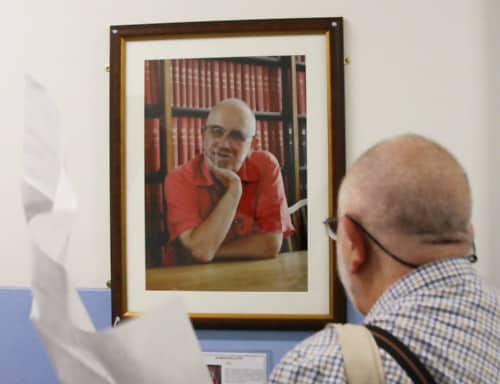
A moment to reflect – Michael Berry unveils a framed photograph of himself in the University of Bristol at an event to mark his 75th birthday. (Courtesy: Brian R Pollard)
By Matin Durrani
Anyone who gets invited to an event that’s being held on April Fools’ Day is bound to think there’s something fishy going on. But last Friday’s meeting to celebrate the 75th birthday of Bristol University physicist Michael Berry was a genuine commemoration of his career, although it did have its lighter moments.
Grandly entitled “Physics, Art, Mathematics, Science”, the meeting was intended to reflect Berry’s extensive and wide-ranging interests, which stretch from the physics of waves and quantum phenomena to optics, tidal bores and magnetic levitation. (There’s also a phenomenon called the Berry phase, although I understand Berry himself is reluctant to use that term.)
It’s difficult to summarize Berry’s many contributions to physics – he has written approaching 500 papers – so I’m going to take the easy way out and instead point you at his excellent website, where you can easily get lost down lots of entertaining and stimulating rabbit holes.
If there’s one item on his site I can recommend, it’s his description of how his work on the mathematics of magnetic levitation led him to share the 2000 IgNobel Prize for Physics with the future (genuine) Nobel laureate Andre Geim, who in 1997 levitated a frog using a powerful permanent electromagnet while at Bristol.
For physicists chasing the holy grail of quantum computing, one tasty recipe is becoming increasingly widespread. Sprinkle a handful of atoms – rubidium is a popular ingredient – into a vacuum chamber. Treat with laser beams to cool the atoms to mere fractions of a degree above absolute zero. Then add a couple of photons and hey presto – you’ve created one of the basic building blocks of a quantum computer.
At least, “that’s the basic idea”, says Mark Saffman, an atomic physicist at the University of Wisconsin–Madison in the US. Central to it all are Rydberg atoms, which have a single outer valence electron that can be excited to higher quantum states. They’re the big daddies of the atomic world. Typically an atomic nucleus is femtometres in size, but in a Rydberg atom the excited valence electron can travel microns from the nucleus while still remaining bound to it, ballooning the atomic radius a billion-fold in size. With such a great reach, a Rydberg atom can interact with other nearby atoms via a powerful electric dipole moment a million times better than “ordinary” atoms. It’s this interactive power – and the ability to control it with a single, carefully chosen photon – that makes Rydberg atoms such a potent force in the world of quantum information systems.
Gateway technology
At the heart of any computer – digital or quantum – are logic gates. A quantum computer works at the atomic scale, where quantum mechanics reigns, meaning the logic gates must also be built out of atoms. A NOT gate, for example, has a single input and two states, 0 and 1, but for the gate to work it requires that the atoms not just interact, but that the interaction is controlled. The electric dipole strength of Rydberg atoms and our ability to control their excitation makes them perfect for quantum logic gates.
In 2010 Saffman and his colleagues at Wisconsin demonstrated the ability to build logic gates using two neutral rubidium atoms, complementing work conducted by a team led by Philippe Grangier at the Institut d’Optique near Paris. The quantum version of a NOT gate is the Controlled-NOT, or CNOT, gate, in which the rubidium atoms themselves are the quantum bits – or “qubits” – of information. One is labelled “control”, and the other “target”. In their ground state, which sports various hyperfine states that hold the quantum information, the atoms don’t interact – the four microns separating them might as well be an infinity. However, by exciting the control atom into the Rydberg state by firing a resonant photon at it that gets absorbed, the valence electron rises to a higher energy level, extending its reach sufficiently to permit an interaction with the target atom, “flipping” it and allowing the CNOT gate to operate. “By using the laser to excite the control atom, we can turn on the interaction and perform our logic gate, before returning the atoms to the ground state,” says Saffman.
Previous experiments had used ions to create CNOT gates, but the problem with ions is that, being charged, there is no easy way to switch their interactions off, which limits how many can be combined into a stable qubit. Neutral Rydberg atoms, however, don’t face this problem. That’s not to say that Rydberg atoms are a new development – they’ve been known about since the late 1800s. What has really spurred the development of Rydberg physics has been the advent of laser trapping and cooling, for which Steven Chu, Claude Cohen-Tannoudji and William Phillips shared the Nobel Prize for Physics in 1997. It is this ability of physicists to hold and manipulate individual atoms using light that has opened the way for Rydberg atoms to be used in exotic new applications.
Starkly shifted
Lasers can be used to create an “optical dipole trap” that can hold and cool atoms to mere microkelvin above absolute zero, or even down to nanokelvin in some cases. By criss-crossing the lasers, this method can be expanded into a 2D or 3D optical lattice. The lasers are tuned to a colour distinct from the atom’s resonant frequency, to avoid the atoms absorbing any of the photons (which would give them energy to jump out of the trap). At this point, a phenomenon known as the Stark effect comes into play, which is the shift in an atom’s energy levels in response to an electric field of alternating current, as in that produced by an electromagnetic wave. For ground-state atoms, the energy levels are shifted to a slightly lower energy. The most intense part of the laser beams, which is where they cross in the lattice, then becomes a potential well in which the atoms become trapped, because it is here that they experience the greatest shift and lose the most energy (figure 1).
1 Rydberg recipe Rubidium atoms are held in place using lasers at 1064 nm (undulating beams). Extra lasers at 795 nm and 485 nm (shown in red and blue) excite electrons from the 5s to the 5p, then from the 5s to the 18s, quantum states, respectively, to form Rydberg atoms. (Courtesy: Sean Kelley/JQI)
Once trapped, the atoms can then be excited to the Rydberg state by firing a photon of resonant frequency at them. The trouble is, the energy of the resonant photon can jolt the atom out of the trap, and so the search has been on for “magic wavelengths” that can both trap and excite an atom at the same time. In 2015, building on nearly a decade’s worth of work by atomic physicists, a group led by physicist Trey Porto at the University of Maryland’s Joint Quantum Institute, US, found a magic frequency for rubidium atoms that simultaneously traps them in two different quantum states, which have the principal quantum numbers n = 5 and n = 18 (Phys. Rev. A91 032518). In other words, they can be excited to a Rydberg state of 18s, where the excited electron is in the 18s orbital, while remaining in the trap. This magic wavelength corresponds to an infrared wavelength of about 1064 nm. By a sheer stroke of luck, this is the wavelength produced by a Nd:YAG laser, which most physicists use anyway because it provides some of the cheapest laser power available. That is particularly important when you want a lot of power without bankrupting your physics department.
“Really, we’ve been sneaky and picked a colour of light that traps both the Rydberg state that we’re interested in and the ground state,” says physicist Elizabeth Goldschmidt, who was one of Porto’s team members and is now based at the US Army Research Laboratory in Maryland.
Although Porto’s team excited the rubidium up to 18s, it was only a start. To get to higher quantum numbers – which results in stronger interactions across greater distances between atoms as well as extending the lifetime spent in the excited state – you need shorter and shorter magic wavelengths. Lasers that emit these shorter wavelengths are not as widely available as 1064 nm lasers and, at the highest frequencies, they can become cost-prohibitive. Nevertheless, the magic wavelengths are a huge advance for physicists such as Saffman. “He traps individual atoms and gets them to interact in gates, so he cares more about finding their magic wavelengths,” says Goldschmidt.
So far so good, but magic wavelengths and Rydberg excitation are not enough on their own to make a quantum computer. What’s missing is the quantum aspect that allows a qubit to exist in many states at once, as opposed to binary bits that can only be in one of two states. In Rydberg physics, this quantum aspect is provided through entanglement.
“The entanglement is the bit that gives you something more than you can do with a classical computer,” explains Charles Adams, a physicist with the Joint Quantum Centre at Durham University in the UK. The entanglement is produced by the interaction of the Rydberg atoms with other unexcited atoms around them. In essence, Saffman’s CNOT gate is an entanglement machine and the efficiency of the gate depends on the “fidelity” of the entanglement, which is defined as the amount of successful computations that the entangled logic gate achieves compared to the total number of attempts.
Running the blockade
When the atoms are the qubits, the photon’s role is simply to excite the atoms into their Rydberg states. However, Adams, among others, has been chasing a slightly different prize: a quantum computer made of light.
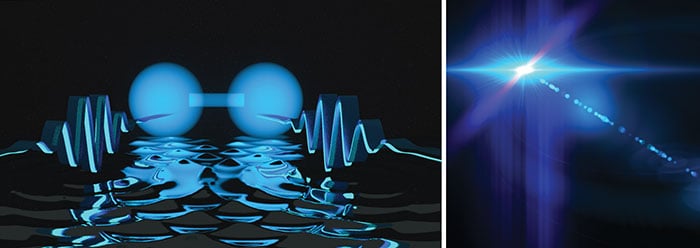
In such a device, rather than the atoms being the qubits, the photons would act as the qubits instead. Immediately there’s a potential showstopper. Photons, being massless particles, don’t interact with one another and so ordinarily cannot create logic gates. Expose them to Rydberg atoms, however, and the game changes, allowing physicists to create exotic photonic states and even “molecules” of light.
It’s all possible thanks to the cliquey nature of Rydberg atoms. Gather a close bunch of rubidium atoms (or strontium, caesium, sodium or whatever your favourite neutral atom is), cool them down and send in a photon. One of the atoms is excited to the Rydberg state and interacts with the other atoms around it, shifting their energy levels. So when a second, identical, photon is sent into this “Rydberg ensemble”, it finds that it is suddenly out of tune with their resonant frequency and cannot excite them. In essence, the Rydberg atoms put a “blockade” on the creation of other Rydberg atoms from a second photon within a volume perhaps 10 μm in diameter.
For the second photon, however, that’s good news. “It means that the second photon sees a different optical response to the medium – effectively it can see a different refractive index – so the behaviour of the medium to the second photon is very different from the first,” says Adams. As long as the two photons are of the same frequency, the rubidium cloud becomes transparent to the second photon, an effect called “electromagnetically induced transparency”. Ordinarily the second photon would race ahead, but the rubidium cloud’s refractive index is altered in such a way that the second photon stays close to the Rydberg ensemble excited by the first photon.
As the atoms excited by the first photon return to the ground state after a few microseconds, then not only can the first photon continue on its way, but the second photon is also free to form its own Rydberg ensemble, putting a blockade on the first photon. In this fashion, the two photons push and pull each other through the rubidium cloud at about 400 m/s, until they emerge together, quantum entangled and seemingly bound like a molecule.
Linked in It may be possible to create a quantum computer from light but the key is getting photons to interact. Two photons (depicted above left as waves), can be locked together at a short distance. Under exposure to Rydberg atoms, the photons can form a state resembling a two-atom molecule. (Courtesy: E Edwards/JQI and iStock/7io)
In this situation, the photons and Rydberg atoms become strongly coupled, says Mikhail Lukin of Harvard University, US. He co-created the blockade technique in cold atoms in 2001 along with his colleagues Robin Cote, Michael Fleischhauer, Ignacio Cirac and Peter Zoller, and was also the first to use blockades to create these Rydberg-enhanced molecules of light in 2012 along with Vladan Vuletić of the Massachusetts Institute of Technology, US.
“The coupling means they essentially form a new quasi-particle called a polariton, which is part light and part atoms,” Lukin explains. The atomic half of the polariton acts as a brake for the photons, so the greater the atomic excitation, the slower the propagation velocity of the photons through the rubidium. Lukin and Vuletić are now working on repeating the experiment with more than two photons.
These photon–photon interactions are fundamentally different from how light normally acts and they open the door for using entangled photons as the circuits of quantum computers. But atomic logic gates are not out of the picture just yet, says Goldschmidt. She thinks that the optical logic gates of the interacting photons would be better applied to quantum simulations rather than quantum computing per se.
A quantum simulator, as the name suggests, simulates complex systems rather than computes them. In essence, it’s a quantum version of a computerized many-body simulation and would be designed to tackle specific problems. “In a quantum simulation you have interactions between the many bodies of your quantum system and you can thus simulate some other many-body quantum system without trying to implement code with specific gates,” says Goldschmidt.
Desktop devices
Researchers working on Rydberg physics have one main aim, regardless of whether the Rydberg atoms themselves will be the circuits of quantum information systems, or whether photons facilitated by Rydberg atoms take that role. Their goal is to push for higher-fidelity manipulation of these logic gates to increase the quality of their output and provide internal error corrections. The best way forward, envisions Lukin, is a hybrid system, whereby Rydberg atoms and photon interactions are both involved in the information processing.
“What’s interesting about our approach is that it enables us to utilize the best of both worlds,” he says. “For computing, you might want to store qubits using atoms, but to communicate between the stored qubits, you actually would like to use photons.”
Adams goes even further, speculating how quantum computers and simulators could one day become desktop machines, not by cooling their atoms to incredibly frigid temperatures, which involves large apparatus and lots of power, but by operating at room temperature. Adams and his colleagues at Durham have conducted experiments with Rydberg atoms in “hot” vapours up to 50 °C, but the problem is the Brownian motion that ensues in the warm, energetic atoms. Since photons are stored within the medium as a wave, this motion destroys the phase information, meaning that the photonic qubit cannot be retrieved. Still, if this and other challenges can be overcome, then Adams suggests it may be possible to build a quantum computer in which photons stored in virtual bubbles imposed by the Rydberg blockade process mediate an interaction that forms an optical gate. “But we’re still some way off knowing how to do this kind of integrated all-optical circuit,” he says.
Rydberg physics is not the only game in town when it comes to quantum computers. Trapped ions, superconductors, diamonds and Bose–Einstein condensates among others are competitors for the quantum crown. But Rydberg atoms have other uses too. For example, by choosing a Rydberg ensemble at a specific resonant frequency – say terahertz, or microwave – it could act as a sophisticated sensor, producing an optical output when it picks up those fields. Photon–photon interactions forced by Rydberg blockades could even lead to exotic states of light that are considered crystalline or liquid, where the interactions hold the photons together in something that might look like a lightsaber.
“Rydberg physics has grown in momentum throughout the last decade,” says Adams. “There are groups almost everywhere now doing some aspect of this.” It is remarkable what Rydberg physics could accomplish, considering the ingredients are some of the simplest things in the universe: atoms and photons.
Journal of Physics B, from IOP Publishing – which also publishes Physics World – is currently releasing a focus issue on “Rydberg atomic physics”
The locations and timing of the closest supernovae to Earth, which took place within the last few million years, could be determined thanks to new studies of a specific isotope of iron. The research, carried out by two independent teams, suggests that two supernovae exploded within 330 light-years of Earth in the past 2.3 million years. The findings – which combine “deep-sea astronomy” with “galactic archeology” – hint at the possibility that the supernovae may have affected Earth’s climate, leading to the Pleistocene geological epoch from which homo sapiens evolved.
Astronomers have long suspected that supernovae taking place in our galactic neighbourhood could have decided effects on our planet, possibly causing mass extinctions or global climate changes. Iron-60 (60Fe) is produced when a supernova explodes, and its presence in the Earth’s deep-sea crust means that one or more supernovae have occurred within the last few million years.
Interstellar iron
Now, two individual teams led by Dieter Breitschwerdt at the Berlin Institute of Technology, and Anton Wallner of the Australian National University, have looked at the links between these 60Fe deposits and supernovae. When sampling sediments at the bottom of the Atlantic, Pacific and Indian oceans, Wallner’s team used accelerator mass spectrometry to measure an overabundance of 60Fe, relative to normal terrestrial iron, 40 times greater than the background level. The 60Fe dates back to two time periods – 1.5 to 3.2 million years ago and 6.5 to 8.7 million years ago. This abundance is far higher than could be explained by meteoric debris or the impact of a large asteroid, leaving only one other alternative: supernovae.
Breitschwerdt believes that it may be possible to tell when and where the more recent of these supernovae took place. Our solar system resides within an enormous cavity within the interstellar medium known as the “Local Bubble”. Some 300 light-years wide, “the very existence of the Local Bubble requires supernovae explosions in the solar neighbourhood to have blown it out” says Breitschwerdt.
The team calculated the most probable trajectories and masses of the massive stars that could have become supernovae, and hit upon a group of local stars known as the Scorpius–Centaurus Association. The researchers found that an 8.8 solar-mass star could have exploded relatively close to Earth 2.3 million years ago, followed by a 9.2 solar-mass star just 1.5 million years ago. Together, these two supernovae contributed 47% of the 60Fe found in the Earth’s crust. Another dozen or so stars in the cluster also exploded earlier, but the longer ago they occurred, the further away they were, lessening their impact on the Earth.
“Both our publication and Breitschwerdt’s complement each other, and I think we now have a very nice and consistent picture through ‘deep-sea astronomy’ and galactic archaeology,” says Wallner.
Cosmic catastrophe?
But there may be another twist in the tale. Around 2.6 million years ago, the Earth entered a period of repeated glaciations known as the Pleistocene epoch. When it ended 11,700 years ago, human beings emerged as the dominant form of life on the planet. The start of the Pleistocene coincides with the onset of the Scorpius–Centaurus supernovae. Could they be related?
Although there is no direct evidence and the timing may merely be coincidental, Adrian Melott of the University of Kansas thinks it might be worth investigating. “One idea is that cosmic rays from supernovae can cause cloud formations that might have cooled the planet,” he says. “We can certainly model the cosmic rays, but the cloud cover is more difficult because that’s a more speculative line of research.”
Both Wallner and Breitschwerdt agree that this is a reasonable proposition. “It might be that there is a similar coincidence for the older 60Fe flux seven to eight million years ago, although not as pronounced,” says Wallner, adding that the idea is still “very speculative, and I think most Earth scientists are sceptical”. While these supernovae were too far away to irradiate the planet and cause mass extinctions, Melott considers them a proof of concept. “The take-home message is that supernovae can happen nearby,” he says. “Over the past 500 million years there must have been supernovae very nearby with disastrous consequences. There have been a lot of mass extinctions, but at this point we don’t have enough information to tease out the role of supernovae in them.”
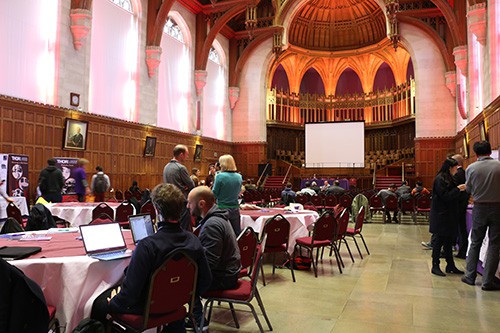
Quantum temple: will the congregation at Bristol’s Wills Memorial Building convert to quantum annealing?
By Hamish Johnston at the BQIT:16 conference in Bristol
Today I have made the short trip from the office to the University of Bristol, which is hosting the BQIT:16 conference on quantum information. I had been looking forward to the “Industry Perspective” session, which was headlined by Steve Adachi of the US defence supplier Lockheed Martin. Several years ago the firm was the first commercial buyer of what some consider to be the world’s first commercial quantum computer – a device made by Canada’s D-Wave Systems – and I wanted to know what Lockheed Martin was doing with it.
To say that D-Wave and its products are controversial is an understatement. Indeed, I wouldn’t be surprised if some delegates to this conference are brought to fisticuffs over D-Wave’s quantum annealing protocols later this evening in Bristol’s cider pubs.
“Inspiring the next generation” offers a profile of Ghada Nehmeh, a physics teacher who has brought about innovative changes at the Bronx High School of Science in New York. By creating an interactive environment in her classroom, Nehmeh has significantly boosted the number of female students taking Advanced Placement (AP) physics.
This is the second film in our Faces of Physics series – a collection of short films about the lives of people working in physics, exploring their motivations and the impact of their work.
Produced by New York filmmaker Lucina Melesio, “Inspiring the next generation” explores Nehmeh’s teaching philosophy. Nehmeh is currently studying for a PhD in science education at Stony Brook University and places a strong emphasis on group work and learning through self-exploration. We visit the teacher in her classroom at Bronx Science, a school that has produced a whopping seven Nobel-prize-winning physicists despite being in a area of New York that has faced many social and economic challenges over the years.
The film also explores Nehmeh’s life outside of the classroom, as we visit her home and meet her family. After moving to the US to undertake research at the Brookhaven National Laboratory, Nehmeh switched to physics education in search of a better work–life balance. She also talks about her Islamic beliefs and how she is affected by the growing religious tensions within the US.
We will be publishing more films in the Faces of Physics series throughout 2016. By telling personal stories, we hope to show that physics is an ordinary activity that can lead to an extraordinary array of careers. To find out more about the social side of physics, take a look at the March 2016 issue of Physics World, a special edition about diversity issues in physics. Find out how to access that issue here.