Five years ago, a group of astronomy PhD students at Harvard University teamed up to solve a problem they’d encountered when, as eager undergraduates just beginning to dip their toes into research, they attempted to read actual scientific papers for the first time. Like thousands of others before them, they found it a daunting experience – the jargon! the pages of citations! the unfamiliar methods! – and they resolved to do something to make it easier for the next generation of students. The result is Astrobites, a blog where current astronomy postgraduate students post undergraduate-friendly summaries of recent papers.
Who is behind it?
The original Harvard group quickly expanded to include PhD students from other universities across the US and Europe, and the site’s current “daily rotation” has 26 members, each of whom has committed to writing one post per month. All told, more than 60 PhD students have written summaries for Astrobites, while a handful of senior academics have posted as guests.
What are some of the topics covered?
The contributors to Astrobites are a diverse group, with research specialisms that range from planetary science to extragalactic observation and theoretical cosmology. That diversity feeds through to their choices about which papers to cover: a typical week might throw up papers about magnetars (neutron stars with super-powerful magnetic fields), newly observed exoplanets, and an estimate of the number of intelligent civilizations in the universe. “We’re not trying to identify the ‘best’ papers – it’s more a question of what will add the most to our site,” explains Nathan Sanders, one of the original Astrobites contributors and now an administrator on the site.
Anything else I should look for?
In addition to the near-daily summaries of recent papers, the site also has a section devoted to explanations of “classic” papers within astrophysics. A few of these classics are now chiefly of historic interest (such as the Astrobite dedicated to Ptolemy’s treatise on his geocentric model of the universe), but many others feature methods and results that remain relevant today. A good example is a 1987 paper from the Astrophysical Journal (315 L77) in which the researchers used the luminosity spectrum of white dwarf stars to estimate the age of the universe. While the number they arrived at – 10.3 ± 2.2 billion years – is lower than the currently accepted value, Astrobites author Josh Fuchs explains, “The debate and process of determining the age of the universe is a good reminder of the workings of science. Multiple independent methods gave different results, which motivated astronomers to keep searching for a believable number.” Also of note is the fact that the Astrobites concept has been adopted by several other scientific fields: there’s an Oceanbites for ocean science and a Particlebites for particle physics, to name just two.
Can I get involved?
If you are a PhD student in astronomy, astrophysics or a related field, then yes, potentially. The site runs a “hiring call” every autumn when would-be contributors are asked to submit a short example post and some information about themselves; the most recent call began on 15 September, so if you’re quick, you might just make it in. They usually have more applicants than they can accept into their regular daily rota of contributors, and Sanders attributes this to the site’s “dual benefit”: reading the summaries is beneficial for undergraduates, but writing them gives graduate students valuable communication experience. “It looks a lot like teaching, which is what some of us are trying to do as lecturers 5–10 years in the future,” he explains. And speaking of teaching, Sanders told Physics World that the Astrobites crew is working on a spin-out site in which astronomy undergraduates write summaries for younger students. Watch this (outer) space.
A special type of laser spectroscopy has been used by researchers in Australia to measure the velocities of atoms in caesium vapour. The technique could allow researchers to infer both the temperature of the vapour and the lifetimes and energy separation of the atomic states. It can also be used to measure Boltzmann’s constant, thereby helping to redefine the kelvin relative to universal physical processes.
Today, the temperature of an object in kelvin is defined relative to the triple point of water – the point at which ice, liquid and steam exist in equilibrium. In 2018 the kelvin is to be redefined in terms of the physics underlying temperature, which is “fundamentally a measure of the energy of the atoms and molecules in an object”, says metrology expert Michael de Podesta of the National Physical Laboratory in Teddington, UK. “We’re going to specify a value of Boltzmann’s constant, which is a certain number of joules per degree. That will tell you fundamentally that, if an object has this much energy of motion, then its temperature is this.”
Transition widths
Several groups are attempting to measure Boltzmann’s constant in different systems. The best measurement to date has an uncertainty of less than one part per million. It was made in 2013 by a team led by De Podesta, who used the speed of sound in argon gas to deduce the constant. In the new research, a team of physicists at several Australian universities used a different technique called Doppler-broadening thermometry, which relies on the spectral width of specific atomic transitions.
The researchers focused on two absorption lines in the caesium spectrum, corresponding to the same atomic transition but separated by the hyperfine splitting of the excited states. These lines are broadened by two underlying effects: the intrinsic uncertainty of the state’s energy as defined by Heisenberg’s uncertainty principle – which leads to a Lorentzian distribution – and the fact that, if an atom is moving towards or away from the laser, it sees a Doppler-shifted laser frequency. This latter effect provides a Gaussian variation in the frequencies to which the laser responds. The hotter the sample becomes, the faster the particles are moving, so this Doppler shift becomes more significant and the peaks become broader. By measuring the relationship between peak width and temperature, one can deduce the value of Boltzmann’s constant.
Distinct deviations
The researchers used a gas of ultra-low-density caesium atoms in a vacuum chamber and probed it with a cavity-stabilized microwave laser. They measured the transmission through the cell and recorded the two distinct dips at the positions of the absorption lines. Textbooks have previously modelled the line width as a simple combination of Gaussian and Lorentz distributions, but the precision of the researchers’ measurements revealed small yet significant deviations from this model. Most noticeable, at the level of hundreds of parts per million, were deviations caused by changes in the population statistics of the caesium gas by the laser. “There’s an analogy with speed traps,” explains team member Tom Stace of the University of Queensland. “We’re measuring the speed of the atoms with a Doppler technique. If you look at the traffic just after a speed trap, the cars are all going a little bit slower than they would otherwise have been.” A further, smaller correction arose from unavoidable reflections inside the laser called etalons.
Having corrected for these effects, the researchers extracted and separated the Gaussian component caused by temperature with unprecedented precision, producing an estimate of Boltzmann’s constant consistent with other measurements that has a precision of six parts per million and an uncertainty of 71 parts per million. They are working to improve this further. They also measured the hyperfine splitting of the state with the lowest uncertainty ever recorded. The largest uncertainty in the measurements after the researchers had performed their corrections was the width of the Lorentzian contribution caused by the state’s finite lifetime. The ability to make this measurement could lead to a more precise method for calculating this lifetime. “We can fit [the lifetime width and the thermal width] and derive their values independently from a single measurement,” says Andre Luiten, from the University of Adelaide, who led the work.
De Podesta is impressed, saying the work is important both to fundamental spectroscopy and because “it’s another measurement of Boltzmann’s constant using completely different physics”. “It doesn’t look like the uncertainty will quite be low enough for the measurement to be a significant contributor to the final value, but it adds to the firmness of the foundations,” he says.
Eureka moment: Takaaki Kajita’s Nobel journey began when he was improving software. (Courtesy: Takaaki Kajita)
This morning I had the pleasure of speaking with Takaaki Kajita, who shared this year’s Nobel Prize for Physics. He won for discovering that some of the muon neutrinos produced by cosmic-ray collisions in the atmosphere change flavour as they travel to Earth. This phenomenon, called neutrino oscillation, tells us that neutrinos have mass – something that was not initially included in the Standard Model of particle physics.
From his office at the University of Tokyo, Kajita told me that the story began in 1986 when he was working on a proton-decay experiment at the Kamioka underground lab in Japan. He was trying to improve some software that was designed to discriminate between electrons and muons created within the detector. He noticed that there were fewer events associated with muon neutrinos than expected. Muon neutrinos are created in the atmosphere when cosmic rays collide with air molecules and a possible explanation for the deficit was that some of the muon neutrinos were oscillating into electron neutrinos on their journey to the detector. Looking back, however, Kajita told me that his initial reaction to the deficit was that he must have made a mistake in his analysis.
ISIS is Europe’s only pulsed source of neutrons and is visited by more than 3000 users from over 30 different countries each year. In 2008 the facility turned on its second target station, which gave the centre space for a further 18 instruments on top of the 20 that are housed in the first target station. Recently, construction was completed of 11 of those 18 instruments, meaning ISIS is just seven short of full capacity.
Many of the new instruments at ISIS will be used by industry – a growth area for neutron-scattering research. Physics World was given a tour of ISIS by Chris Frost, who is industry liaison manager as well as an instrument scientist on ChipIR – a new industry-focused instrument. In this podcast, Frost also outlines how ChipIR can help the aerospace industry mitigate problems when electronic components are hit by neutrons. He also touches on why ISIS will continue to be a major player in neutron scattering even when the €1.8bn European Spallation Source in Lund, Sweden, turns on in 2020.
This podcast was produced in conjunction with a Physics World focus issue on neutron science that was published in October. All full members of the Institute of Physics received a print edition of the focus issue along with their copy of the October issue of Physics World. You can also read the focus issue free of charge on your desktop or on any iOS or Android smartphone or tablet via the Physics World app, available from the App Store and Google Play.
A new way to hack quantum-cryptography systems has been unveiled by physicists in Canada. The method involves using a powerful laser to physically damage the optical equipment used to send and receive secret keys in “quantum key distribution” (QKD) systems. QKD systems are already in commercial use, and this latest disruption comes as quantum-cryptography experts have already modified their systems to make them immune to other eavesdropping techniques.
QKD uses the laws of quantum mechanics to guarantee complete security when two people exchange a cryptographic key. This secret key then allows them to exchange information using conventional communications. The sender and receiver – usually called Alice and Bob, respectively – share a secret key made up of a series of quantum states that an eavesdropper, Eve, is in principle unable to intercept without altering those states and thereby revealing her presence.
Unconditional security?
In practice, however, the security of QKD is impaired by physical limitations of the sources, receivers and other hardware used to implement it. According to Vadim Makarov of the University of Waterloo and colleagues, many scientists assume that as long as the technical shortcomings of this equipment are properly characterized, then QKD can “provide unconditional security”. But the team has shown that even in perfectly understood systems, an eavesdropper can create “loopholes on demand” to steal quantum keys.
Makarov and colleagues have worked out how to create such loopholes in two kinds of QKD system: those using fibre-optic cables and others that send quantum information through free space. The fibre system was based on equipment manufactured by Swiss company ID Quantique, and the team subjected it to a “Trojan horse” attack. This involves Eve shining a bright light at Alice and then measuring the reflected light to try and work out how Alice is encoding a series of photons sent to her by Bob that will constitute the secret key.
Burning bright
Trojan-horse attacks can be prevented if Alice sets up a detector to measure the energy of the incoming photons, which sounds an alarm if the energy is too great. To get around this measure, the team shone an infrared laser at Alice’s photodetector for up to 30 s after disconnecting the fibre channel, which they it during one of the system’s several extended periods of recalibration. The researchers discovered that they could burn a hole in the photodiode detector and render it either partially or completely insensitive to light – the latter requiring at least 1.7 W of laser power. They repeated the experiment using six detectors, and found that in each case “the damage was sufficient to permanently open the system up to the Trojan-horse attack,” although they add that only in half of those trials did QKD continue uninterrupted after reconnecting the fibre between Alice and Bob.
The group also used the same laser to weaken the security of “quantum coin tossing”, which allows two mutually distrustful people to make a decision by metaphorically tossing a coin, even when physically separated. In this case, the impaired sensitivity of the photodetector can increase Bob’s odds of being able to successfully cheat above what is possible with classical technology, so rendering the quantum system redundant.
Faking states
In the case of free-space cryptography, Makarov and colleagues showed that they could enable a “faked-state attack”. Alice and Bob share a key encoded using photon polarization, while Eve inserts a device into the polarized beam that very slightly tilts the beam so that it misses the core of three of the four fibres leading to Bob’s polarization detectors. This allows Eve to control which detectors are used to measure which photons, and by doing so to steal the key unnoticed.
This attack can be prevented by placing a pinhole inside Bob’s receiver – an arrangement that limits the angles over which the incoming beam can enter the device. But Makarov and colleagues were able to enlarge the size of the pinhole by exposing it to a 10 second pulse from a 3.6 W near-infrared laser. Enlarging the hole’s diameter from 25 μm to about 150 μm, the researchers were able to tilt the beam enough to enable any eavesdroppers to steal the secret key.
This work goes further than an experiment reported last year by Makarov and an international group of scientists, because it targets two complete systems and does so without impeding their operation (the earlier research, in contrast, damaged a single isolated component). The Canadian group says that the new results should force scientists to “think again” about how to assess the security of quantum-cryptographic devices, arguing that testing against laser damage and other optical attacks will become “an obligatory part of security assurance for future quantum communications”. It adds that related technologies, such as a type of cloud computing to share the processing power of future quantum computers, might also be vulnerable to laser damage.
Better detectors
Norbert Lütkenhaus of the University of Waterloo, who was not involved in the current work, says this idea of actively damaging QKD components was “not previously on the radar screen” of scientists working on quantum-communication technologies. He believes that countermeasures are possible, suggesting that an additional detector could be installed to register the light from any damaging laser beams. But he points out that manufacturers will need to ensure that their new detectors are themselves resistant to any potential attack, arguing that improving “best engineering practice” is the way to do that. As with other cryptographic technologies, he says, the development of QKD is “always a cat and mouse game”.
A paper describing the research has been uploaded to the arXiv server.
The formation of the spectacular hexagonal stone columns at Ireland’s Giant’s Causeway and similar structures around the world can be explained by two new models of how stone fractures. That is the claim of researchers in Germany who have created models to describe how the hexagonal columns emerge from an initial rectangular pattern of cracks in cooling lava. Beyond addressing a question that has intrigued geologists for centuries, the new models may also help in the study of cracking in other materials, such as cooling ceramics.
Located on the north coast of County Antrim, the Giant’s Causeway is renowned for its hexagonal columns of basalt, formed from an extensive lava plateau that was erupted around 55 million years ago. While local legend says the spectacular feature was built by the giant Finn MacCool, geologists know that the interlocking columns are a result of the lava shrinking as it cools – with the surface of the solidifying rock contracting faster than the material beneath. This results in stresses, which are relieved by cracks that spread from the surface downwards.
Why hexagons emerge, however, is not well understood because the cracks first form a rectangular pattern. According to team member Martin Hofmann of the Technische Universität Dresden, the rectangular pattern occurs because the maximum amount of energy is released from the cooling material when cracks develop at 90° to each other.
Y-junctions emerge
As the lava cools, however, the initially rectangular columns gradually transform into more hexagonal shapes, with the T-junctions of the fledgling fracture patterns evolving into Y-junctions over time. This is also seen in laboratory experiments with solidifying starch, which undergoes a similar transition in fracture patterns.
In their new study, Hofmann and colleagues explore how these fracture patterns evolve using two 3D models based on the theory of linear elastic fracture mechanics. This approach describes how crack patterns evolve in a uniform lava layer while ensuring that the optimum amount of energy is released in the process. This new approach, Hofmann says, “sets itself apart by its proximity to the mechanics of the actual process of this pattern shift”. The first of the two models takes a purely analytical approach, whereas the second is based on a 3D finite-element numerical simulation.
Both models trace the development of the joints from the initial cracking to the point at which the cracks extend all the way through the cooling lava body. The models suggest that the transition from T- to Y-junctions maximizes the energy released at each crack face. This, says the team, occurs when the growth of the fracture pattern goes from being dominated by the growth of individual cracks to a collective process of crack development throughout the material.
Completing the picture
“The necessary ingredients for the formation of basalt columns are fitting in place,” says Eduardo Jagla, a researcher at the Centro Atómico Bariloche in Argentina, who was not involved in this study. While the favourable energetics of the switch between T- and Y-junctions was already clear, he says, the numerical demonstration that fracture mechanics does indeed predict this transition helps to complete our understanding of why the hexagonal patterns emerge.
György Hetényi – a geophysicist at the ETH Zürich – agrees, calling the new model a “step forward”. Hetényi cautions, however, that there are other factors beyond pure fracture mechanics – including rock type, crystallization order and geological environment – that also need to be considered when studying column formation.
As well as helping to explain the fracturing process in solidifying lava, the researchers say that their new model could also be applied to the analysis of crack formation on drying lakebeds, as well as to help prevent or limit the cracking of ceramics as they cool.
The intimate atmosphere of the university campus at Bath University in the UK where I studied physics reminded me of Libreville, the small town I had left behind in Gabon. After completing a year-long placement at the Institut Laue-Langevin (ILL) in Grenoble, France, in 2004, which contributed to my master’s degree in physics, I felt that same atmosphere where everybody knows everybody else.
I enjoyed the experience of my placement so much that I came back to the ILL in 2005 to do a PhD, which involved studying self-assembling filament-like systems for biomedical applications. After a postdoc developing neutron and X-ray techniques to study biological systems, in 2014 I became a staff scientist at the ILL, running the lab’s D19 neutron diffractometer. Part of my responsibility is to help researchers from all over the world make the most of this facility, applying my expertise on their behalf to carry out world-class science.
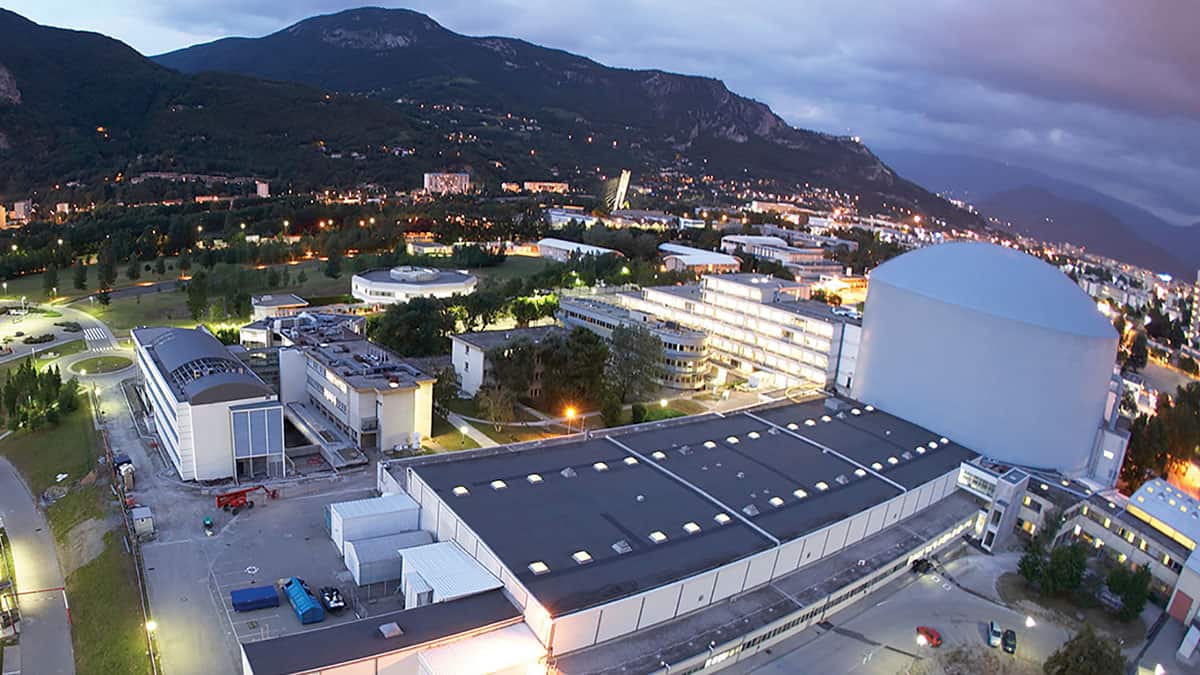
The ILL, which is located at the foot of the French Alps, is an international research centre with close to 500 people from 40 different countries. The facility has around 40 different instruments including diffractometers and spectrometers. The D19 instrument is a world-leading monochromatic thermal diffractometer that is used for detailed molecular studies in chemistry, biology and polymer science. Examples of research performed on D19 includes looking at proton hopping in molecular solids, studying enzymatic pathways connecting glucose to fructose, carrying out structural studies of DNA and analysing of the high-performance polymer Kevlar. The choice of which wavelengths to use for a particular experiment depends on the sample size and crystallographic unit cell, with D19 utilizing neutrons with a wavelength from 0.95 to 2.42 Å.
The choice of instrument and technique very much depends on the problem at hand – academic or industrial. As an instrument scientist, my tasks are diverse and variable. The primary one is to provide support to users for a variety of scientific experiments. Here my job is to assist the experimental team to obtain the best possible results from samples the preparation of which has often taken many months of work. The planning of the experiment will strongly depend on the specific nature of the sample, the length of beam time allocated to that particular experiment and obviously what the users need and expect.
The instrument-scientist role also implies a strong involvement in the development and upgrade of the instrument – something that is carried out very much in consultation with the external user community. Indeed, D19 was recently rebuilt and upgraded thanks to a grant from the UK’s Engineering and Physical Sciences Research Council.
Broadening horizons
Working at a facility like the ILL is not without its challenges. Experiments can be tough and tiring, and instrument scientists have the added worry of being responsible for users’ samples given that the result of their experiments are often crucial to their research. Sample preparation is often very demanding for users as their samples are often fragile, unstable or rare. This puts some added pressure and you have got to be as committed as if it were your own sample. Rigorousness, the ability to multitask, some creativity, patience and perseverance are great assets that you learn to develop, but it is a constant learning curve.
In addition to helping users, I am also developing my own in-house research work directly derived from both my PhD and postdoctoral work that focuses on protein folding and how this can cause neurodegenerative diseases such as Alzheimer’s and Parkinson’s disease. But one of the advantages of working as an instrument scientist is the opportunity to collaborate on a wide variety of research projects well beyond that to which a typical researcher is exposed. Interacting with research teams from around the world opens up your mind to a variety of different ideas in dynamic and challenging fields, and can lead to interesting partnerships and open up new perspectives. Recently, I had the opportunity to be involved in studying how cellulose fibres behave when they are stretched to breaking point. These results will be useful in the manufacture of textiles and have an impact on other industrial applications.
World-class research The Grenoble campus features leading centres such as the ILL and the European Synchrotron Radiation Facility. (Courtesy: P Ginter/ESRF)
On a daily basis this type of role benefits greatly from the interdisciplinary nature, the scientific background, and the multiculturalism of the ILL’s working environment. For me, the single biggest aspect that distinguishes a research centre like the ILL and anywhere else is precisely this sense of variety and diversity. The Grenoble campus is unique in that we have other world-class research facilities next door, such as the European Synchrotron Radiation Facility (ESRF), the European Molecular Biology Laboratory and the Institut de Biologie Structurale.
In all areas it is very clear that there is strong emphasis on interdisciplinary science, and neutrons occupy a central role alongside other major techniques including X-rays, electron microscopy and nuclear magnetic resonance. The European Photon and Neutron campus site – combining ILL, ESRF and the EMBL – naturally fosters a sense of community spirit among its users and staff.
User demands
The work rhythm of an instrument scientist varies and is very much correlated to the reactor cycles, which typically last 50 days. During this time, one of my colleagues or myself will be responsible for running the experiments. The instrument and user experiments are always the priority, so you have to make sure that however you organize your working day, you are – or can be – made fully available to the users whenever needed. Users apply for beam time through a competitive proposal system that is very carefully peer reviewed by a scientific panel of world experts – only the best experiments that are judged feasible on the instrument are selected and a fixed number of days will be allocated to the experiment. Experiments are mostly scheduled back to back so it is very important to maximize the time allocated to each experiment. It is therefore vital to work as efficiently as possible to allow the users to collect the data they need in the time given.
The structure of the working day very much depends on the type of experiment – some are more challenging than others in that they may be less standard in terms of set-up and sample environment, or simply because the sample is not behaving as planned. There are many parameters to take into account and, of course, not everything goes according to plan. As the intervening shutdowns last anywhere from two weeks up to three months during the winter period, that time can be spent catching up with data processing for the users, spending time on your own research, and writing the papers we were too busy to draft while the reactor was on. There is really no such thing as a typical day and that contributes to the attractiveness of the job.
“We build new instruments when we come up with new areas of science that we can explore with neutrons,” explains Chris Frost as he shows Physics World around the ISIS Neutron and Muon Source in Oxfordshire, UK. With new instruments being built and others being upgraded to meet the growing demands of industry and academia, it is apparent that there are lots of new ideas around. Indeed, some parts of the ISIS complex still look like a building site. “It’s a good thing,” adds Frost, who is industry liaison manager and instrument scientist at ISIS. “It means that someone is investing in building something here. We are regularly building new instruments or modifying the ones we already have.”
Having produced its first neutrons in 1984, ISIS is still Europe’s only pulsed source of neutrons. Today, it employs around 360 staff and is visited by more than 3000 users from over 30 different countries each year. The facility’s first target station – with 20 instruments – has been remarkably successful, with more than 10,000 research papers having been written off the back of work carried out there. In 2003 the facility won support for a £145m ($224m) second target station that began producing its first neutrons in 2008. Initially containing seven instruments – including three reflectometers, one spectrometer and three diffractometers – the facility has just completed a £30m upgrade that will see the addition of four instruments, just six short of full capacity.
We started anticipating the needs of the users over the next 10–20 years, so now there are many areas of science into which neutrons are providing key insights
ISIS is the only neutron source in the world running two target stations and the second station marks a shift in focus for ISIS from traditional areas such as magnetism and superconductivity to soft condensed matter, which includes the study of polymers and biological materials. While the first target station provided higher-energy, shorter-wavelength neutrons with a pulse rate of 50 Hz, the second target station will provide lower-energy, longer-wavelength neutrons with a pulse rate of 10 Hz – perfect for studying biological samples. “When we started at ISIS, many people were using neutrons to study magnetic systems,” says Frost. “We then started anticipating the needs of the users over the next 10–20 years, so now there are many areas of science into which neutrons are providing key insights.”
Industrial use
Neutrons are powerful probes that can provide detailed information on the structure of a range of materials from low-temperature superconductors to thin films of biological samples. Unlike X-rays, neutrons penetrate deep into a sample, revealing its bulk properties rather than just the material’s surface characteristics. As well as being electrically neutral, neutrons also have a magnetic moment, which means that they interact with magnetic materials to reveal details about their magnetic structure and spin dynamics.
Frost’s responsibility is as ISIS instrument scientist for ChipIR, which is one of the four new instruments on the second target station. Its role is to examine the damage that can be done to materials by high-energy neutrons and other particles created when cosmic rays interact with the Earth’s atmosphere. These particles can, in particular, affect chips and other electronic systems in aircraft and cars – not only by damaging the electronics, but also by wiping a device’s memory. ChipIR will be able to test components with a measuring time of just one hour – equivalent to exposing microchips to high-energy neutrons over hundreds of years of flying time in an aircraft. “ChipIR will help industry understand where the vulnerabilities are to help mitigate those problems in ways that are as cost-effective as possible,” says Frost.
Next to ChipIR is the IMAT neutron imaging and diffraction instrument. IMAT will be used in a broad range of areas such as aerospace, civil engineering, earth sciences and cultural heritage – for example, by measuring the strain in engineering components or the mechanics of cracks in steel. As for the two other new instruments – LARMOR and ZOOM – they are both small-angle neutron-scattering (SANS) instruments that can be used to study magnetism as well as polymers and biological samples. Rob Dalgliesh, an instrument scientist, says that LARMOR “has the potential to be one of the best instruments of its type in the world”. He adds that the instrument will be able to study many samples in 10–15 minutes or less using SANS and will provide a platform for new and exciting types of measurement using multiple techniques.
An industry angle to ISIS is not, however, new. It was back in the mid-1990s, at the first target station, that ISIS built the first purpose-built instrument for industry. ENGIN, which was upgraded to ENGIN-X in 2003, measures strain within a crystalline material assessing the internal structure of an aeroplane wing, for example. With instruments such as ChipIR and IMAT, ISIS is now keen to to build on this collaboration with industry. “Neutrons can solve near-market problems, be it stress in train wheels and bolts that are used in aircraft or providing better understanding of strain in underwater pipes,” says Frost. “Neutrons are a very effective tool for the non-destructive analysis of industrial materials.”
Users from industry, however, will have to pay for their beamtime if they want to keep the results to themselves rather than publish them in a journal. According to ISIS director Robert McGreevy, industrial participation will be an additional revenue stream for the lab with around 90% of the time on ChipIR being used by industry. Indeed, McGreevy adds that the next instrument to be built at the second target station will likely be another engineering instrument. “Neutron scattering can only be done at big facilities, so industrial engagement is increasing,” he says. “Industry use ISIS to improve their products and processes, and this benefits both the companies and the UK economy.”
Back to the future
While the second target station has taken all the focus in recent years, now some of that is changing back towards the first target station. There are plans to upgrade its target and moderator assembly – the design of which is around 25 years old – based on what has been learned during the construction of the second target station. According to McGreevy, that should result in a three- or four-fold improvement in terms of the neutron flux being delivered to each instrument. “Some instruments might see gains of more than this given the reduction in the background,” says McGreevy. “It would be for a relatively modest cost of around £15m – about the price of two instruments – so it would be a good investment.”
Further ahead, McGreevy adds that there could even be scope for a third target station. “Look at the economics and it is clear,” says McGreevy. “The accelerator is expensive, so the more science you can do with it, the more value for money you get.” Indeed, that optimism for expanding ISIS is not threatened by the upcoming European Spallation Source (ESS), which is being built in Lund, Sweden and will generate its first neutrons in 2019. The UK is a 10% partner in the project where it is building two beamlines. “Our futures are inextricably interwoven – ISIS will not become an obsolete facility,” says McGreevy. “If ISIS was not here, the ESS would not be useful for the UK because you would have no users to use it.”
As we near the end of our tour around both target stations at ISIS, Frost talks about what he sees as the strength of the facility and why it has been not only been successful for the UK, but a pioneering source worldwide. “Instruments scientists here do not just serve the academic community, they are actively part of that academic community,” he says. “We never stop thinking about what you can do next. We have been here for 30 years and we expect to be here for another 30 years.”
How neutrons are made at ISIS
Straight ahead A linear accelerator at ISIS accelerates negative hydrogen ions to 70 MeV before they are stripped of electrons leaving only protons, which are accelerated to 800 MeV in a synchrotron before hitting a tungsten target to generate neutrons. (Courtesy: ISIS)
ISIS produces neutrons by firing high-energy beams of protons at a tungsten target. First, negative hydrogen ions are produced in an ion source and accelerated to 665 keV before being accelerated in the linear accelerator to 70 MeV. They are then stripped of their electrons by a 0.3 µm-thick aluminium-oxide foil to leave a beam of protons that are then accelerated to 800 MeV via a 163 m-circumference synchrotron. Four out of five of the proton pulses kicked out of the synchrotron are sent to the first target station while the fifth pulse is sent to the second target station.
The protons from each beam then hit a tantalum-clad tungsten target where each proton produces 15–20 neutrons with around 2 × 10¹⁶ neutrons being produced each second. The proton beam energy deposited in the target on the first target station is 160 kW, and on the second target station is 40 kW. The neutrons are finally slowed down to useable energies by moderators such as water (316 K), methane (100 K) and liquid hydrogen (20 K). Neutrons are then channelled along beamlines to neutron instruments surrounding the targets.
Amid the endless green lychee orchards near China’s southern coastline lies what will be a new science hub for the country’s researchers. Set to be complete in 2018, the China Spallation Neutron Source (CSNS), located some 30 km southeast of Dongguan, will be the nation’s first “super neutron microscope” to peer into the structure and dynamics of a wide range of materials from high-temperature superconductors and polymers to metals and biological samples.
Compared with other microscopic probes, neutrons have unique advantages by having no electric charge, being able to easily penetrate materials and being sensitive to light atoms such as hydrogen. Yet because of the technical complexity and high cost of building spallation sources, only three are in operation today: the Spallation Neutron Source (SNS) at the Oak Ridge National Laboratory in the US, the Materials and Life Science Experimental Facility (MLF) at the Japan Proton Accelerator Research Complex in Tokai, Japan, and the ISIS Neutron and Muon Source in Oxfordshire, UK. The European Spallation Source in Lund, Sweden, meanwhile, is currently under construction with first neutrons due in 2019.
Joining the prestigious club will be the CSNS, which was first proposed in the early 2000s. Five years later, the CSNS was top of a list of nine big-science facilities to be built in China. While most existing large science facilities are located around Beijing and Shanghai, the CSNS will be the first to be hosted in south China, with the aim to boost science in the region, which includes Hong Kong and Macau. Construction for the 2.2 billion RMB ($350m) CSNS began in 2012 and all civil-engineering work is set to be finished by the end of this year. Delivery of the first neutron beams is expected to start in September 2017.
While China currently has two research nuclear reactors that are used for neutron scattering – one in Beijing and one in Sichuan – it is spallation that will push the country to the forefront of neutron science. “If [China] is to have access to the highest performance neutron scattering in the future, which it presumably will do as a leading research nation, then spallation is the most sensible option,” says ISIS director Robert McGreevy.
A typical spallation neutron source consists of three parts: an accelerator, target and a suite of instruments. The CSNS will feature a 200 m-long linear accelerator that will accelerate negatively charged hydrogen ions to 80 MeV. The particles, stripped of their electrons and converted into protons, will then be injected into a 75 m-diameter circular accelerator – dubbed the rapid cycling proton ring – to be further accelerated to 1.6 GeV. Upon entering the target station, the high-energy proton beams will strike a set of 15 tungsten plates – each 25 × 10 cm in size – with every proton releasing some 20 to 30 neutrons.
Yuanbo Chen, head of the Dongguan Campus of the CAS Institute of High Energy Physics, and former deputy manager for the CSNS, says the proton target was a key aspect of the project and the team initially looked into having a liquid-mercury target that is currently employed on the SNS and the MLF. “We decided to adopt the tungsten target similar to ISIS,” adds Chen.
These fast neutrons will then be slowed by a liquid-hydrogen moderator before they can be guided to different instruments for experiments. The CSNS aims to produce neutron pulses with a beam power of 100 kW, with bunches of protons being released at a rate of 25 times per second – or 25 Hz. Initially, there will be only three general-purpose instruments – a multi-purpose reflectometer, a small-angle diffractometer and a high-intensity diffractometer. “We hope that more will keep coming in within the next few years,” says Chen.
Daoxin Yao, a condensed-matter physicist at Sun Yat-Sen University in Guangzhou, who is a prospective user of the CSNS, says it is unfortunate that more instruments will not be available from day one. In particular, he points out the lack of spectrometers, which can each cost around 10 million RMB. However, Hesheng Chen, CSNS project manager, says they have put in a proposal to the Chinese government to fund delivery of 12 to 13 spectrometers.
Industrial use
As well as being a boon for academia, the CSNS will also benefit industrial users. “As China is increasingly interested in driving innovation and moving beyond manufacturing technologies developed in other countries, having strong domestic R&D facilities oriented to the studies of materials will be an important national asset,” says SNS director Thom Mason.
Indeed, the money for some of the planned spectrometers, Yao suggests, should not just come from the government but from industry. He points to manufacturing and pharmaceutical companies, including industrial giants PetroChina, Sinopec and China Guangdong Nuclear Power Group, as companies that could have a good use for neutrons.
Although the facility will not be complete for another couple of years, researchers in China are already planning to upgrade the facility to generate a 500 kW beam power, which will be met by increasing the energy of the linear accelerator to about 250 MeV. This will be done using superconducting technology that is being developed by the Institute of High Energy Physics and other partner institutions.
Land has also been reserved for a second target station, which will produce neutron beams at a different frequency. This would be more suitable for experiments in the life sciences. “With more research emphasis on areas like biophysics, it would be good for the CSNS to have a low-frequency target station, which might be 5 or 10 Hz,” adds McGreevy.
Located on the summit of Cerro Armazones in the Atacama Desert, in northern Chile, the 39 m main mirror of the E-ELT will gather 13 times more light than the largest optical telescopes operating today. Indeed, the collaboration says that the telescope’s advanced adaptive optics – which adjust the telescope’s deformable mirrors in real time to correct for distortions caused by Earth’s atmosphere – will allow it to take images that are 16 times sharper than those from the Hubble Space Telescope. The colossal telescope will enable astronomers to address fundamental cosmology questions by measuring the properties of stars and galaxies, probing the nature of dark matter, and studying Earth-like exoplanets and young galaxies in great detail.
Eye on the deep sky
MICADO, the E-ELT’s first camera, is being developed by a group of European institutes, led by the Max Planck Institute for Extraterrestrial Physics. The sensitivity of the near-infrared camera will be comparable to the James Webb Space Telescope, but with six times the resolution. It will be able to detect incredibly faint astronomical objects, and reveal the structure of galaxies and nebulae in unprecedented detail. MICADO’s astronomic precision should allow scientists to track the movement of objects that currently appear static, such as star clusters and even individual stars within clusters.
“If we look at two stars on the detector, we will be able to measure their position so precisely and so repeatedly, that if we make the same measurement a year later, we can see whether they have moved apart or closer together by about 1/5 of a micron,” explains Richard Davies, from the Max Planck Institute.
Spectral point-and-shoot
HARMONI – a spectrograph that will split visible and near-infrared light into its component wavelengths – will be built by a European consortium, led by the University of Oxford. Instead of taking spectral data from a single narrow split, like most spectrographs, HARMONI will use a technique known as “integral field spectroscopy” to obtain spatially resolved spectra from across the sky. Light will be split across 152 ”slitlets”, each of which will analyse its spectrum at 214 points. This means that more than 30,000 spectra will be obtained at the same time, making HARMONI much faster and more efficient than conventional instruments.
“HARMONI has been designed to be a workhorse instrument,” says Niranjan Thatte from Oxford. “We have designed it to be easy to calibrate and operate, providing the E-ELT with a ‘point-and-shoot’ spectroscopic capability.”
Complementary views
METIS will complement HARMONI and MICADO by providing imaging and medium-resolution spectroscopy across the longer wavelengths of the mid-infrared spectrum – from 3–19 μm – and high-resolution integral field spectroscopy at wavelengths of 3–5.3 μm. It will make full use of the E-ELT’s main mirror to focus on five goals: the physical and chemical properties of exoplanets, proto-planetary discs and planet formation, the history of the solar system, the growth of supermassive black holes, and high-redshift galaxies.
A group of European institutes, led by Leiden University, will develop the METIS instrument. Bernhard Brandl from Leiden told physicsworld.com that the project “is obviously a big challenge, but everyone is excited to be working on the project and we have received a lot of support from the university and the astronomical community in the Netherlands”.