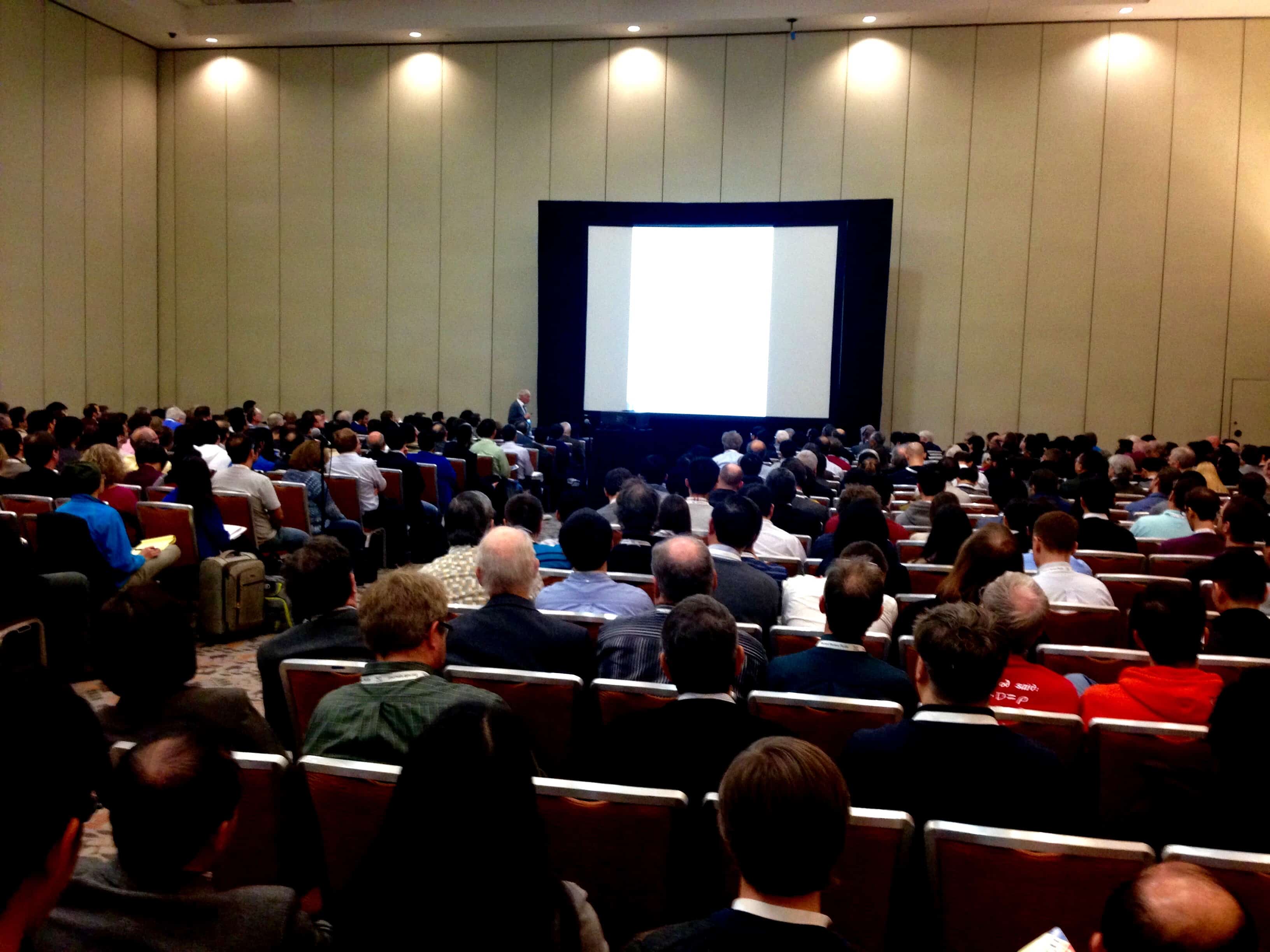
As the abstract of his talk suggests, Leggett looked at the ways, means and even the very definition of “condensed-matter physics” has changed and “evolved since its inception in the early 20th century, with particular reference to its relationship to neighbouring and even distant disciplines”. He went on to “speculate on some possible directions in which the discipline may develop over the next few decades, emphasizing that there are still some very basic questions to which we currently have no satisfactory answers”.
I missed the beginning of his talk as I was attending the morning’s first set of press briefings (more on those later) but when I did walk into the packed hall for his talk, his slide had the rather interesting title: “Would I encourage my grandchildren to go into condensed-matter physics?” Happily enough, his answer at the end of his talk was a resounding “yes”.
A joint European and Russian probe to study the atmosphere and surface of Mars has successfully launched today from the Baikonur Cosmodrome in Kazakhstan. The Trace Gas Orbiter (TGO) – a collaboration between the European Space Agency (ESA) and the Russian space agency Roscosmos – also includes the entry, descent and landing demonstrator module (EDM) that will test landing techniques for a future Mars rover.
When the TGO arrives at Mars following a seven-month journey, it will initially stay in a highly elliptical orbit until January 2017. ESA scientists will then use “aerobraking” – taking advantage of the planet’s atmosphere to slow the spacecraft down – to manoeuvre the TGO into a more circular orbit with an altitude of 400 km. “We do not know exactly how long aerobraking will take because this depends on how effectively we can use atmospheric drag,” Jorge Vago, project scientist for the mission, told physicsworld.com.
Researchers expect TGO’s scientific mission to begin in December 2017, when it will then operate for five years. Carrying four instruments including spectrometers, high-resolution cameras and a neutron detector, the TGO will map Mars for sources of methane, which could be evidence for possible biological or geological activity. The mission will also chart hydrogen below Mars’s surface up to a depth of around 1 m. This could, for example, reveal deposits of water-ice below the surface that could help to provide landing locations for future missions. Vago told physicsworld.com that observations with the TGO will be 1000 times better than previous missions.
Towards a Mars lander
The EDM, which is also known as Schiaparelli, will separate from the TGO three days before arriving at Mars. It will then enter the planet’s atmosphere at 21,000 km per hour and decelerate using aerobraking before deploying a parachute. Finally, it will use a thruster to brake just before landing on the surface. During landing and while it is on the surface of Mars, the EDM will monitor the pressure and temperature as well as take images. The probe is expected to last a couple of days on the surface before its battery is drained.
The EDM will be particularly useful for the next part of the joint mission between ESA and Roscosmos. The ExoMars rover, which is due to launch in 2018, will carry a drill and a suite of instruments dedicated to exobiology and geochemistry research, searching for possible signs of life, characterizing the water and geochemical distribution of the surface, and identifying any hazards for future manned missions to the planet. The EDM will be a useful testing ground for the techniques to successfully land the ExoMars rover, while the TGO will be used to communicate with the rover once it is on the surface.
When one becomes two
Getting the ExoMars project off the ground has been far from straightforward. It was initially a European-only mission that consisted of a single rover. Then following budget struggles, ESA joined forces with NASA, with the mission expanded to include an orbiter. But in 2011, due to the need to fund the James Webb Space Telescope, the US pulled out amid tight budgets. ESA then approached Roscosmos, who agreed to join the mission in 2012 with the TGO and ExoMars rover being split into two separate missions.
Astrobiologist Lewis Dartnell of the University of Leicester explains how ExoMars will look for evidence of life on Mars in the podcast “Is there life on Mars?“
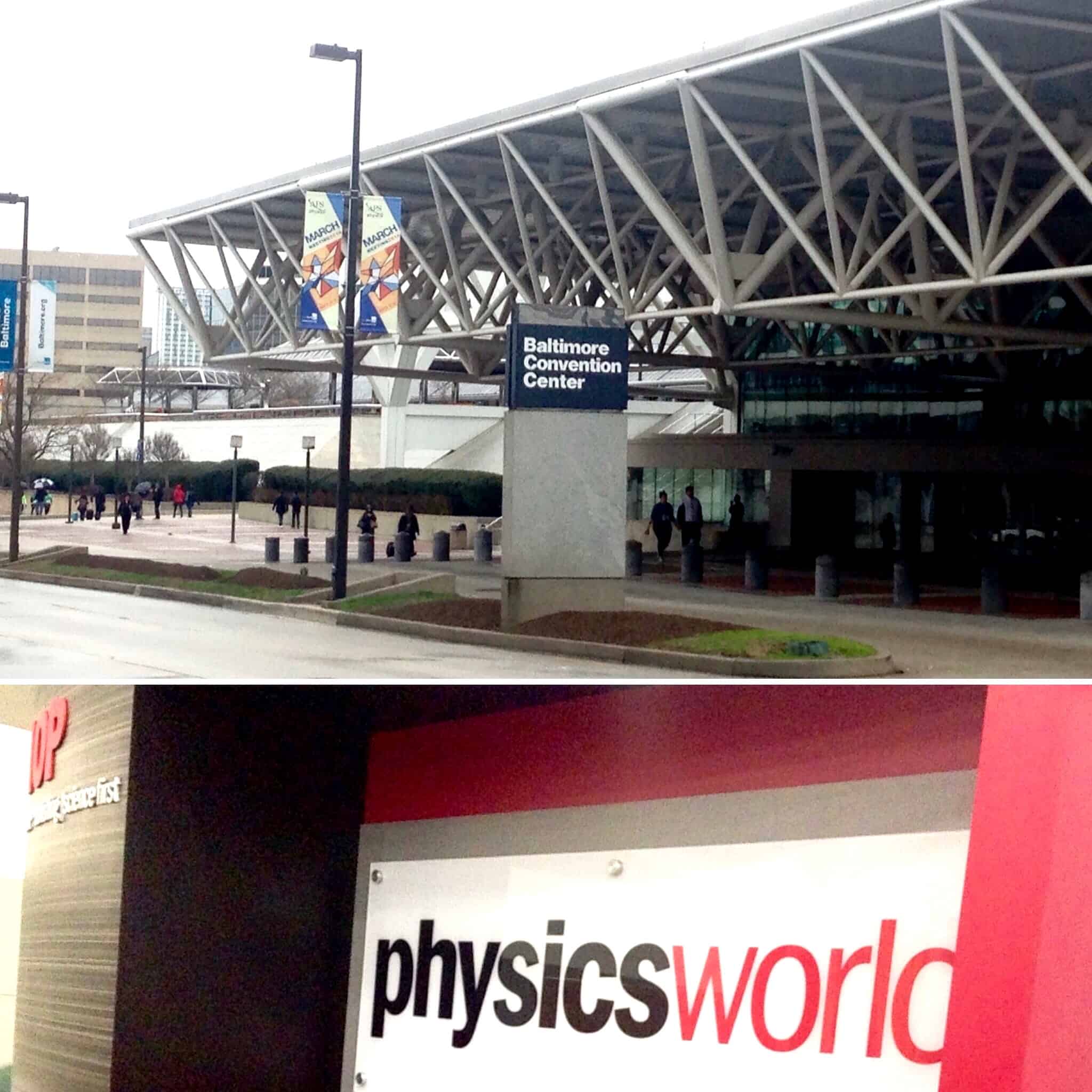
March madness: the APS March meeting at the Baltimore Convention Center (top) and the IOP Publishing stand at the exhibition. (Courtesy: Tushna Commissariat)
By Matin Durrani and Tushna Commissariat in Baltimore, Maryland, US
So here we are in Baltimore to attend the 2016 March meeting of the American Physical Society (APS). We’re writing this at the window seats in a burrito bar on Pratt Street while staring at the hulk that is the Baltimore Convention Center, where nigh-on 10,000 physicists will be congregating all week.
We’ve been playing a game of “spot the APS attendee” while tucking into our burritos. Without wishing to stereotype physicists (okay, go on then, we will) they’re the ones with the backpacks stuffed with poster tubes, pulling little trolley suitcases, looking lost before veering towards the convention centre.
There are also some physicists inside Chipotle Mexican Grill – you can tell because they’re huddled around laptops looking at PowerPoint presentations showing graphs of Fermi surfaces and topological insultators. Probably not the usual subject of discussion in here.
An important property of Majorana quasiparticles has been measured for the first time by physicists at the Niels Bohr Institute in Denmark. They found evidence that electrons in tiny nanowires form entangled states that are highly isolated from noise and other external stimuli. Because they are protected from outside influences, these Majorana “zero modes” could be used as quantum bits (qubits) in quantum computers.
First predicted by the Italian physicist Ettore Majorana in 1937, the Majorana particle obeys “non-Abelian” statistics, which means that quantum information encoded in the particles would be highly resistant to decoherence. Decoherence is the bane of physicists who are trying to develop practical quantum computers, and so devices based on Majorana particles could be used in future quantum-information systems.
While physicists have yet to see isolated Majorana particles, some collective excitations of electrons in solids have the same properties as Majorana particles. These “Majorana quasiparticles” have already been glimpsed in several systems, including semiconductor nanowires coated in a superconducting layer. When these nanowires are cooled to near absolute zero, superconducting electrons can exist within the semiconductor. An electron in the wire becomes entangled with electrons on either side of it, creating an uninterrupted chain of entangled electrons along the entire length of the wire.
Electron halves
At either end of this chain are electrons that are entangled only with one electron, which can each be thought of as “half” an electron and are called Majorana modes. Together they form a Majorana quasiparticle. Quantum information stored in such a quasiparticle would be distributed between both ends of the nanowire, meaning it should be protected from being destroyed by external noise.
“The protection is related to the exotic property of the Majorana mode that it simultaneously exists on both ends of the nanowire, but not in the middle,” explains Sven Albrecht, who was part of the Danish team. “To destroy its quantum state, you have to act on both ends at the same time, which is unlikely,” he adds.
An important feature of the Majorana modes is that the energy required to add another electron to the nanowire decreases exponentially with the length of the nanowire. This exponential decay is a signature of the protected nature of the Majorana modes and is something that previous studies have not measured.
Aluminium coating
Now, Albrecht, Charles Marcus and colleagues in Denmark are the first to measure how much energy is required to add just one electron to such nanowires. They began by creating nanowires of the compound semiconductor indium arsenide that were around 1 μm long and 0.1 μm in diameter. These were then coated with aluminium, which is a superconductor at low temperatures. The wires were then deposited onto a silicon substrate, where each wire was surrounded by a set of gold electrodes used to apply voltages to the nanowires and measure the resulting currents.
Crucial to the success of the experiment, according to Marcus, is the fact that the interface between the superconductor and the semiconductor is perfectly crystalline – rather than having randomly positioned atoms. This allows superconducting electrons from the aluminium to flow into the semiconductor to create a state of matter called a “topological superconductor”.
The team studied several different nanowires ranging in length from 330 nm to 1.5 μm. The researchers used a technique called Coulomb blockade spectroscopy to measure the energy needed to add an extra electron to the nanowires. As expected, they found that this energy decreased exponentially as the length of the nanowires increased.
Fast electronics
Marcus told physicsworld.com that the next step for the team is to use its nanowires to create a qubit and demonstrate that it is indeed protected from decoherence. This will require the development of fast electrical connections to the nanowires to read, write and manipulate quantum information in the Majorana modes.
Sankar Das Sarma of the University of Maryland in the US is one of the theoretical physicists who predicted the behaviour of Majorana modes in superconductor-coated nanowires. He describes this latest measurement as a “significant advance” that offers additional evidence that Majorana particles exist in nanowires. “These experiments provide further support for the semiconductor nanowires to be the best-available topological qubits among the many proposed such candidates,” he adds.
Looks as if LIGO's gravitational-wave discovery is still rocking all over the world, as you can now groove to the dulcet tones of singer and physicist Tim Blais, who runs the acapellascience channel on YouTube. With some help from the Perimeter Institute in Canada, the singer has created his latest "nerd-pop" parody, titled "LIGO Feel That Space" (sung to the tune of The Weeknd's "Can't Feel My Face"). After you listen to the catchy tune above, take a look at this interview with Blais on the Perimeter website to find out just how he creates his songs and how he went from physicist to a viral YouTuber.
A powerful numerical code that uses Einstein's general theory of relativity to describe how large-scale structures form in the universe has been created by physicists in Switzerland and South Africa. The program promises to help researchers to better incorporate dark matter and dark energy into huge computer simulations of how the universe has evolved over time.
At the largest length scales, the dynamics of the universe are dominated by gravity. The force binds galaxies together into giant clusters and, in turn, holds these clusters tight within the grasp of immense haloes of dark matter. The "cold dark matter" (CDM) model assumes that dark matter comprises slow-moving particles. This means that non-relativistic Newtonian physics should be sufficient to describe the effects of gravity on the assembly of large-scale structure in the universe. However, if dark matter moves at speeds approaching that of light, the Newtonian description breaks down and Einstein's general theory of relativity must be incorporated into the simulation – something that has proven difficult to do.
Upcoming galaxy surveys, such as those to be performed by the Large Synoptic Survey Telescope in Chile or the European Space Agency's Euclid mission, will observe the universe on a wider scale and to a higher level of precision than ever before. Computer simulations based on Newtonian assumptions may not be able to reproduce this level of precision, making observational results difficult to interpret. More importantly, we don't know enough about what dark matter and dark energy are, to be able to conclusively say which treatment of gravity is most appropriate for them.
Evolving geometry
Now, Julian Adamek of the Observatoire de Paris and colleagues have developed a numerical code called "gevolution", which provides a framework for introducing the effects of general relativity into complex simulations of the cosmos. "We wanted to provide a tool that describes the evolution of the geometry of space–time," Adamek told physicsworld.com.
General relativity describes gravity as the warp created in space–time by the mass of an object. This gives the cosmos a complex geometry, rather than the linear space described by Newtonian gravity. The gevolution code is able to compute the Friedmann–Lemaítre–Robertson–Walker metric that solves Einstein's field equations to describe space–time's complex geometry and how particles move through that geometry. The downside is that it sucks up a lot of resources: 115,000 central-processing-unit (CPU) hours compared to 25,000 CPU hours for a similarly sized Newtonian simulation.
Other uncertainties
Not everyone is convinced that the code is urgently required, and Joachim Harnois-Déraps of the Institute for Astronomy at the Royal Observatory in Edinburgh points out that there are other challenges facing physicists running cosmological simulations. "There are many places where things could go wrong in simulations."
Harnois-Déraps cites inaccuracies in modelling the nonlinear clustering of matter in the universe, as well as feedback from supermassive black holes in active galaxies blowing matter out from galaxies and redistributing it. A recent study led by Markus Haider of the University of Innsbruck in Austria, for example, showed that jets from black holes could be sufficient to blow gas all the way into the voids within the cosmic web of matter that spans the universe.
"Central and shining"
"In my opinion, the bulk of our effort should instead go into improving our knowledge about these dominant sources of uncertainty," says Harnois-Déraps who, despite his scepticism, hails gevolution as a great achievement in coding. "If suddenly a scenario arises where general relativity is needed, the gevolution numerical code would be central and shining."
Indeed, Adamek views the gevolution code as a tool, ready and waiting should it be required. Newtonian physics works surprisingly well for the current standard model of cold dark matter and dark energy as the cosmological constant. However, should dark matter prove to have relativistic properties, or if dark energy is a dynamic, changing field rather than a constant, then Newtonian approximations will have to make way for the more precise predictions of general relativity.
"The Newtonian approach works well in some cases," says Adamek, "But there might be other situations where we're better off using the correct gravitational field."
It is a battle between man and machine, but one that has been ultimately won by the brute force of computation.
Yesterday as well as today, Google’s DeepMind AlphaGo program has made a breakthrough in artificial intelligence by defeating Lee Sedol – the current world champion from South Korea – at the game of go.
Since its invention in the 1980s, scanning tunnelling microscopy (STM) has opened up a new world of possibilities by enabling researchers to image on the atomic scale. In this latest video for our 100 Second Science series, Peter Wahl from the University of St Andrews in the UK explains the basic principles of STM and explains why its invention has been so revolutionary. He explains how these microscopes overcome the resolution limitations of optical microscopy thanks to the phenomenon of quantum tunnelling.
Like you, I’m not biased. No way, not me. How could I be? I’m the editor of a magazine that’s devoting a whole issue to diversity. I did my PhD with Athene Donald – one of the first female professors of physics in the UK. The Physics World editorial team has more women than men. My father’s from Pakistan and my mother’s from Germany so that makes me ethnically and culturally diverse. I grew up in Birmingham in the English Midlands, which means there’s no way I have a north/south bias. I’m tolerant and fair-minded. I’m not rich or poor. And I’m sure I give everyone an equal chance. If I were a coin and you spun me, you couldn’t predict if I’d land heads or tails. So that’s me: definitely not biased.
But hang on a minute. Here’s the rub. We all like to think we’re not biased but, whatever our background, we all have in-built prejudices. This hidden, or "unconscious", bias means we naturally prefer the company of certain people, namely those who look and sound like ourselves. It’s not about us being bad or nasty people, although it can mean we end up stereotyping others. Our unconscious bias is just the natural outcome of how we’ve been brought up, where we went to school, who we mixed with, what subject we studied and where we’ve lived. That preference for certain kinds of people can be acceptable socially, but when it comes to positions of power – hiring staff, sitting on funding panels or promoting people – that bias can lead to decisions that are irrational, unfair and possibly even illegal.
Once you’re aware of unconscious bias, it becomes easier to spot. I was recently talking to my colleague Louise Mayor, who’s Physics World’s features editor, after she’d returned from a visit to the European Southern Observatory in Chile. She happened to mention two astronomers she’d spoken to who’d both been using the Atacama Large Millimeter Array to study various cosmic phenomena. Based on the many scientists I’ve met over the years, I automatically pictured the researchers as two white, middle-aged men. I think they had beards too. Wrong! Both astronomers were young women. I’d had a stereotyped picture in my head of the "average" scientist.
I could brush that incident under the carpet as an inconsequential one-off. No harm was done; it was a mere thought that popped into my head. What did it matter that I’d imagined those two astronomers as men? But my unconscious bias can have consequences. It could make me more likely to pick bearded white men to write features or book reviews for Physics World, subtly perpetuating the myth that physics is only for bearded white men. I might pay slightly less attention when speaking to a female physicist on the phone; after all, there have only ever been two female Nobel laureates in physics so it’s surely just efficient to focus more on the thoughts of male physicists?
There is, of course, nothing wrong with publishing articles by bearded white men or listening carefully to the thoughts of male physicists on the phone. It’s just a case of giving everyone a fair chance. Unfortunately, our unconscious bias trickles into all areas of our lives. It can lead to schoolteachers treating boys and girls subtly differently in science classes and to recruiters judging women’s CVs as less striking than those of men. It might also explain why many people organizing scientific conferences end up with all-male panels even though women make up a sizeable proportion of the relevant community (see "Reflecting reality", below).
Uncovering my bias
To find out how biased I really am, I decided to take several Implicit Association Tests (IATs), which are designed to tease out your subconscious attitudes to everything from race and gender to disability and sexual orientation. Originally developed in the 1990s by US-based social psychologists including Mahzarin Banaji and Anthony Greenwald, these tests form part of Harvard University’s Project Implicit and can be done by anyone online (http://ow.ly/WF9J9). In the case of race, you’re asked to cross-link white and black faces to positive- and negative-sounding words by striking the correct keys on your computer keyboard. There are no wrong answers; the test measures only how fast and accurately you respond.
Before doing the test, I started reading Banaji and Greenwald’s book Blind Spot: Hidden Biases of Good People (2013 Delacorte Press). It warned me that many people who take IATs are shown to have discriminatory views – despite them genuinely believing they hold egalitarian beliefs. And so it proved for me. According to the test, which takes about five minutes to complete, I have a "strong automatic preference for white people compared to black people". Essentially, I responded faster when faces of white people and good words were paired than when black people and good words were paired. I took the test again just to make sure it hadn’t miscalculated my score, but no, once again it decreed I strongly prefer white people.
That was my ego punctured. There was some comfort, though, in finding that I’m not alone. More than 20,000 people take the online IATs each week, with about 70% of respondents to the race test having a "slight", "moderate" or "strong" automatic preference for white people. Some 17% have no preference and the rest prefer black people. So despite my best intentions, I’m unconsciously racist – or, as Banaji and Greenwald put it, I’m an "uncomfortable egalitarian".
Still, surely my attitudes to women in science were going to be beyond reproach? Gender equality is something we take seriously at Physics World so I was banking on a better score on the IAT for that. This time I was asked to link male and female words with arts- and science-related words. Another disaster. The test suggested I have "a strong association of male with science and female with liberal arts compared to female with science and male with liberal arts". Again, I’m not alone. Overall, 72% of respondents have a "slight", "moderate" or "strong" association between men and science, with 18% having no association and the rest identifying women more with science.
The impact of bias
Chastened by the results, I continued reading Blind Spot. I’d supposed that having an automatic attitude doesn’t necessarily mean that you endorse it. The test, in other words, might have shown me to be biased, but surely I don’t act that way in real life. Yet as Banaji and Greenwald point out, we are so prone to stereotyping certain groups that even people in those groups can hold such stereotyped views to some extent. A female physicist on, say, a recruitment or grant-allocation panel can unconsciously favour a male applicant because she assumes men are better scientists and that it’ll help her to be part of a powerful "in-group" of male colleagues.
So how can we change our unconscious bias? The bad news is we can’t as it’s ingrained into our automatic thinking. However, being aware of the issue – as I now am – at least means we can recognize our bias and seek to address it. Finding solutions can be tricky but they don’t have to be hard to put into practice. Banaji and Greenwald cite a great example from the US symphony-orchestra scene back in the 1970s, which was then – like physics – dominated by men. Several orchestras changed their auditions by simply adding a screen between a musician and the judging committee. These "blind" auditions led to the proportion of women hired doubling from 20% to 40%. Ironically, the procedure wasn’t adopted to improve the gender ratio, but to ensure judges didn’t pick musicians who’d been trained by a small band of famous teachers.
Change in perspective One way to challenge your biases is to surround yourself with images of people you are biased against, so they stop seeming 'unusual' to you. This is the thinking behind social-media campaigns such as #ilooklikeaphysicist. Participants included: (top row) Suma Nallapati (Colorado Governor’s Office of Information Technology), Jennifer Ross (University of Massachusetts Amherst), Maggie Lieu (University of Birmingham), Chiara Mingarelli (California Institute of Technology and Max Planck Institute for Radio Astronomy); (bottom row) Linda French (Illinois Wesleyan University), Becky Douglas (University of Glasgow), Clara Nellist (CERN), Andrea Albert (SLAC National Accelerator Laboratory) and Caitlin Johnson (University of California, Santa Cruz). (Photographs kindly supplied by individual subjects)
One organization tackling unconscious bias is Research Councils UK, which oversees the activities of the UK’s seven research councils. To help ensure that the £3bn it hands out each year in research grants is distributed fairly, it has just launched a new programme that will see more than 1300 people – including peer-reviewers, policy-makers and research-council staff – having access to online training on unconscious bias over the next three years. The training will be based on a series of workshops that will, according to an RCUK spokesperson, "openly explore bias, allowing participants to recognize their own biases and the impact these could have on their decision-making". With such big sums at stake, even a small shift in behaviour could reap big dividends.
Reflecting reality
One consequence of unconscious bias is that people organizing conferences, who are often men, inadvertently pick people who are just like them. That can lead to situations where all invited speakers or every member of a panel debate is a man, not reflecting the gender ratio of the relevant community. Faced with a backlash, conference organizers will defend themselves by claiming there just aren’t enough suitably qualified or appropriate women to invite onto the panel – it’s "just one of those things". There’s even a blog (http://allmalepanels.tumblr.com) devoted to mocking all-male line-ups, in which a picture of David Hasselhoff giving the thumbs up appears on a seemingly endless stream of men-only panels.
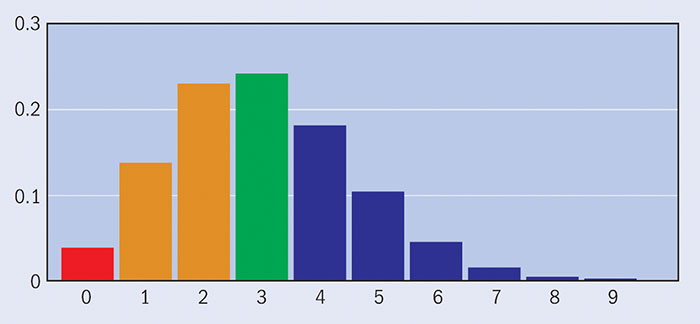
It's all in the numbers For a 20-member group drawn randomly from a community containing 15% women, this graph shows the number of women in the group on the x axis and the fractional probability of having that many women on the y axis.
To illustrate just how statistically unlikely all-male panels or invited-speaker lists are for a given community, Aanand Prasad – a London-based Web developer – has created the Conference Diversity Distribution Calculator (http://ow.ly/WO3px). It tells you how many women you would expect to find in a random selection of x people assuming they make up y% of available speakers. In the case of physics, women account for about 15% of research-active staff according to 2013 data from the Institute of Physics, which publishes Physics World. This means there’s a 44% chance that, at random, a five-member group would have no women at all. With 10 people, the likelihood falls to 20%, while with 20 people the chance is less than 4%.
I can see many physicists rolling their eyes at the prospect of being forced to sit through training sessions on unconscious bias when they could be do something more useful, like proper work. As they will rightly point out, our unconscious brains are wired up to process and sift vast amounts of information looking for patterns. If you only ever come across, say, male IT staff and female receptionists, then surely it’s just an efficient short cut to assume who’s who if faced with a room full of IT staff and receptionists.
The problem is that when we are in positions of power, our unconscious bias can lead to us holding back others professionally. As the Royal Society put it in a briefing note issued last year to those who decide who should win its grants, awards and fellowships: "We perceive a pleasant fluency of action when we experience familiarity, and this makes us feel confident and in control of our decisions. With unfamiliar members of other groups we are on less sure ground." As we feel it’s risky to pick a candidate from such a group, scientists "redefine merit to justify discrimination".
The Royal Society’s note also has five tips for those seeking to avoid unconscious bias (see "Five tips to avoid bias", below). But another simple solution I came across several times while researching this article is that if you have, say, an unconscious bias against female scientists, then simply put lots of photos of female scientists on your pinboard or screensaver. The idea is that by surrounding yourself with such images, the group you’re biased against will feel less different and more normal to you. With time, you’ll become less prone to making negative, snap judgements about people from that group and more likely to keep your bias under control.
As I finished my exploration of unconscious bias, I came across a fascinating study published last year by a team of psychologists in the US, which showed that some of us have a bias against research that shows a bias (Proc. Natl Acad. Sci.112 13201). Led by Ian Handley from Montana State University, the researchers asked more than 200 university staff to read the abstract of a paper reporting a bias against women in science, engineering, technology and mathematics (STEM) and then to rate the quality of the research. While both men and women rated the findings positively, men ranked it less favourably, agreeing with the results less, finding the study less important and judging it more poorly written. Male STEM staff showed a particular bias against the findings.
Perhaps this article is destined for the same fate.
Five tips to avoid bias
The Royal Society last year issued a briefing note for members of its panels and committees who decide which scientists should get grants, awards or fellowships from the society. In seeking to ensure decisions adhere to the society’s ethos – and so are made "purely on the basis of the quality of the proposed science and merit of the individual" – it offered these five tips: 1. When preparing for a committee meeting or interview, try to slow down the speed of your decision making. 2. Reconsider the reasons for your decision, recognizing that they may be post-hoc justifications. 3. Question cultural stereotypes that seem truthful. Be open to seeing what is new and unfamiliar and increase your knowledge of other groups. 4. Remember you are unlikely to be more fair and less prejudiced than the average person. 5. You can detect unconscious bias more easily in others than in yourself so be prepared to call out bias when you see it.
Researchers in the US have taken images of individual atoms in an ultracold fermionic gas as it makes the transition from a metallic phase to a band insulator and then to a Mott insulator. This is the first study of such a transition in a fermionic gas to be made with single-site and single-particle resolution. While such experiments are routinely done using ultracold bosonic atoms, doing the same with fermions is more challenging because they are difficult to cool. However, the rewards for physicists could be greater because fermionic atoms are a closer match to electrons in a solid, and therefore such experiments could shed light on poorly understood solid systems such as high-temperature superconductors.
Fermions are particles that have half-integer spin, and are constrained by the Pauli exclusion principle, which dictates that no two identical fermions can occupy the same quantum state simultaneously. Fermions include many elementary particles such as quarks, electrons, protons and neutrons, and so their collective behaviour is responsible for the structure of the elements in the periodic table, high-temperature superconductors, the properties of nuclear matter and much more.
Cooling off
Studying strongly interacting systems of fermionic atoms in ultracold gases should allow physicists to study a wide range of collective behaviours. However, creating such systems is difficult because the exclusion principle means that each fermion added to a system comes in at an increasingly higher energy, making such gases very difficult to cool and image. It was only last year that researchers managed to create and image an ultracold fermionic gas in an optical lattice, where single fermions were clearly resolved and certain interactions directly detected (see "Fermionic microscope sees first light").
A fermionic microscope allows quantum physicists to delve into the intricacies of how strong interactions between fermions lead to complex quantum many-body systems such as spin liquids and d-wave superconductors. Probing such systems with single-site resolution in a lattice should offer key insights into these phenomena.
Fermionic transitions
Now, Daniel Greif, Markus Greiner and other colleagues at Harvard University in the US have created their own fermionic microscope using ultracold lithium-6 atoms that are trapped in a 2D optical lattice. They then used it to take images of the atoms as the system makes the transition from a metallic phase to a band insulator, and then to an interaction-dominated Mott-insulator phase.
When the interaction energy of the gas is small compared with the kinetic energy, the atoms are largely free to move around, although no two fermions will occupy the same lattice site unless their spins are different. But as the interaction energy between atoms is increased to cause a greater repulsion between atoms – limiting the atoms' ability to hop between lattice sites – phase transitions occur.
In the Mott-insulator state, for example, the repulsion is so strong that an atom cannot hop into a neighbouring site that contains an atom. Because all sites contain one atom, the atoms are unable to move and behave like an insulator in an analogy to electrons in a solid. This kind of self-arranged quantum state could, in principle, have very low entropy, which makes it a good starting point to engineer other many-body quantum systems of interest. Normally, the atoms' spins do not influence one another during a Mott phase and only their relative positions have any influence. However, at very low temperatures a phenomenon known as "superexchange" kicks in and the spins should be ordered in an alternating and anti-aligned pattern.
New view
Team member Sebastian Blatt told physicsworld.com that the team has extended a fermionic microscope technique developed last year to fermionic lithium-6. "The only two alkali metals that can be laser-cooled and have fermionic isotopes are lithium-6 and potassium-40," says Blatt. But he also points out that the metals' atomic structure does not lend itself to the fluorescence-imaging technique used in quantum-gas microscopes, so getting the imaging technique to work at the single-site- and single-atom-resolved level was "a major step forward".
"The new thing about the imaging is that we can now measure local variables and correlations in this quantum many-body system," says Blatt, explaining that the fermionic character of the atoms is important because it leads to very different states of matter than those formed in bosonic systems. "Our fermionic lithium-6 atoms are also much closer in character to electrons in solids than typically used bosonic atoms such as rubidium-87. This is both because lithium-6 is a fermion, and because of its relatively small mass," he adds. This ability to experimentally observe local changes and transitions in ultracold fermionic gasses will help to improve our understanding of fermionic many-body systems.