Between the lines

Filling in the gaps

The story of astronomy has plenty of highlights. Galileo’s observations. Kepler’s calculations. Henrietta Leavitt’s Cepheid variables. Hubble’s receding galaxies. And so on, up through Arno Penzias and Robert Wilson’s puzzling detector noise (“the echo of the Big Bang”) and the still-mysterious discovery that the expansion of the universe is accelerating. All of these highlights could (and in most cases do) have entire books written about them, but it is rare to find all of them in a single volume, let alone one as accessible as Ethan Siegel’s Beyond the Galaxy. An astrophysicist and teacher, Siegel is best known for his blog Starts with a Bang (see October 2011 “Web life”), which has given him plenty of practice at explaining complex concepts to a general audience. This is fortunate, because the story he tells here is an intricate one, taking in elements of nuclear and atomic physics as well as astronomy and the history of science. In this methodical account, how we came to know things about cosmology is almost as important as the knowledge itself, and Siegel’s tale is distinguished by the respectful way he treats hypotheses that fell out of favour after new data emerged to discredit them. “When two explanations can account for the same phenomenon, it is not simply enough to choose the simpler one or the one that you feel better about,” he writes. “Instead, you need to look a little deeper, and find where the explanations differ from one another in their predictions for something you can then go and look for, either observationally or experimentally.” (Sometimes, of course, individual astronomers have clung to their preferred explanations even after the compass needle of evidence had swung in another direction; Siegel is much less forgiving of this.) The book is pitched at a level somewhere between popular science and beginners’ astronomy textbooks, and it contains few equations, but plenty of graphs containing real astrophysical data. It also offers detailed explanations of concepts such as the r-process, which describes how giant stars kick out huge quantities of heavy elements in their death throes. In the book’s later chapters, there are a few lapses; objects such as “cosmic strings” and “domain walls” play important roles in Siegel’s discussion of dark matter but are defined only briefly, while analyses of the three possible fates of our universe (a “big crunch”, limitless expansion in a “big freeze” or a finely balanced “Goldilocks” universe where expansion eventually slows to zero but never reverses) appear three separate times. Overall, though, Beyond the Galaxy is an excellent way for less cosmically minded physicists to fill in the gaps in their astronomy knowledge, and thereby transform “things I’ve vaguely heard about” into “things I actually know something about”.

  • 2015 World Scientific £29.00/$38.00pb 388pp

The Planck problem

For a physicist whose most important insight came in the year 1900 – and who by his own admission fell short of true scientific brilliance – Max Planck is remarkably well known. Physics students learn the value of his famous constant h (or its variant, ħ) by heart. Historians of science trace the quantum era back to Planck’s 1900 paper on black-body radiation, which suggested that light might exist in discrete packets. In Planck’s native Germany, his name is attached to a network of prestigious research institutions. And as Brandon Brown points out in his fine new biography Planck: Driven by Vision, Broken by War, this stern old-fashioned Prussian gentleman was also responsible for “Planck’s principle”, the darkly comic observation that a new scientific idea becomes accepted “because its opponents eventually die and a new generation grows up that is familiar with it”. Early in the book, Brown argues that Planck was an exception to this rule, pointing out that when Albert Einstein came on the scene, Planck (unlike most of his similarly middle-aged contemporaries) eagerly adopted the younger man’s revolutionary ideas about light and gravity. But Planck’s adaptability had limits. As the quantum revolution gathered pace, Brown writes, “Planck would play the role of a worried parent asking everyone to slow down, to be careful please”. Tragically, this innate conservatism also applied to Planck’s politics. In the opening weeks of the First World War, Planck was among the 93 Germans intellectuals who signed an “Appeal to the Cultured Peoples of the World” protesting against supposed “lies and calumnies” about the German army’s conduct in Belgium. His Dutch colleague Hendrik Lorentz (who Brown memorably describes as “the kindly papa bear of physics”) eventually managed to convince him that some of the atrocity stories were true, but he remained deeply patriotic. This stance led him, for the most part, to adopt a strategy of accommodation after the Nazis came to power in 1933. “Flanked by swastikas, he praised his Führer to start speeches [and] executed the Nazi salute,” Brown writes. “When asked to bar Jewish students from his classrooms and then fire Jewish staff, he did as he was told.” Planck’s chosen path, which Brown describes as “working within the new system, however deranged, and trying to make a positive difference, however small”, dealt a severe blow to his reputation. His sporadic attempts to ingratiate himself with the Nazis were also not enough to save his son Erwin, who was hanged for his alleged involvement in the 1944 plot to kill Adolf Hitler. After the war, some of his former colleagues forgave him; Brown quotes a postwar letter from Lise Meitner in which she writes of Planck’s “unusually pure disposition and inner rectitude”. Thanks to an Allied bombing raid that destroyed his home and library, there are big gaps in what we know about Planck; accordingly, Brown’s biography often strays from its central character. Many of these diversions are interesting in their own right, but the book’s nonlinear structure can be disorienting. In one especially jarring passage, Planck’s granddaughter survives a difficult birth on one page, then appears on the next page some 20 years later as a survivor of an apparent suicide attempt. Overall, though, Planck is an illuminating and thought-provoking book about one of physics’ near-greats and his troubled times.

  • 2015 Oxford University Press £20.00/$29.95hb 280pp

How black holes saved relativity

While there have been many popular science books on the historical and scientific legacy of Albert Einstein’s general theory of relativity, a gap exists in the literature for a definitive, accessible history of the theory’s most famous offshoot: black holes. When asked for a good introduction to the strange regions of space–time that nothing, not even light, can escape from, one might mention Stephen Hawking’s A Brief History of Time. However, while this text is highly accessible, it primarily focuses on the search for quantum gravity, with black holes playing a smaller role. Meanwhile, Kip Thorne’s Black Holes and Time Warps is all about black holes, but makes a rather demanding read; although it can be compelling for physicists or serious enthusiasts, it is perhaps too long and technical for a mainstream lay audience.

In Black Hole, the science writer Marcia Bartusiak aims for a discursive middle ground, writing solely about black holes at a level suitable for both high-school students and more mature readers while also giving some broader scientific context for black-hole research. Her text works harder than most to straddle the fence between popular-science exposition and history of science. Instead of simply developing the scientific theory and accessorizing it with historical facts, Bartusiak puts forward a thesis about the intimate relationship between the acceptance of general relativity and the acceptance of black holes by the physics mainstream.

One of the pleasures of Bartusiak’s book is her careful word choice and the exquisitely clear explanations of the science involved at every point in the story. Bartusiak holds a faculty appointment in a science writing programme, and this is strongly reflected in Black Hole. Her words are a powerful riposte to the suggestion that writing for a popular audience requires specious oversimplifications of the science at play or repeated use of the same analogies over and over again. Bartusiak invents some novel ways to describe physics, which is a helpful contribution not only for lay readers but also for scientists looking for new ways to communicate their research. I enjoyed her penchant for unusual phrasing – for example, in describing black holes as “wackily weird” in the preface.

Though the first few chapters on the early history of the idea of black holes are somewhat lethargic, the writing bursts into life when she introduces supernovae – stars that have exploded at the end of their lives – to the story. Her account of Fritz Zwicky’s thought process as he developed the first rudimentary understanding of how a supernova might occur provides a useful lesson about how creativity – an often-ignored quality – is required to succeed in science. By connecting ideas from two seemingly disparate areas of physics, Zwicky used imagination rather than algorithm to develop a new and ultimately profound idea.

In some ways, Black Hole succeeds as a history of science book. The main text de-emphasizes dates, improving the book’s accessibility, while Bartusiak has added a helpful timeline at the back for the curious reader. However, her dedication to readability can prove frustrating for readers looking for a more open interpretation of historical events. For example, in describing a famous incident where the British astronomer Arthur Eddington rejected Subramanyan Chandrashekar’s proposed minimum mass for white-dwarf stars, Bartusiak’s account of what happened between Eddington and the Punjabi-born “Chandra” significantly neuters the story in a way that seems designed to make readers comfortable, at the expense of truly capturing what happened. This part of the story is best read in tandem with Arthur I Miller’s book Empire of the Stars, which describes Chandra’s feeling that racism was a factor in Eddington’s behaviour, and also shows the extreme impact that this rejection had on Chandra’s psychological wellbeing for the rest of his life.

Bartusiak does, ultimately, wonder whether things might have been different if Eddington had championed Chandra’s idea instead of eviscerating it. She answers in the form of a quote from the physicist Werner Israel, who says that the culture was simply not ready to accept black holes. But there’s another question that Bartusiak fails to ask, which is this: What compelling discovery might Chandra have made had he not felt so discouraged that he stopped working on black holes for decades? Einstein himself was a staunch anti-racist, so I doubt he would object to us asking this question 100 years after the advent of general relativity, in an era when “diversity” has become a buzzword. Bartusiak misses an opportunity to reflect on the lessons old mistakes ought to teach us about the impact of discrimination on the scientific mission today.

More broadly, Black Hole was, at times, an uncomfortable read for a theoretical cosmologist. One of the book’s central theses is that acceptance of general relativity was predicated entirely on the community’s belief that black holes were a phenomenon worth investigating. In this particular telling of general relativity’s history, the dramatic competition to accurately measure Hubble’s constant (which lasted for more than half a century) never figures into the conversation, even though it happened simultaneously in some of the same research centres as the black-hole story.

Perhaps Bartusiak is correct, and general relativity would have died out as a research area had it not been for the renewed interest generated by black-hole-related discoveries. But Black Hole never makes a truly compelling case for this idea, in part because Bartusiak circumscribes the storytelling to leave out any true mention of cosmology research. Had this been properly accounted for, the thesis that black holes were simply more important to the theory’s long-term viability might be more believable.

Black Hole ends without fully moving into the modern era of black-hole exploration, where intersections with other areas of research, such as cosmology and galaxy formation, are ever-growing. The community has changed, too, with more members of under-represented groups participating in black hole research, although almost none are mentioned in the book. Ultimately, though, Bartusiak’s work fills a much-needed gap in the popular-science literature and provides an excellent introduction for non-experts to the science of black holes, even if it does not completely succeed at capturing the historical arc of black-hole exploration.

  • 2015 Yale University Press £14.99/$27.50hb 240pp

Indian gravitational-wave observatory wins governmental approval

Hot on the heels of last week’s monumental discovery of gravitational waves – made by researchers working on the Advanced Laser Interferometer Gravitational-wave Observatory (aLIGO) in the US – India’s Union Cabinet has given its “in-principle” approval for a similar observatory, dubbed LIGO-India, to be built in the country. The project will be led by the Indian Initiative in Gravitational-wave Observations (IndIGO), which has been a member of the international LIGO collaboration since 2011 and contributed towards last week’s discovery. Once built, LIGO-India will join the global network of LIGO observatories, which currently includes the US, Germany, Italy and Japan.

LIGO-India will be backed by the government’s Department of Atomic Energy (DAE) and the Department of Science and Technology (DST), together with its US counterparts. Indeed, Indian prime minister Narendra Modi gave his approval this morning via a series of tweets, saying that the “LIGO-India project will establish a state-of-the-art gravitational-wave observatory in collaboration with LIGO Laboratory run by Caltech and MIT”. Modi added that LIGO-India will also bring “considerable opportunities” in cutting-edge technology for Indian industry. “The project will motivate Indian students and scientists to explore newer frontiers of knowledge and will add impetus to scientific research,” he tweeted.

Global eye on the sky

The aLIGO collaboration last week announced that it had detected gravitational waves produced from the collision of two black holes of 36 and 29 solar masses some 1.3 billion light-years from Earth. The holes had merged to form a spinning, 62 solar-mass black hole, in an event dubbed GW150914. The signal revealed the characteristic “chirp” waveform of such an event, and LIGO collaborators in India, including Bala Iyer from the Raman Research Institute in Bengaluru and Sanjeev Dhurandhar at the Inter University Campus for Astronomy and Astrophysics in Pune, were instrumental in calculating and simulating such waveforms.

“It is heartening to see the involvement of many young scientists in India in this discovery”, says LIGO member B S Sathyaprakash, from Cardiff University in the UK.

For GW109914, a signal was picked up by both of LIGO’s US observatories, in Hanford, Washington, and in Livingston, Louisiana, which are separated by 3002 km. But researchers are keen to refine their observations and improve their measurement sensitivity by having a global network of detectors, which would simultaneously detect incoming gravitational-wave signals and reveal more about where they come from.

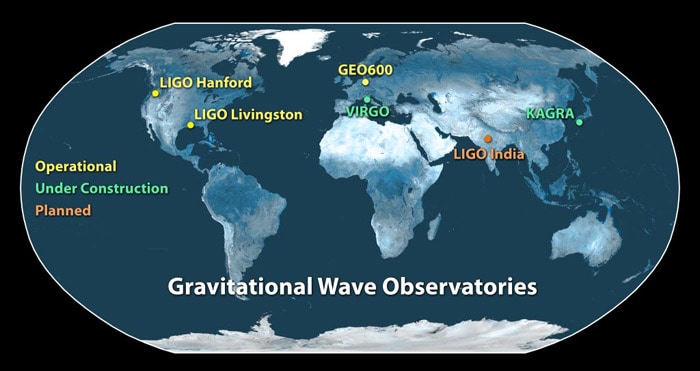
A map showing the global gravitational-wave observatory network

Worldwide network

With each added observatory, the researchers can pick up even more signals, boosting the chances of a confirmed wave. Such a network would also let researchers narrow and localize the gravitational-wave’s source in the sky – with two detectors, LIGO can currently only gauge the general direction from which the waves have come. Pinpointing a fixed location requires data to be combined from geographically separated detectors.

Apart from the two LIGO observatories in the US, astronomers have access to data from the GEO600 detector in Germany, which is currently online, while the Virgo detector in Italy (HHLV) and the KAGRA detector in Japan are both currently being upgraded (see map above). According to the IndIGO collaboration, adding a new detector in India a long way from existing detectors would “dramatically improve the source-localization accuracies (five to 10 times), thus enabling us to use gravitational-wave observations as an excellent astronomical tool”.

It is still, however, early days for LIGO-India, despite the positive global reaction to last week’s discovery of gravitational waves. Although Satyaprakash says he is “absolutely delighted, as this is what our Indian colleagues were seeking”, he told physicsworld.com that the government should now release funds for exploratory work and submit a “detailed project report” for full approval. “In a way, the real work starts now,” he says. “When the full approval comes this will be a new chapter in Indian science but we need to wait until then.”

What’s so super about superconductivity?

The fascinating phenomenon of superconductivity was discovered in Leiden in 1911 by the Dutch physicist Heike Kamerlingh Onnes. In this video from our 100 Second Science series, Catherine Pépin of CEA Saclay, France, describes how Onnes was surprised to see the electrical resistance of mercury drop to zero when the metal was chilled to a temperature of about 4 K. Pépin describes some of the unexpected consequences of this discovery and how it triggered a hunt for room-temperature superconductors that could lead to transformational applications.

If you enjoyed this video explainer, then check out more from our 100 Second Science series.

Japanese X-ray observatory launches

The Japanese Space Agency, JAXA, has launched its heaviest space mission to date – a huge X-ray probe that will study galaxy clusters, active galactic nuclei and supernova remnants. Launched from the Tanegashima Space Center by a H-IIA rocket today at 17:45 local time, ASTRO-H – weighing 2700 kg and measuring 14 m long – will now be placed in a low-Earth orbit at an altitude of 575 km, where it will operate for three years.

Many objects in deep space – including black holes, neutron stars, and galaxy clusters – emit X-rays as well as visible light. As the Earth’s atmosphere blocks X-rays from reaching land-based telescopes, the best way to study X-rays from deep space is to use an orbiting telescope.

ASTRO-H is a multipurpose X-ray observatory that will aim to explore the structure and evolution of the universe, including the distribution of dark matter in galaxy clusters. “ASTRO-H will extend the frontier of high-resolution X-ray spectroscopy,” ASTRO-H project manager Tadayuki Takahashi from the University of Tokyo told physicsworld.com. “ASTRO-H will determine the velocity field of the gas in clusters of galaxies and allow sensitive and precise measurements of how clusters grow and evolve, as well as measure the chemical composition of the gas in active galaxies that should allow measurements of the strength of the winds in these sources.”

Unique instrument

ASTRO-H contains four instruments including a gamma-ray detector, a soft X-ray spectrometer (SXS) and imager, as well as a hard X-ray imager. The craft will cover a wide energy range from 0.3 keV (soft X-rays) to 600 keV (gamma-rays), providing the highest energy resolution ever between 3–10 keV.

Indeed, the SXS will have an energy resolution of 7 eV – much better than previous missions such as NASA’s Chandra and Swift missions, as well as the European Space Agency’s XMM-Newton probe. “The SXS will be the first instrument capable of high spectral resolution for extended sources such as supernova remnants, normal galaxies and clusters of galaxies,” says Takahashi, “while the Hard X-ray Imager is only the second instrument that can provide very sensitive images and spectra in the 5–80 keV band.”

Astronomer David Burrows from Penn State University also thinks the SXS is a special instrument. “The most important capability is the extremely high energy resolution of the SXS,” he adds. “This will allow much better characterization of hot gas in clusters and supernova remnants – including measurements of both temperature and abundance – than has been possible until now.”

The ASTRO-H launch comes shortly after India sent its own X-ray mission into space in September. Dubbed Astrosat, it surveys the skies in the hard X-ray and ultraviolet bands, as well as monitoring the sky for new transients and studying X-ray binaries, active galactic nuclei and clusters of galaxies. “ASTRO-H is a very exciting X-ray astronomy mission that the community of X-ray astronomers had been looking forward to for quite some time,” says K P Singh from the Tata Institute of Fundamental Research, who was a lead scientist for one of Astrosat’s instruments.

“ASTRO-H is a very exciting project for high-energy astrophysics and in some ways it will start a new era in X-ray astronomy,” says Kirpal Nandra, a director at the Max Planck Institute for Extraterrestrial Physics in Garching, Germany, who is also lead scientist on the European Space Agency’s planned Athena X-ray observatory. “ASTRO-H is an extremely ambitious and complex mission. It continues a great tradition in Japanese X-ray astronomy.”

ASTRO-H has been built by an international collaboration of more than 70 contributing institutions in Canada, Europe, Japan and the US. Takahashi told physicsworld.com that he is “very proud” that such a large international team has come together to build the craft. “The power of ASTRO-H will certainly discover unexpected phenomena,” he adds.

Ground-penetrating radar boosts asparagus production

Ground-penetrating radar can improve the automated harvesting of asparagus spears. That is the conclusion of a new study by researchers from Germany, which demonstrates how radar can detect the best height at which to cut asparagus plants to maximize crop yield. Asparagus harvesting is a labour-intensive process and the researchers believe that the new technique could maximize production while minimizing damage to the part of the plant that is left in the ground to produce future crops.

Asparagus plants consist of two parts – the root network and the edible spears. The root network comprises both downward-growing roots and the sideways-growing rhizome from which multiple spears grow upwards. White asparagus is popular in much of Europe and is usually grown buried in ridges of soil. This forces the spears to grow underground, where the absence of light stops them from turning green.

During harvesting, spears are cut from the root network. Manually harvesting is labour intensive because it involves cutting the spears individually. Automatic harvesting sees the whole top layer of the soil sliced off – from which severed spears are sieved out. The challenge with automation lies in selecting the appropriate depth of soil to remove. If too little is removed, then valuable crop remains wasted in the ground. If too much is removed, then the cutting machinery may damage the rhizomes or even kill the plants entirely. Individual plants normally provide a crop for 10 years, so not damaging the plants is desirable. While manual inspection of selected plants can help guide automatic harvesting, the variation between plants makes selecting the optimum height challenging.

Success with tree roots

“A few centimetres of additional cutting depth, and hence average [spear] length, can make a few thousand euros difference on a typical asparagus field,” explains Jörg Schöbel of the Technische Universität Braunschweig – an institution in a region famous for its asparagus production. Schöbel and his colleagues’ previous research had focused on more established applications for ground-penetrating radar, such as the detection of buried pipes and cables for civil-engineering purposes. The technique uses reflected radio pulses to image beneath the ground and had previously been applied successfully to monitor tree-root growth. When presented with the asparagus problem, Schöbel’s team immediately recognized the technique as a potential solution.

The researchers created a detection system consisting of a radar transmitter and receiver mounted on an adjustable framework, attached to a rail-guided trolley (see image). The system scans the top surface of the asparagus bed using radio-wave pulses in the 0.2–2 GHz band as well as continuous-wave radar. To test their set-up, the researchers planted a 9 m long test bed of asparagus, on which was heaped a ridge of soil about 0.5 m in height. Plants in the first part of the bed were spaced at a distance of 1 m apart, while the rest were planted 0.3 m apart, the latter being typical of a large-scale asparagus plantation.

As long as the asparagus are planted close together, where radar signals overlap, the top of the plant’s root networks can be detected as a horizontal reflection pattern in the radar data. To calculate depth from the low-contrast reflections recorded, the researchers used a digital processing algorithm called “phase congruency” – which provides edge detection based on the frequency, rather than time, domain. Knowing the rough depth of the asparagus, reflections from the plants can be distinguished from those from the soil surface above and the solid ground beneath.

Margin of safety

From this, a small safety margin can be added to produce a single cutting depth for the entire field or, to better maximize crop yield, the cutting depth could be dynamically adjusted as the harvester moves across each ridge. Alternatively, the radar apparatus could be attached to the harvester itself, allowing scanning and cutting to be undertaken in tandem.

With their initial study complete, the researchers are now looking to further develop and simplify their detection technique, with the long-term aim of working towards a commercially viable application. One particular challenge to be overcome is how to refine the signal-processing technique to handle different soil conditions. While the researchers tested their system with the dry, sandy soil found in the Braunschweig region, detection becomes more difficult with heavier and more humid soils, which more strongly absorb high-frequency radar signals.

The research is described in the Journal of Applied Geophysics.

New insights emerge from LIGO’s gravitational-wave data

Researchers from the LIGO collaboration who last week announced they had detected the first ever gravitational waves – spewed out from two merging black holes – have also picked up a second possible gravitational-wave event. Although the signal from “LVT151012″ is much weaker than the confirmed “GW150914” event, the LIGO team says it most likely has an astrophysical source and arose from two coalescing black holes. The researchers have in addition spotted “several even less significant events in the data, most likely just due to some disturbance at the detectors”, which they are now analysing to see if any are from gravitational waves. Their conclusions, expected over the course of this year, will see the new era of gravitational-wave astronomy finally start.

While LVT151012 is the next most interesting candidate event, the data for it are currently not statistically significant enough (about 2σ) for it to be declared a “detection” and the team will need to analyse it further to say if it is a true event or noise. Despite this, LIGO scientist Amber Stuver, who is based at the LIGO Livingston Observatory in Louisiana, US, told physicsworld.com that the signal from the candidate event, which was detected last October, was similar to that from GW150914 and was “clean and clear”. These events suggest that the rate of binary-black-hole mergers is higher than expected, between six and 400 per cubic gigaparsec per year.

Indeed, Stuver points out that the stellar-mass black holes that merged in the GW150914 event are themselves surprising. Astronomers previously thought that such stellar-mass binaries would either not form at all or, if they did, they would be too far apart to merge within the age of the universe. LIGO’s detection has showed that this is untrue, prompting what Stuver hopes will be a revolution in astronomy.

First black-hole signals

James Hough from the University of Glasgow in the UK agrees with Stuver, pointing out that LIGO’s discovery is also the only direct evidence we have for the existence of any black holes. Astronomers had previously obtained only indirect evidence in the form of X-rays from matter falling into other black holes and the distortion of the orbits of stars at galactic centres that host supermassive black holes.

Hough says the team can be sure that the waves in the GW150914 event came from two merging stellar-mass black holes because the waves are directly related to the size of the system. The radius of the objects is such that they must be black holes for the mass that they have, he explains. “I think that there is no doubt about that at all.”

He adds that the signal from GW150914 was so perfect and clear that it almost needed no sophisticated data analysis to tease it out of LIGO’s data. The signal lasted in the detector for nearly 0.2 s, sweeping from about 30 Hz to 150 Hz, almost exactly as was expected for such a wave.

Matching the templates

According to Stuver, LIGO has a large “template bank” containing detailed simulations and predictions for every possible type of merger – be it binary black holes or neutron stars – with many different permutations and combinations of possible masses. Each template produces a unique gravitational-wave signal and the researchers’ computer system actively looks for a high correlation between it and an incoming signal. If the two are close, a detection is flagged. For GW150914, this correlation was extremely clear and immediately noticeable.

LIGO uses another method of detecting “burst” gravitational waves from an unknown source for which we have no models (such as supernovae) that involves looking for a “statistically significant anomaly” in the data. Both computational methods easily picked up the GW150914 signal, boosting the chances of it being a detection right from the start. Still, the team spent the next four months confirming its find. “We tried everything to show that it was not an actual signal, but it passed every hurdle,” she says.

As the detection was so clear, the researchers were able to tease out information such as the final black hole’s spin. LIGO spokesperson Gabriela González, from Louisiana State University in the US, explains that this spin distorts the gravitational waveform, leaving a stamp on it that LIGO was able to detect. “We produce all kinds of waveforms with all kinds of spins, all kinds of masses,” she says. These are then matched to the data to see which fit best.

González adds that the spin information from GW150914 is also interesting as the spin is not large. The “spin parameter” for the final black hole was found to be just 0.67, which is quite low as high-mass black holes are expected to have a spin near the maximum value of 1. González says that finding out why from LIGO’s data will be fertile ground for theorists and astrophysicists to dig into. “We’ll just keep detecting waveforms and gathering data,” she adds.

Gravitational waves may also contain key information about the nature of dark matter. Although it is too soon to say for sure if the current detection will reveal any information about dark matter, Hough thinks there is a good possibility that “we may see something in the future, about the way the signals are distorted when they reach us”.

Physicist Jim Gates Jr is delighted by the gravitational wave discovery, which was on his personal bucket list of physics discoveries. In the audio clip below, he talks to us about the future of gravitational wave astronomy.

Jim Gates on the implications of LIGO having detected gravitational waves


Something more concrete

By Margaret Harris at the AAAS Meeting in Washington, DC

Although Thursday’s LIGO result was extremely exciting, I’m afraid I can only spend so much time pondering ripples in the fabric of space–time before I start yearning for something a little more…concrete. Like, well, concrete. And asphalt. And cement. These decidedly ordinary materials were the stars of two of the most fascinating talks I’ve seen at the AAAS meeting here in Washington DC over the past two days.

First up was Erik Schlangen, a civil engineer at the Delft University of Technology in the Netherlands who develops “self-healing” materials. One of his projects (which you can watch him demonstrate in a TED talk) involves mixing porous asphalt with fibres of steel wool. The resulting conglomerate is magnetic (that’s a magnet sticking to it in the photo), which means that microscopic cracks in it can be repaired using induction heating. The heat melts the bitumen in the asphalt, allowing it to re-fuse, but the surrounding aggregate remains relatively cool – meaning that cars can be driven over asphalt road surfaces almost as soon as the repair is complete.

(more…)

Surfing the LIGO wave, sounding out black holes and more


By Matin Durrani and Tushna Commissariat

Unless you are completely disconnected from all electronic media, the Internet and don't read a newspaper, by now you must have heard that the LIGO Virgo collaboration has made the first ever detection of gravitational waves, spewed out by two black holes merging into one. The story made waves across the world, if you will excuse the pun, and seemed to capture the interest of scientists and the public alike. Above you can listen to the chirp of the merger event, dubbed GW150914, that occurred 1.3 billion years ago, when multicellular life was just emerging on Earth. Indeed, these sounds are so intriguing that they are being turned into musical compositions.

(more…)

Theorists disentangle particle identity

For years, physicists have debated how to quantify the entanglement of identical particles. Now, two theorists in Italy have shown that this can be done using the formalism usually applied to non-identical particles, so long as the particles are considered together as an indivisible whole. They say their work could improve quantum-information processing, where the entanglement of identical particles is essential.

Entanglement is a purely quantum-mechanical process that allows two or more particles to have a much closer relationship than is allowed by classical physics, such that measuring the quantum state of one of them will instantaneously fix that of the other, no matter how far apart they are.

To the max

For example, if one particle is revealed to have its intrinsic angular momentum (spin) pointing up, then the other will automatically have its spin pointing down, and vice versa. The two particles are said to be "maximally entangled" when, over the course of repeated measurements, the states spin-up/spin-down and spin-down/spin-up along any axis are observed with the same frequency. If either combination appears more often than the other, then the entanglement is less than one.

To work out the amount of entanglement in any particular quantum system, physicists calculate the quantum-mechanical analogue of classical entropy known as Von Neumann entropy. To date, however, this approach has been limited to what are known as non-identical or distinguishable particles. Any two particles are non-identical if they are of two different types, such as an electron and a proton, or they are of the same type but are far enough apart in space that their quantum wavefunctions do not overlap.

In contrast, physicists have been unable to agree on a way of quantifying entanglement between identical particles. In this case, the particles are close enough that their wavefunctions overlap, and it is impossible to say whether the outcomes of two successive measurements relate to a specific particle or not. In other words, the inherent quantum correlations between the two particles muddy the waters when it comes to establishing the amount of entanglement between them. According to Rosario Lo Franco of the University of Palermo, attempts to quantify entanglement between identical particles "remain technically awkward and not intuitive" and, he says, do not always generate the same result.

Two become one

In the latest work, Lo Franco and Palermo-colleague Giuseppe Compagno have shown that it is possible to use the Von Neumann formalism, even in the case of identical particles. To do so they avoid, as Compagno puts it, "artificially assigning unphysical labels", such as "1" and "2" or "A" and "B", to two identical particles. Instead, they consider the two particles as a single entity described by a wavefunction expressed in terms of physical quantities of a single particle.

By doing this, the researchers were able to quantify the effect of particle type and particle separation on entanglement. They found that two particles with opposite spin and partially overlapping wavefunctions are more entangled when they are closer together, and they also found that the amount of entanglement depends on whether the particles are bosons (having integer spin) or fermions (which have half-integer spin). But they found that two particles with opposite spin will be fully entangled when they are located at the same point in space (within the limits of Heisenberg's uncertainty principle), regardless of particle type.

Efficient entanglement

These characteristics, say the researchers, allow the creation of what they call "entangling gates", in which particles with opposite spin become more entangled as they are brought closer together and become fully entangled when they occupy the same site. Indeed, the researchers point out that such a device was demonstrated last year by physicists at the University of Colorado in the US, who showed that two rubidium atoms placed in opposite spin states became fully entangled when brought together using optical tweezers.

Lo Franco and Compagno also found that identical particles will always be at least as entangled as non-identical ones placed in the same quantum state. "This suggests that identical particles may be more efficient than distinguishable ones for entanglement-based quantum-information tasks," says Lo Franco.

Nathan Killoran of the University of Ulm in Germany believes that the new research helps to support the idea that entanglement between identical particles is not merely a mathematical artefact, as some physicists have argued. He also thinks it could help scientists to "tap the large stores of entanglement" contained within identical particles for use in applications such as state teleportation, quantum metrology and quantum cryptography. "Entanglement can be thought of as a 'fuel' for many quantum-information technologies," he says.

The research is published in Nature Scientific Reports.

Copyright © 2026 by IOP Publishing Ltd and individual contributors