The quantum Zeno effect: how the ‘measurement problem’ went from philosophers’ paradox to physicists’ toolbox

Imagine, if you will, that you are a quantum system. Specifically, you are an unstable quantum system – one that would, if left to its own devices, rapidly decay from one state (let’s call it “awake”) into another (“asleep”). But whenever you start to drift into the “asleep” state, something gets in the way. Maybe it’s a message pinging on your phone. Maybe it’s a curious child peppering you with questions. Whatever it is, it jolts you out of your awake–asleep superposition and projects you back into wakefulness. And because it keeps happening faster than you can fall asleep, you remain awake, diverted from slumber by a stream of interruptions – or, in quantum terms, measurements.

This phenomenon of repeated measurements “freezing” an unstable quantum system into a particular state is known as the quantum Zeno effect (figure 1). Named after a paradox from ancient Greek philosophy, it was hinted at in the 1950s by the scientific polymaths Alan Turing and John von Neumann but only fully articulated in 1977 by the physicists Baidyanath Misra and George Sudarshan (J. Math. Phys. 18 756). Since then, researchers have observed it in dozens of quantum systems, including trapped ions, superconducting flux qubits and atoms in optical cavities. But the apparent ubiquitousness of the quantum Zeno effect cannot hide the strangeness at its heart. How does the simple act of measuring a quantum system have such a profound effect on its behaviour?

A watched quantum pot

“When you come across it for the first time, you think it’s actually quite amazing because it really shows that the measurement in quantum mechanics influences the system,” says Daniel Burgarth, a physicist at the Friedrich-Alexander-Universität in Erlangen-Nürnberg, Germany, who has done theoretical work on the quantum Zeno effect.

Giovanni Barontini, an experimentalist at the University of Birmingham, UK, who has studied the quantum Zeno effect in cold atoms, agrees. “It doesn’t have a classical analogue,” he says. “I can watch a classical system doing something forever and it will continue doing it. But a quantum system really cares if it’s watched.”

1 A watched quantum pot
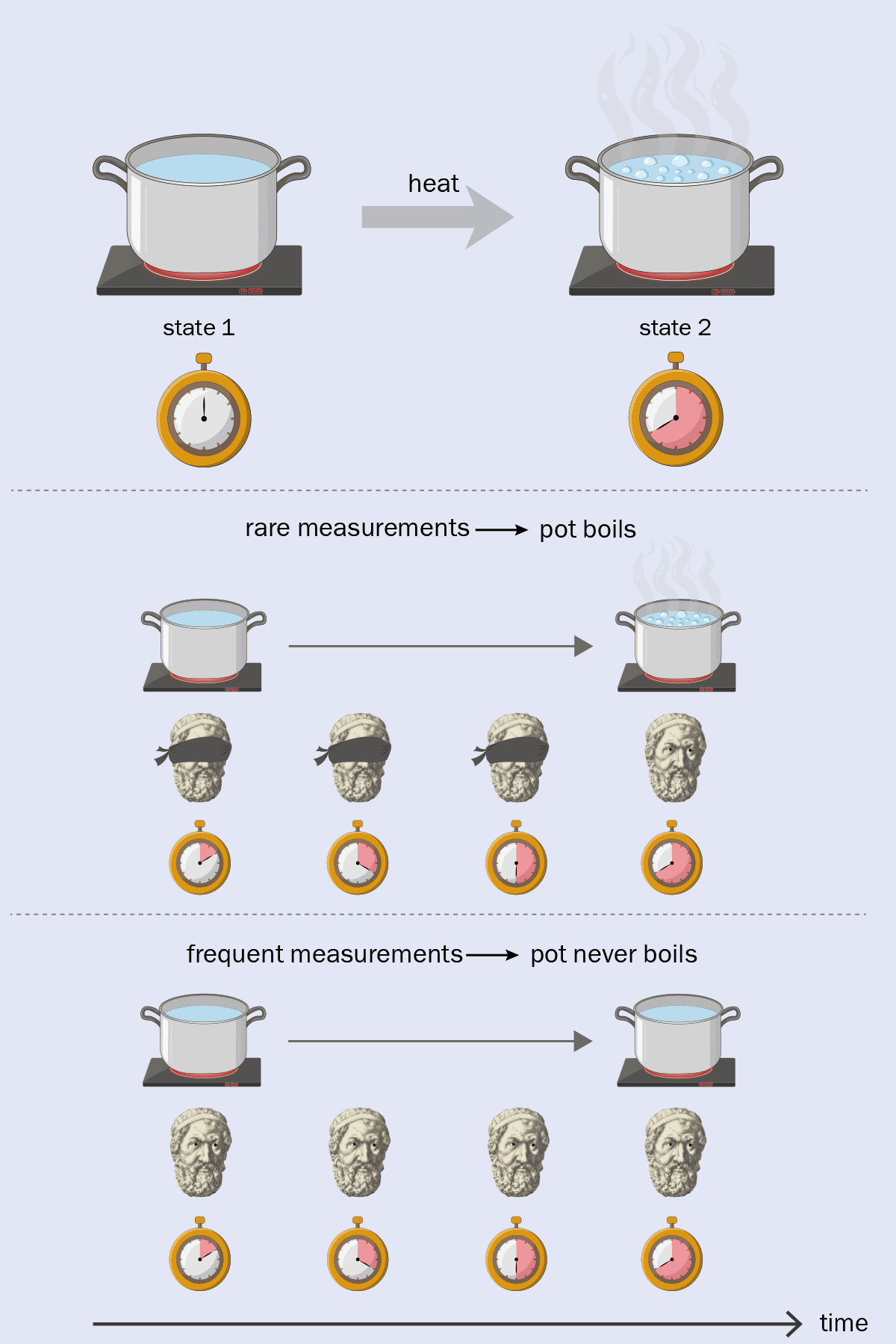
Diagram showing several cooking pots and how whether or not they are watched affects their temperature

Applying heat to a normal, classical pot of water will cause it to evolve from state 1 (not boiling) to state 2 (boiling) at the same rate regardless of whether anyone is watching it (even if it doesn’t seem like it). In the quantum world, however, a system that would normally evolve from one state to the other if left unobserved (blindfolded Zeno) can be “frozen” in place by repeated frequent measurements (eyes-open Zeno).

For the physicists who laid the foundations of quantum mechanics a century ago, any connection between measurement and outcome was a stumbling block. Several tried to find ways around it, for example by formalizing a role for observers in quantum wavefunction collapse (Niels Bohr and Werner Heisenberg); introducing new “hidden” variables (Louis de Broglie and David Bohm); and even hypothesizing the creation of new universes with each measurement (the “many worlds” theory of Hugh Everett).

But none of these solutions proved fully satisfactory. Indeed, the measurement problem seemed so intractable that most physicists in the next generation avoided it, preferring the approach sometimes described – not always pejoratively – as “shut up and calculate”.

Today’s quantum physicists are different. Rather than treating what Barontini calls “the apotheosis of the measurement effect” as a barrier to overcome or a triviality to ignore, they are doing something few of their forebears could have imagined. They are turning the quantum Zeno effect into something useful.

Noise management

To understand how freezing a quantum system by measuring it could be useful, consider a qubit in a quantum computer. Many quantum algorithms begin by initializing qubits into a desired state and keeping them there until they’re required to perform computations. The problem is that quantum systems seldom stay where they’re put. In fact, they’re famously prone to losing their quantum nature (decohering) at the slightest disturbance (noise) from their environment. “Whenever we build quantum computers, we have to embed them in the real world, unfortunately, and that real world causes nothing but trouble,” Burgarth says.

Quantum scientists have many strategies for dealing with environmental noise. Some of these strategies are passive, such as cooling superconducting qubits with dilution refrigerators and using electric and magnetic fields to suspend ionic and atomic qubits in a vacuum. Others, though, are active. They involve, in effect, tricking qubits into staying in the states they’re meant to be in, and out of the states they’re not.

The quantum Zeno effect is one such trick. “The way it works is that we apply a sequence of kicks to the system, and we are actually rotating the qubit with each kick,” Burgarth explains. “You’re rotating the system, and then effectively the environment wants to rotate it in the other direction.” Over time, he adds, these opposing rotations average out, protecting the system from noise by freezing it in place.

Quantum state engineering

While noise mitigation is useful, it’s not the quantum Zeno application that interests Burgarth and Barontini the most. The real prize, they agree, is something called quantum state engineering, which is much more complex than simply preventing a quantum system from decaying or rotating.

The source of this added complexity is that real quantum systems – much like real people – usually have more than two states available to them. For example, the set of permissible “awake” states for a person – the Hilbert space of wakefulness, let’s call it – might include states such as cooking dinner, washing dishes and cleaning the bathroom. The goal of quantum state engineering is to restrict this state-space so the system can only occupy the state(s) required for a particular application.

As for how the quantum Zeno effect does this, Barontini explains it by referring to Zeno’s original, classical paradox. In the fifth century BCE, the philosopher Zeno of Elea posed a conundrum based on an arrow flying through the air. If you look at this arrow at any possible moment during its flight, you will find that in that instant, it is motionless. Yet somehow, the arrow still moves. How?

In the quantum version, Barontini explains, looking at the arrow freezes it in place. But that isn’t the only thing that happens. “The funniest thing is that if I look somewhere, then the arrow cannot go where I’m looking,” he says. “It will have to go around it. It will have to modify its trajectory to go outside my field of view.”

By shaping this field of view, Barontini continues, physicists can shape the system’s behaviour. As an example, he cites work by Serge Haroche, who shared the 2012 Nobel Prize for Physics with another notable quantum Zeno experimentalist, David Wineland.

In 2014 Haroche and colleagues at the École Normale Supérieure (ENS) in Paris, France, sought to control the dynamics of an electron within a so-called Rydberg atom. In this type of atom, the outermost electron is very weakly bound to the nucleus and can occupy any of several highly excited states.

The researchers used a microwave field to divide 51 of these highly excited Rydberg states into two groups, before applying radio-frequency pulses to the system. Normally, these pulses would cause the electron to hop between states. However, the continual “measurement” supplied by the microwave field meant that although the electron could move within either group of states, it could not jump from one group to the other. It was stuck – or, more precisely, it was in a special type of quantum superposition known as a Schrödinger cat state.

Restricting the behaviour of an electron might not sound very exciting in itself. But in this and other experiments, Haroche and colleagues showed that imposing such restrictions brings forth a slew of unusual quantum states. It’s as if telling the system what it can’t do forces it to do a bunch of other things instead, like a procrastinator who cooks dinner and washes dishes to avoid cleaning the bathroom. “It really enriches your quantum toolbox,” explains Barontini. “You can generate an entangled state that is more entangled or methodologically more useful than other states you could generate with traditional means.”

Just what is a measurement, anyway?

As well as generating interesting quantum states, the quantum Zeno effect is also shedding new light on the nature of quantum measurements. The question of what constitutes a “measurement” for quantum Zeno purposes turns out to be surprisingly broad. This was elegantly demonstrated in 2014, when physicists led by Augusto Smerzi at the Università di Firenze, Italy, showed that simply shining a resonant laser at their quantum system (figure 2) produced the same quantum Zeno dynamics as more elaborate “projective” measurements – which in this case involved applying pairs of laser pulses to the system at frequencies tailored to specific atomic transitions. “It’s fair to say that almost anything causes a Zeno effect,” says Burgarth. “It’s a very universal and easy-to-trigger phenomenon.”

2 Experimental realization of quantum Zeno dynamics
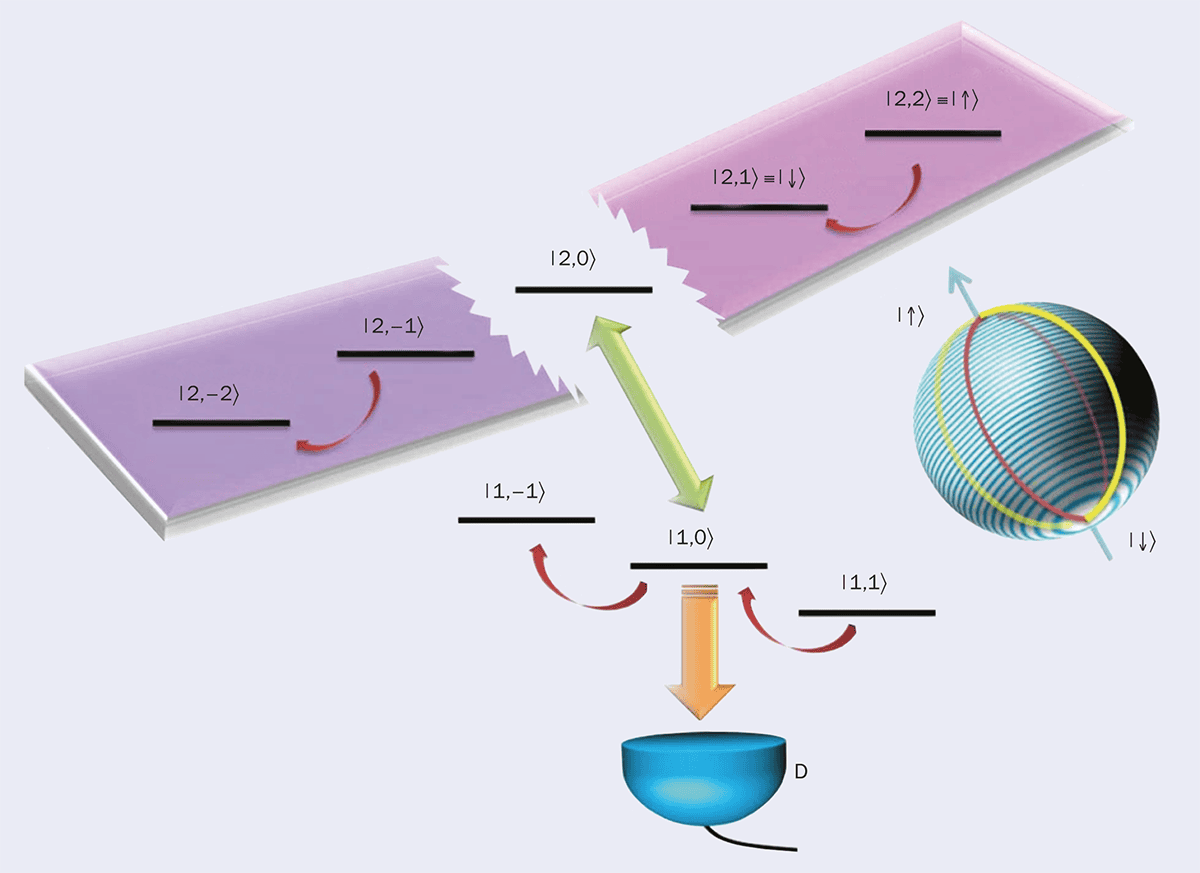
Diagram of a quantum arrow

The energy level structure of a population of ultracold 87Rb atoms, evolving in a five-level Hilbert space given by the five spin orientations of the F=2 hyperfine ground state. An applied RF field (red arrows) couples neighbouring quantum states together and allows atoms to “hop” between states. Normally, atoms initially placed in the |F, mF> = |2,2> state would cycle between this state and the other four F=2 states in a process known as Rabi oscillation. However, by introducing a “measurement” – shown here as a laser beam (green arrow) resonant with the transition between the |1,0> state and the |2,0> state – Smerzi and colleagues drastically changed the system’s dynamics, forcing the atoms to oscillate between just the |2,2> and |2,1> states (represented by up and down arrows on the so-called Bloch sphere at right). An additional laser beam (orange arrow) and the detector D were used to monitor the system’s evolution over time.

Other research has broadened our understanding of what measurement can do. While the quantum Zeno effect uses repeated measurements to freeze a quantum system in place (or at least slow its evolution from one state to another), it is also possible to do the opposite and use measurements to accelerate quantum transitions. This phenomenon is known as the quantum anti-Zeno effect, and it has applications of its own. It could, for example, speed up reactions in quantum chemistry.

Over the past 25 years or so, much work has gone into understanding where the ordinary quantum Zeno effect leaves off and the quantum anti-Zeno effect begins. Some systems can display both Zeno and anti-Zeno dynamics, depending on the frequency of the measurements and various environmental conditions. Others seem to favour one over the other.

But regardless of which version turns out to be the most important, quantum Zeno research is anything but frozen in place. Some 2500 years after Zeno posed his paradox, his intellectual descendants are still puzzling over it.
This article forms part of Physics World‘s contribution to the 2025 International Year of Quantum Science and Technology (IYQ), which aims to raise global awareness of quantum physics and its applications.

Stayed tuned to Physics World and our international partners throughout the next 12 months for more coverage of the IYQ.

Find out more on our quantum channel.

Intercalation-based desalination and carbon capture for water and climate sustainability

Want to learn more on this subject?

webinar main image

With increased water scarcity and global warming looming, electrochemical technology offers low-energy mitigation pathways via desalination and carbon capture.  This webinar will demonstrate how the less than 5 molar solid-state concentration swings afforded by cation intercalation materials – used originally in rocking-chair batteries – can effect desalination using Faradaic deionization (FDI).  We show how the salt depletion/accumulation effect – that plagues Li-ion battery capacity under fast charging conditions – is exploited in a symmetric Na-ion battery to achieve seawater desalination, exceeding by an order of magnitude the limits of capacitive deionization with electric double layers.  While initial modeling that introduced such an architecture blazed the trail for the development of new and old intercalation materials in FDI, experimental demonstration of seawater-level desalination using Prussian blue analogs required cell engineering to overcome the performance-degrading processes that are unique to the cycling of intercalation electrodes in the presence of flow, leading to innovative embedded, micro-interdigitated flow fields with broader application toward fuel cells, flow batteries, and other flow-based electrochemical devices.  Similar symmetric FDI architectures using proton intercalation materials are also shown to facilitate direct-air capture of carbon dioxide with unprecedentedly low energy input by reversibly shifting pH within aqueous electrolyte.

Want to learn more on this subject?

Kyle Smith headshot

Kyle C Smith joined the faculty of Mechanical Science and Engineering at the University of Illinois Urbana-Champaign (UIUC) in 2014 after completing his PhD in mechanical engineering (Purdue, 2012) and his post-doc in materials science and engineering (MIT, 2014).  His group uses understanding of flow, transport, and thermodynamics in electrochemical devices and materials to innovate toward separations, energy storage, and conversion.  For his research he was awarded the 2018 ISE-Elsevier Prize in Applied Electrochemistry of the International Society of Electrochemistry and the 2024 Dean’s Award for Early Innovation as an associate professor by UIUC’s Grainger College.  Among his 59 journal papers and 14 patents and patents pending, his work that introduced Na-ion battery-based desalination using porous electrode theory [Smith and Dmello, J. Electrochem. Soc., 163, p. A530 (2016)] was among the top ten most downloaded in the Journal of the Electrochemical Society for five months in 2016.  His group was also the first to experimentally demonstrate seawater-level salt removal using this approach [Do et al., Energy Environ. Sci., 16, p. 3025 (2023); Rahman et al., Electrochimica Acta, 514, p. 145632 (2025)], introducing flow fields embedded in electrodes to do so.

Photon collisions in dying stars could create neutrons for heavy elements

A model that could help explain how heavy elements are forged within collapsing stars has been unveiled by Matthew Mumpower at Los Alamos National Laboratory and colleagues in the US. The team suggests that energetic photons generated by newly forming black holes or neutron stars transmute protons within ejected stellar material into neutrons, thereby providing ideal conditions for heavy elements to form.

Astrophysicists believe that elements heavier than iron are created in violent processes such as the explosions of massive stars and the mergers of neutron stars. One way that this is thought to occur is the rapid neutron-capture process (r-process), whereby lighter nuclei created in stars capture neutrons in rapid succession. However, exactly where the r-process occurs is not well understood.

As Mumpower explains, the r-process must be occurring in environments where free neutrons are available in abundance. “But there’s a catch,” he says. “Free neutrons are unstable and decay in about 15 min. Only a few places in the universe have the right conditions to create and use these neutrons quickly enough. Identifying those places has been one of the toughest open questions in physics.”

Intense flashes of light

In their study, Mumpower’s team – which included researchers from the Los Alamos and Argonne national laboratories – looked at how lots of neutrons could be created within massive stars that are collapsing to become neutron stars or black holes. Their idea focuses on the intense flashes of light that are known to be emitted from the cores of these objects.

This radiation is emitted at wavelengths across the electromagnetic spectrum – including highly energetic gamma rays. Furthermore, the light is emitted along a pair of narrow jets, which blast outward above each pole of the star’s collapsing core. As they form, these jets plough through the envelope of stellar material surrounding the core, which had been previously ejected by the star. This is believed to create a “cocoon” of hot, dense material surrounding each jet.

In this environment, Mumpower’s team suggest that energetic photons in a jet collide with protons to create a neutron and a pion. Since these neutrons are have no electrical charge, many of them could dissolve into the cocoon, providing ideal conditions for the r-process to occur.

To test their hypothesis, the researchers carried out detailed computer simulations to predict the number of free neutrons entering the cocoon due to this process.

Gold and platinum

“We found that this light-based process can create a large number of neutrons,” Mumpower says. “There may be enough neutrons produced this way to build heavy elements, from gold and platinum all the way up to the heaviest elements in the periodic table – and maybe even beyond.”

If their model is correct, suggests that the origin of some heavy elements involves processes that are associated with the high-energy particle physics that is studied at facilities like the Large Hadron Collider.

“This process connects high-energy physics – which usually focuses on particles like quarks, with low-energy astrophysics – which studies stars and galaxies,” Mumpower says. “These are two areas that rarely intersect in the context of forming heavy elements.”

Kilonova explosions

The team’s findings also shed new light on some other astrophysical phenomena. “Our study offers a new explanation for why certain cosmic events, like long gamma-ray bursts, are often followed by kilonova explosions – the glow from the radioactive decay of freshly made heavy elements,” Mumpower continues. “It also helps explain why the pattern of heavy elements in old stars across the galaxy looks surprisingly similar.”

The findings could also improve our understanding of the chemical makeup of deep-sea deposits on Earth. The presence of both iron and plutonium in this material suggests that both elements may have been created in the same type of event, before coalescing into the newly forming Earth.

For now, the team will aim to strengthen their model through further simulations – which could better reproduce the complex, dynamic processes taking place as massive stars collapse.

The research is described in The Astrophysical Journal.

Researchers claim Trump administration is conducting ‘a wholesale assault on science’

The US administration is carrying out “a wholesale assault on US science” that could hold back research in the country for several decades. That is the warning from more than 1900 members of the US National Academies of Sciences, Engineering, and Medicine, who have signed an open letter condemning the policies introduced by Donald Trump since he took up office on 20 January.

US universities are in the firing line of the Trump administration, which is seeking to revoke the visas of foreign students, threatening to withdraw grants and demanding control over academic syllabuses. “The voice of science must not be silenced,” the letter writers say. “We all benefit from science, and we all stand to lose if the nation’s research enterprise is destroyed.”

Particularly hard hit are the country’s eight Ivy League universities, which have been accused of downplaying antisemitism exhibited in campus demonstrations in support of Gaza. Columbia University in New York, for example, has been trying to regain $400m in federal funds that the Trump administration threatened to cancel.

Columbia initially reached an agreement with the government on issues such as banning facemasks on its campus and taking control of its department responsible for courses on the Middle East. But on 8 April, according to reports, the National Institutes of Health, under orders from the Department of Health and Human Services, blocked all of its grants to Columbia.

Harvard University, meanwhile, has announced plans to privately borrow $750m after the Trump administration announced that it would review $9bn in the university’s government funding. Brown University in Rhode Island faces a loss of $510m, while the government has suspended several dozen research grants for Princeton University.

The administration also continues to oppose the use of diversity, equity and inclusion (DEI) programmes in universities. The University of Pennsylvania, from which Donald Trump graduated, faces the suspension of $175m in grants for offences against the government’s DEI policy.

Brain drain

Researchers in medical and social sciences are bearing the brunt of government cuts, with physics departments seeing relatively little impact on staffing and recruitment so far. “Of course we are concerned,” Peter Littlewood, chair of the University of Chicago’s physics department, told Physics World. “Nonetheless, we have made a deliberate decision not to halt faculty recruiting and stand by all our PhD offers.”

David Hsieh, executive officer for physics at California Institute of Technology, told Physics World that his department has also not taken any action so far. “I am sure that each institution is preparing in ways that make the most sense for them,” he says. “But I am not aware of any collective response at the moment.”

Yet universities are already bracing themselves for a potential brain drain. “The faculty and postdoc market is international, and the current sentiment makes the US less attractive for reasons beyond just finance,” warns Littlewood at Chicago.

That sentiment is echoed by Maura Healey, governor of Massachusetts, who claims that Europe, the Middle East and China are already recruiting the state’s best and brightest. “[They’re saying] we’ll give you a lab; we’ll give you staff. We’re giving away assets to other countries instead of training them, growing them [and] supporting them here.”

Science agencies remain under pressure too. The Department of Government Efficiency, run by Elon Musk, has already  ended $420m in “unneeded” NASA contracts. The administration aims to cut the year’s National Science Foundation (NSF) construction budget, with data indicating that the agency has roughly halved its number of new grants since Trump became president.

Yet a threat to reduce the percentage of ancillary costs related to scientific grants appeared at least on hold, for now at least. “NSF awardees may continue to budget and charge indirect costs using either their federally negotiated indirect cost rate agreement or the “de minimis” rate of 15%, as authorized by the uniform guidance and other Federal regulations,” says an NSF spokesperson.

Ultrashort electron beam sets new power record

Researchers at the SLAC National Accelerator Laboratory in the US have produced the world’s most powerful ultrashort electron beam to date, concentrating petawatt-level peak powers into femtosecond-long pulses at an energy of 10 GeV and a current of around 0.1 MA. According to officials at SLAC’s Facility for Advanced Accelerator Experimental Tests (FACET-II), the new beam could be used to study phenomena in materials science, quantum physics and even astrophysics that were not accessible before.

High-energy electron beams are routinely employed as powerful probes in several scientific fields. To produce them, accelerator facilities like SLAC use strong electric fields to accelerate, focus and compress bunches of electrons. This is not easy, because as electrons are accelerated and compressed, they emit radiation and lose energy, causing the beam’s quality to deteriorate.

An optimally compressed beam

To create their super-compressed ultrashort beam, researchers led by Claudio Emma at FACET-II used a laser to shape the electron bunch’s profile with millimetre-scale precision in the first 10 metres of the accelerator, when the beam’s energy is lowest. They then took this modulated electron beam and boosted its energy by a factor of 100 in a kilometre-long stretch of downstream accelerating cavities. The last step was to compress the beam by a factor of 1000 by using magnets to turn the beam’s millimetre-scale features into a micron-sized long current spike.

One of the biggest challenges, Emma says, was to optimise the laser-based modulation of the beam in tandem with the accelerating cavity and magnetic fields of the magnets to obtain the optimally compressed beam at the end of the accelerator. “This was a large parameter space to work in with lots of knobs to turn and it required careful iteration before an optimum was found,” Emma says.

Measuring the ultra-short electron bunches was also a challenge. “These are typically so intense that if you intercept them with, for example, scintillating screens (a typical technique used in accelerators to diagnose properties of the beam like its spot size or bunch length), the beam fields are so strong they can melt these screens,” Emma explains. “To overcome this, we had to use a series of indirect measurements (plasma ionisation and beam-based radiation) along with simulations to diagnose just how strongly compressed and powerful these beams were.”

Beam delivery

According to Emma, generating extremely compressed electron beams is one of the most important challenges facing accelerator and beam physicists today. “It was interesting for us to tackle this challenge at FACET-II, which is a facility designed specifically to do this kind of research on extreme beam manipulation,” he says.

The team has already delivered the new high-current beams to experimenters who work on probing and optimising the dynamics of plasma-based accelerators. Further down the line, they anticipate much wider applications. “In the future we imagine that we will attract interest from users in multiple fields, be they materials scientists, strong-field quantum physicists or astrophysicists, who want to use the beam as a strong relativistic ‘hammer’ to study and probe a variety of natural interactions with the unique tool that we can provide,” Emma tells Physics World.

The researchers’ next step will be to increase the beam’s current by another order of magnitude. “This additional leap will require the use of a different plasma-based compression technique, rather than the current laser-based approach, which we hope to demonstrate at FACET-II in the near future,” Emma reveals.

The present work is described in Physical Review Letters.

Quantum Mpemba effect appears in a real experimental system

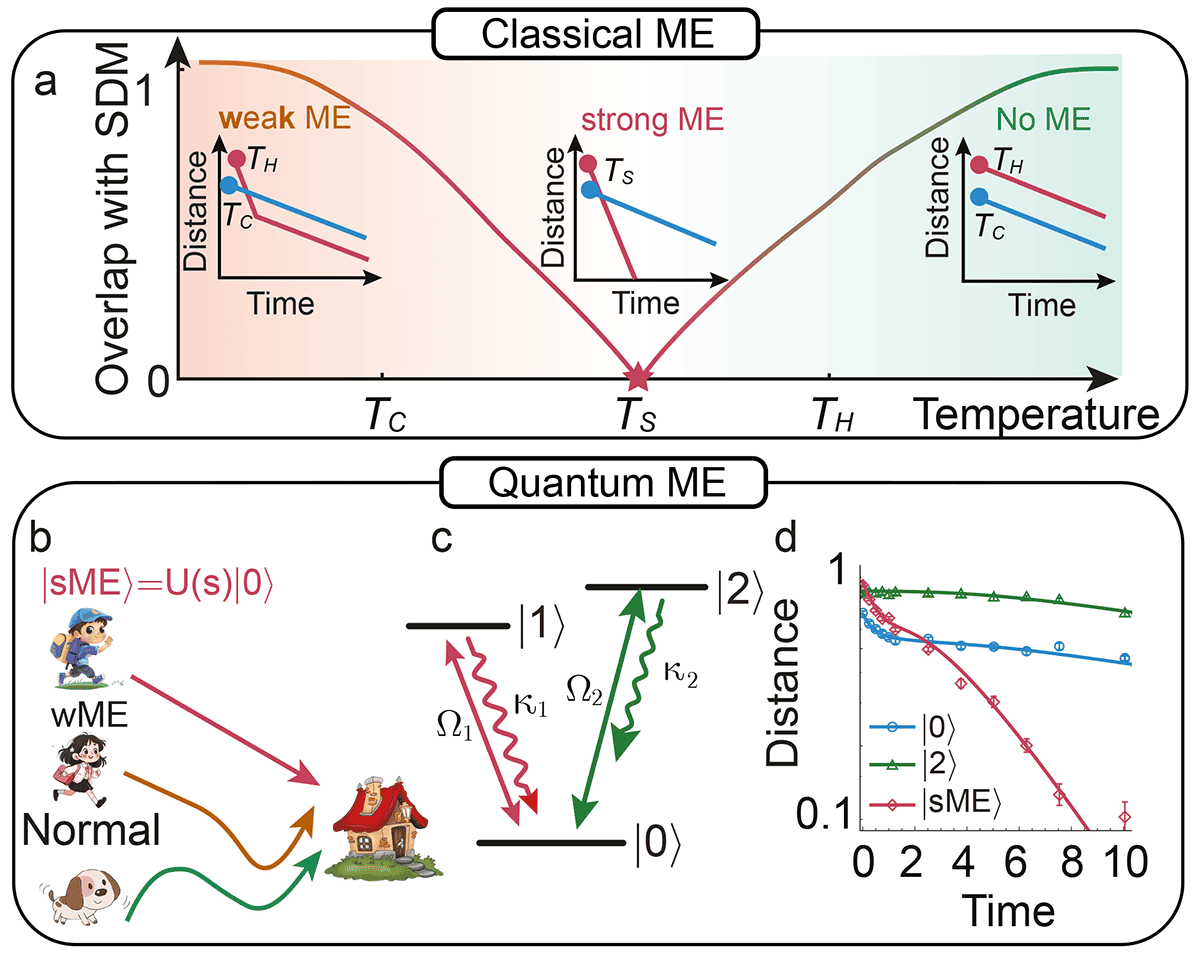
Researchers from China, the UK and Singapore have demonstrated for the first time that choosing the right set of initial conditions can speed up the relaxation process in quantum systems. Their experiments using single trapped ions are a quantum analogue of the classical Mpemba effect, in which hot water can, under certain circumstances, cool faster than cold water. By showing that it is possible to exponentially accelerate the relaxation of a pure state into a stationary state – the hallmark of the so-called strong Mpemba effect – they also provide strategies for designing and analysing open quantum systems such as those used in quantum batteries.

In both the classical and the quantum worlds, the difference between the relaxation process of a system in a strong Mpemba effect (sME) state and any other state is that the decay rate of a sME state is greater than the others. This naturally leads to the conclusion that initial conditions influence the speed at which a system will reach equilibrium. However, the mathematics of the quantum and classical sME are different. While in the classical world an open system is described by the Fokker-Planck equation, with the temperature as the key variable, in the quantum world the Lindblad master equation applies, and the energy of the sME state is what matters.

Paths and overlap

To understand why a quantum system in a particular initial state reaches a steady state faster than any other, we should think about the possible paths that a system can take. One key path is known as the slowest decay mode (SDM), which is the path that takes the system the most time to decay. At the other extreme, the fastest relaxation path is the one taken by a system in the sME initial state. This relaxation path must avoid any overlap with the SDM’s path.

Hui Jing, a physicist at China’s Hunan Normal University who co-led the study, points out that a fundamental characteristic of the quantum sME is that its relaxation path includes the so-called Liouvillian exceptional point (LEP). At this point, an eigenvalue of the dynamical generator, which is the Liovillian superoperator that describes the time evolution of the open quantum system through the Lindblad master equation, changes from real to complex.  When the eigenvalue of the SDM is real, the system is successfully prepared in the sME. When the eigenvalue of the SDM acquires an imaginary part, the overlap between the prepared sME state and the SDM is no longer zero. The LEP therefore signals the transition from strong to weak Mpemba effect.

Experimental set-up

To create a pure state that presents zero overlap with the SDM in an open quantum system, Jing and colleagues trapped a 40Ca+ ion and coupled three of its energy levels through laser interactions.  The first laser beam, with a wavelength of 729 nm, coupled the ground state with the two excited states with coupling strengths characterized by Rabi frequencies Ω1 and Ω2. A second, circularly polarized laser beam at 854 nm controlled the decay between the first excited state and the ground state.

By tuning the Rabi frequencies, researchers were able to explore different relaxation regimes of the system. When the ratio between the Rabi frequencies was much smaller or bigger than the LEP, they observed the sME and weak ME, respectively.  When the ratio equalled the LEP, the transition from sME to weak ME took place.

This work, which is described in Nature Communications, marks the first experimental realization of the quantum strong Mpemba effect. According to Jing, the team’s methods offer an experimental alternative to existing ways of increasing the ion cooling rate or enhancing the efficiency of quantum batteries. Now, the group plans to study how the quantum Mpemba effect behaves at the LEP, since this point could lead to faster decay rates.

Fusion industry meets in London to discuss ‘one of the economic opportunities of the century’

“Fusion is now within reach” and represents “one of the economic opportunities of the century”. Not the words of an optimistic fusion scientist but from Kerry McCarthy, parliamentary under-secretary of state at the UK’s Department for Energy Security and Net Zero.

She was speaking on Tuesday at the inaugural Fusion Fest by Economist Impact. Held in London, the day-long event featured 400 attendees and more than 60 speakers from around the world.

McCarthy outlined several initiatives to keep the UK at the “forefront of fusion”. That includes investing £20m into Starmaker One, a £100m endeavour announced in early April to kickstart UK investment fusion fund.

The usual cliché is that fusion is always being 20 years away, perhaps not helped by large international projects such as the ITER experimental fusion reactor that is currently being built in Cadarache, France, which has struggling with delays and cost hikes.

Yet many delegates at the meeting were optimistic that significant developments are within reach with private firms racing to demonstrate “breakeven” – generating more power out than needed to fuel the reaction. Some expect “a few” private firms to announce breakeven by 2030.

And these aren’t small ventures. Commonwealth Fusion Systems, based in Massachusetts, US, for example, has 1300 people. Yet large international companies are, for the moment, only dipping their toe into the fusion pool.

While some $8bn has already been spent by private firms on fusion, many expect the funding floodgates to open once breakeven has been achieved in a private lab.

Most stated that a figure of about $50-60bn, however, would be needed to make fusion a real endeavour in terms of delivering power to the grid, something that could happen in the 2040s. But it was reiterated throughout the day that fusion must provide energy at a price that consumers would be willing to pay.

On target

It is not only private firms that are making progress. Many will point out that ITER has laid much of the groundwork in terms of fostering a fusion “ecosystem” – a particular buzzword of the day – that was demonstrated, in part, by the significant attendence at the event.

And developments are not just being confined to magnetic fusion. Kim Budil, director of the Lawrence Livermore National Laboratory, which is home to the National Ignition Facility, noted that the machine had recently achieved a fusion gain for the eighth time.

In a recent shot, she said that the device had produced 7 MJ with about 2 MJ having been delivered to the small capsule target. This represents a gain of about 3.4 – much more than its previous record of 2.4.

NIF, which is based on inertial confinement fusion rather than magnetic confinement, is currently undergoing refurbishment and upgrades. It is hoped that this will increase the energy input to about 2.6 MJ but gains of between 10-15 will be demonstrated if the technique can go anywhere.

Despite the number of fusion firms ballooning from a handful in the early 2010s to some 30 today, the general feeling at the meeting was that only a few will likely go on to build power plants, with the remainder using fusion for other sectors.

The issue is that no-one knew what technology would likely succeed, so all to play for.

Non-invasive pressure sensor could revolutionize how brain injuries are diagnosed

This episode of the Physics World Weekly podcast features an interview with Panicos Kyriacou, who is chief scientist at the UK-based start-up Crainio. The company has developed a non-invasive way of using light to measure the pressure inside the skull. Knowing this intracranial pressure is crucial when diagnosing traumatic brain injury, which a leading cause of death and disability. Today, the only way to assess intracranial pressure is to insert a sensor into the patient’s brain, so Crainio’s non-invasive technique could revolutionize how brain injuries are diagnosed and treated.

Kyriacou tells Physics World’s Tami Freeman why it is important to assess a patient’s intracranial pressure as soon as possible after a head injury. He explains how Crainio’s optical sensor measures blood flow in the brain and then uses machine learning to deduce the intracranial pressure.

Kyriacou is also professor of engineering at City St George’s University of London, where the initial research for the sensor was done. He recalls how Crainio was spun out of the university and how it is currently in a second round of clinical trials.

As well as being non-invasive, Crainio’s technology could reduce the cost of determining intracranial pressure and make it possible to make measurements in the field, shortly after injuries occur.

Don’t have a PhD? The quantum industry still wants you

Andrew Martin, skills policy lead at the UK’s Department for Science, Innovation and Technology (DSIT), flashed up a slide. Speaking at the ninth Careers in Quantum event in Bristol last week, he listed the eight skills that the burgeoning quantum-technology sector wants. Five are various branches of engineering, including electrical and electronics, mechanical, software and systems. A sixth is materials science and chemistry, with a seventh being quality control.

Quantum companies, of course, do also want “quantum specialists”, which was the eighth skill identified by Martin. But it’s a sign of how mature the sector has become that being a hotshot quantum physicist is no longer the only route in. That point was underlined by Carlos Faurby, a hardware integration engineer at Sparrow Quantum in Denmark, which makes single-photon sources for quantum computers. “You don’t need a PhD in physics to work at Sparrow,” Faurby declared.

Quantum tech certainly has a plethora of career options, with the Bristol event featuring a selection of firms from across the quantum ecosystem. Some are making prototype quantum computers (Quantum Motion, Quantinuum, Oxford Ionics) or writing the algorithms to run on quantum computers (Phasecraft). Others are building quantum networks (BT, Toshiba), working on quantum error correction (Riverlane) or developing quantum cryptography (KETS Quantum). Businesses building hardware such as controllers and modems were present too.

With the 2025 International Year of Quantum Science and Technology (IYQ) now in full swing, the event underlined just how thriving the sector is, with lots of career choices for physicists – whether you have a PhD or not. But competition to break in is intense. Phasecraft says it gets 50–100 applicants for each student internship it offers, with Riverlane receiving almost 200 applications for two summer placements.

That’s why it’s vital for physics students to develop their “soft skills” – or “professional skills” as several speakers preferred to call them. Team working, project management, collaboration and communication are all essential for jobs in the quantum industry, as indeed they are for all careers. Sadly, many physicists don’t realize soon enough just how crucial soft skills are.

Reflecting on his time at Light Trace Photonics, which he co-founded in 2021, Dominic Sulway joked in a panel discussion that he’d “enjoyed developing all the skills people told me I’d need for my PhD”. Of course, if you really want to break into the sector, why not follow his lead and start a business yourself? It’s a rewarding experience, I was told, and there doesn’t seem to be any slow-down in the number of quantum firms starting up.

  • For more information on career options for physicists, check out the free-to-read 2025 Physics World Careers guide

This article forms part of Physics World‘s contribution to the 2025 International Year of Quantum Science and Technology (IYQ), which aims to raise global awareness of quantum physics and its applications.

Stayed tuned to Physics World and our international partners throughout the next 12 months for more coverage of the IYQ.

Find out more on our quantum channel.
Quantum computer generates strings of certifiably random numbers

A quantum computer has been used for the first time to generate strings of certifiably random numbers. The protocol for doing this, which was developed by a team that included researchers at JPMorganChase and the quantum computing firm Quantinuum, could have applications in areas ranging from lotteries to cryptography – leading Quantinuum to claim it as quantum computing’s first commercial application, though other firms have made similar assertions. Separately, Quantinuum and its academic collaborators used the same trapped-ion quantum computer to explore problems in quantum magnetism and knot theory.

Genuinely random numbers are important in several fields, but classical computers cannot create them. The best they can do is to generate apparently random or “pseudorandom” numbers. Randomness is inherent in the laws of quantum mechanics, however, so quantum computers are naturally suited to random number generation. In fact, random circuit sampling – in which all qubits are initialized in a given state and allowed to evolve via quantum gates before having their states measured at the output – is often used to benchmark their power.

Of course, not everyone who wants to produce random numbers will have their own quantum computer. However, in 2023 Scott Aaronson of the University of Texas at Austin, US and his then-PhD student Shi-Han Hung suggested that a client could send a series of pseudorandomly chosen “challenge” circuits to a central server. There, a quantum computer could perform random circuit sampling before sending the readouts to the client.

If these readouts are truly the product of random circuit sampling measurements performed on a quantum computer, they will be truly random numbers. “Certifying the ‘quantumness’ of the output guarantees its randomness,” says Marco Pistoia, JPMorganChase’s head of global technology applied research.

Importantly, this certification is something a classical computer can do. The way this works is that the client samples a subset of the bit strings in the readouts and performs a test called cross-entropy benchmarking. This test measures the probability that the numbers could have come from a non-quantum source. If the client is satisfied with this measurement, they can trust that the samples were genuinely the result of random circuit sampling. Otherwise, they may conclude that the data could have been generated by “spoofing” – that is, using a classical algorithm to mimic a quantum computer. The degree of confidence in this test, and the number of bits they are willing to settle for to achieve this confidence, is up to the client.

High-fidelity quantum computing

In the new work, Pistoia, Aaronson, Hung and colleagues sent challenge circuits to the 56-qubit Quantinuum H2-1 quantum computer over the Internet. The attraction of the Quantinuum H2-1, Pistoia explains, is its high fidelity: “Somebody could say ‘Well, when it comes to randomness, why would you care about accuracy – it’s random anyway’,” he says. “But we want to measure whether the number that we get from Quantinuum really came from a quantum computer, and a low-fidelity quantum computer makes it more difficult to ascertain that with confidence… That’s why we needed to wait all these years, because a low-fidelity quantum computer wouldn’t have given us the certification part.”

The team then certified the randomness of the bits they got back by performing cross-entropy benchmarking using four of the world’s most powerful supercomputers, including Frontier at the US Department of Energy’s Oak Ridge National Laboratory. The results showed that it would have been impossible for a dishonest adversary with similar classical computing power to spoof a quantum computer – provided the client set a short enough time limit.

One drawback is that at present, the computational cost of verifying that random numbers have not been spoofed is similar to the computational cost of spoofing them. “New work is needed to develop approaches for which the certification process can run on a regular computer,” Pistoia says. “I think this will remain an active area of research in the future.”

Studying other problems

Quantinuum has also released the results of two scientific studies performed using the Quantinuum H2-1. The first examines a well-known problem in knot theory involving the Jones polynomial. The second explores quantum magnetism, which was also the subject of quantum computing work by groups at Harvard University, Google Quantum AI and, most recently, D-Wave Systems. Michael Foss-Feig, a quantum computing theorist at Quantinuum who led the quantum magnetism study, explains that the groups focused on different problems, with Quantinuum and its American and European academic collaborators studying thermalization rather than quantum phase transitions.

A more important difference, Foss-Feig argues, is that whereas the other groups used a partly analogue approach to simulating their quantum magnetic system, with all quantum gates activated simultaneously, Quantinuum’s approach divided time into a series of discrete steps, with operations following in a sequence similar to that of a classical computer. This digitization meant the researchers could perform a discrete gate operation as required, between any of the ionic qubits in their lattice. “This digital architecture is an extremely convenient way to compile a very wide range of physical problems,” Foss-Feig says. “You might think, for example, of simulating not just spins, for example, but also fermions or bosons.”

While the researchers say it would be just possible to reproduce these simulations using classical computers, they plan to study larger models soon. A 96-qubit version of their device, called Helios, is slated for launch later in 2025.

“We’ve gone through a shift”

Quantum information scientist Barry Sanders of the University of Calgary, Canada is impressed by all three works. “The real game changer here is Quantinuum’s really nice 56-qubit quantum computer,” he says. “Instead of just being bigger in its number of qubits, it’s hit multiple important targets.”

In Sanders’ view, the computer’s fully digital architecture is important for scalability, although he notes that many in the field would dispute that. The most important development, he adds, is that the research frames the value of a quantum computer in terms of its accomplishments.

“We’ve gone through a shift: when you buy a normal computer, you want to know what that computer can do for you, not how good is the transistor,” he says. “In the old days, we used to say ‘I made a quantum computer and my components are better than your components – my two-qubit gate is better’… Now we say, ‘I made a quantum computer and I’m going to brag about the problem I solved’.”

The random number generation paper is published in Nature. The others are available on the arXiv pre-print server.

Copyright © 2026 by IOP Publishing Ltd and individual contributors