Mention the two words “science policy” and most physicists’ eyes will probably glaze over. Most of us dream of discovering a new planet or finding the Higgs boson – not poring over budget spreadsheets, championing science to politicians or commenting on legislation.
But science policy is vital in today’s world, which depends hugely on scientific research and in the cover feature of the August issue of Physics World, which is now out, Len Fisher and John Tesh offer 12 practical tips for scientists who want their ideas incorporated into science policy. You’ll be intrigued by what the two authors have to say.
Elsewhere in the issue, as my colleague Tushna Commissariat explains in the video above, there’s a great feature based on an interview with the French physicist Hélène Langevin-Joliot – the granddaughter of Marie Curie. In the article, Langevin-Joliot explains what’s known as the “Curie complex” and gives her own tips for scientific success. Langevin-Joliot didn’t suffer from the complex herself, but she acknowledges that it is a big problem for others and, these days, spends her time actively promoting careers for women in science.
The year was 1921. Humanity was attempting to recover from the devastation of the First World War, and looked to the dawn of the roaring twenties with tentative optimism. At the same time, Albert Einstein was awarded a Nobel prize for his discovery of the photoelectric effect, Boeing tested its first plane over land and the enigmatic physicist Marie Curie, who had won her own physics Nobel 18 years before, embarked on a tour of the US to raise funds for her radium research.
Curie is one of only two women to have won the Nobel Prize for Physics, and nowadays is often seen as a role model for aspiring scientists. However, the idolized story of her success has led some people to treat female scientists as equal to male scientists only if they take a similar approach to work and life as Curie herself did. There exists, in other words, a subtle and insidious belief that not only do female scientists have to achieve as much as their male counterparts in order to be treated as equals in science, but that they also have to be academically superior – almost some kind of genius – as well as modest and family-orientated to boot.
It was during that 1921 trip to the US that the rise of Curie’s now near-mythical status began. Curie, then 53, was travelling at the behest of journalist Marie Meloney, who had interviewed her the year before as editor of the American women’s magazine The Delineator. During that dialogue, Meloney had been surprised to learn that Curie’s institute was in need of funding to source radium, yet research and therapy centres in the US together had about 50 times as much radium as the single gram that Curie – the discoverer of the element – had in her own laboratory. In response, Meloney had taken it upon herself to fulfil Curie’s most ardent wish of having access to a second gram of radium. She had set up the “Marie Curie Radium Fund” and publicized the trip widely.
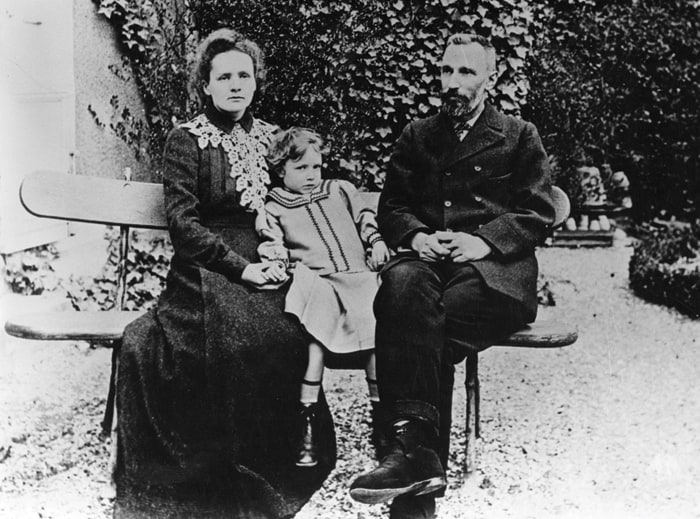
Family first Pierre and Marie Curie with daughter Irène, c. 1904, shortly after the couple had shared the Nobel Prize for Physics. (Courtesy: AIP Emilio Segrè Visual Archives)
Curie toured the US with her daughters Ève and Irène, who at the time were in their late teens and early twenties, respectively. Curie’s visit was a big sensation. The girls even stood in for their mother during some of the many public events, as so many people wanted to shake Curie’s hand that it was soon in a sling. Thanks to Meloney’s efforts, together with a committee of wealthy American women and distinguished scientists, the campaign was hugely successful. The visit culminated with then US president Warren Harding presenting Curie with one gram of radium at the White House. A photograph of this meeting shows a pleased-looking Curie, arm in arm with the smiling president.
Celebrity status
Unbeknownst to Curie and her daughters at the time, their trip to the US – which was to become the first of many – would have a long-lasting impact on women in science.
Before long, the American media’s romanticized portrayal of Marie Curie led to her status as a celebrity and role model. Curie’s life made for an alluring story. Not only had she defied the social conventions of her time to achieve scientific greatness, but she did so despite an impoverished upbringing and appeared to have been unaffected by her success. A humble woman, Einstein once described her as the only person who could not be corrupted by fame. Taken together with her work on the front lines of the First World War with her mobile X-ray equipment, and her role as a caring mother, Curie was presented as someone who balanced great achievements and family life with ease.
Enabler Journalist Marie Meloney (top centre) encouraged Curie to tour the US with her daughters to raise funds for her research. (Courtesy: Library of Congress/Science Photo Library)
In many ways, it is easy to see why Curie is almost the perfect role model, being a woman with an extensive list of “firsts” to her name. Not only was she the first woman to win a Nobel prize, she was also the first person and only woman to win one twice. Curie was also the first woman to become a professor at the University of Paris. Even 60 years after her death in 1934, Curie’s heritage was such that she became the first woman to be entombed on her own merits in the Panthéon in Paris in 1995 – an honour normally reserved for “national heroes”, including the likes of Voltaire and Victor Hugo.
So profound was the impact of this image of perfection that it has since led to the “Curie complex”, which was first observed in the 1980s by science historian Margaret Rossiter and was later tackled in Julie Des Jardins’ 2011 book The Madame Curie Complex (see August 2011 pp36–37). Despite the fact that Curie’s work and life empowered and encouraged women, Rossiter observed that Curie’s towering successes were so unattainable and her image so perfect that it has led to both women and men feeling they can dismiss women who do not meet the unrealistically high standards that Curie inadvertently seemed to have set.
Radiant Curie with US president Warren Harding at the White House in 1921 when he presented her with a gram of radium. (Courtesy: National Photo Company Collection/Library of Congress)
Today, despite there being more women in science than ever before, many people still identify Curie as the most famous female physicist more than 80 years after her death. In the intervening years, a long and distinguished list of other women have made great strides in physics, but – lacking the buzz and idolization that surrounded Curie – they find their contributions too often ignored or minimized in importance. Curie’s legendary status, meanwhile, lives on.
Demystifying Mae
In an interview with Physics World, Curie’s granddaughter, Hélène Langevin-Joliot, reveals a much more down-to-Earth picture of Marie, or “Mae”‘ as she was known by her family. Daughter of Irène and Frédéric Joliot-Curie, 87-year-old Hélène was a professor at the Institute of Nuclear Physics at the University of Paris and is an emeritus director of research at the French national research council (CNRS). Speaking after addressing a meeting in March on “The lives and times of pioneering women in physics” organized by the Institute of Physics (which publishes Physics World), Langevin-Joliot laughs as she recalls visiting Curie most weeks and wandering “straight into the kitchen for a snack before going to see my grandmother, like in any ordinary family”. She fondly recalls going on walks with Curie as well as summer holidays in the mountains or by the seaside – memories that suggest the Joliot-Curie household was, in most ways, a typical happy family home.
Langevin-Joliot seems to have been largely unaffected by the fame of her parents and grandparents. Indeed, she only vaguely remembers the day in 1935 when a telegram arrived, which was followed by some discussion in the house between her parents. They had just learned they had won the Nobel Prize for Chemistry for their discovery of artificial radioactivity. She explains that at around that time, the family had recently moved from a flat in the centre of the French capital to a “large house with a garden in the outskirts of Paris”. For Langevin-Joliot, who was then eight, there was a lot of change afoot and she was more excited about the prospect of friends visiting her new home to play tennis at the weekends than she was about her parents’ news.
Golden generations (From left) Marie Curie, Irène Joliot-Curie, Pierre Joliot (the baby), Hélène Langevin-Joliot, Frédéric Joliot-Curie and his mother Emilie at a family picnic c. 1932. (Courtesy: Société Française de Physique, Paris/AIP Emilio Segrè Visual Archives/Jost Lemmerich)
In fact, the more she reveals about her childhood, the less it seems like Langevin-Joliot faced any of the pressures one might think would accompany growing up in a family like hers. Langevin-Joliot admits that her grandmother’s status is almost mythical today, but adds that “my brother [Pierre] and I were not brought up in this myth, and this helped us”. She herself feels that she did not suffer from the Curie complex. As a child, she did very well at school and particularly enjoyed studying maths, physics, gymnastics and literature. “My parents never pushed the idea that I should choose science,” she says, but adds that they would give her and her brother small experiments to do as children. “I remember building a small powered car…doing some chemistry at home…I was very happy to grow a crystal from scratch,” she says. Langevin-Joliot maintains that the final decision to take up physics and chemistry after school was hers alone.
As well as not being affected by the Curie complex, Langevin-Joliot also feels that she personally has not been the subject of gender bias in her career, although whether her impressive lineage protected her from it is not clear. “When I was a young researcher, it didn’t bother me at all as there were a significant number of young women in my lab,” she says. It was only as she began attending conferences, especially outside of France, that Langevin-Joliot noticed for the first time the distinct lack of women in physics. She adds that in the 1960s and 1970s, while there were some female researchers in France, Spain and Italy, the only female British career scientist she recalls meeting is Daphne Jackson, the UK’s first female professor of physics.
Perfect parents Irène and Frédéric Joliot-Curie won the 1935 Nobel Prize for Chemistry, but their children didn’t feel pressure to follow in their footsteps. (Courtesy: Emilio Segrè Visual Archives/American Institute of Physics/Science Photo Library)
A generation earlier, there had not been such equality among French scientists. Langevin-Joliot remembers her mother, Irène, describing how she had been rejected three times by the French Academy of Sciences – which also famously never elected Curie into its ranks. “She said, ‘Okay, I will ask for a seat at the Academy at every occasion and we will see how long it will take,’ ” recalls Langevin-Joliot. Sadly, her mother died in 1956 before that could happen. It was to be another six years before the first woman was elected to the academy – Marguerite Perey, who was one of Curie’s doctoral students.
Campaigning for equality
Well over a century after winning the Nobel Prize for Physics, Marie Curie is still one of only two women to have won the award – the other being Maria Goeppert Mayer – and she is one of only four female Nobel laureates in chemistry. Despite Langevin-Joliot feeling she did not experience gender bias in science herself, she acknowledges that it is a big problem for others and, these days, spends her time actively promoting careers for women in science. She also talks about her family at schools and other institutes, having herself rediscovered the legacy of her grandmother in the past few decades. This happened, in part, after her aunt Ève revealed that she had preserved some of Curie and husband Pierre’s original papers, letters and apparatus, which were ultimately given to the Radium Institute and National Library in France.
Langevin-Joliot strongly feels that attitudes towards female scientists relate directly to the state of society at any given time, and that the answer to truly achieving equality between men and women, at least in the workplace, involves many factors – the Curie complex being just one. “I am convinced that progress over a long time will not occur without solidarity between different parts of society,” she says. “People now speak about diversity a lot, which is good.”
A new hope Hélène Langevin-Joliot lecturing at Microcity in Neuchâtel, Switzerland, in January 2014. (Courtesy: Guillaume Perret/Graine de génie et Graine de citoyen)
Another belief Langevin-Joliot has is that not getting to the top of your field does not mean failure. While physicists should aspire to do their best, she feels it is essential to work hard without the promise of necessarily being at the very top of your field, or being the one to make a great discovery. It’s not fruitful, she thinks, for physicists to constantly compare themselves to top researchers, and the tendency to only promote research that qualifies as a “breakthrough” can be detrimental. “Sometimes, you are able to distinguish some people who are really exceptional [but they are] a very very small number,” she says. “After that, there are many people who do well, and are able to improve, if they find something that motivates them.”
For anyone thinking of starting out on a research career, Langevin-Joliot encourages today’s new researchers to pick a topic that they are truly interested in, rather than choosing an area that happens to be in vogue. “You have to look carefully [at] what happens in the lab in your chosen field and what those researchers feel about their work,” she says. She urges students to visit a few labs they are interested in joining to get a better idea of the realities of the work they will do and the people they might have to work with.
Returning to her grandmother, Langevin-Joliot feels Curie’s life “showed science as a human adventure”. Curie herself believed that a combination of self-confidence and diplomacy throughout her career helped her to achieve her goals. “There is a comment of hers that I like very much,” says Langevin-Joliot: ” ‘I have given a great deal of time to science because I wanted to – because I loved research.’ “
Missile Man: APJ Abdul Kalam delivering a speech in 2010. (CC BY 3.0/Pushrakv)
By Tushna Commissariat
This week, India is mourning the loss of an esteemed leader – the country’s 11th president APJ Abdul Kalam, who died on Monday. Kalam was in office from 2002 to 2007 and enjoyed country-wide popularity, even post his presidency. Described by US president Barack Obama as a “scientist and a statesman” in his eulogy, Kalam was a physicist and an aeronautical engineer before he turned to politics, first acting as a science administrator and adviser for nearly four decades before his office run. Indeed, he was heavily involved in India’s nuclear tests and its military missile programme, earning him the moniker of “Missile Man”. In 2007 he was awarded the Royal Society’s King Charles II Medal, which is “awarded to foreign heads of state or government who have made an outstanding contribution to furthering scientific research in their country”.
A reservoir of ultracold atoms that is topped-up continuously has been unveiled by physicists in Germany and Denmark. The system can store 38 million rubidium atoms at a temperature of 102 μK, and the team says that it could be adapted to work for a wide range of particles and trapping methods. Applications of the reservoir include using the cold atoms in metrology systems or to cool other gases or even tiny objects.
Gases of ultracold atoms and molecules are used in a wide range of applications, including atomic clocks and simulating quantum effects in solid materials. While physicists have come a long way in developing and perfecting techniques for cooling gases to temperatures as low as 50 pK, these are “one-shot” systems in which the gas is cooled in isolation and then the atoms are put to use until their numbers are exhausted or the gas is destroyed by making a measurement. In some cases, however, it would be useful to maintain a continuous reservoir of ultracold atoms that could be used to perform continuous metrology or to cool other systems.
Now, Jan Mahnke and colleagues at Leibniz Universität Hannover and Aarhus Universitet have created a continuously pumped reservoir of ultracold atoms that is integrated within an L-shaped device that is made from a copper block measuring several centimetres across (see image above). The cooling process begins in a separate device that functions as a 2D magneto-optical trap (MOT). This uses laser beams and magnetic fields to cool and guide about 10 billion rubidium-87 atoms at temperatures as low as 25 μK. Some of these atoms are then transferred to the first stage of the reservoir device, which is a 3D MOT that can store about 2 billion atoms.
Atomic evaporation
Pulses of atoms are then sent along a magnetic guide towards the reservoir trap. Each pulse contains about 84 million atoms and the process is repeated about once every second. To enter the trap, the atoms must overcome an energy barrier. Once in the trap, the atoms can collide with each other and some will lose a significant amount of energy and will remain in the trap. Others will not lose energy (or will even gain energy) and these will be able to escape from the trap. The overall effect is a cooling of the gas by a process that is analogous to evaporation.
After about 50 s, the number of atoms lost by evaporation is the same as the number gained via the pulses, and the total number of atoms in the trap reaches an equilibrium value of about 38 million atoms. The temperature also equilibrates at about 102 μK.
An important feature of the device is that the reservoir is a magnetic trap that does not contain any laser light. Indeed, the atoms must travel 20 cm from the 3D MOT to the reservoir via a U-bend, and this ensures that no light from the 3D MOT reaches the reservoir. This is particularly important for achieving the sympathetic cooling of molecules, which can very easily be heated up by absorbing stray light. The U-bend also has a differential vacuum-pumping stage, which ensures good vacuum conditions in the reservoir while allowing atoms to be loaded into the 3D MOT.
Continuous cooling
One potential metrology application is the inertial sensing of motion. This involves passing ultracold atoms through an interferometer and watching for changes in how they interfere caused by accelerations of the system. Such accelerometers could allow nuclear submarines to navigate while underwater, where they cannot use global positioning systems. Another important application, according to Mahnke, is the sympathetic cooling of atoms, molecules and even tiny solid objects. This is done by putting the system of interest in direct contact with the reservoir atoms, which takes away energy via collisions. The advantage of using a reservoir that is continuously pumped is that hot atoms escaping the reservoir will be replaced by colder ones, thereby enhancing the cooling process.
Mahnke told physicsworld.com that the team is now working to improve the performance of the system in several ways. The researchers are working to reduce the presence of eddy currents in the copper block, which degrade the magnetic fields within the traps and the magnetic guide. The team also wants to reduce the switching time of the atom-chip currents to reduce the temperature already in the pumping beam. This would lead to colder temperatures in the reservoir, bringing them close to the point where a Bose–Einstein condensate will form – about 170 nK. This would also involve lowering the energy of the entrance barrier so that only very cold atoms remain in the trap.
Journal clubs – groups of people who gather, regularly or otherwise, to analyse and discuss the latest scientific works – have a long and distinguished history. Many modern scientific societies grew out of such organizations, and innumerable smaller, less formal clubs have played an important role in training junior scientists and helping more senior ones keep up with new developments. Journal Club for Condensed Matter Physics takes this framework and applies it, more or less unchanged, to the online era. Each month, the club’s members write commentaries on a handful of papers and post them on the site, so that members of the wider community of condensed-matter physicists can read them and offer their own thoughts in reply.
Who is behind it?
The site’s tagline – “A Monthly Selection of Interesting Papers by Distinguished Correspondents” – has a slight 19th-century ring to it, but the last two words of the phrase are certainly not a hollow boast. The 64-strong list of current corresponding members includes dozens of well-established, active researchers, several notable emeriti (such as the physics Nobel laureate Philip Anderson) and a handful of prominent up-and-comers. Keeping this melange of luminaries in line are Chandra Varma, the club’s chief organizer, and M Cristina Marchetti, a soft-matter physicist at Syracuse University.
How are papers chosen?
For the most part, that decision is left to the corresponding members, although for obvious reasons they are not allowed to submit commentaries on their own work or that of their close collaborators. Journal club guidelines also advise correspondents to select papers that will appeal to a reasonably broad audience (“about a quarter of the readership should be interested in more than one paper identified in a given month”) and to adopt a positive approach by, for example, not using commentaries to settle scores or tear apart flawed works. “Identification of a paper for being awful is strongly discouraged,” the guidelines warn, although “critical remarks…on papers chosen for their high quality are of course very welcome.”
What are some of the topics covered?
The club’s corresponding members hail from a wide range of fields including finance (Jean Philippe Bouchaud, for example) and nanoscience (Carlo Beenakker) as well as superconductivity (Catherine Kallin) and topological phases (Joel Moore). Most, though not all, choose to comment on papers that lie within or close to their own speciality. Marchetti’s most recent commentary, for example, focused on the concept of “durotaxis”, a word coined by biologists to describe how living cells move from soft to stiff regions of a substrate. In Marchetti’s chosen paper (2013 Proc. Natl Acad. Sci.110 12541), the writers showed that inanimate objects such as water droplets can exhibit similar behaviour – leading her to conclude that “a careful reanalysis of simple force balance” may be needed to distinguish biochemically-driven cell movement from migration caused by passive physical processes.
Why should I visit?
Condensed-matter physics is a big field. In the first six months of 2015, around 8000 new papers with the “cond-mat” tag were submitted to the arXiv pre-print server. No-one can read all of those papers; indeed, even keeping up with one’s own small sub-field is sometimes a struggle. Hence, any organization – be it an online journal club or even (ahem) a magazine such as Physics World – that performs some kind of filtering process on this information deluge is, in our admittedly biased view, worthy of the physics community’s support.
A stretchable and bendable transistor has been made by researchers in the US by applying the principles of kirigami – the Japanese art of paper cutting – to graphene. The researchers have also made tiny graphene-based hinges and pyramids, and they are confident that they could reduce the size of their devices to the nanometre scale. The team also points out that the current micro-scale devices could be useful for biocompatible electronics, including probes for the study of neurons.
The mainstay of the electronics industry, silicon, is rigid and brittle, and is therefore not appropriate for making deformable electronics. The ability to deform is particularly useful for electronic devices that interface with biological organisms, for example sensitive prosthetic skin and subcutaneous sensors, which must bend and stretch with surrounding tissue. Graphene is a flexible sheet of carbon just one atom thick, and could offer a way to create deformable electronics because of its high electrical conductivity. One problem with graphene, however, is that it stretches very little.
Nanoscientist Paul McEuen and colleagues at Cornell University in Ithaca, New York, were inspired to try graphene kirigami after they investigated the bending stiffness of the material. They used an infrared laser beam to press on a gold pad located on the tip of a graphene cantilever that is about 10 μm long. By measuring the displacement in response to the known force of the laser photons, they calculated the bending stiffness of the material. They also monitored the thermal oscillations of a graphene cantilever and calculated the stiffness from the oscillation amplitude.
Like crumpled paper
Curiously, both measurements showed that graphene was about 4000 times stiffer than theoretical calculations predict. The reason appears to be that free sheets of graphene contain ripples, both from thermal fluctuations of the carbon atoms and manufacturing imperfections that arise when it is delaminated from a substrate. These cause monolayer graphene to behave like crumpled paper, which is much harder to bend than pristine paper.
While this might seem like a strike against the possibility of graphene-based deformable electronics, McEuen points out that the ratio of graphene’s bending stiffness to its stretching stiffness is no greater than that of paper, and both values are orders of magnitude lower. This, he says, makes the material suitable for the ancient Japanese art of kirigami. This involves making strategic cuts in paper so that the material can bend and stretch in much the same way as bending a metal wire into a spring allows the resulting structure to stretch.
McEuen and colleagues created their kirigami structures by first depositing tiny gold pads onto graphene sheets and then used lithography techniques to create patterned networks of kirigami cuts. They used this cut graphene to create electrolyte-gated transistors, and found that the electrical properties of these transistors were virtually unchanged, even when the transistors were stretched to 240% of their original length. Although the transistors were only one atom thick, they could be stretched and contracted more than 1000 times without degrading their electrical properties.
Gold-peaked pyramid
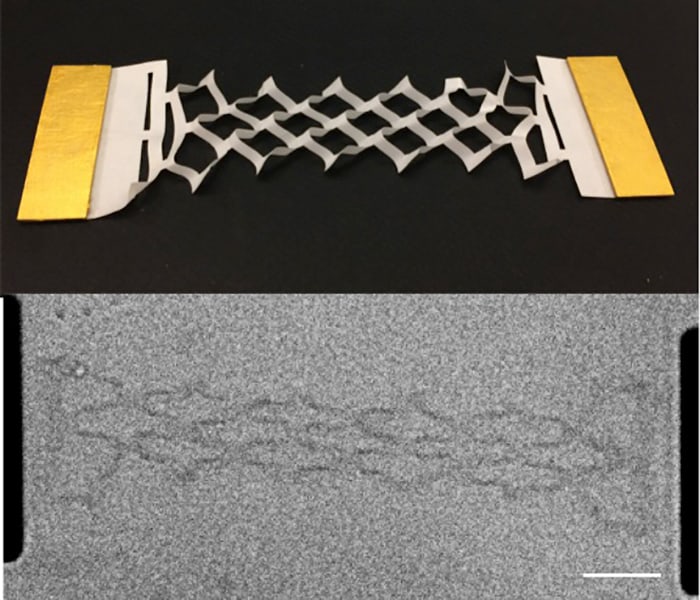
The team also produced graphene hinges that connected two pads together to create door-like devices. The devices were designed to be opened and closed either mechanically or magnetically, and survived about 10,000 open/close cycles before the gold pads started to warp. Perhaps the most eye-catching device created by the team is a pyramid-like structure with a gold peak that can be raised more than 10 μm above the graphene surface using the force of a laser beam (see figure above).
McEuen says the researchers worked at the micron scale partly for experimental convenience, but adds that there is nothing stopping them from further miniaturizing the devices to the nanometre scale. “All of the experiments were done in water using an optical microscope,” he explains, “If we went to the nanometre scale we wouldn’t be able to see anything.”
The current size of the devices is approximately the same size as many living cells, and this makes the technology ideal for many of the biological processes studied by McEuen’s team. “If you’re trying to detect the signal from a neuron, probably the 10 μm scale is the size that you would want. If you’re trying to make a device that can fold up and go inside a cell and then release some drug or chemical, you might want to make it much, much smaller, so it would have a better chance of being brought across the cell membrane.”
Nanoscientist Nicholas Kotov of the University of Michigan, whose own group recently published similar work using electrically conductive paper composites instead of graphene, is impressed by the researchers’ demonstration of “the applicability of the kirigami approach to the micron scale and to very thin sheets”. However, he points out that composites are better materials to work with at larger sizes.
Christian Santangelo of the University of Massachusetts, Amherst, agrees the work is “pretty exciting”, and thinks that the very fact that this can be done with graphene will interest researchers working to exploit the novel electrical phenomena of the material, although he thinks a quantitative, predictive model of the unexpected bending stiffness of graphene would also be an important contribution to our knowledge of the material.
In less than 100 seconds, Carole Mundell provides a succinct introduction to gamma-ray bursts (GRBs) – the brightest, instantaneously most luminous explosions in the universe. Astronomers believe these extreme events occur when certain stars reach the end of the lives, collapsing to form a black hole before ejecting material that becomes focussed by strong magnetic fields.
Mundell, an astronomer at the University of Bath in the UK, explains that because GRBs lie at the outer edge of the discovered universe, they can be used to probe its early history. Mundell’s research group uses ground-based telescopes to study the optical properties of GRBs. The researchers have to be on constant alert for the discovery of the next GRB in the universe by satellites so they can start looking for the optical counterpart signals.
Electrons in an iron-based molecule have been spotted crossing between four different spin states in less than 50 fs (5 × 10–14 s), which is the fastest ever observation of such a transition. The measurements were made by researchers in Switzerland, who say that the speed of the transition means that the electrons jump directly from the initial low-spin state to the final high-spin state without going through any intermediate states. A new theoretical model is now needed to describe such rapid transitions, and their discovery has implications for future devices based on the spin of the electron.
Electrons in atoms, molecules and solids exist in different spin states, and electrons can make transitions between these states. Spintronics makes use of such states to process and store information, and has the potential to deliver devices that are smaller and more energy efficient than conventional electronics. These states are quantum-mechanical in nature and therefore could also be used as building blocks for quantum computers, which could out-perform conventional computers on certain tasks. But before the full potential of spintronics can be realized, researchers need to gain a better understanding of the nature of spin transitions – or crossovers, as they are called in iron-based molecules.
Iron(II) complexes are molecules with an iron atom that shares two of its electrons with other atoms in the molecule. These complexes could play an important role in spintronics because their electron spins are able to cross over through four spin states. This is unlike most materials, in which the electron spin will only shift through one or two states. The ability to switch through four spin states makes these materials potentially useful for many spintronic applications, including magneto-optical data storage.
100,000 times faster
In 2009 researchers at the Laboratory of Ultrafast Spectroscopy (LSU) at Ecole Polytechnique Fédérale de Lausanne in Switzerland measured electrons in an iron(II) complex shifting through four spin states – in less than 150 fs. This was 100,000 times faster than any recorded spin crossover and the researchers suspected the process was even faster.
Majed Chergui, head of the LSU, hypothesized that the speed of the switch meant it was a direct event and the electrons do not pass through the two intermediate spin states – but not everyone in the research community agreed with this. To test this theory, Chergui and colleagues had to measure the speed of the electron shift. To do this, researchers at LSU developed an ultrafast ultraviolet spectroscopy experiment that was capable of measuring faster spin crossovers than had been possible. In their latest research, Chergui and his colleague Gerald Auböck have shown that the electrons actually jump through the four spin states in less than 50 fs, which is the time-resolution limit of their equipment.
This shows that it is a direct spin transition, Chergui claims, because there simply is not enough time for the intermediate spin states to develop. “I would even put it the other way round, because there are no intermediate steps, the switch is extremely fast,” he told physicsworld.com.
Despite the measurement, the researchers do not know exactly what is happening during the transition. This is because the observation does not fit with current theories of spin crossover, which assume that electrons pass through the intermediate states. Chergui says that these theories apply to other molecular systems with crossovers that are much slower than those observed at LSU – crossovers that take hundreds of picoseconds, or even nanoseconds.
‘Quasistatic regimes’
“All modelling of spin transitions is based on the old models, which are correct, but they are not applicable in this case,” Chergui says. He says that the current models are correct for “quasistatic regimes” where the spin transitions occur on much longer timescales than other molecular processes. He adds that the fast transitions occur in the “dynamic regime” on the same timescale that atoms are vibrating and moving around in the molecule.
Chergui is calling on theoreticians to come up with new models to explain the dynamic spin transitions they have seen, so that the technological and scientific implications of the ultrafast switches can be better understood. In the meantime, researchers at LSU are developing new techniques to enable them to measure the actual time it takes for the spin crossover to occur, which they believe is around 20 fs.
Coen de Graaf, a quantum chemist at Universitat Rovira i Virgili in Spain, who had previously proposed a mechanism involving intermediate states for spin crossover in iron(II) complexes, says: “In the paper it is argued that the timescale of the deactivation process from excited singlet to final quintet is even shorter than assumed so far, and that the [final spin state] populates on the very same timescale at which the [initial spin state] disappears. This indeed puts serious doubts on the possibility of other intermediate states.”
Certain types of swimming bacteria can lower the viscosity of an ordinary liquid, sometimes even turning it into a superfluid, according to work done by researchers in France. The team studied how the collective swimming motion of bacteria can substantially alter a fluid’s hydrodynamic properties. In some cases, the change is so great that highly active bacteria create a “negative-viscosity” liquid and are then pushed along by the fluid itself. The researchers suggest that the energy from such bacterial suspensions could be used to drive tiny mechanical motors in microfluidic systems.
The viscosity of a liquid is a measure of its resistance to being forced to flow. For example, honey and oil have much higher viscosities than water, and therefore do no flow as easily. Viscosity arises because of collisions between neighbouring particles in a fluid that move at different velocities. On the other hand, a superfluid – such as liquid helium – is a type of ideal fluid that has zero viscosity and flows as if it is not affected by surface tension or gravity.
All shook up
In the past, scientists had suspected that the presence of certain bacteria in a fluid could cause a change in its viscosity because of bacterial motion. Some models even sought to explain how this might happen: for example, the swimming movement of the bacteria being thought to make local changes in the liquid’s flow as the bacteria align themselves to reduce the velocity gradient of the liquid.
Now, Harold Auradou of the University Paris-Sud and colleagues have studied the well-known Escherichia coli, or E. coli, bacteria. These are a type of “pusher swimmer” that force fluid to flow outwards away from their flagella as they propel themselves forward. Auradou’s team studied E. coli suspensions made up of varying amounts of bacteria in solutions of water and just enough nutrients to keep the cells alive, but not adequate for them to reproduce. The flow of the solutions was studied as they were spun at different speeds in a rheometer – a device that applies shear stress through a rotating outer wall and is used to measure the viscosity of a liquid.
Bacterial brews
With this set-up, the researchers were able to determine that, for low to moderate stress values, the bacteria do indeed lower the viscosity of the liquid, as predicted. When the team then increased the number of bacteria and “doped” them with extra nutrients, the higher activity meant that the viscosity plummeted to zero – and even below zero.
The team still cannot say for sure what causes the viscosity drop, although the pusher-swimming motion may play a key role. Auradou and colleagues are confident, however, that the viscosity drop was indeed caused by the motion of the bacteria, rather than their mere presence, because adding dead bacteria to the solution made no difference to the viscosity. The team says that it may, in theory, be possible to somehow harness the viscosity-lowering ability of such bacterial cocktails. This could involve placing tiny rotors in the fluid that would be dragged around and could power a small device such as a microfluidic pump.
This week’s Red Folder opens with a fantastic video (above) from the folks at Veritasium. It involves dropping a spinning basketball from the top of a very tall dam in Tasmania and watching as the ball accelerates away from the face of the dam before bouncing across the surface of the water below. In comparison, a non-spinning ball simply falls straight down. This happens because of the Magnus effect, which has also been used to create flying machines and sail-free wind-powered boats. The effect also plays an important role in ball sports such as tennis and is explained in much more detail in our article “The physics of football”.