The Pierre Auger Observatory – the world’s largest cosmic-ray observatory – is set for a $14m upgrade that will also see its operations extended until 2025. The AugerPrime upgrade will involve installing scintillation detectors alongside the 1660 existing water Cerenkov detectors. This will enable more precise measurements of the mass of particles that make up cosmic rays, as well as help to identify the origin and nature of such particles.
The facility, which covers an area of 3000 km2 in Argentina, measures the cascade of secondary particles produced when a cosmic ray hits the Earth’s atmosphere. By observing these particles, astronomers can obtain information on the mass, direction and energy of the original cosmic ray.
Recent results have shown that at the highest energies – 1018–1021 eV – the number of cosmic-ray particles decreases much faster than at lower energies. A better understanding of the mechanisms responsible for this flux suppression should help infer the maximum energy of cosmic rays and identify what is responsible for accelerating cosmic rays to such high energies. However, this requires more detailed measurements of the highest energy rays.
Unique capabilities
The new 4 m2 scintillators will complement the existing Cerenkov water detectors and enable electrons and muons to be separated in the secondary shower more efficiently. Researchers will also be aided by a 23 km2 area of new buried muon detectors. “The ratio of electrons to muons turns out to be very sensitive to the mass of the primary particle,” says Pierre Auger Observatory spokesperson Karl-Heinz Kampert. “AugerPrime will address a number of fundamental scientific problems that cannot be addressed anywhere else within the next decade or more.”
Measuring the fluxes of both muons and electrons should make it easier to identify cosmic rays that are high-energy protons. This is important because they are deflected less by cosmic magnetic fields and do a better job of pointing back to their distant sources than cosmic rays that are heavy, highly charged, nuclei.
“It has been said that identifying the sources of cosmic rays is the ‘holy grail’ of our field,” says Gordon Thomson, co-principal investigator for the Telescope Array cosmic-ray observatory in Utah. “This is exactly the aim of the AugerPrime project. The technique of counting both muons and electrons in air showers has been used successfully in previous experiments, and I believe it will work very well for the Auger experiment also.”
Better electronics
Work will start on the upgrade next year, which will also include faster and more powerful electronics to facilitate the new detector components and enhance the overall performance of the observatory.
When Norman Lockyer, an astronomer and science writer with a day job as a clerk at the War Office in London, approached the publishing house Macmillan and Company in 1869 with a proposal for a new weekly journal about science, few could have predicted the outcome. The journal in question was Nature, and given its influence over the past 146 years, it is hard to believe that Melinda Baldwin’s Making Nature is the first full-length book to be written about it.
As Baldwin explains, Lockyer had originally intended Nature to appeal to both scientists and the general public, but the former refused to write in a way that could be understood by the latter, and the journal soon focused on researchers. However, Lockyer’s double-stranded philosophy is still in evidence in the modern Nature, where the “front half” contains news, opinion articles, book reviews and other magazine-style content aimed at a wide readership, while the “back half” is home to research papers aimed at specialists. Lockyer also established the idea of the journal being a player in the game, rather than merely reporting what was happening.
In its early decades, Nature was not the place where scientists sent their best work, but by the 1890s it was fast becoming the place where they could find out about and discuss exciting results that had been published elsewhere. The avalanche of new physics kicked off by the discovery of X-rays in November 1895 is a good example. Wilhelm Röntgen submitted his paper (written in German) to the Physical Medical Society of Würzburg on 28 December 1895 and sent copies to other physicists around the world, including Lord Kelvin in Glasgow and Arthur Schuster in Manchester. The discovery was widely reported in British newspapers in early 1896, and there was a short report in the issue of Nature dated 16 January 1896. However, Nature quickly showed what it was capable of, with the next issue containing an English translation of Röntgen’s paper; a paper from the Scottish engineer Alan Archibald Campbell-Swinton reporting that he had successfully repeated Röntgen’s experiments; and letters from Schuster and James Thomas Bottomley, a physicist at the University of Glasgow.
Although the paper reporting the discovery of X-rays was published in a German journal, Nature’s speed and engagement with researchers in the UK at the time meant that it was at the heart of the action as modern physics took shape. Relatively little of the original work was published in Nature but, as with X-rays, the journal played an important role in spreading news of the latest developments. All this was to pay dividends in the form of original research papers in later years from James Chadwick, Niels Bohr and Enrico Fermi (although Nature did reject Fermi’s seminal paper on the theory of beta decay).
By the 1930s Nature editorials increasingly covered topics outside the UK, notably the suppression of scientists in the Soviet Union and the threats posed by the rise of the Nazi party in Germany. However, the Second World War restricted the number of pages the journal could print, and its front half entered a lull. There were some highlights in this period, such as the publication of the double-helix structure of DNA in 1953, but as one long-time contributor put it: “almost anything could get into it at the time, if it wasn’t actually wrong”.
The lull ended when John Maddox was appointed editor in the mid-1960s. A former physics lecturer turned science journalist, Maddox immediately set about shaking up Nature’s front half, dealing with a backlog of 2000 submissions awaiting a decision and overhauling the journal’s approach to peer review. In 1971, however, Maddox took the bold decision to split Nature into three: Nature Physical Sciences was published on Monday, Nature New Biology on Wednesday and Nature on Friday. While this move clearly prefigures the more recent explosion in Nature-branded titles, it was not a success financially (the cost of a subscription remained the same as printing and postage costs soared), or editorially (being published in one of the “offcuts” felt like a demotion to authors), and the new titles were folded back into Nature at the end of 1973.
By that time, Maddox had been replaced by the geophysicist David Davies, who began to place greater emphasis on the use of external referees for papers that had survived scrutiny by Nature’s own editors. But in 1980 Davies decided he was ready for a new challenge, and, to many people’s surprise, Maddox returned. Baldwin focuses on two notorious incidents during this second term: the Benveniste affair and cold fusion. In 1988, in one of the more bizarre episodes of modern science, Maddox decided – against the advice of referees and his own staff – to publish a paper on homeopathic dilution by Jacques Benveniste and co-workers. He then led a team of investigators to Benveniste’s lab to watch the experiments being repeated. The team was unimpressed, the results were discredited (but never retracted) and Maddox emerged with his reputation somewhat tarnished. Baldwin argues (convincingly in my view) that his unorthodox behaviour was driven by his belief that Nature should follow Lockyer’s lead and take an active part in science.
His fingers burned by the Benveniste affair, Maddox was more cautious when cold fusion arrived the following year. Briefly, Nature rejected a paper by Martin Fleischmann and Stanley Pons, accepted a paper on muon-catalysed cold fusion that made more modest claims, and then proceeded to publish a series of articles that poured cold water on both. Active, yes, but also more orthodox.
Maddox stepped down in 1995, and under his successor Philip Campbell (previously editor of Physics World), both Nature and its parent company have continued to grow and prosper. This poses a challenge to the historian: if you are writing a history of an institution that is still going strong, when should the book end? Baldwin concludes with a disappointing chapter about current trends in publishing: Nature is at the centre of several important debates about scientific publishing, but Making Nature covers them fleetingly, if at all. Open access and the growth of Nature-branded journals are both mentioned, but it is odd not to discuss the degree to which Nature Publishing Group is staking its future on two open-access publications – Scientific Reports and Nature Communications (which now employs more manuscript editors than Nature itself) – while continuing to launch new subscription journals at an ever-increasing rate.
However, the biggest omission, I feel, is a failure to analyse the remarkable influence that Nature and two other journals – Cell and Science – exert on researchers in the life sciences and biomedical research. Many early-career researchers in these fields believe that they need a paper in one of these journals to stand a chance of getting a permanent position. This state of affairs is generally attributed to the high “impact factors” (a measure of how often papers are cited) of these journals, but Baldwin is silent on how Nature went from being ranked 109th by impact factor in 1975 to being “unquestionably top of the journal hierarchy, rivalled only by Science and Cell”. Part of the reason is that it now publishes considerably fewer papers per week than it did in 1975.
Given the focus of earlier chapters on the Benveniste affair and cold fusion, it also seems odd not to mention some of the high-profile scandals that have rocked science since then, and to overlook the “reproducibility crisis” that Nature has covered at length in its front half. The Benveniste affair would have been an ideal starting point for such a debate. There is more to be written about the history of Nature.
2015 University of Chicago Press £31.50/$45.00 hb 328pp
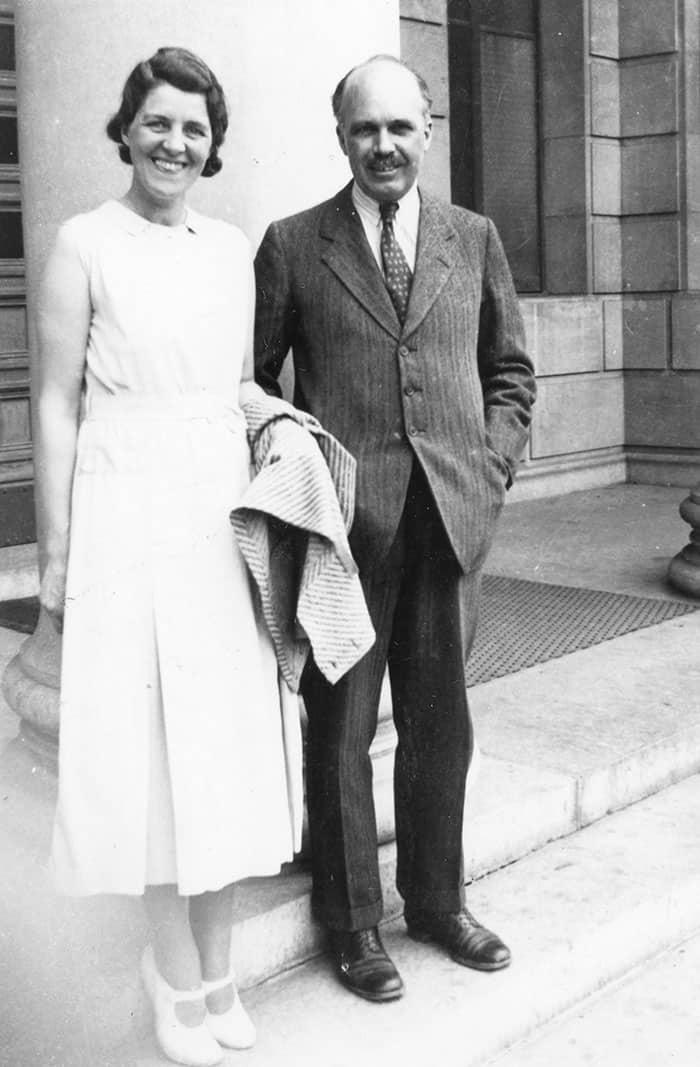
Tellers of tales Lady Alice and Sir Lawrence Bragg were keen observers of science and society in the 20th century. (Courtesy: AIP Emilio Segre Visual Archives)
Recent years have seen a surge of material released on the lives and works of William Henry Bragg and William Lawrence Bragg, the father-and-son team who shared the 1915 Nobel Prize for Physics. Their prize, awarded “for their services in the analysis of crystal structure by means of X-rays”, recognized research that fundamentally changed the way we think about molecules and crystals, and laid the foundations for modern crystallography. This wonderful book – published in the centenary year of the Braggs’ Nobel prize – adds to this trend by giving us, for the first time, the family stories of Sir Lawrence Bragg (WLB) and his wife, Lady Alice Bragg, in their own words.
But Crystal Clear is far more than the autobiographies of the two main players. Rather, it tells the story of their lives – scientific, political, social and personal – in four quite distinct voices. The first voice is that of Mike Glazer, an emeritus professor of physics at the University of Oxford, who gives a brief but essential history of the scientific events behind the Braggs’ Nobel prize and a summary of WLB’s career in the book’s foreword. Glazer also relates the events that led to the present volume (the original material for which he edited “with the lightest of touches”) and adds succinct footnotes throughout. This material is essential to fully appreciate the story being told.
The ensuing chapters are personal recollections from WLB, Lady Alice and their younger daughter Patience Thomson. There is of course plenty of science, but at heart this is a love story, of the kind that encompasses so much more than just romance: it is also about family, ancestry, children, gardening, sketching, painting, sailing, bird-watching and (especially) holidays. We see the enduring, loving relationship between WLB and Lady Alice, and we develop a picture of the family as a very normal one confronted by abnormal events. The Braggs experienced the very pinnacle of scientific achievement and mixed socially and professionally with other scientists at the very top (as well as leading politicians and royalty), but they also endured two world wars and the loss of close family members and friends. And they were not immune to the enormous changes in society in the 20th century, especially for women.
Patience Thomson’s portion of the book, entitled Meet My Mother and Father, provides a personal perspective on her parents and siblings, including her thoughts about some incidents that are also mentioned in the autobiographies of WLB and Lady Alice. In addition, her account features some wonderful material not found elsewhere. Many quite surprising images are evoked in these passages, among them that of WLB mowing the lawn of a friend, Lady Thomson (the widow of J J Thomson, discoverer of the electron), using a mower “pulled by a pony wearing leather booties, so as not to make holes in the lawn”.
William Lawrence Bragg (In His Own Words) is more formal, and commences with the author’s birth in 1890 in Adelaide, South Australia, where his father (WHB) was professor of mathematics and experimental physics. It describes his childhood growing up in Adelaide, followed by the family’s return to England with his father’s appointment at the University of Leeds in 1909. Unsurprisingly, WLB’s account covers in considerable detail the important scientific phases of his career: the appointment at Manchester, the National Physical Laboratory and the Cavendish Chair at Cambridge. We are given insight into physical science in the first half of the 20th century as experienced by one of its pre-eminent practitioners, and WLB’s account is peppered with the names of many other famous scientists from physics, chemistry and crystallography. His part of the family story ends quite abruptly, however, in 1951; the heavy demands that followed his move to the Royal Institution in 1954 apparently left little time for WLB to finish his account.
WLB mentions surprisingly little of his family background, but his wife takes a different tack. In Alice Grace Jenny Bragg: “The Half Was Not Told”, she relates many stories about her parent’s ancestors, the Hopkinsons and the Cunliffe-Owens. Her childhood and schooling are described in detail, including some fascinating extracts from her mother’s diary. According to her daughter Patience, Lady Alice was deeply religious, and the title of her account seems to come from a Biblical verse (1 Kings 10:7); it was perhaps intended to mean “half the story has never been told”. But while she was a devoted member of the Anglican High Church, her husband was “a blue sky worshipper”: he stayed at home and worked in the garden on Sundays.
Lady Alice’s account includes many anecdotes and observations on her family, close friends and scientific colleagues of WLB. Some of these are rather quaint and even somewhat surprising: on meeting her future father-in-law, for example, she writes that “Sir William Bragg was a large man, beaming genially but rather silent. He made pleasing noises, a way of communication common to scientists, I was to discover.”
Several events recounted in these autobiographies remind us that we are now a century past the tragic events of the First World War. This conflict greatly affected the family: Alice’s brother, Eric Hopkinson, was killed in Belgium in June 1915; Robert Bragg, WLB’s brother, died at Gallipoli in September 1915; and Cecil Hopkinson, Alice’s cousin, was wounded on the western front in 1915, dying in England in 1917. The family was also affected by, and sometimes intimately involved in, the social changes that occurred in the first half of the 20th century, many of which provide a background to specific events and recollections. Alice had numerous public roles, including Mayor of Cambridge (her official title was “His Worship Mr Mayor”), and she served on the Royal Commission for Marriage and Divorce for four years. The changing expectations of mothers are conveyed with humour in the delightful essay “Learning from daughters”, written by Lady Alice in 1966.
Lady Alice’s account finishes with WLB’s death in 1971, which was preceded by “five happy years of retirement living in Suffolk, where we could garden and WLB could paint”. Both WHB and WLB were talented artists, and the book includes numerous beautiful sketches by WLB as well as two by WHB (regrettably reproduced too small to fully appreciate his fine attention to detail). In his foreword, Glazer notes that “Crystallography is by its nature both a highly mathematical and a visual subject,” and many of its practitioners would certainly share this view.
Although Alice survived her husband by 18 years, the final words of her account appear to have been written soon after his death, and movingly sum up their journey together: “After that there is no more to be told. I have the joy of children, grandchildren and all our friends… I look back with gratitude, knowing that I have had the greatest of human experiences, that of loving and being loved.”
Biophysicists have long wondered how swimming micro-organisms co-ordinate the motions of their arms – or flagella – as they propel themselves through water. Now, researchers at the Delft University of Technology in the Netherlands have shown that the single-cell alga Chlamydomonas reinhardtii synchronizes its two flagella via internal fibres within the cell, rather than via interactions with the surrounding fluid – as had been previously thought.
Many bacteria and algae, and other tiny cells, possess whip-like appendages called flagella, which they use to propel themselves. Similar, shorter-moving filaments, known as cilia, are also found on the surface of many cells, which perform functions such as moving fluids and other particles over the cell. Flagella and cilia tend to synchronize their beating motions with one another. This co-ordinated beating is often vital to the role of these filaments, but the physical mechanism behind the synchronization in not well understood.
Synchronized breaststroke
Most research on synchronization has focused on Chlamydomonas reinhardtii, a single-cell green alga that swims with two flagella that beat in opposite directions and perform a breaststroke-like motion. Previous studies have suggested that the synchronization is driven by hydrodynamic coupling in the liquid surrounding the cell. The idea is that the flow generated by one flagellum acts on the other flagellum and vice versa, causing them to move in synchronicity. However, these studies are far from conclusive, and there is also some evidence that other mechanisms are involved.
To study the extent to which flagella respond to hydrodynamic forces, Daniel Tam and colleagues held individual C. reinhardtii at the tip of a pipette inside a flow chamber. The team then sloshed fluid back and forth across the alga and recorded the motion of the flagella.
The researchers found that while the breaststroke-like movement of the flagella can be controlled by external flow, the hydrodynamic forces needed for synchronization are greater than those produced by the beating flagella. The flagella did synchronize with the external flow, but only if the forcing frequency of the flow was very close to the natural beating frequency of the flagella. The intrinsic beating frequencies – the rates at which single flagellum beat in isolation – of the flagella of C. reinhardtii individuals, however, differ from each other by as much as 30%. The researchers calculate that to generate hydrodynamic forces large enough to drive one another at such frequency differences, the flagella would need to produce flows 30 times the natural swimming speed of the algae.
Internal connection
From these observations, the team was able to conclude that synchronization is caused by fibres within the cell. “Chlamydomonas doesn’t react as strongly to flows as we would have expected,” Tam explains, which means it is “very likely that hydrodynamic interaction does not play a role in the synchronization”. He cautions that this does not rule out the idea that hydrodynamic flows drive synchronization in other micro-organisms.
As for how C. reinhardtii is able to perform the breaststrokes, Tam and colleagues suspect that synchronization occurs via a contractile fibre – the distal striated fibre – that connects the two flagella. This had been suggested previously but never tested. Tam and his team investigated the significance of this intracellular coupling using a mutant strain of C. reinhardtii that has defects in the contractile fibre – the vfl3 mutant. They found that the two flagella in mutant algae always beat in an asynchronous fashion.
The study is described in Physical Review Letters. In a review that accompanies the letter, Marco Polin of the University of Warwick in the UK and Idan Tuval of the Mediterranean Institute for Advanced Studies in Spain write that “The results, which the authors unfortunately only describe qualitatively, are clear: without the fibres, the flagella fail to synchronize. These experiments are promising, and unequivocally point to the importance of intracellular mechanical coupling.”
Raymond Goldstein and colleagues at the University of Cambridge in the UK have completed a comprehensive study of the nature of synchrony and the significance of intracellular connections in C. reinhardtii and other related organisms, with a preprint available on the arXiv server. Goldstein told physicsworld.com that they found “the vfl mutants can display synchrony if the flagella are close enough together – it varies how close they are cell by cell – exactly as you would expect from hydrodynamic coupling”, but this involves a different front-crawl-like swimming motion. This, he explains, “is evidence that the two processes, hydrodynamics and internal coupling, compete” to determine the form of flagella synchronization that is observed.
Birmingham’s new central library resembles a fancy wedding cake, and a recent light-themed festival at the building certainly brought plenty of cheer. Lightfest was a celebration of light in science, art, technology and culture – held in connection with the International Year of Light and Light-based Technology (IYL 2015). This video captures some of the highlights of the event as various students and researchers give light-themed demonstrations to the public.
Lightfest was organized by Aston University and the choice of a public venue in central Birmingham, UK, enabled the event to reach out beyond the scientific community. “The basic idea is that researchers meet the public – particularly young people – and inspire people to take up science as a career, or to engage more with science,” says Paul Harris of the European Commission, which provided funding for the event. Among the demos featuring in this video are a “laser harp”, an “LED cube” and an experiment to show how different coloured gummy bears filter light in different ways.
“One of the most inspiring things about this year has been the way it’s brought together a uniquely wide variety of communities,” says Beth Taylor, chair of the IYL 2015 UK national committee, one of the speakers to officially open the event. If you want to find out more about the themes and goals of IYL 2015, take a look at this film we produced at the opening ceremony held in Paris back in January.
As an official media partner of IYL 2015, we have also commissioned a series of films that explore the impact of light and light-based technologies on people’s lives. Each film reflects the culture and geography of the country in which it was produced, telling captivating personal stories. You can view all of these films, along with articles about light, in this free-to-access digital collection.
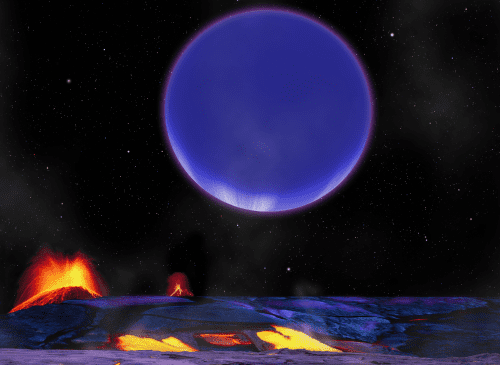
It’s raining life: could two nearby planets exchange living organisms? An artist’s impression of one planet in the Kepler 36 system as seen by its neighbour. (Courtesy: Harvard-Smithsonian Center for Astrophysics/David Aguilar)
By Hamish Johnston and James Dacey
There is an intriguing article about alien life this week in The Conversation. “Twin civilizations? How life on an exoplanet could spread to its neighbour” is by David Rothery of the Open University and is a popular account of a paper that will soon be published in the Astrophysical Journal. The paper is inspired by the star Kepler 36, which has two planets that are in very close proximity to each other. While the Kepler 36 worlds are not suitable for life, the paper’s authors – Jason Steffen and Gongjie Li – explore possible exchanges of life between two Earth-like planets in similarly close orbits. Rothery explains that debris flung off one of the planets would stand a good chance of finding its way to the surface of the other planet after a relatively brief journey through space.
The first direct evidence of magnetic fields near a black hole has been found by researchers using the Event Horizon Telescope (EHT), who have seen such fields around Sagittarius A* (Sgr A*) – the black hole at the centre of our Milky Way galaxy. While such magnetic fields have long been predicted, this is the first time that they have been detected close to the “event horizon” of the black hole. Magnetic fields near a black hole are thought to power the huge relativistic jets that emerge from many accreting black holes and blast across thousands of light-years – shaping entire galaxies along the way.
Global effort
Astrophysicists have long been keen to understand how relativistic jets form and where they get their colossal power. However, detecting magnetic fields at or near the event horizon – the boundary at which even light cannot escape a black hole’s gravitational pull – has been an impossible task until very recently. The Event Horizon Telescope (EHT) – a global network of radio telescopes that are linked together to function as one giant, Earth-sized telescope – now makes it possible to resolve features at the horizon of Sgr A*. This is the Milky Way’s 4.5 million solar-mass black hole that is hidden behind colossal veils of gas and dust some 26,000 light-years away from Earth.
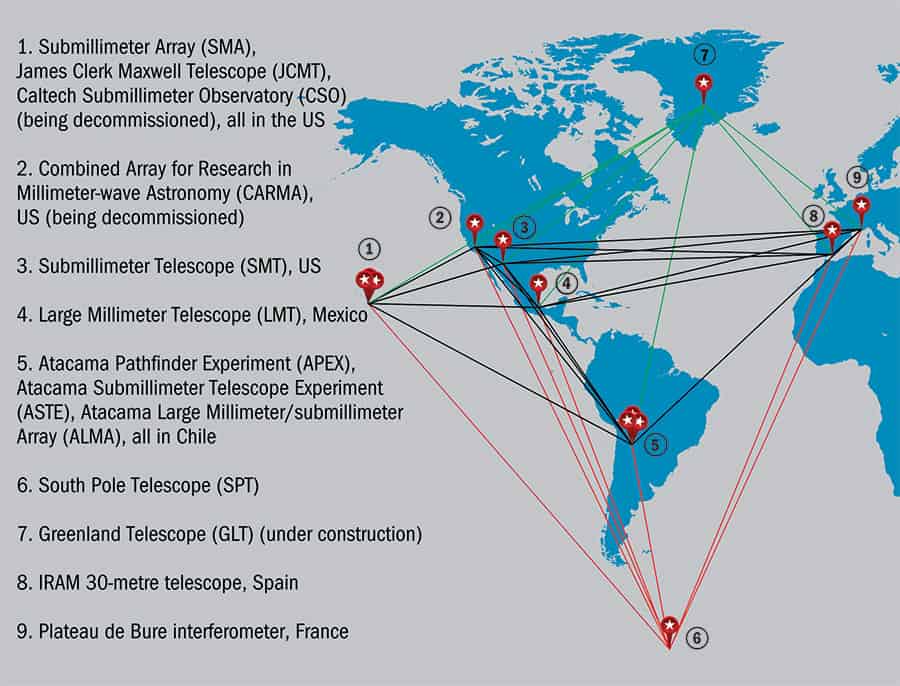
The EHT uses a radio-astronomy technique called very-long-baseline interferometry (VLBI), and its network of receivers extends from Hawaii to Spain (illustration below). It is still being built but when it is fully functional, it should be able to resolve features as small as 15 micro-arcseconds – an angular resolution that would allow it to see an orange on the surface of the Moon.
Cross-continental network: the 13 radio telescopes – past, present and future – involved in the Event Horizon Telescope. This map also shows the coincident visibility lines between telescopes. Telescopes connected by these lines will work together to image black holes. Green lines indicate connections used for objects in the northern sky, red lines for objects in the southern sky, and black lines denote telescopes viewing both northern and southern skies. (Courtesy: Perimeter Institute)
To make its measurement, the EHT team connected together four telescopes: the Submillimeter Array and the James Clerk Maxwell Telescope, both in Hawaii; the Submillimeter Telescope in Arizona; and the Combined Array for Research in Millimeter-wave Astronomy (CARMA) in California. The team observed the polarization of the incoming radio waves on different angular – and therefore spatial – scales. The orientation of this polarization is dependent on the orientation of the local magnetic fields in the vicinity of Sgr A*.
Polarization data
EHT researcher Michael Johnson, from the Harvard-Smithsonian Centre for Astrophysics, explains that each telescope records two data streams that capture both the right- and left-handed circular polarization of the incoming radio waves. The team then compares streams from different telescopes using a supercomputer. In the past, all of the data used by the EHT compared streams that were of the same handedness: right versus right and left versus left. The cross-hand signals are much weaker, but they carry information about the linear polarization. “Because of technical advances with the EHT, we can now detect this polarization information. And because the emission near Sgr A* is synchrotron radiation, the direction of linear polarization traces the magnetic fields. So that’s how we can go from measuring polarization at the telescope to understanding magnetic fields near the black hole,” says Johnson.
EHT physicist Avery Broderick, of the University of Waterloo and the Perimeter Institute for Theoretical Physics in Canada, told physicsworld.com that this is the first time that researchers have detected horizon-scale order in the magnetic fields in the immediate vicinity of a black hole and not thousands of Schwarzschild radii away. “By measuring high-polarization fractions on horizon scales, compared with low polarizations on scales 5–10 times larger, we have shown that the polarization patches, and thus magnetic fields, are organized on horizon scales,” says Broderick.
The researchers were “shocked to see how strong the polarization signal was on our longest interferometric baseline”, says Johnson, adding that the polarization fraction on the longer baseline was a factor of 10 higher than what the shorter baselines detect. “Such a dramatic difference in how the polarization appears when you observe with the highest angular resolution really took us by surprise, and it comes about because of this mix of ordered and tangled magnetic fields near the black hole. The ordered fields are good news for theories of jets, since ordered fields are thought to play a central role in the formation and collimation of these jets.”
The other surprise that lay in wait for the team was just how active the polarization was and how it changed on a daily basis. “On one day, the polarization traced out a clean ‘loop’ over the two-and-a-half-hour observation, possibly from orbiting material very close to the event horizon,” says Johnson. The researchers also saw fluctuations in the strength and direction of the horizon-scale linear polarization from Sgr A* over a 15 min timescale, revealing the extreme dynamics at play at the heart of the black hole. Indeed, the innermost orbits near Sgr A* have timescales of about 30 min, so the fluctuations most likely arise from turbulent fields in the innermost accretion disc. Johnson points out that “it is very difficult for material to fall into a black hole without turbulence, so these first direct observations of the turbulence are finally placing these accretion theories on firm observational footing”.
Once the EHT is functioning with its full complement of telescopes, the researchers will study these magnetic fields repeatedly, as they try to understand what drives accretion onto black holes and what powers their jets. While Sgr A* does not currently have a jet, the team’s other candidate – the supermassive black hole at the centre of the M87 galaxy – has a prominent one, and the researchers hope to understand what role the magnetic fields play in launching and powering that jet. “All of that means that we are one step closer to understanding, and ultimately removing, the uncertain astrophysics that complicates the forthcoming precision tests of Einstein’s general relativity in the strong-gravity limit,” adds Broderick.
Hawaii’s Supreme Court has ruled that the construction permit for the $1.4bn Thirty Meter Telescope (TMT) on top of Mauna Kea mountain is invalid. Construction of the telescope has been on hold since March, when hundreds of native Hawaiians and their supporters protested and prevented building crews from entering the site. The court ruling is a fresh blow to the project, with the telescope’s backers now having to restart the permit process.
With a 30 m primary mirror made of 492 hexagonal segments, the TMT will be the largest and most powerful instrument on Mauna Kea, which is already home to 13 others. The TMT will sit on a plateau about 150 m below the summit – a location picked to reduce the telescope’s visibility from the majority of the island.
In its ruling on 2 December, the court claimed that Hawaii’s Board of Land and Natural Resources (BLNR) should not have approved the permit in 2011 because it failed to follow due process when awarding it. “Quite simply, the board put the cart before the horse when it issued the permit before the request for a contested case hearing was resolved and the hearing was held,” the ruling notes. “Accordingly, the permit cannot stand.”
The court decision now requires the TMT to go through the process again that will first involve a “contested case hearing”, which must be heard first before a permit can be issued. The decision by the court will result in delays beyond the targeted 2023 construction date, although how long is currently unknown.
“I’m not surprised the court looked at the permitting process itself, since the actual case for building the TMT – that it will be an environmentally and culturally responsible observatory that benefits the educational and economic future of Hawaii – is and remains exceptionally strong,” says Thayne Currie, an astronomer with the Subaru Telescope on Mauna Kea. “Considering the tremendous scientific discoveries and opportunities that the TMT will afford, the wait will be worth it.”
Respecting the decision
In a statement, Henry Yang, chair of the TMT International Observatory Board of Directors, noted that the TMT collaboration is now considering its next steps. “We thank the Hawaii supreme court for the timely ruling and we respect their decision. TMT will follow the process set forth by the state, as we always have,” says Yang. “We appreciate and thank the people of Hawaii and our supporters from these last eight-plus years.”
Groups opposed to the TMT’s construction have, however, welcomed the decision. Kamahana Kealoha, head facilitator of Sacred Mauna Kea Hui, says the group is “elated” at the move to annul the permit, which he says has been acquired “through an immorally and unethically manipulated process that has been negligently overseen by the BLNR”. “Our goal has always been to systematically secure the Mauna,” Kealoha told physicsworld.com. “The revoking of the construction permit is essential for us to succeed in protecting the mountain summit and the endangered-species environment from further development by this 18-storey monstrosity.”
Kealoha adds that they now hope that TMT’s backers will “see red flags and pull out”. “Quite frankly, the resistance is here to stay, and we plan to see to it that the TMT is not built,” he says. “This could be more costly than the $1.4bn already appropriated and, speaking for myself and my group, we will continue to make sure the TMT being built on our sacred summit is not a profitable venture for investors, as we already have.”
Since 1968, the University of Hawaii has leased more than 44.5 km2 of land on Mauna Kea from the Hawaiian Department of Land and Natural Resources (DLNR) for scientific purposes, with the highest 2.1 km2 devoted to astronomy research. Two months after the protests in March, the governor of Hawaii, David Ige, noted that the TMT had the right to proceed, and that all of the necessary permits for the observatory had been obtained. However, he criticized how the University of Hawaii has managed the land on Mauna Kea, outlining that a quarter of the telescopes on the summit should be completely dismantled and each site returned to its natural state by the time the TMT is operational.
Well written, scientifically interesting to physicists, and novel: these are the criteria used to select Physics World’s annual list of the year’s top physics books. We’ve donethiseveryyearsince2009, and over the past few weeks, we’ve been at it again, sifting through the 52 books reviewed in the magazine in 2015 and separating the best from the rest (most of which, I should add, are also very good – we try not to review bad books).
This is never an easy task, and as usual, the selections in our shortlist have been influenced by the views of external experts: the physicists, science writers and science historians who read and reviewed books for Physics World magazine throughout 2015. Their reviews (and, in a few cases, their private opinions) helped us decide which books deserved a closer look, and we thank them all for their contributions.
Deciding on a winner, however, is a privilege we reserve for ourselves, and with so many great books to choose from, it has been both a privilege and a challenge this year. We’ll be announcing our “Book of the Year” in a special edition of the Physics World podcast later this month, but in the meantime, here are the candidates:
Pick up a newspaper, and chances are it will have a story about water in it. From news of floods and droughts to the discovery of water flowing on Mars, water is embedded in our surroundings and in our culture (“Water, water everywhere”). Yet despite its ubiquity, we don’t really understand it. From the forces that bind it into a solid, to the way it cools and even how it sustains the cells that build our bodies – the humble H2O molecule still retains many of its mysteries.
In The Water Book, science journalist Alok Jha endeavours to connect each of us through the intrigues of this deceptively simple substance “to everyone and everything else and the rest of the universe”. The book is told in the form of a story that chases the enigmatic water molecule from the far reaches of space to the Atacama Desert and back again. But it isn’t just us, the readers, who get to go on a journey, for Jha is on the move as well: as the book begins, he is boarding the vessel MV Akademik Shokalskiy, bound for Antarctica on a research trip.
The voyage doesn’t start well, but it does give Jha an excuse to treat us to an extensive description of the trials and tribulations of a journey through the “roaring forties” to the icy Southern continent. As the ship progresses, he describes the larger context of its voyage, elegantly moving from historic to present-day scientific impacts. In doing so, Jha sets the tone for the book, weaving tales from his journey to Antarctica in with the twists (and a few red herrings) in the meandering story of water.
The scope of the task Jha sets himself is challenging, as there are few scientific topics that water does not seep into. To tackle this, Jha loosely separates his treatise into sections discussing water on Earth in liquid (“The Hydrosphere”) and solid (“The Cryosphere”) forms before heading off our planet to hunt for places where water hides out in the rest of the solar system. This sectioning of the book serves him well as he winds descriptions of various research on the water molecule into stories of his own journey south.
When discussing water here on Earth, Jha is unapologetic about refusing to separate the fundamentals of water science (particularly as it is applied to our environment) from the pressing issue of climate change. This issue crops up a number of times, and although he states that a discussion of climate change is beyond the scope of the book, many of the topics he chooses to cover stray unavoidably into the Earth’s gloomy future. This is particularly stark as he travels across the Antarctic ice in search of the now ice-locked hut that sheltered the Australian explorer and scientist Douglas Mawson in 1912–1913. On arrival at the hut, Jha pauses his story to discuss the effect of the changing landscape on the nearby colony of Adélie penguins, followed swiftly by a description of research on ice-sheet dynamics and ice-core isotopes, and then by a summary of results from the Intergovernmental Panel on Climate Change. This rather breathless coverage of topics is somewhat a feature of the book.
As for water as a chemical, I particularly liked the book’s account of the “Victorian controversy” over who actually discovered that water molecules consist of two hydrogen atoms attached to an oxygen. Was it the aristocrat Henry Cavendish? The engineer James Watt? Or the French tax collector Antoine Lavoisier? Jha includes a deft description of the polar nature of the water molecule and its implications, and he delves particularly into the impact of polarity on our understanding of biochemistry, pointing out the usefulness of the ubiquitous hydrogen bond in water. In doing so, he certainly fulfils the brief to connect water to everyone in the most intimate sense. Most crucial, he explains, is the generation of “proton currents” (thanks to water’s ability to carry charge momentarily) for storing energy in our bodies and indeed those of most other living organisms. Paired with water’s extraordinary solvent properties, which enable it to transport elements where needed, it’s easy to see why we are made of more than 70% water.
In tackling the physics behind water, Jha takes in both the big and the small. He describes the compound’s astrophysical beginnings in chance encounters of oxygen and hydrogen atoms, then moves on to discuss the diversity and complexity in the structure of water. To learn about the many solid forms that water can take, he consults with a number of scientists who explain how 16 different solid structures of ice can form, depending on pressure and temperature. Jha then applies all of this knowledge to the question of where water might exist elsewhere in our solar system – and perhaps beyond.
The subject matter in The Water Book is admirably diverse, but in its quest to use water to connect such a wide range of scientific topics, the book does come across as a little rushed in places. Some topics that Jha promises to return to are barely covered later in the text, while various intriguing aspects of water research are introduced but not dwelled on – meaning that at some junctures, the reader is only given a tantalizing glimpse into possible depths.
To my mind, there also seemed to be a number of exciting, topical water quests that went under-explored. What about all the water in the interior of the Earth? Surely the ability of water to store energy, or the physics of quasi-liquid layers, also has an impact on our lives? I also found it surprising that some historic water controversies, such as the “polywater” debacle of the 1960s and early 1970s, were not covered. But perhaps this is churlish. Overall, I would venture to say that even the most general of “water experts” is likely to learn something new in this book. In addition to the breadth of topics covered, I genuinely enjoyed Jha’s descriptions of the voyage on the MV Akademik Shokalskiy. He brings to life the progress of the voyage in a way few Antarctic explorers could. The dramatic conclusion of the journey, and of the book, serves as the perfect testament to humankind’s struggle with water – a substance that never quite does what we expect.


 Well written, scientifically interesting to physicists, and novel: these are the criteria used to select Physics World’s annual list of the year’s top physics books. We’ve