A team of researchers in Switzerland, Germany and the US has observed clear evidence of quantum mechanical interference behaviour in collisions between a methane molecule and a gold surface. As well as extending the boundaries of quantum effects further into the classical world, the team say the work has implications for surface chemistry, which is important for many industrial processes.
The effects of interference in light are generally easy to observe. Whenever a beam of light passes through closely-spaced slits or bounces off an etched grating, an alternating pattern of bright and dark intensity modulations appears, corresponding to locations of constructive and destructive interference, respectively. This was the outcome of Thomas Young’s original double-slit experiment, which was carried out in the 1800s and showed that light behaves like a wave.
For molecules and other massive objects, observing interference is trickier. Though quantum mechanics decrees that these also interfere when they scatter off surfaces, and a 1920s version of Young’s double-slit experiment showed that this was true for electrons, the larger the objects are, the more difficult it is to observe interference effects. Indeed, the disappearance of such effects is a sign that the object’s wavefunction has “decohered” – that is, the object has stopped behaving like a wave and started obeying the laws of classical physics.
Similar to the double-slit experiment
In the new work, researchers led by Rainer Beck of the EPFL developed a way to observe interference in complex polyatomic molecules. They did this by using an infrared laser to push methane (CH4) molecules into specific rovibrational states before scattering the molecules off an atomically smooth and chemically inert Au(111) surface. They then detected the molecules’ final states using a second laser and an instrument called a bolometer that measures the tiny temperature change as molecules absorb the laser’s energy.
Using this technique, Beck and colleagues identified a pattern in the quantum states of the methane molecules after they collided with the surface. When two states had different symmetries, the quantum mechanical amplitudes for the different pathways taken during the transition between them cancelled out. In states with the same symmetry, however, the pathways reinforced each other, leading to an intense, clearly visible signal.
The researchers say that this effect is similar to the destructive and constructive interference of the double-slit experiment, but not quite the same. The difference is that interference in the double-slit experiment stems from diffraction, whereas the phenomenon Beck and colleagues observed relates to the rotational and vibrational states of the methane molecules.
A rule to explain the patterns
The researchers had seen hints of such behaviour in experiments a few years ago, when they scattered methane from a nickel surface. “We saw that some rotational quantum states were somewhat weakly populated by the collisions while other states that were superficially very similar (that is, with the same energy and same angular momentum) were more strongly populated,” explains Christopher Reilly, a postdoctoral researcher at EPFL and the lead author of a paper in Science on the work. “When we moved on to collisions with a gold surface, we discovered that these population imbalances were now very pronounced.”
This discovery spurred them to find an explanation. “We concluded that we might be observing a conservation of the reflection parity of the methane molecule’s wavefunction,” Reilly says. “We then set out to test it for molecules prepared in vibrationally excited states and our results confirmed our hypothesis spectacularly.”
Because the team’s technique for detecting quantum states relies on spectroscopy, Reilly says the “intimidating complexity” of the spectrum of quantum states in a medium-sized molecule like methane was a challenge. “While our narrow-bandwidth lasers allowed us to probe the population in individual quantum states, we still needed to know exactly which wavelength we need to tune the laser wavelength to in order to address a given state,” he explains.
This, in turn, meant knowing the molecule’s energy levels very precisely, as they were trying to compare populations of states with only marginally different energies. “It is only just in the last couple years that modelling of methane’s spectrum has become accurate enough to permit a reliable assignment of the quantum states involved in a given infrared transition,” Reilly says, adding that the HITEMP project of the HITRAN spectroscopic database was a big help.
Rethinking molecule-surface dynamics
According to Reilly, the team’s results show that classical models cannot fully capture molecule-surface dynamics. “This has implications for our general understanding of chemistry at surfaces, which is where in fact the majority of chemistry relevant to industry (think catalysts) and technology (think semiconductors) occurs,” he says. “The first step of any surface reaction is the adsorption of the reactants onto the surface and this step often requires the overcoming of some energetic barrier. Whether an incoming molecule will adsorb depends not only on the molecule’s total energy but on whether this energy can be effectively channelled into overcoming the barrier.
“Our scattering experiments directly probe these dynamics and show that, to really understand the different fundamental steps of surface chemistry, quantum mechanics is needed,” he tells Physics World.
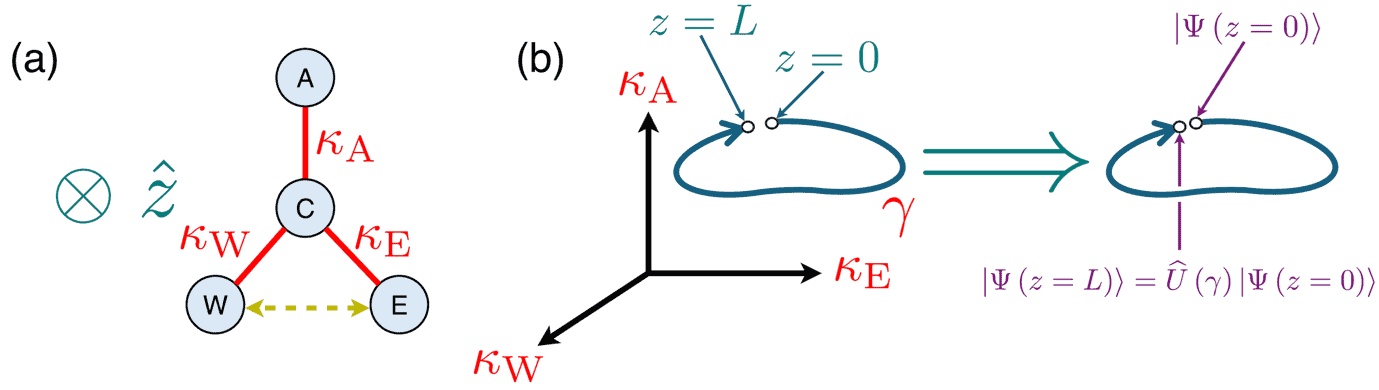
Deterministic entanglement through holonomy: A system of four coupled optical waveguides (A, C, E, W), with three inter-waveguide coupling coefficients (k_A,k_E,k_W) vary in such a way to define a closed path γ. (Courtesy: Reprinted with permission from http://dx.doi.org/10.1103/PhysRevLett.134.080201)
Physicists at the Georgia Institute of Technology, US have introduced a novel way to generate entanglement between photons – an essential step in building scalable quantum computers that use photons as quantum bits (qubits). Their research, published in Physical Review Letters, leverages a mathematical concept called non-Abelian quantum holonomy to entangle photons in a deterministic way without relying on strong nonlinear interactions or irrevocably probabilistic quantum measurements.
Entanglement is fundamental to quantum information science, distinguishing quantum mechanics from classical theories and serving as a pivotal resource for quantum technologies. Existing methods for entangling photons often suffer from inefficiencies, however, requiring additional particles such as atoms or quantum dots and additional steps such as post-selection that eliminate all outcomes of a quantum measurement in which a desired event does not occur.
While post-selection is a common strategy for entangling non-interacting quantum particles, protocols for entangled state preparation that use post-selection are non-deterministic. This is because they rely upon making measurements, and the result of obtaining a certain state of the system after a measurement is associated with a probability, making it inevitably non-deterministic.
Non-Abelian holonomy
The new approach provides a direct and deterministic alternative. In it, the entangled photons occupy distinguishable spatial modes of optical waveguides, making entanglement more practical for real-world applications. To develop it, Georgia Tech’s Aniruddha Bhattacharya and Chandra Raman took inspiration from a 2023 experiment by physicists at Universität Rostock, Germany, that involved coupled photonic waveguides on a fused silica chip. Both works exploit a property known as non-Abelian holonomy, which is essentially a geometric effect that occurs when a quantum system evolves along a closed path in parameter space (more precisely, it is a matrix-valued generalization of a pure geometric phase).
In Bhattacharya and Raman’s approach, photons evolve in a waveguide system where their quantum states undergo a controlled transformation that leads to entanglement. The pair derive an analytical expression for the holonomic transformation matrix, showing that the entangling operation corresponds to a unitary rotation within an effective pseudo-angular momentum space. Because this process is fully unitary, it does not require measurement or external interventions, making it inherently robust.
Beyond the Hong-Ou-Mandel effect
A classic example of photon entanglement is the Hong–Ou–Mandel (HOM) effect, where two identical photons interfere at a beam splitter, leading to quantum correlations between them. The new method extends such interference effects beyond two photons, allowing deterministic entanglement of multiple photons and even higher-dimensional quantum states known as qudits (d-level systems) instead of qubits (two-level systems). This could significantly improve the efficiency of quantum information protocols.
Because state preparation and measurement are relatively straightforward in this approach, Bhattacharya and Raman say it is well-suited for quantum computing. Since the method relies on geometric principles, it naturally protects against certain types of noise, making it more robust than traditional approaches. They add that their technique could even be used to construct an almost universal set of near-deterministic entangling gates for quantum computation with light. “This innovative use of non-Abelian holonomy could shift the way we think about photonic quantum computing,” they say.
By providing a deterministic and scalable entanglement mechanism, Bhattacharya and Raman add that their method opens the door to more efficient and reliable photonic quantum technologies. The next steps will be to validate the approach experimentally and explore practical implementations in quantum communication and computation. Further in the future, it will be necessary to find ways of integrating this approach with other quantum systems, such as matter-based qubits, to enable large-scale quantum networks.
Water molecules on the surface of an electrode flip just before they give up electrons to form oxygen – a feat of nanoscale gymnastics that explains why the reaction takes more energy than it theoretically should. After observing this flipping in individual water molecules for the first time, scientists at Northwestern University in the US say that the next step is to find ways of controlling it. Doing so could improve the efficiency of the reaction, making it easier to produce both oxygen and hydrogen fuel from water.
The water splitting process takes place in an electrochemical cell containing water and a metallic electrode. When a voltage is applied to the electrode, the water splits into oxygen and hydrogen via two separate half-reactions.
The problem is that the half-reaction that produces oxygen, known as the oxygen evolution reaction (OER), is difficult and inefficient and takes more energy than predicted by theory. “It should require 1.23 V,” says Franz Geiger, the Northwestern physical chemist who led the new study, “but in reality, it requires more like 1.5 or 1.8 V.” This extra energy cost is one of the reasons why water splitting has not been implemented on a large scale, he explains.
Determining how water molecules arrange themselves
In the new work, Geiger and colleagues wanted to test whether the orientation of the water’s oxygen atoms affects the kinetics of the OER. To do this, they directed an 80-femtosecond pulse of infrared (1034 nm) laser light onto the surface of the electrode, which was in this case made of nickel. They then measured the intensity of the reflected light at half the incident wavelength.
This method, which is known as second harmonic and vibrational sum-frequency generation spectroscopy, revealed that the water molecules’ alignment on the surface of the electrode depended on the applied voltage. By analysing the amplitude and phase of the signal photons as this voltage was cycled, the researchers were able to pin down how the water molecules arranged themselves.
They found that before the voltage was applied, the water molecules were randomly oriented. At a specific applied voltage, however, they began to reorient. “We also detected water dipole flipping just before cleavage and electron transfer,” Geiger adds. “This allowed us to distinguish flipping from subsequent reaction steps.”
An unexplored idea
The researchers’ explanation for this flipping is that at high pH levels, the surface of the electrode is negatively charged due to the presence of nickel hydroxide groups that have lost their protons. The water molecules therefore align with their most positively charged ends facing the electrode. However, this means that the ends containing the electrons needed for the OER (which reside in the oxygen atoms) are pointing away from the electrode. “We hypothesized that water molecules must flip to align their oxygen atoms with electrochemically active nickel oxo species at high applied potential,” Geiger says.
This idea had not been explored until now, he says, because water absorbs strongly in the infrared range, making it appear opaque at the relevant frequencies. The electrodes typically employed are also too thick for infrared light to pass through. “We overcame these challenges by making the electrode thin enough for near-infrared transmission and by using wavelengths where water’s absorbance is low (the so-called ‘water window’),” he says.
Other challenges for the team included designing a spectrometer that could measure the second harmonic generation amplitude and phase and developing an optical model to extract the number of net-aligned water molecules and their flipping energy. “The full process – from concept to publication – took three years,” Geiger tells Physics World.
The team’s findings, which are detailed in Science Advances, suggest that controlling the orientation of water at the interface with the electrode could improve OER catalyst performance. For example, surfaces engineered to pre-align water molecules might lower the kinetic barriers to water splitting. “The results could also refine electrochemical models by incorporating structural water energetics,” Geiger says. “And beyond the OER, water alignment may also influence other reactions such as the hydrogen evolution reaction and CO₂ reduction to liquid fuels, potentially impacting multiple energy-related technologies.”
The researchers are now exploring alternative electrode materials, including NiFe and multi-element catalysts. Some of the latter can outperform iridium, which has traditionally been the best-performing electrocatalyst, but is very rare (it comes from meteorites) and therefore expensive. “We have also shown in a related publication (in press) that water flipping occurs on an earth-abundant semiconductor, suggesting broader applicability beyond metals,” Geiger reveals.
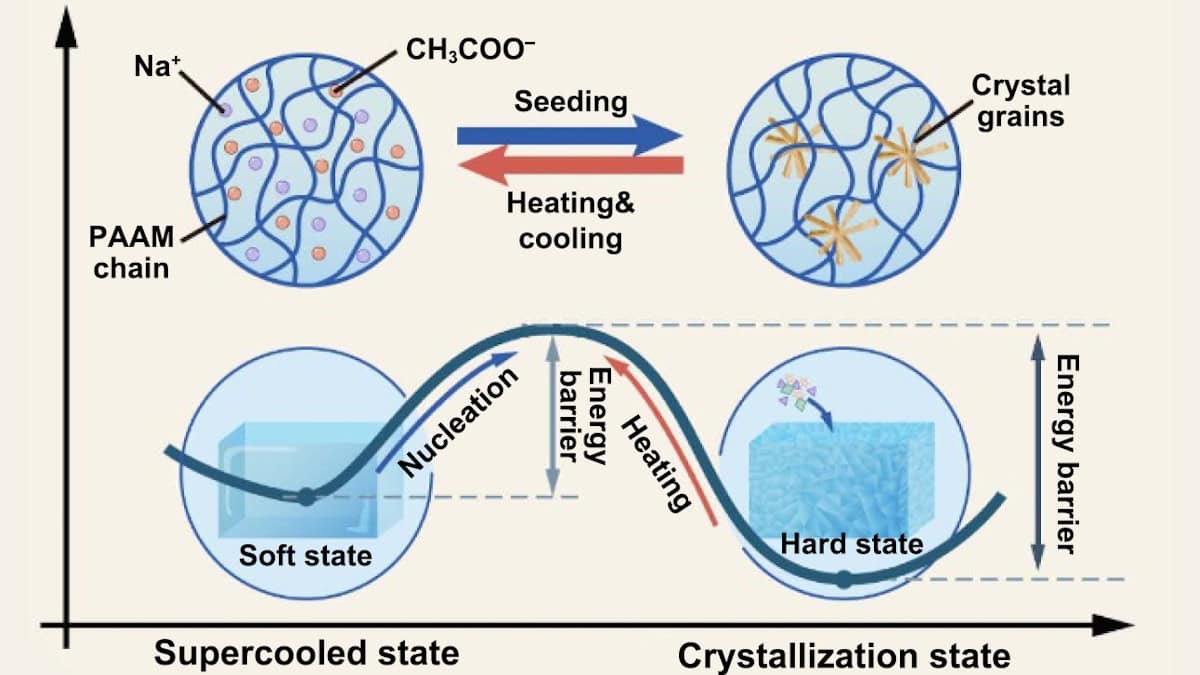
Reversible switching Schematic illustrating the hard/soft transition of the hydrogel/NAAC composite. (Courtesy: CC BY 4.0/Int. J. Extrem. Manuf. 10.1088/2631-7990/adbd97)
Complex hydrogel structures created using 3D printing are increasingly employed in fields including flexible electronics, soft robotics and regenerative medicine. Currently, however, such hydrogels are often soft and fragile, limiting their practical utility. Researchers at Zhejiang University in China have now fabricated 3D-printed hydrogels that can be easily, and repeatably, switched between soft and hard states, enabling novel applications such as smart medical bandages or information encryption.
“Our primary motivation was to overcome the inherent limitations of 3D-printed hydrogels, particularly their soft, weak and fragile mechanical properties, to broaden their application potential,” says co-senior author Yong He.
The research team created the hard/soft switchable composite by infusing supersaturated salt solution (sodium acetate, NAAC) into 3D-printed polyacrylamide (PAAM)-based hydrogel structures. The hardness switching is enabled by the liquid/solid transition of the salt solution within the hydrogel.
Initially, the salt molecules are arranged randomly within the hydrogel and the PAAM/NAAC composite is soft and flexible. The energy barrier separating the soft and hard states prevents spontaneous crystallization, but can be overcome by artificially seeding a crystal nucleus (via exposure to a salt crystal or contact with a sharp object). This seed promotes a phase transition to a hard state, with numerous rigid, rod-like nanoscale crystals forming within the hydrogel matrix.
Superior mechanical parameters
The researchers created a series of PAAM/NAAC structures, using projection-based 3D printing to print hydrogel shapes and then soaking them in NAAC solution. Upon seeding, the structures rapidly transformed from transparent to opaque as the crystallization spread through the sample at speeds of up to 4.5 mm/s.
The crystallization dramatically changed the material’s mechanical performance. For example, a soft cylinder of PAAM/1.5NAAC (containing 150 wt% salt) could be easily compressed by hand, returning to its original shape after release. After crystallization, four 9x9x12 mm cylinders could support an adult’s weight without deforming.
For this composite, just 1 min of crystallization dramatically increased the compression Young’s modulus compared with the soft state. And after 24 h, the Young’s modulus grew from 110 kPa to 871.88 MPa. Importantly, the hydrogel could be easily returned to its soft state by heating and then cooling, a process that could be repeated many times.
The team also performed Shore hardness testing on various composites, observing that hardness values increased with increasing NAAC concentration. In PAAM/1.7NAAC composites (170 wt% salt), the Shore D value reached 86.5, comparable to that of hard plastic materials.
The hydrogel’s crosslinking density also impacted its mechanical performance. For PAAM/1.5NAAC composites, increasing the mass percentage of polymer crosslinker from 0.02 to 0.16 wt% increased the compression Young’s modulus to 1.2 GPa and the compression strength to 81.7 MPa. The team note that these parameters far exceed those of any existing 3D-printed hydrogels.
Smart plaster cast
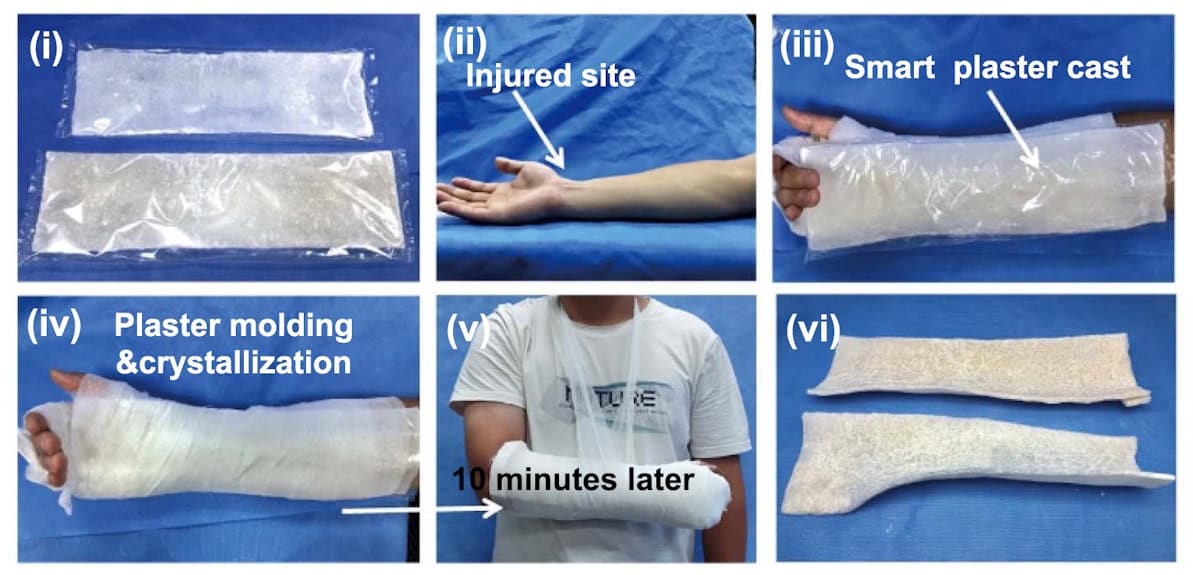
He and colleagues demonstrated how the hard/soft switching and robust mechanical properties of PAAM/NAAC can create medical fixation devices, such as a smart plaster cast. The idea here is that the soft hydrogel can be moulded around the injured bone, and then rapidly frozen in shape by crystallization to support the injury and promote healing.
The researchers tested the smart plaster cast on an injured forearm. After applying a layer of soft cotton padding, they carefully wrapped around layers of the smart plaster bandage (packed within a polyethylene film to prevent accidental seeding). The flexible hydrogel could be conformed to the curved surface of limbs and then induced to crystallize.
Medical fixation device Application of the PAAM/NAAC composite to create a smart plaster cast. (Courtesy: CC BY 4.0/Int. J. Extrem. Manuf. 10.1088/2631-7990/adbd97)
After just 10 min of crystallization, the smart plaster cast reached a yield strength of 8.7 MPa, rapidly providing support for the injured arm. In comparison, a traditional plaster cast (as currently used to treat bone fractures) took about 24 h to fully harden, reaching a maximum yield strength of 3.9 MPa
To determine the safety of the exothermic crystallization process, the team monitored temperature changes in the plaster cast nearest to the skin. The temperature peaked at 41.5 °C after 25 min of crystallization, below the ISO-recommended maximum safe temperature of 50 °C.
The researchers suggest that the ease of use, portability and fast response of the smart plaster cast could provide a simple and effective solution for emergency and first aid situations. Another benefit is that, in contrast to traditional plaster casts that obstruct X-rays and hinder imaging, X-rays easily penetrate through the smart plaster cast to enable high-quality imaging during the healing process.
While the composites exhibit high strength and Young’s modulus, they are not as tough as ideally desired. “For example, the elongation at break was less than 10% in tensile testing for the PAAM/1.5NAAC and PAAM/1.7NAAC samples, highlighting the challenge of balancing toughness with strength and modulus,” He tells Physics World. “Therefore, our current research focuses on enhancing the toughness of these composite materials without compromising their modulus, with the goal of developing strong, tough and mechanically switchable materials.”
In 2014 the American mathematical physicist S James Gates Jr shared his “theorist’s bucket list” of physics discoveries he would like to see happen before, as he puts it, he “shuffles off this mortal coil”. A decade later, Physics World’s Margaret Harris caught up once more with Gates, who is now at the University of Maryland, US, to see what discoveries he can check off his list; what he would still like to see discovered, proven or explored; and what more he might add to the list, as of 2025.
The first thing on your list 10 years ago was the discovery of the Higgs boson, which had happened. The next thing on your list was gravitational waves.
The initial successful detection of gravity waves [in 2015] was a spectacular day for a lot of us. I had been following the development of that detector [the Laser Interferometer Gravitational-wave Observatory, or LIGO] almost from its birth. The first time I heard about detecting gravity waves was around 1985. I was a new associate professor at Maryland, and a gentleman by the name of [Richard] Rick Isaacson, who was a programme officer at the National Science Foundation (NSF), called me one day into his office to show me a proposal from a Caltech-MIT collaboration to fund a detector. I read it and I said this will never work. Fortunately, Isaacson is a superhero and made this happen because for decades he was the person in the NSF with the faith that this could happen; so when it did, it was just an amazing day.
Why is the discovery of these gravitational waves so exciting for physicists?
Albert Einstein’s final big prediction was that there would be observable gravitational waves in the universe. It’s very funny – if you go back into the literature, he first says yes this is possible, but at some point he changes his mind again. It’s very interesting to think about how human it is to bounce back and forth, and then to have Mother Nature say look, you got it right the first time. So such a sharp confirmation of the theory of general relativity was unlike anything I could imagine happening in my lifetime, quite frankly, even though it was on my bucket list.
The other thing is that our species knows about the heavens mostly because there have been “entities” that are similar to Mercury, the Greek god who carried messages from Mount Olympus. In our version of the story, Mercury is replaced by photons. It’s light that has been telling us for hundreds of thousands of years, maybe a million years, that there’s something out there and this drove the development of science for several hundred years. With the detection of gravitational waves, there’s a new kid on the block to deliver the message, and that’s the graviton. Just like light, it has both particle and wave aspects, so now we have detected gravitational waves, the next big thing is to be able to detect gravitons.
We are not completely clear on exactly how to see gravitons, but once we have that knowledge, we will be able to do something that we’ve never been able to do as a species in this universe. After the initial moments of the Big Bang, there was a period of darkness, when matter was far too hot to form neutral atoms, and light could not travel through the dense plasma. It took 380,000 years for electrons to be trapped in orbits around nuclei, forming the first atoms.
Eventually, the universe had expanded so much that the average temperature and density of particles had dropped enough for light to travel. Now what’s really interesting is if you look at the universe via photons, you can only look so far back up to that point when light was first able to travel through the universe, often referred to as the “first dawn”. We detected this light in the 1960s, and it’s called the cosmic microwave background. If you want to peer further back in time beyond this period, you can’t use light but you can use gravitational waves. We will be able as a species eventually to look maybe all the way back to the Big Bang, and that’s remarkable.
What’s the path to seeing gravitons experimentally?
At the time that gravitational waves were detected by LIGO there were three different detectors, two in the US and one on the border of France and Italy called Virgo. There is a new LIGO site coming online in India now, and so what’s going to happen, provided there continues to be a global consensus on continuing to do this science, is that more sites like this are going to come online, which will give us higher-fidelity pictures. It’s going to be a difference akin to going from black and white TV to colour.
Wish fulfilled Aerial view of the Virgo detector in Italy. This facility became the third to detect gravitational waves, in 2017, after the two LIGO detectors in the US. As more gravitational-wave facilities come online around the world, we increase our chance of detecting gravitons. (CCO 1.0 The Virgo collaboration)
In the universe now, the pathway to detecting gravitons involves two steps. First, you probably want to measure the polarization of gravitons, and Fabry–Pérot interferometers, such as LIGO, have that capacity. If it’s a polarized graviton wave, the bending of space-time has a certain signature, whether it’s left or right-handed. If we are lucky enough we will actually see that polarization, I would guess within the next 10 years.
The second step is quantization, which is going to be a challenge. Back in the 1960s a physicist at the University of Maryland named Joseph Weber developed what are now called Weber bars. They’re big metal bars and the idea was you cool them down and then if a graviton impinges on these bars, it would induce lattice vibrations in the metal, and you would detect those. I suspect there’s going to be a big push in going back and upgrading that technology. One of the most exciting things about that is they might be quantum Weber bars. That’s the road that I could see to actually nailing down the existence of the graviton.
Number three on your bucket list from a decade ago was supersymmetry. How have its prospects developed in the past 10 years?
At the end of the Second World War, in an address to the Japanese people after the atomic bombing of Hiroshima and Nagasaki, the Japanese emperor [known as Showa in Japan, Hirohito in the West] used the phrase “The situation has developed not necessarily to our advantage”, and I believe we can apply that to supersymmetry. In 2006 I published a paper where I said explicitly I did not expect the Large Hadron Collider (LHC) to detect supersymmetry. It was a back-of-the-envelope calculation, where I was looking at the issue of anomalous magnetic moments. Because the magnetic moments can be sensitive to particles you can’t actually detect, by looking at the anomalous magnetic moment and then comparing the measured value to what is predicted by all the particles that you know, you can put lower bounds on the particles that you don’t know, and that’s what I did to come up with this number.
It looked to me like the lightest “superpartner” was probably going to be in the range of 30 Tev. The LHC’s initial operations were at 7 TeV and it’s currently at 14 TeV, so I’m feeling comfortable about this issue. If it’s not found by the time we reach 100 Tev, well, I’m likely going to kick the bucket by the time we get that technology. But I am confident that SUSY is out there in nature for reasons of quantum stability.
Also, observations of particle physics – particularly high-precision observations, magnetic moments, branching ratios, decay rates – are not the only way to think about finding supersymmetry. In particular, one could imagine that within string theory, there might be cosmological implications (arXiv:1907.05829), which are mostly limited to the question of dark matter and dark energy. When it comes to the dark-matter contribution in the universe, if you look at the mathematics of supersymmetry, you can easily find that there are particles that we haven’t observed yet and these might be the lightest supersymmetric particle.
And the final thing in your bucket list, which you’ve touched on, was superstring theory. When we last spoke, you said that you did not expect to see it. How has that changed, if at all?
Unless I’m blessed with a life as long as Methuselah, I don’t expect to see that. I think that for superstring theory to win observational acceptance, it will likely come about not from a single experiment, but from a confluence of observations of the cosmology and astrophysics type, and maybe then the lightest super symmetric particle will be found. By the way, I don’t expect extra dimensions ever to be found. But if I did have several hundred years to live, those are the kinds of likely expectations I would have.
And have you added anything new to your bucket list over the past 10 years?
Yes, but I don’t quite know how to verbalize it. It has to do with a confluence of things around quantum mechanics and information. In my own research, one of the striking things about the graphs that we developed to understand the representation theory of supersymmetry –we call them “adinkras” – is that error-correcting codes are part of these constructs. In fact, for me this is the proudest piece of research I’ve ever enabled – to discover a kind of physics law, or at least the possibility of a physics law, that includes error-correcting codes. I know of no previous example in history where a law of physics includes error-correcting codes, but we can clearly see it in the mathematics around these graphs (arXiv:1108.4124).
That had a profound impact on the way I think about information theory. In the 1980s, John Wheeler came up with this very interesting way to think about quantum mechanics (“Information, physics, quantum: the search for links” Proc. 3rd Int. Symp. Foundations of Quantum Mechanics, Tokyo, 1989, pp354–368). A shorthand phrase to describe it is “it from bit” – meaning that the information that we see in the universe is somehow connected to bits. As a young person, I thought that was the craziest thing I had ever heard. But in my own research I saw that it’s possible for the laws of physics to contain bits in the form of error-correcting codes, so I had to then rethink my rejection of what I thought was a wild idea.
In fact, now that I’m old, I’ve concluded that if you do theoretical physics long enough, you too can become crazy – because that’s what sort of happened to me! In the mathematics of supersymmetry, there is no way to avoid the presence of error-correcting codes and therefore bits. And because of that my new item for the bucket list is an actual observational demonstration that the laws of quantum mechanics entail the use of information in bits.
In terms of when we might see that, it will be long after I’ve gone. Unless I somehow get another 150 years of life. Intellectually, that’s how long I would estimate it will take as of now, because the hints are so stark, they suggest something is definitely going on.
We’ve talked a little bit about how science has changed in the past 10 years. Of course, science is not unconnected with the rest of the world. There have been some changes in other things that impinge on science, particularly those recently developing in the US. What’s your take on that?
Unfortunately, it’s been very predictable. Two years ago I wrote an essay called “Expelled from the mountain top?” (Science 380 993). I took that title from a statement by Martin Luther King Jr where he says “I’ve been to the mountaintop”, and the part about being “expelled” refers to closing down opportunities for people of colour. In my essay I talked about the fact that it looked to me like the US was moving in a direction where it would be less likely that people like me – a man of colour, an African American, a scientist – would continue to have access to the kind of educational training that it takes to do this [science].
I’m still of the opinion that the 2023 decision the Supreme Court made [about affirmative action] doesn’t make sense. What it is saying is that diversity has no role in driving innovation. But there’s lots of evidence that that’s not right. How do you think cities came into existence? They are places where innovation occurs because you have diverse people coming to cities.
You add to that the presence of a new medium – the Internet – and the fact that with this new medium, anyone can reach millions of people. Why is this a little bit frightening? Well, fake news. Misinformation.
Still hopeful Jim Gates discusses his career and his lifelong interest in supersymmetry with an audience at the Royal College of Art in London earlier this year. (Courtesy: Margaret Harris)
I ran into a philosopher about a year ago, and he made a statement that I found very profound. He said think of the printing press. It allowed books to disseminate through Western European society in a way that had never happened before, and therefore it drove literacy. How long did it take for literacy levels to increase? 50 to 100 years. Then he said, now let’s think about the Internet. What’s different about it? The difference is that anyone can say anything and reach millions of people. And so the challenge is how long it will take for our species to learn to write the Internet without misinformation or fake news. And if he’s right, that’s 100, 150 years. That’s part of the challenge that the US is facing. It’s not just a challenge for my country, but somehow it seems to be particularly critical in my country.
So what does this have to do with science? In 2005 I was invited to deliver a plenary address to the American Association for the Advancement of Science annual meeting. In that address, I made statements about science being turned off because it was clear to me, even back then in my country, that there were elements in our society that would be perfectly happy to deny evidence brought forth by scientists, and that these elements were becoming stronger.
You put this all together and it’s going to be an extraordinarily important, challenging time for the continuation of science because, certainly at the level of fundamental science, this is something that the public generally has to say “Yes, we want to invest in this”. If you have agencies and agents in society denying vaccines, for example, or denying the scientific evidence around evolution or climate change, if this is going to be something that the public buys into, then science itself potentially can be turned off, and that’s the thing I was warning about in 2005.
What are some practical things that members of the scientific community can do to help prevent that from happening?
First of all, come down from the ivory tower. I’ve been a part of some activities, and they normally are under the rubric of restoring the public’s trust in science, and I think that’s the wrong framing. It’s the public faith in science that’s under attack. So from my perspective, that’s what I’d much rather have people really thinking about.
What would you say the difference is between having trust in science and having faith in science?
In my mind, if I trust something, I will listen. If I have faith in something, I will listen and I will act. To me, this is a sharp distinction.
Personally, even though I expect that it’s going to be really hard going forward, I am hopeful. And I would urge young people never to lose that hope. If you lose hope, there is no hope. It’s just that simple. And so I am hopeful. Even though people may take my comments as “oh, he’s just depressed” – no, I’m not. Because I’m a scientist, I believe that one must, in a clear-eyed, hard-headed manner, look at the evidence that’s in front of us and not sentimentally try to dodge what you see, and that’s who I am. So I am hopeful in spite of all the things that I’ve just said to you.
If a water droplet flowing over a surface gets stuck, and then unsticks itself, it generates an electric charge. The discoverers of this so-called depinning phenomenon are researchers at RMIT University and the University of Melbourne, both in Australia, and they say that boosting it could make energy-harvesting devices more efficient.
The newly observed charging mechanism is conceptually similar to slide electrification, which occurs when a liquid leaves a surface – that is, when the surface goes from wet to dry. However, the idea that the opposite process can also generate a charge is new, says Peter Sherrell, who co-led the study. “We have found that going from dry to wet matters as well and may even be (in some cases) more important,” says Sherrell, an interdisciplinary research fellow at RMIT. “Our results show how something as simple as water moving on a surface still shows basic phenomena that have not been understood yet.”
Co-team leader Joe Berry, a fluid dynamics expert at Melbourne, notes that the charging mechanism only occurs when the water droplet gets temporarily stuck on the surface. “This suggests that we could design surfaces with specific structure and/or chemistry to control this charging,” he says. “We could reduce this charge for applications where it is a problem – for example in fuel handling – or, conversely, enhance it for applications where it is a benefit. These include increasing the speed of chemical reactions on catalyst surfaces to make next-generation batteries more efficient.”
More than 500 experiments
To observe depinning, the researchers built an experimental apparatus that enabled them to control the sticking and slipping motion of a water droplet on a Teflon surface while measuring the corresponding change in electrical charge. They also controlled the size of the droplet, making it big enough to wet the surface all at once, or smaller to de-wet it. This allowed them to distinguish between multiple mechanisms at play as they sequentially wetted and dried the same region of the surface.
Their study, which is published in Physical Review Letters, is based on more than 500 wetting and de-wetting experiments performed by PhD student Shuaijia Chen, Sherrell says. These experiments showed that the largest change in charge – from 0 to 4.1 nanocoulombs (nC) – occurred the first time the water contacted the surface. The amount of charge then oscillated between about 3.2 and 4.1 nC as the system alternated between wet and dry phases. “Importantly, this charge does not disappear,” Sherrell says. “It is likely generated at the interface and probably retained in the droplet as it moves over the surface.”
The motivation for the experiment came when Berry asked Sherrell a deceptively simple question: was it possible to harvest electricity from raindrops? To find out, they decided to supervise a semester-long research project for a master’s student in the chemical engineering degree programme at Melbourne. “The project grew from there, first with two more research project students [before] Chen then took over to build the final experimental platform and take the measurements,” Berry recalls.
The main challenge, he adds, was that they did not initially understand the phenomenon they were measuring. “Another obstacle was to design the exact protocol required to repeatedly produce the charging effect we observed,” he says.
Potential applications
Understanding how and why electric charge is generated as liquids flow during over surfaces is important, Berry says, especially with new, flammable types of renewable fuels such as hydrogen and ammonia seen as part of the transition to net zero. “At present, with existing fuels, charge build-up is reduced by restricting flow using additives or other measures, which may not be effective in newer fuels,” he explains. “This knowledge may help us to engineer coatings that could mitigate charge in new fuels.”
The RMIT/Melbourne researchers now plan to investigate the stick-slip phenomenon with other types of liquids and surfaces and are keen to partner with industries to target applications that can make a real-world impact. “At this stage, we have simply reported that this phenomenon occurs,” Sherrell says. “We now want to show that we can control when and where these charging events happen – either to maximize them or eliminate them. We are still a long way off from using our discovery for chemical and energy applications – but it’s a big step in the right direction.”
An international team led by chemists at the University of British Columbia (UBC), Canada, has reported strong experimental evidence for a superfluid phase in molecular hydrogen at 0.4 K. This phase, theoretically predicted in 1972, had only been observed in helium and ultracold atomic gases until now, and never in molecules. The work could give scientists a better understanding of quantum phase transitions and collective phenomena. More speculatively, it could advance the field of hydrogen storage and transportation.
Superfluidity is a quantum mechanical effect that occurs at temperatures near absolute zero. As the temperatures of certain fluids approach this value, they undergo a transition to a zero-viscosity state and begin to flow without resistance – behaviour that is fundamentally different to that of ordinary liquids.
Previously, superfluidity had been observed in helium (3He and 4He) and in clusters of ultracold atoms known as Bose-Einstein condensates. In principle, molecular hydrogen (H2), which is the simplest and lightest of all molecules, should also become superfluid at ultracold temperatures. Like 4He, H2 is a boson, so it is theoretically capable of condensing into a superfluid phase. The problem is that it is only predicted to enter this superfluid state at a temperature between 1 and 2 K, which is lower than its freezing point of 13.8 K.
A new twist on a spinning experiment
To keep their molecular hydrogen liquid below its freezing point, team leader Takamasa Momose and colleagues at UBC confined small clusters of hydrogen molecules inside helium nanodroplets at 0.4 K. They then embedded a methane molecule in the hydrogen cluster and observed its rotation with laser spectroscopy.
Momose describes this set-up as a miniature version of an experiment performed by the Georgian physicist Elephter Andronikashvili in 1946, which showed that disks inside superfluid helium could rotate without resistance. They chose methane as their “disk”, Momose explains, because it rotates quickly and interacts only very weakly with H2, meaning it does not disturb the behaviour of the medium in which it spins.
Onset of superfluidity
In clusters containing less than six hydrogen molecules, they observed some evidence of friction affecting the methane’s rotation. As the clusters grew to 10 molecules, this friction began to disappear and the spinning methane molecule rotated faster, without resistance. This implies that most of the hydrogen molecules around it are behaving as a single quantum entity, which is a signature of superfluidity. “For clusters larger than N = 10, the hydrogen acted like a perfect superfluid, confirming that it flows with zero resistance,” Momose tells Physics World.
The researchers, who have been working on this project for nearly 20 years, say they took it on because detecting superfluidity in H2 is “one of the most intriguing unanswered questions in physics – debated for 50 years”. As well as working out how to keep hydrogen in a liquid state at extremely low temperatures, they also had to find a way to detect the onset of superfluidity with high enough precision. “By using methane as a probe, we were finally able to measure how hydrogen affects its motion,” Momose says.
A deeper understanding
The team say the discovery opens new avenues for exploring quantum fluids beyond helium. This could lead scientists to a deeper understanding of quantum phase transitions and collective quantum phenomena, Momose adds.
The researchers now plan to study larger hydrogen clusters (ranging from N = 20 to over a million) to understand how superfluidity evolves with size and whether the clusters eventually freeze or remain fluid. “This will help us explore the boundary between quantum and classical matter,” Momose explains.
They also want to test how superfluid hydrogen responds to external stimuli such as electric and magnetic fields. Such experiments could reveal even more fascinating quantum behaviours and deepen our understanding of molecular superfluidity, Momose says. They could also have practical applications, he adds.
“From a practical standpoint, hydrogen is a crucial element in clean energy technologies, and understanding its quantum properties could inspire new approaches for hydrogen storage and transportation,” he says. “The results from these [experiments] may also provide critical insights into achieving superfluidity in bulk liquid hydrogen – an essential step toward harnessing frictionless flow for more efficient energy transport systems.”
I recently met an old friend from the time when we both worked in the light-emitting diode (LED) industry. We started discussing how every technology has its day – a window of opportunity – but also how hard it is to know which companies will succeed long-term. As we got talking, I was reminded of a very painful product launch by an LED lighting firm that I was running at the time.
The incident occurred in 2014 when my company had a technology division that was developing wirelessly connected lighting. Our plan was to unveil our new Bluetooth control system at a trade show, but everything that could go wrong for us on the day pretty much did. However, the problems with our product weren’t down to any
particular flaws in our technology.
Instead, they were triggered by issues with a technology from a rival lighting firm that was also exhibiting at the event. We ended up in a rather ugly confrontation with our competitors, who seemed in denial about their difficulties. I realized there was a fundamental problem with their technology – even if they couldn’t see it – and predicted that, for them, the writing was on the wall.
Bother at the booth
Our plan was to put microprocessors and radios into lighting to make it smart, more energy efficient and with integrated sensors and Bluetooth controls. There were no fundamental physics barriers – it just needed some simple thermal management (the LEDs and particularly the radios had to be kept below 70 ºC), some electronics and lots of software.
Back then, the LED lighting industry was following a technology roadmap that envisaged these solid-state devices eventually generating 320 lumens per watt, compared to about 10 lumens per watt from conventional incandescent lamps. As the road map progressed, there’d be ever fewer thermal challenges.
With more and more countries phasing out conventional bulbs, LEDs are continuing their march along the roadmap. Almost every bulb sold these days is an LED and the overall global lighting market was worth $140bn in 2023, according to Fortune Business Insights. Lighting accounts for 15–18% of all electricity consumption in the European Union alone.
Back at that 2014 trade show, called LuxLive, all initially seemed to be going well as we set up our display. There was the odd software bug, but were able to work around that and happily control our LED lights with a smart phone connected via WiFi to a low-cost lighting server (a bit like a Raspberry Pi), with the smart LED fixtures and sensors connected via Bluetooth.
Opportunity knocks Almost all lights now sold are based on light-emitting diodes, but – as with all new technologies – it wasn’t initially clear which firms’ products would succeed. (Courtesy: iStock/KirVKV)
With final preparations over, the trade show opened and our first customer came up to the stand. We started giving them a demo but nothing seemed to be working – to our surprise, we simply could not get our lights to respond. A flurry of behind-the-scenes activity ensured (mostly us switching everything off and on again) but nothing made a difference.
Strangely, my phone call appeared to go dead just as I passed another booth from a rival firm
To try to get to the bottom of things, I stepped a decent distance away from our booth and rang one of our technical team up in London for support. I explained our problem but, strangely, as I walked back towards the booth, I got cut off. My call appeared to have gone dead just as I passed another booth from a rival firm called Ceravision.
It was developing high-efficiency plasma (HEP) lamps that could generate up to 100 lumens per watt – roughly where LEDs were at the time. Its lamps used radio-frequency waves to heat a plasma without needing any electrodes. Designed for sports stadia and warehouses, Ceravision’s bulbs were super bright. In fact, I was almost blinded by its products, which were pointing into the aisle, presumably to attract attention.
Back at base, our technical team frantically tried to figure out why our products weren’t working. But they were stuck and I spent the rest of the day unable to demonstrate our products to potential customers. Then, as if by magic, our system started working again – just as someone noticed we weren’t being blinded by Ceravision’s light any more.
I walked over to Ceravision’s booth as its team was packing up and had a chat with a sales guy, who I asked how the system worked. He told me it was a microwave waveguide light source but didn’t appear to know much more. So I asked him if he wouldn’t mind turning on the light again to demonstrate its output, which he did.
I glanced back at my team, who a few moments earlier had been all smiles that our system was now working, even if they were confused as to why. Suddenly, as the Ceravision light was turned on, our system broke down again. I requested to speak to one of Ceravision’s technical team but was told they wouldn’t be back until the following day.
Lighting the way
I left for the show’s awards dinner, where my firm won an innovation award for the wireless lighting system we’d been trying – unsuccessfully – to demonstrate all day. Later that night, I started looking into Ceravision in more detail. Based in Milton Keynes, UK, its idea of an electrodeless lamp wasn’t new – Nikola Tesla had filed a patent for such a device back in 1894.
Tesla realized that this type of lamp would benefit from a long life and little discolouration as there are no electrodes to degrade or break. In fact, Tesla knew how to get around the bulbs’ technical drawbacks, which involved constraining the radio waves and minimizing their power. Eventually, in the late 1990s, as radio-frequency sources became available, a US company called Fusion Lighting got this technology to market.
Its lamps consisted of a golf ball-sized fused-quartz bulb containing several milligrams of sulphur powder and argon gas at the end of a thin glass spindle. Enclosed in a microwave-resonant wire-mesh cage, the bulb was bombarded by 2.45 GHz microwaves from a magnetron of the kind you get in a microwave oven. The bulb had a design lifetime of about 60,000 hours and emitted 100 lumens per watt.
Unfortunately, its efficiency was poor as 80–85% of the light generated was trapped inside the opaque ceramic waveguide. Worse still, various satellite companies petitioned the US authorities to force Fusion Lighting to cut its electromagnetic emissions by 99.9%. They feared that otherwise its bulbs would interfere with WiFi, cordless phones and satellite radio services in North America, which also operate at 2.4 GHz.
Tasty stuff LED lights these days are used in all corners of modern life – including to grow plants for food. (Courtesy: iStock/Supersmario)
In 2001 Fusion Lighting agreed to install a perforated metal shield around its lamps to reduce electromagnetic emissions by 95%. However, this decision only reduced the light output, making the bulbs even more inefficient. Ceravision’s solution was an optically clear quartz waveguide and integrated lamp that yielded 100–5000 watts of power without any damage to the lamps.
The company claimed its technology was ideal for growing plants – delivering blue and ultraviolet light missing from other sources – along with everything from sterilizing water to illuminating TV studios. And whereas most magnetrons break down after about 2000 hours, Ceravision’s magnetrons lasted for more than 40,000 hours. It had even signed an agreement with Toshiba to build high-efficient magnetrons.
What could possibly go wrong?
The truth hurts
Back at the trade show, I arrived the following morning determined to get a resolution with the Ceravision technical team. Casually, I asked one of them, who had turned up early, to come over to our booth to see our system. It was working – until the rest of Ceravision arrived and switched their lights on. Once again, our award-winning system gave up the ghost.
Ceravision refused to accept there was a correlation between their lights going on and our system breaking down
Things then got a little ugly. Ceravision staff refused to accept there was a correlation between their lights going on and our system breaking down. Our product must be rubbish, they said. If so, I asked, how come my mobile phone had stopped working too? Silence. I went to talk to the show organizers – all they could do was tell Ceravision to point its lights down, rather than into the aisle.
This actually worked for us as it seemed the “blocking signal” was reasonably directional. It became obvious from Ceravision’s defensive response that this WiFi blocking problem must have come up before – its staff had some over-elaborate and clearly rehearsed responses. As for us, we simply couldn’t show our product in its best light to customers, who just felt it wasn’t ready for market.
Messaging matters For companies developing new products, it’s vital to listen and act on customer feedback as the market develops. (Courtesy: Shutterstock/magic pictures)
In the intervening years, I’ve talked to several ex-employees of Ceravision, who’ve all told me it trialled lots of different systems for different markets. But its products always proved to be too expensive and too complex – and eventually LEDs caught up with them. When I asked them about lights disrupting WiFi, most either didn’t seem aware of the issue or, if they did, knew it couldn’t be fixed without slashing the light output and efficiency of the bulbs.
That in turn forced Ceravision to look for ever more niche applications with ever-tinier markets. Many staff left, realizing the emperor had no clothes. Eventually, market forces took their toll on the company, which put its lighting business into receivership in 2020. Its parent company with all the patents and intellectual property suffered a similar fate in 2023.
I suspect (but don’t know for sure) that the window of opportunity closed due to high system costs, overly complex manufacturing and low volumes, coupled with LEDs becoming cheaper and more efficient. Looking back on 2014, the writing was really on the wall for the technology, even if no-one wanted to read the warning signs. A product that disrupts your mobile or WiFi signal was simply never going to succeed.
It was a classic case of a company having a small window of opportunity before better solutions came along and it missed the proverbial boat. Of course, hindsight is a wonderful thing. Clearly the staff could see what was wrong, but it took a long time for managers and investors to see or tackle the issues too. Perhaps when you are trying to deliver on promises you end up focusing on the wrong things.
The moral of the story is straightforward: constantly review your customers’ feedback and re-evaluate your products as the market develops. In business, it really is that simple if you want to succeed.
A ground-breaking method to create “audible enclaves” – localized zones where sound is perceptible while remaining completely unheard outside – has been unveiled by researchers at Pennsylvania State University and Lawrence Livermore National Laboratory. Their innovation could transform personal audio experiences in public spaces and improve secure communications.
“One of the biggest challenges in sound engineering is delivering audio to specific listeners without disturbing others,” explains Penn State’s Jiaxin Zhong. “Traditional speakers broadcast sound in all directions, and even directional sound technologies still generate audible sound along their entire path. We aimed to develop a method that allows sound to be generated only at a specific location, without any leakage along the way. This would enable applications such as private speech zones, immersive audio experiences, and spatially controlled sound environments.”
To achieve precise audio targeting, the researchers used a phenomenon known as difference-frequency wave generation. This process involves emitting two ultrasonic beams – sound waves with frequencies beyond the range of human hearing – that intersect at a chosen point. At their intersection, these beams interact to produce a lower-frequency sound wave within the audible range. In their experiments, the team used ultrasonic waves at frequencies of 40 kHz and 39.5 kHz. When these waves converge, they generated an audible sound at 500 Hz, which falls within the typical human hearing range of approximately 20 Hz–20 kHz.
To prevent obstacles like human bodies from blocking the sound beams, the researchers used self-bending beams that follow curved paths instead of travelling in straight lines. They did this by passing ultrasound waves through specially designed metasurfaces, which redirected the waves along controlled trajectories, allowing them to meet at a specific point where the sound is generated.
Manipulative metasurfaces
“Metasurfaces are engineered materials that manipulate wave behaviour in ways that natural materials cannot,” said Zhong. “In our study, we use metasurfaces to precisely control the phase of ultrasonic waves, shaping them into self-bending beams. This is similar to how an optical lens bends light.”
The researchers began with computer simulations to model how ultrasonic waves would travel around obstacles, such as a human head, to determine the optimal design for the sound sources and metasurfaces. These simulations confirmed the feasibility of creating an audible enclave at the intersection of the curved beams. Subsequently, the team constructed a physical setup in a room-sized environment to validate their findings experimentally. The results closely matched their simulations, demonstrating the practical viability of their approach.
“Our method allows sound to be produced only in an intended area while remaining completely silent everywhere else,” says Zhong. “By using acoustic metasurfaces, we direct ultrasound along curved paths, making it possible to ‘place’ sound behind objects without a direct line of sight. A person standing inside the enclave can hear the sound, but someone just a few centimetres away will hear almost nothing.”
Initially, the team produced a steady 500 Hz sound within the enclave. By allowing the frequencies of the two ultrasonic sources to vary, they generated a broader range of audible sounds, covering the frequencies from 125 Hz–4 kHz. This expanded range includes much of the human auditory spectrum, increasing the potential applications of the technique.
The ability to generate sound in a confined space without any audible leakage opens up many possible applications. Museums and exhibitions could provide visitors with personalized audio experiences without the need for headphones, allowing individuals to hear different information depending on their location. In cars, drivers could receive navigation instructions without disturbing passengers, who could simultaneously listen to music or other content. Virtual and augmented reality applications could benefit from more immersive soundscapes that do not require bulky headsets.
The technology could also enhance secure communications, creating localized zones where sensitive conversations remain private even in shared spaces. In noisy environments, future adaptations of this method might allow for targeted noise cancellation, reducing unwanted sound in specific areas while preserving important auditory information elsewhere.
Future challenges
While their results are promising, the researchers acknowledge several challenges that must be addressed before the technology can be widely implemented. One concern is the intensity of the ultrasonic beams required to generate audible sound at a practical volume. Currently, achieving sufficient sound levels necessitates ultrasonic intensities that may have unknown effects on human health.
Another challenge is ensuring high-quality sound reproduction. The relationship between the ultrasonic beam parameters and the resulting audible sound is complex, making it difficult to produce clear audio across a wide range of frequencies and volumes.
“We are currently working on improving sound quality and efficiency,” Zhong said. “We are exploring deep learning and advanced nonlinear signal processing methods to optimize sound clarity. Another area of development is power efficiency — ensuring that the ultrasound-to-audio conversion is both effective and safe for practical use. In the long run, we hope to collaborate with industry partners to bring this technology to consumer electronics, automotive audio, and immersive media applications.”
Multiphoton microscopy is a nonlinear optical imaging technique that enables label-free, damage-free biological imaging. Performed using femtosecond laser pulses to generate two- and three-photon processes, multiphoton imaging techniques could prove invaluable for rapid cancer diagnosis or personalized medicine.
Imaging biological samples with traditional confocal microscopy requires sample slicing and staining to create contrast in the tissue. The nonlinear mechanisms generated by femtosecond laser pulses, however, eliminate the need for labelling or sample preparation, revealing molecular and structural details within tissue and cells while leaving the sample intact.
Looking to bring these benefits to cancer diagnostics, Netherlands-based start-up Flash Pathology is developing a compact, portable multiphoton microscope that creates pathology-quality images in real time, without the need for sample fixation or staining.
Fast and accurate cancer diagnosis with higher harmonic imaging
The inspiration for Flash Pathology came from Marloes Groot of Vrije Universiteit (VU) Amsterdam. While studying multiphoton microscopy of brain tumours, Groot recognized the need for a portable microscope for clinical settings. “This is a really powerful technique,” she says. “I was working on my large laboratory setup and I thought if we start a company, we could transform this into a mobile device.”
Groot teamed up with Frank van Mourik, now Flash Pathology’s CTO, to shrink the imaging device into a compact 60 x 80 x 115 cm system. “Frank made a device that can be transported, in a truck, wheeled through corridors, and still when you plug it in, it’s on and it produces images – for a nonlinear microscope, this is pretty special,” she explains.
Van Mourik has now built several multiphoton microscopes for Flash Pathology, with one of the main achievements the ability to measure samples with extremely low power levels. “When I started in my lab, I used 200 mW of power, but we’ve been able to reduce that to 5 mW,” Groot notes. “We have performed extensive studies to show that our imaging does not affect the tissue.”
Flash Pathology’s multiphoton microscope is designed to provide rapid on-site histologic feedback on excised tissue, such as diagnostic biopsies or tissue from surgical resections. One key application is lung cancer diagnosis, where there is a clinical need for rapid intraoperative feedback on biopsies. The standard histopathological analysis requires extensive sample preparation and can take several days to provide results.
Rapid tissue analysis Multiphoton microscopy images of (left to right) adipose tissue, cartilage and lymphoid tissue (each image is 400 x 400 µm). The adipose tissue image shows large adipocytes (fat cells); the cartilage image shows a hyaline (glass-like) background with chondrocytes (cells); the image of lymphoid tissue shows many small lymphocytes (a type of immune cell). (Courtesy: VU Amsterdam)
“With lung biopsies, it’s challenging to obtain good diagnostic material,” explains Sylvia Spies, a PhD student at VU Amsterdam. “The lesions can be quite small and it can be difficult to get to the right position and take a good sample, so they use several techniques (fluoroscopy/CT or ultrasound) to find the right position and take multiple biopsies from the lesion. Despite these techniques, the diagnostic yield is still around 70%, so 30% of cases still don’t get a diagnosis and patients might have to come back for a repeat biopsy procedure.”
Multiphoton imaging, on the other hand, can rapidly visualize unprocessed tissue samples, enabling diagnosis in situ. A recent study using Flash Pathology’s microscope to analyse lung biopsies demonstrated that it could image a biopsy sample and provide feedback just 6 min after excision, with an accuracy of 87% – enabling immediate decisions as to whether a further biopsy is required.
“Also, many clinical fields are now focusing on a one-stop-shop with diagnosis and treatment in one procedure,” adds Spies. “Here, you really need a technique that can rapidly determine whether a lesion is benign or malignant.”
The microscope’s impressive diagnostic performance is partly due to its ability to generate four nonlinear signals simultaneously using a single ultrafast femtosecond laser: second- and third-harmonic generation plus two- and three-photon fluorescence. The system then uses filters to spectrally separate these signals, which provide complementary diagnostic information. Second-harmonic generation, for example, is sensitive to non-centrosymmetric structures such as collagen, while third-harmonic generation only occurs at interfaces with differing refractive indices, such as cell membranes or boundaries between the nucleus and cytoplasm.
“What I like about this technique is that you can see similar features as in conventional histology,” says Spies. “You can see structures such as collagen fibres, elastin fibres and cellular patterns, but also cellular details such as the cytoplasm, the nucleus (and its size), nucleoli and cilia. All these tiny details are the same features that the pathologists look at in conventional histology.”
Applying femtosecond lasers for 3D-in-depth visualization
The femtosecond laser plays a key role in enabling multiphoton microscopy. To excite two- and three-photon processes, you need to have two or more photons in the same place at exactly the same time. And the likelihood of this happening increases rapidly when using ultrashort laser pulses.
“The shorter the pulses are in the time domain, the higher the probability that you have an overlap of two pulses in a focal point,” explains Oliver Prochnow, CEO of VALO Innovations, a part of HÜBNER Photonics. “Therefore you need to have a very high-intensity, extremely short laser pulse. The shorter the better.”
The VALO Femtosecond Series of ultrafast fibre lasers can deliver pulses as short as 30 fs, which is achieved by exploiting nonlinear mechanisms to broaden the spectral bandwidth to more than 100 nm. As the optical spectrum and pulse duration are inherently related by Fourier transformation, a broadband spectrum will result in a very short pulse. And the shorter the pulse, at the same average power, the higher its peak power – and the higher the probability of producing multiphoton processes.
Laser parameters Left: typical temporal pulse profile highlighting the sub 50 fs pulse duration with very low pulse pedestal; the inset shows the typical beam profile. Right: typical optical spectrum of HÜBNER Photonics’ VALO Femtosecond Series lasers. (Courtesy: HÜBNER Photonics)
“If you decrease the pulse duration by a factor of five, this gives roughly a five times higher signal from two-photon absorption,” says Prochnow. “In contrast, a three-photon process scales with the third power of the intensity and with the inverse of the pulse duration squared. So you have a roughly 25 times higher signal, if you decrease the pulse duration by a factor of five at the same average power.” Crucially, the shorter pulses deliver this high peak power while maintaining a low average power, reducing sample heating and minimizing photobleaching.
The broadband optical spectrum is particularly important for enabling practical three-photon microscopy. The challenge here is that traditional ytterbium-based lasers with a wavelength of around 1030 nm produce a three-photon signal in the UV range, which is too short to be transmitted through standard optics.
Broadband spectrum Fundamental and third-harmonic generation (THG) spectra of a 30 fs broadband fibre laser (red) compared with standard 150 fs lasers. The solid black line shows the typical transmission characteristics of a standard microscopy objective. Only a THG spectrum generated from wavelengths of above 1080 nm will be transmitted. (Courtesy: HÜBNER Photonics)
The VALO Femtosecond Series overcomes this problem by having a broadband spectrum that extends up to 1140 nm. Frequency tripling then generates a signal with a long enough wavelength to pass through a standard microscope objective, enabling the VALO lasers to excite both two-photon and three-photon processes. “Our lasers provide the opportunity to perform simultaneous three-photon microscopy and two-photon microscopy using a simple fibre laser solution,” says Prochnow.
The lasers include an integrated dispersion pre-compensation unit to compensate for the dispersion of a microscope objective and provide the shortest pulses at the sample. Additionally, the lasers do not require water cooling, making them easy to use or integrate.
Towards future clinical applications
Flash Pathology is currently testing its microscope in several hospitals in the Netherlands, including Amsterdam UMC, as well as the Princess Maxima Center for paediatric oncology. “Sylvia performed a study in their pathology department and for a year measured all kinds of tissue samples that came through,” says Groot. “We also recently installed a device at the Queen Elizabeth Hospital in Glasgow, for a study on mesothelioma.”
With prototypes now available for research use, the company also plans to develop a fully certified multiphoton microscopy system. “Our ultimate goal is to sell a certified medical diagnostic device that will take a biopsy and produce images, but also contain artificial intelligence to help to interpret the images and give diagnostic conclusions about the nature of the illness,” says van Mourik.
Once fully realised in the clinic, the multiphoton microscopy system will provide an invaluable tool for rapid, in situ tissue analysis during bronchoscopy procedures or other operations. The unique combination of four nonlinear imaging modalities, made possible with a single compact femtosecond laser, delivers complementary diagnostic information. “This will be the big gain, to be able to provide a diagnosis bedside during a procedure,” van Mourik concludes.