It was 100 years ago this month that Einstein first presented his general theory of relativity – a work that would transform our understanding of the nature of space and time. In a time dilation of sorts, philosopher Jürgen Renn gives a 100-second explanation of this great work and the impact it has had on physics.
Renn, a researcher at the Max Planck Institute for the History of Science in Berlin, describes how remarkable the theory is, especially given that Einstein was seemingly not aware of all it consequences. The theory has since been used to explain all manner of physical phenomena, including black holes, bending light and the expanding universe.
Renn and his research group have been building their own theory of how Einstein – along with his collaborators – could have arrived at such a revolutionary view of the physical world. “He did it as a transformation of the knowledge of classical physics from a new perspective,” says Renn.
The quantum entanglement of a large ensemble of spins in a semiconductor has been carried out at room temperature for the first time, by researchers in the US. The team entangled more than 10,000 copies of two-qubit entangled states in a commercial silicon-carbide (SiC) wafer at ambient conditions. SiC is widely used in electronics, so this latest achievement could be an important step towards the creation of sophisticated quantum devices that harness entanglement.
Entanglement is a purely quantum-mechanical phenomenon that allows two or more particles to have a much closer relationship than is allowed by classical physics, no matter how far apart they may be. The states of entangled particles are inextricably linked such that any change made to one particle instantly influences the state of the other. Entangled particles are seen as a key component of quantum computers, but for entanglement to be truly utilized in practical applications, researchers must be able to entangle quantum bits (qubits) at room temperature and preserve the entangled state.
Ordered states
To produce entanglement between particles, the system must initially be in a highly ordered state. This is normally only possible at cryogenic temperatures of around –270 °C and involves applying extremely large magnetic fields – conditions that are rather impractical. Entanglement becomes even more difficult when a large number of qubits are involved, for example in a solid-state ensemble.
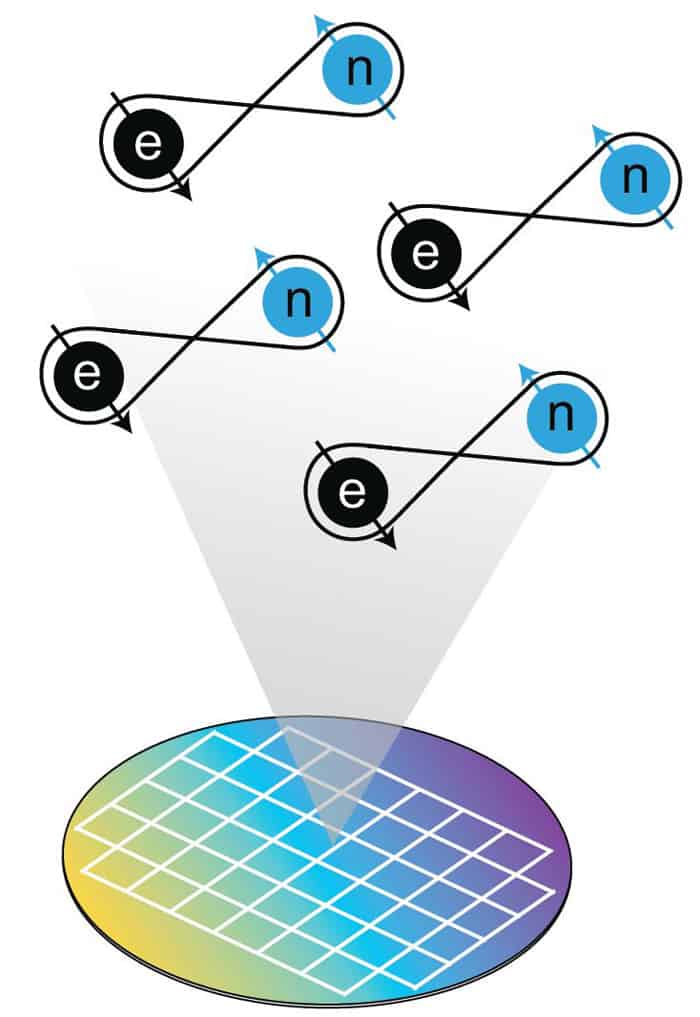
Now, Paul Klimov and David Awschalom from the University of Chicago, together with colleagues at the University of California, Santa Barbara and the Argonne National Laboratory, have developed a new method that addresses these challenges. It uses a combination of infrared laser light with microwave and radio-frequency pulses to entangle nearly 10,000 two-qubit electron and neutron spin pairs. This is done in a macroscopic 40 µm3 volume of the commercial SiC wafer.
The electron–nuclear spin pairs are located at the intrinsic “colour centre” defects found in SiC. These are similar to the “nitrogen vacancy” centres found in diamond, which can also be used as qubits. While the team’s techniques could be applied to diamond, Awschalom told physicsworld.com that the team used SiC because of the important role it plays in high-power electronics, optoelectronic devices and sensors. The fabrication techniques developed in these fields will transfer directly to the development of sophisticated entanglement-harnessing devices, says Awschalom, adding that “creating sophisticated devices from diamond is generally much more difficult”.
Two-step process
Creating the entangled ensemble is a two-step process. The team first “initializes” or polarizes the system, in a very small magnetic field using infrared laser light. The entanglement that the researchers measure starts out highly coherent – up to 88% fidelity with respect to a maximally entangled state – and then decays within 300 ns. This initial “inhomogeneous” entanglement coherence can then be extended by applying sequences of radio-frequency and microwave pulses.
Physicists create many entangled states of electrons (“e”) and nuclei (“n”) in the industrially important semiconductor silicon carbide, all at ambient conditions. (Courtesy: Paul Klimov, University of Chicago)
“Many of the microwave/radio-frequency pulse techniques have been developed over decades of nuclear magnetic resonance (NMR) research, and many of them are implemented in commercial magnetic resonance imaging (MRI) technologies,” says Awschalom. “We believe that the ultimate limit of this coherence will be of the order of 100 μs, however, we have not performed the measurements necessary to confirm this.”
The entanglement is confirmed by performing “quantum state tomography”, which is a measurement of the quantum state of the system. It can be very difficult to measure the quantum state of a specific ensemble when it is intertwined with many other quantum systems that are naturally present in the substrate. To overcome this challenge, the team developed a new tomography protocol for precisely measuring the state of a specific ensemble, even when there is significant noise.
Surprisingly, the team found that this entanglement works best at ambient conditions – at lower temperatures, the polarization of the system degrades slightly, and so the maximum possible entanglement fidelity is also lowered. “With more sophisticated polarization techniques, however, the entanglement fidelity at cryogenic conditions can be made to approach the entanglement fidelity that is possible at ambient conditions,” says Awschalom.
Practical scaling
The team managed to entangle nearly 10,000 spin pairs, but by tweaking the experimental apparatus, it could be possible to create hundreds of billions of two-qubit entangled states in a chip of material that is 0.5 mm × 3 mm × 3 mm (the approximate size of the sample). “The more copies of the system, the stronger its signal-to-noise, and the stronger it can couple to things like other ensembles or light, for example,” cautions Awschalom.
While it is far too early to tell if this technique will directly lead to a practical quantum computer, the entangled states created could be used as building blocks in a quantum computer many years in the future. But even this is only possible if it can be expanded beyond two-qubit entanglement to much larger entangled states. This, according to Awschalom, is probably the biggest challenge in scaling up any quantum system – at room or cryogenic temperatures – into a useful quantum technology.
On the flip side, the entangled spins could be used as quantum sensors. “Given that the entanglement works at ambient conditions and the fact that SiC is bio-friendly, one particularly exciting application is in vivo biological sensing,” explains Awschalom, adding that “future devices of this type could include entanglement-enhanced magnetic resonance imaging probes, which could have important biomedical applications”.
Researchers in Sweden have created electronic circuits and devices that are integrated within living plant material. The team introduced a conductive polymer into the vascular system of plants, which allowed the researchers to create the key components of an electrical circuit. They were also able to demonstrate transistor modulation, digital logic function and elements of a digital display. Plant-integrated electronics could enable us to monitor and regulate plant physiology and harvest energy from photosynthesis, the team says.
Organic electronic materials are polymers and molecules that can conduct and process both electronic and ionic signals. They can be shaped into almost any form and used to build devices that can convert electronic signals into chemical processes, and vice versa. The resulting electrochemical devices can then be used to regulate and monitor biological and chemical processes. Such technologies are currently being exploited in various medical settings, such as drug delivery, regenerative medicine, neuronal interconnects, and diagnostics.
Magnus Berggren and colleagues at Linköping University and the Swedish University of Agricultural Sciences are interested in whether similar organic bioelectronics can be used to sense, record and control chemical processes in plants. This could have many useful applications in agriculture, Berggren explains. For example, if you could monitor hormones that indicate when crops are ready to flower and were able to regulate that process, you could adjust flowering times to avoid periods of bad weather.
Conducting wires
The team tried merging electronic circuitry with sections of stems from Rosa floribunda (garden rose) by soaking them in solutions of conductive polymers. Only one, poly(3,4-ethylenedioxythiophene) or PEDOT, was taken up through the tube-like xylem, which transports water through the plant, and incorporated into the plant’s internal structure. The polymer was shown to have self-organized to form conducting wires – some of which were more than 5 cm in length – inside the xylem, while still allowing the transport of water and nutrients.
The researchers showed that the wires could interact with the electrolytic compartments in the surrounding cells. They used this interaction to create an electrochemical transistor that converts ionic signals to electronic output. They then created two such transistors in the same piece of PEDOT/rose-stem wire and showed that the pair can function as a NOR logic gate.
They also infused a variant of PEDOT into rose leaves, using a technique called vacuum infiltration. The conductive polymer made its way into compartments separated by the veins of the leaf, creating a 2D network of electrochemical cells. When a voltage was applied to the leaf, the polymer cells changed colour, indicating that they were interacting with the ions in the leaf.
Fundamental circuits
While the colour-changing leaves are a bit of a novelty, Berggren says they demonstrate that you can build “pretty advanced circuits inside the leaves”. He adds that although they have yet to develop sensors and other advanced devices, the research shows that you can create all of the “fundamental circuits and devices that are important to develop more dedicated applications for specific needs”.
This is yet another wonderful development in the field of living technologies Andy Adamatzky, University of the West of England
“This is yet another wonderful development in the field of living technologies – hybrids of wetware and hardware,” says Andy Adamatzky, director of the Unconventional Computing Centre at the University of the West of England. “I believe it could be used to develop embedded computers, where plants can sense their environments, analyse the information by employing internal computers and then send the results of their analyses to humans.”
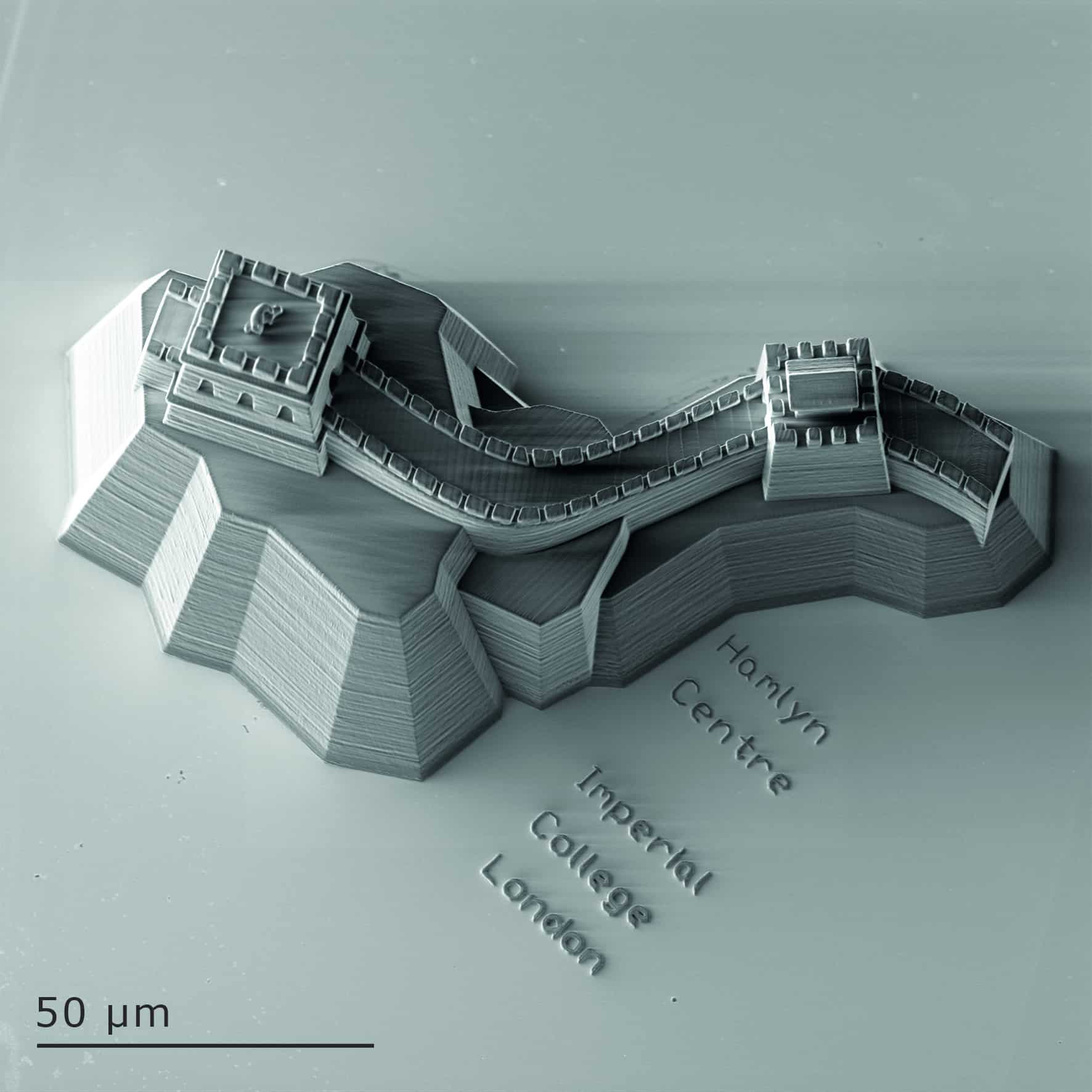
Tiny trophy: The Great Wall of China, printed with a Nanoscribe system at the Hamlyn Centre, Imperial College London. (Courtesy: Nanoscribe)
By Hamish Johnston and Tushna Commissariat
Last month, China’s president Xi Jinping’s was on a state visit in the UK and while here, he toured a few academic institutions, including the UK’s new National Graphene Institute (NGI) in Manchester and Imperial College London. As we reported in an earlier blog, Nobel-prize-winning Manchester physicist Kostya Novoselov presented President Xi “with a gift of traditional Chinese-style artwork, which Kostya himself had painted using graphene paint”. This week we found out that the Imperial scientists also presented him with a “tiny gift” in the form of a 50 µm scale version of a section of the Great Wall of China, imaged above, created with a Nanoscribe 3D printer. Prince Andrew, who was also on the visit, was given an image of a panda leaping over a bamboo cane, which was printed on the tip of a needle.
Pillars of light: this week’s meeting at the Royal Society focused on how Maxwell’s equations illuminate physics. (CC BY-SA 3.0 Tom Morris)
By Hamish Johnston
Earlier this week I caught the 6.30 a.m. train from Bristol to London to attend the second day of “Unifying physics and technology in light of Maxwell’s equations” at the Royal Society. It was a particularly damp and gloomy morning as I emerged from Piccadilly Circus station and tramped through St James, my sights set on the Duke of York pillar next to the Royal Society in Carlton House Terrace.
It seemed like the perfect morning to be thankful for the light described by James Clerk Maxwell’s equations, and to ponder how they have since illuminated many shadowy corners of physics.
The meeting was organized by three physicists at nearby King’s College London: biophysicist and nanotechnologist Anatoly Zayats; particle physicist John Ellis and condensed-matter physicist Roy Pike. Already, you can see the breadth of physics covered at the meeting.
Atmospheric gravity waves drive winds, temperature and chemical composition in the middle and upper atmosphere, but not enough is known about those that occur at higher altitudes. Now though, an international team of researchers has unexpectedly discovered that the new “Day/Night Band” (DNB) sensor, on-board a US environmental satellite, can detect disturbances in the upper atmosphere’s nightglow caused by the waves.
“The DNB observations reveal a complex array of gravity waves in the upper atmosphere that have never before been observed globally at this spatial detail, says Steve Miller of Colorado State University, US, adding that all of the data are available thanks to the sensor’s extreme sensitivity to visible and near-infrared light.
Dark clouds
The DNB is part of the Visible Infrared Imaging Radiometer Suite (VIIRS) on the US NOAA/NASA Suomi National Polar-orbiting Partnership environmental satellite launched in October 2011. The sensor, which detects wavelengths of 505–890 nm, sits 834 km above the Earth and images the atmospheric state as it races by at about 7 km/s. When assessing their sensor’s performance, Miller and colleagues noticed clouds in images taken on nights without moonlight. They realized that the instrument could detect nightglow emissions, which in this case were reflecting off the clouds. Nightglow, also known as airglow, is due to emissions of light in the upper atmosphere from atomic oxygen, sodium and hydroxyl radicals. The emissions are strongest at about 85–95 km, around the mesopause.
Although the DNB sensor is optimized to image the nocturnal surface and lower atmosphere at extremely low levels of light, the team discovered it can pick up nightglow emissions on dark nights. These emissions are sometimes disrupted by gravity waves – disturbances to the density of the atmosphere that gravity and buoyancy act to restore – that are the main form of energy exchange between the lower and upper atmosphere.
Volcanic waves
The gravity waves alter the local temperature and density, modulating the intensity of nightglow emissions and creating rippling patterns of visible light. They may appear as alternating bright and dark bands or as complex patterns, and the team found that the DNB can image the waves with a horizontal resolution of around 0.74 km.
The team imaged gravity waves resulting from a number of phenomena, including mountains, hurricanes, thunderstorms, tropical cyclones, the jet streams of intensifying cold fronts, mesospheric bores and, in the first known spaceborne measurement of its kind, a volcano. Chile’s Calbuco volcano erupted in April 2015, sending a plume of ash into the stratosphere and making a concentric-ring gravity-wave pattern in the nightglow above.
Miller says that the volcanic eruption suggests that other seismic-related airglow signals are yet to be observed, such as “a large earthquake, which may produce an observable ‘bright-sky’ airglow response and/or gravity-wave train coupled to a tsunami front”.
Miller cautions that as their sensor was not optimized for these kinds of observations, there are a number of caveats to working with the data, but there are many more discoveries to come. “There are many wave structures that we have difficulty attributing or explaining. We anticipate that we have not observed all of the possible forms of gravity waves,” he adds.
Better predictions
Because they drive circulation patterns at high altitudes, atmospheric gravity waves also tie back to the weather and climate that we experience near the surface, so this new data could help to improve predictions of climate and climate change. Miller explains that data for the lower atmosphere – taken from surface-based sensors and satellites – are relatively good, but the information for the upper atmosphere is comparatively sparse. The DNB observations could help researchers to understand the structural details of gravity waves produced globally by a variety of mechanisms.
“As a satellite-based sensor, the DNB provides global coverage, and hence an ability to capture wave activity over remote regions and above clouds that would obscure surface-based viewing,” says Miller, explaining that these DNB measurements are unique when compared with most other existing satellite observations. The Ionosphere, Mesosphere, upper Atmosphere, and Plasmasphere (IMAP) Visible-light and Infrared spectrum Imager (VISI), on board the International Space Station, is the only other kit that can provide horizontal details of upper-atmosphere gravity waves, but its resolution is 10 km, an order of magnitude coarser than the DNB’s.
Because the DNB is slated to fly on the NOAA’s Joint Polar Satellite System (JPSS) satellites well into the next decade, it could prove useful to researchers analysing decadal-scale trends in wave activity as they attempt to improve model parameterizations. And by combining DNB observations with measurements of gravity waves in the middle atmosphere from the Advanced Infrared Sounder on NASA’s Aqua satellite or the Cross-track Infrared Sounder (CrIS) on the same JPSS satellites, researchers could study the 3D structure of the waves.
Miller and colleagues would like to develop quantitative ways to extract as much information as possible from the “challenging” DNB imagery. They also hope to collaborate with the IMAP/VISI research team and groups operating surface-based nightglow sensors, to compare information content at different spatial resolutions.
Every other year, for four nights only, the Lumiere light festival transforms the ancient cathedral city of Durham, UK, into an illuminated garden of the imagination. The 2015 Lumiere marked the fourth such transformation, and this year, for the first time, a science-themed artwork took centre stage. The World Machine – a sound-and-light show projected onto the façade of Durham Cathedral – told the story of how the universe began, and also how, over the nearly 1000 years of the cathedral’s existence, humans have worked to develop theories of cosmology. Meanwhile, below the cathedral, on the banks of the River Wear, another physics-related installation, Rainbow River, celebrated the optics work of Isaac Newton.
In the video, you’ll see The World Machine, Rainbow River and a few of the two dozen other works of art that made up the 2015 Lumiere. You’ll also hear from cosmologist Carlos Frenk, director of the Institute for Computational Cosmology at Durham University and one of the scientific consultants on The World Machine; and Richard Hornby, physicist and co-creator of Rainbow River.
The artworks in the video (in order of appearance):
Complex Meshes 2015
A “fresco of light” projected onto the arched ceiling of the nave of Durham Cathedral, it responds to the movement of the crowds of people below.
Artist: Miguel Chevalier. Music: Jacopo Baboni-Schilingi. Software: Cyrille Henry and Antoine Villeret.
The World Machine
The story of modern cosmology, projected onto the façade of Durham Cathedral.
Artist: Ross Ashton. Sound: John Del’Nero. Music: Isobel Waller-Bridge. Scientific consultants: Carlos Frenk and Richard Bower.
Garden of Light
A group of illuminated plants made of recycled materials and scattered around the cathedral grounds.
Artist: TILT.
Fogscape #03238
An artificially generated cloud of fog rises from the banks of the River Wear, creating patterns of light and shadow in the woodlands below the west front of the cathedral.
Artists: Fujiko Nakaya and Simon Corder.
Rainbow River
Created to celebrate the UNESCO International Year of Light, this work evokes Isaac Newton’s work on the optics of triangular prisms, with beams of white and coloured light reflecting off the surface of the river.
Artists: Alison Lowery and Richard Hornby.
A technique to authenticate the identity of electronic devices using quantum tunnelling has been developed by researchers in the UK. The idea takes a problem in quantum electronics – the extreme sensitivity of the energy levels of a quantum well to its height and breadth – and turns it into an opportunity for creating a unique “quantum fingerprint” that is impossible to forge.
The secure exchange of electronic information is a cornerstone of modern society and security technology must be improved continuously to stay one step ahead of criminals and hackers. Password encryption is known to be vulnerable to cyber-attack. Where possible, it is far more secure to store data on hardware that has an identifying mark or feature that is random and therefore impossible to clone – a hi-tech version of a key. These marking systems are called physically unclonable functions (PUFs), and several have already been developed using the laws of classical physics. For example, the speckle pattern produced when a laser is incident on a surface is invariant, so the same surface will produce the same speckle pattern repeatedly; and yet it is impossible even for the manufacturer to produce another surface that will produce the same pattern. Other examples of such PUFs are modes in silicon ring oscillators and states of static random-access memories.
Forging ahead
As computers become more powerful, there is a real danger that criminals will find ways to reproduce the signature of such a device. In 2013, for example, Jean-Pierre Seifert and colleagues at the Technical University of Berlin produced a physical clone of a “unique” static random-access memory that, when tested, demonstrated identical responses to the original.
“Quantum devices all behave slightly differently, and that’s a big problem” Robert Young, Lancaster University
In the new research, experimental physicist Robert Young of Lancaster University has made his mark by exploiting a problem facing quantum technologists. Making practical quantum devices is very difficult because their performance is extremely sensitive to tiny imperfections introduced during manufacturing – imperfections that are much smaller than state-of-the-art manufacturing tolerances. “In a lab environment, on a one-off basis, [quantum devices] work fantastically well,” explains Young. “But when you want to make millions [of them], they all behave slightly differently, and that’s a big problem.” The researchers realized that this shortcoming is also a potential opportunity to create a device that is impossible to duplicate.
To exploit this opportunity, the researchers used resonant tunnelling diodes (RTDs) – quantum wells formed by sandwiching a layer of a conductor between two insulating gaps. The current through the diode depends on whether or not the potential difference across it is in resonance with the potential of one of the electronic energy levels in the well. The positions of these energy levels are sensitive to the atomic-scale variations of the atoms in the four interfaces on either side of the two barriers. These variations cannot be controlled using existing technology. The researchers manufactured 26 RTDs, all of which supposedly had identical specifications. However, when the researchers tested the voltage at which the peak current occurred and the maximum current through the diode at this peak, there was no overlap between the diodes.
Commercially sensitive
Straightforward circuitry exists for picking out a single resonant peak, says Young, so this technology could be commercialized by using multiple quantum wells, each with a different resonant peak. “This is standard semiconductor technology,” says Young. “You can make devices that are less than a micron squared, so you can easily make huge arrays of these identities.” The researchers have patented the technology, and they are currently looking at ways to exploit it in practice. Young describes the details as “commercially sensitive”, but he says that “these physically unclonable functions are already in use in many different markets, and all we’ve done is made one which is better – we think – than any that’s been made before”.
Jean-Pierre Seifert is intrigued. “All the PUFs so far presented that are manufacturable are clonable, either mathematically or physically,” he says. This one, he feels, is not clonable with available technology. However, he does have two concerns about the technology. Conceptually, he wonders whether the device truly relies on quantum mechanics as, although tunnelling is a quantum phenomenon, the positions of the resonances, though difficult to calculate, are still deterministic. More practically, he questions Young’s claim to be using standard semiconductor technology because, in the laboratory, the researchers grew the device by molecular beam epitaxy on an indium-phosphide substrate. “The question is whether a similar device can be manufactured in a standard CMOS process,” he says.
On average, 91 people are killed by asteroids each year. This number – taken from a 2010 report published by the US National Academy of Science – might seem alarmingly high, especially since we know of only a few such deaths in recorded history. But in fact it is simply a consequence of statistics: the average value takes into account deaths from enormous collisions that happen only rarely, but could potentially cause massive destruction. For example, it is generally thought that, roughly 66 million years ago, the impact of an object at least 10 km in diameter produced effects that led to the extinction of around three-quarters of life on Earth, including the majority of the world’s dinosaurs.
Many questions remain unanswered about the sequence of events that produced this cataclysm. In her book Dark Matter and the Dinosaurs, theoretical physicist Lisa Randall focuses on a novel one: how did the dinosaur-killing asteroid end up on its collision course with Earth in the first place? It has been suggested that the impactor was a comet nudged from an innocuous orbit in the Oort Cloud at the outermost reaches of the solar system. But if that is the case, Randall asks, what did the nudging?
Initial inspections of the fossil record (which Randall describes in detail) reveal some evidence to suggest that large impacts tend to occur in groups separated by around 35 million years. Although this periodicity has not been clearly established, could it provide a clue to the nature of the dislodging force?
After ruling out the possibility that the gravitational influence of an invisible companion star of our Sun might be responsible, Randall considers the motion of our solar system through the Milky Way galaxy. As it orbits the galactic centre, the solar system also oscillates through the plane that contains most of the galaxy’s stars. If there was a thin, dense region of matter contained within this stellar plane, then our orbit would periodically take us through regions of space with a density greater than the average. In that case, the additional gravitational interactions that take place during that period could be responsible for nudging Oort Cloud objects towards the Sun.
At first sight, this idea is hard to justify, as we have no observational evidence for such dense patches of space. But if these regions were made of dark matter – the invisible substance that makes up around 85% of the mass in the universe – then an absence of observational evidence is exactly what we would expect. This is an intriguing idea, because it is now widely accepted that dark matter has helped to create the cosmic scaffold on which the large-scale structure of the universe was built.
The story is that these dark-matter particles were created in the Big Bang and, through gravitational interactions, began to concentrate in the very first moments of the life of the universe. The resulting clumps acted as seeds that attracted (again via gravity) the stable atoms that began to form once the temperature of the universe had fallen sufficiently. As the universe expanded, gravity magnified these irregularities in the matter distribution, finally producing the pattern of galaxies we see today.
Unfortunately for Randall’s dinosaur-killing story, the cold and essentially collisionless dark matter described above does not behave in the same way as conventional matter. In particular, it could not be distributed in the galactic plane as a thin, dense disc capable of triggering a comet’s fatal trajectory through gravitational attraction, because galaxy-formation models fail to predict the existence of an overdense region within the plane of the galaxy.
This leads Randall to introduce a more hypothetical variety of dinosaur-killing dark matter, via the radical concept of a whole new “dark sector” in which partially interacting dark matter interacts with itself through the new force of “dark electromagnetism” to which ordinary matter is oblivious. Such self-interactions might allow this new class of dark matter to lose energy and slow down enough to form a disc within the galaxy.
There is little doubt that a massive impact 66 million years ago was, at least in part, responsible for the demise of the dinosaurs. The nature of the impactor remains unknown, but if it was indeed a comet dislodged from the Oort Cloud, then Randall’s book provides an entertaining and radical explanation of the events leading up to their ultimate extinction. However, the partially interacting dark-matter model that spawned this explanation is, as Randall concedes, “speculative”, with little experimental evidence to support it. Many of the observations that provided the original motivation for creating the model have now been questioned, while some reported discrepancies between observations and the results of dark-matter simulations have since been resolved. And as Randall herself states, “If there is a conventional explanation for an observation, it is almost always the right one. Radical departures should be accepted only when they explain phenomena that older ideas fail to accommodate. In only very rare instances are new ideas truly necessary to explain observations.”
Perhaps I am more comfortable with established ideas, aligning myself with the majority of scientists who are (in Randall’s opinion) a “conservative lot”. But you may wish to read this entertaining book before making up your own mind. After all, to misquote Robert Frost, “We dance round in a ring and suppose, but nature sits in the middle and knows”.
Forthcoming data from the Large Hadron Collider at CERN and the European Space Agency’s Gaia mission – which is designed to produce a 3D map of the Milky Way with unprecedented accuracy – may well cast some light on the properties of dark matter in our galaxy and the universe at large. In doing so, there is a chance that we could come closer to discovering what was ultimately responsible for the demise of the dinosaurs.
A new technique for measuring the electronic band structure of solid materials has been unveiled by physicists in Canada. The new method does not require the sample to be placed in a vacuum chamber and can also probe the bulk of a sample – something that some other techniques cannot do. The team believes that its new method could be particularly useful for studying matter under extreme conditions, including samples under extremely high pressure in a diamond anvil.
Angle-resolved photoemission spectroscopy (ARPES) is an important laser-based method for studying the electronic band structure of solid materials. Photons with enough energy to eject electrons from a material are fired at a sample and the energy and momenta of the emitted electrons are then measured. This information reveals the structure of the electronic bands in terms of the energy and momentum of the electrons within them.
Surface science
ARPES has been used extensively by physicists to study a wide range of materials including semiconductors and superconductors – but the technique has some important limitations. Measurements must be done in an ultra-high vacuum (UHV) because the emitted electrons are scattered and absorbed by air. Also, ARPES only probes a thin layer of material near the surface of the sample because the electrons cannot escape from deeper in the bulk.
Now, Paul Corkum and colleagues at the University of Ottawa, the Institut National de la Recherche Scientifique and the National Research Council of Canada have developed a new all-optical technique for studying the band structure of solids that overcomes these problems.
The technique involves exposing a sample to intense pulses of laser light, but with a photon energy much lower than that required to eject an electron from the material. There is a very large electric field associated with such a pulse, which causes an electron to quantum-mechanically tunnel from the top of the valence band to the bottom of the conduction band, thus creating a hole in the conduction band. The electron and hole are then driven by the electric field to high momenta in opposite directions. The electric field itself oscillates, and when the field direction switches, the electron and hole both reverse direction and are reunited. At this point, the electron and hole recombine, giving off a photon that can escape the material and be detected. The energy of the photon is equal to the energy gap between the valence and conduction band at the point of recombination.
To measure the momentum of the electron at recombination, Corkum and colleagues fire a much dimmer pulse from a different-coloured laser light at the sample, at the same time as the intense pulse. By measuring the intensity of the emitted light as a function of the phase between the light in the two laser pulses, the team can work out the momentum of the electron that recombined to produce the emitted photon.
Chemical processes
The electron–hole recombination process occurs very quickly, and this combined with the use of very short laser pulses means that the technique could be used to study changes in band structure over very short timescales.
Corkum says that the technique could prove particularly useful for studying materials under great pressure in a diamond anvil, because diamond is transparent to the laser light used to make the measurements. The method could be used to look at how the band structure of a material changes during catalysis and other chemical processes that cannot be studied in UHV. The study of materials in very high magnetic fields, which would deflect ARPES electrons, should also be possible.