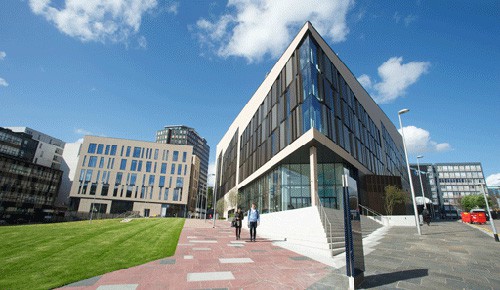
Glasgow’s Technology and Innovation Centre. (Courtesy: University of Strathclyde)
By Margaret Harris in Glasgow
If you’re the first speaker after lunch at a conference, how do you make sure your audience stays awake and engaged?
For Oliver Ambacher – who occupied the dreaded post-prandial slot during Wednesday’s applied photonics conference at Glasgow’s Technology and Innovation Centre (TIC) – the answer is simple. You pretend to jump off a cliff.
Ambacher, the director of the Fraunhofer Institute for Applied Solid State Physics in Freiburg, Germany, made his leap (actually, several leaps of varying lengths) to illustrate one of the toughest challenges in applied physics: the yawning gap between what academic researchers can provide, and what industry scientists need to turn that research into innovative products. This gap is sometimes called the “valley of death”, and Ambacher’s point was that the risks of leaping across it are generally higher on the industry side. “If I, whose heart is still in physics, jump into the valley of death, I lose funding, maybe a project,” Ambacher explained. “But somebody from industry, they may lose their job. So they cannot jump so far.”
For domestic use, options abound. Pitch black, jack black, lamp black, fine black, velour black, onyx black, blackboard black, black fossil, charcoal, soot, smoke, sinner, black stillness, off black, little black dress, penny black, deep black and – should you want to be left in no doubt – black black.
There are probably 50 shades of black, if not more. But sometimes, and especially where physicists are concerned, even the blackest black isn’t black enough.
For many years, NASA has used a black paint manufactured by the international aerospace corporation Lord that has a reflectivity of just 3.5%. That’s several per cent lower than conventional black pigments. Dubbed Z306, it was applied to the Hubble Space Telescope, as well as other NASA instruments, to reduce stray light from the Sun, Moon, Earth and indeed the telescope’s own housing. Without it, all those images of distant galaxies and novae might not have appeared quite so spectacular.
Black is important in the design of the best telescopes, but it is also key in other scientific equipment, including infrared detectors, black-body calibrating materials, radiators and solar panels. The military, too, requires very black materials for sensitive infrared seekers used in ballistic missile defence and satellite surveillance, because the blacker the surface, the more sensitive it is to light. With such high-stakes applications, it is no wonder that the fashion for black is being eagerly updated. After all, Z306 is so last season. Enter the new black: super black.
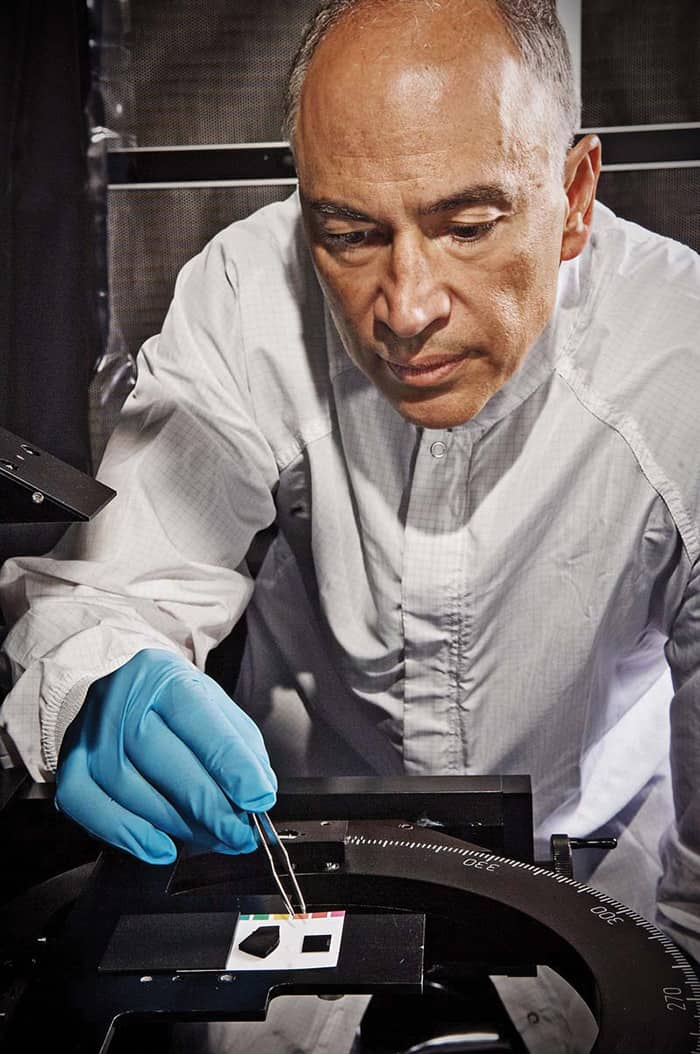
Dark materials John Hagopian with his nanotube-based black material. (Courtesy: Chris Gunn/NASA)
As it happens, NASA has been working on a super black for some time. In 2007 physicist John Hagopian from the agency’s Goddard Space Flight Center in Maryland, US, began experimenting with the growth of carbon nanotubes. These materials share the same hexagonal “chicken wire” structure of the layers in graphite, but are rolled up into tiny hollow cylinders with diameters ranging from fractions of a nanometre to hundreds of nanometres. Carbon nanotubes are typically grown on a substrate inside a furnace, into which a carbon-containing gas is fed. What Hagopian did was to coat a silicon substrate with iron, which acted as a catalyst, encouraging the nanotubes to grow vertically, like a forest.
Hagopian’s nanotube forests had a refractive index close to one – that of air – which meant that light striking the surface didn’t “see” a barrier. Rather than reflect, the light was absorbed by the nanotubes’ hollow interiors, and ultimately turned into heat. The material had a reflectivity of just 0.5%, making it seven times blacker than Z306.
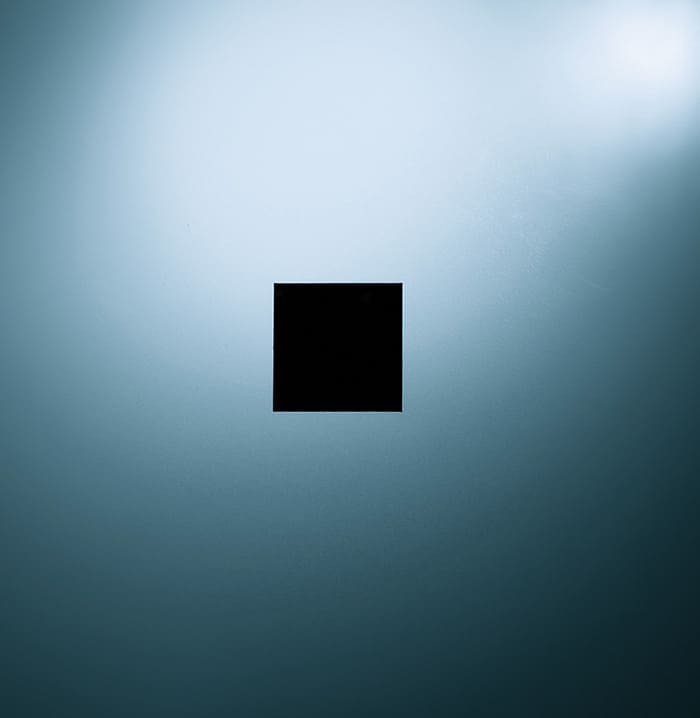
That is very black. Look around and you will probably see several black surfaces – on computers, smartphones and televisions. Black is the designer’s go-to chic colour when it comes to consumer technologies. But this familiar black, it turns out, is hardly black at all compared with the carbon-nanotube variety. Hagopian’s coating was so black in fact that it attracted interest from a Belgian artist, Frederik De Wilde, who quickly persuaded the NASA group to allow him to use it on some of his projects. One of them, the 2010 work Hostage, is a square nanotube forest on a conventionally black background. It looks like a mysterious void: no reflections, no features to speak of.
Dark rivalry
A coating that absorbs all but 0.5% of light is surely black enough, you might say. But even while Hagopian’s group was writing up a paper on its super-black nanotube forests in 2008, another group, based at the Rensselaer Polytechnic Institute (RPI) in New York, US, announced that it had made “the darkest material ever made by man”. That material, too, was a carbon-nanotube forest, albeit with a density even better tuned to minimize reflectance. “This is the kind of field where everyone feeds off everyone else,” says Hagopian. “There’s a lot of history, a huge number of papers.”
Hostage by Frederik De Wilde. (Courtesy: Frederik De Wilde)
The RPI group, led by physicist Shawn-Yu Lin, claimed a visible-light reflectance for its nanotube forest of 0.045%, making the material more than 10 times blacker than Hagopian’s, and nearly 80 times blacker than Z306 (Nano Lett.8 446). The material swiftly became the blackest black, as recognized by the book Guinness World Records.
For a few years the RPI record seemed unbreakable. During this time, however, Ben Jensen and others at Surrey NanoSystems, a company in Newhaven, UK, had been experimenting with the growth of carbon nanotubes at relatively low temperatures to make highly conductive electrical contacts. The problem is that carbon nanotubes do not normally grow below a temperature of about 700 °C, which is above the melting temperature of aluminium, one of the most widely used metals in aerospace. To make the two materials compatible, Jensen’s group realized that it could keep the bottom of an aluminium substrate cool while locally heating the top surface with a high-powered lamp. That way, the nanotubes could grow without any disruption to the bulk metal.
In 2012 the idea caught the attention of Theo Theocharous at the National Physical Laboratory (NPL) in Teddington, UK, who immediately realized its potential for creating super-black surfaces for space applications. The result, after two years’ collaboration between NPL and Surrey NanoSystems, was “Vantablack” – the “vanta” prefix being an acronym of “vertically aligned nanotube arrays” (Opt. Express22 7290). Although the paper emphasized the importance of the aluminium substrate, the firm’s press releases stressed Vantablack’s claimed minimum reflectivity in the visible spectrum of 0.04%, later revised to 0.035%. The improvement over the RPI material may have been slight, but in due course Guinness World Records made it official: Vantablack was the new black.
Here is where the rivalry for the blackest black has shown its dark side. After Surrey NanoSystems’ 2014 announcement, lawyers acting on behalf of De Wilde reportedly contacted Dazed, a UK fashion and culture magazine, to contradict its description of Vantablack as “the world’s blackest material”. “Nobody likes to be left out and disrespected,” the artist said in a subsequent interview with the same magazine. “Unfortunately I cannot talk in detail yet about my relationship with Surrey NanoSystems…The only thing I can say is that Surrey NanoSystems contacted me and we exchanged information.”
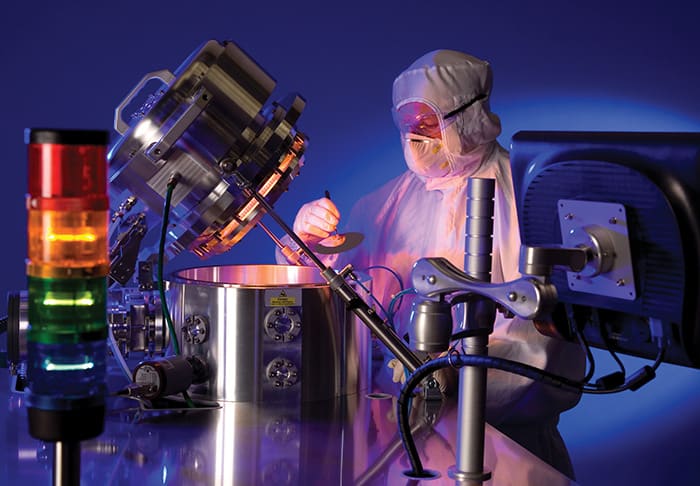
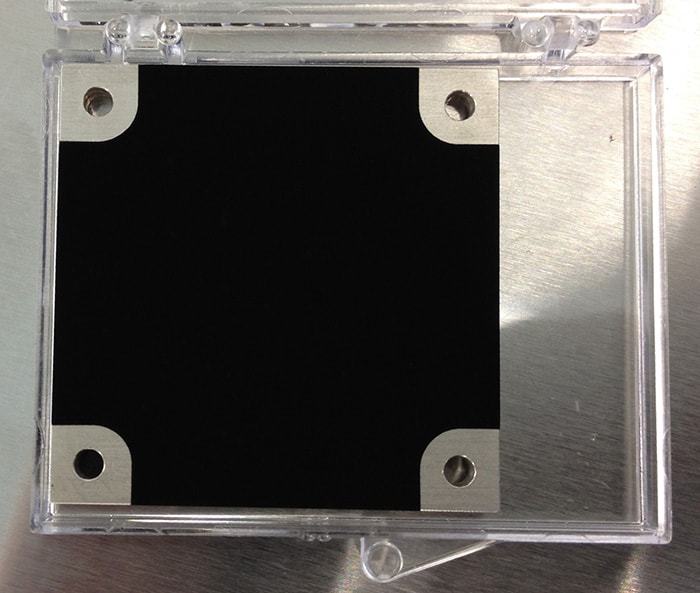
In production UK firm Surrey NanoSystems produces Vantablack, the current record holder for the least-reflective material. (Courtesy: Surrey NanoSystems)
De Wilde did not respond to questions from Physics World about the reasons behind his contention. Jensen from Surrey NanoSystems, however, says that the artist had approached his firm with a proposal of artistic collaboration, but it had to refuse because it had already signed a separate exclusive agreement with the British-Indian Turner Prize-winning sculptor Anish Kapoor. In any case, Jensen adds, De Wilde’s claim is plain wrong: Vantablack was, and still is, the blackest black. “It’s just bad cheese because we refused to work with him,” he says.
Back at NASA, Hagopian tries to distance himself from the claims of his artist collaborator. “There’s a little battle going on – who can be the darkest,” he says. “We’re kind of foregoing that, and working on practical applications.” Still, Hagopian does not bow out of the competition altogether. “You know, the difference between RPI and Surrey NanoSystems – what is that, about 0.01%? It’s not that great. I’m sure we could do better, it’s just not what we’re trying to optimize.” In recent tests, he claims, the visible-light reflectivity of his nanotube forests has dropped below 0.1%.
Space, shock waves and solar power
Rather than creating blackness for blackness’ sake, much of Hagopian’s work has had the practical focus of applying the nanotube forests to substrates suited to aerospace. By using a patented aluminium-oxide buffer layer, his group has managed to grow nanotubes on stainless steel, titanium, copper, silicon and silicon nitride. He admits that the ability to deposit Vantablack on aluminium is interesting, but doubts how much it would be used in practice. “I think their systems are quite expensive, half a million dollars or so, versus a tube furnace that costs maybe ten thousand,” he says. “We didn’t really find it to be cost effective for what we’re doing. Titanium, the stainless steels – they’re just as good as aluminium.”
The blackest black UK firm Surrey NanoSystems produces Vantablack, the current record holder for the least-reflective material. (Courtesy: Surrey NanoSystems)
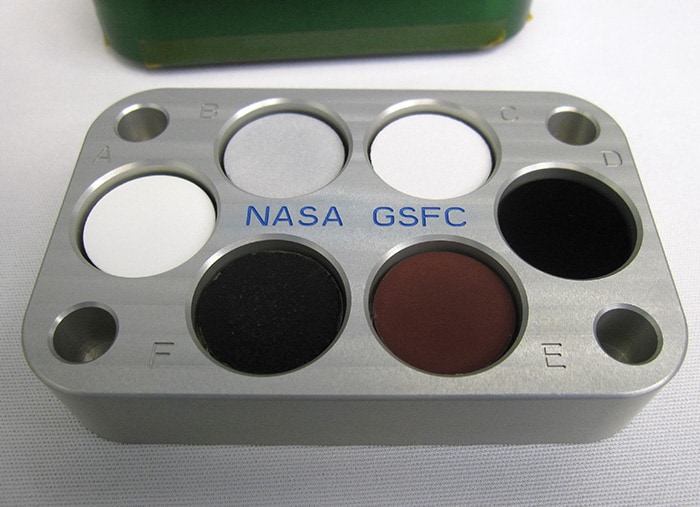
Most scientists seem to agree that when it comes to space applications, a super black’s minimum reflectivity in the visible spectrum is somewhat incidental: low reflectivity across the entire infrared, visible and ultraviolet spectrum is more important. Even then, there are other concerns, such as the material’s mass and its tolerance to extreme conditions. Hagopian points out, though, that his nanotube forests have already been tested for durability aboard the International Space Station, being exposed to the harsh radiation of outer space. Elsewhere they are being used to boost the signal-to-noise ratio of an airborne laser fluorescence experiment, tracking gases used to monitor atmospheric currents. His group has also applied its super black to an occulter used to block out starlight in exoplanet hunting, as well as to diffraction baffles for the upcoming LISA gravitational-wave experiment.
Not that the main destination for super blacks is necessarily space. In 2012 Jay Guo, an engineer at the University of Michigan in Ann Arbor, US, and colleagues reported that nanotubes could be coated with polymers onto a concave lens. When irradiated with a laser, the coating quickly transformed the light to heat, generating ultrasonic shock waves that could destroy materials placed in the lens’s focal zone (Sci. Rep.2 989). The lens, says Guo, could become an “invisible scalpel” for use in surgery.
Working with researchers at Zhejiang University in China, Guo’s group is also planning to report on an entirely new way to make a super black. Although he cannot yet give details, Guo claims that simple evaporation of materials can produce a multi-layered structure that has a reflectivity of 1% from the visible to near-infrared. This is not nearly as low as other super blacks, but he reckons that the technique can be scaled more easily to large areas.
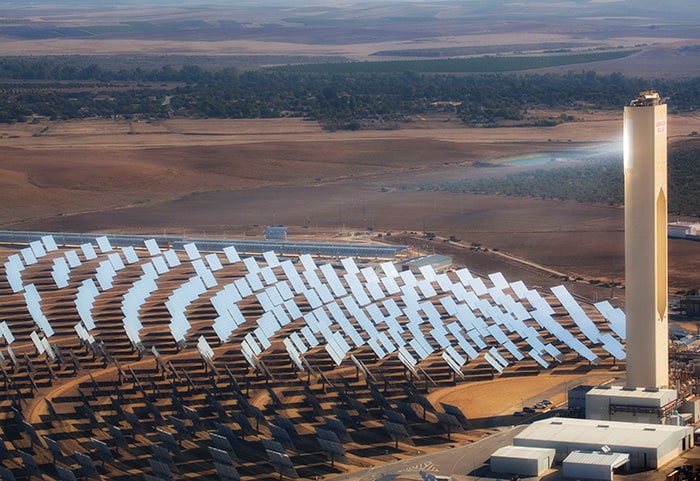
Guo isn’t the only one to highlight scalability as another important factor. Renkun Chen – an engineer at the University of California in San Diego, US – is interested in applying super blacks to the sunlight-absorbing tubes used in concentrated solar power plants. In these plants, a field of mirrors concentrates sunlight onto a central tower containing tubes, which heat up gas to drive turbines. A super-black material made from a carbon-nanotube forest – and especially the painstaking method needed to create one – would simply not be up to this task, he says. “For a solar tower you need hundreds of tubes,” he explains. “Each tube is about 20 m long. Think about it.”
Looking forward The Abengoa Solar plant in Spain is an example of concentrated solar power, which could be much improved by the use of super blacks. (Courtesy: Abengoa)
Even if super blacks made from nanotubes were coated onto such tubes, says Chen, they would burn up in the heat of a solar tower. Current solar towers can reach temperatures of about 600 °C, but engineers want to push them even higher to improve efficiency and to make the technology competitive with solar photovoltaics. To meet this challenge, Chen and his colleagues are now developing a super black consisting of cobalt-oxide nanoparticles that can be sprayed onto the absorber tubes. Stable up to 750 °C, the nanoparticles create a rough surface that absorbs light in much the same way as a nanotube forest, although the reflectivity reaches a minimum of only 2% (Sol. Energ. Mat. Sol. Cells.134 417).
With this development, the hunt for super blacks has gone full circle. Chen’s super black is, in essence, a spray paint. But that is not to say that growing carbon nanotubes, or depositing materials by evaporation, is the wrong approach. It only means that there are other criteria to consider. Depending on who’s asking, the best black may not be the blackest black.
Hiding in the shadows
The search for super blacks could, in time, turn up ideas that bear fruit in other areas. In one 2011 experiment, Guo found that if he coated a micron-scale 3D etching of a military tank with a nanotube forest, the tank became perfectly camouflaged against its surroundings: it appeared as flat and as black as the surface it was etched upon (Appl. Phys. Lett.99 211103). The military applications were obvious. But the result also got him thinking: what if objects in outer space were hidden in this way? In principle, he concluded, a super-black coating could hide an arbitrarily large object from the ultraviolet through the infrared and into the terahertz part of the electromagnetic spectrum.
Beyond black NASA has already begun testing its super blacks on the International Space Station. (Courtesy: NASA)
“It is interesting to note that deep space itself is a perfect background without reflecting any radiations,” he wrote in his paper. “It would only take a ‘magic veil’ consisting of low density and broadband absorbing particles to render matters and objects totally invisible to our instruments based on the detection of electromagnetic waves.”
Perhaps, then, the allure of super blacks is rather more primitive than many scientists let on. It is that ultimate uncertainty, the one that has tormented every human who has ever stared into the void. Is there something there, or not?
Water droplets will bounce spontaneously on a specially designed surface by simply evaporating some of their liquid, according to scientists in Switzerland. The bounces become successively higher until the droplets freeze. The researchers believe the effect could be put to work on self-cleaning surfaces.
The bouncing is reminiscent of the well-known Leidenfrost effect, whereby a droplet of liquid can levitate slightly above a hot surface such as a frying pan. The high temperature underneath the droplet evaporates some of its liquid to create a vapour pressure that offsets the downward pull of gravity and keeps the droplet afloat. In the Leidenfrost effect, the droplet oscillates briefly with decreasing amplitude before reaching an equilibrium height where the pressure differential is just enough to balance gravity.
In the new research, mechanical engineer Dimos Poulikakos and colleagues at ETH Zurich looked at how water droplets interact with superhydrophobic surfaces at low pressure. The researchers created arrays of tiny silicon micropillars coated with water-repellent fluorosilane. Such a material is expected to be superhydrophobic because water droplets will sit on top of the micropillars. This reduces the contact area between the droplet and the surface, and so makes it more likely that the droplet will not stick.
Pressure drop
At ambient atmospheric pressure, this small contact area is sufficient to keep droplets tethered to the surface. Lowering the air pressure normally reduces the water repellence of a superhydrophobic surface. This is because with less air underneath it, a drop will sink deeper into the textured surface, thereby increasing the contact area. However, when Poulikakos and colleagues looked closely at the behaviour of water droplets in 1% atmospheric pressure, they found them bouncing up and down on the micropillars with ever-increasing height (see image). “I was very surprised, of course,” says Poulikakos.
The researchers have worked out that the bouncing is related to an additional effect of low pressure – it reduces the humidity of the air and thereby allows the droplet to evaporate faster. Liquid evaporating from the top of the droplet dissipates rapidly in the air. Underneath the droplet, however, things are different. Vapour cannot easily dissipate between the micropillars, and this generates pressure under the droplet that increases until it is large enough to detach the droplet and send it flying upwards. Once the droplet leaves the surface, the pressure is released and the droplet falls back down onto the surface. The droplet then bounces upwards with an extra kick generated by its vapour pressure. This effect is repeated again and again, and the evaporation of the droplet feeds increasing amounts of energy into its motion, causing it to bounce higher each time.
Supercool effect
Evaporation also causes the droplet to cool rapidly, putting it into a supercooled-liquid state. When the droplet does eventually freeze, the decrease in enthalpy in passing from liquid to solid causes a sudden increase in its temperature, and a consequent increase in how much vapour it sheds. The sudden increase in vapour then propels the ice crystal away from the surface.
“If the surface is vertical, it will fall off,” says Poulikakos. “If a breeze blows, it will blow it off.” Even if an ice crystal falls back down after it freezes completely, it will be much easier to remove than the crust of ice that would form if water froze on the surface, he explains.
Physical chemist Doris Vollmer of the Max Planck Institute for Polymer Research in Germany is impressed. “It’s beautiful and very amazing work – I would never have guessed this,” she says. She cautions that, at present, this is not a practicable proposal for a self-cleaning surface because it does not work at atmospheric pressure, but she concludes that “the aim of science is fundamental understanding and, from the point of view of fundamental understanding, it’s brilliant”.
“Pictures convey abstract concepts to each other and to ourselves,” explained Michael Berry last night in his talk “Optica Fantastica: Nature’s optics and our understanding of light” here at IOP Publishing in Bristol as part of the city’s Festival of Ideas. Berry, who is the Melville Wills emeritus professor of physics at the University of Bristol, began by declaring that he was going to take the “opposite approach to Einstein”. Whereas Einstein said, “I want to know God’s thoughts, the rest is just detail”, Berry is interested in those details.
Sponsored by the Institute of Physics, which publishes Physics World, the talk was held to celebrate the International Year of Light 2015 and in it Berry ran the audience through the four levels of understanding light: rays, waves, polarization and quantum. He showed beautiful pictures from his own research but also included some artworks related to the phenomena he was explaining and even quoted passages from novels.
To explain some of the effects of light on water, Berry showed the David Hockney painting “Dive in” and read an extract from AS Byatt’s Possession, in which she described “tessellation in the water’s glaze”.
A series of pictures of interference patterns between random waves allowed Berry to explain phases of light, optical vortices, knot theory and the cosmic microwave background.
The image above was taken by creating what Berry called a “black sandwich” – placing a sheet of overhead transparency foil between two polarizing filters and taking a photo through them with an ordinary digital camera. It creates a beautiful effect (one that I fully intend to try myself just as soon as I can find a supply of overhead transparency foil) and Berry assured us that he can give a full hour’s lecture on the mathematical properties that the image elucidates.
I learned some interesting nuggets, such as the controversy over whether Vikings used polarization in crystals to navigate from Norway and Iceland to Canada 1000 years ago. (Berry’s conclusion is that it’s unlikely but he’d still like it to be true.) And that the halo you sometimes see around your own shadow (or if you’re in an aeroplane, the halo you see around the plane’s shadow on a cloud) is called a Brocken spectre and is described in Thomas Pynchon’s Gravity’s Rainbow.
I also learned that while Berry appreciates art, and can name many examples of science having inspired art, he believes it is a one-way street – he does not know of any science inspired by art (despite a few tentative examples given by the audience). What do you think? Are there any solid examples of art inspiring science?
Bursting balloons is good fun, but there is also some fascinating physics lurking in how the fabric of the balloon is ripped apart. Two physicists in France have studied the bursting process using a high-speed camera, and have discovered that there is a critical point in the inflation of a balloon beyond which it will create beautiful flower-like patterns when it bursts. The research could boost our understanding of how materials fail when subjected to high degrees of stress.
The French artist Jacques Honvault is famous for his high-speed photographic images, including a spectacular shot of a balloon fragmenting just after it is popped. This flower-like image fascinated the physicist Sébastien Moulinet of the École Normale Supérieure in Paris, because the fragmentation pattern is very similar to the patterns of cracks that can form when a material such as glass is struck by a hammer.
Blowing bubbles
To try to understand why these patterns occur, Moulinet and Mokhtar Adda-Bedia made balloons by forcing air into a latex membrane that is stretched over a circular aperture – a process akin to blowing a soap bubble. They then filmed the rupturing process at 60,000 frames per second using a high-speed camera (see video and image).
In some of their experimental runs, the balloons were filled to a relatively low internal air pressure and then pierced with the tip of a scalpel. In these cases, the slit made by the blade simply expanded as the balloon burst, leaving a piece of latex with just one slit in it.
Y-shaped cracks
Things changed dramatically, however, when the balloons were inflated to (or near to) the pressure at which they would burst spontaneously. In these cases the initial slit began to expand but then would suddenly split into two cracks that move off at angles to create a “Y” shape. These cracks would then undergo a similar division, and the process continued until the balloon was shredded into a number of finger-like pieces.
To understand the bursting process, the researchers looked at balloons made of latex of four different thicknesses and also varied the degree to which the balloons were inflated – the latter being related to the tension in the latex membranes. They found that the crucial parameter is the stress within the material – the ratio of the tension to the thickness of the latex. When the stress is above a critical value of about 1.8 MPa, the balloon will fragment. Below this critical value, the balloon will come apart in a single slit.
Speed of sound
Moulinet and Adda-Bedia believe that at low stress values the crack moves relatively slowly through the material, relieving stress as it goes. Higher stress values, however, correspond to faster crack-propagation speeds. The physicists believe that the critical stress value corresponds to the crack moving at its maximum speed. This was measured to be about 570 m/s, which the two physicists say is probably the speed of sound in the latex membranes. Because the crack can move no faster, the stress is relieved by creating two cracks.
Moulinet told physicsworld.com that he was “happy and amazed to be able to reproduce Honvault’s bursting balloon in the lab”. He also points out that the study could help scientists to understand how materials fail under stress. Moulinet and Adda-Bedia are now taking a closer look at how the cracks divide, and in particular the angles between the cracks.
Over the past two decades, astronomers have discovered a veritable glut of planets orbiting stars other than our Sun. Thanks to the way we have detected these exoplanets, many of them are so-called hot Jupiters – being significantly larger than the Earth and orbiting close to their parent stars. But exoplanet discoveries are now coming thick and fast, and we are starting to discover planets that are increasingly more Earth-like and orbiting their stars closer to the “Goldilocks zone” where it is possible for liquid water to be maintained.
In this short explainer video, the astronomer Sara Seager of the Massachusetts Institute of Technology (MIT) explains how we can look for some of the telltale signs of life on these planets. She explains that by examining the starlight coming from their planetary systems, we can infer some of the constituents of the exoplanet atmospheres by looking for signatures within the spectra. The study of planetary atmospheres in this way will be greatly enhanced by the instruments aboard the James Webb Space Telescope (JWST), which is set for launch in 2018.
Seager spoke in more depth about the search for life beyond the Earth in the July edition of the Physics World podcast series. Our next podcast – available later this month – is an interview with the astrobiologist Lewis Dartnell, who talks about what life beyond the Earth might actually be like.
A wearable brain-scanning device that will provide high-resolution images of the whole brain, while the subject is moving about and performing everyday activities, is being developed by researchers in the US. The new approach – called ambulatory microdose positron emission tomography (AMPET) – miniaturizes positron emission tomography (PET) technology, such that it fits onto a helmet that’s worn during scanning.
Clinical brain imagers currently require a trade-off between motion and resolution. Large, bolted-to-the-floor devices – for techniques such as PET, magnetic resonance imaging (MRI) and magnetoencephalography (MEG) – provide high-resolution images but require the participant to remain completely still. Meanwhile, approaches such as electroencephalography and near-infrared spectroscopy can be used with a moving subject, but have low spatial resolution and cannot visualize important structures such as the hippocampus and amygdala deep within the brain.
“Standard PET scanners in hospitals utilize large photomultiplier tubes; but recent advances in material science have led to the development of detectors using silicon photomultiplier (SiPM) technology, which is orders of magnitude more compact,” says Julie Brefczynski-Lewis, from the West Virginia University (WVU) Centers for Neuroscience. Brefczynski-Lewis and colleagues built a ring of SiPM detectors that go around the head and are now in the process of developing this into a wearable PET scanner.
Portable PET
Stan Majewski, the original principal investigator on the project, explained that the team’s motivation for developing the portable PET brain scanner lay both in the challenge and the assumption that improved instruments will offer new opportunities. Following the development of such technology for rats – wearable Rat-Cap PET imagers – built at Brookhaven National Laboratory, and the development of the so-called PET-Hat in Japan, where the patient is in an upright position, but still has to remain motionless, Majewski’s “vision was to free the patient/subject and make him/her stand or even walk within a limited space”.
Initial simulations of the device showed that the helmet scanner offers more than a 400% increase in sensitivity over a conventional whole-body PET scanner. AMPET also requires a much lower radiation dose than conventional scanners. “The detectors are close to the head and thus capture more photons,” says Brefczynski-Lewis, who presented the team’s work at the recent Neuroscience 2015 annual meeting.
“We have already demonstrated that we can reconstruct images from this close geometry using 10–25% of the dose used for standard PET,” she adds. “Low dose has advantages both in reducing radioactivity exposure – making longitudinal scans, purely research scans and scans using young populations more feasible – as well as allowing detection of lower concentration targets like rarer neuron types and ligands with a low binding efficiency.”
Applications abound
Last year, the WVU team and its collaborators were awarded $1.5m through the newly set up BRAIN Initiative from the National Institutes of Health. While still in the prototype stage, AMPET has a wide variety of potential research and clinical applications, including studies of balance, physical therapies, natural social interactions and virtual reality, as well as disorders such as stroke, Alzheimer’s and Parkinson’s disease, multiple sclerosis and traumatic brain injury.
“Imagine imaging a savant while painting or a chess master in action: we might be able to tap into the mechanisms behind these super abilities,” says Brefczynski-Lewis. “Clinically, we may better understand why people with autism react differently to social situations and this may inform diagnosis and therapies. Moving forward, we’ll be talking with researchers and clinicians working in stroke rehabilitation, Parkinson’s disease and balance disorders, as well as neuroscientists who study social, cognitive and emotional processes, to determine how such a scanner could be used and what features are most necessary.”
“I was excited to discover that the system can potentially assist with early diagnosis of Alzheimer’s by combination with virtual reality,” adds Majewski. “Apparently, the earliest signs of Alzheimer’s are not seen in the memory loss but in the loss of navigational skills. Well-controlled navigational tests in the virtual-reality environment, correlated with functional/molecular images of the brain obtained at low radiation dose with our upright high-resolution PET imager, can be really revolutionary.”
The properties of a good memoir are simple, yet elusive: the author needs to have something to say, and they need to be able to say it. In A Singularly Unfeminine Profession, the physicist Mary K Gaillard displays both qualities in abundance. As one of the leading theorists of her generation, she was both a participant in and a witness to the events that produced the Standard Model of particle physics. Moreover, as one of the field’s very few women, Gaillard has a vitally important story to tell about the swamp of sexism she had to slog through to get there. The book covers her entire career, but it focuses particularly on her time at CERN in the 1960s and 1970s. During this period, Gaillard made her name by predicting (with Ben Lee and Jon Rosner) the mass of the charm quark, but she also faced pervasive discrimination – something that initially surprised her when she arrived in Europe as a PhD student. In the US, she writes, “while many members of the physics community implicitly or explicitly expressed scepticism as to my ultimate survival in the field, there was no question of being refused the chance to try, and judgement on achievement was essentially objective”. Not so in 1960s France, where one academic after another declined to serve as her PhD adviser, offering a cavalcade of excuses and putdowns that Gaillard may have forgiven, but certainly hasn’t forgotten. Later, as her reputation grew, her position at CERN nevertheless remained irregular and (for the most part) unpaid. Well into the 1990s, she claims, the lab was simply “not ready” to hire a woman as a senior staff scientist. Have things changed? Gaillard agrees that they have – but not uniformly, and not as much as they should.
2015 World Scientific £16.00pb 200pp
Scarce resources
The world’s entire supply of platinum, melted down, would barely fill a swimming pool. Other elements are rarer still: all the Earth’s promethium, for example, would fit in the palm of a child’s hand. These and other exotic denizens of the periodic table are the subject of Rare: the High-Stakes Race to Satisfy Our Need for the Scarcest Metals on Earth. In it, science writer Keith Veronese offers an accessible (though US-centric) overview of the key issues surrounding these scarce but industrially important metals. Briefly, mining them is tricky; removing them from conflict-ridden countries is tricky and morally dubious; and recycling them is tricky, messy and energy intensive. But while there’s a lot of interesting material in Rare, it’s seldom explained in much depth, and the number of minor scientific inaccuracies is worryingly high. Ultimately, this is an important topic that deserves a better book.
Peering into a small 17th century metallic box, without damaging its contents, is no mean feat. But thanks to the use of synchrotron radiation, scientists at the European Synchrotron Radiation Facility (ESRF) in Grenoble were able to “see” inside one, using a technique known as synchrotron X-ray phase contrast micro-tomography. They were also able to create a 3D reconstruction of clay medals concealed within the very fragile and badly oxidized box, which was discovered on the archaeologicalsite of the Saint-Laurent church, and is now at the archaeological museum of Grenoble (MAG). Take a look at the video above to see what the box held. You can also learn more about the researcher’s tomography technique in an article of ours.
A study of successful physical-sciences grant proposals in the UK has found that a small number of universities obtain the vast majority of funding, forming a “clique”. The study, by mathematicians in the UK and Italy, looked at networks between institutions and between principal investigators on grant proposals. They discovered that funding was “highly skewed”, with around half of all grants given to just 8% of both institutions and principal investigators. More than 90% of all funding was awarded to just 20% of institutions.
Vito Latora of Queen Mary University of London and colleagues examined more than 43,000 projects funded between 1985 and 2013 by the UK’s Engineering and Physical Sciences Research Council (EPSRC). The researchers found that the institutions receiving the most funding formed a “rich club” that allowed them to diversify their collaborations and occupy “brokerage positions” between otherwise disconnected institutions. “A network exhibits rich-club behaviour if the nodes with the largest number of links – the dominant elements of the systems – tend to be connected to each other, forming tightly interconnected communities,” says Latora.
The study found that the number of citations among an institution’s researchers and its h-index – a link between the quantity and impact of research papers – increased relative to the number of years an organization spent in the rich club, indicating a rise in the quality. The number of research areas carried out at an institution was also found to increase relative to the number of years in the rich club, indicating an increase in the breadth of research.
Three universities – Imperial College London and the universities of Cambridge and Manchester – showed a marked deviation in their h-index scores, however, outperforming other institutions. These organizations also showed an increased performance when total funding was compared with the number of years in the rich club, suggesting their outstanding funding profiles enabled them to generate high-quality papers.
The researchers say that the notion that a clique of institutions controls the majority of resources is not entirely unfavourable. “Arguably, those elite affiliations that have successfully become very rich seemed to have produced in both the variety of research, and unmistakably in quality,” the researchers claim. Latora points out that other well-funded institutions, which might have less capacity to expand, “have consistently benefited from their association with the elites through the rich core”.
EPSRC director Lesley Thompson told physicsworld.com that it was aware that the majority of its funding was going to a core group of institutions, but “this is the outcome of funding proposals received and judged primarily on excellence by peer review”. She says that the 12 universities that EPSRC classifies as its “framework universities” (which receive nearly 60% of its funding) fluctuates over time, “as do those institutions in the group we call ‘strategic universities’, who hold a further 20% of our portfolio”. Thompson adds that EPSRC looks for high-impact research “wherever it is found in UK universities – we currently fund excellent research in 102 universities and other academic institutions across the UK“.
Ellen Hazelkorn, director of the Higher Education Policy Research Unit at Dublin Institute of Technology, says that the results match a similar analysis carried out in the European Union. “What we see is not only a consolidation of research performance in a smaller number of institutions, but also a regressive transfer of resources into a smaller number of elite institutions,” she says. “There are both inevitable and negative consequences; the quality of the research and the quality of the research environment is incredibly important, and small institutions without sufficient critical mass and success are less likely to be able to provide this.” Hazelkorn adds that by concentrating research in a small number of institutions, people may be ignoring high-quality research being carried out by a wider group of institutions in niche areas.