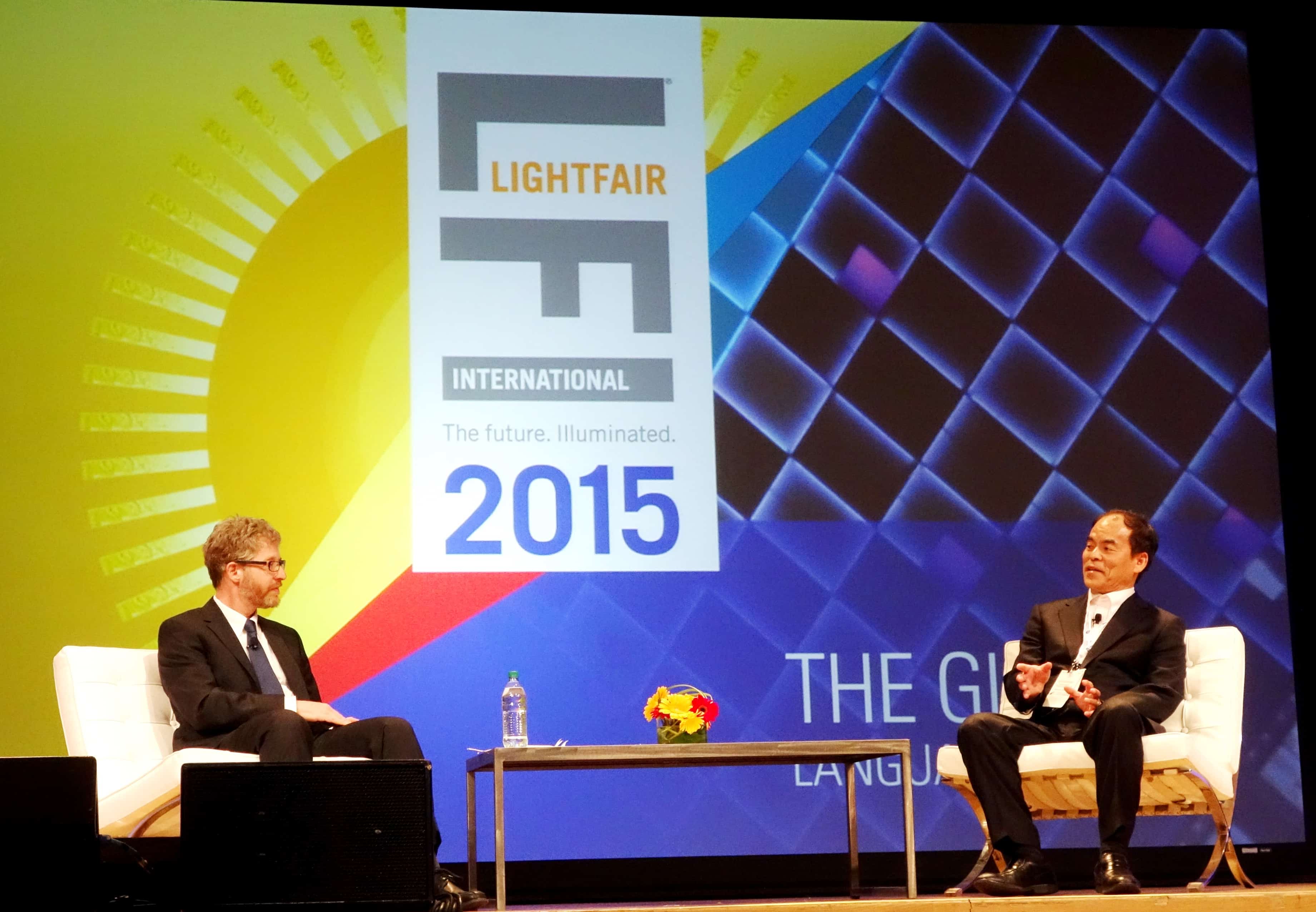
Lunchtime chat: Shuji Nakamura (right) in conversation with Scott Rosenfeld.
By Robert P Crease in New York
I seldom go to the Javits Center, New York City’s big, ugly convention space where the food, drinks and parking are way overpriced. Its shows on fashion, furniture and food don’t interest me and it’s a 20-minute walk from the nearest subway station. I once heard comedian Seth Meyer quip that it’s “smack-dab in the middle of New York’s stabbing district”.
On Sunday I went for the first time in years to attend the inaugural lunch of LIGHTFAIR, the world’s largest lighting trade show that draws architects, engineers and designers from all over the world. The featured speaker was Shuji Nakamura, the Japanese-born American materials scientist who shared last year’s Nobel in physics for developing the blue LED. Nakamura described his research path – when he started virtually everyone was working on selenium and he said he chose gallium only because he thought it would make it easier to publish – and was joined on stage by Scott Rosenfeld of the Smithsonian American Art Museum.
Member countries building the world’s largest radio telescope – the Square Kilometre Array (SKA) – have chosen the Jodrell Bank site near Manchester in the UK to host the observatory’s headquarters. The decision has delighted UK astronomers but is a huge disappointment to their Italian counterparts, who say that their Padua-based bid was backed by the project’s site-selection panel.
The design for the multi-billion-euro SKA calls for thousands of dishes and millions of dipole antennas with a total collecting area of a square kilometre. Together, these devices will allow astronomers to observe the universe as it was just a few hundred-million years after the Big Bang, when the first stars and galaxies started to form. The SKA will also look for the gravitational waves predicted by general relativity.
Following a bitter contest to host the telescope itself, which resulted in the project being split between southern Africa and Australia/New Zealand in 2012, the process to select a site for the headquarters got under way last year. Both Italy and the UK submitted bids, with the former proposing to host the headquarters in a renovated 14th-century castle in Padua and the latter to expand the existing temporary headquarters at Jodrell Bank in Cheshire, home of the Lovell Telescope.
Competing sites
A panel set up by the SKA’s 11 member countries – Australia, Canada, China, Germany, India, Italy, New Zealand, South Africa, Sweden, the Netherlands and the UK – to review the two bids submitted a report in February, in which it recommended the Italian proposal. The panel said that both bids fulfilled nine pre-established criteria, but judged the Padua site to be stronger in five of them – being larger, housing more astronomers, and providing easier access to services such as restaurants and hotels. Nevertheless, at a meeting on 6 March, members did not declare a winner but instead asked both teams to prepare a second round of bids – much to the chagrin of the Italians.
In reviewing the updated bids, the advisory panel was not asked to recommend one proposal over another, but instead to establish whether either of the two bids had been improved in any of the nine categories and what risks were involved in choosing either of the two proposals. Like the panel’s earlier report, this second review has not been made public, but has been seen by physicsworld.com.
The Italian bid was again considered superior against five of the criteria, but this time the British proposal was judged better in one category, that of financial support. The UK pledged £200m (about €270m) towards the €1bn needed for the first stage of the SKA – construction of which is due to start in 2018 – while Italy promised €193m in national funding and another potential €200m from the European Union.
It is that promise of additional funds, among other things, which appears to have swayed the SKA members at a meeting on 29 April at Jodrell Bank, where at least 75% of those members voting in a secret ballot put a cross beside the British bid. Philip Diamond, director-general of the SKA Organisation, says that “each member looked at the panel’s advice and then assigned weights to the various criteria as they saw fit”. He adds that the British funds have been “fully committed by ministers all the way up to the prime minister” and remarks that the upcoming general election in the UK should not change the situation. “I believe there is bipartisan support for the SKA,” he says.
Disappointed decision
Martin Barstow, president of the Royal Astronomical Society, says he is delighted with the decision, adding that it will mean that “SKA scientists will be able to take advantage of the wealth of expertise Britain has in radio astronomy.” But Giovanni Bignami, president of Italy’s National Institute of Astrophysics and co-ordinator of the Italian bid, says he is very disappointed with the outcome. “It would have been much easier to accept if the advisory panel had reached the same verdict,” he says. Bignami adds that the Italian government is now considering its options, including possibly leaving the project. He thinks that it will be a tough task explaining the defeat to Italian prime minister Matteo Renzi, who wrote three letters in support of the bid.
The Sun is – as the old song has it – a mass of incandescent gas, a gigantic nuclear furnace. But it is also much more. Throughout human history, the Earth’s parent star has been an object of fascination, study, myth-making and worship. In Sunspots, Simon Barraclough explores these various identities through poetry, deftly juggling science and art. In one series of poems, for example, a chatty Sun muses on the artists who have tried to capture its essence. Ultimately, Vincent van Gogh, J M W Turner, Joan Mir ó, Georges Seurat and Kazimir Malevich are all judged to be “faves” in one way or another. Other poems are pastiches of works by historical poets. One of the best poems in the book is, in fact, a tribute to Byron’s “Darkness”. Whereas the original version imagined an apocalyptic world starved of sunlight, Barraclough’s homage adroitly flips the problem on its head, describing a Sun that has “stalled at its zenith”, turning the Earth into “a famished, loveless coal”. Literary-minded readers will surely delight in this game of spot-the-allusion, but Sunspots can be accessible as well as erudite. Many of the poems in it are short, stand-alone gems, including one that reads, in its entirety, “Your careless boyfriend, / half-uninterested, / has left a shape of skin upon your shoulder / unprotected, / unsunblocked. / I’ll work all day on that tender, precious spot.” There are scientific references, too, in wry asides such as “I’m starting to repeat myself, my daddy was a pulsar”. The result is a book that seems, in the words of one of the poems in it, designed to “appeal to the dedicated Sun lover and casual astronomer alike”.
2015 Penned in the Margins £12.99hb 112pp
Tales from the dark side
There is a lot of dark matter in the universe. We don’t know nearly enough about it. We are trying to fix that. And by the way, astrophysicists do some wild and crazy things at conferences. That, in a nutshell, is the message of Katherine Freese’s scientific-memoir-cum-popular-science book The Cosmic Cocktail: Three Parts Dark Matter. In the relatively young field of dark-matter research, Freese counts as a veteran. A professor of astrophysics at the University of Michigan, she recently became the director of Sweden’s Nordic Institute for Theoretical Physics (September 2014 p49), and she has worked on the theory of dark matter – the mysterious substance that makes up around 26% of the universe’s total mass-energy – since the early 1980s. Her book, therefore, is a real insider’s account, stuffed full of details about the latest work in the field. Some of these details concern experimental searches for dark matter, while others relate to Freese’s own research, including her suggestion that the first stars to form in the early universe could have been powered by dark-matter annihilation, rather than by fusion of ordinary matter. Dubbed “dark stars”, these primeval behemoths may have been the predecessors of the supermassive black holes at the centre of the Milky Way and other galaxies. Occasionally, the dark-matter community’s love of bulky acronyms dominates Freese’s writing (sample sentence: “Does LUX rule out DAMA, CoGeNT, and CRESST results?”), but for the most part, The Cosmic Cocktail is highly accessible for readers who lack her deep knowledge of the field and its various personalities. And while some of her anecdotes don’t seem to go anywhere, others offer useful lessons in just how much science takes place during the informal parts of scientific conferences – the swanky dinners, the impromptu games of table football, the early-hours clubbing sessions, you name it. For women working in an overwhelmingly male community, these kinds of activities can be tricky to negotiate; fortunately, Freese observes, a student job as a bar hostess “taught her to deflect men’s advances and demand to be treated professionally – skills that later proved invaluable in the male-dominated physics world”.
2014 Princeton University Press £19.95/$29.95hb 264pp
Another Hubble tribute
Most of us have long since grown accustomed to seeing images from the Hubble Space Telescope (HST) on our computers or smartphone screens, but there is still something exceptional about seeing them set out in large glossy pages. With nearly 100 of the most iconic and mesmerizing images in Hubble’s vast archives, including four spectacular fold-out photos, Expanding Universe: Photographs from the Hubble Space Telescope is truly a celebration of Hubble’s success. This is a book of few words, but it does include some insights from veteran NASA astronomers Charles F Bolden Jr and John Mace Grunsfeld, as well as an eye-opening interview in which a photography critic, Owen Edwards, quizzes the head of the HST imaging group, Zoltan Levay, about how raw HST data are converted into the images that we ultimately gaze at in wonder. The perfect present for astronomy, photography or art enthusiasts, this coffee-table book is not just a collection of exquisite photographs but a marker of how far we have come in understanding our place in a vast and magnificent universe.
It’s not often that physics, or indeed a physicist, has much in common with pop music or exceedingly popular boy bands. But earlier this week, at an event at the Sydney Opera House titled “An Evening with Stephen Hawking, with Lucy Hawking and Paul Davies”, an audience member asked Hawking (who appeared in holographic form) “What do you think is the cosmological effect of Zayn Malik leaving One Direction?” Watch the video above to see what Hawking said to comfort the distraught fan and how theoretical physics truly may have all the answers.
A couple of years back, I had the pleasure of travelling 1100 metres below ground to visit a dark-matter laboratory at the bottom of the Boulby Mine on the north-east coast of England. The journey was certainly memorable – it involved plunging down in a rattling lift cage for several minutes with a group of miners setting off on their morning shift. Once in the lab – housed inside a souped-up set of trailers – I interviewed physicist Sean Paling about the experimental projects going on there.
Setting up an underground lab, like that at Boulby, certainly doesn’t come cheap and in recent years, many have started to diversify into new areas. In the May issue of Physics World, which is now out in print and digital formats, Paling and his colleague Stephen Sadler – who is director at DURRIDGE UK Radon Instrumentation – describe the renaissance in the science taking place far beneath our feet. Studies in underground labs now range from Mars rovers to muon tomography and from radioactive dating to astrobiology.
After four years studying Mercury in great detail, NASA’s $446m Mercury Surface, Space Environment, Geochemistry (MESSENGER) mission has come to an end. MESSENGER was the first spacecraft to visit Mercury since the mid-1970s, when the Mariner 10 probe flew past the planet three times. MESSENGER crashed into the planet yesterday after using up all of its fuel, while continuing to take data until the very end.
First proposed in 1996, MESSENGER was launched from Cape Canaveral aboard a Delta II rocket on 3 August 2004. It then made its way to Mercury – a 7.9 billion-kilometre journey – completing a fly-by of Earth, two fly-bys of Venus and three of Mercury itself. In 2011 MESSENGER became the first craft to orbit Mercury, with the craft entering a highly elliptical orbit around the planet that ranged from an altitude of 200 km at its nearest to about 15,000 km at its furthest point.
New discoveries
Having orbited Mercury more than 4000 times over the past four years, the 513 kg spacecraft has mapped and imaged the inner planet, worked out its geological history, discovered that its internal magnetic field is offset from the planet’s centre and found a surprising amount of water in its exosphere. MESSENGER’s nine instruments – including cameras, spectrometers and magnetometers – also uncovered evidence for past volcanic activity, as well as the possibility that Mercury has a liquid-iron core. In 2014 scientists even suggested that the probe had unearthed signs of an annual meteor shower on Mercury.
The MESSENGER spacecraft has given us much of what we now know about one of Earth’s nearest neighbours
Sean Solomon, MESSENGER principal investigator
“The history of solar-system exploration has taught us that the first spacecraft to orbit a planet, because of its global perspective and the opportunity for continuous observations over an extended period, always provides a huge increase in information,” MESSENGER principal investigator Sean Solomon, who is director of Lamont Doherty Earth Observatory at Colombia University, told physicsworld.com. “Over the last four years, the MESSENGER spacecraft, – the latest example of this lesson – has given us much of what we now know about one of Earth’s nearest neighbours.”
After running out of propellant late last year, MESSENGER began to enter a “terminal” orbit. In the last few weeks it began to use up its helium reserves that extended the craft’s operation by a couple of weeks. But with that since exhausted, the craft – travelling at around 14,000 km per hour – plummeted into the planet creating a crater some 15 m wide.
“I have worked on MESSENGER for 14 years, so seeing the end of the mission is bittersweet – it has been far more successful than any of us could ever have hoped or dreamed, but we are extremely sad to see the end of this tough and capable little spacecraft,” says Louise Procker, a planetary scientist at the Johns Hopkins University Applied Physics Laboratory who is also deputy project scientist on MESSENGER. “MESSENGER’s legacy will be huge: not only have we discovered so much about how the innermost planet evolved to its present state, we have also learned more about how terrestrial planets work, which helps us understand why the Earth is such a special place.”
Future missions
MESSENGER, however, will not be the last probe to visit Mercury. BepiColombo – a joint mission of the European Space Agency and the Japan Aerospace Exploration Agency – will pick up where MESSENGER left off. To be launched in 2017, it will comprise two satellites – the Mercury Planetary Orbiter and the Mercury Magnetospheric Orbiter – that are planned to enter orbit around Mercury in 2024. “MESSENGER’s discoveries have raised many new questions about the innermost planet, so it is heartening that two spacecraft are scheduled to be launched to Mercury two years from now,” Solomon adds.
A practical, portable ultralow-field magnetic resonance imaging (MRI) system has been unveiled by researchers from the Los Alamos National Laboratory in the US. With its low power requirements and lightweight construction, the researchers hope that their prototype design can soon be deployed for use in medical centres in developing countries as well as in military field hospitals.
MRI is a powerful medical diagnostic tool, which can be applied to the detailed imaging of a variety of soft tissues, in particular the brain. MRI scanners work by using large, powerful magnets to align the protons (hydrogen atoms) in water molecules. Short bursts of radio waves are then used to excite the protons, which as they relax give off weak radio waves the scanner can detect. Image contrast is provided by the varying relaxation times between different tissue types. Despite their usefulness, however, conventional MRI systems require both a considerable source of power and a supply of cryogens, such as helium or liquid nitrogen, to keep the magnets cool and functioning. On top of that, they are expensive to build and bulky to house.
Scaling down
“Standard MRI machines just can’t go everywhere,” explains project leader Michelle Espy, a physicist at Los Alamos. “Soldiers wounded in battle usually have to be flown in to a large hospital – and people in emerging nations just don’t have access to MRI at all.”
To scale down the scanners, Espy and her team have made use of ultralow magnetic fields, which have intensities comparable to that of the Earth’s magnetic field, to develop what they call “battlefield MRI” (bMRI). To detect the much weaker signals, their machine uses a superconducting quantum interference device (SQUID), which acts as an extremely sensitive magnetometer. While previous research has demonstrated the potential of ultralow-field MRI scanners, it has been limited by poor image qualities, long imaging times and – most critically – an impractical need to operate in an environment almost entirely isolated from ambient electromagnetic noise. “SQUIDs are so sensitive they’ll respond to a truck driving by outside, or a radio signal from 50 miles away,” explains Al Urbaitis, an engineer at Los Alamos.
To combat potential sources of interference, the team built its first prototype device within a large metal enclosure, which acted as a shield. The researchers scanned the brains of human test subjects, producing images with a special resolution of 2.1 × 2.4 mm2, with a 15 mm slice thickness. Having used this set-up to demonstrate their machine’s potential, the researchers have now switched to developing a second iteration of the device that works in an open environment. In the new design, shielding is offered by a series of lightweight wire coils, which encircle the scanner. Currently, the coils only compensate for the Earth’s magnetic field, but the team is confident the shielding can be enhanced to cancel out additional interference on the fly.
Clear imagery
“We’ve been very happy with some of the initial imagery that’s been produced from the lightweight, second-generation system,” says Espy, adding that “with additional development, these systems could be relatively easy and inexpensive to deploy”.
The team has been working towards a military medical application, but is also investigating the potential benefits the device could provide in developing countries that do not have access to conventional MRI. In addition, ultralow-field MRIs also have the potential to be used in situations where – because of the powerful magnets – conventional MRI is not suitable. For example, an ultralow-field machine could be used in emergency situations where metal cannot practically be excluded from the scanning environment.
“The ultralow-field MRI images presented by [the researchers] are very impressive and encouraging for all other groups working along similar lines of research,” says Peter Blümler, a physicist from Johannes Gutenberg University Mainz in Germany, who is not a part of the Los Alamos team. He adds “Personally, I do not see portable MRI systems replacing the high-field equipment, but rather complementing the diagnostic potential of magnetic resonance.” Mark Cohen, a bioengineer from UCLA in the US who was also not involved in this study, is impressed with the work, especially as it represents the first practical test of the principle at the scale of a true human imaging system.
Restricted Data is a blog about the history of nuclear weapons and the efforts policy-makers and scientists have made to try to keep this history secret. Its author is Alex Wellerstein, a historian of science at the Stevens Institute of Technology in New Jersey, US, whose CV includes a one-year stint as the “Edward Teller Graduate Fellow in Science and Security Studies” at the US Department of Energy (“still my best job title” he writes). Wellerstein’s academic research interests lie in the same area, but in the blog, he is writing for a general audience.
What are some of the topics covered?
Most posts on Restricted Data deal with events from the 1940s and 1950s, such as the Manhattan Project to build the first atomic weapons and the US and Soviet hydrogen bomb tests. Over the past decade or so, many formerly secret documents related to this period have been declassified, and others are emerging all the time. Wellerstein is also interested in less-well-studied aspects of nuclear history. One recent post (with the arresting title “How to die at Los Alamos”) focuses on occupational safety at the wartime weapons lab, while another complains about the use of fake “mushroom cloud” photographs (and their associated physical inaccuracies) in books.
Anything else of note?
As well as the blog itself, Wellerstein has also built a tool called Nukemap that models what would happen if a nuclear device were to explode in a certain location. Users of Nukemap can specify the device’s yield (in kilotons), the type of explosion (airburst or surface) and a few other parameters, as well as choosing where the explosion takes place. From a policy perspective it is, perhaps, reassuring to know that if a “crude nuclear terrorist weapon” with a yield of 0.1 kilotons went off in a city centre, few if any people would die in the blast itself, and prompt medical care would save the lives of most of the radiation casualties. But it is quite another thing to look at a map centred on your own house, and imagine what even a “minor” nuclear incident would do to familiar people and landmarks nearby.
Why should I visit?
For those who want to learn more about the history of nuclear weapons, Wellerstein’s blog offers an accessible introduction to a wide range of “science and society” issues, from the morality of the atomic bombings of Hiroshima and Nagasaki during the Second World War to the health risks of radioactive fallout from later nuclear tests. Perhaps more importantly, though, Restricted Data is a good reminder that, like scientists, historians are in the business of analysing data, using it to construct theories, and then checking those theories against new facts that emerge. The declassification of once-secret documents is part of this historical-scientific process, and reading Restricted Data will help you appreciate how perceptions of our scientific past are changing.
Can you give me a sample quote?
From a post about the first Soviet hydrogen-bomb test: “The fully loaded Tu-16 bomber had to abort when the test site was unexpectedly covered by clouds, making them unable to see the target aiming point and rendering the optical diagnostic systems inoperable. The plane was ordered to land, only now it had a fully armed experiment H-bomb on board. There was concern that if it crashed, it could result in a nuclear yield…destroying the airfield and a nearby town. The airfield had meanwhile iced over. Igor Kurchatov, the lead Soviet nuclear-weapons scientist, drove out to the airfield himself personally to see the airfield. [Weapons scientist and later dissident Andrei] Sakharov assured him that even if it crashed, the odds of a nuclear yield were low. An army unit at the airfield quickly worked to clear the runway, and so Kurchatov ordered the plane to land. It did so successfully. Kurchatov met the crew on the field, no doubt relieved. Sakharov recalls him saying, ‘One more test like [this one] and I’m retiring.’ As for Sakharov, he called it ‘a very long day’.”
New real-time information about the electric fields that create lightning could be obtained from the radio waves formed when cosmic-ray showers pass through thunderstorms. That is the conclusion of an international team of physicists, after examining the data recorded by a radio telescope during electrical storms. The team saw changes in radio emissions from charged particles, which computer models suggest are due to deflections by the strong electric fields in thunderclouds.
About 40 flashes of lightning occur every second around the world, according to satellite imaging. While most are harmless, lightning strikes can damage buildings and even kill people. Some of this destruction could be mitigated if we knew where and when lightning will strike, but such predictions are hard because we understand so little about how lightning is created. Thunderstorms evolve quickly and unpredictably, making it tricky to use instruments on rockets or balloons to measure the huge electric fields that build up in thunderclouds before a lightning discharge.
Showers from space
The new research takes a different tack and studies the shower of particles created when a high-energy cosmic particle collides with an atomic nucleus in the atmosphere and sets off a shower of particles that rain down towards Earth. Many of these particles are electrically charged and so get deflected by the Earth’s magnetic field. This deflection causes the particles to emit radio waves that can be detected by a radio telescope.
According to calculations carried out in 2010 by Heino Falcke at Radboud University in the Netherlands, and colleagues, both the polarization and the intensity of these radio waves would be altered in a measurable way by electric-field gradients above about 10 kV/m, which is a typical value found in a thundercloud.
While these calculations were done mainly to help astrophysicists filter out the effect of electric fields on radio studies of cosmic rays, Falcke and colleagues have now joined up with geophysicists and astrophysicists to measure the electric field in thunderclouds using a radio telescope for the first time.
Led by the Radboud-based astrophysicist Pim Schellart, the team sifted through data taken in 2011–2014 by the Low Frequency Array (LOFAR) radio telescope in the Netherlands. The telescope had spotted 762 air showers in this time, but only about 60 events could not be explained by magnetic deflection alone. Further analysis identified 31 of these events as having sufficient signal-to-noise ratio to allow further examination.
Messy throwaways
Schellart describes these as throwaway events that would not normally have been analysed because they are “too messy”. But records held by the Royal Dutch Meteorological Society show that lighting strikes had occurred within 2 h and 150 km of 20 of the 31 anomalous showers, enabling Schellart and colleagues to argue that the remaining 11 events might correspond to atmospheric electric fields that did not lead to recorded lightning strikes.
The team then used a computer simulation to analyse telescope data from one of the lightning events. Their modelling suggests that the radio waves were produced in a thundercloud that extended from 3 km above the ground to a maximum altitude of 8 km – which are both reasonable values for a thundercloud. It is possible that the cloud extended beyond 8 km, but above that altitude there would have been fewer charged particles because the shower would not have been fully developed.
Gradient makes the grade
The analysis also suggests that the electric-field gradient was 50 kV/m at the top of the cloud and 27 kV/m in its lower reaches, which again are typical values for a thundercloud. Interestingly, the researchers found that increasing the electric-field gradient in their model beyond 50 kV/m led to very little change in the predicted radio-wave intensity – an effect that they are now investigating.
“How the radio emission changes gives us a lot of information about the electric fields in thunderstorms”, says Schellart, adding, “We could even determine the strength of the electric field at a certain height in the cloud.” His team has also installed an electric-field meter at LOFAR to further understand anomalous events that do not correspond to recorded lightning strikes.
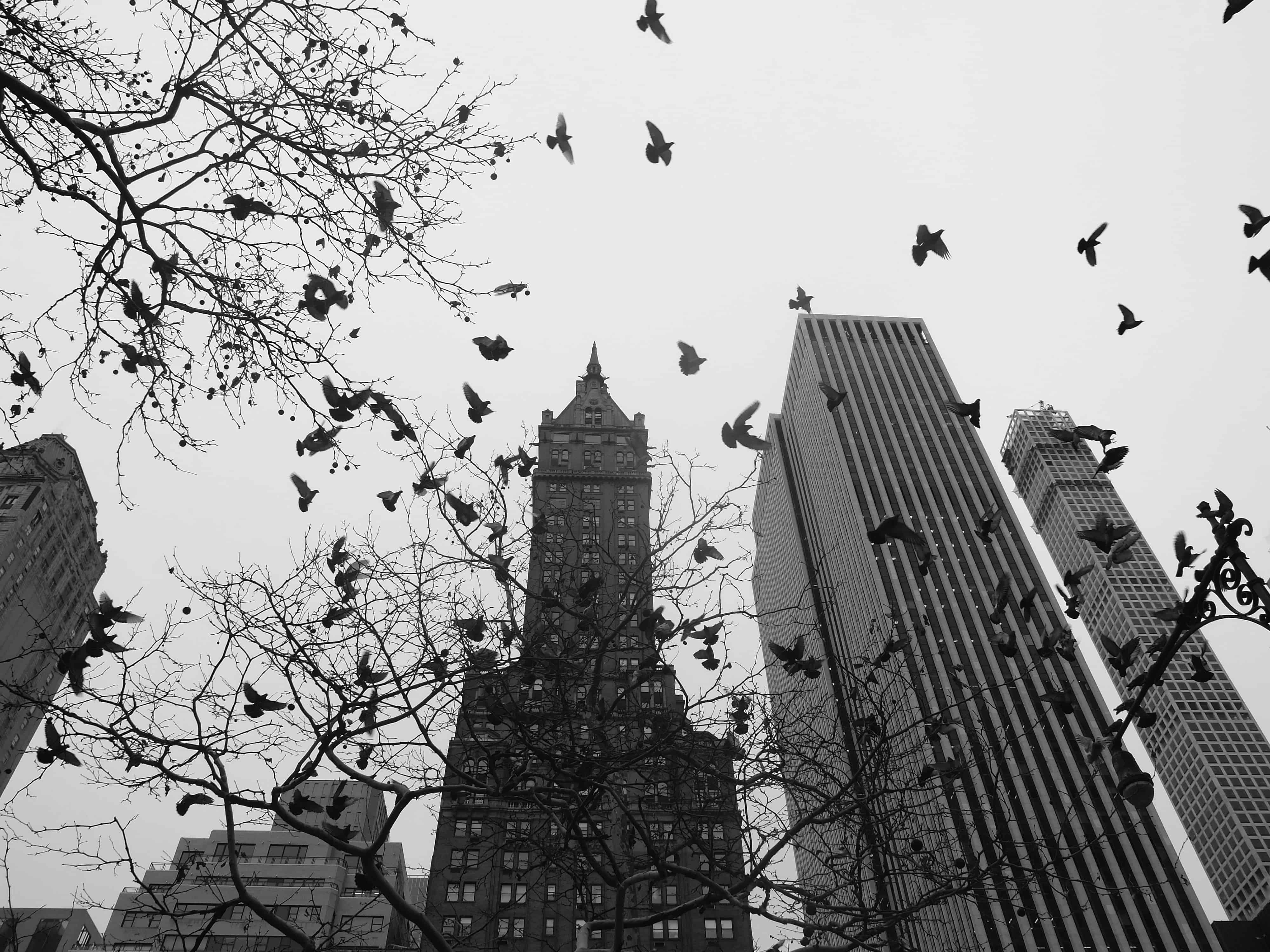
Birds flock over Central Park. (Courtesy: iStockphoto/giovanni1232)
It’s been a great week for birds – or at least those flying over the state of New York – after state governor Andrew Cuomo pledged to create safer migration routes for our feathered friends. All state buildings will now have to comply with a national US initiative that seeks to curb levels of light pollution, which can disorient birds and lead to huge numbers of avian deaths by “fatal light attraction”.
Many species of bird rely on the light from star constellations to help them navigate during spring and autumn migrations. Unfortunately, artificial light sources can throw the animals off course, and light reflected from glass can cause the birds to smack into windows, walls, floodlights and other hard surfaces. It is estimated that as many as a billion birds succumb to this cruel end each year in the US alone, according to the US Department of Agriculture.