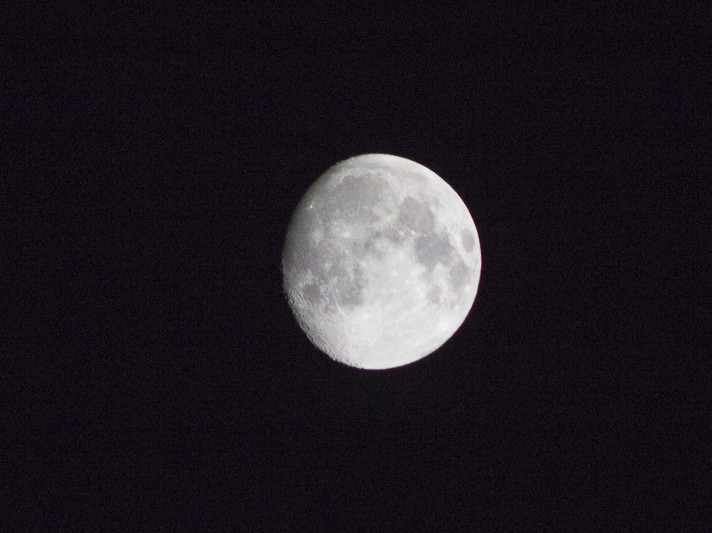
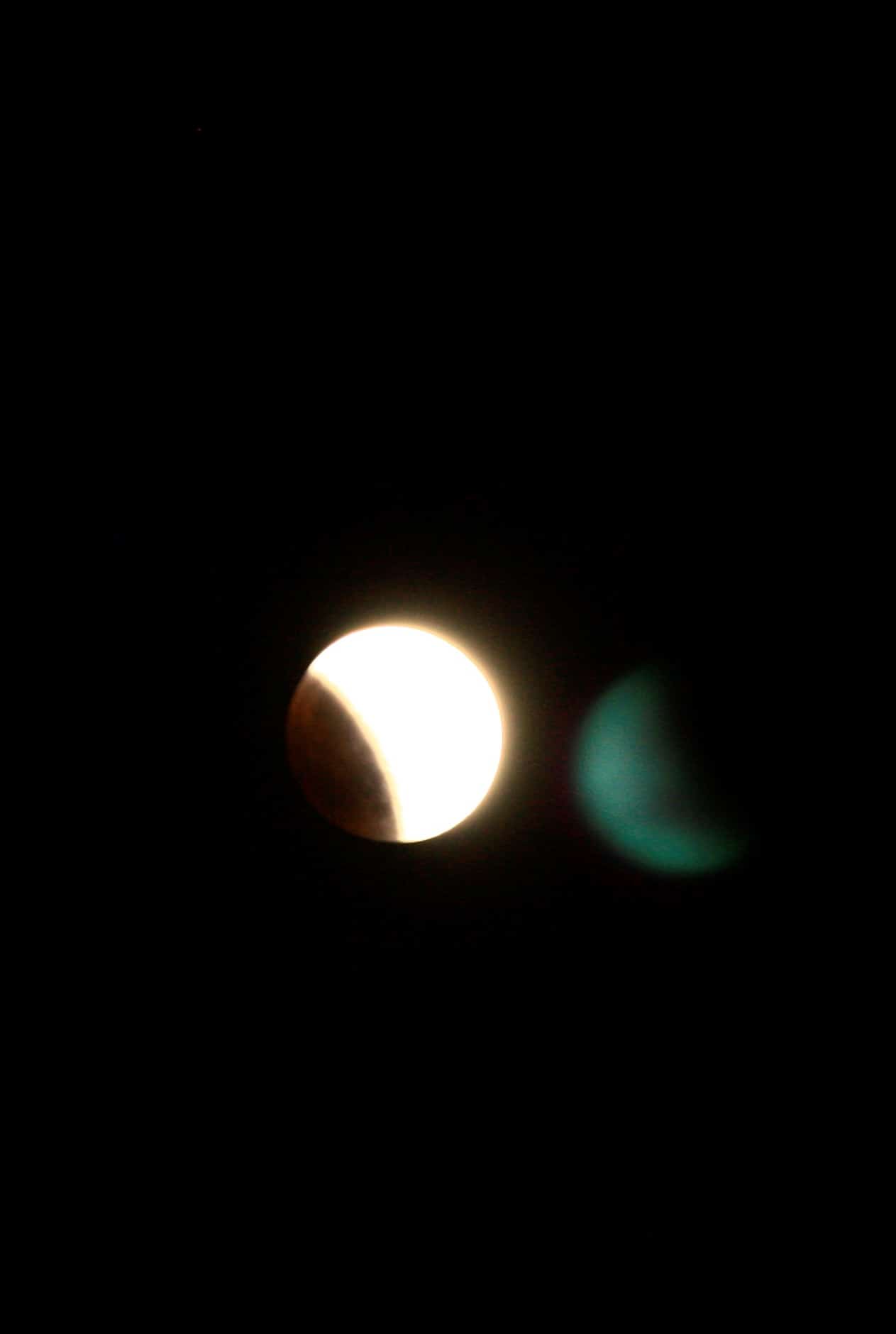
I am rather tired as I type up this post, but I do have an excellent excuse for being so sleepy today as I was awake until the wee hours of the morning watching the “super blood Moon” eclipse. As most of you know, today’s eclipse was particularly impressive as a super Moon (when the Moon is at its closest point to the Earth) coincided with a total lunar eclipse – when the Earth is perfectly in-between the Sun and Moon.
Rather unusually for the UK, we (in and around Bristol, at least) had a crystal-clear night, devoid of any clouds. I set up camp in my backyard, armed with a pair of binoculars, my camera with a zoom lens (but, unfortunately, no tripod) and a hot cup of tea…or two!
Despite the cold bite of an autumn night, the Moon really was a sight to behold. Before the eclipse, the super Moon was so bright that I could hardly look at it through my binoculars.
The full “super Moon” at around 10 p.m. BST, a few hours before the eclipse began. (Courtesy: Graeme Watt)The Moon partially eclipsed, not quite bloody just yet, with a lunar flare. (Courtesy: Tushna Commissariat)
An image of the solar system – showing our luminous Sun ringed by nine (or is it eight?) evenly spaced planets and the asteroid belt – is a familiar feature in many school textbooks. In fact, such images are so commonplace that we often forget just how wrong they are when it comes to showing the true scale of the solar system. In particular, the billions and billions of kilometres of empty space that lie between each planet are rarely depicted.
Now, filmmakers and friends Wylie Overstreet and Alex Gorosh have “drawn” a realistic model of the solar system on a dry Nevada lakebed, complete with planetary orbits. The duo describes it as “a true illustration of our place in the universe”. Watch the video above to see how the pair planned and executed their massive portrait.
Astronomers have been left scratching their heads after an international team failed to find evidence for gravitational waves in 11 years’ worth of radio-telescope observations. The team had expected to see a modulation in the arrival time of pulsar signals caused by gravitational waves from binary supermassive black holes (SMBHs). The null result could mean that binary SMBHs collapse much faster than previously thought, and therefore spend much less time broadcasting gravitational waves. The result could also provide important information to astrophysicists who are trying to model binary SMBHs.
SMBHs have masses in excess of one million Suns and exist at the cores of many galaxies. When galaxies collide, their two SMBHs will form a rotating binary system that will eventually merge into one SMBH. As the two SMBHs get closer together, their gravitational potential energy is broadcast outwards in the form of gravitational waves. These waves are ripples in space–time that are predicted by Einstein’s general theory of relativity but have yet to be detected by astronomers.
Cosmic timekeepers
One proposal for detecting gravitational waves is to measure their effect on the signals we receive from millisecond pulsars. These cosmic timekeepers emit pulses of radio waves at extremely stable frequencies – some even rivalling the stability of an atomic clock. If the signal from a pulsar happens to travel through a binary-SMBH gravitational wave on its way to Earth, then the distance travelled by some of its pulses will be stretched or compressed by about 10 m. While this is a tiny distance compared with the overall journey, it should be revealed by tiny changes in the relative arrival times of several successive pulses.
The sensitivity of such a measurement is increased if a number of pulsars are monitored to create a pulsar-timing array. One such project is the Parkes Pulsar Timing Array, which is running at the Parkes Observatory in Australia. Now, astronomers working on the array have released the latest results in their attempt to measure something called the gravitational-wave background (GWB). This is a mishmash of gravitational waves generated by all of the binary SMBHs in the universe, and is described by the team as a “background rumble”.
Billionths of a second
The team focused on four pulsars that are known to have very high timing precisions, and are therefore best suited to reveal the GWB. Over an 11 year period, the team recorded the arrival times of the pulses to an accuracy of 10-billionths of a second – which is the time it takes for radio waves to travel about 3 cm.
We heard nothing. Not even a whimper
Ryan Shannon, Parkes Observatory
“But we heard nothing. Not even a whimper,” says team member Ryan Shannon of the Parkes Observatory. “It seems to be all quiet on the cosmic front – at least for the kind of waves that we are looking for.”
Now, astronomers and astrophysicists are left wondering why no sign of the GWB was seen. One possibility, according to the team, is that SMBHs merge much more quickly than expected. As a result, the binaries would spend less time generating gravitational waves. Team member Paul Lasky of Monash University speculates how this could happen: “There could be gas surrounding the black holes that creates friction and carries away their energy, allowing them to come to the clinch quite quickly.”
The null result means that the Parkes team will have to keep looking for many more years before it can hope to see evidence of the GWB. However, future telescopes such as the Square Kilometre Array – which will come online in 2020 – may have better luck.
Better models
Ben Stappers of the University of Manchester in the UK describes the latest work from Parkes as “an exciting result”. He told physicsworld.com that astronomers working on other pulsar-timing-array programmes such as the European Pulsar Timing Array and the North America Nanohertz Observatory for Gravitational Waves will now be looking at their newest data to see if they are able to confirm the result. Stappers also points out that the Parkes measurement provides important information to astrophysicists who are developing models of how SMBHs merge.
Parkes team member Vikram Ravi of the Californai Institute of Technology points out that the failure to detect the GWB has no implications on experiments such as Advanced LIGO, which are looking for gravitational waves from sources other than binary SMBHs.
Researchers at the Los Alamos National Laboratory in the US have developed the first ultrafast photodetector made from quantum dots that is capable of directly observing the extra electrons in a process called “carrier multiplication”. This process has the potential to boost the efficiency of solar cells and understanding how it occurs could lead to the development of new types of light and radiation detectors.
When a conventional solar cell or photodetector absorbs a photon, a single electron–hole pair called an exciton is created within the device’s active semiconductor layer. In nanometre-sized pieces of semiconductor called quantum dots, electrons can interact more strongly with each other after they have absorbed light, and this results in multiple electrons being unleashed by a single photon. This effect is known as carrier multiplication, and it could help to make cheaper and more efficient solar cells as well as new types of detectors.
Rapid changes
Until now, it has been difficult to observe and quantify this multiplication process as it happens in real time in working devices. To address this problem, researchers at the Center for Advanced Solar Photophysics at the Los Alamos National Laboratory led by Victor Klimov have created a specially engineered photodetector that reveals carrier multiplication by monitoring the rapid changes in electrical current that occur when light is absorbed by the device. Indeed, the device can distinguish between events occurring just 50 ps apart.
“Previous research in this field mainly relied on optical spectroscopy for detecting carrier multiplication and quantifying its efficiency,” Klimov explains. “However, it remained unclear whether results from these spectroscopic measurements could be reproduced in photocurrent measurements in real-life devices. Our new study has allowed us to address this important question.”
At the heart of the new photodetector are quantum dots made from lead selenide, which form the active photoconductive layer of the device. As team member Jianbo Gao explains, “Using an appropriate photodetector design combined with ultrafast electronics, we have been able to resolve very short photocurrent spikes coming from multiexcitons produced in a carrier multiplication process.”
Avoiding Augers
One of the main difficulties when studying carrier multiplication is being able to quickly extract charge carriers (electrons and holes) before they recombine, adds team member Andrew Fidler. “In the case of multiexcitons, the recombination process is governed by ‘Auger decay’, which occurs on extremely short, picosecond time scales. We have shown that by treating the outer layers of the quantum dots with 1,2-ethanedithiol and hydrazine, we can indeed extract the charges from the quantum dot before they recombine,” he says.
Popocatépetl, meaning “the smoking mountain” in the language of the Aztecs, is a huge active volcano that has always inspired awe and respect among the people living in its shadow. Legend has it that the fiery mountain is the embodiment of the Nahua warrior Popocatépetl, who is still smouldering after the death of his princess lover, Iztaccíhuatl “the white woman”. She gives her name to another snow-topped volcano said to resemble a woman lying on her back, located within the same volcanic belt in central Mexico.
Popocatépetl is still a threat today because more than 25 million people live within 100 km of the volcano, making it the active volcano with the most populous surrounding area in the Americas. The city of Puebla lies 45 km to the east, while 70 km to the north-west is Mexico City – one of the largest metropolitan areas in the world. Fears of an imminent eruption have been rising since 1994, when the volcano released its first ash in 70 years, and the crater has been steaming ever since. In 2000 the volcano had its largest eruption in 1200 years and more than 50,000 people were evacuated from the nearby communities. “Popo”, it seems, has woken up from his geological catnap.
The awakening of Popocatépetl has led to renewed interest among both governing authorities and geoscientists in Mexico
The awakening of Popocatépetl has led to renewed interest in the volcano among both governing authorities and geoscientists in Mexico. They want to build a clearer picture of the innards of this raging man-mountain so they can improve their ability to predict eruptions and the scale of those events. In doing so, they have now turned to astrophysics – and in particular to an imaging technique that begins with particles arriving from outer space.
Hazards aplenty
With a proud conical shape and snowy top, Popocatépetl looks just like a volcano should. But this recently awoken beast, which rises to a height of 5426 m, is grouchy. Fortunately, nobody died in the 2000 eruption, but the volcano is posing a threat to human life. Communities in the immediate vicinity are vulnerable to pyroclastic flows where clouds of hot volcanic fragments race down the slopes of the volcano at staggering speed. If those scorching blizzards don’t get you, then there is also a danger from rapid mud flows known as lahars, caused by melting ice mixing with volcanic debris. A sediment surge of this nature occurred during the eruption of Nevado del Ruiz in Colombia in 1985, killing more than 23,000 people and destroying communities in its wake.
So Popo is a threat to locals – that much is clear. But the fuming giant holds another hazard too – the ash it spews out. This dirty dust causes respiratory problems, can damage buildings and affects air travel. Large plumes of ash and water vapour from Popo forced Puebla’s international airport to close temporarily in separate incidents in December 2014 and February 2015. Similar precautions have been taken in recent years at Mexico City’s airport.
The trouble for the Mexican authorities is that no-one knows for sure when – or how severe – the next eruption will be. So far they have relied on conventional volcano monitoring techniques, which have been deployed at the site since 1989. As an interesting side-story, monitoring of the volcano increased following an early warning of renewed volcanic activity in 1986 when the Mountain Climbers Group from the National Autonomous University of Mexico (UNAM) had reported an increase in the amount of smoke and gases escaping from vents within the summit crater.
Today, the gadgetry – managed by UNAM and the National Centre for the Prevention of Disasters (CENEPRED) – gathers data such as chemical compositions, seismic activity, how the ground is deforming and changes in local gravity readings. The information has enabled geophysicists to build a model of the internal structure of Popo’s volcanic cone with a resolution of several hundred metres, which is only really a fairly crude picture of what is going on inside.
In the footsteps of Luis Alvarez
When a volcano erupts, the amount of material ejected depends largely on how much molten rock has built up within the volcano’s throat within a tubular structure known as the magma conduit. The relationship is not linear: a conduit with a diameter of 100 m results in an eruption rate that is 10 times faster than a 50 m-diameter conduit. To peer inside a volcano and observe changes in the size of these conduits requires an imaging technique with a resolution of the order of tens of metres. Just as importantly, this imaging technique needs to be suitable for a structure as large and inhospitable as a giant active volcano.
At Popocatépetl, a team of scientists and engineers may now have found a creative solution called muon radiography, which exploits the radiation that arrives at the Earth from distant sources in the cosmos. These cosmic rays react with the atmosphere to create showers of muons that rain down on the Earth’s surface. These muons interact very little with air, but they can rapidly lose energy and change direction when interacting with more dense matter. Placing a muon detector beneath or behind a relatively dense object – such as a pyramid or volcano – and monitoring the flux of muons could therefore help reveal the inner structure.
One early adopter of this imaging technique was Luis Alvarez, who won the 1968 Nobel Prize for Physics for his work in particle physics. In the late 1960s he had been looking for unknown structures within the Chephren pyramid in Egypt, one of his many “side projects”, which also included proposing the asteroid-impact theory of how the dinosaurs were wiped out (see “Revisiting the crater of doom”). Sadly, no hidden treasures were revealed in Egypt, but that in itself was an important archaeological discovery, and importantly Alvarez had proved the principle of muon radiography. The technique has since been widely applied. It is, for example, currently being used at the Fukushima Daiichi nuclear power plant in Japan to build a picture of the damage to the sealed-off reactor cores without causing more radiation to be released.
Pyramid scheme The project to study Popocatépetl was preceded by muon radiography at the mysterious Pyramid of the Sun in Teotihuacan, 50 km north-east of Mexico City. (Courtesy: James Dacey)
Arturo Menchaca Rocha, a particle physicist at UNAM and one of the principal investigators within the Popocatépetl study, recalls meeting Alvarez and discussing the Chepren project back in the 1970s. The work went on to inspire Menchaca to use muon radiography at the Mesoamerican city of Teotihuacan, 50 km north-east of modern-day Mexico City. Menchaca and his team were interested in the 75 m-tall Pyramid of the Sun, a mysterious sealed structure the interior of which is largely unknown. That 15-year project came to an end in May (see “The pyramid detectives” Physics World December 2014). The final results of that investigation are yet to be published, but it seems that interpretation issues mean that the pyramid’s hidden interior remains largely mysterious.
On the positive side, however, the Teotihuacan project did demonstrate the quality of the detector design by reconstructing several known features of the pyramid’s exterior. Given that success, Menchaca is now turning his gaze from the pyramid to the volcano. He has teamed up with Jaime Urrutia Fucugauchi, a UNAM geophysicist, who had been intrigued by the project at Teotihuacan. Urrutia says the idea for the Popo project was formulated a few years ago when various geophysics groups in Japan and Italy were adopting a similar approach, such as the MuRay group that studies the Stromboli and Vesuvius volcanoes in Italy.
Mountainous challenges ahead
Urrutia points out that although conic volcanoes have a similar shape to pyramids, they bring their own challenges. “Installing the detectors in an active volcano is a difficult problem because it keeps ejecting material including big boulders. So access is difficult and it’s also difficult to keep the instruments working and maintain the power supply,” he says.
Popocatépetl is also much larger than the Sun pyramid, so fewer muons will make it through the mountain than was the case at Teotihuacan. For these reasons, Urrita and Menchaca have designed a detector that is lightweight so it can be transported easily but with a large detecting area to ensure that enough muons are recorded. It will consist of three 9 m2 sheets stacked in parallel with space in between, enabling a 3D reconstruction of particles’ trajectories. Each sheet holds scintillating fluid contained within 30 aligned PVC pipes connected optically to fast light detectors at either end. Using a liquid – rather than plastic – means the researchers can easily replace the scintillating material as required, an important consideration for a long-term project in a volatile environment. Having secured funding for the design project, the scientists say a prototype detector will be ready within three years.
One of the other key differences is that while the pyramid is a static structure, the volcano is a dynamic system and it is these changes the researchers want to image on relatively short timescales, on the order of three months. So on the face of it, it appears as if the Popocatépetl project comes with more challenges than the work at Teotihuacan. Given the challenges of that previous project, then surely Urrita and Menchaca are on a hiding to nothing?
Perhaps not. Studying a volcano does have one big advantage: our existing knowledge. When archaeologists use muon radiography to peer inside a pyramid, they most likely have no idea what lies within, they are feeling their way around in the dark (quite literally in the case of the Sun pyramid, as access to the detector was via a dark, narrow passageway beneath the pyramid). Geophysicists, on the other hand, do have a general idea of a volcano’s structure and know they are looking for the size and location of the magma conduit. “It is more akin to a doctor using X-rays to look inside a human body,” says Menchaca.
Menchaca adds that if the prototype detector is a success, the fully operational system could be in place as early as 2020, so long as they can get the funding for the next stage. “Our detector will become part of the monitoring system, which includes other – more standard – techniques,” he says. In the meantime, he and the team will be making various trips to Popo to select an appropriate site for the detector. Its resting place may end up being something of a trade-off between getting close enough to the peak to maximize the number of muons making it through the rock, but not so close that it gets damaged by eruptions.
Urrita is optimistic about the project. He believes that by mining Popocatépetl for information, his team is following in the footsteps of their Mesoamerican ancestors. The Aztecs, he says, used to climb Popo in order to gather ice from its summit, which they would mix with honey to make a tasty snack. If this audacious muon project goes to plan, this team of intrepid scientists may also live to appreciate the sweet taste of success.
CONACYT is celebrating its 45th anniversary this year. Since it was set up, it’s been an agency that funds research and scholarships at a national and international level. It also financially supports the careers of researchers in Mexico – we have 23,000 members in the National Research System (SNI) (the body that accredits professional researchers) and provide 58,000 scholarships for students in Mexico and abroad. We support not just basic research, but also research that addresses solutions to our country’s national problems. CONACYT also has 26 research centres, many of which have their own branches throughout all of Mexico’s 32 states.
What is CONACYT’s overall budget?
It’s roughly Mex$37bn (about US$2.3bn). This is a figure that’s risen by almost 47% over the last two years because the current government sees science and technology as a priority – as a strategic way to develop and grow the country and to improve people’s welfare. Mexico is now basically trying to create a knowledge-based economy, which is a change of strategy and different to how things were done in the past.
What kinds of problems does Mexico need to tackle?
We have 10 main national priorities, including health, the environment, energy and climate change, biotechnology, and industry, covering complex manufacturing and nanotechnology. Mexico cannot at this moment try to develop a capacity in every field of science and technology, so we have to choose what to concentrate on.
Which areas is Mexico particularly good at?
There’s a very strong physics community and we have a good tradition in astronomy, too. I think we’re also better in biotechnology than before, and we’re doing well in nanoscience.
How good is Mexico at innovation?
We are better than we used to be, but one of the biggest problems is that Mexico doesn’t have strong links between industry, academia and government. The science carried out in academia is not bad and our manufacturing sector is pretty good, but we need to establish better relationships between these three parts of what I call the “triple helix”. Because if you don’t, you won’t get any innovation.
So what is CONACYT doing to improve things?
We’ve been investing heavily in science, but the resulting new knowledge isn’t being transferred to industry. The problem is that Mexico is not bad in science but not good at innovation. So we’re trying to develop new programmes, including something called the Stimulus for Innovation, whereby CONACYT supports innovative projects proposed to us. What we really need to create is an entire ecosystem for innovation, which we don’t yet have. But we are getting there, bit by bit.
How is CONACYT raising Mexico’s international profile?
If Mexico wants to become a knowledge-based society, we have to be truly global. We can’t remain isolated and we need good links with other countries and foreign institutions, even if it means Mexican researchers going abroad. Before the current administration, we only used to react to international initiatives sent to CONACYT from other countries. Instead, we’ve now selected 15 countries as strategic partners for international co-operation, notably the US, the UK and France, with whom we have very strong relations. Mexico is also part of the EU’s Horizon 2020 programme and, as we do not qualify any more for development aid from the EU, we have created mechanisms to support Mexican scientists to continue taking part in it.
Are you doing anything to stem the brain drain?
In 2014 CONACYT started a new programme that has so far created 470 new positions for early-career researchers within the university system and at national research centres. These can be taken both by people from within Mexico and abroad, but we hope these posts will help us to bring back Mexico’s scientific diaspora, who can be found throughout the US, Europe and Asia. The programme will have a huge impact as it will give researchers both a salary and a starting research grant.
What’s the number-one challenge for Mexican science?
Mexico is a country where society doesn’t yet value scientific knowledge. Surveys suggest that 60% of Mexican people believe more in magic than in science – they think scientists are strange and weird. So we have to diffuse scientific knowledge more widely and convince citizens, entrepreneurs and politicians that we have to invest more in science. Things have improved over the last two years, but we need greater spending over the mid- to long-term.
And do you think the president understands all this?
Yes he does. Historically, Mexican society felt science was good, but it was viewed more as a kind of decorative window-dressing, like art or music. CONACYT is trying to change things so that more people realize that without science and technology, we will not be productive and we will not be competitive. The change of heart may be for economic reasons and not simply for the pure value of gaining new knowledge, but the fact is we have a president – and a finance minister – that really supports science.
Despite the title, this blog has nothing (or at least very little) to do with string theory, and you can put away your looms and knitting needles, too: the “yarns” on this site are of the storytelling variety. Cosmic Yarns is a blog about science fiction, and its author, Robert Scherrer, is an academic scientist who occasionally moonlights as a science-fiction writer. More specifically, in his “day job”, Scherrer is a cosmologist (and chair of the Department of Physics and Astronomy) at Vanderbilt University in the US, and he has published several stories in the magazine Analog Science Fiction and Fact.
Ooh, I like a good science-fiction story.
So do a lot of physicists – although, as Scherrer observed in a post back in April 2015, it’s hardly a universal obsession. In his experience, he writes, roughly a third of physicists and astronomers are “avid science-fiction fans”, a third have always been indifferent and the remaining third loved it when they were kids but lost interest as they grew older. (This last viewpoint, he notes, is also very common in the general population: there is a saying among aficionados that “the Golden Age of science fiction is 12”.) Scherrer’s blog is mostly aimed at people in the “avid fan” group. Many posts discuss specific stories, books or series written by particular authors, and you will probably enjoy it more if you are already familiar with the works in question (or, alternatively, if you are looking for recommendations to add to your reading list). Other entries, however, focus on plot devices that are common to many works of science fiction, and these posts may also interest physicists who lack Scherrer’s familiarity with the genre.
What sort of plot devices?
Oh, you know. Faster-than-light transport. Failed or misunderstood attempts to communicate with alien life forms. Time travel. Mass extinctions. The usual.
Right…can you be a bit more specific?
Sure. In a pair of posts from April and May 2015, Scherrer examines the science behind supersized and undersized creatures, such as the giant radioactive ants in the classic B-movie Them and the ant-sized human in the recent film Ant-Man. As he explains, neither of these extremes is entirely realistic from a physical or biological perspective. Unnaturally large animals fall foul of the “square-cube law”: as they get bigger, their weight and volume increase in proportion to the cube of their length, but their surface area (which affects their ability to respire, digest and shed heat) only goes up with the square of length. Super-sized ants would also struggle to support their huge weight on their spindly little legs. Microscopic humans are somewhat more plausible, but they would, Scherrer observes, find it hard to swim through water in the same way that we do because of their smaller Reynolds number (the ratio of an object’s inertial force to the viscous force it experiences as it moves through a liquid).
Can you give me a sample quote?
From the last in a series of posts about time travel: “[E]ven if time travel were possible, scientists think that the past could not be changed, since physics would make no sense if we allowed things like the grandfather paradox. This is encoded in Igor Novikov’s ‘self-consistency conjecture’, which simply states what I’ve just said: maybe you can go back in time, but you can’t stop the Kennedy assassination or make the Cubs win the 1945 World Series. Even with this assumption, you still run into the possibility of creating something from nothing. Suppose my future self built a time machine and e-mailed this post back in time for me to put on my blog. Then in the future, I’ll just read it, copy it and e-mail it back in time to my past self. So who wrote it?”
The orbital angular momentum of neutrons has been measured and controlled for the first time by researchers in Canada and the US. The research opens up the possibility of using beams of “twisted” neutrons as a new probe of materials, and could also lead to applications in quantum-information science and new tests of the foundations of quantum mechanics.
The principle of wave–particle duality at the heart of quantum mechanics means that neutrons scattered from a sample will have a wave-like diffraction pattern that can be used to study the structural and magnetic properties of a wide range of materials. Furthermore, neutrons interact very differently with the constituent atoms of materials than do photons or electrons. This means that neutron scattering can often probe material properties that are inaccessible to electron beams or synchrotron light.
All waves can carry orbital angular momentum, which arises from wavefronts being twisted around the wave’s axis of propagation like spirals of fusilli pasta. The orbital angular momentum of both photons and electrons has already proven useful for both investigating and manipulating matter. Photons with orbital angular momentum, for example, have been used to rotate tiny objects. Orbital-angular-momentum-carrying “twisted” electrons, meanwhile, have distinguished between enantiomers of chiral magnets, which could be useful for analysing pharmaceuticals. However, until now, it has not been possible to measure or control the angular momentum of neutrons, partly because it is almost impossible to produce a beam of coherent neutrons in the same rotational state.
Simple device
Now, Dmitry Pushin and colleagues at the University of Waterloo, along with physicists at the Joint Quantum Institute in Maryland and Boston University, have used a remarkably simple device to create beams of twisted neutrons and then measured their orbital angular momentum using a neutron interferometer.
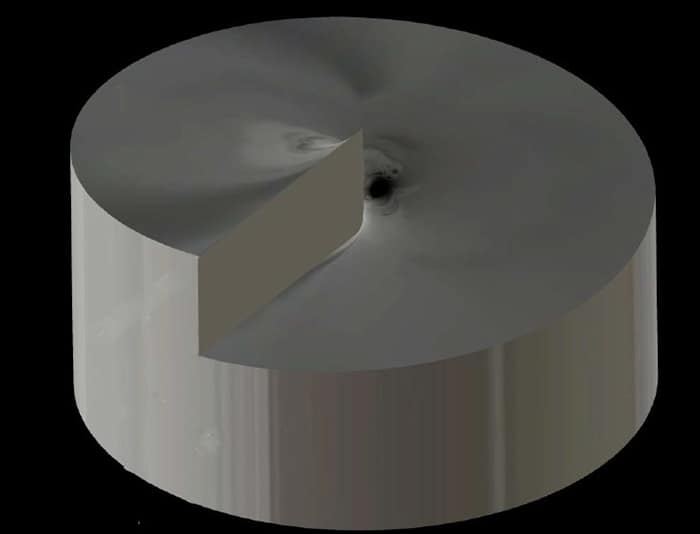
Ramping up: illustration of the aluminium spiral phase plate used to impart orbital angular momentum to cold neutrons. (Courtesy: Ivar Taminiau)
The twisted neutrons are made by passing a low-intensity beam of cold neutrons from a nuclear reactor through a spiral phase plate (SPP) – a coin-sized piece of solid aluminium that resembles one twist of a spiral ramp (see figure “Ramping up”). Neutrons speed up slightly as they pass through aluminium, so the phase of the parts of the neutron wavefront that travels through thinner regions of the SPP is delayed relative to the parts of the wavefront that travel through thicker regions. As a result, the emerging beam has orbital angular momentum. Different phase plates were designed to imprint different amounts of angular momenta on the beam.
The team then measures the angular momentum imparted by the SPPs using a neutron interferometer (see figure “Particle interference”). The neutron beam from the reactor is first split into two beams by the interferometer. One beam is sent though an SPP and the other is not. The beams are then recombined, and the resulting interference pattern can be related to the orbital angular momentum of the beam that passed through the SPP.
One neutron at a time
An important feature of the experiment is that it was done with a very low intensity neutron beam, which means that neutrons went through the experiment one at a time. As a result, each neutron interferes with itself in a coherent manner – eliminating the need for a coherent beam of neutrons in the same rotational state.
Pushin predicts that the twisted neutrons will eventually be used as a tool to study matter: “We have had more time to study the orbital angular momentum of light and electrons, and we can see that the applications are growing and growing.” He adds, “What we have done here is a first step, and we cannot really predict where the applications will be.” Beyond this, the researchers intend to look at quantum entanglement between the various degrees of freedom of the neutrons, and applications to quantum information science.
Neutron optics specialist
Yuji Hasegawa of Vienna Institute of Technology describes the research as “great work” and believes that twisted neutrons may provide useful insights into fundamental quantum physics because “many quantum features are very obvious” with neutrons. However, he is sceptical about the potential of neutrons to provide a practical system for quantum information because of the need for a nuclear reactor as a neutron source.
Twisted-light expert Miles Padgett of the University of Glasgow, meanwhile, is most impressed by the vivid demonstration of wave–particle duality: “This is the most particle-like, extreme form of orbital angular momentum that’s been reported,” he says, “and interestingly, they’ve done it using exactly the same techniques that one would have used optically.”
To those who crave natural daylight, the idea of spending large chunks of time deep underground may seem like hell. But to particle physicists, this subterranean lifestyle is a price worth paying for the excellent radiation shielding provided by the overlying rock. In this video, Art McDonald of Queen’s University in Canada briefly outlines the major benefits of taking your particle-physics lab to a land beneath our feet.
McDonald, who was a long-standing director of the Sudbury Neutrino Observatory (SNO), explains how these underground science labs are designed to detect the interesting particles that can make it through the layers of overlying rock. An example is the neutrinos produced in the core of the Sun, whose properties can help to verify solar dynamics models. “We also make the surrounding areas really clean, avoiding the radioactivity contained in any mine dust that would potentially get into our experiments,” McDonald adds.
SNO has now expanded into SNOLAB, which covers a more diverse range of research. This includes the search for dark-matter particles and the hunt for a rare form of decay called neutrinoless double beta decay – a process that could help explain why the universe has significantly more matter than antimatter.
To find out more about subterranean physics, check out this feature article from the May 2015 issue of Physics World that looks at how deep underground laboratories of the world are no longer the scientific realm of astroparticle physics alone.
Also, if you enjoyed this video explainer, then check out more from our 100 Second Science series.
Earthquakes may be triggered by sound waves that reduce the friction between rocks at a geological fault. That is the conclusion of an international team of researchers that has done laboratory-based experiments that mimic the process. The results support the “acoustic fluidization” theory of earthquake triggering, which seeks to explain the unexpected weakness of some faults. The research could also help to reveal how aftershocks are generated at great distances from the earthquakes that precede them.
Large earthquakes are often followed by a number of smaller tremors – called aftershocks – that can occur in geological faults thousands of kilometres from the epicentre of the original earthquake. While aftershocks are well documented, exactly how they are triggered remains a mystery.
The theory of acoustic fluidization suggests that the seismic waves generated by the initial earthquake could create sonic vibrations that help to trigger subsequent fault movements. These vibrations affect the small grains of rock at the interface between two plates at a fault. The idea is that the vibrations cause the grains to behave collectively like a fluid, lowering friction in the granular material and causing the plates to slip past each other.
Bed of grains
In their new study, the researchers used a simulated fault system to investigate whether acoustic waves may indeed be able to trigger earthquakes. Their model fault was composed of two rough, pressed-together plates, between which lay a bed of spherical grains.
When a shear stress was applied to the model system, the researchers observed the fault undergo periodic slips, as expected. Sound waves at certain frequencies were then fired at the system and this caused the fault movements to occur much sooner than when no sound was applied. The team also found that the premature slips were more likely to occur with sound waves at a characteristic range of resonant frequencies corresponding to waves bouncing back-and-forth within the fault. This observation is in line with acoustic-fluidization theory.
“Acoustic fluidization reduces the confining pressure and the system becomes abruptly unstable, promoting a transition to an unjammed fluid-like state,” explains team member Eugenio Lippiello of the Second University of Naples. “When this occurs, an earthquake nucleates.”
Spontaneous sound
Lippiello and colleagues also discovered that the same resonant sound waves emerge spontaneously from the model fault, even when no external sound is applied. This happens a short time before a fault movement. “Even in the stick phase [when the fault is motionless], the granular medium is never in a frozen state,” says Lippiello. Instead, each grain oscillates weakly around its own centre and the sound waves are generated “when oscillations of individual particles synchronize to the resonant frequency”. Accordingly, acoustic fluidization may also help to explain why the measured rate of slips on real-life faults is higher than would be anticipated, based on studies of rock-on-rock friction.
“This work moves forward the idea that the surprising weakness observed on faults during earthquakes is caused by strong vibrations close to the fault plane,” comments Jay Melosh of Purdue University, who originally proposed the acoustic-fluidization process but was not involved in this study. “These waves are generated in the core of the fault as sliding starts and – just as a car moving too fast over a rough road can skid uncontrollably – the vibrations briefly offload the normal friction and allow the fault to slide as if it were greased.” Melosh commends the team for demonstrating the effectiveness of acoustic fluidization in faults with a granular core.
Other trigger candidates
However, Emily Brodsky of the University of California, Santa Cruz, remains cautious about the results. Brodsky, who was not involved in the study, points out that there are many candidate mechanisms for triggering aftershocks. “I am not sure that the observational evidence thus far supports the assertions about acoustic fluidization being the relevant mechanism for earthquake triggering by seismic waves,” she says.
With their initial study complete, the researchers are now looking to explore in more detail the mechanism through which the grain oscillations are synchronized. At the same time, the team is also planning to explore the role of heterogeneities in granular material on the overall behaviour of the fault system.