

Mechanics was never my favourite topic when I was studying physics for my BSc, but I think I might have been more interested if we had looked at real-world situations rather than square blocks sliding down an incline plane. A bicycle that carries on, sans rider, without toppling over for quite a long time, for example, would have got my attention. This is a rather well-known quirk of mechanics though and it isn’t even the first time we have discussed it on the blog. Indeed, Physics World‘s James Dacey, a keen cyclist, delved into the topic in 2011. This week, we spotted a a new Minute Physics video on the subject, over at ZapperZ’s Physics and Physicists blog. Watch the video to get a good, if a tiny bit rushed, explanation of the three forces that come into play to allow a bicycle at a certain speed to zip along without its human companion. As the video suggests, all is not known about the secrets of free-wheeling bicycles just yet though, and I have a feeling that we will blog about it again in the years to come.
Physicist who brought symmetry breaking to particle physics dies at 94
The Japanese–American particle physicist Yoichiro Nambu died on 5 July at the age of 94. Nambu shared one half of the 2008 Nobel Prize for Physics, with the other half split between Makoto Kobayashi and Toshihide Maskawa. Nambu won his half of the prize for realizing in 1960 how to apply spontaneous symmetry breaking to particle physics.
Nambu achieved his breakthrough while working on how spontaneous symmetry violation can cause substances to become superconducting. His work inspired Peter Higgs, François Englert and others in the 1960s to develop the theoretical mechanism for the Higgs boson, which was discovered by CERN’s Large Hadron Collider (LHC) in 2012. A year later, Higgs and Englert shared the 2013 Nobel Prize for Physics for building on Nambu’s ideas to predict the existence of the Higgs boson.
In an interview with Physics World in 2004, Higgs acknowledged Nambu’s influence: “Although my name gets thrown around in this context, it was Nambu who showed how fermion masses would be generated in a way that was analogous to the formation of the energy gap in a superconductor.”
“Nambu’s work was an act of imagination that was way ahead of its time”
Frank Wilczek, Massachusetts Institute of Technology
Commenting on Nambu’s Nobel prize, Frank Wilczek of the Massachusetts Institute of Technology told Physics World that “Nambu’s work was an act of imagination that was way ahead of its time”. Wilczek, who shared the 2004 Nobel Prize for his work on the strong interaction, added that “It introduced the idea that what we perceive as empty space is, to a deeper vision, a medium that complicates the motion of matter we observe.”
Nambu was born on 18 January 1921 in Tokyo and studied physics at the Imperial University of Tokyo from 1940 to 1942. Like many physicists of his generation, he then worked on military applications of radar. He completed a PhD at the University of Tokyo in 1952 and then worked briefly at Osaka City University before moving to the Institute for Advanced Study in Princeton, US. In 1954 Nambu arrived at the University of Chicago, where he spent the rest of his career and became an American citizen in 1970.
The STEM jobs paradox rumbles on

By Hamish Johnston and Margaret Harris
Are countries such as the UK, the US and Canada suffering from a shortage of scientists and engineers, or are scientists and engineers struggling to find jobs there? Our US correspondent Peter Gwynne reports that, according to a recent survey, physicists in that country can expect to be rewarded with handsome salaries if they work in industry – which suggests that their skills are in great demand. However, over in the New York Review of Books, an article on “The frenzy about high-tech talent” claims that “by 2022 the [US] economy will have 22,700 non-academic openings for physicists. Yet during the preceding decade 49,700 people will have graduated with physics degrees.”
In the past few years, Physics World has published several articles on the “STEM shortage paradox”, where reports of severe skills shortages in science, technology, engineering and mathematics (STEM) coexist with lukewarm – and sometimes borderline alarming – data on employment in these fields. Hence, conflicting reports on career prospects for physicists don’t really surprise us anymore (although this is actually slightly different to what we’ve seen before, in that rosy employment data are going up against a downbeat statement about demand, rather than vice versa). But even so, when two reports point in such different directions, it’s tempting to conclude that one of them must be wrong, or at least missing something important.
Bountiful buckyballs resolve interstellar mystery
It is official: buckminsterfullerene molecules, or “buckyballs”, exist in our galaxy – the Milky Way. The latest, unambiguous confirmation, from researchers at the University of Basel in Switzerland, not only confirms a 20-year-old prediction but also indicates that C60 might be ubiquitous in space.
It is nearly a century ago now that scientists first detected certain features in starlight from the Milky Way. Since then, these features, called diffuse interstellar bands (DIBs), have also been recorded in the spectra from the interstellar medium of other galaxies. However, researchers have not yet identified which chemical molecules are responsible for producing these bands.
In 1994 astrophysicists Pascale Ehrenfreund and Bernard Foing, who are now at George Washington University in the US and the European Space Agency, reported on two bands at 9632 Å and 9577 Å. These bands were thought to come from C60+ molecules because C60+ absorbs light at these wavelengths.
Band match
Now, thanks to new spectroscopy experiments on bound C60+ and helium at 5.8 K (the temperature of interstellar space), a team led by John Paul Maier in the Department of Chemistry at the University of Basel has found that the light absorption features of C60+ indeed match those of the two bands identified more than two decades ago. The researchers obtained their result by comparing the light absorption spectra of stars through diffuse interstellar clouds and the electronic spectrum of C60+.
“Scientists have known about DIBs for more than 90 years now and around 400 of them are currently listed in the literature,” explains Maier. “However, until our work on C60+, none of these bands had been unequivocally identified.”
The fact that a molecule as complex as C60+ is present in the interstellar medium (in fact, the two C60+ DIBs have also already been observed in protoplanetary nebula) indicates that it may be commonplace in space and stable in very hostile environments, Maier adds.
Maier notes that it has taken his team 20 years to measure the spectrum of C60+ in the gas phase. “Our motivation to undertake this study started in 1993, when we obtained the light absorption spectrum of C60+ in solid neon at 6 K,” he says. “The following year Foing and Ehrenfreund found the two DIBs that had wavelengths close to those in our laboratory measurements and suggested that the absorbing molecule (or ‘carrier’) in these DIBs was C60+. Confirming this theory has been no easy task and has required measuring the molecule’s absorption in the gas phase and at low temperature.”
Ultracold RF trap
The researchers developed a technique that allows them to trap ions with different masses in a radio frequency trap at ultralow temperatures. “Using such a process, we can trap thousands of C60+ ions,” explains Maier. However, because it is not possible to directly measure the absorption of such low concentrations of C60+, the team bound it with helium. “We knew from experiments that we had already carried out on small ions some time before that the helium has only a very tiny influence on the C60+ and that the absorption spectrum we measured would essentially be that of C60+,” he says.
They proved their assumption by attaching two helium atoms to each C60+ molecule and showed that any remaining shifts in the absorption bands were less than 0.2 Å – an error figure that is much more precise than that required when analysing astronomical data.
The team measured the light absorption of the C60+-He complex by exciting a few hundred of the species in the ion trap with a laser. When excited, the helium atoms are removed. By quantifying the decrease in the number of C60+-He+ species in the trap, Maier and colleagues were able to obtain the absorption spectrum of the C60+ alone. “When we then compared the wavelengths of the laboratory-measured absorption with the astronomical data, we found a perfect agreement – thus proving that C60+ is indeed at the origin of the interstellar absorption, and that it exists in space.”
Circle of life
Their results suggest that C60 is probably produced in dying stars that “push out” the molecule into the planetary nebula and into diffuse interstellar clouds, he adds. “The ionizing radiation present here means that the C60 predominantly exists as the positively charged ion C60+. Ultimately the diffuse clouds provide seeds for new stars to form and the C60+ is thus recycled back into them,” says Maier. Astrophysicists will now ask themselves whether C60 and its ion are in fact responsible for the formation and presence of smaller molecules identified in the next ‘evolutionary’ phase of diffuse clouds – dense clouds.”
Carbon cousins?
In recent years, astronomical observations have found DIBs across the entire optical range, meaning that they abound in space. Indeed, they have recently been spotted in the Milky Way’s satellite galaxies, known as the Magellanic Clouds, and in other galaxies. The carrier C60+ molecules may consequently be crucial in the formation of organic material across the universe.
The Basel researchers say that they will be trying to find out if any of these DIBs are directly related to derivatives of C60+, such as those containing metals and other elements. “This possibility has already been put forward by the British scientist Harry Kroto (who was awarded the Nobel Prize for Chemistry in 1996 – shared with Robert Curl and Richard Smalley) shortly after C60 was discovered,” explains Maier. “As mentioned, experiments on this topic are very challenging and it took us 20 years to obtain the data we present on C60+ alone. It is now up to the next generation of scientists to continue with this work. I am due to become emeritus professor in a year’s time, so do not have much time left to have a go at solving such fascinating problems – another life is required!” he says.
The research is published in Nature
- A version of this article first appeared on nanotechweb.org
The green flash
My interest in the “green flash” began at a young age. I can’t remember precisely when or where I’d read about it, but I do recall being fascinated by the thought of an effect that was supposed to produce an emerald-green flash at around sunset.
My interest was piqued at the age of 10 on a fishing trip off the south coast of England. It was a trip organized by my father and coincided with a sky that was clear and blue. We were at sea as the Sun was setting and I recall my hopes rising, despite knowing that the green flash had been described as rare, and normally best seen over a sea horizon from the tropics. On this occasion, I saw a beautiful sunset, but my hopes of seeing the green flash took a hit as nothing green appeared.
Many years later, having become an established astrophotographer, I found myself again on England’s south coast, this time trying to photograph a really thin crescent Moon in the post-sunset twilight on Selsey beach in West Sussex. I had a digital single-lens-reflex (DSLR) camera attached at the prime focus of my 100 mm refracting telescope – an arrangement where the telescope acts like a super-telephoto lens. As the Sun got lower in the sky, it was visibly contorting due to the thick, unstable atmosphere close to the horizon.
As the bottom edge of the Sun touched the horizon, I swung the telescope into position (see safety note at the end of this article), fine-tuned the focus via the review screen and started photographing. The stuttering animation of the sunset that appeared on my camera’s rear-view screen revealed large ripples running up the Sun’s disc. As they hit the top, some caused the upper edge to briefly magnify and detach. Later, as I viewed the shots on my computer, I was reminded of my childhood obsession – the upper edge of the Sun was significantly green. But what exactly is the green flash?
Emerald emanation
As light passes through the atmosphere, it gets refracted. The thicker the layer it has to pass through, the more refraction occurs, so maximum refraction occurs close to the horizon. (When the Sun appears to be touching the horizon, in reality its disc has already set.) The atmosphere acts like a prism, refracting different wavelengths by varying amounts.
At sunset the Sun’s light smears into a spectrum of colour, most of which overlaps and can’t be seen individually. However, at the vertical extremes, you can sometimes notice a bluer top edge and a redder bottom edge. The effect is small, appearing like colour fringes when seen under magnification. Unless the air is very clean, the atmosphere scatters the blue fringe away leaving a green one. This is known as the “green rim”, with the bottom red counterpart known as the “red rim”. The same effect occurs around the rising Sun and the rising or setting Moon.
For a green rim to become a green flash, the atmosphere through which you’re viewing the Sun needs to have the right temperature structure. The atmosphere’s temperature normally reduces with height, but what is needed for a green flash is an inversion layer – a layer of warmer air sandwiched between cooler air on either side – below the observer’s line of sight. This essentially creates a cylindrical lens, which both magnifies and visually detaches the upper green rim from the Sun’s disc. If the conditions and timings are right, then as the last bit of Sun slips below the horizon, a thin, bright-green blob of detached sunlight can be seen hanging above the horizon – a purist’s green flash.

A more common version occurs when the Sun remains just above the horizon or has partially set. Here, the green rim may simply elongate away from the Sun’s edge, appearing more like a “green appendage”. A less common appearance occurs as the Sun dips behind clouds close to the horizon – here a small inversion layer may be present at the top of the clouds, which can result in a “proper” detached green flash.
Surprise views
After photographing the green rim and green appendages described above, I finally got to see my first proper green flash while visiting the European Southern Observatory’s Very Large Telescope platform in Paranal, Chile, during 2013. I’d taken a small, 66 mm refracting telescope along with me for the trip and decided to see whether I could capture the green flash as the Sun set over the Pacific.
The air was very clear at the platform’s 2.6 km altitude, making estimating a safe time to point the camera at the setting Sun quite tricky. As it slipped ever lower – as in my Selsey beach experience – the Sun underwent a series of impressive contortions indicating that inversion layers were present. Then, right at the final moment of sunset, a layer of green rim detached to give a beautiful green flash. Although I had thought I might get lucky, actually seeing the green flash properly for the first time caught me by surprise and was really rather emotional. (This experience was caught on camera by filmmaker Brady Haran.) Later analysis of my shots revealed that a small amount of blue flash was also present. Under less pristine skies, this rare blue light would have been scattered away. (See top image for a composite image compiled from this green flash observation.)
After seeing my first proper green flash from Paranal in August 2013, I unexpectedly saw my second in November of the same year, and this was a real surprise. I was visiting the Roque de los Muchachos Observatory in La Palma, for filming duties with the BBC’s The Sky at Night television programme. I’d taken time off from filming to watch the sunset, and as we were based around the Isaac Newton Telescope we had been allowed on the roof to take in the view. As the Sun slowly sank towards a bank of cloud, I can remember thinking I really ought to have my camera with me. However, as the cloud’s edge had a decent altitude above the horizon, I wasn’t expecting to see the green flash. Of course, nature has an inbuilt ability to detect such oversights and as the last vestiges of the Sun’s disc slipped below the cloud bank, a dramatic, emerald-green flash appeared.
Safety note
Turning a camera or telescope towards the Sun is not normally a safe thing to do. Under no circumstances ever view the Sun through a telescope or via a camera viewfinder. To do so invites eye damage, even permanent blindness. It’s safe to watch events unfold on the camera’s rear-view screen, but point at the Sun when it’s too high above the horizon and the camera could be damaged.
US astronomers call for a new space telescope with a giant 12 m mirror
Plans for a new telescope that would be one of the biggest probes ever sent into space have been outlined by a group of astronomers. If the project goes ahead, the probe – tentatively called the High-Definition Space Telescope (HDST) – would feature a 12 m mirror and could be launched in the first half of the 2030s. The plans have been unveiled by a 17-strong committee at the US Association of Universities for Research in Astronomy (AURA), which warns, however, that many additional steps need to be taken to procure funding and develop the necessary technologies before the telescope could be built.
Following the planned launch in October 2018 of the infrared James Webb Space Telescope (JWST), there are no large-scale space observatories on NASA’s schedule. The HDST would detect a similar wavelength range as the Hubble Space Telescope, from near-infrared to far-ultraviolet light, but using a substantially larger mirror than Hubble – 12 m compared with 2.4 m. Because launch systems cannot fit that size of mirror into the rocket fairing, the plan is for the main mirror to comprise 54 segments attached to a foldable backplane.
I’m hopeful that we’ll figure out a way to do it
Marc Postman, Space Telescope Science Institute
Such technology has been developed and is being utilized by the JWST, which has a 6.5 m segmented mirror, yet it is untested on a structure that would be almost twice that size. “I’m hopeful that we’ll figure out a way to do it, in a way that is technically feasible, affordable and can be done on a timescale that is not in the too distant future,” says committee member Marc Postman of the Space Telescope Science Institute in Baltimore, Maryland.
One of the HDST’s main goals would be to study planets around other stars. To do that, the telescope would use a “coronagraph” to suppress light from some 500 to 600 stars individually and hunt for planets orbiting within those stars’ habitable zones – a region where the conditions could support liquid water on an exoplanet’s surface. According to Postman, once the HDST finds these worlds, it would be possible to get a spectrum of the planet that could tell astronomers whether or not there are “potential signs of life as reflected in the atmosphere of the planet”.
Focus on galaxy formation
In addition to its exoplanet observations, the HDST could measure how most of the stars in our galaxy move over the course of 10 years. It could also study the 3D motions of nearby galaxies compared with more distant ones, revealing characteristics about the nature of dark matter. The telescope, moreover, would be the first instrument to resolve how gas flows in and out of galaxies, a crucial observation for understanding galaxy formation.
Heidi Hammel, AURA executive vice president, says that the committee incorporated lessons learned from the JWST, a project that is over budget and has suffered delays. While the report does not touch on the costs required to construct the HDST, astronomers hope the study will now influence those at NASA who oversee technology development so that it is studied further.
How do you produce laser light with bespoke colours?
In less than 100 seconds, William Wadsworth reveals how he can create bespoke colours of laser light by shining a high-power laser at glass. To explain what is taking place within the glass, Wadsworth uses the analogy of a ball stuck at the bottom of a valley that can be kicked to move it up and down the asymmetric hills on either side. In a similar way, electrons inside the atoms of glass can be given a “kick” with a high-power laser, causing them to oscillate over a range of frequency components – corresponding to different colour emissions.
If lasers are your thing, then don’t forget to also check out the Physics World Focus on Optics & Photonics. This free-to-read issue includes a special feature about the giant laser interferometers underpinning the latest searches for gravitational waves.
Solarquest, Pluto and the importance of New Horizons
By Margaret Harris
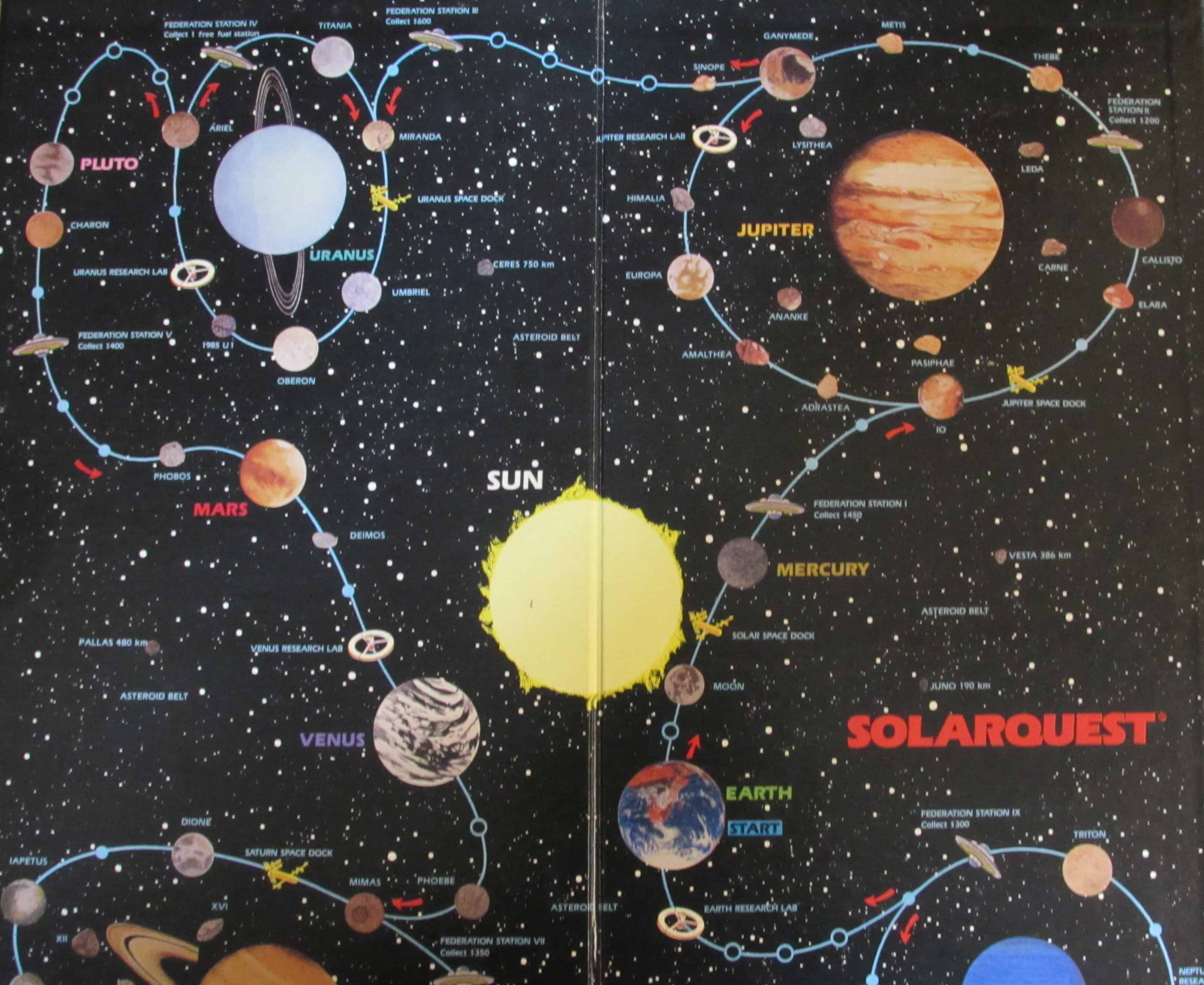
Last night, in honour of the New Horizons mission to Pluto, I pulled out my copy of Solarquest. This classic board game was a childhood favourite of mine, and it’s basically Monopoly in space: instead of buying properties named after streets in Atlantic City, New Jersey (or London, if you’re British), you buy planets, moons and artificial satellites. Then, when your fellow players land on an object you own, you charge them rent.
Such nostalgia is all well and good, I hear you say, but what’s it got to do with New Horizons or Pluto? Well, Solarquest’s inventors clearly took their science seriously. By board game standards, there’s quite a lot of physics in it. For example, you can’t leave a planet unless you roll a number high enough to overcome its gravitational pull, and its Monopoly-like property deed cards include facts about each planet and moon as well as their prices.
Pluto fly-by: New Horizons sails past cold, distant world
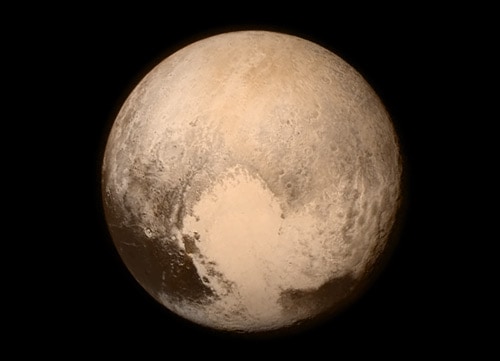
After trundling through our solar system for more than 10 years, NASA’s New Horizons mission made its closest approach to the dwarf planet Pluto earlier today, at 12:49 BST. It was a mere 12,472 km from the planet’s surface – roughly the same distance from New York to Mumbai, India – making it the first-ever space mission to explore a world so far from Earth.
If you want to find out more about the New Horizons mission, read this recent news story by physicsworld.com editor Hamish Johnston. Above is best close-up view of this cold, unexplored world that the spacecraft sent back before its closest approach (when it was still 766,000 km from the surface), revealing in clear detail many of the planet’s surface features, including the “heart” at the bottom.
LHCb claims discovery of two pentaquarks
The best evidence yet for the existence of a new type of particle called a pentaquark has been unveiled by physicists working on the LHCb experiment on the Large Hadron Collider (LHC) at CERN. Containing five bound quarks, pentaquarks were first predicted to exist in the late 1970s, and evidence for their existence emerged from several labs in the 2000s, only to be contradicted by experiments done elsewhere. While this latest evidence from LHCb is very strong, the data do not reveal exactly how the five quarks are bound together – something that will be the subject of further studies at CERN.
Most known hadrons are either mesons, which contain a quark and an antiquark, or baryons, which comprise three quarks. A proton contains two “up” quarks and one “down” quark, while a positive kaon contains an up quark and a “strange” antiquark. But the theory of the strong force – quantum chromodynamics (QCD) – allows for other types of baryons, providing that the number of quarks minus the number of antiquarks is a multiple of three. In particular, it allows for particles containing four quarks and one antiquark.
In the early 2000s several independent groups of physicists reported the observation of pentaquarks, most with masses in the 1520–1560 MeV/c2 range. Since then, however, other research groups have failed to find further evidence for these pentaquarks, and by the start of this decade, the consensus in the particle-physics community was that the pentaquark had yet to be discovered.
9σ significance
Now, physicists at LHCb have found compelling evidence for the existence of pentaquarks – this time at the much higher mass of about 4400 MeV/c2. The team studied the decay of the Λb baryon into three other particles: a J/ψ, proton and a charged kaon. A careful analysis of the decay products revealed that two intermediate states were sometimes involved in their production. Dubbed Pc+ (4450) and Pc+ (4380) – where the numbers are the particle masses in units of MeV/c2 – both particles have been observed with statistical significances greater than 9σ. In particle physics a significance greater than 5σ is consider to be a discovery.
The LHCb team is confident that the particles are indeed pentaquarks that comprise two up quarks, one down quark, one charm quark and one anticharm quark. “Benefitting from the large data set provided by the LHC, and the excellent precision of our detector, we have examined all possibilities for these signals, and conclude that they can only be explained by pentaquark states,” explains LHCb physicist Tomasz Skwarnicki of Syracuse University in the US.
LHCb physicist Tim Gershon of the University of Warwick in the UK explains why he is confident of the result: “The LHCb analysis is significantly different from those of previous experiments that found hints of [pentaquarks] that were later disproved.” He adds that “LHCb has analysed all of the available information in the decay distribution to prove that the peak in the mass distribution cannot be a fake caused by other processes.”
Subatomic molecules
The LHCb data do not, however, reveal how the five quarks are bound within the pentaquark. The five quarks could be tightly bound within a single structure, for example. Another possibility is that a quark and antiquark are bound together to form a meson and the remaining three quarks form a baryon. The meson and baryon could then be bound to each other to create a structure resembling a subatomic molecule.
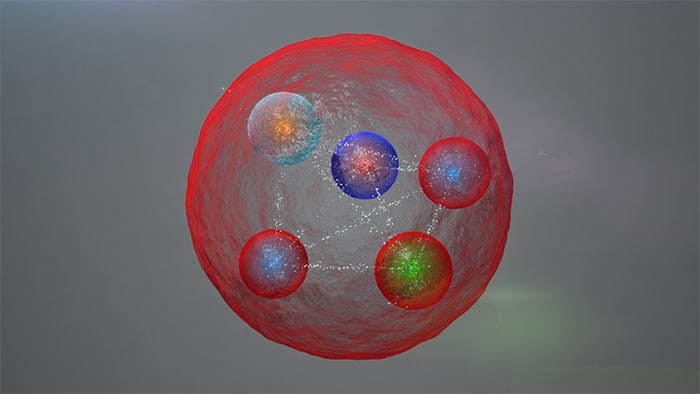
“Studying [the pentaquark’s] properties may allow us to understand better how ordinary matter, the protons and neutrons from which we’re all made, is constituted,” says LHCb spokesperson Guy Wilkinson. This will have to wait for more data from the current run of the LHC, which started last month.
The pentaquarks are described in a paper submitted to Physical Review Letters and a preprint is available on arXiv.
Copyright © 2026 by IOP Publishing Ltd and individual contributors