Single photons are very useful for physicists. When generated in a controlled fashion, they can be used for studying quantum physics and for transmitting and processing information. In this 100 Second Science film, Peter Mosley explains how these individual particles of light can be produced in a systemic way using a process known as parametric down conversion. Mosely, an optics researcher at the University of Bath in the UK, describes this process in an accessible way using just a whiteboard.
To find out more about the latest light-related research, take a look at the Physics World Focus on Optics & Photonics. This free-to-read issue includes a special feature about the vital role that optics and photonics play in the UK’s new £270m Quantum Technologies Programme.
The skins of two slithery reptiles – the ball python and a type of lizard known as the sandfish skink – have inspired researchers to create a new kind of super-slippery biomimetic material. By etching patterns similar to those found on these creatures into the surface of steel, Christian Greiner and Michael Schäfer of the Karlsruhe Institute of Technology were able to cut friction by as much as 40%. The researchers say that the work could help to minimize friction in tiny mechanical devices where lubricants cannot be used.
The skin of some snakes and lizards is unusual in that it is slippery when the creature moves forward but resistant to movement in the opposite direction. Apart from allowing the creatures to propel themselves forward, this low friction associated with forward motion combined with the skin’s high resistance to wear has made it an attractive model for researchers seeking to develop new materials. In 2012, for example, scientists were inspired by the skin of the sandfish to create a material that is highly resistant to wear by sand and other particles.
Overlapping scales
Greiner and Schäfer created their reptile-inspired patterns on flat steel surfaces 7.5 mm in diameter using a technique called laser surface texturing. The two patterns they studied were inspired by the overlapping scales found on the python and sandfish, with each scale being oval shaped and about 50 μm long.
The scales protrude about 5 μm from the surface and overlap each other to form columns. In one pattern the columns are isolated from each other, whereas in the other pattern the columns overlap each other (see figure above).
The patterned surfaces were then slid across a smooth, dry sapphire surface at a constant speed of 0.1 m/s and downward force of 2 N. When compared with a smooth steel surface, the isolated columns had 40% lower friction, whereas the overlapping columns had a 22% reduction. The researchers had expected friction to be lower because the species they mimicked live in dry environments and do not secrete oils or other liquids onto their skin. However, they were amazed by the size of the reduction.
Leaping forward
“If we’d managed just a 1% reduction in friction, our engineering colleagues would have been delighted; 40% really is a leap forward and everyone is very excited!” says Greiner. Indeed, when the textured surfaces were lubricated with mineral oil, they experienced greater friction than did a smooth lubricated surface.
The researchers believe that their discovery could help to reduce friction in machines that cannot be lubricated. These include nanometre and micron-sized devices in which lubricants tend to gum up moving parts, rather than help them move. Potential applications include reducing friction in the sensors used in anti-lock braking systems, computer hard-disk drives, accelerometers used in mobile phones and machines that operate under vacuum conditions.
Unlike reptile skin, which has low friction when moving in only one direction, the new textured surfaces have reduced friction in at least two directions. Surfaces with unidirectional friction reduction could be used to create snake-inspired robots that would be useful for exploring extremely dusty environments on Earth or even in space. Greiner is currently trying to develop textured polymer surfaces that mimic the unidirectional nature of reptile skin.
If you’re as impatient as I am, the worst part about flying off for your summer vacation is the interminable hold-up that sometimes occurs right before take-off – waiting for the plane to taxi onto the runway and desperately hoping the in-flight entertainment will kick off soon. But these annoying delays may soon be cut down thanks to Georgios Vatistas and colleagues at Concordia University in Montreal. The team has developed a new mathematical airflow model to help refine the safe separation distances needed between planes during take-off and landing.
As an aeroplane moves along, the lift-generating difference in pressure between the top and bottom surfaces of its wings causes air to flow out from beneath each wing and up around the wing tip. This creates a circular vortex pattern behind each tip (pictured above), with a downwash in-between – forming a turbulent wake that can be hazardous to any craft that passes through it. If large enough, this turbulence can roll the next aircraft, faster than they can resist – leading to a crash.
The capacity of a lithium-ion battery can be nearly doubled by using an anode made from tiny nanoparticles of silicon wrapped in several layers of graphene. Researchers from South Korea – including electronics giant Samsung – have found that the graphene coating boosts the electrical conductivity of the particles and stops them from being damaged as their volume expands when the battery is charged. The scientists describe their work as “a meaningful step” towards the development of commercial batteries with silicon anodes.
Ubiquitous in portable electronics, rechargeable lithium-ion batteries consist of two electrodes – anode and cathode – separated by an electrolyte. When the battery is being charged with electrical energy, lithium ions move from the cathode through the electrolyte to the anode, where they are absorbed into the bulk of the anode material.
Expansion and contraction
When the battery is discharged, lithium ions come out of the anode and return to the cathode. This makes the anode first expand and then contract, which can damage the anode over repeated charge/discharge cycles. Anodes made from graphite, though, are resistant to this damage, which is why this material has been used in commercial batteries for three decades.
As portable devices become more energy-hungry, however, researchers have sought to boost the amount of energy that can be stored in lithium-ion batteries by developing anodes made from silicon. As well as being cheap and easy to work with, silicon can absorb 10 times more lithium ions per unit mass than graphite. Unfortunately, the volume of silicon expands by a factor of four when it absorbs lithium, which makes the silicon anodes prone to fracture and failure.
Cracking and coating
One way round this problem is to make the anode from an agglomeration of tiny spheres of silicon – each about 100 nm diameter – that are more resistant to cracking. But this approach also has its own challenges. Silicon is a semiconductor and to be an effective anode it must be coated with an electrical conductor. This coating must also remain intact as the nanospheres expand and contract.
Now Mark Rümmeli and colleagues at the Institute for Basic Science in Korea, at Samsung and at the Korea Advanced Institute of Technology and the Centre of Polymer and Carbon Materials of the Polish Academy of Sciences have devised a way to coat silicon nanoparticles with multiple layers of graphene. Graphene is a layer of carbon just one atom thick that is both a good electrical conductor and an extremely strong material. These two properties combine to make the coated nanoparticles very good conductors that are able to increase in size without damage to the coating or to the nanoparticles.
An important challenge for Rümmeli and colleagues was how to coat silicon with graphene without creating a thin layer of silicon carbide between the two materials. This is because silicon carbide is an electrical insulator and also inhibits the flow of lithium ions. The team achieved silicon-carbide-free growth by heating the nanoparticles in the presence of methane and carbon dioxide.
High conductivity
Thanks to the graphene coating, a powder sample of nanoparticles has a conductivity that is 100 million times greater than a powder sample of uncoated particles. The team then made anodes from the coated nanoparticles and tested them in otherwise standard lithium-ion batteries. During the first charge–discharge cycle they found that the batteries held 1.8 times more energy than a battery with a conventional graphite anode. After 200 cycles, the batteries were still able to store 1.5 times more energy than a conventional device.
When the team took a closer look at individual nanoparticles using an electron microscope, the researchers found that each layer of graphene did not completely encapsulate a nanoparticle. This allowed the graphene layers to slide across each other as the nanoparticle grew in size, thereby creating an expandable shell. Rümmeli told physicsworld.com that a similar sliding effect has been seen in multiwalled carbon nanotubes – rolled up sheets of graphene – which can extend telescopically.
The team also believes that the sliding is offset by an inward “clamping” force that maintains the integrity of the graphene coating and reduces cracking in the nanoparticles. The incomplete layers also provide paths for the lithium ions to travel through the graphene coating to reach the anode.
A survey by the American Institute of Physics (AIP) has found that US physicists with PhDs who go on to work in industry do not suffer a loss of earnings or intellectual satisfaction. Those who find jobs in the private sector, the survey finds, typically have careers that are rewarding both professionally and financially, even though they do not necessarily use the specific training they acquired in their doctoral and – for some – postdoctoral training.
The survey – Common Careers of Physicists in the Private Sector – focuses on 503 US-based physicists employed in the US private sector who were awarded their PhDs in 1996, 1997, 2000 or 2001. Those years were chosen because they were either side of the 2000 “dot-com” bubble, to provide a balance to the survey because Internet firms often hire physicists.
Carried out by Roman Czujko, recently retired head of the AIP’s Statistical Research Center, together with his colleague Garrett Anderson, the survey identifies eight main career paths outside academic and government work for physicists with PhDs. These are identified as self-employment; finance; government contracting; engineering; computer science; physics; other science, technology, engineering and mathematics (STEM) fields; and non-STEM fields.
Broad knowledge
In nearly all cases, those with PhDs were working in areas that require the frequent use of scientific and technical knowledge, with many finding their jobs “intellectually stimulating and challenging”. Czujko, who claims that the survey is the “first systematic study of what physicists do in the private sector”, adds that even physics PhD graduates who do not work in science or engineering “are making significant amounts of money and seem quite happy”.
Indeed, the survey found that more than 75% of physicists in the private sector in 2011 reported annual salaries of more than $100,000 – higher than many academic positions. Around 85% of respondents were working in STEM fields, even if not specifically in physics. Czujko and Anderson also discovered that physicists who were self-employed did not fit the stereotype of a solitary worker. Rather, they often ran their own businesses.
Michael Idelchik, vice-president for advanced technologies at GE Global Research, says that the survey’s findings agree with his own observations. “When you study physics, you learn how to deal with complexities, noise and uncertainties,” he says. “It really positions you to enter private companies and the corporate world. A degree in physics makes you very broad and very adaptable.”
“A surprising amount of stuff gets wasted every year because consumers can’t get it out of the packaging it came in,” writes Katie Palmer, who covers the science beat at Wired. In her article “The physics behind those no-stick ketchup and mayo bottles”, she explains how the company LiquiGlide has developed its slippery coating for the insides of bottles. The challenge was to create a permanently wet coating that would stick to the inside of the bottle but not mix with the liquid foodstuff – and it also has to be safe for human consumption.
LiquiGlide spun out of the lab of Kripa Varanasi at the Massachusetts Institute of Technology and has just announced that an international food-packaging supplier will be using the coating on its mayonnaise bottles. You can watch a demonstration of the coating in the video above.
The first-ever spectrometer made from quantum dots has been unveiled by Jie Bao of Tsinghua University in China and Moungi Bawendi of the Massachusetts Institute of Technology in the US. According to its inventors, the instrument could be produced commercially to be as small, inexpensive and simple as a mobile-phone camera. Such compact spectrometers could find a wide range of applications, from gathering scientific data on space missions to sensors integrated within household appliances.
Spectrometry measures the intensity of light as a function of wavelength and is used to study various properties of light-emitting and light-absorbing substances. This makes it an invaluable analytical technique that is used in a broad range of scientific and technological disciplines. Most spectroscopic techniques involve dispersing light in terms of its wavelength. A prism, for example, can be used to bend light into its constituent wavelengths (colours) and a spectrum can then be acquired using a position-sensitive light detector. Bao and Bawendi have taken a different approach, using quantum dots to create an array of band-pass filters for the light to pass through before it reaches a position-sensitive detector.
Tunable artificial atoms
Quantum dots are tiny pieces of semiconductor just a few nanometres across. They are sometimes described as artificial atoms because, like atoms, they absorb and emit light at specific wavelengths. Unlike atoms, however, the wavelengths can be tuned by simply adjusting the size of the quantum dot.
Bao hit upon the idea of using quantum-dot materials in spectrometers while investigating their use in solar cells and light detectors. “I realized this material has a very unique property that no other material can match,” he says, referring to the simple means of tuning the optical response. With this in mind, he began investigating using large numbers of quantum dots in a new type of spectrometer. By monitoring the light that the dots absorbed, it would be possible to determine relative intensities at various wavelengths in the spectrum of the incident light.
Bao and Bawendi’s device is an array of 195 different types of quantum dot with absorption spectral features that cover a wavelength range of 300 nm. The quantum dots were dispersed in solution as colloids. These mixtures were then used to coat individual pixels of the light-detecting array of a digital camera. Because it is compatible with existing camera technology, Bao says that the spectrometer could be mass-produced at a relatively low cost.
Wavelength multiplexing
The new spectrometer employs wavelength “multiplexing”, a technique that was first developed by the telecommunications industry to allow several different signals to be transmitted along the same optical fibre. Multiplexing has already been used for spectroscopy, but Bao says that previous designs were not appropriate for making small, low-cost and high-performance devices. “With these colloidal quantum-dot materials you can do that,” he says.
“This is the first time people have used quantum dots in a spectrometer,” adds Bao. “In fact, it’s the first time that more than a handful of different quantum-dot materials have been used in the same device.”
Beyond the daguerreotype
Bao believes that the device could be the start of a revolution in the practical application of spectroscopy. He likens this to the plethora of applications for photography that emerged as the technology evolved from the cumbersome daguerreotype process – with its huge cameras and long exposure times – to the tiny digital cameras of today.
“If you think of cameras in the old days, their use was very limited – but now cameras are not just used in mobile phones but also for endoscopes, or added to pills to image digestion,” says Bao. “When the process of taking photos was complicated, these applications were hard to imagine.”
The researchers are now investigating how the quantum-dot spectrometer could be used in sensors and are also looking at ways to optimize the device architecture.
Full details of the research are reported in Nature.
When you step out onto Racetrack Playa in California, the first thing you notice is the desert wind whistling through the craggy terrain around you. The next thing to catch your attention is the hard-packed surface of the playa itself, inconceivably flat and dotted with dark, angular rocks. Look a little bit closer, though, and you will see that in this vertiginous landscape, something very strange has happened: the rocks have been moving.
Racetrack’s “sailing stones” range from pebbles to boulders weighing hundreds of kilograms. They originate from the ancient dolomite cliffs at the playa’s southern end, where incessant winter freeze–thaw cycles cause pieces to splinter off and tumble down onto the flat expanse below. The stones’ dark colour and angularity contrast with the playa’s smooth, beige surface, giving the distinct impression of a man-made sculpture. And trailing behind many of the rocks are long, shallow furrows in the hard-packed clay: a telltale sign that, at some point, these stones must have been on the move.
The rock trails wind erratically, sometimes turning 90°, sometimes doubling back on themselves. They often terminate with a rock at one end that has mounded up clay in front of it, like the scrapings of a bulldozer. Some furrows run parallel to one another, wheeling like line-of-battle ships tacking into the wind. Apparently, the stones formed the furrows by ploughing through the clay when it was wet. But how?
This question has plagued generations of visitors to Racetrack Playa, and scientists have tried to answer it for decades. One of the first, John Shelton of Pomona College, landed a small aircraft on the playa back in 1953. He found that the airflow from the plane’s propeller (equivalent to a 70 km/h wind) was enough to flip over one of the rocks, suggesting that wind could play a role in their movement. These days, US federal law prohibits such adventurous experiments on the playa, which is now a protected wilderness area. However, later, less disruptive research by San José State University geologist Paula Messina also found support for the wind theory. During her graduate studies, Messina – known as the mother of modern Racetrack research – measured high and highly variable winds on the playa. In 2000 she and her longtime collaborator (and husband) Phil Stoffer demonstrated that the surrounding valley’s topography channels these winds onto the playa’s southern edge.
Even so, a simple calculation shows that to move a typical sailing stone with a diameter of about 10 cm and a mass of 3 kg, the wind speeds would need to exceed 50 m/s or 180 km/h – much higher than anyone has observed on Racetrack. To circumvent the need for high winds, several alternative theories have been proposed over the decades, from the growth of slippery algal or bacterial mats when the playa is wet to pranking rituals by university students and even the actions of passing aliens. But all these hypotheses, from the plausible to the absurd, remained uncorroborated, and exhaustive surveys of the sailing stones and their trails by Messina during the 1990s and early 2000s produced interesting but ambiguous results that didn’t point towards any one hypothesis.
Tracking device Close-up of a GPS-equipped rock. The GPS unit begins logging the rock’s position when an initial movement triggers an internal switch. (Courtesy: Interwoof)
Solving the mystery of the sailing stones would take years’ more fieldwork, an array of hi-tech instruments, and more than a little luck. On a cold December morning in 2013, all these things came together. As members of our research group stood on the banks of Racetrack, we finally saw the sailing stones in motion – and the mechanism for their wanderings proved more complex and subtle than any of us had suspected.
Remote observations
Racetrack Playa is a closed basin nestled high in the Last Chance Range, more than two hours’ drive from the Death Valley National Park visitor centre. To get there, you head north-west from the centre on Highway 190, then turn off onto a rough gravel road that takes you past the Ubehebe volcanic craters, through a forest of Joshua trees, and down into the desolate Panamint Valley. After you pass the Teakettle Junction signpost (bestrewn with signed teakettles from generations of park visitors), Racetrack Playa appears as a flat, kidney-shaped landform in the hazy distance.
My first visit to Racetrack came during a class field trip when I was in graduate school at the University of Arizona’s Lunar and Planetary Laboratory. My friend and colleague Ralph Lorenz, a research scientist in the lab, came on the trip, too. Stepping onto the windswept playa, we were immediately struck by its austere beauty and gripped by the mystery of the sailing stones, squatting on the surface like desert sphinxes. Soon after the trip, Ralph and I began preparing to return.
The same technology revolution that brought us iPhones and military drones has also provided scientists a wealth of instrumentation for in situ observations of natural phenomena. Ralph had already collected a considerable arsenal of these tools through his other desert fieldwork, and deploying them on Racetrack over the winter to observe meteorological conditions seemed like an obvious thing to do. With luck, we thought, we might even catch the rocks in motion.
After obtaining a research permit from the National Park Service, we began deploying our time-lapse cameras, wind gauges and thermometers in the late autumn of 2007. Sometimes, we set up equipment on nearby playas (such as Little Bonnie Claire, located only an hour from Death Valley) where rock tracks have also been seen, although not as dramatically as on Racetrack. Each autumn, we cast our scientific net in order to observe the rainy season during winter, when the rocks probably moved, and each spring, we hauled in our catch of data. By spring 2012 we’d collected a wealth of data about winter weather on Racetrack. But somehow, in six winters, there had been no significant rock movements. Perhaps the rocks were camera-shy?
Still, we had made some progress. Our data showed that Death Valley and the surrounding region is a meteorologically dynamic place. At more than 1 km elevation, Racetrack’s winters are cold as well as wet, and snow storms are common, often covering the playa in centimetres of snow. In our time-lapse imagery, we watched the winter Sun creep out onto the playa and melt this snow to produce a shallow, crystal-clear pond. We knew beforehand that such ponds were responsible for the playa’s extreme flatness; by periodically wetting and smoothing the surface clay, they keep Racetrack nearly level, with only a few centimetres of relief across its entire 2 km by 4.5 km area. We saw that these ponds persisted for days or weeks at a time, and night-time lows would often re-freeze them, producing large ice floes many tens of metres across.
The data began to implicate ice as the key to solving the sailing-stone enigma, although this wasn’t an entirely original result. In 1955 George Stanley, a geologist at California State University, Fresno, had suggested the moving rocks might be frozen into large ice floes. By physically connecting the rocks to something with a bigger surface area, Stanley reasoned, these ice floes would increase the total wind drag on the rocks and, if they were big enough, act like sails to help them move. This explanation accounted for the geometrical congruence of many, but not all, rock trails: the rocks that formed congruent trails must have been carried together by the same ice floe.
However, a well-known experiment in the 1970s called the role of ice into question. As part of a long-term survey of Racetrack, two California geologists, Robert Sharp and Dwight Carey, drove steel rebar into the playa’s surface to form a corral around two rocks, with stakes spaced about half a metre apart around the corral’s circumference. (This was, again, before the area became a protected federal wilderness.) Sharp and Carey theorized that the stakes would prevent a large ice floe from carrying rocks out of the corral. Instead, one rock escaped the corral, while the other remained. How could large ice floes do that?
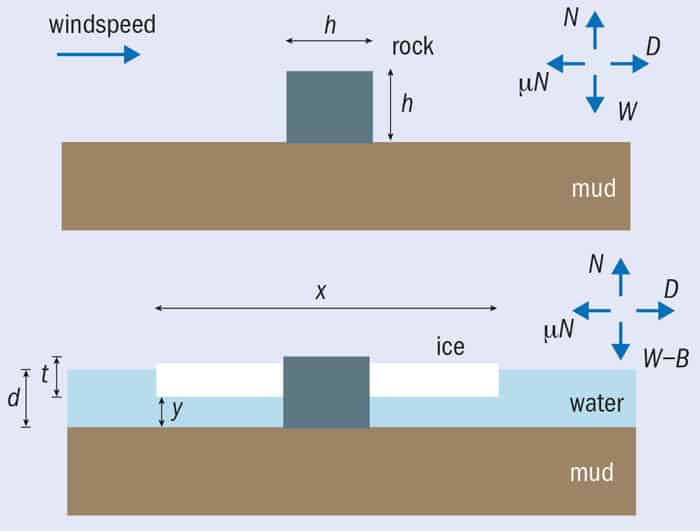
In 2011 we proposed an alternative “ice-pothesis”. An ice floe might buoy a rock frozen inside, and for sufficiently (and plausibly) thick ice floes, the buoyancy would reduce the friction and possibly bring the wind speed required for movement down to observed values (see figure 1, below). An ice raft could also circumvent the Sharp and Carey result since the floes could be small enough to squeeze out of the corral but still large enough to buoy the rocks slightly. Experimenting in his kitchen sink, Ralph froze a small rock in ice and showed that, in principle, ice-rafting could work.
1 Go with the floe Forces acting on a solitary rock (a) and a rock in an ice raft (b). In the former case, the normal force N on a cubic rock of dimensions h is the weight of the rock, Wr = gρrh3, where the density ρr is approximately 2700 kg/m3. The presence of water of depth d, along with a square ice raft of thickness t and horizontal dimensions x reduces this by introducing a buoyant force B. The magnitude of B depends on the submerged volume of the rock and ice, but for sufficiently large ice rafts, the frictional force μN is reduced enough for the force of the wind D to push the rock along the playa. (Courtesy: IOP Publishing)
Like so many ideas before it, our ice raft idea was plausible but unproven, and our time-lapse data were ambiguous. Two more years would pass before we would learn whether we were right.
Joining forces
During a visit to Racetrack in autumn 2012, Ralph and I found a brand-new weather station at one end of the playa. There was a phone number attached and, thanks to the vagaries of radio physics (which provided impressively clear mobile phone reception at that one spot in Death Valley and nowhere else), we were able to call it immediately.
A friendly voice greeted us on the other end. The weather station belonged to Jim Norris, an engineer in Santa Barbara, and his cousin Richard Norris, a palaeobiologist based at Scripps Institution of Oceanography in California. They were trying to unravel the mystery, too, and with permission from the national park, they had set up the station as part of their Slithering Stones Research Initiative. They agreed to talk more about their work, and we began an e-mail correspondence.
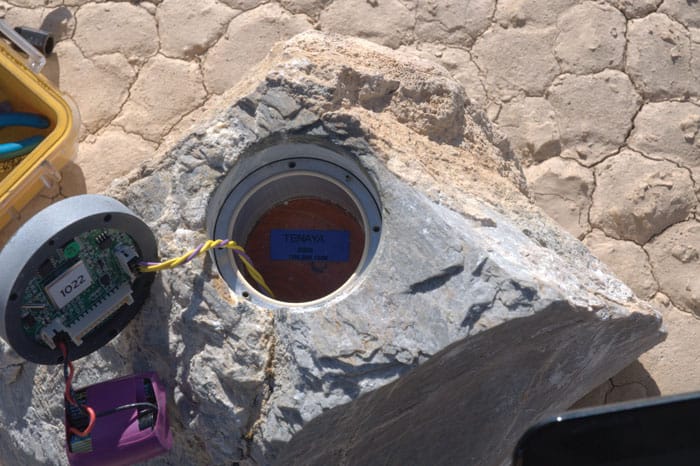
The Norrises’ approach was to drill holes in test rocks and insert specially engineered GPS receivers (see image above). These receivers would show when the rocks moved and how fast they went, while the weather station would keep tabs on the winds and rain. When Ralph met the Norris group in early November 2013, he teased them that putting GPS receivers in rocks was “probably going to be the most boring experiment in the history of science”. Even so, their approach complemented ours, and we agreed to keep each other informed about any interesting developments. By this time, though, Ralph and I were used to waiting.
But we didn’t have to wait much longer. Arriving at night for a routine visit on 18 December 2013, Jim and Dick found the playa glistening with an extensive layer of ice. When they returned the next morning, a pond covered the southern third of the playa, but below-freezing temperatures kept the rocks locked in place, stuck in ice sheets a few millimetres thick floating on a pond about 5–7 cm deep. At 10 a.m. on the following day, Jim and Dick were at the opposite end of the playa from the rocks, servicing some instruments, when a light breeze began blowing. When they returned to the playa’s southern end in the mid-afternoon, they saw that more than 70 rocks had ploughed fresh trails in the surface. They had just missed it!
Desperately hoping to see the rocks move in person, they camped another night near the playa and awoke on 21 December to watch the sunrise over Racetrack’s broad, icy pond. Melt pools formed and enlarged as the Sun rose, a mid-morning breeze rippled the pond, and abruptly, at 11.37 a.m. the ice broke up, popping and snapping across its whole extent. And then, finally, the rocks began to move.
The ice, although thin as window glass, formed massive floating sheets that shattered as they made contact with the rocks. Most of the rocks remained motionless, acting like miniature ice-breakers as the ice was pushed past them, leaving wakes of ice shards floating in channels of open water downstream of each rock. But other rocks moved, hesitatingly, under the force of the floating ice, ploughing the murky bottom and shoving the mud out of the way, against the underside of the ice. The splintering ice melted quickly, and in less than 15 minutes, the ice panels were too fragile to move the rocks any farther. Within an hour, the floating ice had melted completely.
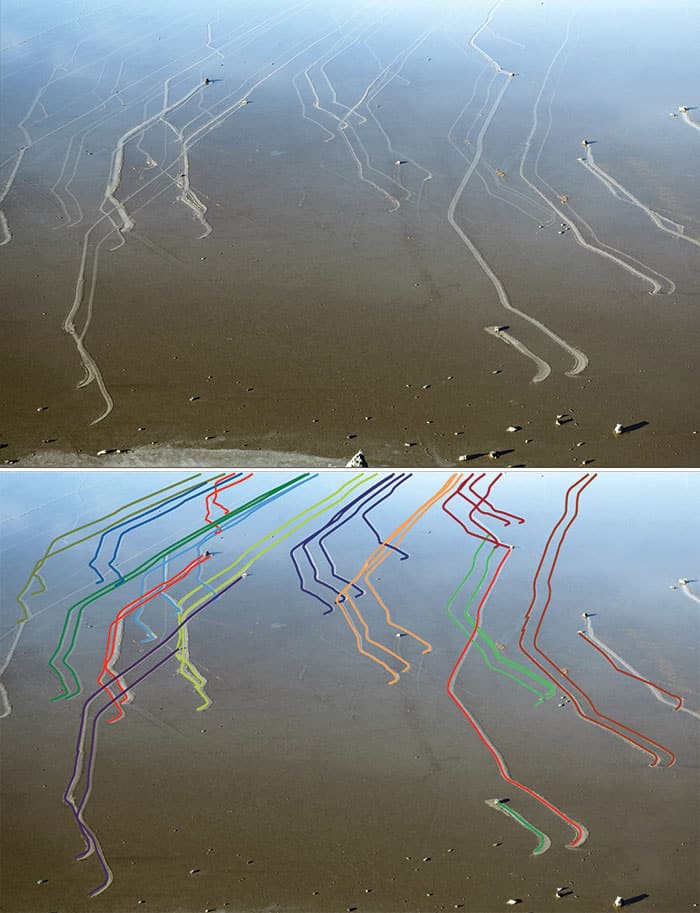
The subtle motion was hard to capture on film, but Jim and Dick’s GPS trackers showed the rocks had crept along at a few metres per minute, about the same rate as a crawling baby. GPS-tagged rocks separated by 153 m moved together, at exactly the same speeds and times, scribing identical trails (see figure 2, below).
2 Rocky roads A view from the dolomite cliff south of Racetrack reveals newly formed rock trails (top). Coloured lines (bottom) emphasize the congruence of adjacent rock trails. (CC BY PLOS One 10.1371/journal.pone.0105948)
Later that same winter, Ralph joined Jim Norris on a visit to the playa, and the rocks – recovered from their earlier stage fright – put on another show. This time, their movement was captured with Ralph’s kite-borne camera, and Jim filmed a cantaloupe-sized rock as it moved a few metres, at a distance of more than 30 m from shore. This meant that not only had several observers seen the rock movement first-hand, they had also obtained quantitative documentation of the circumstances. We knew how far the rocks moved, how fast and exactly when. We knew how thick the ice was and how strong the wind.
The answers emerge
It turns out that rock motion is rare because it seems to require a very precise set of conditions: a recent storm and a night-time freeze, followed by light breezes and sunshine to mobilize the ice. When these things combine, the vast momentum of a kilometre-wide floating ice panel can shove the rocks around like a bulldozer. These observations suggest that during Sharp and Carey’s rock corral experiment, a thin ice sheet may have shattered past the rebar stakes to push one rock (but not the other) out. Large, but increasingly fragmented, ice sheets could also account for some of the more puzzling results in Messina’s extensive GPS surveys, by producing trails that were often, but not always, parallel.
By mid-February of 2014 the pond had dried up completely and all the rocks went back to their slumber, baking in the Sun on a dry, cracked-mud playa. Rock trails that formed in a few minutes will probably remain for a decade, until a new pond appears. Always a place of wonder, Racetrack Playa is now a place with a bit of scientific understanding, too.
To learn more about the Slithering Stones Research Initiative, check out these videos from the Scripps Institution of Oceanography:
Sometimes, nature does something unexpected – something so rare, transient or remote that only a lucky few of us get to see it in our lifetimes. In the July issue of Physics World, we reveal the physics behind our pick of the weirdest natural phenomena on our planet, from dramatic rogue waves up to 30 m tall, to volcanic lightning that can be heard “whistling” from the other side of the world, and even giant stones that move while no-one is watching. We also tackle tidal bores on rivers and the odd “green flash” that is sometimes seen at sunset.
Plus, we’ve got six fabulous full-page images of a range of weird phenomena, including salt-flat mirrors, firenadoes, “ice towers”, beautifully coloured nacreous clouds, mysterious ice bubbles of gas trapped in columns, as well as my favourite – the delicately wonderful “frost flowers” seen very occasionally on plants.
Recently I blogged about quark novae, which are a passion of the University of Calgary astrophysicist Rachid Ouyed. I caught up with Ouyed at the Canadian Association of Physicists Congress in Edmonton last month, where between sessions he was busy writing a paper about quark novae.
I managed to coax him away from his calculations for long enough to record the above video, in which he talks about quark novae – huge explosions that some astrophysicists believe could occur shortly after some supernovae. Ouyed also talks about the quark stars that may be left behind and how quark novae could affect how astronomers measure cosmological distances.