Latin America’s scientific ‘magic’

Latin America is a diverse continent, interconnected by its common Iberian heritage. Its pre-Columbian societies were quite sophisticated, as can be seen in the Teotihuacan pyramids (see “The pyramid detectives” December 2014 pp24–27) near Mexico City, or the remains of the city of Machu Picchu in Peru, or even by a visit to the Museo del Oro in Bogotá, Colombia. Nevertheless, this part of the world always has, nowadays, the adjective “developing” associated with it, or even (at least until recently) the politically unsavoury term “underdeveloped”.

Beyond Imported Magic explores the science, technology and society of the Latin American countries in a collection of essays. Its title seems to be inspired by Gabriel García Márquez’ wonderful novel One Hundred Years of Solitude and its magical-realist set-up, but upon reading the opening remarks of the editors, I found that it actually refers to the way that engineering students in Rio de Janeiro in the early 1970s supposedly talked about computers as “imported magic”. Since I was a student in São Paulo at that time, it strikes me as quite improbable that this was the case. Nevertheless, one of the book’s editors (and the author of the introduction), Ivan da Costa Marques, is well known in Brazil for leading an attempt to set up a computer industry there. After a period in government, private industry and state industry, he came back to academia, focusing his interest on the interactions of science, technology and society. One presumes, therefore, that he knows what he is talking about.

The essays in this book are written by (and for) sociologists of science who have an interest in Latin America, rather than for scientists. They cover a wide array of topics, ranging from provocative subjects such as “Who invented Brazil?” (a title taken from a famous carnival samba lyric), to accounts of scientific expeditions that brought medical care to isolated populations and studied unknown diseases. It was on one such expedition that Chagas disease, which affects many of the poorest populations in the world, was identified. Another essay describes the invention, in late 19th-century Argentina, of fingerprinting as a tool to help solve criminal cases.

Two of the essays touch directly on the role of physicists in the promotion of nuclear energy in Argentina and Mexico, and by extension in Brazil as well. The first – entitled “Bottling atomic energy in Argentina” – describes how, in 1951, Juan Perón, the charismatic president of Argentina, announced at a press conference the success of Proyecto Huemul. This was an atomic fusion research programme that would, he claimed, bring cheap energy to every household in the country. The improbable character behind this announcement was an Austrian-German physicist called Ronald Richter, who had done his research on an isolated island in a gorgeous Andean lake, just across from the city of Bariloche. The amount of money invested in Richter’s enterprise is estimated to have been around $150m at today’s prices, but the whole operation came apart when a group led by another physicist, José A Balseiro, used concealed gamma-ray detectors to reveal the fraudulent nature of the project’s experiments.

That a programme like Proyecto Huemul could have been supported, despite the solid tradition of physics already present in Argentina at the time, is a reflection of a phenomenon seen again and again in Latin America, whereby populist leaders such as Perón tend to distrust their countries’ scientific establishments. But the article points out that despite the disaster of this enterprise, it nevertheless became the seed of what is now one of the most productive research centres in physics in Latin America: the Instituto Balseiro, a top-class research and educational establishment that lies just across the channel separating the island and Bariloche.

The book’s other essay on nuclear energy is “Peaceful atoms in Mexico”. Written by Edna Suaréz-Díaz and Gisela Mateos – two historians of science based in Mexico – it emphasizes the role that programmes such as Atoms for Peace (an initiative by US president Dwight D Eisenhower) had in establishing nuclear activity in Latin America. It also highlights how physicists worked to encourage the establishment of peaceful nuclear research in Mexico. In particular, the main force behind the Mexican effort was Manuel Sandoval-Vallarta, a physicist who worked at the Massachusetts Institute of Technology before the Second World War and is best known for identifying the effect of latitude on the flux of cosmic rays.

Suaréz-Díaz and Mateos argue that the distinctive feature of the Mexican nuclear programme was its civil, non-military character, in contrast to the Argentinian and Brazilian programmes. To me, though, this distinction seems to be exaggerated. While it is true that the Brazilian Navy was interested in developing nuclear submarines for defensive purposes, there was never any serious attempt there to develop nuclear armaments. Also, both the Argentinian and the Brazilian nuclear programmes were actually developed by civilian institutions: the CNEA (Comisión Nacional de Energía Atómica) in Argentina and CNEN (Comissão Nacional para Energia Nuclear) in Brazil.

Further evidence of the pacifist character of the use of nuclear energy in this part of the world is shown by the Tlatelolco Treaty, which forbids nuclear weapons in Latin America and the Caribbean and was signed by all the countries in the region. In addition to this treaty, Argentina and Brazil have an even more stringent agreement for mutual verification of all nuclear facilities, one that came about after strong pressure from the physics communities of both countries.

The essays in Beyond Imported Magic focus mainly on frustrated attempts to develop science and technology in the Latin American continent. But while it is true that many such attempts have fallen short, the book fails to recognize the immense advances that the region has seen, in part as an indirect consequence of peaceful nuclear-energy initiatives. One result of cross-border collaboration on nuclear science was the creation, in 1962, of the international Centro Latino Americano de Física (CLAF) under the auspices of the United Nations Educational, Scientific and Cultural Organization (UNESCO). The CLAF came about after the First Latin American School of Physics, an initiative by three leading figures in the region (Juan José Giambiagi from Argentina, José Leite Lopes from Brazil and Marcos Moshinsky from Mexico) that influenced a whole generation of Latin American physicists. Today, the CLAF remains very active in promoting co-operation among the Latin American countries and giving support to initiatives to establish physics facilities in the region.

Physics research is also linked with other Latin American success stories. Brazil is home to a very successful aircraft manufacturer, Embraer, which is smaller only than Boeing and Airbus. The boom in agrobusiness in Brazil has been supported by research conducted at EMBRAPA, a company that is developing ways to improve the productivity of Brazilian agriculture; one of EMBRAPA’s main research centres (located in São Carlos, in the state of São Paulo) is dedicated to the application of physics to agriculture. But regardless of whether the focus is on “atoms for peace” or on “atoms for peas”, physics in Latin America has been much more than “imported magic” for many decades now. I wish this book had done more to reflect that.

  • 2014 MIT Press £24.95/$35.00pb 410pp

Web life: The Conversation

So what is the site about?

The Conversation‘s stated aim is to provide “informed news analysis and commentary that’s free to read and republish”. In other words, it’s a blog. It is, however, a very big blog, with lots of expert authors, a prestigious team of editors and some very deep-pocketed sponsors.

Who is behind it?

That depends on which edition you’re asking about. The Conversation was founded in Australia in 2011, but it has since spread to more northerly reaches of the English-speaking world, gaining a full UK edition in May 2013 and a pilot US version in October 2014. In Australia and the UK, its financial backers are mostly universities and government bodies, such as the Commonwealth Scientific and Industrial Research Organisation (CSIRO) and Research Councils UK. In the US, it’s currently supported by an array of private charities, including the Bill and Melinda Gates Foundation.

Who’s doing the writing?

Each edition has its own set of editors, who are largely drawn from the (decimated) ranks of broadsheet newspaper journalists in Australia and the UK. Most of the articles, though, are written by academic experts from The Conversation‘s supporting universities. Within the science and technology section, for example, top columnists include Monica Grady, a planetary scientist at the UK’s Open University; Simon Redfern, an earth scientist at the University of Cambridge in the UK, and Matthew Bailes, an astrophysicist who is also a pro-vice-chancellor at Swinburne University of Technology in Australia.

What are some of the topics covered?

All three national editions feature stories on arts, business, culture, economics, education, energy, the environment, health, medicine, politics, society, science and technology – so pretty much everything, in other words. Each edition also features country-specific “hot topics” that change over time. As of mid-April, for example, Australian conversationalists were busy debating taxation and private health insurance, while the Americans were keen on vaccines and cybersecurity. In the UK, meanwhile, the conversation was focused on the forthcoming national elections and the digital economy.

These national differences persist within The Conversation‘s science and technology section, and the divisions are not always logical: at the time of writing this, the top physics story on the UK site was about the US space programme, while the Australian edition featured an article about Albert Einstein and Leó Szilárd’s famous 1939 letter to US president Franklin Roosevelt, in which they urged him to consider building nuclear weapons. But with so many stories to choose from, it’s fair to say that Physics World readers are sure to find something, somewhere, that interests them.

Can you give me a sample quote?

From a 28 March post by Nate Szewczyk (University of Nottingham, UK) and Tim Etheridge (University of Exeter, UK) about NASA’s plans to send astronauts to the International Space Station for a full year: “Several strong and valid arguments have been put forward to justify the significant public expenditure that this research involves. These include the notion that the survival of humankind ultimately centres on our ability to inhabit other planetary bodies…More immediate benefits may present themselves, though. The muscle problems from spaceflight closely resemble those caused by numerous conditions on Earth, including long periods of bed rest, muscular dystrophies, cardiovascular diseases and type-2 diabetes. In particular, the ageing process also displays a striking similarity with the changes that occur in space, albeit over a more prolonged timeframe…In short, the unique stresses imposed by living in space provide an opportunity to study, understand and develop countermeasures to some of the most prominent health challenges faced by the human race. The question should therefore not be ‘why should we continue exploring space’, but rather ‘why wouldn’t we?’ “

Nascent ‘Kuiper belt’ seen encircling nearby star

A debris disc just discovered around a nearby star bears an uncanny resemblance to a young version of our solar system’s Kuiper belt, according to an international team of astronomers. This extrasolar disc shares many similarities with our ring, and it could be the key to better understanding the interactions between debris discs and planets, as well as how our solar system evolved early in its lifetime.

Analogue rings

The Kuiper belt is a ring of icy and dusty debris that lies just beyond Neptune’s orbit, and it is home to Pluto, several other known dwarf planets, and thousands of other remnants of the early stages of icy-planet formation in our solar system.

Understanding how this disc was formed, and how it gained its current structure and composition, is crucial to understanding the birth and evolution of our solar system. The best way to do so would be to witness a similar debris disc in an earlier stage of its life. Until now, astronomers had discovered several other discs around nearby stars but none of the systems were similar to our own: the rings are typically too large, the central star too massive, or the stars exist in regions very unlike what we think our Sun’s birthplace was like. Furthermore, the observations made of these discs were limited in their quality, and they did not include spatially resolved spectra that could provide clues about the composition of the discs.

Now, though, a team of astronomers led by Thayne Currie from the University of Toronto in Canada and the National Astronomical Observatory of Japan has changed this using the Gemini Planet Imager (GPI), an instrument on the Gemini South Telescope located in Chile. The researchers discovered a debris disc of roughly the same size as the Kuiper belt orbiting the star HD 115600, which is located a mere 360 light-years from Earth. The star is only slightly more massive than our Sun, and sits in a star-forming region similar to that in which we believe the Sun was born. But HD 115600 is different in one key way – it is only 15 million years old, compared with our Sun’s age of 4.6 billion years. This means that observing it gives us the perfect opportunity to see how our solar system might have behaved when it was much younger.

“To be able to directly image planetary-birth environments around other stars at orbital distances comparable to the solar system is a major advancement,” says team member Nikku Madhusudhan of the University of Cambridge in the UK. “Our discovery of a near-twin of the Kuiper belt provides direct evidence that the planetary-birth environment of the solar system may not be uncommon.”

This spectroscopy, combined with measurements of the reflectivity of the disc, has led the team to suspect that the disc might be composed partly of water ice, just like our own Kuiper belt. The disc also shows evidence of having been sculpted by the motions of giant planets orbiting the central star, in much the same way that the outer planets in our solar system may have shaped the Kuiper belt.

Next-generation planet hunters

This discovery has been made possible thanks to the new generation of extreme adaptive-optics systems, such as those used on the GPI, in which the optics actively correct – in real time – for the distortion caused by effects such as atmospheric turbulence. This results in images with reduced glare and higher levels of sharpness than were previously possible at the same wavelengths. “In about 50 seconds of exposure time on GPI, we can see things (like this debris ring) that we cannot see in 50 minutes of time with conventional systems,” Currie explains. The GPI also boasts another unique advantage – it records spatially resolved spectra while it images, thus giving astronomers additional information about the dust in the disc, such as its composition.

The research will be published next month in Astrophysical Journal Letters. A preprint is available on arXiv.

Do atoms going through a double slit ‘know’ if they are being observed?

Does a massive quantum particle – such as an atom – in a double-slit experiment behave differently depending on when it is observed? John Wheeler’s famous “delayed choice” Gedankenexperiment asked this question in 1978, and the answer has now been experimentally realized with massive particles for the first time. The result demonstrates that it does not make sense to decide whether a massive particle can be described by its wave or particle behaviour until a measurement has been made. The techniques used could have practical applications for future physics research, and perhaps for information theory.

In the famous double-slit experiment, single particles, such as photons, pass one at a time through a screen containing two slits. If either path is monitored, a photon seemingly passes through one slit or the other, and no interference will be seen. Conversely, if neither is checked, a photon will appear to have passed through both slits simultaneously before interfering with itself, acting like a wave. In 1978 American theoretical physicist John Wheeler proposed a series of thought experiments wherein he wondered whether a particle apparently going through a slit could be considered to have a well-defined trajectory, in which it passes through one slit or both. In the experiments, the decision to observe the photons is made only after they have been emitted, thereby testing the possible effects of the observer.

For example, what happens if the decision to open or close one of the slits is made after the particle has committed to pass through one slit or both? If an interference pattern is still seen when the second slit is opened, this would force us either to conclude that our decision to measure the particle’s path affects its past decision about which path to take, or to abandon the classical concept that a particle’s position is defined independent of our measurement.

Photon first

While Wheeler conceived of this purely as a thought experiment, experimental advances allowed Alain Aspect and colleagues at the Institut d’Optique, Ecole Normale Supérieure de Cachan and the National Centre for Scientific Research, all in France, to actually perform it in 2007 with single photons, using beamsplitters in place of the slits envisage by Wheeler. By inserting or removing a second beamsplitter randomly, the researchers could either recombine the two paths or leave them separate, making it impossible for an observer to know which path a photon had taken. They showed that if the second beamsplitter was inserted, even after the photon would have passed the first, an interference pattern was created.

The wave–particle duality of quantum mechanics dictates that all quantum objects, massive or otherwise, can behave as either waves or particles. Now, Andrew Truscott and colleagues at Australian National University carried out Wheeler’s experiment using atoms deflected by laser pulses in place of photons deflected by mirrors and beamsplitters. The helium atoms, released one by one from an optical dipole trap, fell under gravity until they were hit by a laser pulse, which deflected them into an equal superposition of two momentum states travelling in different directions with an adjustable phase difference. This was the first “beamsplitter”. The researchers then decide whether to apply a second laser pulse to recombine the two states and create mixed states – one formed by adding the two waves and one formed by subtracting them – by using a quantum random-number generator. When applied, this final laser pulse made it impossible to tell which of the two paths the photon had travelled along. The team ran the experiment repeatedly, varying the phase difference between the paths.

Double pulse

Truscott’s team found that when the second laser pulse was not applied, the probability of the atom being detected in each of the momentum states was 0.5, regardless of the phase lag between the two. However, application of the second pulse produced a distinct sine-wave interference pattern. When the waves were perfectly in phase on arrival at the beamsplitter, they interfered constructively, always entering the state formed by adding them. When the waves were in antiphase, however, they interfered destructively and were always found in the state formed by subtracting them. This means that accepting our classical intuition about particles travelling well-defined paths would indeed force us into accepting backward causation. “I can’t prove that isn’t what occurs,” says Truscott, “But 99.999% of physicists would say that the measurement – i.e. whether the beamsplitter is in or out – brings the observable into reality, and at that point the particle decides whether to be a wave or a particle.”

Indeed, the results of both Truscott and Aspect’s experiments shows that a particle’s wave or particle nature is most likely undefined until a measurement is made. The other less likely option would be that of backward causation – that the particle somehow has information from the future – but this involves sending a message faster than light, which is forbidden by the rules of relativity.

Aspect is impressed. “It’s very, very nice work,” he says, “Of course, in this kind of thing there is no more real surprise, but it’s a beautiful achievement.” He adds that, beyond curiosity, the technology developed may have practical applications. “The fact that you can master single atoms with this degree of accuracy may be useful in quantum information,” he says.

The research is published in Nature Physics.

The museum exhibit that you inspired

Robert P Crease at the Mind Museum in Manilla, the Philippines

By Robert P Crease in Singapore

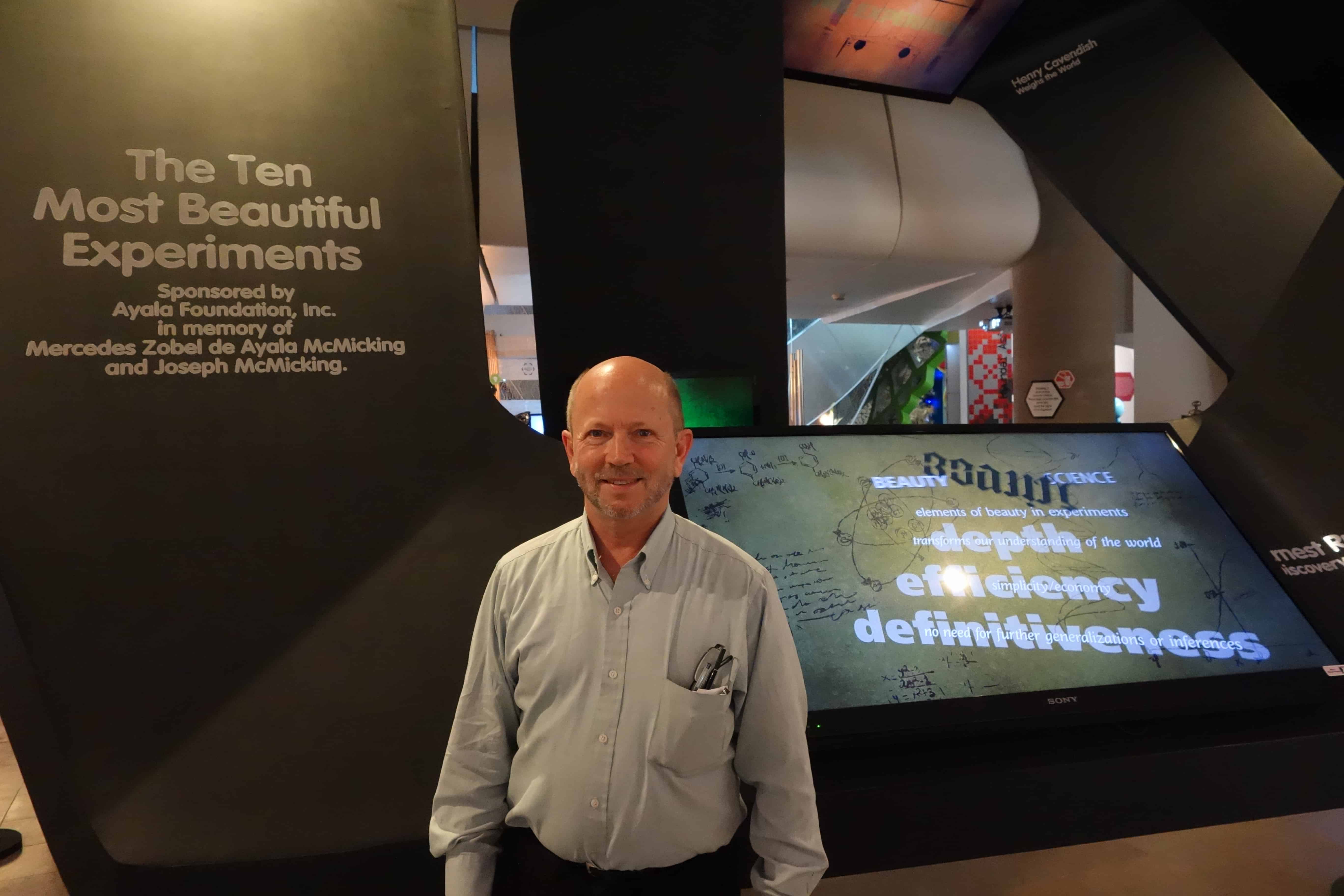
It’s not often that you come across a museum exhibit based on a Physics World article. But I did on Saturday at the Mind Museum – an extraordinarily beautiful and original science museum in Taguig, on the outskirts of Manila in the Philippines.

Not only that, the exhibit is right at the entrance. You may recall that I once asked Physics World readers for their thoughts on the 10 most beautiful experiments and wrote up the results in an article in September 2002. The project turned into a book, The Prism and the Pendulum: The Ten Most Beautiful Experiments in Science, which came out the following year and which Physics World reviewed.

Maria Isabel Garcia, who was planning exhibits for the then-future Mind Museum, saw the article and book, and created an exhibit based on it, consisting of videos and explanations of each of the 10 experiments, along with a sculpture designed by the Philippine artist Daniel de la Cruz.

(more…)

New maze-like beamsplitter is world’s smallest

An ultracompact beamsplitter – the smallest one in the world – has been designed and fabricated by researchers in the US. Using a newly developed algorithm, the team built the smallest integrated polarization beamsplitter to date, which could allow computers and mobile devices of the future to function millions of times faster than current machines.

Beamsplitters divide light waves into two separate channels of information, and will be crucial for the development of so-called silicon photonic chips that compute and shuttle data using light instead of electrons. “Light is the fastest thing you can use to transmit information,” says Rajesh Menon, an electrical and computer engineer at the University of Utah. “But that information has to be converted to electrons when it comes into your laptop. In that conversion, you’re slowing things down. The vision is to do everything in light.”

Light maze

Silicon photonics could significantly increase the power and speed of machines such as supercomputers and data-centre servers. In theory, devices employing such chips should not only be faster, but also consume far less power as well. Measuring only 2.4 × 2.4 μm2, the new beamsplitter is nearly 50 times smaller than any beamsplitter created to date. It also has an unorthodox maze-like shape. “Most polarizing beamsplitters do not look like this today,” says Menon. “We wanted our device to be as easy as possible to fabricate using existing techniques, and to be as efficient as possible.”

To do this, Menon and his team created an algorithm that tried various geometries, until it found the smallest and most efficient design. Menon described this process as a “smart” search, explaining that “the ‘smartness’ is important because there are too many possibilities to try and the alternatives would take a very long time.” As the design takes existing manufacturing techniques into account, the team says its beamsplitter could be produced on an industrial scale almost as inexpensively as electronic transistors are today.

Tech library

Menon noted, however, that many other technological advances will be needed before a fully photonic computer is possible. “For our device to be utilized fully, we need a whole library of other complementary devices, all of which are highly miniaturized and efficient. These devices will enable different functions such as bending the light, splitting the light, transporting light, modulating the light, and so on,” Menon says. “Once such a library is available to designers, one can expect them to put such devices together into functional circuits. That’s when the most fun and unexpected results will come.”

Andrea Alù, a researcher at the University of Texas, Austin, who did not participate in the research, thinks the team’s algorithm could have other uses as well. Last year, Alù and his collaborators proposed the idea of designing artificial materials that can perform mathematical operations as light propagates through them. “I believe the concept pushed forward by Menon and his colleagues is not limited to polarization control,” says Alù. He told physicsworld.com that it may also be “a viable platform to imprint mathematical operations of choice on a CMOS compatible chip” – a widely used type of semiconductor.

Zongfu Yu, an electrical and computer engineer at the University of Wisconsin-Madison who was also not involved in the study, called the new beamsplitter design a significant advance in silicon photonics. He adds that the work shows, for the first time, that “computational optimization can be used to achieve ultra-compact devices that are absolutely beyond the intuition of even the most experienced device designer”.

The research is published in Nature Photonics.

On top of the volcano – part two


By Matin Durrani at Sierra Negra, Mexico

Just as my Physics World colleague James Dacey mentioned earlier, neither of us felt super-wonderful yesterday visiting the Large Millimeter Telescope (LMT), which sits at a height of 4600 metres above sea level.  Spectacular though the facility is, the air pressure is roughly 60% of that at sea level and there is so little oxygen that even walking up a flight of stairs made me feeling pretty light-headed.

So, James and I were both quite glad to descend with LMT director David H Hughes to a height of 4100 metres, where it was time to visit another leading Mexican astronomy facility – the High-Altitude Water Cherenkov (HAWC) gamma-ray observatory.

(more…)

On top of the volcano – part one


By James Dacey at Sierra Negra, Mexico

Friday was the final full day of the Physics World Mexican adventure and we ended with a breathtaking experience, quite literally.

Matin and I rose early in Puebla to travel over a hundred kilometres east to the ominously named Sierra Negra volcano. This extinct beast is home to two of Mexico’s finest astrophysics facilities.

(more…)

The Dark Matter Garden, gravitational atoms, boys and girls with toys, and more

Gravitational gardening: the Dark Matter Garden at Chelsea

By Hamish Johnston

Gardening is something that the British take very seriously and this week’s RHS Chelsea Flower Show is the pinnacle of that obsession. Indeed, it is so popular that it is covered live on television by the BBC. One highlight of the show is the garden competition, in which designers transform an empty plot into a dazzling garden in just 10 days. This year’s entries include the Dark Matter Garden, which “brings the mysteries of the universe to Chelsea”. That’s the claim of the designers of the garden (including several astronomers), who built it for the UK’s National Schools’ Observatory. The team says that its gold-medal-winning design includes “innovative structures and planting, and represents the effect of dark matter on light”.

(more…)

Nanomachine pumps molecules ‘uphill’

A new molecular pump capable of pumping other small molecules up an energy gradient has been developed by researchers at Northwestern University in the US. The new pump is very much like the protein pumps in living cells, and might be used to design artificial molecular machines similar to those found in nature. Such machines could be important for a range of applications, including synthetic muscles, tiny robots and advanced mechanical motors.

Molecular machines are ubiquitous in nature and have evolved over billions of years to exploit energy from sunlight or complex chemical reactions in the body. They are made up of complicated assemblies of proteins that are responsible for a host of processes in living organisms, such as ion transport, ATP synthesis and cell division. In fact, our muscles are controlled by the co-ordinated movement of thousands of these machines.

“Our new molecular pump is, in a sense, reminiscent of the pump proteins in our cells, which are vital components of life involved in transferring energy from food to a form that is compatible with our cells,” explains Paul McGonigal, who is part of Fraser Stoddart’s team at Northwestern. “We have designed a relatively simple small molecule that can also drive a system away from equilibrium with chemical energy from redox (oxidation-reduction) reactions.”

One-way valves and rings

The new pump is based on a molecule called a rotaxane, which has already been used to create other molecular machines. The molecule contains a linear axle capable of restricting the motion of a ring-shaped component threaded onto it. The chemical structure of the axle is such that the rings can move in one direction via a complex mechanism that involves two one-way valves (see figure above).

The machine contains several components. The first is a positively charged pyridinium unit (red) that acts as the first one-way valve. The second is a viologen unit (orange) that acts as the pump. The third is a bulky isopropylphenyl chemical group that acts as the second one-way valve (purple). Finally, the fourth component is an alkyl chain (green) that acts as the collection unit. This chain contains a chemical group at its end that is big enough to stop the rings from de-threading.

Pumping process transfers and stores energy

“The machine works thanks to reduction-oxidation cycles and precisely organized non-covalent bonding interactions,” explains team member Chuyang Cheng. “It pumps positively charged rings from solution and ensnares them around an oligomethylene chain. The redox-active viologen unit at the heart of this dumb-bell-shaped molecular pump plays a dual role in first of all attracting and then secondly repelling the rings during redox cycling,” he says.

“The pumping process is actually a way of transferring and storing energy at the molecular level,” he continues. “Part of the energy released during a reaction is siphoned off and stored in the high-energy molecules produced. In the long term, we could imagine that the energy stored by such an artificial molecular pump might be used to power another molecular machine – perhaps one that is part of an artificial muscle, for example.”

The team, reporting its work in Nature Nanotechnology, says that it would now like to be able to anchor its molecular pump in a membrane so that it pumps molecules from one side to another during operation. “Such a pump would be directly inspired by nature’s molecular machines, and especially carrier proteins,” adds McGonigal.

Copyright © 2026 by IOP Publishing Ltd and individual contributors