L’Aquila verdict quashed

Six of the seven scientists and engineers who were controversially found guilty of manslaughter for the role that they played in the 2009 L’Aquila earthquake have been cleared after a month-long appeal trial. However, one expert – seismic engineer Bernardo De Bernardinis, who in 2009 was deputy head of Italy’s Civil Protection Department (DPC) – remains convicted, although his six-year sentence has been reduced to two years.

The earthquake that struck L’Aquila, which is the capital of the Abruzzo region in central Italy, in the early hours of 6 April 2009 left hundreds dead and the city in ruins. A couple of months before the quake hit there was a “swarm” of regular, small quakes with maximum magnitudes of about 2.5. Then on 30 March that year, the tremors suddenly rose in magnitude to 4.1. In response, the then head of Italy’s DPC, Guido Bertolaso, ordered a meeting of the Major Risks Committee (MRC) for the following day.

Present at the MRC meeting were volcanologist Franco Barberi of the University of Rome; geophysicist Enzo Boschi of the Istituto Nazionale di Geofisica e Vulcanologia (INGV); seismic engineer Gian Michele Calvi of the University of Pavia; seismologist Claudio Eva of the University of Genova; seismic engineer Mauro Dolce, director of the DPC’s seismic risk office; seismologist Giulio Selvaggi of the INGV; and De Bernardinis. They reportedly concluded that a swarm did not increase the risk of a major earthquake, and that no action was needed.

Six days later, however, an earthquake of magnitude 6.3 struck, killing more than 300 people, injuring about 1600 and leaving some 40,000 homeless. In August 2009 a number of L’Aquila citizens filed a lawsuit against the seven MRC members who, the prosecution argued, had provided “inaccurate, incomplete and contradictory” information about the threat posed by the preceding tremors. Following a trial that lasted more than a year, in October 2013 the seven MRC members were found guilty of manslaughter and given a six-year sentence – two years longer than those requested by the prosecutor.

In a 943-page document explaining the reasoning for the conviction and the sentences, trial judge Marco Billi stated that the defendants’ “level of guilt [was] particularly high” and that this guilt is accentuated by their “conscious and uncritical” participation in a “media operation” ordered by Bertolaso.

The appeal trial began last month in the L’Aquila courtroom before a three-judge court. The judges reached their verdict yesterday, overturning the initial ruling for the six scientists and reducing the sentence for De Bernardinis from six to two years. It is likely that both verdicts will now be challenged in Italy’s Supreme Court, which may not hear the case until 2016.

“As I read it, the scientists have all been acquitted, while [De Bernardinis] who made the public statements that downplayed any risk was convicted of some counts. This seems to me to be an appropriate criminal outcome,” says Lucy Jones, who is science adviser for risk reduction at the US Geological Survey in California. “The scientists provided an analysis of the seismic hazard that was technically correct, and I see nothing that could be called criminally negligent.”

However, Jones adds that seismologists should not consider the result of the appeal as a vindication of their current procedures. “A technically correct prediction that is not used correctly is not a good prediction. We need to take responsibility for how the information is communicated,” adds Jones. “There is a lot of research going on in disaster communication that we should use to take our uncertain information and make it useful.”

Prizewinning book gives materials science a chance to shine

Materials scientist and first-time popular-science author Mark Miodownik was all smiles last night as his book Stuff Matters scooped one of the UK’s top non-fiction awards, the Royal Society Winton Prize for Science Books. The book, an engaging and often highly personal look at some of the everyday materials that make modern civilization possible, was the unanimous choice of the five-member judging panel, coming top in a strong shortlist that also included a history of general relativity, a memoir about cancer and an analysis of the role played by physicists in Nazi Germany.

Miodownik picked up his award – a rectangular prism that looked like glass but was, he informed us, actually made of acrylic – at the end of a ceremony in which he and four of the other shortlisted authors appeared on stage at the Royal Society’s London headquarters to read passages from their books. Earlier in the evening, there had been an audible buzz in the room as Miodownik read from the introduction of Stuff Matters, in which he describes how, as a teenager, he was slashed with a razor blade during an attempted mugging, and how he became obsessed with materials and their properties afterwards. (He is now a materials engineer at University College London.)

(more…)

‘Quantum reporters’ measure magnetic resonance of one proton

The positions of individual protons on a surface can be pinned down to within 0.1 nm, thanks to a new quantum technique based on nuclear magnetic resonance (NMR) developed by researchers in the US. The method, which works at room temperature, uses an effect that is usually considered a nuisance because it degrades the performance of diamond-based quantum bits (qubits). The researchers say that the technique could be used to study individual proteins or even spins in a superconductor.

At the heart of the new method are crystal defects that occur in diamond when two adjacent carbon atoms are replaced by a nitrogen atom and a vacant site. These “nitrogen-vacancy” (NV) centres have an electronic spin that is very well isolated from its surroundings, which means that they could play a key role in future quantum computers. And because an NV centre can emit just a single photon if excited by a laser, quantum information could be stored for long times in this kind of defect before being read out as a photon.

Bling NMR

While NV centres that lie deep within a diamond are well-isolated, those within a few nanometres of the surface interact strongly with electron spins on the surface. Such centres would not, therefore, be used to make a quantum computer, but physicists have used them to study the properties of electrons on the surface of diamond. Two independent groups have also used NV centres to do NMR studies of molecules on the surface of diamond (see “Diamond downsizes classical MRI and NMR”).

Now, Alex Sushkov and colleagues at Harvard University have developed a new NMR technique that uses the surface electrons as “quantum reporters” to measure the positions of individual protons on the surface of diamond.

In the future we hope that it will be useful for gathering structural information for biomolecules, such as proteins
Alex Sushkov, Harvard University

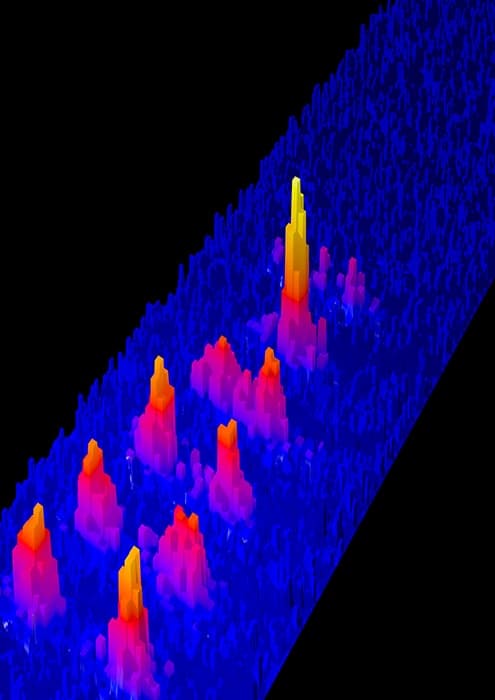
The first step involves mapping the locations of surface spins that are within a few nanometres of a NV centre, by applying a magnetic field to the diamond and then firing a sequence of radio-frequency pulses (RF) at the sample. Known as double electron–electron resonance (DEER), this is an established technique used to measure the distance between electrons in a molecule. Information is extracted from the system by measuring the final spin state of the NV centre by observing the fluorescent light it emits. By repeating the measurement with the magnetic field in different directions, the team can map the locations of the surface spins nearest to the NV centre (see figure above).

Spin echoes

In an experiment reported in Physical Review Letters, the team was able to locate four surface spins that were within several nanometres of an NV centre, which itself was about 3 nm below the diamond’s surface. The team then focused its efforts on the spin nearest to the NV centre. Using an applied magnetic field and a different sequence of RF pulses, the researchers were able to make a “spin-echo” measurement of the magnetic field near that single “reporter” spin. This measurement is affected by the presence of the nuclear magnetic moments of nearby protons that happen to be stuck to the diamond surface. Two protons were seen to be near to the reporter spin and, by careful analysis of the spin-echo data, the team was able to determine the locations of the protons to within 0.1 nm. This distance is on a par with the spacing between atoms in molecules and solids.

An important practical feature of the technique is that it is sensitive to protons on the surface of diamond, which means that a range of molecules could, in principle, be studied by simply depositing them on diamond. “We are currently working on applying this technique to magnetic structural imaging of simple molecules,” says Sushkov. “In the future, we hope that it will be useful for gathering structural information for biomolecules, such as proteins, that cannot be studied with other techniques.” Sushkov also believes that it could also be possible to use quantum reporters to make time-resolved measurements, which would allow some chemical reactions to be monitored.

With further development, reporter spins could be used to make localized magnetic measurements in solid materials, such as superconductors and topological insulators.

Blockbuster physics, bowling balls and feathers in a vacuum, and more

By Tushna Commissariat

The results of a successful scientific experiment can make scientists very happy. Indeed, in the clip above, taken from the BBC TV series Human Universe, one scientist exclaims “holy mackarel!” when he sees the outcome he was hoping for. In the video, everybody’s favourite physicist Brian Cox carries out an experiment similar to Galileo’s Leaning Tower of Pisa experiment, where he tested that no matter the mass of objects, they fall at the same rate under gravity. In the video above, Cox drops a bunch of feathers and a bowling ball in the world’s biggest vacuum chamber – the Space Simulation Vacuum Chamber at NASA’s Space Power Facility in Ohio, US. In the slow-motion video, you can see with exquisite clarity just how accurate Galileo’s prediction was, as the feathers and ball land at precisely the same time. We came across this video on the Dot Physics blog on the Wired Science network, written by physicist Rhett Allain, where he has worked out some of the maths and pointed out some of the nuances of the above experiment, so make sure you take a look.

(more…)

‘Spectacular’ image shows planet formation in action

The clearest image yet of planets forming around a star has been unveiled by astronomers working on the ALMA array of radio telescopes in Chile. The image shows a series of concentric rings of material surrounding HL Tauri – a very young star that is only about one million years old.

“When we first saw this image, we were astounded at the spectacular level of detail,” says Catherine Vlahakis, ALMA deputy programme scientist. “HL Tauri is no more than a million years old, yet already its disc appears to be full of forming planets. This one image alone will revolutionize theories of planet formation”.

HL Tauri is about 450 light-years away, and is expected to evolve into a “main sequence” star like the Sun. Indeed, the ALMA team believes that HL Tauri provides a glimpse of what our solar system looked like more than four billion years ago, when the Earth and other planets were forming.

Swept-out orbits

Stars form within clouds of gas and dust, and some of this material will end up orbiting the star. Over time, some of this material binds together to form increasingly large pieces of rock and ice, which create a thin disc around the star. Then, material in the disc will join up to create large structures such as asteroids, comets and planets. The HL Tauri system appears to be at the point in its evolution when the nascent planets have acquired enough mass to “sweep out” smaller objects from their orbits, creating the observed structure of rings.

Images with this level of detail have, up to now, been relegated to computer simulations or artist’s impressions
Tim de Zeeuw, director-general of ESO

“These features are almost certainly the result of young planet-like bodies that are being formed in the disc,” says ALMA’s deputy director Stuartt Corder. “This is surprising, since such young stars are not expected to have large planetary bodies capable of producing the structures we see in this image.”

“Most of what we know about planet formation today is based on theory,” explains Tim de Zeeuw, director-general of the European Southern Observatory (ESO), which part-funded ALMA. “Images with this level of detail have, up to now, been relegated to computer simulations or artist’s impressions.”

Spaced-out antennas

The spatial resolution of the image is about five times the distance between the Earth and the Sun, which is better than could be achieved by the Hubble Space Telescope. This high resolution was achieved by spacing the individual ALMA antennas – located in the Atacama Desert – as much as 15 km apart. When connected together, the array functions as a giant radio telescope with a resolution that is much better than an individual antenna.

A 21st-century discourse on quantum mechanics and space–time

Image of Nima Arkani-Hamed

If you fancy a bit of late-night quantum mechanics, make sure that tonight you tune into the live webcast of “Quantum Mechanics and Spacetime in the 21st Century” – a lecture that by physicist Nima Arkani-Hamed as part of the Perimeter Institute’s Public Lecture Series. Arkani-Hamed, who won the inaugural Fundamental Physics Prize in 2012, says that he hasn’t “been this excited about physics in a very long time”. He will talk about how the most recent advances in quantum mechanics shed new light on our understanding of the universe’s fabric of time and space. In the past, Arkani-Hamed has shown how the weakness of gravity, compared with the other fundamental forces of nature, might be explained by the existence of extra dimensions of space. He has also recently been involved in the 2013 documentary Particle Fever, about the search for the Higgs boson.

The webcast will begin at 11.45 p.m. GMT (7 p.m. EST) and you can send questions to Arkani-Hamed by tweeting @Perimeter and using the hashtag #piLIVE. Take a look at a short teaser video for his talk below and tell us what you think about it in the comments section.

Colliding Bose–Einstein condensates vanish from sight

Time sequence of images showing a collision between two matter-wave solitons

Colliding solitons made from Bose–Einstein condensates (BECs) can travel straight through each other and emerge almost unaltered. That is the result of experiments done by physicists in the US, Israel and Australia. Their research provides new insights into how matter waves interact with each other, and could further the development of new techniques in matter-wave interferometry.

Solitons are wave packets that can propagate long distances without breaking up or diminishing. They are best known in optics, but soliton solutions exist for a number of different wave equations. One important example is the 1D nonlinear Schrödinger equation, which can apply to light in nonlinear fibres as well as BECs confined to narrow tubes.

When true solitons collide, they pass straight through each other, keeping their shapes, amplitudes and velocities unchanged. Randy Hulet and colleagues at Rice University in Texas, together with researchers from Tel Aviv University in Israel and Swinburne University in Melbourne, examined whether this would apply to wave packets of matter called bright solitons in a BEC.

Divide and collide

A BEC comprises ultracold atoms all in the same quantum state, and therefore behaving as a single quantum object. In this latest work, the researchers create a BEC of lithium-7 atoms and shape it into a narrow tube using a cylindrically symmetric potential. The BEC is then divided in half using a laser beam, and both halves are further manipulated to form two solitons. Each soliton contains about 28,000 atoms and the pair are separated by about 26 μm.

The dividing laser beam is removed, allowing the two solitons to move towards each other. Crucially, when they meet, they usually pass straight through each other before re-emerging unaltered on the other side. Then the solitons oscillate back and forth in the tube, passing through each other repeatedly. It is neither experimentally feasible nor theoretically possible to determine how any two lithium atoms pass each other. This is because all of the atoms in a single soliton are represented by the same wave function, and are therefore in a superposition of all the possible trajectories through the tube. These paths include passing on top of each other, going around each other or even by tunnelling through each other.

Vanishing trick

Exactly what happens each time the two solitons collide depends on the phase difference between the two wave packets. For example, two solitons that meet when perfectly in phase will interfere constructively and momentarily, producing a denser clump of atoms. Conversely, when two perfectly out-of-phase solitons collide, the atoms momentarily vanish before reappearing again on either side of the collision point. Intermediate phase differences produce results between these two extremes.

While the researchers were unable to control or directly measure the relative phase of the soliton pairs used in the experiment – which was random – they were able to work backwards from their collision observations to understand the effect of a specific phase shift on a collision. First, they used theoretical models to simulate what a collision with a particular phase shift would look like. Then they ran the simulation multiple times, to calculate how the distribution of interactions should look if their calculations of the interactions resulting from each specific phase shift were correct, and compared it with the observed distribution from repeated runs of the experiment. They found generally good agreement between theory and experiment.

Collapse in 3D

However, unexpected things did happen occasionally. For example, the solitons sometimes fused together or collapsed completely when they collided. Such effects, which are not predicted by the 1D nonlinear Schrödinger equation, were far more common when the two solitons met in phase or nearly in phase, producing a high density region in the middle. Hulet explains that the larger and denser the clump becomes, the less well it is described by the 1D equation: “When the density peak is too high,” he says, “the density rises to such a level that it violates the 1D criterion and begins to sample the 3D space, and when it does that it collapses.” In future work, the researchers hope to control the phase difference between the two solitons and the number of particles in each soliton better, and thereby to determine more precisely where the 1D approximation becomes unstable.

Florian Schreck of the University of Amsterdam describes the work as “a clear textbook example, so it will be useful for teaching”. Schreck, who was not involved in the experiment, suggests that a practical application could be matter-wave interferometry – something that is also suggested by Hulet and colleagues. “Perhaps it will be useful to build an atom interferometer using solitons – wave packets that just don’t disperse,” he says.

The research is published in Nature Physics.

Carbon nanotubes make molybdenum disulfide more active

Hydrogen has emerged as a promising renewable energy since it is one of the cleanest fuels and has a large energy capacity. Two-dimensional (2D) molybdenum disulfide (MoS2) nanosheets have potential as substitutes for traditional platinum (Pt) catalysts in the production of hydrogen through the hydrogen evolution reaction (HER). However, the poor electron transport severely limits the application of MoS2 catalysts. Reporting in Nanotechnology, researchers prepare a high-performance catalytic system to overcome this by introducing carbon nanotubes.

Electron transport is a crucial factor that affects the activity of a catalyst. Normally, MoS2 nanosheets contain a mixed metallic 1T phase and semiconducting 2H phase. The latter one constrains the conduction of MoS2 nanosheets.

The complications of carbon

In order to attain a faster charge transport of MoSx-based catalysts, carbon-based nanomaterials are used as conductive networks or supporting templates. However, the preparation of these composite materials contains complicated multiple-steps, either with high temperatures, or the catalytic systems lead to relatively low catalyst loadings.

Electron transport pathways

Researchers from Zhejiang University in China develop a facile method to prepare a high-performance catalytic system comprising 2D MoS2 nanosheets and single-walled carbon nanotubes (SWCNTs) for HER. Because of their excellent conductivity and flexibility, SWCNTs can serve as efficient electron transport pathways in the hybrid catalytic system.

Compared to pure MoS2 counterpart catalysts, the composite system exhibits dramatically enhanced electrocatalytic activity. With a low onset overpotential and a Tafel slope of 40.82 mV/decade, these are among the lowest values for MoS2-based catalysts reported so far.

More information can be found in Nanotechnology 25 465401.

Celebrating the life and work of John Bell

This year marks the 50th anniversary of the publication of a now-famous paper in the journal Physics by the Northern Irish physicist John Bell, in which he proved that making a measurement on one particle could instantaneously affect another particle – even if it’s a long way off.

As our regular columnist Robert P Crease writes in the November issue of Physics World magazine, that kind of instantaneous effect, which proved the concept of entanglement, was not something that Bell was originally keen on. In fact, Bell had actually set out to prove the opposite – that it was possible, using “hidden variables”, to have a theory of physics that could keep things nice and “local”, and so avoid what Einstein had dubbed “spooky action at a distance”.

But Bell reversed his thinking. “I made a phase transition in my mind,” he told Crease shortly before his death in 1990 aged 62.

Yesterday (4 November) marked the 50th anniversary of the day that Bell’s paper arrived at the journal’s offices and today (5 November) sees the opening of an exhibtion at the Naughton Gallery on the campus of Queen’s University Belfast, from which Bell graduated with a first-class degree in mathematical physics in 1949.

Entitled “Action at a distance”, the exhibition runs until 30 November and promises to “explore Bell’s life and the artistic response to his legacy by artists from across the world”. There is also an accompanying series of lectures from Andrew Whitaker, Maire O’Neill, Mauro Paternostro, Artur Ekert and Anton Zeilinger.

(more…)

Have you ever been lost in Hilbert space?

In less than 100 seconds, David Colton attempts to shed light on this seemingly abstract concept of mathematics. He starts by reminding viewers of the principles of vectors within a plane, such as how to calculate their lengths and dot their products. He explains that these concepts developed for two dimensions can extended to infinite dimensions within the realm of Hilbert space.

Colton, who is a researcher at the University of Delaware in the US, explains how this mathematical device was devised by the German mathematician David Hilbert in the early 20th century. It was immediately used by physicists including Erwin Schrödinger in the development of quantum theory. Today, it is widely used by physicists and mathematicians who want to study the solutions of the Schrödinger equation.

Watch more from our 100 Second Science video series.

Copyright © 2026 by IOP Publishing Ltd and individual contributors