Devices made from resonating graphene “drums” could be used as microwave amplifiers and memory chips in quantum computers. So say researchers at the Kavli Institute of Nanoscience at the Delft University of Technology in the Netherlands, who are the first to demonstrate optomechanical coupling between a mechanical resonator and a superconducting microwave cavity.
Graphene is a sheet of carbon just one atom thick, and Gary Steele and colleagues created their drum by placing a multilayer sheet of graphene over a 4 μm-diameter hole in a silicon chip. The drum is adjacent to a superconducting microwave cavity that has been created by depositing a metal alloy on the chip, and microwave photons are able to move between the two structures.
Tiny changes in position
The graphene drum behaves like a mirror that reflects microwave photons that are fired at it. By measuring the interference of the reflected photons, the researchers are able to sense tiny changes in the position of the graphene sheet. Indeed, a shift in position of just 17 fm, which is 1/10,000th of the diameter of a single atom, can be measured.
“The microwave light is not only good for helping us to detect the position of the vibrating graphene drum, it can also exert a force,” explains team member Vibhor Singh. This force arises because light carries momentum. “If I shine a flashlight at a piece of paper, in principle, the light hitting the paper will exert a force on it, pushing it away from the light source,” he says. “The radiation pressure force that light exerts, however, is usually far too small to detect – you cannot push somebody over by shining a laser pointer at them. But, thanks to the graphene sheet weighing so little, and our ability to detect small displacements of the resonator, we can make the graphene ‘dance to tune’ with the ‘beat’ set by the incident microwave light.”
This “beating” leads to an interference phenomenon known as optomechanically induced transparency. By measuring this effect in their device, the team is the first to show that it has achieved optomechanical coupling between a mechanical resonator and a superconducting microwave cavity.
Amplifying microwave signals
“Now that we have firmly established that optomechanical coupling is taking place here, the consequences of this are enormous,” Singh says. Similar devices could be used to amplify microwave signals, or even to store microwave photons for up to 10 ms. This storage capability means that the drum could function as a memory device that can store quantum information in quantum computers.
“One of the long-term goals of our project is to use these 2D crystal drums to study quantum motion,” says Steele. “If you hit a classical drum with a stick, it will start oscillating, shaking up and down. This up and down motion can be thought of as the 1 and 0 bit states in a computer chip. With a quantum drum, however, we can not only make the drumhead move up and then down, but also make it move both up and down at the same time by putting it into a ‘quantum superposition state’.”
Steele adds, “Quantum graphene drums that are shaking up and down at once could be used to store quantum information in the same way as RAM chips in ordinary computers store information today.”
With space agencies across the world planning manned missions to Mars in the coming decades, pondering what one would eat while on Mars seems like a sensible thing to do. SpaceX engineer Andrew Rader helps us out with this difficult question in the video above, sharing gems like “chickens can’t swallow in space.” In the video, titled “Cooking on Mars” Rader cooks and eats a seemingly unappetizing option – bugs and insects – and makes it clear that is the fare future astronauts will be partaking in.
Construction has finally begun on the long-awaited €1.84bn European Spallation Source (ESS), which will take five years to build and will be the most advanced neutron source in the world. Initially envisioned almost two decades ago, the ESS buildings will be complete by 2019, with experiments set to begin four years later. “We are thrilled to be able to move ahead,” says Jim Yeck, ESS director-general. “Many people have been working hard for several years already to get to this point.”
The facility will include a 600 m underground linear proton accelerator, which will create a beam of protons with energy of 2 GeV and power of 5 MW. These protons will then be sent to a heavy-metal target station to produce neutrons, which will in turn travel to 22 instruments where researchers will use them to investigate a range of materials from superconductors to proteins. The ESS will also feature sample-preparation labs as well as a supercomputing centre and a software development centre.
The European Spallation Source is a must for European researchers
Dimitri Argyriou, ESS science director
“This is a very important project for material scientists in Europe, especially for those using neutrons to study matter,” says ESS science director Dimitri Argyriou. With existing European facilities aging and competition in the field growing in Asia and North America, Argyriou adds that “the ESS is a must for European researchers”.
Some 13 nations have committed about 97% of the total construction costs, with Sweden paying 35%, Denmark 12.5%, Germany 11%, the UK 10% and France 8%. Talks are currently ongoing with the Netherlands, Latvia and Lithuania to cover the remaining 2.5%. Yeck says that other factors were important in ensuring construction can begin, including securing approvals from the Swedish Environmental Court and the Swedish Radiation Safety Authority (SSM), which came during the summer. The SSM approval is, however, conditional, meaning that additional permits will be necessary as construction progresses.
Multinational effort
Yeck adds that all partner countries will be involved in the construction of the ESS, with a large part of the accelerator being built in France and Italy, while Germany, Spain and the UK will contribute to the target station. Meanwhile, Czech, Hungarian and Swiss partners will contribute instruments, and universities and institutes in Sweden and Denmark will make “significant contributions”.
The ESS has also announced that Roland Garoby, who has spent more than 35 years at the CERN particle-physics lab, will become its technical director this month. Garoby recently led the upgrade of CERN’s injector complex for the Large Hadron Collider and is also chair of the ESS’s technical advisory committee. “The opportunity to play a leading role in the ESS project is incredibly attractive,” he says, adding that the next five years will be “a multi-facetted challenge”.
A foundation-laying ceremony for the ESS is set for 9 October, with more than 600 people from the European scientific community expected to attend.
The ice bucket challenge, which involves people pouring a bucket of ice-cold water over their heads, has taken the social media world by storm raising millions of pounds for motor neurone disease and other charities.
Not wanting to miss out, researchers have also got involved in the act. One of those to take part is the Cambridge physicist Stephen Hawking, who has suffered with the disease since he was 21. He stepped up to the challenge – albeit with a twist. In a video filmed outside his family home in Cambridge, UK, Hawking says that as he suffered from a bout of pneumonia last year it would “not be wise” to have a bucket of ice-cold water poured over him. So instead he passed over the challenge to his children – Robert, Lucy and Tim – who were then doused with three buckets of icy water, while Hawking watched on.
Microscopic vesicles that swirl with oscillating surface patterns and sprout appendages like living cells have been unveiled by an international team of scientists. The researchers say that the tiny objects could be an important step in the development of shape-changing soft materials and may even shed light on some biological processes.
The vesicles were created using lipid bilayers and other components found in living cells. The work was done by scientists at Technische Universität München (TUM) in Germany, Brandeis University and Syracuse University in the US, SISSA International School for Advanced Studies in Italy, and Leiden University in the Netherlands
The shape shifting is achieved by creating an artificial cytoskeleton, which is the dynamic structure of microtubules found within living cells. “Here, we managed for the first time to reconstitute a part of the cytoskeleton inside a vesicle – in an active state, which means forces are exerted continuously inside the vesicle, leading to deformations and shape transformations of the vesicle,” Andreas Bausch, a researcher at TUM and team leader, told physicsworld.com.
Motors and scaffolding
The team formed lipid-bilayer vesicles tens of microns in diameter, and gave them an inner lining of microtubules. The researchers also added kinesin molecular motors, bound together in clusters, which formed cross-links among the microtubules. The resulting bundles of microtubules attached themselves to the inner surface of each vesicle as a nematic film – a single layer of parallel molecules with the fluid and self-assembly properties of a liquid crystal.
As in previous studies of nematic fluids on spherical surfaces, the flat sheets of parallel-aligning molecules had to bend to conform to the round surface. As a result, defects similar to the loops seen in fingerprints formed among the parallel lines. As the attractive forces in the film achieved equilibrium, the defects migrated apart and became stable at equal distances from one another. A typical number of singularities for a sphere was four, which stopped in positions at the points of an imaginary tetrahedron within the vesicle.
However, the kinesin motors ensured that the defects did not stay in place for long. Clusters of molecular motors latched onto adjacent microtubules and pulled them in opposite directions, forcing the long molecules to slide lengthwise past each other. This continuous action maintained a steady outward push, forcing each bundle to keep lengthening.
Migrating singularities
Pushed out of their stable tetrahedral points, the singularities migrated to new positions, passing through an orientation with all four in the same plane before settling again into a new tetrahedron. The motion continues as the singularities are forced out of those positions and begin another oscillation.
By creating an osmotic gradient between the inside and outside of the vesicles, the researchers could create arm-like protrusions that resemble the filopodia that occur in some living cells. As osmotic pressure deflated a vesicle, a surplus of membrane became available. In the defects, microtubules quickly took up this extra membrane as they aligned in parallel and extended outward as new appendages. When the osmotic pressure was reversed, the swelling vesicle reclaimed the surplus membrane, retracting the appendages.
“To me, it’s very cool; it’s dynamism,” says David Nelson of Harvard University. Nelson explains that all previous studies of nematic films on round surfaces focused on films in equilibrium. Defects had formed but had not moved, and no one had engineered a vesicle that grew filopodia-like appendages. “They made these defects come alive,” he says.
Hand-drawn noodles
Randall Kamien of the University of Pennsylvania points out three areas of significance. “First of all, this demonstrates that topological constraints that control equilibrium behaviour react much, much differently out of equilibrium,” he says. “Secondly [citing a figure in the paper describing the work], the beautiful mode that looks like how hand-drawn noodles are made suggests that this mechanism could be used for mixing on the few-micron level. Finally, the oscillation frequency of these states is about once per hundred seconds. Cell cycles are typically much longer. What role could oscillators at this time scale do in vivo? Are they present in cells?”
Bausch and his colleagues are focusing on future insights into basic biology. “[We want to] rebuild biological complexity by a bottom-up approach,” he says. “The big goal – very, very long term – is to rebuild cellular functions like cell migration or cell division. This is only a first step.”
Vincenzo Vitelli of Leiden University also believes that the research could improve our understanding of biology. “These synthetic structures are close enough to living organisms to provide insights into the behaviour of early life forms that marked the cross-over from inanimate to living matter,” says Vitelli, who was not involved with the research.
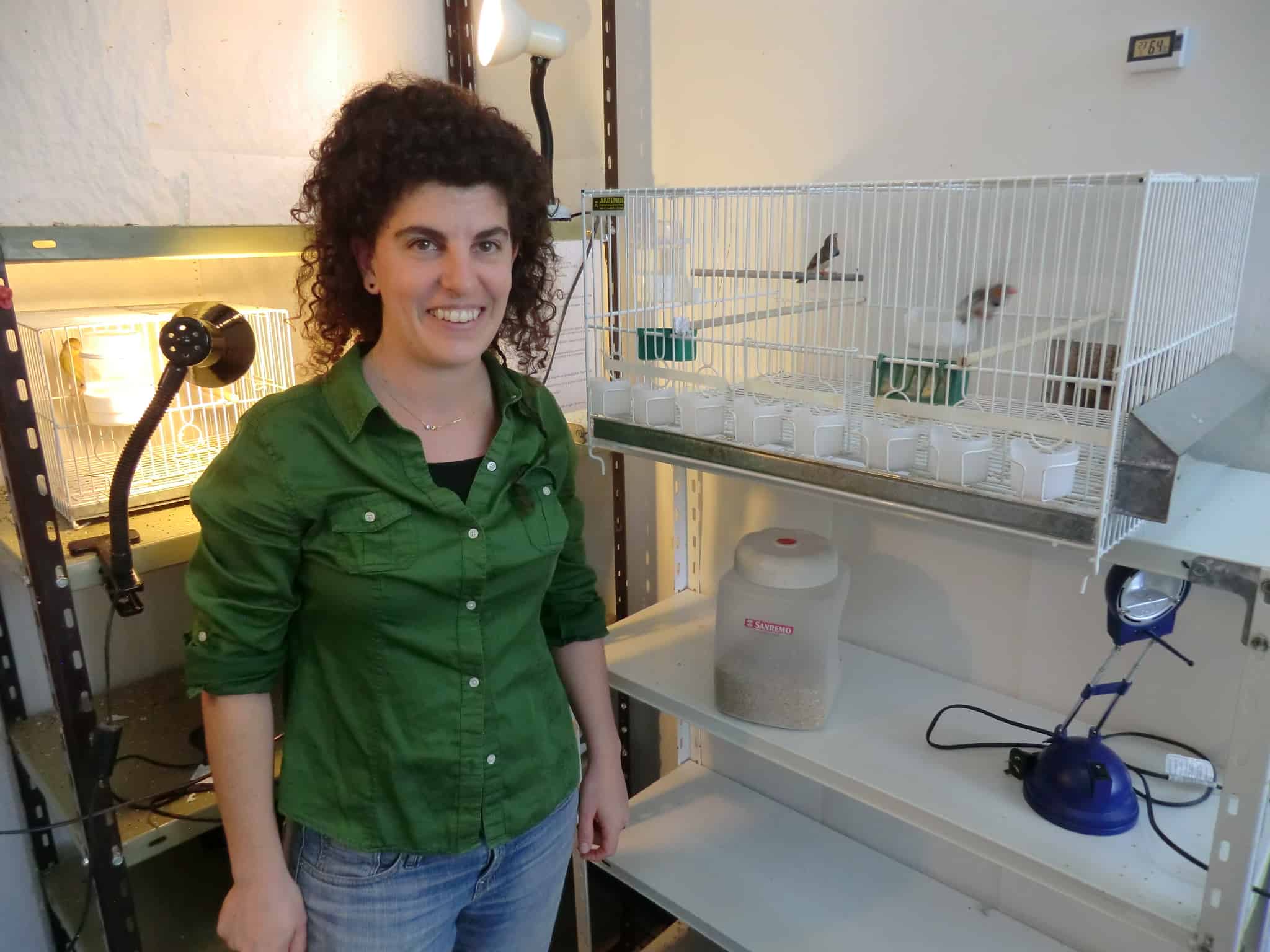
Some university physics departments are modern, others are old-fashioned, but by and large they tend to contain similar features: a bunch of physicists and a selection of equipment such as microscopes and lasers. That was why I was caught by surprise in the physics department of the University of Buenos Aires when I stumbled across a collection of caged birds living in the corner of one of the labs. My curiosity was captured and I had to find out more.
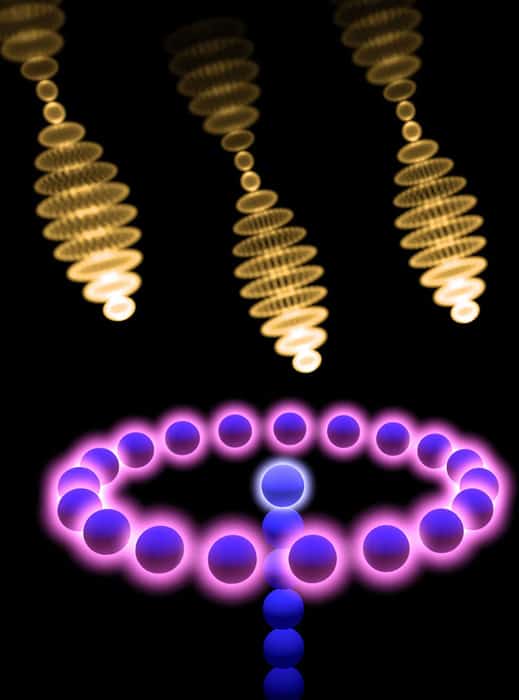
Artist’s impression of a ring of interacting absorbers. (CC-BY Simon Benjamin)
Rings of excited atoms that harness a quantum effect to absorb light at an enhanced rate could be used in future technologies such as highly sensitive cameras, solar cells and systems for optical power transmission. That is the claim of researchers in Australia, Singapore and the UK, who have done calculations that show that the well-known quantum phenomenon of superradiance could be used to create a new type of optical absorber.
First discovered 60 years ago by the US physicist Robert Dicke, superradiance occurs when a group of N emitters of light – such as atoms, molecules or quantum dots – emit at a rate that is proportional to N2. This is a much higher rate than is predicted by classical physics.
Emission and absorption are related processes, and this means that systems that superradiate must also be very good at absorbing light: an effect that the researchers dub “superabsorption”. As a result, closely spaced atoms can absorb collectively, making it impossible to tell which specific atom absorbs any given photon. When the group absorbs a photon, it is in a quantum superposition of all the possible excited states. This is known as a Dicke state. Similarly, subsequent absorptions lead to further Dicke states – each a superposition covering all the possible ways in which the total number of excitations might have occurred.
Exploring pathways
“This is why the absorption/emission rates are enhanced,” says Kieran Higgins of the University of Oxford, who did the calculations along with colleagues at Oxford, the University of St Andrews, the National University of Singapore and the University of Queensland. “Quantum mechanics tells us that all these possible pathways will be explored; so if there are many ways for a particular event to happen, its probability – and thus its rate – is enhanced commensurately.”
Together, these Dicke states form a kind of “ladder” – one with unevenly spaced rungs – of different rates of absorption. Higgins explains that the mid-point of the ladder provides the optimum absorption rate, “because the state with half the atoms excited has the largest number of possible ways to compose it”. For the purposes of taking advantage of the maximum absorption, then, the challenge lies in ensuring that – once charged up to the mid-point by a laser – the atoms remain excited, rather than trending back towards the bottom-most state.
The researchers’ solution to this problem makes use of ring molecules. This was inspired by similar rings used by plants to capture light during photosynthesis, albeit not involving such excited states. The ring geometry ensures that each rung on the Dicke ladder has a unique frequency of light that it can absorb or emit. The team has shown that quantum control techniques could be used to enhance or suppress the transitions between states to keep the system at the desired rung.
Simple filters
This could be realized in the lab by placing the superabsorber into an environment – such as a photonic-crystal cavity or photonic band-gap crystal – that limits the unwanted transitions that lie away from the mid-point. “Alternatively, the simplest proposal would be just to filter the light you shine onto the superabsorber,” adds Higgins, “although this requires more frequent resetting of the system.”
With the absorption being maintained at the optimum rate, a charge sensor such as a quantum point contact would allow the system to be used as a photon sensor. Alternatively, a nanowire could be used to create an irreversible trap to extract surplus energy; this approach could be used in solar-energy and optical-energy-transmission technologies.
It is only a matter of time before such “quantum engineered” systems will replace the classical systems we use today
Maarten Hoogerland, University of Auckland
Maarten Hoogerland, a physicist from the University of Auckland, commends the paper for its “innovative, outside-the-box thinking”, and notes that – while there will be practical hurdles to overcome – the principle might well be implementable in coming years. “As device-manufacturing techniques get better and easier,” he adds, “it is only a matter of time before such ‘quantum engineered’ systems will replace the classical systems we use today.”
“The time is ripe for learning how to harness quantum-mechanical collective behaviour to enhance and direct physical processes in ways not possible with classical physics,” agrees Michael Raymer, an optical physicist from the University of Oregon. “If energy transport could be engineered through the coherent collective effects in molecular systems, it would lead to numerous breakthroughs in science and engineering.”
At 2.57 a.m. GMT on 12 February 2013, seismometers around the world detected an earthquake of magnitude 4.9. Globally, a quake of that size is an unremarkable event – more than 1000 take place every year. But the seismic waves generated by the tremor showed something unusual. The quake had taken place in a corner of east Asia relatively unaffected by seismic activity and it appeared not to be caused by the tectonic processes that trigger most earthquakes. Rather, it looked to be man-made. In fact, as confirmed shortly afterwards by the country’s official news agency, the event had been generated by a nuclear test in North Korea.
The third and most powerful test that North Korea has carried out to date, the explosion was condemned by leaders around the world as a threat to regional and international security. More specifically, the event was a blow to the Comprehensive Nuclear-Test-Ban Treaty (CTBT), which bans all signatory nations from carrying out nuclear tests anywhere – on the Earth’s surface, underground, underwater, in the atmosphere or in outer space. Since it came into being in 1996, more than 180 nations have signed the CTBT, but a handful, including North Korea, have not, while others – notably the US – have still to ratify it, which means it is not yet in force (see “Testing times” below).
The fact that the North Korean test was detected and then quickly identified as a suspicious event shows that a global network of listening devices known as the International Monitoring System (IMS) was working as planned. Consisting of hundreds of seismic, acoustic and radioactive sensors dotted around the planet (see “Listening out for treaty violators” below), the IMS provides the first evidence that a country has violated the CTBT. However, until the treaty comes into force, the organization responsible for carrying out the monitoring – the Comprehensive Nuclear-Test-Ban Treaty Organization (CTBTO) – cannot carry out the final and crucial part of its verification regime: on-site inspection.
Such an inspection would involve experts entering a country suspected of having carried out a nuclear test, and deploying advanced instruments close to the presumed “ground zero” to prove whether or not a test has taken place. Such an operation would be politically delicate as inspectors would be granted wide-ranging powers to search a large area of a country, which may then face severe sanctions. The inspection would also be highly complex, involving dozens of people from different countries and with different backgrounds transporting themselves and more than 150 tonnes of equipment to a probably remote spot where they would live and work for several months. Meanwhile, the clock would be ticking, since much of the evidence – such as seismic aftershocks and radioactive emissions – diminishes rapidly in the wake of an explosion.
In an attempt to put such an operation to the test, a group of roughly 40 scientists and technicians will arrive in Jordan this November. Experts in seismology, geophysics, nuclear physics and other disciplines, the team will head to a site on the banks of the Dead Sea, where they will spend three or four weeks combing roughly 1000 km2 of mountainous desert and scrubland for signs that a fictitious nuclear device was detonated underground in the days or weeks before they arrived.
The aim of this elaborate role-playing game – known as the Integrated Field Exercise 2014 – is to recreate as closely as possible almost all of the elements of a real on-site inspection. It will therefore include evidence suggestive of a recent nuclear test as well as people who will be the inspectors’ adversaries, namely representatives of the state under inspection. The CTBTO’s Gordon Macleod, who leads the team that devised the fictional scenario to be played out in Jordan, says that the role-playing inspectors – like their real counterparts – will have their work cut out trying to be as exhaustive and as fair as possible, while dealing with the inspected state trying to throw them off the scent.
“The really hard part would be proving no test had taken place,” says Macleod. “As an inspector you would say that you do not have the evidence that could prove a nuclear explosion occurred. But the people who made the request can always say that you didn’t look in the right place.”
Locating ground zero
Underground explosions have been the most common kind of nuclear test, accounting for around three-quarters of those carried out during the Cold War. In general they are not as spectacular as atmospheric, above-ground or underwater blasts and do not release as much radioactive fallout, but they do have their own tell-tale signs. In particular, an underground explosion generates temperatures and pressures high enough to vaporize rock and create an underground cavity measuring up to several tens or hundreds of metres across. Around this cavity, rock is crushed, cracked, inelastically deformed and then elastically deformed in successive layers. It is in this last, outermost, layer that seismic waves are created – the rock within it relaxing back to its former state and releasing the strain that had temporarily built up.
These waves, which can be detected in minutes by seismometers up to thousands of kilometres from the test site, provide information on the strength, location and nature of an event. But the waves cannot reveal for sure if an event is due to a nuclear test or to something more conventional, such as a chemical blast in a mine or an earthquake (see figure below). Acoustic data collected by underwater microphones and by “infrasound” stations are also important, but the “smoking gun” of a nuclear test is radioactive emissions, such as from xenon, which differ substantially from those of a nuclear power plant.
Red alert A comparison of two seismic waveforms in North Korea – a nuclear explosion (top) and an earthquake (bottom).
Together, these four data streams make up the outputs of the IMS and are sent from their respective monitoring stations in near real-time via satellite and ground links to the CTBTO in Vienna, Austria. There the data are first processed automatically by computers, which identify specific events and calculate their distances, and then by human analysts, who add missed events and correct wrongly attributed ones. After the numerous natural events have been filtered out, analysts send preliminary lists of suspicious events to the signatory states of the CTBT.
Anders Ringbom, a noble-gas expert at the Swedish Defence Research Agency, likens the multi-pronged monitoring effort to a legal investigation. “It is like a court case where you are looking for pieces of evidence and trying to put them together,” he says. “The more evidence you have the stronger your case is.” Unfortunately, the evidence from the IMS is not always enough to convince signatories of the CTBT that a nuclear test has taken place. The network did not, for example, detect any radionuclides following a test North Korea carried out in 2009, and it was nearly two months before stations in Japan and Russia picked up radioactive noble gases after the 2013 test.
This is where the on-site inspection would come in. With the CTBT yet to enter into force, no such inspection has ever taken place for real. But if the treaty does eventually become legally binding, then such investigations would play a central role. The mere fact that an on-site inspection could take place, reasoned the negotiators who drew up the CTBT, ought to deter any state from carrying out a nuclear test in the first place. But if a test is believed to have been carried out, then measurements at the site of the presumed explosion would provide far more sensitive measurements than is possible remotely, and would therefore give treaty parties more confidence in pressing for any sanctions.
Once an inspection request from one or more states has been approved by the CTBTO’s executive council, inspectors would travel to the site of the alleged test and set up camp. Top of their to-do list would be to survey the surrounding terrain from a helicopter to look for any suspicious geological features, such as rock falls, sinkholes or other depressions. Of particular interest would be large craters, up to several hundred metres across, that could have been caused by rock above the blast cavity collapsing. Initially, that rock is supported by high-pressure steam formed by the explosion, but once temperatures drop and the steam condenses, the rock can give way to produce a “rubble chimney” that can extend to the surface.
Inspectors can also make more careful measurements of the phenomena observed by the IMS. In particular, they can set up a network of extremely sensitive seismometers in the inspection area to record the weakening aftershocks created by a nuclear explosion. Another crucial activity is testing samples of air, soil, vegetation and water for the presence of radioactive particles, and gases such as argon, which is produced when neutrons from a nuclear explosion slam into rocks.
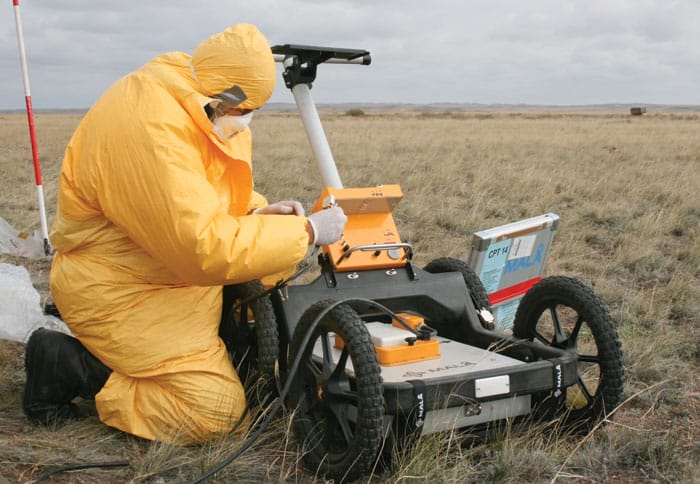
If evidence of the cavity is not visible at ground level, inspectors have other tools up their sleeve, including “gravitational field mapping”, which is sensitive to variations in the density of rock underground, as well as instruments that measure changes in subterranean electrical conductivity. They can also use ground-penetrating radar or sensitive magnetic-field detectors to search for suggestive objects, such as pipes or cables that might have formed part of the test infrastructure.
If inspectors are confident of having precisely located the test site, they have one final technique they can call upon. Assuming they can get permission from the CTBTO’s executive council, they can drill a hole down to the explosion cavity and extract samples of solid or molten rock containing radioactive material. According to Matjaz Prah, the CTBTO’s on-site inspection co-ordinator, any relevant fission products in the rock would be “undeniable evidence” of a nuclear test, pointing out that if the explosion had been very deep – it could be up to several kilometres below the Earth’s surface – radioactive xenon and argon might not emerge at all.
The appliance of science
The IMS has developed a lot over the last decade, with the number of facilities rising from three at the end of 2000 to 278 now. With another 59 needed to complete the network, gaps remain, however – there are no monitoring stations, for example, in India or Pakistan. Still, according to a 2012 report from the US National Academy of Sciences, the IMS in its current form will already make life tough for any potential test-ban violator. The report estimated that only explosions with yields below about 1 kilotonne could be confidently hidden from the network’s 38 primary seismic stations (now 42), which is too feeble to allow the test nation to develop powerful or novel nuclear weapons.
Our ability to detect down to such levels is partly due to there being more monitoring stations than in the past. But it is also due to a greater use of “regional” seismic waves – defined as those detected within about 1500 km of their source – which provide valuable information about low-yield events. These waves travel through the crust and upper mantle – which are far more complex than the more homogenous material deeper down – and so are generally harder to interpret than long-range “teleseismic” waves. Fortunately, improved models of the Earth’s structure developed over the last decade mean that regional seismic data can now yield monitoring sensitivities for many continental areas 10 times greater than is possible with teleseismic waves.
However, while the CTBTO’s global monitoring is close to completion, its on-site inspection capabilities have lagged behind. The organization (technically called the CTBTO Preparatory Commission as the treaty is not yet in force) has previously carried out simulated inspections, including one in 2008 in Kazakhstan at the Semipalatinsk nuclear test site used by the Soviet Union in the Cold War. Inspectors, however, had access to only basic detector technology, which limited them largely to visual inspection and measuring seismic aftershocks.
The Jordan exercise should give participants a much better feel for what can be achieved on the ground. To investigate the scenario laid out for them by Macleod’s team, which is itself a major technical challenge (see “Planting a fake bomb (or not)” below), the role-playing experts will have access to almost all sensor technologies available to them under the terms of the CTBT. These include using ultraviolet light, which can penetrate dirt on the ground and so perhaps reveal the tracks of vehicles used to set up the test site, as well as infrared radiation, which could point to the location of the explosion by measuring heat escaping through cracks in the Earth’s surface. Inspectors will also use portable equipment, such as noble-gas detection systems, to measure the tell-tale gases xenon and argon.
First flash Castle Romeo – an atmospheric nuclear test carried out by the US in 1954 – was the first deployed thermonuclear device. (Courtesy: US Government)
Assessing whether or not a virtual nuclear device has been detonated will be more than a technical challenge, however. In particular, role-playing representatives of the inspected state might invoke a treaty clause to let them seal off certain areas for reasons of “national security”. The inspectors, says Prah, will “have to use all the means foreseen by the treaty to get hold of the data they need”, which could involve them carrying out lengthy negotiations with their hosts.
But Prah adds that inspectors will have to stick to what is relevant – even uranium enrichment cannot be reported because it is, strictly speaking, unrelated, while ballistic-missile development would not be a violation of the CTBT. “As an inspector you come open-minded and simply try and understand what is going on, without any prejudices,” he says. “Your job is to collect data. Whether or not there has been a violation is a political decision.” Prah nevertheless believes that the wide range of evidence available to inspectors in Jordan should leave no doubt as to what has gone on. “I think that our on-site inspection capabilities have improved hugely over the last four or five years,” he says. “With these developments, those who violate the treaty will have nowhere to hide.”
Some gaps will remain. Participants in the Integrated Field Exercise 2014 will not do any drilling, which would require a massive oil-field-sized rig that is beyond the $10m budget of the exercise. Also absent in Jordan will be “resonance seismometry”, which could help inspectors to find an explosion cavity by measuring variations in tiny background tremors that pass through different rock layers. “We haven’t fully got to grips with how this technique would work in an on-site inspection regime,” says Macleod. “It is still in an R&D stage.”
Other research to improve the IMS, meanwhile, includes “cross-correlating” the seismic waveforms of new events with those of historical tremors to help to identify new blasts. The CTBTO is also working with the World Meteorological Organization to improve atmospheric transport models, which are used to calculate where and when radioactive particles come from. In addition, the CTBTO’s huge data bank of noble-gas measurements could, says Ringbom, be scrutinized for patterns to improve our understanding of the radionuclide background.
But as Jerry Carter – a chief CTBTO data analyst – points out, the organization does not develop any of these techniques itself, relying instead on academics communicating their work or carrying out dedicated research on the CTBTO’s behalf. Recent relevant advances, says Carter, include research on whale noise, which has helped the understanding of the background registered by hydrophones, and the development of a self-calibrating infrasound sensor. “New technologies and scientific developments are really important to us,” he says, “so we look to see what is out there and try to incorporate whatever is most relevant.”
However, such research will remain under-used until the treaty is brought into force. David Hafemeister, a physicist and arms-control expert at the California Polytechnic State University, thinks that US president Barack Obama “won’t push hard” for American ratification of the CTBT despite saying he strongly supports it. In 1999 almost all Republican senators voted against ratification and Hafemeister thinks it might take a Republican president “to bring along his or her colleagues”. At that point, he speculates, were China to lean on North Korea, all eight of the states needed for the treaty to enter into force might ratify it. “The stakes are really high because countries such as China, which has only tested about 50 times, have much more to learn from future tests,” he says. “If we don’t have the test ban, one could imagine unleashing an old-fashioned arms race.”
While the treaty remains on hold, CTBTO scientists will continue to refine and test their monitoring techniques, ensuring that they are as ready as possible if finally called on to investigate what could be the explosion of a real nuclear weapon. The exercise in Jordan should provide a stern test of that preparedness.
Testing times
Efforts to ban nuclear testing have been ongoing since the 1950s when thermonuclear explosions carried out in the atmosphere by the US and the Soviet Union created lots of radioactive fallout. The Partial Nuclear Test-Ban Treaty, signed in 1963, outlawed testing in outer space, in the atmosphere and in the oceans, but it was not until 24 September 1996, once the Cold War had ended, that the Comprehensive Nuclear-Test-Ban Treaty (CTBT) was opened for signature at the United Nations in New York.
Testing times Map of the world showing which states have or have not signed the Comprehensive Nuclear-Test-Ban Treaty.
Paul Richards, a seismologist at Columbia University in the US, contrasts the CTBT with the Non-Proliferation Treaty. The latter, which came into force in 1970, inhibits what he calls “horizontal proliferation”: it prevents non-nuclear-weapon states from obtaining weapons (in exchange for a commitment from the weaponized states to gradually disarm). The underlying goal of the former, he says, is instead to limit “vertical proliferation” – to restrict the development of more sophisticated nuclear weapons.
Indeed, since the CTBT was opened for signature, none of the five established nuclear powers – the US, Russia, the UK, France and China – has exploded a nuclear weapon, bringing an end to five decades of explosions that saw more than 2000 separate tests of ever more advanced weapons. Other countries, however, have not followed suit. In 1998 two non-signatories, India and Pakistan, carried out nuclear tests within two weeks of one another. Another non-signatory – North Korea – has carried out tests in 2006, 2009 and 2013.
To become legally binding, the CTBT requires that all 44 countries that possessed nuclear technology in 1996 (“Annex 2” states) sign it and then ratify it, which typically means that their parliaments must approve it in a vote. However, eight of those countries have still to do so, including the US. Doubts about the ability of the US and its allies to monitor potential cheating, along with question marks about America’s capacity to maintain a nuclear arsenal without testing, were among the reasons for which the Senate voted against ratification in 1999.
Listening out for treaty violators
The International Monitoring System looks at four types of physical phenomena. The numbers of stations listed for each type are those of the final network, which is currently 83% complete.
1. Seismic waves
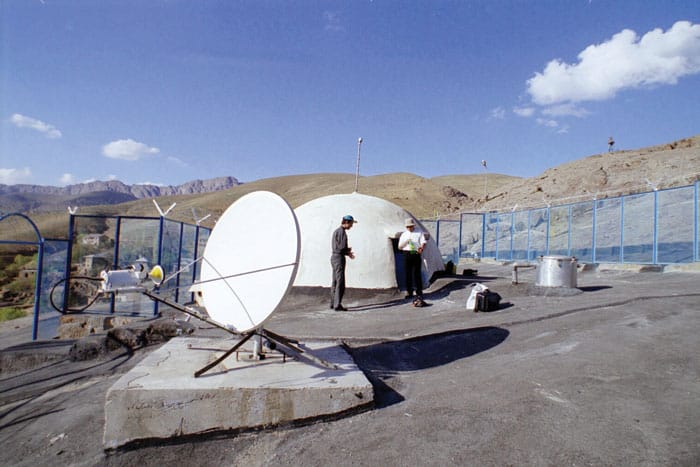
Seismic waves A seismic station forming part of the International Monitoring System. (Courtesy: CTBTO Preparatory Commission)
How many? 50 primary and 120 secondary stations What do they do? Each station has either an individual seismometer or an array of up to 25 arranged geometrically over a wide area. Both primary and secondary stations send their data continuously to the Comprehensive Nuclear-Test-Ban Treaty Organization (CTBTO) in Vienna, but only data from the former are used routinely (the latter being called upon when needed). The time lag between fast-moving, longitudinal “primary” seismic waves and slower, transverse “secondary” waves can give the distance to an event, while data from several stations can be combined to yield rough values for the location and depth of an explosion. Nuclear blasts can be distinguished from earthquakes by comparing the two types of wave.
2. Radioactive nuclei
Radioactive nuclei A radioactive-nuclei measuring station. (Courtesy: CTBTO Preparatory Commission)
How many? 80 stations and 16 laboratories What do they do? Using filters, the stations extract from the passing air solid particles with distinct radioactive signatures produced by atmospheric, underwater and some shallow underground fission explosions. To detect deep-buried explosions, which do not release such particles to the air, half of the stations also use a charcoal-based device to extract radioactive xenon isotopes. Gaseous xenon is inert and so does not combine with debris or dust to form larger solid particles, but can seep through rock to the surface. As for the labs, which are spread across the world, they check the output of the radionuclide stations, providing independent analysis of suspicious-looking samples.
How many? 11 stations What do they do? To monitor for underwater nuclear explosions, the CTBTO uses specially adapted microphones suspended 600–1200 m below the sea surface and seismometers on land at 11 islands in the Atlantic, Pacific and Indian oceans. The “hydrophones” detect sound waves given off by a nuclear test, exploiting the fact that such waves can travel very long distances through water, particularly at depths of about 1 km.
4. Infrasonic waves
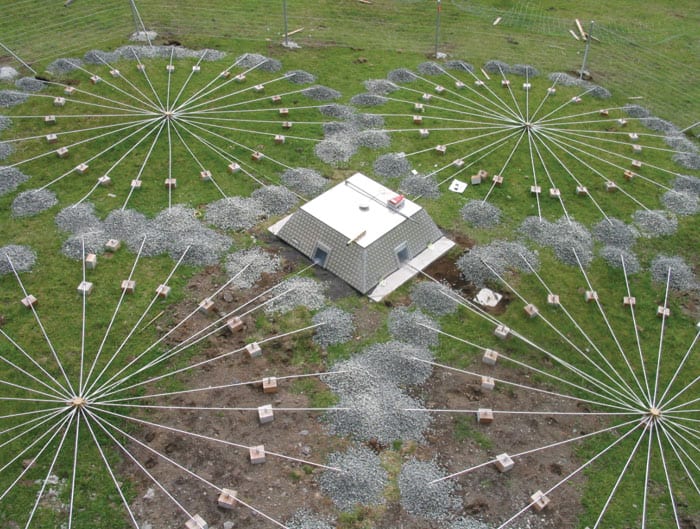
Infrasonic waves An infrasonic-wave measuring station. (Courtesy: CTBTO Preparatory Commission)
How many? 60 stations What do they do? They pick up very low-frequency sound waves given off by nuclear tests in the atmosphere and at shallow depths underground. The stations, built in 35 different countries, use arrays of microbarometers to measure minute changes in atmospheric pressure, with each barometer sitting at the centre of a set of spoke-like pipes designed to reduce noise generated by the wind.
Planting a fake bomb (or not)
Setting up the inspection area for the Integrated Field Exercise 2014 in Jordan to make it look as if a nuclear test might have taken place (without actually detonating a nuclear bomb) will be a challenge for staff from the Comprehensive Test Ban Treaty Organization. One of the hardest things to recreate will be the correct levels of radionuclides in the air. Rather than actually dispersing radioactive material in the environment, which has health risks, one option is to use a computer simulation to model the spatial variation of the different substances in question and then use this information to automatically and continuously update the readout on the inspectors’ measuring equipment, based on their geographical position as revealed via GPS.
“We had to make sure that the test scenario is scientifically credible and self-consistent, but also difficult,” says Gordon Macleod, who leads the team of scientists and technicians developing the scenario. “The people who are going out there really don’t know whether a virtual bomb has been exploded or not.”
Mobile detection A seismologist at a previous simulated inspection in Kazakhstan in 2008. (Courtesy: CTBTO Preparatory Commission)
Another headache for those recreating the correct conditions close to ground zero is the set of aftershocks that would accompany a test. Computer simulation is also an option here – the idea being to hijack the seismic data recorded by inspectors in the field and swapping them with “artificial” data before they are analysed. However, says Macleod, experience shows that “this is difficult to do without making it obvious that something has gone on”.
The alternative is to make real (non-tectonic) earthquakes, which can be done using chemical explosions, as was the case in Kazakhstan, or by crashing a huge weight into the ground. Time is on the side of Macleod and his colleagues as at least 10 days will have elapsed before the would-be inspectors can start carrying out their measurements, at which point any aftershocks would be less intense and less frequent, making them easier to imitate.
Unfortunately, however, the shape of the seismic waves differs to some extent between those from nuclear blasts and other man-made events. “There is a risk that people will think the aftershocks look industrial,” says Macleod, who points out that an additional challenge will be making these tremors detectable above the considerable natural seismicity in Jordan.
Collisions between hydrogen and helium nuclei deep under a mountain in Italy have confirmed a mystery of cosmic proportions: why the amount of lithium-6 observed in today’s universe is so different from the amount that theory predicts was produced shortly after the Big Bang. Working at the Laboratory for Underground Nuclear Astrophysics (LUNA) at Gran Sasso, an international team of researchers has measured for the first time how fast lithium-6 is produced under conditions similar to those when the universe was a few minutes old. The measured rate suggests that almost all lithium-6 was actually produced well after the Big Bang – something that current theories of nucleosynthesis cannot explain.
The only three elements created in the early universe before stars and galaxies began to form were hydrogen, helium and lithium. According to Big Bang nucleosynthesis (BBN) theory, protons and neutrons combined to form these three elements just a few minutes after the Big Bang. The snag is that while the theory does a good job of predicting the observed abundances of hydrogen and helium isotopes in the universe, it fails miserably when it comes to the two stable lithium isotopes: lithium-6 and lithium-7.
As far as lithium-7 is concerned, numerous observations suggest that there is much less of it in the universe than predicted with BBN, with the theory that underlies the prediction having been confirmed in 2006 by experiments done at LUNA by Daniel Bemmerer of Helmholtz-Zentrum Dresden-Rossendorf (HZDR) in Germany and colleagues. Now, Bemmerer and an international team of physicists have turned their attention to lithium-6, which accounts for about 7% of the lithium here on Earth.
A thousand times more abundant
The BBN model predicts that lithium-6 should account for about two out of every 100,000 lithium nuclei in “metal-poor” stars, which are believed to be among the first stars to have formed and so should reflect the composition of the early universe. However, observations made in 2006 by Martin Asplund of the Australian National University and colleagues suggest that the abundance of lithium-6 is more than a thousand times greater in such stars, accounting for about 5% of all the lithium present. The question, therefore, is whether the calculations or the observations were wrong.
The production of lithium-6 by BBN should be dominated by one nuclear reaction, namely the collision and subsequent fusion of deuterium (hydrogen-2) with helium-4 to create lithium-6 and a gamma ray. Bemmerer and colleagues have now used the 400 kV accelerator at LUNA to study this interaction at two collision energies that would have occurred in the early universe. They did this by firing an intense beam of helium-4 nuclei at a target of deuterium gas and monitoring the collisions for the gamma rays associated with the production of lithium-6.
Minimizing the background
The probability that this specific fusion process occurs is very low, and so an important experimental challenge for the physicists was to see the weak gamma-ray signal among all the other radiation produced by the collisions, as well as background signals from naturally occurring radioactive materials and cosmic rays. By going deep underground, LUNA’s researchers were able to reduce the cosmic-ray background, while the effect of naturally occurring radon gas was minimized by flushing the experimental area with nitrogen gas.
For the first time, we could actually study the lithium-6 production in one part of the Big Bang energy range with our experiment
Daniel Bremmerer, HZDR
After carefully analysing tiny bumps in the gamma-ray spectra acquired during two experimental runs, the team calculated the rate at which lithium-6 is produced by fusion – finding it to be more or less as was expected. “For the first time, we could actually study the lithium-6 production in one part of the Big Bang energy range with our experiment,” says Bemmerer. The team then used BBN to calculate the ratio of lithium-6 to lithium-7 that should have been present in the early universe. The result is of the same order of magnitude as previously calculated, albeit a bit smaller, which makes the observation of high levels of lithium-6 in metal-poor stars even more mysterious. “Should unusual lithium concentrations be observed in the future, we know, thanks to the new measurements, that it cannot be down to the primordial nucleosynthesis,” says Bremmerer.
Hints of new physics?
As for the origin of most of the lithium-6 in the universe, this latest measurement reinforces the argument that it could not have been forged in the early universe. One possibility is that the isotope is produced in stellar flares. A much more radical suggestion is that the excess of lithium-6 was created by hitherto unknown physical processes, making cosmic measurements of the isotope a potential probe of physics beyond the Standard Model of particle physics.
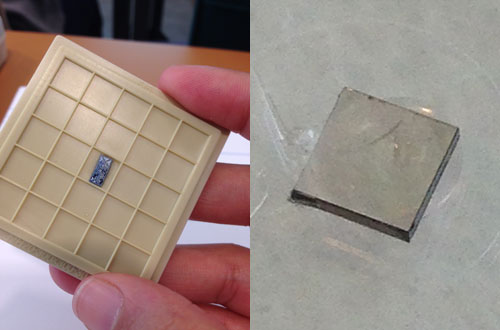
Quantum kit: two superconducting qubits (left) and an artificial diamond with an NV centre (right). (Courtesy: Tushna Commissariat)
I’ve left sunny Stockholm and I’m back at the office in blustery Bristol, but I still have a few good quantum tales to tell from the science-writers’ workshop at NORDITA last week. On Thursday, the main speaker of the day was Raymond Laflamme, who is the current director of the Institute for Quantum Computing at the University of Waterloo in Canada. Laflamme – who kick-started his career working on cosmology at the University of Cambridge in the UK as a student of Stephen Hawking – studies quantum decoherence and how to protect quantum systems from it by applying quantum error-correction codes, as well as using nuclear magnetic resonance (NMR) to develop a scalable method of controlling quantum systems.