How to make a tougher quantum computer

A system of nine quantum bits (qubits) that is robust to errors that would normally destroy a quantum computation has been created by researchers at the University of California, Santa Barbara (UCSB) and Google. The device relies on a quantum error-correction protocol, which the team says could be deployed in practical quantum computers of the future.

In principle, powerful quantum computers can be built from a collection of qubits. For a qubit based on an electron, for example, these states would be “spin up” and “spin down”, with one state representing a logical “1” and the other “0”. Each qubit can be in a superposition of two quantum states at the same time and N qubits could be quantum-mechanically entangled to represent 2N values simultaneously. This would lead to the parallel processing of information on a massive scale not possible with conventional computers.

Extremely fragile

However, quantum computers are extremely fragile, and a computation can be easily destroyed by “bit errors” that occur when external noise in the environment affects the values of the qubits. While it is proving very difficult to create practical qubits that are robust enough to eliminate such errors, an alternative approach is to accept that errors will occur and to try to correct for them as the quantum calculation progresses.

Now, UCSB’s John Martinis and colleagues have taken an important step forward by demonstrating repetitive error correction in an integrated quantum device that consists of nine superconducting qubits. Each qubit is a small circuit consisting of a capacitor and a Josephson junction, and is made from an aluminium film evaporated onto a sapphire substrate. The qubit can be thought of as an artificial atom with information stored in its quantum states.

“Our nine-qubit system can protect itself from bit errors that unavoidably arise from noise and fluctuations from the environment in which the qubits are embedded,” explains team member Julian Kelly. “We also show that ‘more is better’: nine qubits protect the system better than five qubits, a critical requirement when moving to more qubits in a real quantum computer of the future.”

Measuring parity

“In quantum mechanics, we cannot measure a qubit without destroying the superposition and entanglement that makes quantum mechanics work,” says team member Rami Barends, “but we can measure something called parity – which forms the basis of quantum error correction.” The parity is defined to be “0” if both qubits have the same value and “1” if they have different values. Crucially, it can be determined without actually measuring the values of both qubits.

The researchers exploited this fact and repetitively measured the parity between adjacent “data” qubits by making use of “measurement” qubits. “Each cycle, these measurement qubits interact with their surrounding data qubits using quantum logic gates and we can then measure them,” Kelly explains. “When an error occurs, the parity changes accordingly and the measurement qubit reports a different outcome. By tracking these outcomes, we can figure out when and where a bit error has occurred and correct for it.”

More is better

The more qubits that are involved in the process, the more information is available to identify and correct for errors, explains team member Austin Fowler. “Errors can occur at any time and in all types of qubits: data qubits, measurement qubits, during gate operation and even during measurements. We found that a five-qubit device is robust to any type of bit error occurring anywhere during an algorithm, but a nine-qubit device is better because it is robust to any combination of two-bit errors.”

Although still a long way off from real-world applications, the researchers say that a “self-correcting” device such as theirs could be a great platform for testing some of the ideas behind error correction – such as protecting a quantum state against so-called phase-flip errors. “We are also now busy improving the quality of our qubits and the materials we use to make them,” says Kelly.

The research is described in Nature.

Pioneering women of physics, why you should become a particle physicist and a BICEP2 scientist on all that dust

Over on the Quantum Diaries blog, Aidan Randle-Conde has put together a lovely photo-essay called “30 reasons why you shouldn’t be a particle physicist”. It is reverse psychology, of course, and the 30 images highlight the benefits of devoting your life to studying subatomic particles. As someone who chose to do condensed-matter physics, do I now think that I made a huge mistake? No, but I have shared the thrill and excitement of being at CERN when the Higg’s was discovered and seen the Large Hadron Collider and its detectors up close, so I know where he is coming from.

(more…)

Quantum measurement is for the birds, but is not essential for plants

A new general approach for evaluating the “quantumness” of biological processes such as the ability of some birds to sense the Earth’s magnetic field has been developed by physicists in Switzerland and the US. It involves describing the process as a “quantum meter” that uses quantum coherence to measure magnetic-field strength or light intensity. Atac Imamoglu of ETH Zürich and Birgitta Whaley of the University of California, Berkeley, have applied their framework to bird navigation and photosynthesis, and have concluded that only the former is completely dependent on quantum coherence.

Scientists believe that some species of birds navigate using Earth’s magnetic field – an idea known as magnetoreception that is backed up by experiments that show that captive birds will respond to changing magnetic fields. Understanding how this happens is tricky. Although electron spins in biological molecules are affected by the Earth’s magnetic field, the size of the effect is so small that it should be completely washed out by thermal fluctuations. However, some quantum systems can be extremely sensitive to external magnetic fields, and this is why scientists believe that some birds could navigate by making quantum measurements.

Radical measurements

One such bird is the European robin, which appears to have magnetoreceptor molecules located in its visual system. Physicists believe that the measurement process is triggered when a “cryptochrome” protein absorbs light. This causes a flavin adenine (FAD) nucleotide on the protein to form an excited singlet spin state, which involves two electron spins with a combined spin of zero. This state then decays in picoseconds to a “radical pair state” in which the spin of one of the FAD electrons is transferred to an amino acid that is located about 1.5 nm away along the length of the protein.

This transfer is believed to preserve quantum coherence and because each spin is isolated from its surroundings, the resulting radical pair remains in a coherent quantum state for times greater than 10 ns. This, physicists believe, should be long enough for a robin to make a quantum measurement.

The direction in the protein along which this separation occurs provides a spatial reference for measuring the Earth’s magnetic field. In particular, the relative orientation of the separation direction and the Earth’s field affects the rate at which the radical pair will decay to a protonated state that provides a signal to the bird’s nervous system. Scientists believe that it is this protonated state – or subsequent chemical reactions – that links the bird’s sensory system to the magnetic-field measurement.

Success hinges on coherence

In this new work, Imamoglu and Whaley developed a general approach for looking at the interactions involved in the magnetic-field measurement, to work out whether the system is indeed a quantum meter. In the case of magnetoreception, they conclude that the measurement process hinges on the long-lived quantum coherence of the radical pair. Indeed, Imamoglu told physicsworld.com that quantum coherence boosts the ability of the system to measure magnetic fields by many orders of magnitude.

However, when Imamoglu and Whaley applied their analysis to photosynthesis, they came to a very different conclusion. In this case, the quantum meter is a collection of chromophore molecules, which transfer energy from absorbed sunlight to a “reaction centre” where the energy is extracted in the form of mobile electrons. Therefore, the quantum meter measures the intensity of the sunlight in terms of the rate at which electrons are produced.

The measurement process begins with sunlight “pumping” the chomophores from their electronic ground state into an excited state. Energy is then transferred from this state to the reaction centre by excitons (electron–hole pairs) that must first find their way through a labyrinth of chromophores. This involves hopping from molecule to molecule in a process similar to a random walk. This transfer occurs more rapidly and more efficiently than expected. This has led some physicists to suggest that the excitons travel through the chromophores via a coherent quantum superposition of all possible pathways, which could allow the excitons to find the most efficient route to the reaction centre with very few excitons being lost along the way.

Minor improvement

To decide whether coherent transfer makes a difference, Imamoglu and Whaley looked at the relevant timescales. If the excitons remained coherent for relatively long periods of time, they should be more likely to reach their destination and therefore boost the performance of the quantum meter. What the researchers found, however, is that this enhancement is at best 5–10%, and therefore photosynthesis could function without the need for quantum coherence.

Gregory Scholes of Princeton University told physicsworld.com that the role of quantum coherence in photosynthesis is still a matter of scientific debate. “My opinion is that coherence (whether or not it’s quantum I don’t specify) is the unavoidable consequence of fast energy transfer in a compact light-harvesting complex,” he explains. “So nature may not be targeting coherence, but it may use it ‘unknowingly’ by optimizing energy transfer rates.”

The research is described in Physical Review E.

Zombie outbreaks in San Antonio

By Michael Banks in San Antonio, Texas

If you ever find yourself in the unfortunate position of trying to survive a zombie apocalypse in the US, what should you do?

Well, according to Alex Alemi of Cornell University and colleagues, you should head to the Rocky Mountains or the Nevada desert.

Using 2010 US census data for population levels around the country, Alemi and colleagues used statistical mechanics to model how a zombie outbreak would spread.

(more…)

Gravitational lensing creates ‘Einstein’s cross’ of distant supernova

Multiple images of a supernova created by gravitational lensing have been captured for the first time by an international team of astronomers using the Hubble Space Telescope (HST). The “Einstein cross” pattern comprises four images of a distant supernova created by the gravitational lensing of its light as it passed a distant galaxy within a cluster of galaxies on its way to Earth. In addition to giving us a closer look at the dynamics of distant supernovae, the team says that its discovery will help to improve our understanding of the distribution of dark matter in the lensing galaxy and galaxy cluster, as well as to test Einstein’s general theory of relativity and measure the rate of cosmic expansion in the universe.

A gravitational lens is a large galaxy or group of galaxies that bends or “lenses” light from a distant source as it travels towards an observer. The effect was predicted by Einstein’s general theory of relativity and the first such lens was discovered in 1979. Sometimes, the distant light source, lensing galaxy and the observer line up precisely, and we can see an “Einstein ring” – a perfect loop of light from the source encircling the lensing mass. But if there is any misalignment along the way, we observe partial arcs or spots. Depending on the relative positions of the bodies, four such spots can be seen, forming an Einstein cross. The lensing effect serves as a “natural telescope” for astronomers, who can determine the mass of the lensing galaxy and its dark-matter content based on the amount of distortion observed.

Long search

“It’s a wonderful discovery,” says Alex Filippenko of the University of California, Berkeley, who is part of the team that found the latest quadruple-lensed supernova image, explaining that researchers have been “searching for a strongly lensed supernova for 50 years, and now we’ve found one”. Thanks to the many conditions that need to be fulfilled for a gravitational lens to be seen from Earth, and the relatively short lifetime of a supernova, such a lensed supernova with four images has never been seen before.

Even more interesting, thanks to an understanding of the peculiarities of gravitational lensing, the team already knows that a fifth image will appear in the next decade. This will give astronomers a “replay” of the supernova, because light can take various paths around and through a gravitational lens and therefore arrive at Earth at different times. This is particularly rare and useful, because astronomy is not normally a predictive science. “The longer the pathlength, or the stronger the gravitational field through which the light moves, the greater the time delay,” says Filippenko.

The team used a computer model to predict the pathways that the light from the supernova can take around the lensing cluster, which also suggests that we already missed out on seeing earlier images of the exploding star 10 and 50 years ago. The team has dubbed the distant supernova SN Refsdal (after the late pioneering astrophysicist Sjur Refsdal), and it is located about 9.3 billion light-years away (redshift 1.5), near the edge of the observable universe, while the lensing galaxy is about 5 billion light-years (redshift 0.5) from Earth.

Multiple replays

“Basically, we get to see the supernova four times and measure the time delays between its arrival in the different images, hopefully learning something about the supernova and the kind of star it exploded from, as well as about the gravitational lenses,” says team member Patrick Kelly, also at Berkeley, who discovered the supernova while looking through infrared images taken by the HST last November.

The galaxy that splits the supernova’s light is part of a large cluster – MACS J1149.6+2223 – that was discovered more than 10 years ago. In 2009 astronomers reported that the cluster created the largest known image of a spiral galaxy ever seen through a gravitational lens. The more distant galaxy appears in multiple images around the foreground lensing cluster and it hosts the supernova in one of the galaxy’s spiral arms. “We get strong lensing by a red galaxy, but that galaxy is part of a cluster of galaxies, which is magnifying it more. So we have a double lensing system,” explains Kelly.

Kelly hopes that measuring the time delays between the phases of the supernova in the four images will let them put better constraints on the mass distribution of the foreground galaxies, as well as the expansion and geometry of the universe. If the researchers identify it as a Type Ia supernova (these have relatively standard brightness) by studying its spectrum, they could place even stronger limits on both the matter distribution and cosmological parameters.

The work is published in Science.

Rediscovering Marie Curie and the pioneering women of science

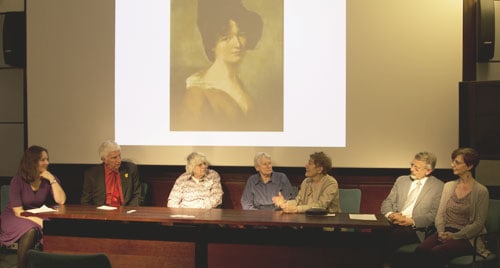
This Sunday, as the world celebrates International Women’s Day, I’ll be thinking of some amazing women who had a huge impact on the world of physics, helping shape the field as we know it today. Indeed, yesterday I was at the Institute of Physics in London, attending a day-long conference on “The lives and times of pioneering women in physics” hosted by the Institute’s Women in Physics group along with its History of Physics group. While there were a host of interesting speakers at the event, undoubtedly the star of the day was French nuclear physicist Hélène Langevin-Joliot, granddaughter of one of the 20th-century’s most famous female physicists – Marie Curie.

(more…)

Daresbury holds a ‘wedding for microscopists’

Photograph of Quentin Ramasse

Last month on a rainy grey morning in north-east England I headed to the Daresbury Laboratory as the SuperSTEM lab there celebrated the installation of its latest world-class microscope. Industrial and academic microscopists from around the world gathered for the inauguration, which was described as a “wedding for microscopists” because so many people from the tightly knit microscopy community were there. You can hear the excitement in the audio piece below, where SuperSTEM lab director Quentin Ramasse and other researchers at the event tell me their plans for the new instrument.

Celebrating SuperSTEM 3

(more…)

Celebrating a year of light

By Michael Banks in San Antonio, Texas

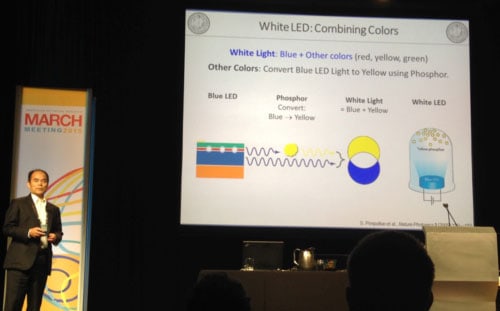
With 2015 being the International Year of Light it is perhaps the perfect opportunity to have a session at this year's American Physical Society meeting in San Antonio dedicated to the forefront of optics research.

Yesterday afternoon saw a number of light pioneers update delegates about their research. The session boasted three of last year's Nobel-prize winners: Stefan Hell of the Max Planck Institute for Biophysical Chemistry in Gottingen, Germany; William Moerner of Stanford University; and Shuji Nakamura of the University of California, Santa Barbara.

(more…)

Virus mapped in 3D using X-ray pulses

Intense, extremely short pulses of X-rays have been used for the first time to reconstruct 3D images of individual virus particles. Developed by an international team of physicists, the diffraction technique could make it possible to map the structure of infectious viruses such as HIV, influenza and herpes, shedding light on possible ways to combat diseases caused by these infectious agents.

Scientists have used X-ray diffraction to image live cells, viruses and simple nanostructures in 2D using a technique called nanocrystallography. This involves incorporating a number of identical particles (viruses, for example) into a crystal – a time-consuming and expensive process that does not work for some particles. Now, a team led by Janos Hajdu at Uppsala University in Sweden has tested a technique that avoids crystallization with the added benefit of delivering 3D images.

We outrun radiation damage but we only get one shot per sample
Janos Hajdu, Uppsala University

Brighter than the Sun

The team focused on the Acanthamoeba polyphaga mimivirus, which is about 450 nm across. The researchers injected virus particles into an aerosol stream, which was then subjected to high-energy pulses from an X-ray free-electron laser at Stanford University. Each pulse lasted just 70 fs and delivered a peak power density more than 1018 times that of sunlight hitting the Earth.

Such an extremely intense pulse will vaporize a mimivirus particle, but not before the X-rays scatter from the virus and create a diffraction pattern that is recorded by a bank of detectors. "We outrun radiation damage but we only get one shot per sample," explains Hajdu. Because X-rays primarily scatter off of electrons, the diffraction patterns that Hajdu and his team recovered can be used to calculate the distribution of electrons within the mimivirus particles.

Hajdu and his team scattered X-rays off nearly 200 identical mimivirus particles, collecting one 2D diffraction pattern from each event. To make sure that the particles were not altered by being injected into an aerosol, the team showed that mimivirus particles that did not intersect the laser pulses were still infectious.

Adding a dimension

With nearly 200 diffraction patterns in hand, Hajdu and his colleagues next set about adding the patterns together to produce a single 3D image. Combining data from different observations not only increases the signal – necessary for small viruses that scatter X-rays weakly – but also gives insights about viral structure that are only possible with 3D observations.

Series of 24 diffraction patterns captured from 24 different virus particles

One important complication that the researchers had to overcome is that they were not all oriented in the same way with respect to the X-ray pulses. Instead, their orientations were randomly distributed. Therefore, it is necessary to retrieve the relative orientation of each mimivirus particle before adding the diffraction patterns together. Hajdu and his team did this using a mathematical optimization algorithm developed by another group of physicists in 2009. Because this algorithm presumes that the particles differ only in orientation, identical particles must be used. Fortunately, many pathogenic viruses that affect humans are reproducible, such as HIV, influenza and herpes.

The researchers achieved a spatial resolution of approximately 125 nm in their final reconstructed image of the mimivirus's electron density. Better resolutions have been recorded in other 2D studies, but this investigation is important because it shows that 2D diffraction patterns can be combined to produce 3D images of biologically important samples. "We now look forward both to pushing towards higher resolution and studying both smaller and larger samples," says Hajdu.

This research is described in Physical Review Letters.

Supporting industrial physicists

By Michael Banks in San Antonio, Texas

Here is a stat for you: around 50% of US physics graduates (both undergraduates and postgraduates) go on to work in industry.

Whether you think that is good or bad, the American Physical Society (APS) wants to do more to support those physicists who don't pursue a career in academia.

(more…)

Copyright © 2026 by IOP Publishing Ltd and individual contributors