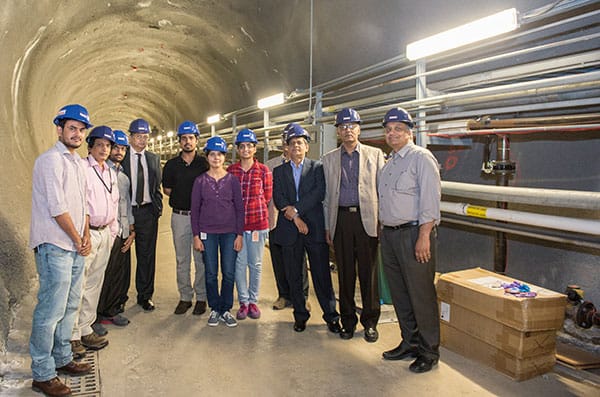
The Indian government has given the go-ahead for a huge underground observatory that researchers hope will provide crucial insights into neutrino physics. Construction will now begin on the Rs15bn ($236m) Indian Neutrino Observatory (INO) at Pottipuram, which lies 110 km from the temple city of Madurai in the southern Indian state of Tamil Nadu. Madurai will also host a new Inter Institutional Centre for High Energy Physics that will be used to train scientists and carry out R&D for the new lab.
Originally planned to be complete by 2012, the INO has been in limbo for a number of years. In 2010 ecologists and conservationists raised objections to the INO’s initial proposed site at Singara in Tamil Nadu, which was near an elephant corridor and a tiger reserve. Researchers then had to find a new location, with the environment ministry only approving the Pottipuram site in 2011. Funding from the government arrived three years later.
The INO will be built some 1.3 km underground, accessible via a 2 km-long tunnel. The lab will comprise three caverns, the largest being 132 m long, 26 m wide and 30 m high, which will house a 50,000 tonne Iron Calorimeter (ICAL) neutrino detector. The detector will consist of alternate layers of some 30,000 “resistive plate chambers” and iron plates.
The outcome of this investment will be extraordinary and long term
Krishnaswamy Vijayraghavan, secretary of the Department of Science and Technology
The INO team hopes to use the detector to address the “neutrino-mass hierarchy”. Scientists know that there are three neutrino-mass states, but do not yet know which is the most massive and which is the lightest. “Understanding this will help scientists to pick the correct theory beyond the Standard Model and, along with other accelerator-based experiments worldwide, address the problem of matter–antimatter asymmetry in the universe,” says INO project director Naba Mondal, who is based at the Tata Institute of Fundamental Research in Mumbai (TIFR).
As well as housing other experiments such as those searching for dark matter and neutrino-less double-beta decay, scientists are also hopeful that the INO will provide opportunities for young students to work on all aspects of particle-physics research, such as detector development and data analysis. “Science students across the country will have the opportunity to participate in building sophisticated particle detectors and electronic data-acquisition systems from scratch,” says Mondal.
Indeed, Krishnaswamy Vijayraghavan, secretary of the Department of Science and Technology, which oversees funding for many science projects, says that the INO could “allow India to train experimental physicists and high-end engineers on a large scale” in “extremely important and competitive high-energy physics”. “INO will be the agent of transforming physics of this kind in India and will make a global impact,” he adds. “The outcome of this investment will be extraordinary and long term.”
Taking centre stage
Researchers also hope that the INO could help India to reclaim its leading position in neutrino physics and in constructing underground labs. The country led the way in the 1960s when physicists used a gold mine at Kolar in the southern state of Karnataka to create what was then the world’s deepest underground lab. Known as the Kolar Gold Field Lab, in 1965 it enabled researchers to detect neutrinos that are created when cosmic rays smash into the atmosphere. The lab later studied proton decay and was only shut down in 1992 when gold mining at the site became uneconomical.
“With the closure of the mines, we lost a unique facility for carrying out research in the field of non-accelerator-based particle physics,” rues Mondal. “With the approval of the INO facility, we are now back on the centre stage of particle-physics research.”
The family of chicken-sized birds native to South America called tinamous lay brightly coloured eggs that are some of the glossiest in nature. Now, an international team of scientists has discovered the secret to the eggs’ mirror-like sheen, which rivals that of highly polished man-made materials.
“Imagine a shiny, brand new car. The eggs of these birds are so shiny that they are reflective,” says Branislav Igic, an avian biologist from the University of Akron in Ohio, who did the work with colleagues in the US, the Czech Republic and New Zealand.
In the new study, Igic and his team used a combination of microscopy and chemical analyses to show that the glossiness of tinamou eggs is down not to pigments, but rather the nanostructure of the shell itself. In particular, the outermost layer of the shells, called the cuticle, is extremely smooth and composed of a unique mix of proteins and chemical elements such as calcium carbonate and calcium phosphate.
Smooth reflection
“A smooth surface means that light gets reflected back at the same angle that it comes in at,” says Igic. “A rough surface has tiny valleys and hills that scatter the light in all directions, and that leads to a more matt appearance.”
The study also reveals that the blue eggs of the great-tinamou bird are weakly iridescent – that is, the colour perceived by the viewer changes depending on the angle of observation and illumination. This optical effect, common in moth and butterfly wings, has never been seen in bird eggs before. “It’s a very subtle iridescence,” says Igic. “Human eyes may not be able to discern it, but birds have better colour acuity, so they are probably more sensitive to these changes in colour.”
Silvia Vignolini, a chemist at the University of Cambridge in the UK who studies colours in nature and who was not involved in the study, says the work sheds new light on how different bird species use combinations of materials and structural features to create various optical effects.
Surprising function
Mary Stoddard, an evolutionary biologist at Harvard University in the US who also did not participate in the research, says that the new findings reveal a surprising function for egg cuticles: “Typically, we think about the cuticle’s function in protecting the egg from bacteria or in containing surface pigment, but here the researchers show that it can also play an important role in producing the egg’s sheen.”
It is still unclear, however, why tinamous – and birds in general – lay conspicuous eggs that could make them more attractive to predators. In the case of tinamous, one important clue may be that it is the males and not the females who incubate the eggs.
Blackmailing males
“One idea”, says Igic, “is that by laying shiny, conspicuous eggs, females are blackmailing the males into incubating the eggs for longer periods, because otherwise the eggs would be easy targets for predators.”
Another possibility is that the eggs’ shininess is a by-product of a mechanism that reduces water exposure. “A polished surface might be better at repelling water, but this hypothesis hasn’t been tested yet so we don’t know for sure,” says Igic.
The research is described in the journal Interface.
As glaciers move faster, they experience less friction between the ice and the ground below. This is the conclusion of Lucas Zoet and Neal Iverson of Iowa State University in the US, who used a new experimental tool to simulate glacial sliding and demonstrate the importance of understanding how ice deforms to create cavities as it flows across large obstacles.
Given their potential for contributing to sea-level rise, understanding how glaciers move is vital to predicting their response to changing climates. However, gaining insights into how the underside of a huge piece of ice travels across the rough surface of the Earth is an extremely challenging problem. When modelling the flow of ice sheets, an increase in a glacier’s sliding speed was assumed to result in a corresponding increase in drag. In the late 1950s, however, the French glaciologist Louis Lliboutry proposed a more complicated sliding law – one in which increasing speed could ultimately result in a decrease in drag, once a threshold sliding speed has been exceeded. At the heart of this alternative theory is the impact of cavities that form in ice in the wake of obstacles on the Earth’s surface.
Bumps and pockets
“As ice slides forward, it has to viscously deform to get around a bump, much like water has to viscously deform to get around a stone at the bottom of a stream,” explains Zoet. Unlike with water, however, the ice is slow to fill in behind the obstacles that it passes around. “This leaves a pocket behind the bump of a size that is dependent on how fast the ice is sliding and how much pressure is acting on the ice to close the pocket,” Zoet adds.
As the glacier slides faster, the sizes of the cavities formed increase, extending out further behind the topographic obstacles that created them. According to Lliboutry’s theory, on an idealized glacier bed comprising a series of sinusoidal bumps, drag can be decreased when the cavities become large enough to extend beyond the inflection point of the next bump in the series. While this “double-value theory” has been the subject of debate, the difficulties of studying sub-glacial processes in the field – via boreholes, for example – have prevented it from being empirically tested.
To better explore these processes in a controlled setting, Zoet and Iverson created a new experimental device for simulating glacial sliding in the laboratory. Their simulator consists of a ring of ice 90 cm in diameter and 21 cm thick that is rotated above a rigid, sinusoidal bed. A hydraulic ram applies a constant downward force on the ice, simulating the weight of an overlying glacier while also allowing for the growth or contraction of cavities at the bed interface. The simulator operates within a cold room, with an additional fluid cooling system maintaining the ice ring at its pressure-melting temperature of 0.01 °C. Windows in the wall of the simulator allow the internal deformation of the ice to be observed, through the displacement of plastic marker beads embedded into the ice.
More realistic sliding rules
The researchers conducted a number of experiments to determine the relationship between the drag exerted on the ice and its sliding speed. “Lliboutry’s predictions matched our results well,” Zoet told physicsworld.com, adding that the results “will give theorists firm ground to stand on, moving forward, so that more complicated and realistic sliding rules can be developed”.
Ian Willis – a glaciologist at the University of Cambridge who was not involved in the study – calls the work “exceedingly valuable”, commenting that “it provides ammunition to the idea that existing large-scale numerical glacier and ice-sheet models – the sort of models that are used to project ice-mass responses to future warming – should incorporate such ‘double-valued’ sliding laws”.
Commending the design of the researchers’ experiment, glaciologist Martin Sharp of the University of Alberta agrees, adding that the double-valued relationship “could help to explain the episodic occurrence of ice avalanches, and the sudden changes in rates of glacier flow that are increasingly observed in the era of satellite monitoring of glacier velocities”.
The première was only 30 minutes away, and my voice was alarmingly hoarse. I had come down with a common cold just as I was supposed to play the role of the devious pilot Yang Sun in Bertolt Brecht’s The Good Person of Szechuan. Our enthusiastic amateur theatre group had been practising the piece three times a week for months, and I hated the prospect of having to cancel our first public performance. Luckily, one of the cast was a doctor, and she gave me a shot of industrial-grade cough medicine. Within minutes my voice had made a miraculous recovery, and I followed through with the 90-minute vocal ordeal.
The next day, however, I couldn’t utter a word – no sound whatsoever. My regular doctor instructed me to stay completely quiet for 10 days to let me heal my vocal folds – those twin flaps of mucous membrane in the larynx that vibrate to create sound when air is forced through them. My enforced silence caused surprisingly many inconveniences. The worst was that my wife couldn’t help thinking I was mad at her, despite knowing full well that I wasn’t giving her the “silent treatment”!
What this episode illustrates is that spoken language is simply such an integral part of our everyday experience that it is hard to imagine life without it. For me, my temporary lack of voice was a minor inconvenience, but sadly there are many people who are not able to speak at all. For some of them it is a disability they were born with, while others end up with no voice as a result of a stroke, an accident or cancer.
Although the spoken sounds we utter every day are effortless to produce, they are actually extremely complex
Fortunately, it is possible to help speech-impaired people with technological aids. And in this digital age we can do far better than the infamous bicycle horn of Harpo Marx. We can programme computers to turn text input into audio output, as evidenced by Stephen Hawking’s speech synthesizer. However, mimicking human speech is not as easy as it might seem. Although the spoken sounds we utter every day are effortless to produce, they are actually extremely complex. Communicating is not only a question of what you say but also a question of how you say it, and the how part is based on very subtle nuances.
It is these human-like how features that are very difficult to design into text-to-speech algorithms. In other words, it is hard to make computers speak with versatile and natural-sounding emotional content. Another problem is that it is tricky to synthesize a woman’s or a child’s voice – as these have a higher pitch than men’s voices – meaning that many women and children who have lost their voice have to use a speech synthesizer that sounds like a man.
Computer-generated speech
Designing and programming good speech-synthesis software is a daunting task. The most straightforward approach would be to record a huge collection of sample sounds, Each word would be read by a person at several pitches, with different emotional content – angry, loving, happy, strict and so on – and possibly for several dialects. Each word would need to be spoken by women, men, girls and boys, and for each language we wish to synthesize.
This method has its drawbacks, however. Consecutive samples do not necessarily fit well together, resulting in unnatural-sounding speech, while the processing power and computer memory required may make portable devices impractical.
An alternative approach, which is computationally more efficient, is to first analyse and understand speech by dividing it up into its structural components and then to synthesize each of these. This method, which Hawking uses, lets him control many aspects of speech, such as melody, rhythm and intonation, all of which are important in distinguishing statements from questions and for expressing emotion.
There are many mathematically and computationally challenging aspects of this method. In my research I focus on generating vowel sounds, which is hard but at least it suffices to model “static” sounds. Synthesizing consonants is even harder since it always involves dynamical, fast-changing features.
For model purposes These life-sized replicas of vocal-tract shapes were simulated on a computer to make the vowel sounds (from left to right) “a”, “i”, “u”, “e” and “o”. Produced by 3D printing in the Industrial Mathematics Laboratory of the University of Helsinki, these physical models, which accurately represent the computational models, are crude – the longitudinal axis of the real vocal tracts is curved instead of straight, and the cross-sections are not circular. Nevertheless, holding a vibrating electronic larynx to the end of these tubes demonstrates that these five shapes do provide decent vowel sounds. (Courtesy: Samuli Siltanen)
A vowel sound consists of two independent ingredients. The first is the sound produced by the vocal folds flapping against each other, known as the glottal excitation signal. (The vocal folds and the gap between them are called the glottis.) The second ingredient is the modification of this sound by the vocal tract, which is the curved and intricately formed air space between the vocal folds and the lips.
Let’s try a simple musical experiment to demonstrate. While the suggested performance may not hit the charts, it illustrates the independence of the two components of a vowel sound. First, sing “Mary had a little lamb” with all the words replaced by “love”. This shows that the same vowel can be uttered using an arbitrary pitch (well, within some limits, obviously). Second, sing the words “sweet love” at the same pitch as each other. This demonstrates how the pitch can be kept the same while singing two different vowels.
The pitch of a vowel sound is measured in hertz and is the number of times the glottis closes in a second. The vocal folds are actually the fastest-moving parts of the human body, with the pitch of a typical male voice being between 85 and 180 Hz, and that of a female voice from 165 to 255 Hz. The pitch of the vowel sound comes solely from the glottal excitation signal.
As the “sweet love” example above shows, even when two different vowel sounds have the same pitch it is very easy to distinguish between them. The same goes for notes of the same pitch played by different musical instruments – think of how easy it is to tell the difference between a piano and a saxophone playing the same note, for example.
This quality of the sound that makes it identifiable – often referred to as the character or “timbre” – is best studied in the frequency domain. The simplest sound, known as a pure tone, contains only one frequency. The glottal excitation signal contains all frequencies equal to or higher than the pitch of the signal. However, the shape of a vocal tract modifies this signal to create a complex tone, in which some of these frequencies are damped and others emphasized to create a unique sound.
Figure 1
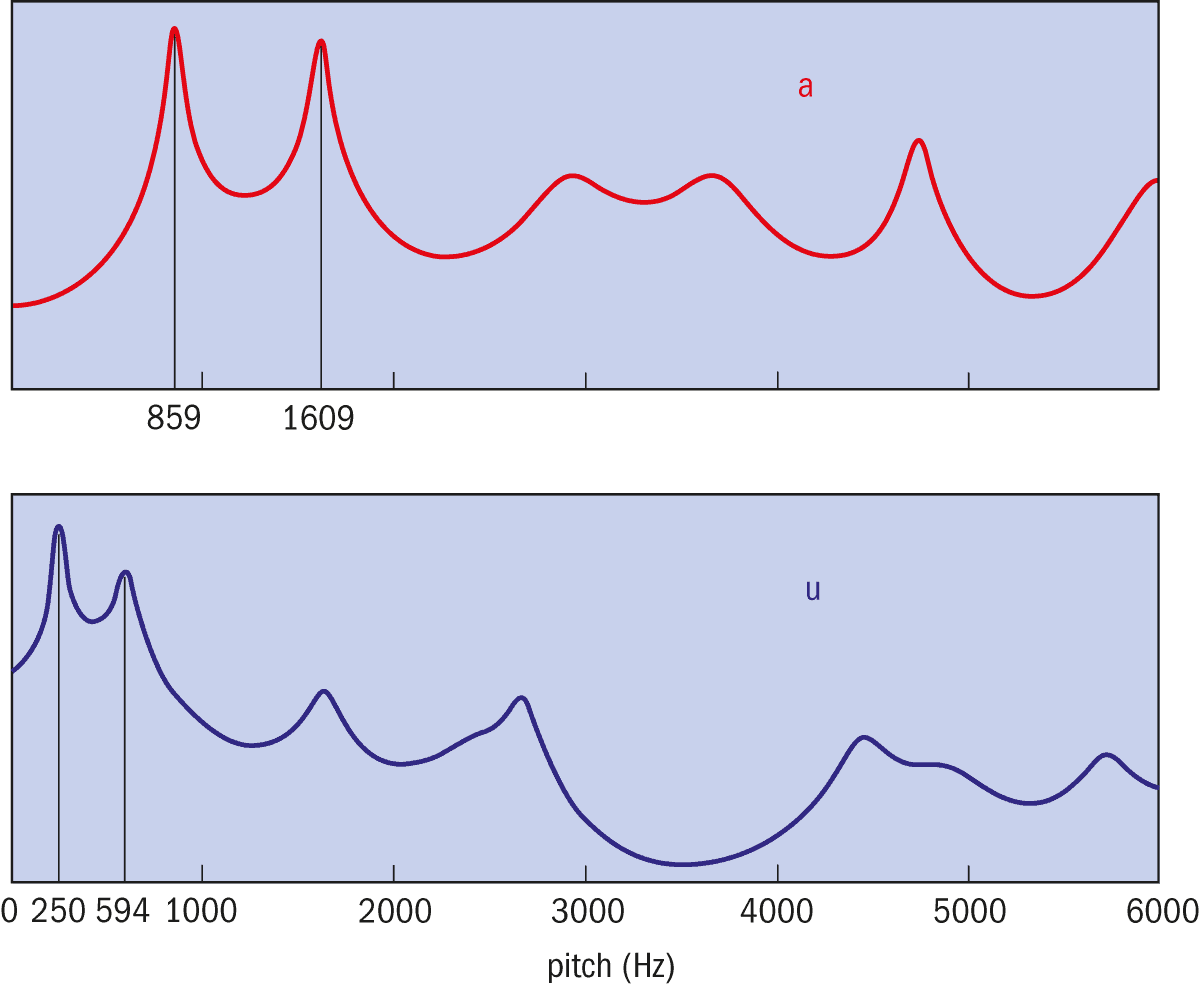
When people make vowel sounds, such as “a” in the word “car”, and “u” in the word “rule”, the effect of the vocal tract can be neatly observed in the so-called frequency domain. Similarly to a frequency equalizer on 1980s home stereos, the vocal tract emphasizes some frequencies and damps others. The most prominent frequencies are called the formants and define which vowel sound is being made. As shown here for example, the first and second formants for “a” are 859 Hz and 1609 Hz, while in “u” they are 250 Hz and 594 Hz.
Figure 1 shows examples of two vowel sounds in the frequency domain. Each vowel has two specific frequencies that are strongly emphasized, seen here as the two highest peaks: the so-called first and second formants. To make a particular vowel sound, muscles in the tongue, mouth, throat and larynx activate to give the vocal tract a particular shape in which these two formants resonate. You can observe a similar resonance when singing in a shower cubicle: certain notes seem to vibrate the whole bathroom, while others do not.
Creating natural-sounding vowels
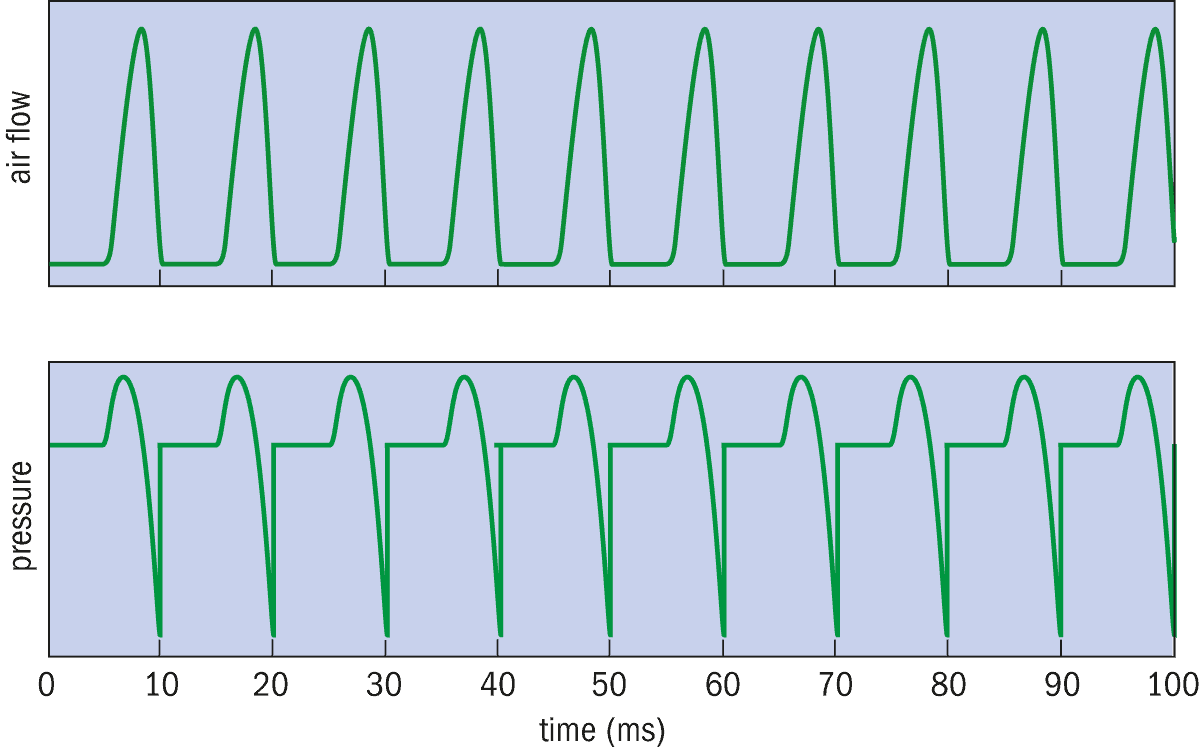
To generate natural-sounding synthetic vowel sounds using a computer, we use a simple model for both the glottal excitation signal and the shape of the vocal tract. The excitation signal is described by a mathematical formula giving the amount of air flowing through the glottis at any given time (figure 2). Regarding the vocal tract shape, in the simulations we use circular tubes of varying radii, creating life-sized models of them for demonstration purposes (see the photo higher up this article). While these forms are far from the true anatomical shapes, they produce surprisingly natural vowel sounds.
Figure 2
In our synthetic speech simulation at the University of Helsinki we simulate the periodic airflow through the glottis as a function of time, here with a pitch of 100 Hz (top). The vocal folds periodically flap against each other and every closure of the glottis brings the airflow abruptly to zero. Vital for our model is the pressure in the vocal tract as a function of time, known as the glottal excitation signal (bottom), which is calculated as the derivative of the airflow.
Good-quality synthetic speech needs natural samples of glottal excitations and shapes of vocal tracts. Those things are difficult to measure directly. The glottal excitation signal can be roughly recorded using a microphone attached to the Adam’s apple, and the shape of the vocal tract can be imaged using magnetic resonance imaging. It would be much nicer, however, if one could recover all that information simply from regular microphone recordings of vowel sounds. This in turn requires solving an inverse problem.
As with many inverse problems, the measurement data are not enough on their own to uniquely determine the cause
An inverse problem involves trying to recover a cause from a known effect. It is a bit like a doctor trying to find out the reason why a patient has joint pain, a cough and a fever: there are several different conditions that could lead to those symptoms. As with many inverse problems, the measurement data (i.e. the symptoms) are not enough on their own to uniquely determine the cause (i.e. the illness). Therefore, enough a priori information – such as ongoing epidemics, season and weather, the patient’s history of illness – has to be added in order to arrive at a correct solution. (A forward problem, incidentally, involves simply going from cause to effect: if the patient is known to be infected with an influenza virus, then the doctor can easily and reliably predict joint pain, a cough and a fever.)
A roulette of vowels
The inverse problem my collaborators and I are studying is called glottal inverse filtering (GIF). The starting point is a short vowel-sound recorded with a microphone and given to the computer in digital form. The aim of our method is for the computer to output a glottal excitation signal and a vocal tract shape that together produce as closely as possible the original vowel sound. The recovered excitation signal and vocal tract shape can then be used separately in many other combinations to produce a wide variety of different vowel sounds.
A simple trial-and-error approach would not work, as there are several different combinations of excitations and tract shapes that produce very closely the recorded vowel sound: in that case the effect is right but the cause, or structural components of the vowel, are wrong.
The GIF method we have developed is kind of a refined, probability-driven, trial-and-error procedure, which uses Bayesian inversion implemented as a so-called Markov chain Monte Carlo (MCMC) approach. As this gambling-related name implies, MCMC involves generating random values, which we like to think of as spinning a roulette wheel. (See the box below for more on this general method.)
For each vowel sound that we are trying to simulate, our MCMC-GIF method produces a long sequence of vowel sounds – typically 30,000 of them. The sequence is created using a random process subtly geared so that the average of all the 30,000 sounds in the sequence will be a nice solution to the inverse problem.
The gearing of the random process goes like this: the first sound in the sequence can be freely chosen. From then on, the next sound in the sequence is always defined either by accepting a candidate sound or rejecting the candidate and repeating the previous sound in the sequence. The candidate vowel sound is randomly picked by “spinning the roulette wheel”, or choosing a random glottal excitation signal and a random shape for the vocal tract. It is accepted only if it has high enough probability judged by the known measurement information (how close the candidate sound is to the original microphone recording) and the a priori knowledge (e.g. that the formants of the candidate are not too far from those of a typical vowel “a”).
Synthesizing speech by solving an inverse problem
In simulating speech using computers, we need to solve something called an inverse problem to produce natural-sounding vowels. This mathematical problem involves starting with a vowel sound and figuring out from it the initial conditions that led to that sound, i.e. the frequency at which the vocal tracts vibrated and the shape of the vocal tract.
To illustrate how this method works, here is a simple example in which we estimate the age of an imaginary girl, Jill. Suppose we have a recently taken, badly focused photo of Jill blowing out the candles on her birthday cake. It seems that there are 10 candles, but we cannot say for sure. This is our noisy measurement information: the number of candles is 10, give or take a few. We can model the uncertainty using a Gaussian bell curve centred at 10 and having a standard deviation of, say, three years.
We also have a priori information: say we know Jill won a medal in the under 32 kg division of the last International Open Judo Championship. The historical record of medallists gives empirical probabilities: for example, there is a 4% chance that Jill is 9 years old and 13% chance that she is 11. Also, from the championship rules we know that she is definitely at least 8 and at most 15.
Let us now construct a sequence of numbers that are estimates of Jill’s age. The first number is 10 – the apparent number of candles on Jill’s birthday cake. To determine the next number we spin a hypothetical roulette wheel and call the result (a randomly picked number between zero and 36) the “candidate”. Now we either accept the candidate and add it to the end of our sequence, or reject it and instead repeat the last number in the sequence.
So how do we choose whether to accept or reject the candidate? What we do is to calculate the probability of the last number in the sequence and the probability of the candidate – the latter being the product of the photo-based probability (the Gaussian bell curve centred on 10) and the judo-based probability (given by the historical percentage). If the probability of the candidate is higher than the probability of the last number in the sequence, we accept the candidate. If the candidate is less probable, we do not reject it outright but rather give it one more chance. For example, if the probability of the candidate is a third of that of the last number in the sequence, we spin the roulette wheel again and accept the candidate only if the wheel gives a number smaller than or equal to 12 (which is a third of 36).
Finally, the average of the sequence of numbers generated with the above randomized method is an estimate for Jill’s age. The longer the sequence of numbers we generate, the better estimate we get.
Of course, in our simulation we’re not trying to compute an age but the frequency and vocal-tract shape that led to a certain vowel sound (see main text).
Voice of the future
Before our new method, there were no clear samples available of high-pitched excitation signals that women and children could use for natural-sounding synthetic speech. That’s because traditional methods are unable to solve the inverse problem for high-pitched voices – they cannot separate the excitation signal and the filtering effect of the vocal tract from each other. This means that the only option for many women and children is to use a speech synthesizer with a man’s voice.
In our work, we show that the probabilistic MCMC-GIF method can recover glottal excitation signals and vocal tract shapes more accurately than traditional GIF algorithms, even for voices with high pitch. Once these new computational advances are put in place, women and children will therefore be able to express themselves via computer-generated speech better suited to their identity. We hope that, as a result, quality of life will be improved for women and children who have lost their voice.
Our new method is still in the research phase in the sense that it is computationally quite expensive. However, now that we have demonstrated that it works, we are working on the next step – using mathematical techniques to speed it up. Once this is achieved we will be able to offer it to speech-synthesizer companies, who can then make the technology available.
Making a biographical film about someone who is still alive is tricky, especially when the subject is both famous and intensely guarded about his private life. But with The Theory of Everything – a biopic of the physicist Stephen Hawking that focuses on his relationship with his first wife Jane, based on her memoir of their 30 years together – director James Marsh seems to have pulled it off. The film starts in 1963, when Hawking (played by Eddie Redmayne) is a cosmology student at the University of Cambridge. Already determined to find a “simple, eloquent explanation” for how the universe works, the young Hawking comes across as both intelligent and awkward – a combination that intrigues and charms Jane Wilde, an arts student he meets at a party. Early in their courtship, Hawking is diagnosed with motor neurone disease and told that it will kill him in about two years. Despite this bleak prediction, the pair get engaged and initially it seems they can navigate the troubled waters of illness (and rising fame) together. As time passes and Hawking’s physical limitations become more significant, however, stresses take their toll and previously stiff upper lips begin to wobble, especially after an emergency tracheotomy causes Hawking to lose his voice. The Theory of Everything is, in the main, a love story, but it is no saccharine drama, and Marsh deliberately steers away from the maudlin. While the character of Jane Hawking (played by Felicity Jones) appears slightly naive at the start, she comes into her own as the film progresses, rationing her tears as she tries to cope with the burdens of raising a family and dealing with her husband’s increasing fame, as well as the looming shadow of his illness. The film is not without its lighter moments, though: when Hawking gets a new computerized voice, one of the first things he says with it is “Ex-ter-minate!” While strong on Hawking’s humanity (and humour), The Theory of Everything has less to say about the physics research that made him famous. A few scenes do show him working on his theories and presenting them to ever-increasing audiences of friends and colleagues, but these merely skim the surface. While it seems odd to give so little time to the source of Hawking’s celebrity, Marsh was clearly aiming to depict Hawking the man, rather than Hawking the brilliant scientist. In this, he succeeds, with a subtle, restrained portrait of the lives of some very clever people.
2014 Universal Pictures/Focus Features, a Working Title production
A daily dose of mathematics
In a religious context, the term “devotional” refers to a book containing short prayers or other spiritual reflections for each day of the year. In The Mathematics Devotional, author Clifford Pickover strips out the religious element, replacing holy writ with quotations about mathematics and saintly iconography with computer-generated artwork, but otherwise leaves the devotional format intact. What you will find inside the crisp covers of his book are a short introductory essay, an even shorter set of micro-biographies of mathematicians, 366 quotations about the wonders (or frustrations) of mathematics and 366 pretty pictures to accompany them. And that’s it. Although sparse in its form and content, The Mathematics Devotional is (like some of its religious counterparts) a beautiful object, and the daily quotations are well selected from a diverse range of sources, including novelists, philosophers, physicists and mathematicians. On 20 January there’s even a snippet from Physics World’s own columnist, Robert P Crease, on the subject of great equations. Disappointingly, though, the illustrations are more or less information-free. Drawn from an opaque list of sources with only the briefest attribution, it is generally quite difficult to tell what (if any) mathematics they contain, and many bear little relation to the quotations that appear below them. Given that several robotic Twitter accounts provide their followers with much the same sort of thing, and for infinitely less money, it is a little hard to see where the audience for a book like this will come from – unless it’s made up of people who would otherwise struggle to think of gift ideas for mathematician in-laws or distant relatives.
Physicists around the world are gearing up for the International Year of Light and Light-based Technologies (IYL), which kicks off later this month at an official opening ceremony at the headquarters of the United Nations Educational, Scientific and Cultural Organization (UNESCO) in Paris. Some 1500 delegates are set to converge on the French capital for the event, which runs from 19 to 20 January, and will include representatives from the UN and UNESCO as well as the Nobel laureates Zhores Alferov, Steven Chu, Serge Haroche and William Phillips. Designed to highlight how light and light-based technologies touch every aspect of our lives, the IYL will involve more than 100 partners from 85 countries – including the Institute of Physics (IOP), which publishes Physics World.
The UN has declared “international years” since 1959 to draw attention to topics deemed to be of worldwide importance. In recent years, there have been a number of successful science-based themes, including physics (2005), astronomy (2009), chemistry (2011) and crystallography (2014), with the idea for a celebration of light having been initiated by the European Physical Society (EPS) in 2009.
Photonics is a technology that underpins modern life and provides real solutions to global problems
John Dudley, European Physical Society
“We began the IYL focusing primarily on outreach and education, but we rapidly realized that there was a political dimension that we hadn’t appreciated,” John Dudley, president of the European Physical Society (EPS), told Physics World. “Photonics is a technology that underpins modern life and provides real solutions to global problems, and we need to make sure that this is fully appreciated on all levels. We also need to stress that research can take decades before practical outcomes are apparent; a strategic long-term vision is required in investing in research and technology.”
Marking several anniversaries
This year was picked to celebrate light because it marks a number of anniversaries, including 1000 years since the publication of the work on optics by Ibn al-Haytham, during the Islamic Golden Age. The year also marks 200 years since Augustin-Jean Fresnel’s seminal paper introducing the notion of the wave nature of light, 150 years since James Clerk Maxwell’s work on electromagnetism that paved the way for technologies from lasers to mobile phones, as well as the centenary of the incorporation of the speed of light as an essential part of our description of space and time in Einstein’s equations of general relativity.
“One of the most exciting aspects of this International Year is the way in which it brings together such a wide range of different communities, from astronomy to medicine and photonics to arts and culture,” says Beth Taylor, chair of the UK National Committee for the IYL. “It creates a unique opportunity to cross traditional cultural divides and engage new and different audiences with the excitement of light and its applications.”
Worldwide events
The IYL will consist of a series of co-ordinated events around the world to communicate the importance of light and optical technologies in society – ranging from the Story of Light Festival in Goa, India, to Worldwide Pinhole Photography Day.
While Dudley does not want to single out any specific event, he says that the opening ceremony will be “high profile” to make an impact on a political level. “There are many wonderful and varied things happening and we will see many different outcomes in many different countries,” he says.
Hundreds of events are planned in countries all around the world. In the UK, a launch event will be hosted by the Duke of York, who is UK patron for the year, at St James’s Palace on 28 January. It is expected to highlight the strength of the photonics sector in the UK, which is worth some £10.5bn to the economy. The year will also feature events that monitor light pollution, while talks and exhibitions will be held aimed at educating the public about light-based technologies.
Proud legacy
Taylor says she is “particularly inspired” by the IYL’s Study after Sunset initiative, which aims to promote the use of solar lanterns in regions where there is little or no reliable source of light. “If we can help to make a difference to the uptake of solar lighting by families in the developing world with no current access to safe, clean, affordable light, we will ensure that the IYL leaves a real legacy after 2015, of which we can all be very proud,” she told Physics World.
The IYL was officially launched by the EPS during the Passion for Light workshop held in Varenna, Italy, on 16 September 2011, which was attended by more than 100 physicists and officials from UNESCO. A resolution endorsing the IYL was first adopted by UNESCO in October 2012 and submitted to the UN in November 2013. At the 68th session of the UN General Assembly in Paris in September 2013, the resolution was then adopted to declare 2015 the International Year of Light and Light-Based Technologies.
While officials are firmly focused on the myriad of events happening this year, Dudley, for one, is setting his sights beyond 2015. “One of the pleasures of organizing the IYL over the last few years has been to see the emergence of the next generation of leaders in education and public communication of science,” he says.
A free-to-read collection of our 10 favourite features on light from Physics World will be available later this month online via the digital version of the magazine or via the Physics World app, available from the App Store and Google Play
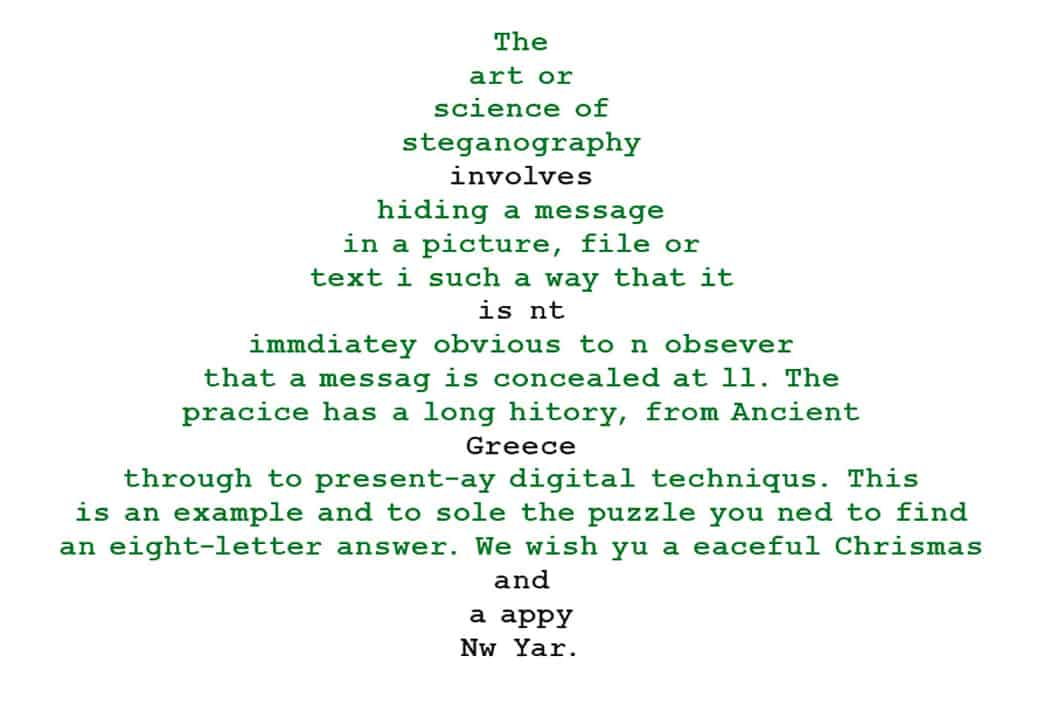
The image above is the second and final part of Physics World’s festive puzzle 2014. If this is the first you’ve heard about the puzzle, start by checking out Physics World’s festive puzzle: part 1, which was published a week ago.
Can you solve it? Let us know how you get on by posting a comment below, but please do keep the answer to yourself, if you work it out, to avoid giving the game away for others.
We hope you enjoy this bit of fun. There are no prizes – the only reward is the satisfaction of finishing the puzzle. Solutions will be published on this blog in January.
Although I wouldn’t want to tar us all with the same brush, for many people – including me – the festive period marks indulging in rest, rich food and a reacquaintance with the goggle-box.
Switching off and slumping on the sofa seems like the best thing ever for a few days, but eventually I find it gets a bit boring. That’s when I find myself craving some mental stimulation, whether that be gorging on crosswords, designing a new knitting pattern or learning a new programming language.
But how about you – are you busy right now digesting roast potatoes and zoning out on Indiana Jones, or do you have an appetite, instead, for a challenge?
Particle physicists in India have had much to cheer about since 2012. Not only could they take some of the credit for having helped to discover the Higgs boson at the CERN particle-physics lab near Geneva, but also the discovery spilled over from the confines of department coffee rooms to newsrooms around the country. The resulting TV and press bulletins clearly pointed to the enormous contributions that Indian physicists from both national research institutes and universities had played in one of the biggest discoveries in particle physics in recent memory – a finding that led to François Englert and Peter Higgs being awarded the 2013 Nobel Prize for Physics.
India’s Department of Atomic Energy entered into an agreement with CERN in 1991 to participate in the lab. Since 2002, India has had “observer” status at CERN and contributes towards many aspects of the lab, including the design of the detectors at the Large Hadron Collider (LHC) – including CMS and ATLAS – as well as the software that is used to monitor and analyse data. Indeed, those efforts will be all the more important given that CERN will begin to hunt for particles beyond the Standard Model of particle physics when the LHC starts up again in mid-2015. It is expected that the LHC will then be accelerating and colliding protons with an energy of about 6.5 TeV – near the LHC’s 7 TeV design energy.“For the past 40 years, international collaboration in particle physics has always been our strength,” says particle physicist Atul Gurtu of the Tata Institute of Fundamental Research (TIFR) in Mumbai, who is a formerspokesperson for the LHC’s CMS experiment.
Still miles to go
With an economy that was expanding by around 10% a year, the Indian government recognized that more scientists and engineers were needed to sustain the continued development of science. So in 2008 the then Prime Minister Manmohan Singh announced that the government would set up eight new Indian Institutes of Technology (IIT) to build on the country’s five existing IITs. Singh also announced the new Indian Institute of Science Education and Research, as well as plans to fund 30 new central universities.
While these initiatives will take time to have an effect, most scientists in India agree that the country has done exceedingly well in theoretical particle physics, but needs to improve its performance in experimental particle physics before the country can emerge as a top player in the field. India’s weaknesses include a lack of financial clout as well as a lack of technological expertise to do the necessary hardware and instrumentation R&D. “We do not have that many financial resources as well as the necessary number of trained scientists to participate in diverse international projects,” says Gurtu. “That is now biting us.”
Sunanda Banerjee from the Saha Institute of Nuclear Physics in Kolkata heads a 22-member group that works at the LHC. The team is involved with CMS, monitoring the performance of its hadron calorimeter, which measures the energies of elementary particles that are produced during the collisions. Banerjee’s team is also involved in constructing the electronics for a planned upgrade to the hadron calorimeter and tracking system.
Although particle physicists in India have gained recognition for their work in software, Banerjee says that the credit for that mostly goes to the efforts of individual physicists rather than “concerted institutional efforts in the sector”. Another area of struggle is specifically in acquiring the know-how to build particle detectors. “We are good in following well-established techniques in making a detector, but we are far away from making a detector of novel design,” adds Banerjee, who is also a member of the Geant4 team – an international collaboration with scientists from CERN, Fermilab and other key international labs – that isdeveloping a software toolkit to track particles.
One reason why India is struggling in these areas could be because the country does not have an indigenous high-energy particle accelerator of its own. “In India, we don’t have an accelerator that can provide even 1 GeV centre-of-mass energy,” says CERN-based physicist Archana Sharma. “We need to learn from CERN how to design high-current, high-energy accelerators.” Sharma adds that even if India did build a new particle collider, it would also need to develop much more expertise in electronics design and microchip development.
That view is backed by physicist Jasbir Singh from Panjab University. “In experimental particle physics, most faculty members and students are involved in data analysis and software development, but participation in detector development, especially making detectors for big projects is lacking,” says Singh. “Most Indian universities do not create facilities to strengthen the experimental base.”
Chasing China
While India has not yet been able to reach a level competitive with that of Europe, the US or Japan, some physicists in India think that the country has slipped behind China – its long-time rival since the mid-1970s. China has been developing the necessary technology for accelerators such as high-vacuum systems, fast electronics and precision-guided waveguides as well as sending hundreds of young physicists to labs abroad to learn.
“China is doing better than India when it comes to taking on big projects domestically,” says Rohini Godbole of the Indian Institute of Science’s Centre for High Energy Physics in Bangalore. Singh agrees that China is doing well in detector development adding that some aspects of Chinese development such as accelerator technology is “on par with the West”.
While many say that India needs to provide much greater investment to train scientists and develop the necessary technology so that it can compete globally, it is not all doom and gloom for India’s particle physicists. Fermilab director Nigel Lockyer says that in some areas, such as the design of cyclotron accelerators, India is “neck and neck with other countries”. Lockyer predicts that India will be a leading nation in particle physics in the coming decade, even with competition from China, thanks to India’s national commitment to science, from training in schools and universities to advanced research institutes.
“This gives India a significant advantage compared with its peers, as evidenced by its early and significant participation in the software and computing industries,” says Lockyer. “With these successes, India has the chance to continue to lead through focused commitment to national science facilities such as observatories, accelerators and new laboratories.”
Towards the forefront of neutrino physics
Guided tour Researchers from the Bhabha Atomic Research Center see the construction of the Main Injector Neutrino Oscillation Search – a long baseline experiment at Fermilab. (Courtesy: Reidar Hahn/Fermilab)
It is not just CERN where India has a focus on particle physics but also at Fermilab near Chicago in the US. A number of Indian institutes, including the Bhabha Atomic Research Centre in Mumbai, Raja Ramanna Centre for Advanced Technology in Indore and the Variable Energy Cyclotron Centre in Kolkata, are involved in developing the technology for accelerators based on superconducting magnets. The country’s universities are also making their presence felt too. Physicists at Panjab University in Chandigarh, for example, contributed towards the construction of the Tevatron’s now-defunct DZero detector as well as the Bubble Chamber Detector Neutrino Experiment.
Physicists at Panjab are now involved in the planned Long Baseline Neutrino Experiment (LBNE), which will study neutrino mass and interactions when it is switched on in the coming decade. They are involved in the integration and construction of one of the LBNE’s two main detectors – the “near” neutrino detector that will be placed right at the neutrino beam at Fermilab. (The second detector – the far neutrino detector – lies 800 km away from the Chicago lab.)
In the euphoria of India’s independence in 1947, the country’s first Prime Minister Jawaharlal Nehru described its national laboratories as “temples of modern India”. These national institutes have for decades played a key role in India’s progress in science and technology by carrying out basic science research often of world-leading quality. The Tata Institute of Fundamental Research in Mumbai, for example, was built to kick-start Indian research in the aftermath of the Second World War.
Yet what Nehru and other Indian leaders since him have neglected, however, is to support the nurseries that train budding young scientists to go and work at such “temples”. Except for a few pockets of excellence, university science education in India is in the doldrums. The result is that Indian universities are now the poor cousins of elite, national research institutes when it comes to receiving government funds and in infrastructure.
The Indian university system comprises a mix of public- and private-funded universities plus single institutions that are autonomous but not allowed to have off-campus colleges. The latter are dubbed “deemed” universities and the Indian Institute of Science (IIS) in Bangalore, for example, is one. According to India’s University Grants Commission, there are now an estimated 45 national universities, 320 state universities, 130 deemed universities together with 189 private universities.
It is the publicly funded universities that form the backbone of India’s higher education, but they have endemic problems ranging from poor funding and neglected buildings to a lack of staff and equipment, too much red tape and political influences in some university appointments. But what holds such universities back the most is that funding and research focus is so skewed in favour of the national institutes. This leaves most public-funded universities, except a few such as those in Delhi, Jammu, Kolkata and Punjab, unable to engage in quality research. “Isolated cases of academic excellence are not enough,” says Sunil Mukhi, chair of the physics programme at the Indian Institute of Science Education and Research (IISER), Pune. “You need them across the country.”
Divides and divorces
State universities in India mostly offer students three-year undergraduate degrees that are done in “colleges” and two-year postgraduate degrees that they carry out in university departments. What this means is that most undergraduate lecturers at public-funded universities do not carry out any research as they are forced to spend all of their time teaching – only those who teach postgraduate students can engage in research, as at Delhi University. Elite institutions such as the IIS in Bangalore, on the other hand, run degrees that do offer a year of hands-on research experience. “It is a very big gap and an artificial divide,” says physicist Vikram Vyas of St Stephens College, which is Delhi University’s top-ranked undergraduate college.
There is a feeling, however, that if those who teach undergraduates also did research, it could benefit their teaching. “These lecturers could then point out the messy areas at the frontiers, where knowledge is still evolving, and where there are unsolved problems and unanswered questions with no clear answers,” says Vyas. “I believe that the absence of this perspective in undergraduate teaching is one of the main reasons for the paucity of original ideas in science” Vyas adds that India needs to rethink its university system so that every teacher in an undergraduate college is associated with the corresponding research department in the university. Similarly, every faculty member in the main department should be associated with an undergraduate college. “This is possible only if we have many more smaller and compact universities,” he says.
However, Sri Krishna Joshi of the National Physical Laboratory (NPL) in Delhi, and a former head of the Council of Scientific and Industrial Research, says that many state and central universities do not in fact distinguish between those who teach undergraduate and postgraduate courses. Institutions like Delhi University are an exception, not the rule, according to Joshi, a former member of India’s University Grants Commission that funds public universities. The main issue, he says, is rather the quality of physics teachers in state universities. Such staff are responsible for teaching more than four-fifths of India’s postgraduate physics students and even higher numbers of undergraduate students (see box below). “On both counts, nearly all state universities, barring a few, and even some central universities are not doing well,” Joshi says.
Whatever the causes, the bottom line is that physics students in India are by and large disconnected from top-class research and researchers. Indeed, Joshi goes as far as saying that there is a “total divorce” between teaching and research outside the country’s elite institutions such as the Indian Institutes of Technology, the IISERs or some central universities where teachers are appointed after taking their research contributions into account.
Another problem at non-elite institutions is the often outdated nature of the syllabus itself. Joshi says that universities often follow a syllabus that may not have changed much over the years or even have been decided by India’s leading physicists. “The syllabus does not offer students the scope to know the latest trends in the field or be exposed to emerging inter-disciplinary areas of research,” he says.
The physics syllabi for undergraduate courses are often based on broad guidelines and updating them is time-consuming, complicated and often involves bitter wrangles. They also do not give undergraduate physics students problem-solving skills but rather only encourage derivations to be memorized. Grants to buy laboratory equipment are based on a decades-old syllabus, which leaves little or no scope for colleges to devise new teaching and experimental projects in tune with recent advances in a field.
Infrastructure woes
The poor condition of laboratories in most state universities is a big problem in the declining quality of university physics education in India. Unlike national research institutes, where funds for costly, hi-tech equipment are more readily available, most state universities have to go with a begging bowl for funds. “Even to buy a simple thing like a laptop, not to speak of equipment, we face delays and difficulties,” complains Amitava Raychaudhuri, a physicist at Calcutta University. “Departments in state universities are so cash-strapped that they cannot get modern laboratories or equipment. Students make do with aging equipment.”
Even if money is forthcoming, delays and red tape can be an issue. Unlike research institutes that receive research project funds direct from the government, universities depend on funds from national funding agencies. Unfortunately, India’s funding agencies are slow moving and the money can arrive months after a university department has had a project sanctioned, according to Raychaudhuri, who insists that despite the problems his university still gets “extremely sharp, intelligent and motivated students”.
What is more, as grant money is handed out towards the end of a financial year, undergraduate colleges end up buying equipment or software towards the end of the teaching year. So even if a university gets approval to buy something, any students whose semesters have already ended (or are about to end) lose out on learning how to work with the equipment.“Apart from administration and salary funding, there is not much available for development of infrastructure,” says Shobhit Mahajan, a physicist at Delhi University who teaches postgraduates and researchers. “Poor infrastructure and lack of opportunities is a major determinant.”
Back at the IISER in Pune, Mukhi suggests that the government should also periodically review universities through external committees, as is already done with the IISERs. “Reviews are an important tool to assess if universities are performing according to expectations,” adds Mukhi. He thinks that universities should not merely follow a textbook-bound approach, but encourage creative ideas and a research spirit in the classroom. “If we could do it in the five years since the IISERs were set up, the universities should be able to do it too.”
Reason for hope
One brief opportunity for students to learn directly from top researchers are summer camps and training programmes run by science academies, the Department of Science & Technology and the Council of Scientific and Industrial Research. Active researchers do most of the teaching, giving students first-hand experience about research. “Teaching should not be reduced to a blackboard exercise,” says physicist Anand Bharadvaja of the Bhaskaracharya College of Applied Sciences, one of the newer colleges run by the Delhi state government.
Another welcome step, says Bharadvaja, is Delhi University’s new initiative to encourage undergraduate teachers to carry out interdisciplinary and innovation-driven research. Bharadvaja’s team, for example, has collaborated with other scientists in a study on the potential of agricultural waste as an alternative source of energy. Some also see benefits to undergraduate students of universities that are engaged in international collaborations. “When they see hardware activities centred on the cutting-edge technology being done at their home institutions, they get enthused to take up challenging tasks in science and technology as a career option,” says Archana Sharma, an Indian physicist at CERN.
Things, however, might about to be turning out for the better, given that science minister Jitendra Singh announced in September that scientists from national institutes would be required to spend a few months teaching in universities. However, not everyone is convinced. “I don’t think that a handful of scientists from research institutes jet-setting to a university to deliver some lectures will make too much of a difference,” says Mahajan. “Unless they have a stake in the teaching per se, it will soon evolve into a chore that is performed for the sake of regulation.”
Filling the vacancies
Lying vacant In physics, some 30% of faculty positions still need to be appointed. (Courtesy: iStockphoto/Elenathewise)
One major problem for physics in India is that most universities, especially those that are state funded, have many job vacancies that they cannot fill. In the case of physics, around 30–40% of the faculty positions are lying vacant. “Universities are not able to hire people,” says Atul Gurtu, a former researcher at the Tata Institute of Fundamental Research in Mumbai. “It is very frustrating.”
What this means is that physics and other sciences are therefore mostly taught by ad hoc teachers who are not well paid and who face an uncertain future, including candidates with just a Master’s degree and no research track record. Despite their lack of experience, if such appointees continue for several years, they are eventually appointed as regular teachers. “This is doing a lot of damage to science education in general, including physics education,” says Sri Krishna Joshi of the National Physical Laboratory in Delhi.
To make matters worse, advertisements for faculty positions are often not well publicized to attract the best talent. Even if top people are interested in the positions, they have to battle through university red tape before they can start work. At the University of Calcutta, for example, it may take up to two years between the advertisement of aposition and final recruitment. “By then, the best candidates would have a found a good job elsewhere,” says theoretical particle physicist Amitava Raychaudhuri of the University of Calcutta.
Another deterrent is the comparatively low salaries for state universities compared with central universities and national research institutes. Many say that political interference and corruption in university appointments, including even the vice-chancellor, is a common and serious problem across India. Unlike central universities, which usually boast a top-class academic as vice-chancellor, the bosses at state universities are often political appointees. “In India, state governments are like parasites, using state universities to wield clout but not rewarding academic performance,” says Raychaudhuri. “This is demoralizing to the state universities and political appointments are destroying universities.”