Fears and hopes for physics education in India

In the euphoria of India’s independence in 1947, the country’s first Prime Minister Jawaharlal Nehru described its national laboratories as “temples of modern India”. These national institutes have for decades played a key role in India’s progress in science and technology by carrying out basic science research often of world-leading quality. The Tata Institute of Fundamental Research in Mumbai, for example, was built to kick-start Indian research in the aftermath of the Second World War.

Yet what Nehru and other Indian leaders since him have neglected, however, is to support the nurseries that train budding young scientists to go and work at such “temples”. Except for a few pockets of excellence, university science education in India is in the doldrums. The result is that Indian universities are now the poor cousins of elite, national research institutes when it comes to receiving government funds and in infrastructure.

The Indian university system comprises a mix of public- and private-funded universities plus single institutions that are autonomous but not allowed to have off-campus colleges. The latter are dubbed “deemed” universities and the Indian Institute of Science (IIS) in Bangalore, for example, is one. According to India’s University Grants Commission, there are now an estimated 45 national universities, 320 state universities, 130 deemed universities together with 189 private universities.

It is the publicly funded universities that form the backbone of India’s higher education, but they have endemic problems ranging from poor funding and neglected buildings to a lack of staff and equipment, too much red tape and political influences in some university appointments. But what holds such universities back the most is that funding and research focus is so skewed in favour of the national institutes. This leaves most public-funded universities, except a few such as those in Delhi, Jammu, Kolkata and Punjab, unable to engage in quality research. “Isolated cases of academic excellence are not enough,” says Sunil Mukhi, chair of the physics programme at the Indian Institute of Science Education and Research (IISER), Pune. “You need them across the country.”

Divides and divorces

State universities in India mostly offer students three-year undergraduate degrees that are done in “colleges” and two-year postgraduate degrees that they carry out in university departments. What this means is that most undergraduate lecturers at public-funded universities do not carry out any research as they are forced to spend all of their time teaching – only those who teach postgraduate students can engage in research, as at Delhi University. Elite institutions such as the IIS in Bangalore, on the other hand, run degrees that do offer a year of hands-on research experience. “It is a very big gap and an artificial divide,” says physicist Vikram Vyas of St Stephens College, which is Delhi University’s top-ranked undergraduate college.

There is a feeling, however, that if those who teach undergraduates also did research, it could benefit their teaching. “These lecturers could then point out the messy areas at the frontiers, where knowledge is still evolving, and where there are unsolved problems and unanswered questions with no clear answers,” says Vyas. “I believe that the absence of this perspective in undergraduate teaching is one of the main reasons for the paucity of original ideas in science” Vyas adds that India needs to rethink its university system so that every teacher in an undergraduate college is associated with the corresponding research department in the university. Similarly, every faculty member in the main department should be associated with an undergraduate college. “This is possible only if we have many more smaller and compact universities,” he says.

However, Sri Krishna Joshi of the National Physical Laboratory (NPL) in Delhi, and a former head of the Council of Scientific and Industrial Research, says that many state and central universities do not in fact distinguish between those who teach undergraduate and postgraduate courses. Institutions like Delhi University are an exception, not the rule, according to Joshi, a former member of India’s University Grants Commission that funds public universities. The main issue, he says, is rather the quality of physics teachers in state universities. Such staff are responsible for teaching more than four-fifths of India’s postgraduate physics students and even higher numbers of undergraduate students (see box below). “On both counts, nearly all state universities, barring a few, and even some central universities are not doing well,” Joshi says.

Whatever the causes, the bottom line is that physics students in India are by and large disconnected from top-class research and researchers. Indeed, Joshi goes as far as saying that there is a “total divorce” between teaching and research outside the country’s elite institutions such as the Indian Institutes of Technology, the IISERs or some central universities where teachers are appointed after taking their research contributions into account.

Another problem at non-elite institutions is the often outdated nature of the syllabus itself. Joshi says that universities often follow a syllabus that may not have changed much over the years or even have been decided by India’s leading physicists. “The syllabus does not offer students the scope to know the latest trends in the field or be exposed to emerging inter-disciplinary areas of research,” he says.

The physics syllabi for undergraduate courses are often based on broad guidelines and updating them is time-consuming, complicated and often involves bitter wrangles. They also do not give undergraduate physics students problem-solving skills but rather only encourage derivations to be memorized. Grants to buy laboratory equipment are based on a decades-old syllabus, which leaves little or no scope for colleges to devise new teaching and experimental projects in tune with recent advances in a field.

Infrastructure woes

The poor condition of laboratories in most state universities is a big problem in the declining quality of university physics education in India. Unlike national research institutes, where funds for costly, hi-tech equipment are more readily available, most state universities have to go with a begging bowl for funds. “Even to buy a simple thing like a laptop, not to speak of equipment, we face delays and difficulties,” complains Amitava Raychaudhuri, a physicist at Calcutta University. “Departments in state universities are so cash-strapped that they cannot get modern laboratories or equipment. Students make do with aging equipment.”

Even if money is forthcoming, delays and red tape can be an issue. Unlike research institutes that receive research project funds direct from the government, universities depend on funds from national funding agencies. Unfortunately, India’s funding agencies are slow moving and the money can arrive months after a university department has had a project sanctioned, according to Raychaudhuri, who insists that despite the problems his university still gets “extremely sharp, intelligent and motivated students”.

What is more, as grant money is handed out towards the end of a financial year, undergraduate colleges end up buying equipment or software towards the end of the teaching year. So even if a university gets approval to buy something, any students whose semesters have already ended (or are about to end) lose out on learning how to work with the equipment.  “Apart from administration and salary funding, there is not much available for development of infrastructure,” says Shobhit Mahajan, a physicist at Delhi University who teaches postgraduates and researchers. “Poor infrastructure and lack of opportunities is a major determinant.”

Back at the IISER in Pune, Mukhi suggests that the government should also periodically review universities through external committees, as is already done with the IISERs. “Reviews are an important tool to assess if universities are performing according to expectations,” adds Mukhi. He thinks that universities should not merely follow a textbook-bound approach, but encourage creative ideas and a research spirit in the classroom. “If we could do it in the five years since the IISERs were set up, the universities should be able to do it too.”

Reason for hope

One brief opportunity for students to learn directly from top researchers are summer camps and training programmes run by science academies, the Department of Science & Technology and the Council of Scientific and Industrial Research. Active researchers do most of the teaching, giving students first-hand experience about research. “Teaching should not be reduced to a blackboard exercise,” says physicist Anand Bharadvaja of the Bhaskaracharya College of Applied Sciences, one of the newer colleges run by the Delhi state government.

Another welcome step, says Bharadvaja, is Delhi University’s new initiative to encourage undergraduate teachers to carry out interdisciplinary and innovation-driven research. Bharadvaja’s team, for example, has collaborated with other scientists in a study on the potential of agricultural waste as an alternative source of energy. Some also see benefits to undergraduate students of universities that are engaged in international collaborations. “When they see hardware activities centred on the cutting-edge technology being done at their home institutions, they get enthused to take up challenging tasks in science and technology as a career option,” says Archana Sharma, an Indian physicist at CERN.

Things, however, might about to be turning out for the better, given that science minister Jitendra Singh announced in September that scientists from national institutes would be required to spend a few months teaching in universities. However, not everyone is convinced. “I don’t think that a handful of scientists from research institutes jet-setting to a university to deliver some lectures will make too much of a difference,” says Mahajan. “Unless they have a stake in the teaching per se, it will soon evolve into a chore that is performed for the sake of regulation.”

Filling the vacancies

Hand holding a pen

One major problem for physics in India is that most universities, especially those that are state funded, have many job vacancies that they cannot fill. In the case of physics, around 30–40% of the faculty positions are lying vacant. “Universities are not able to hire people,” says Atul Gurtu, a former researcher at the Tata Institute of Fundamental Research in Mumbai. “It is very frustrating.”

What this means is that physics and other sciences are therefore mostly taught by ad hoc teachers who are not well paid and who face an uncertain future, including candidates with just a Master’s degree and no research track record. Despite their lack of experience, if such appointees continue for several years, they are eventually appointed as regular teachers. “This is doing a lot of damage to science education in general, including physics education,” says Sri Krishna Joshi of the National Physical Laboratory in Delhi.

To make matters worse, advertisements for faculty positions are often not well publicized to attract the best talent. Even if top people are interested in the positions, they have to battle through university red tape before they can start work. At the University of Calcutta, for example, it may take up to two years between the advertisement of a  position and final recruitment. “By then, the best candidates would have a found a good job elsewhere,” says theoretical particle physicist Amitava Raychaudhuri of the University of Calcutta.

Another deterrent is the comparatively low salaries for state universities compared with central universities and national research institutes. Many say that political interference and corruption in university appointments, including even the vice-chancellor, is a common and serious problem across India. Unlike central universities, which usually boast a top-class academic as vice-chancellor, the bosses at state universities are often political appointees. “In India, state governments are like parasites, using state universities to wield clout but not rewarding academic performance,” says Raychaudhuri. “This is demoralizing to the state universities and political appointments are destroying universities.”
At the cosmic helm: how India will follow the Mars Orbiter Mission

How does it feel now that India has reached the red planet?

I am happy and contented that we have done our job. It was a historic moment for everyone in the country. It was a technological mission primarily, and we have successfully achieved that.

How challenging was it to develop the Mars Orbiter Mission?

It was a race against time to build the craft as we had to make sure that it was launched no later than November 2013, since the specific celestial positions of the Earth, Mars and the Sun gave India the opportunity to use a relatively low-power launcher – the Polar Satellite Launch Vehicle (PSLV) – to head to Mars.

How long did it take to build?

The mission was realized in less than two years. We also had to build autonomy into the spacecraft and then go through all simulations to ensure that the satellite does not make wrong decisions by itself.

What are you studying on Mars?

The primary objective is establishing the capability of keeping a spacecraft around Mars. We also have five scientific instruments on board to see if methane is present, and whether its origin is biological or geological.

So, we are asking if we’re alone in the universe?

Yes. The second aim is to study the atmosphere of Mars in terms of the deuterium and hydrogen, and the other particles that are there.

To find out why Mars has lost water?

Yes, that is one of the questions.

What are the big things from this mission that the world needs to wake up to?

What we have established is that our PSLV is capable of delivering a mission to Mars. We are also showing that there is a novel way of doing low-cost planetary exploration and that we can do such complex missions in a short time. There are also several technological spin-offs from this mission in communication, navigation and observation.

What does it mean for India?

There have been 51 missions to Mars, and the success rate has not been high because of the sheer complexity of the missions. So, we are the fourth group in the world to succeed after Europe, Russia and the US – and also the first to do so at the first attempt.

After Mars, what other big missions is India planning?

Two things are happening. One is that our Geosynchronous Satellite Launch Vehicle Mark III – the vehicle needed to put a four-tonne class of communication satellite into orbit – is going through experimental mission preparation. The vehicle is being integrated and we should be able to have the launch in 2014. This mission is essentially to understand the atmospheric phase of the flight. The second thing is that we are also building a crew module that could be used for a possible human spaceflight. 

So you are the testing technology for putting Indian astronauts into space?

This crew module, without any human beings, is being tested to see how it withstands re-entry into the Earth’s atmosphere.

What is the state of India’s second mission to the Moon?

Chandrayaan II is a mission with a lander and a rover. At the moment, we are designing the Indian lander for Chandrayaan II. It should take at least three years for us to have that lander ready.

And what about the Sun?

The Aditya satellite will study the Sun and scientists would like to put it in the Langrangian point, which is 1.5 million kilometres away from Earth. Preparations and studies are under way and we should be able to synchronize that with the solar activity, so it would come somewhere in 2017–2018. Another exciting mission is AstroSAT, which is going to be a multiwavelength astronomy satellite. We are in the final phase of integration and testing, so it should launch by 2015.

And how are spirits inside the ISRO?

It is exciting, it is challenging, it is rewarding, and at the end of the day we feel there is a purpose in life in working in this organization.

Is India in a 21st-century space race?

Yes, we are in race, but with ourselves. We need to excel. We need to do much more and get into the next level of excellence. This is our objective.

The pyramid detectives: using muons to unveil archaeological secrets

When the Aztecs first happened upon a certain valley near modern-day Mexico City back in the 14th century, what they saw must have come as a shock. Before them lay a vast deserted city, comprised of such grand monuments that the tribe believed it to be the site at which the gods had created the universe. They named it Teotihuacan – “The City of the Gods”.

Today, tourists are similarly awed as they stroll down the Avenue of the Dead – the two kilometre-long processional road at the heart of the city. Of the numerous monumental buildings that line this street, two immediately catch the eye because they are so much bigger than the rest: the Pyramid of the Moon and the even larger Pyramid of the Sun, which by volume is the third-largest pyramid in the world.

Archaeologists have scrutinized the city over the years and learned a lot, finding, for example, that Teotihuacan was established in around 100 BC, before growing to become one of the largest cities of ancient times with at least 125,000 people. But one question remains as mysterious as it was in the time of the Aztecs: where are the ancient rulers of Teotihuacan buried? We know that Egypt’s pyramids were built as tombs for the country’s pharaohs, but the past rulers of Teotihuacan are nowhere to be found. What’s more, there is no sign that the Pyramid of the Sun contains any burial chambers at all – or so it would seem from the outside.

To find out once and for all what – if anything – is inside the Pyramid of the Sun, in 2000 a team of physicists from the National Autonomous University of Mexico (UNAM) hung up their lab coats, strapped on their boots and helmets and went to Teotihuacan. Taking advantage of the muons that continually shower the Earth’s surface, the researchers set up an imaging tool that would allow them to explore the insides of the ancient structure without moving so much as a single pebble. But their method would take time and patience, relying as it does on building up a signal very slowly. It will have been more than a decade before they are ready to reveal what the Sun Pyramid conceals within.

Muons to the rescue

The idea of imaging the internal structures of pyramids using muons was developed in the 1960s by Luis Alvarez at the University of California at Berkeley, who also won the 1968 Nobel Prize for Physics for developing the hydrogen bubble chamber and who later postulated the idea that the dinosaurs became extinct after an asteroid crashed into the Earth. Muons are charged elementary particles that continually rain down from the sky where they are created in muon–antimuon pairs as by-products of cosmic rays interacting with the atmosphere. Roughly 200 times heavier than their cousins the electrons, muons are able to penetrate dense materials such as rock, but in doing so they gradually lose energy and slow down.

The principle behind the technique involves placing a muon detector within or beneath a pyramid

The principle behind Alvarez’s pyramid-imaging technique involves placing a muon detector within or beneath a pyramid and measuring the energies and trajectories of the incident muons. When a muon passes through a material, the amount of energy it loses increases with the density of the substance, which means that the energy of a muon travelling through an air-filled hidden chamber will be hardly affected at all. By comparing the muon data with simulated data based on what would be expected if the pyramid were solid through and through, researchers can pinpoint differences in density within a structure that might indicate an archaeologically significant feature. Named “muography”, the technique is similar to radiography, except that in muography a 2D image is taken of a pyramid’s insides using muons, whereas in radiography a 2D image is taken of a patient’s insides using X-rays.

Alvarez first developed the technique in the late 1960s in a search for hidden chambers inside the Pyramid of Chephren in Egypt. He set up a muon detector inside an inner chamber and found “nothing”, as some people incorrectly put it. Arturo Menchaca, leader of the physics team at Teotihuacan, recalls making the mistake of saying this to Alvarez back in the 1970s. “He furiously corrected me: he had demonstrated there was nothing inside the pyramid,” says Menchaca, who at the time was a postdoc at the Lawrence Berkeley Laboratory with an interest in this new field. Menchaca explains that this is no subtlety: finding there is nothing inside these huge structures is incredibly useful to archaeologists, who can then conclude that there are no hidden wonders for them to explore and can move on to other sites.

Adventuring below

The “Alvarez test” – as Menchaca nicknamed it – suited the Sun Pyramid well since beneath the massive structure, which is 75 m tall and 225 × 225 m at its square base, is a deep underground tunnel leading towards the pyramid’s centre and ending with a small clover-shaped chamber. The tunnel was most likely excavated by humans to get soil and rubble to build the pyramid, and is centrally located 6 m beneath the pyramid’s structure. The existence and position of the cavity was a stroke of luck because it is a rather uncommon feature of American pyramids but is the ideal place in which to position a muon detector. (Not all pyramids are so fortuitously designed – see box about pyramids at the La Milpa site in Belize below.)

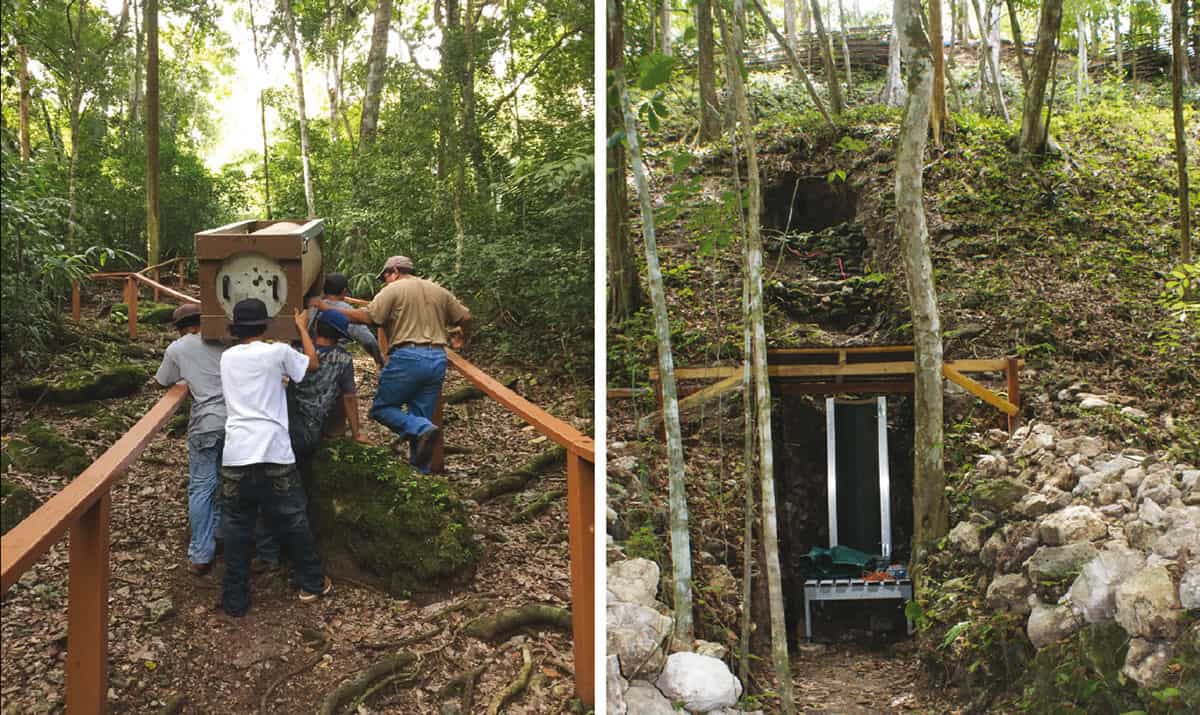
Besides updating Alvarez’s original experiment with modern technology, one of the major issues Menchaca’s team has faced over the last decade’s work has been adjusting to the on-site conditions, which were extremely different from those in the lab. Needless to say, the chamber wasn’t exactly designed to fit a physics experiment inside it. Access to the tunnel is through a small hatch at the base of the pyramid that leads to a two-storey metal staircase down into pitch darkness. The tunnel leading to the chamber is narrow and irregular – in some parts researchers had to line up and crouch down just to get through. The detector, which is 1.5 m3 in size, could not have fit through the tunnel in its final form, so had to be custom built so that its smaller constituent parts could be taken through one by one, before being re-assembled inside the chamber, within a small shed. The team managed to get power from the electrical grid about a mile away by running cables through hosepipes all the way to the pyramid. And since oxygen became scarce towards the far end of the tunnel, they installed a pump to send fresh air throughout the entire passage, while carbon-dioxide monitors and oxygen tanks were placed in critical areas as a safety measure.

It took the team almost a decade to custom-design the final detector. As the imaging angle of a muon detector increases with its surface area, the researchers scaled up small models until their detector was big enough to look at almost the entire Sun Pyramid at once. They would have to tilt the detector a little bit to get a glimpse of the few remaining blind areas, but otherwise it was completely stationary. The final detector was an array of rectangular multi-wire chambers, and since tiny drops of water condense all over the internal rock walls, these chambers had to be made robust enough that they would be unaffected by the humid conditions.

Waiting for the final verdict

After a decade’s work, the physicists at the Sun Pyramid have now packed up. Having collected all the data they need, they are finishing their analyses and preparing to publish their results. Their most significant finding, which Menchaca presented at a UNAM conference in February, is that within the pyramid they have found an area with a base the shape of an equilateral triangle with 60 m sides that is less dense than the rest of the structure. Since their image is 2D, their data cannot tell them the height or volume of what they have found.

This preliminary result hit the headlines earlier this year, but – disappointingly for Menchaca – reports tended to focus on one alarming scenario out of several possible interpretations. The Sun Pyramid was reported as being at risk of collapsing “like a sandcastle”, going with the scenario that, since the less-dense area is on the southern, sunnier side, the density difference is due to a drier area that might be weakening the entire structure. But the team is not ready to reveal its final interpretations just yet. “We reserve the right to declare whether or not we have found chambers within the pyramid until we finish our analysis and publish our results this year,” says Menchaca. Before then, the team still has to finish analysing the data obtained when the detector was tilted towards the highest part of the pyramid.

While the theory that the Sun Pyramid could collapse like a sandcastle is plausible, it is premature to jump to firm conclusions

Menchaca explains that while the sandcastle theory is one of many that are plausible, it is premature to jump to firm conclusions. After all, the muography is a 2D projection, so height distribution is indeterminable. “For all we know, this area we see might be an ancient nightclub,” he jokes. “We won’t be able to find out until we report our final results for the archaeologists to interpret and they decide the best way to physically probe into that area to get an actual glimpse of it.” In the meantime, Menchaca assures us that he honestly doesn’t think the pyramid will collapse. “My guess is that the Sun Pyramid will be here for the next 2000 years, just as always,” he says.

The once-busy tunnel under the Sun Pyramid is now silent. The detector has been stripped of all its electronics. Some of the light bulbs that used to faintly light the way along the dark passageway are burnt out. And the ever-present hum of the oxygen pump has given way to silence. Soon the remains of the experiment will be removed for good, and the detector will be exhibited in the site’s museum.

After more than a decade-long renaissance of pyramid detective work, we could be in store for some great revelations from the particle physicists who have gone out tomb-seeking. As we await the final report on the Sun Pyramid, and with the new detectors now collecting data at La Milpa in Belize, the collaboration between particle physics and archaeology is alive and well.

Muons at La Milpa

Pyramids at La Milpa in Belize

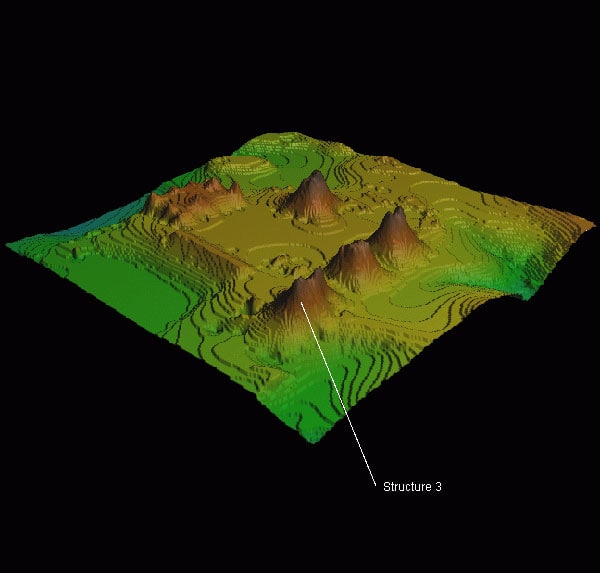
Contour map of pyramids at La Milpa in Belize

The researchers at Mexico’s ancient city of Teotihuacan are not the only group using muons to image pyramids in the Americas. Another team of physicists, led by Roy Schwitters from the University of Texas (UT) at Austin, travelled this summer to a remote Mayan site in Belize where they installed two muon detectors in search of royal tombs. “All over Central America there are things that look like jungle-covered hills, but there are rubble-covered marvellous pyramids underneath that haven’t been exposed at all,” says Schwitters.

The site, called La Milpa, lies in a jungle near the border with Guatemala and Mexico, where the team’s target is a tree-covered mound about 20 m high. Simply named “Structure 3”, it is one of four large structures likely to hold pyramids within. “Mayan pyramids are built like nested dolls – there is one structure inside of the next,” says Fred Valdez, an archaeologist from UT Austin who is in charge of the site and is collaborating with Schwitters’ team. “The detector will allow us to see internal walls and internal staircases; it may detect voids or holes within the structure, and if they are sizeable, they might represent tombs.”

Mayan pyramids typically contain royal tombs, but in La Milpa, the third-largest Mayan site in Belize, archaeologists have yet to find any. “We know there are tombs in these buildings; the question is: where are they located?” asks Valdez. Tombs are often discovered by sheer luck, with archaeologists at La Milpa unable to use standard technologies such as ground-penetrating radar that require flat terrains free from rocks and roots to operate. But by using “muon-tomography” (a 3D version of tomography – see main text), which suits large volumes and uneven terrains, archaeologists will find out exactly where to look.

The two pyramids that have been imaged using muons previously – the Chephren and Sun pyramids – have tunnels running underneath or inside them, in which the detector was placed. Structure 3 does not have such a tunnel, so instead, Schwitters’ team placed two solar-powered detectors – each the size of a large household boiler – in trenches either side of the mound. Each detector will collect muons crossing sideways through the pyramid, and once the data are put together they will create a stereographic 3D image of its internal structure. The system is fully stand-alone because the local climate is so rainy that the team can work on-site only during a single eight-week window each year. The researchers plan to return to collect their first data in 2015.

Season’s greetings and last-minute gift ideas


Things are winding down for the holidays at Physics World and we are all looking forward to recharging our batteries before we get stuck in to all the exciting physics that is sure to come our way in 2015.

If you are like me, you probably haven’t finished your Christmas shopping so here are a few suggestions that are sure to get a smile out of the physicists in your life. In the above video, author and scientist Neil Downie recommends a few traditional gifts as well as several quirky presents. I’m not sure that many people have a retort stand on their wish list, but I would certainly welcome a multimeter if I didn’t own one already.

(more…)

The world of physics in 2015

The science story of 2014, which Physics World picked as its Breakthrough of the Year, simply had to be the successful landing of a man-made probe onto a comet, for the first time. Philae dropped on to comet 67P/Churyumov–Gerasimenko in November after a 10-year journey aboard the Rosetta craft – triggering scenes of wild jubilation among scientists and engineers at the European Space Agency (ESA), who had lived through a nail-biting final hour as they waited for radio signals to travel the 511 million kilometres from the comet to Earth after its scheduled landing time. Data from the mission are likely to keep astronomers busy for years to come, including signs that water on Earth came not from comets, as was previously thought, but from asteroids.

In fact, 2014 was quite a year for space science, with India putting its Mangalyaan craft in orbit around Mars for the first time and Japan launching the country’s second asteroid sample-return mission, Hayabusa 2. Further new findings also came in from the Planck mission, confirming the standard model of cosmology and further constraining what dark matter could be. But what of 2015? What will be the key events in physics and who will have taken the accolades in 12 months’ time?

Let there be light

One thing we know for sure is that 2015 has been officially designated the International Year of Light and Light-based Technologies (IYL). Designed to highlight how light touches every aspect of our lives, the IYL will involve more than 100 partners from 85 countries – including the Institute of Physics, which publishes Physics World. A string of events will take place across the globe next year, ranging from the Story of Light Festival in Goa, India, to Worldwide Pinhole Photography Day, and much more besides.

The year has been picked to celebrate light because it marks a number of anniversaries, including 1000 years since the publication of the work on optics by Ibn al-Haytham, during the Islamic Golden Age. Next year is also the bicentenary of Augustin-Jean Fresnel’s paper introducing the notion of the wave nature of light, 150 years since James Clerk Maxwell’s work on electromagnetism that paved the way for everything from lasers to mobile phones, as well as the centenary of Einstein’s equations of general relativity – the latter having a series of special events of its own.

The IYL kicks off formally next month at an official opening ceremony at the headquarters of the United Nations Educational, Scientific and Cultural Organization (UNESCO) in Paris. Physics World, which is an official media partner for the IYL, will be reporting from the event, where we will also be launching a special, free-to-read digital collection of the magazine containing our 10 best light-related features of all time. Selecting the 10 articles was hard but great fun – so stay tuned for more details about how to access that issue.

Hunting high and low

Elsewhere next year, over at the CERN particle-physics lab in Geneva, physicists and engineers are set to restart the Large Hadron Collider (LHC) and its main experiments ALICE, ATLAS, CMS and LHCb, following a major maintenance and upgrade programme that finished last June. After a long fallow period, the LHC has now been cooled to near its operating temperature of 1.9 K, and the first proton beams are expected to be circulated round the 27 km-long collider in March. Researchers then plan to collide protons together at energies of 13 TeV, just short of the LHC’s design energy of 14 TeV, in May. Previously, the LHC operated with collision energies of just 7 TeV, or 3.5 TeV per beam.

Photograph of the CMS pixel detector at the CERN particle-physics lab

In “Run 2” at the revamped LHC, CERN scientists will be able to study the Higgs boson, which was discovered at the lab in 2012, in greater detail than has been possible so far, with the number of Higgs bosons produced expected to increase by an order of magnitude in total. The upgrade could also shed light on the nature of dark matter and why there is so much more matter than antimatter in the universe. Run 2 could also yield possible evidence for “supersymmetry”, which predicts that for every fundamental particle we know about, there should be so-far-undiscovered “superpartner” particle with subtly different properties. Next year will also see current CERN boss Rolf-Dieter Heuer start handing over the reins to his successor Fabiola Gianotti, before she takes over in 2016.

Away from CERN, 2015 will see a series of fascinating missions in space science and astronomy bearing fruit. After many years’ planning, ESA-led researchers have set a launch date of July for the Lisa Pathfinder mission, which will test the technology needed to develop future space-borne gravitational wave detectors. Another ESA craft due to blast off in July 2015 is ADM-Aeolus, which will monitor Earth’s winds. The Japanese space agency, JAXA, also has plans to launch its Astro-H X-ray telescope, while in March NASA is set to launch the Magnetospheric Multiscale (MMS) to study the mystery of how magnetic fields around Earth connect and disconnect, explosively releasing energy through “magnetic reconnection”. We can also expect further interesting insights from the Curiosity rover about possible signs of life on Mars.

Am I hot or not?

But what will be the burgeoning fields of physics in 2015? For some help in answering this question, we can turn to the Research Fronts 2014 report from science-information provider Thomson-Reuters, which identifies the 10 hottest fields in physics, based on citation data. The list is topped by studies of the Higgs boson, followed second by neutrino data analysis, and “nonlinear massive gravity” third. Six of the remaining seven spots in the list are all in condensed-matter physics, including three topics that we have covered a lot on physicsworld.com in recent times – spin-orbit-coupled Fermi gases, graphene plasmonics and topological Mott insulators. Relativistic heavy-ion collisions are in 10th place.

Meanwhile, staff at Altmetric – a London-based firm specializing in “alternative article-level metrics” – have drawn up their annual list of which 100 papers have attracted the most attention online in 2014 (though that does not mean they are necessarily the best). Taking into account all mentions and shares of articles published from November 2013 onwards in mainstream and social media, blogs, post-publication peer-review forums and so on, the list is, sadly for physicists, dominated by research into biology and the life sciences. The highest “physics-y” paper – and even this is stretching the definition quite far – is a paper about dogs being sensitive to small variations of the Earth’s magnetic field. So if you are a physicist who wants your work to get talked about in 2015, our suggestion is to do something involving animals.

Who will be in the news?

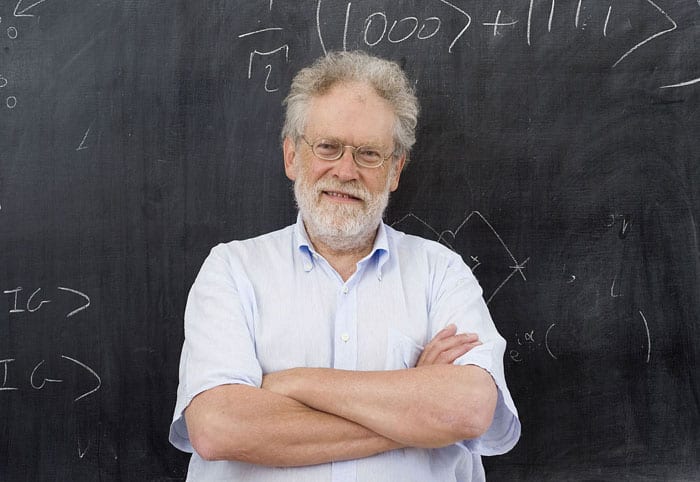
So what of the people and personalities in physics? Last year we put our money on Anton Zeilinger from the University of Vienna bagging the Nobel Prize for Physics for his work in quantum computing and communication. We were wrong, as it turned out, but surely 2015 must be the year he finally gets honoured. In fact, Zeilinger’s university is hosting a high-profile event in May on the “quantum physics of nature” that marks numerous anniversaries in the field. Another giant of physics – Stephen Hawking – could well be back in the limelight in March at next year’s Oscars, with the movie The Theory of Everything – which covers his stormy relationship with his first wife Jane – possibly picking up a prize.

Photograph of Anton Zeilinger

Also likely to make the news are the scientists behind the BICEP2 collaboration, who earlier this year claimed to have seen evidence for primordial gravitational waves and for cosmic inflation. Those early results appear to have been ruled out by researchers on the Planck collaboration, but 2015 could well see the question settled once and for all. There are also sure to be more findings from the Rosetta mission scientists, although hopefully project scientist Matt Taylor will not be wearing that shirt. But we will finish by saying something we say every year, which is that the beauty of physics is that you just do not know what’s around the corner.

As for Physics World, which is published by the Institute of Physics (IOP), we have special issues coming up on light (March), weird natural phenomena (July) and extremes in physics (December). All IOP members can read the magazine online or through our apps and, if you are not already an IOP member, don’t forget to join to get instant access to every issue. We will also be publishing reports on Mexico (September), as well as focus issues on medical imaging (February), nanotechnology (May), optics and photonics (June), vacuum technology (August), neutron scattering (September) and astronomy and space science (December). And, of course, we will be brining you our audio and video programme, including more Google hangouts.

  • Happy with our predictions? Annoyed at something we missed? Tell us what you think by commenting below.

Our favourite pictures of 2014

Physics World brings Feynman lecture to life

Commissioned for our March 2014 education special issue, which focused on novel ways to teach and learn physics, the riot of colour above is based on a lecture by Richard Feynman called “The Great Conservation Principles”. It is one of seven Messenger Lectures that Feynman gave at Cornell University in the US half a century ago. This lovely image was created by professional “science doodler” Perrin Ireland – a science-communications specialist at the Natural Resources Defense Council in the US – who describes herself as “a learner who needs to visualize concepts in order to understand them”.

Scientists crack oyster’s secret of strength

Micrograph showing localized damage in an oyster shell

The pink and green hues in this colourized, scanning electron micrograph show localized damage on the shell of a windowpane oyster (Placuna placenta). The image was taken by researchers at the Massachusetts Institute of Technology, who uncovered a series of nanoscale mechanisms that make such transparent oyster shells resistant to the piercing teeth of predators. Living in waters off the Philippines and other parts of the tropical central Indo-Pacific region, the windowpane oyster’s shell might be the toughest see-through material in nature, with studies revealing that the shell’s toughness is down to how its very thin calcite layers respond to being hit.

Rise of the real transformers

While the latest Transformers film hit cinemas in the UK in August this year, scientists at Harvard University and the Massachusetts Institute of Technology in the US were busy developing the first “real life” transformer, pictured above. Starting out flat, the robot folds and assembles itself into a complex shape and can then scuttle away – all without any human intervention. These printed robots can self-fold in about four minutes – a huge improvement on previous models that could take up to two hours to do the same thing – and can even turn around, making them a handy tool.

NASA’s Stardust mission snares first dust from beyond the solar system

False colour image of the diffraction pattern of the dust grain Orion

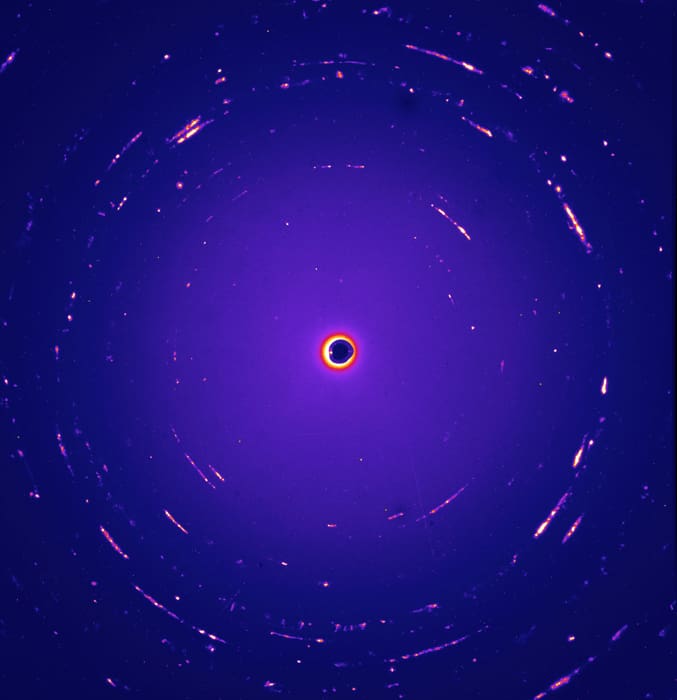
Seven rare, microscopic dust particles, which could be of interstellar origin, have been found among samples collected by NASA’s Stardust mission. Above is a false-colour image of a diffraction pattern from one of the dust grains, dubbed Orion. The tiny particles show features that are consistent with dust that would be found in an interstellar dust stream, suggesting that they date back to the beginnings of the solar system. If confirmed to be of interstellar origin, the discovery could improve our understanding of the origin and evolution of the solar system itself.

“Angry alien spider” emerges from packing calculations

A packing density surface that resembles an angry alien spider

Determining the most efficient way to pack simple objects such as spheres has entertained and infuriated mathematicians from Aristotle to the present day. Earlier this year, researchers at the University of Michigan in the US took a new computational approach to the problem, by studying how packing efficiency varies as the shape of an object is modified. They looked at how the maximum packing efficiency of tetrahedrons and several other simple polyhedrons varies according to two parameters. So, the alien spider that seems to be guarding its colourful bounty of eggs in the image above is nothing to worry about. In fact, it illustrates a plot of maximum packing efficiency as a function of the two parameters for one selected family of polyhedrons with tetrahedral symmetry. The polyhedrons are shown below the main image, while the corresponding maximum packing density surface is shown in a 3D plot.

SPHERE opens its “all-seeing” eye

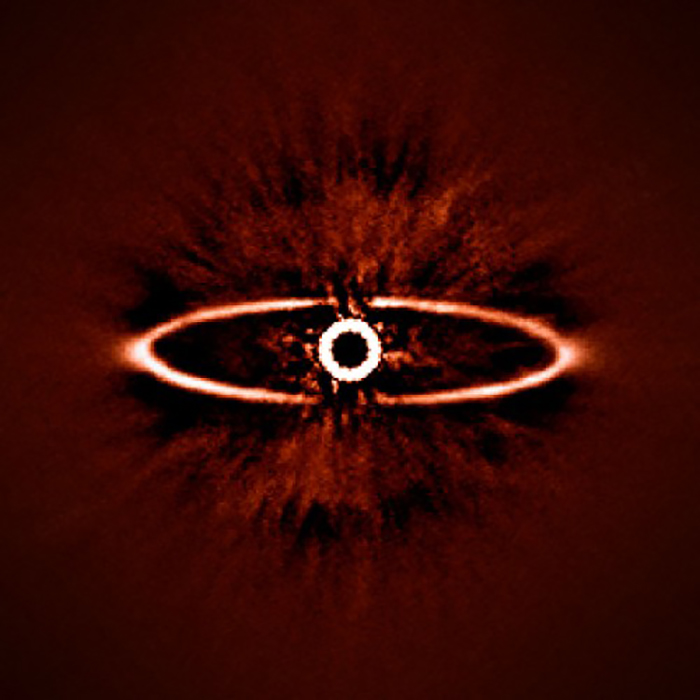
While the fiery shades of the image above may seem familiar to fans of the Lord of the Rings movie franchise, pictured above in exquisite clarity is a ring of dust that surrounds the nearby star HR 4796A. This particularly clear image has been obtained by the new Spectro-Polarimetric High-contrast Exoplanet REsearch instrument (SPHERE), which was installed in May this year on the European Southern Observatory’s Very Large Telescope (VLT) at the Paranal Observatory in Chile. Thanks to SPHERE, not only is the dust ring clearly outlined, but the glare of the bright star at the centre of the picture has been supressed. This has provided a much clearer view of the whole system, which researchers think also harbours an exoplanet or two.

Lasers ignite “supernovae” in the lab

An image of the lab-based supernova created using the lasers

Attempting to recreate one of the most massive explosions in the universe in your lab may not sound like such a good idea. But that is exactly what researchers at the University of Oxford in the UK wanted to do, as they used one of the world’s most powerful laser facilities to create tiny versions of supernova explosions in the laboratory. The simulated “bang” was created by firing three laser beams onto a tiny carbon rod in an argon-filled chamber. The exploding rod creates an asymmetric shock wave that expands outwards through the argon gas, much like a real supernova in space. In the image above, the shock and the turbulent flow are captured with the Schlieren imaging technique (blue-black hues). The electron density predicted by computer simulations (blue-red hues) is superimposed.

First view from the comet crasher

A black-and-white image of the comet 67P/Churyumov-Gerasimenko

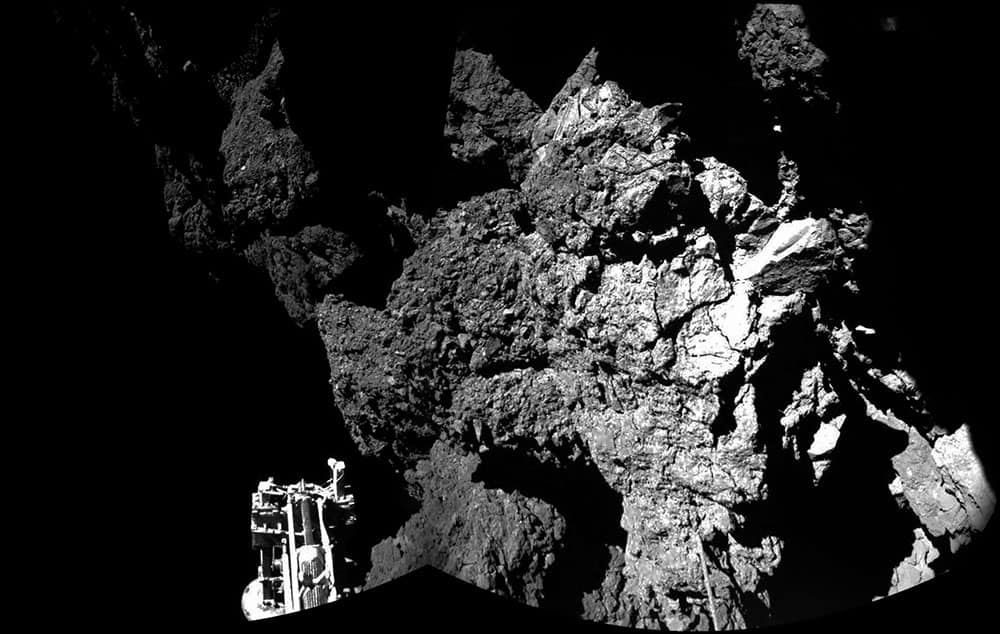
Earlier this month, scientists working on the Rosetta mission of the European Space Agency (ESA) made history when their “Philae” module touched down safely on the surface of comet 67P/Churyumov–Gerasimenko. The lander bounced twice, moving nearly 1 km back out into space, and touched the comet’s surface three times before settling at a location nearly 1 km away from the target site. Above is the first panoramic image from the surface of the comet captured by the CIVA-P imaging system, and features a 360° view around the point of final touchdown. One of the lander’s three feet can be seen in the foreground.

Planck offers sharpest view of the early universe

Image of the sky as seen by Planck

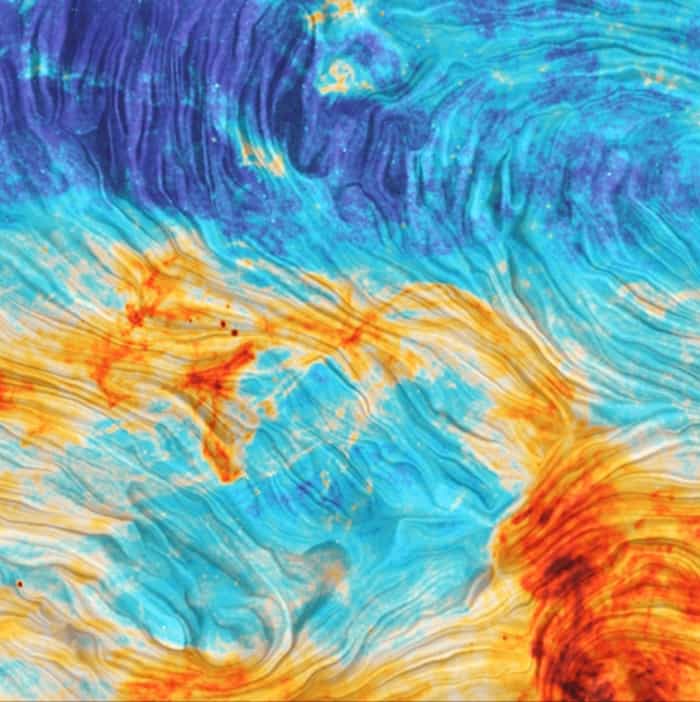
The beautiful image above, which is reminiscent of an Impressionist painting, comes from the latest data from the €700m Planck mission of the European Space Agency (ESA), which was released last month. It shows the 353 GHz polarization sky map as seen by Planck, with the colours depicting galactic dust, while the relief shows magnetic fields. These results cover four years of observations and provide the most precise confirmation so far of the Standard Model of cosmology, as well as placing new constraints on the properties of potential dark-matter candidates. The collaboration also revealed that it has detected traces left behind by primordial neutrinos – thought to have been released one second after the Big Bang – on the cosmic microwave background for the first time.

Hawking in the movies

Eddie Redmayne as Stephen Hawking in the film The Theory of Everything

Early next month, director James Marsh’s biopic based on Stephen Hawking will hit cinemas across the UK. Above is a still from the film, The Theory of Everything. The story is based on the memoir Travelling to Infinity: My Life with Stephen, penned by Hawking’s former wife Jane Hawking, and covers the early days of the couple’s courtship up to the point where the two divorced in 1995. Hawking is played by British actor Eddie Redmayne, who has already received praise for his performance as he portrays Hawking slowly deteriorating because of motor-neuron disease – amyotrophic lateral sclerosis – that he is diagnosed with at an early age.

The 10 quirkiest physics stories of 2014

From a particle collider made of LEGO to physicists taking on the ice-bucket challenge, physics has had its fair share of interesting stories this year. Here is our pick of the 10 best, in chronological order.

The designated survivor

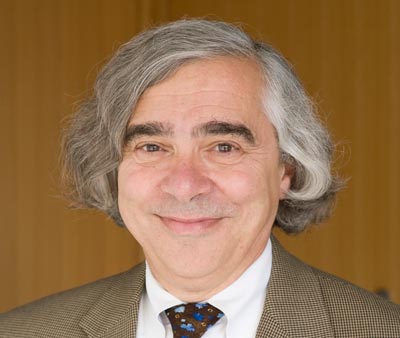
The nuclear physicist and US energy secretary Ernest Moniz may be 14th in the US presidential line of succession, but if something really terrible had happened in late January, then he might have found himself leading the world’s biggest economy. That is because Moniz was appointed the “designated survivor” while US president Barack Obama delivered his State of the Union address earlier this year.

Ernest Moniz

The speech, which is attended by the country’s top leaders, including the vice-president, members of the US cabinet and Supreme Court justices, is where US presidents outline their legislative agenda for the coming year. A designated survivor is a member of the cabinet who stays at a distant, secure and undisclosed location during the address to maintain continuity of government in the event of a natural disaster or terrorist attack that ends up killing officials in the presidential line of succession.

Of course, nothing untoward happened, so Moniz did not find himself as leader of the world’s richest nation. The question remains, however, where was Moniz during the speech? Having emerged with his trademark flowing grey hair intact, at least we know Moniz wasn’t at the hairdressers.

Spin-glass: the game

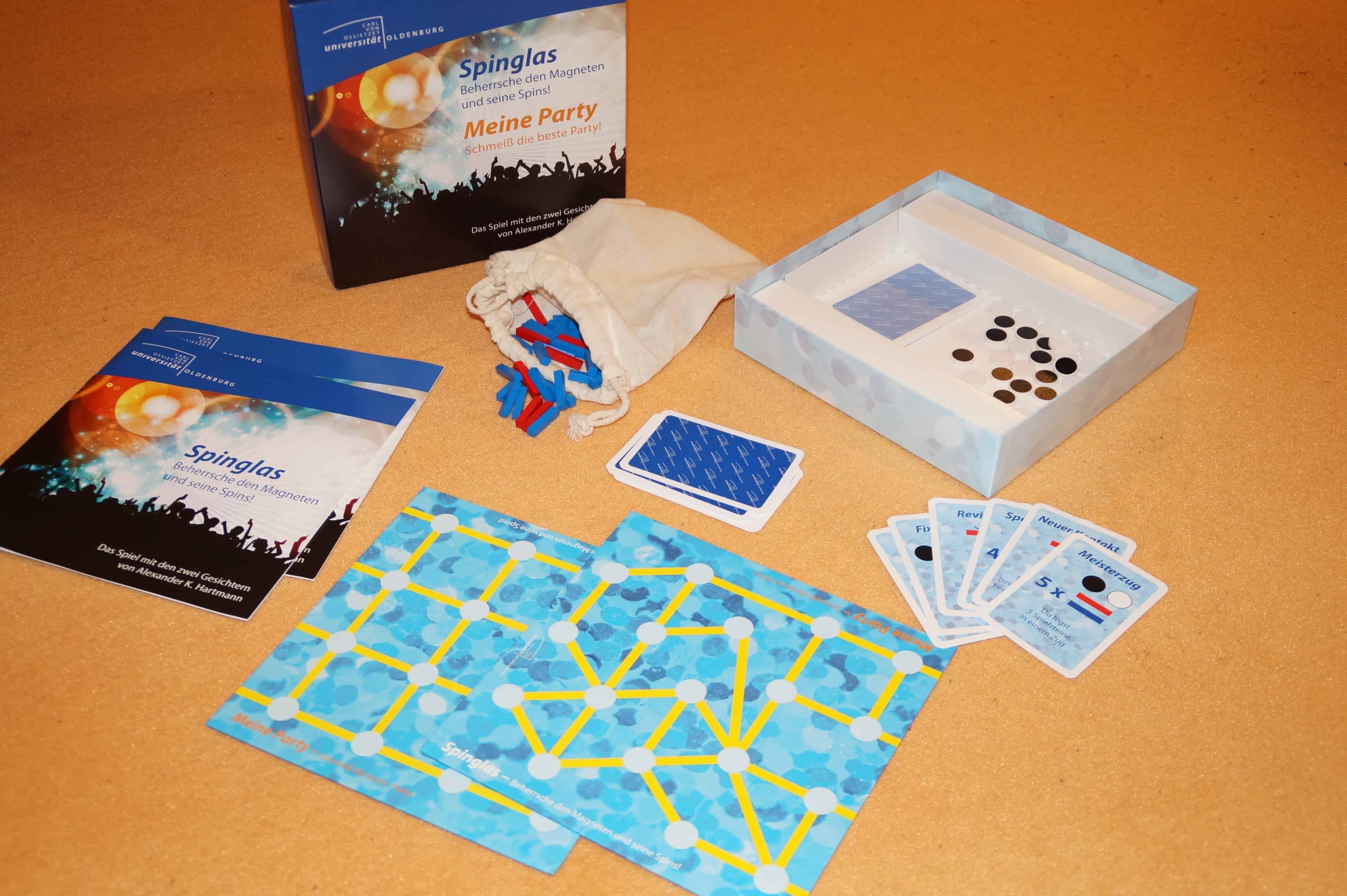
Alexander Hartmann is determined to make condensed-matter physics fun. The University of Oldenburg physicist has created a board game for two players dubbed “Spinglas”, in which each player has either white or black counters (representing spin up or down) and then takes turns to place three pieces on the board. (Full instructions on how to make Spinglas are on the arXiv preprint server).

Pieces played can be either these counters or wooden links representing “interactions” between spins – blue being ferromagnetic and red antiferromagnetic. If a player’s move results in the majority of interactions around the spin being “satisfied” – like ferromagnetic bonds between two similar spin orientations – then the energy is negative, but if more are unsatisfied, like an antiferromagnetic interaction between two up spins, then the net energy is positive.

A total positive energy near the spin means that a player can also “flip” the spin to result in a lower energy. The winner is whoever has more counters of their colour on the board at the end of the game. “People who have played the game say that it is a real challenge,” Hartmann told physicsworld.com, adding that high schools and universities are using it to teach students. It might be the best €16 you ever spend. Possibly.

Tied in knots

Eldredge tie

If you have ever pondered how many ways there are to tie a necktie then wonder no more. Mikael Vejdemo-Johansson, a mathematician at the KTH Royal Institute of Technology in Stockholm, and colleagues have come up with a mind boggling 177,147 variations.

The inspiration for the work apparently came from the fiendishly complex knot sported by the “Merovingian” villain from the Matrix films. The number Vejdemo-Johansson and pals came up with is a vast increase on the 85 ways that physicists Thomas Fink and Yong Mao from the Cavendish Laboratory in Cambridge found in 2000. According to Vejdemo-Johansson, their number is much larger because Fink and Mao made various assumptions about tie knots that drastically reduced the number available, including that tie-wearers would only make a “tuck” – pushing the tie into the knot to lock it in place – at the end of a given tying sequence.

So what is his favourite from the 177,147 variations? “I waver back and forth between the Eldredge, the Trinity and the Allwin depending on my mood and the current tie,” Vejdemo-Johansson revealed to physicsworld.com.

Rock, paper, scissors

What is the best strategy to beat an opponent at rock-paper-scissors? The answer, according to three physicists in China, is apparently not to have one. Zhijian Wang from Zhejiang University and Bin Xu from Zhejiang Gongshang University teamed up with Hai-Jun Zhou from the Institute of Theoretical Physics in Beijing to recruit 360 students to play the game. The students were divided into 60 groups of six players with each group playing 300 rounds of the game while their actions were recorded.

On average, the physicists found that the players initially chose each action about a third of the time, which is what you would expect if their choices were random. However, on closer inspection, the players’ strategy was seen to consist of predictable patterns so that the players who won the first round tended to stick with the same action, while those who lost would usually switch actions so that rock changes to paper, paper to scissors and scissors to rock. Zhou told physicsworld.com that they are now looking for such hidden patterns in other games, but would not reveal which.

Rolling back the years

Feynman's van

You might not know this, but the Nobel-prize-winning physicist Richard Feynman once painted his Dodge Tradesman Maxivan with Feynman diagrams – pictorial representations that he invented to describe particle interactions. Feynman and his family used to take the van on camping holidays in the US, Canada and Mexico, but once it had seen better days, Feynman’s close friend – the film producer Ralph Leighton – bought the van and put it in storage.

There it remained until 2012 when computer-games designer Seamus Blackley got his hands on the rust-infested motor and sought to bring it back to its former glory. Blackley, who originally studied for a PhD in physics at Tufts University and Fermilab, is an avid restorer of classic Italian cars. “It was a sense of duty, or some kind of possibly dubious feeling regarding a higher calling or some such,” Blackley told physicsworld.com.

Blackley has already retouched the Feynman diagrams, but there is still more work to do, and he hopes that one day the van will go on show at the Smithsonian Museum in Washington, DC. Blackley is also thinking about renovating historical high-energy physics lab equipment. “Anything that one can do to inspire young people to think about fundamental science is our duty to do, right?”

Pets in space

Celestis, the firm behind sending the remains of loved ones into space, has branched out into animals. Celestis Pets now lets you send 1 g of the cremated remains of your cherished dog or cat – or a lock of its hair – into the cosmos.

The cheapest package is “Earth Rise”, which sets you back $995 and involves the remains being blasted into the atmosphere and then returning safely to Earth. For $4995, “Earth Orbit” lets your pet orbit Earth before “harmlessly vaporizing” in the atmosphere upon re-entry. But for those really wanting to go that extra mile, $12,500 sends your domesticated friend to the Moon or even into interstellar space through the “Voyager” bundle.

“The service provides your beloved pet with an incredible journey through the stars, allowing them to explore places they could have only dreamed of in life,” says the firm on its website. And what do you get in return? A certificate confirming that your pet did indeed go into space. Well worth the cash then.

Hawking takes the ice-bucket challenge

The ice-bucket challenge, which involves people pouring a tub of ice-cold water over their heads and posting a video of the dousing online, took the social-media world by storm this year, raising millions of pounds for motor neurone disease awareness and other charities. One of those to get involved is the Cambridge physicist Stephen Hawking, who has suffered with the disease since he was 21.

In a video filmed outside his family home in Cambridge, UK, however, Hawking said it would “not be wise” to be covered with ice after suffering from a bout of pneumonia last year and so let his children – Robert, Lucy and Tim – get soaked instead at his expense.

But ice was clearly not enough for Muhammad Qureshi, an undergraduate from the University of Toronto, who instead poured liquid nitrogen over his head while wearing just a T-shirt and shorts. “Do not try this at home,” Qureshi warned quite rightly on his video, before doing the deed and then frantically trying to prevent the nitrogen from getting in his hair and under his clothes. “It was well planned and executed and didn’t hurt,” Qureshi told physicsworld.com. “But it did feel very unusual.” We’ll take his word for it.

Why Spaniards aren’t lazy

We don’t want to resort to national stereotypes, but there is a view that the Spanish are, well, a bit lazy. In fact, a Spanish parliamentary commission last year advised that Spain should turn its clocks back by an hour from Central European Time to Greenwich Mean Time (GMT) to improve “productivity, absenteeism, stress, accidents and school drop-out rates”.

So when José María Martín Olalla – a condensed-matter physicist at the University of Seville – examined official statistical data from Spain, Italy and the UK, it perhaps came as no surprise to find that Spaniards do indeed wake up, eat breakfast and go to work later. But when Martín Olalla converted the data into “local solar time” – thereby taking both latitude and longitude into account – he discovered that the Spaniards’ daily timetables match those of the Italians or British, being essentially related to the level of sunlight.

Or, as he concludes: the Spanish aren’t lazy, but merely “keeping pace with [their] geographical position”.

Fusion in Chelsea

Fans of the UK reality-TV programme Made in Chelsea, which follows the lives of affluent young people in London, are familiar with those characters dealing with whatever life throws at them. But few would have guessed that one former star of the show would move into physics. Entrepreneur Richard Dinan, who starred in three series of the show, has founded the firm Applied Fusion Systems, which aims to build a prototype fusion reactor.The 28 year old, who doesn’t have a university degree, has been teaching himself tokamak design for over a year and has now employed a team of scientists to “explore the technology” of fusion reactors. Indeed, Dinan is not averse to trying out new ventures, having created a 3D printing business – Ion Core – that he will use to produce some of the tokamak’s components.

The venture has apparently already attracted interest from private investors, with Dinan adding that details about the funding arrangements as well as the project’s members will be released early next year. “I am completely fascinated and convinced in the eventual success of this technology,” Dinan told physicsworld.com. “I feel strongly that it is time private companies started to take this technology very seriously.” Move over ITER.

The LEGO Brick Collider

Avid readers may remember a 560-piece LEGO model of CERN’s ATLAS detector that was created by particle-physicist Sascha Mehlhase from the Niels Bohr Institute in Copenhagen. Not to be outdone, LEGO fan Jason Allemann has now created a LEGO particle accelerator. Dubbed the LEGO Brick Collider (LBC), the design has been submitted to the LEGO Ideas website, which lets fans share blueprints of their own creations.

The 170-piece LBC features a circular track that accelerates a LEGO football to a speed of just over 12.5 km/hr by passing it in-between two horizontal spinning wheels that “kick” out the balls. Allemann, who told physicsworld.com that he could tweak his design to include a detector, says it would be “pretty awesome” if CERN endorsed the project. He is now looking for 10,000 supporters for his design before LEGO will conduct a review of it and, if successful, approve the design for release.

Still, if it doesn’t work out, there’s always a LEGO version of The Big Bang Theory set. It will feature Minifigures of all the main characters as well as the front room set of Leonard and Sheldon’s flat, although the final design, pricing and release date are still being worked out.

You can be sure of more quirky stories from the world of physics next year. See you in 2015!

Physics World’s 2014 Book of the Year honours materials that matter

Cover of the book Stuff Matters

In the world of popular-science books and TV documentaries, physics is often presented as a really esoteric subject, one that mostly concerns itself with tiny things such as atoms and molecules or really big things such as stars and galaxies. This, however, is only part of the story. In reality, there is a lot of physics going on somewhere in the messy middle, scattered among the ordinary objects we encounter as we go about our daily life. From the buildings we live in to the screen you are reading this on, you will find physics principles at work pretty much everywhere you look – often hiding in plain sight.

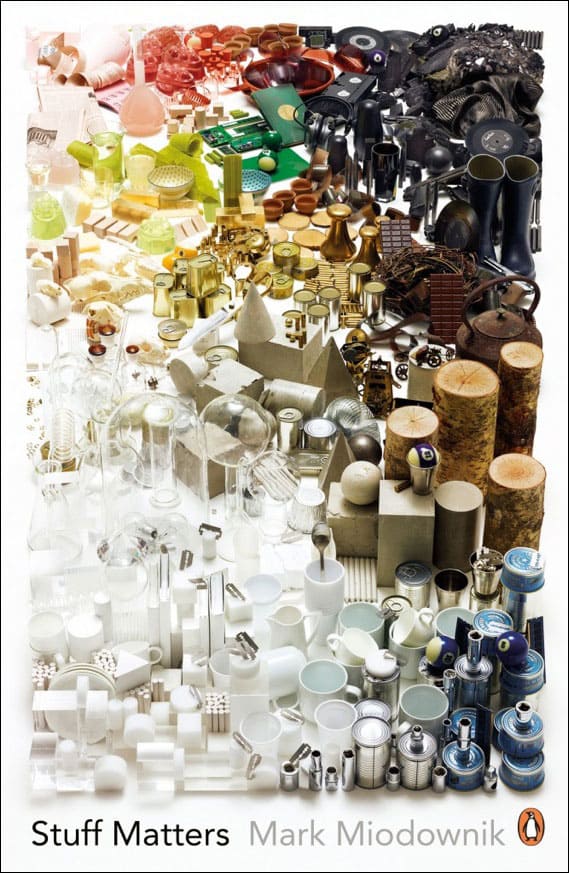
In his book Stuff Matters, author and materials engineer Mark Miodownik turns a bright spotlight on the hidden physics and chemistry of everyday materials. Weaving together science and storytelling, he shows readers that these materials are both fascinating in their own right and an essential part of what defines us as human beings – ingenious, tool-using creatures who, for good or ill, have the power to modify our environment to suit our needs. For this, and for bringing a bit of sparkle to a field that has too often been overlooked in popular-science writing, Stuff Matters is Physics World‘s 2014 “Book of the Year”.

Miodownik’s book beat several other strong candidates on Physics World‘s shortlist of 10. To be eligible for this shortlist, a book first had to be selected for review in the magazine in 2014 – a fairly high hurdle, as there are always many more good books published than we have space to review. It also had to win the approval of the external expert or staff member who reviewed it. Members of the magazine’s editorial team then winnowed this list of standouts down to 10 books that we considered particularly well written, scientifically interesting and novel – the three criteria we have stuck with since 2009, when Graham Farmelo’s biography of Paul Dirac, The Strangest Man, became our first “book of the year”.

Although Stuff Matters grabbed the top spot for 2014, we think all of the books on this year’s shortlist are well worth reading. You can hear more about a few of them – and also listen to Miodownik talk about his award-winning book – in our latest podcast, in which Physics World‘s editor Matin Durrani and reviews editor Margaret Harris discuss some of their favourites with host James Dacey.

So, congratulations to Miodownik and all the other shortlisted authors. If you want to keep up to date with physics books in 2015, be sure to keep an eye on the reviews section of this website. In the meantime, we hope some of you will follow our advice in the podcast, and head straight for your favourite bookstore or website to stock up on some of the best physics writing from 2014.

Book of the Year 2014

In this podcast, Physics World‘s editor, Matin Durrani, and reviews editor, Margaret Harris, share their thoughts about the year’s shortlist with host James Dacey. You’ll hear them describe how the shortlist was chosen, and then discuss four of the books on it in more detail before they announce the winner.

The books on the shortlist cover a wide range of topics, from acoustic physics and astronomy to quantum theory and volcanology, and they all meet the criteria of being well written, scientifically interesting and novel. We hope you enjoy hearing about these books as much as the panel enjoyed reading and talking about them, and congratulations again to all the shortlisted authors.

2014 Books of the Year shortlist (alphabetical by author)

Wizards, Aliens & Starships: Physics and Math in Fantasy and Science Fiction Charles Adler

Serving the Reich: the Struggle for the Soul of Physics Under Hitler Philip Ball

Five Billion Years of Solitude: the Search for Life Among the Stars Lee Billings

Plutopia: Nuclear Families, Atomic Cities, and the Great Soviet and American Plutonium Disasters Kate Brown

Smashing Physics: Inside the World’s Biggest Experiment Jon Butterworth

Sonic Wonderland: a Scientific Odyssey of Sound Trevor Cox

The Perfect Theory: a Century of Geniuses and the Battle Over General Relativity Pedro G Ferreira

Stuff Matters: the Strange Stories of the Marvellous Materials that Shape Our Man-made World Mark Miodownik

Einstein and the Quantum: the Quest of the Valiant Swabian A Douglas Stone

Island on Fire: the Extraordinary Story of Laki, the Volcano that Turned Eighteenth-century Europe Dark Alexandra Witze and Jeff Kanipe

Multimedia highlights of 2014

The journey of innovation

From the fun to the far more serious with our next choice. “A better way to detect landmines” is a short film that we made about how physics-based techniques can help to clear mines faster and more efficiently. It features Bill Lionheart, a mathematician at the University of Manchester in the UK, who has been working with colleagues to develop ways to reduce the number of false-positives when searching for mines. One approach taken by Lionheart and his colleagues is to develop the technology and the underlying maths of metal detectors. They are designing devices that can not only detect, but also characterize metal objects in the ground. This makes it possible to disregard the signals that relate to harmless bits of scrap metal, which would otherwise have been treated as dangerous. Lionheart’s work is supported by the charity Find a Better Way, founded by Sir Bobby Charlton, the former England and Manchester United footballer. In the film, interviews with Charlton and Lionheart are combined with photography from conflict zones to illustrate powerfully how even niche areas of physics and maths can have important and unexpected applications across the globe.

We need to talk about quantum mechanics

Illustration of a person lecturing to a crowd

Finally, the end of the calendar year can bring the opportunity to reflect on the way that you are doing things in your professional lives, and we at Physics World are no exception to this. In November, Physics World reporter Tushna Commissariat presented “We need to talk about quantum mechanics”, a podcast about her experiences at a “quantum boot camp” for people involved in the communication of quantum research. The intensive crash course – held in Sweden – brought together a host of scientists and journalists from across the world to discuss the possibilities and pitfalls of communicating the ideas of quantum mechanics to a global audience. In the podcast, Tushna interviews a number of her fellow “bootcampers”, including the conference organizer, who is the blogger and physicist Sabine Hossenfelder.

So, that wraps up another year on the Physics World multimedia front. Join us in 2015, when one of our key focal points will be the International Year of Light and Light-based Technologies (IYL 2015). This celebration of light and its uses will provide a great opportunity for us to provide more colourful multimedia next year. Join us then.

Copyright © 2026 by IOP Publishing Ltd and individual contributors