Comet landing named Physics World 2014 Breakthrough of the Year

History was made at 15:35 GMT on 12 November 2014 when the Philae module touched down on the surface of 67P/Churyumov–Gerasimenko, a comet 511 million km from Earth and hurtling towards the inner solar system at nearly 55,000 km/h. The module bounced twice before coming to rest, and then began collecting data, which has now been sent back to Rosetta scientists for analysis. The landing followed a seven-hour journey for Philae after it separated from the main Rosetta spacecraft. Launched in 2004, Rosetta itself reached the comet after completing a journey of 6.4 billion km that involved three gravity-assisted fly-bys of Earth and one of Mars (see “Rosetta scientists land probe on comet for first time”).

By landing the Philae probe on a distant comet, the Rosetta team has begun a new chapter in our understanding of how the solar system formed and evolved – and ultimately how life was able to emerge on Earth. As well as looking forward to the fascinating science that will be forthcoming from Rosetta scientists, we also acknowledge the technological tour de force of chasing a comet for 10 years and then placing an advanced laboratory on its surface.

The mission was not without its problems. Despite landing in an awkward position where its solar panels do not currently receive enough sunlight to power its instruments, Philae managed to complete all of its planned measurements on battery power alone. The lander was also not able to secure itself to the comet surface as planned, however it did manage to drill into the surface and acquire a sample for analysis.

Organic molecules and dust-covered ice

Preliminary analysis of data sent back from Philae’s Cosac instrument suggests that there are carbon-based organic molecules on the comet. This could prove to be very important information for scientists studying conditions on the very young Earth, which is believed to have been regularly bombarded by comets. The lander’s Mupus instrument was also able to hammer at the comet’s surface, which we now know is covered by a layer of dust about 10–20 cm thick on top of an unexpectedly hard material thought to be water ice.

The instruments aboard the main Rosetta spacecraft have also made important contributions to our understanding of the solar system. Indeed, only this week, scientists using the ROSINA mass spectrometer discovered that the ratio of deuterium to hydrogen in the comet is much greater than that found on Earth (see “Asteroids, not comets, gave Earth most of its water”). This adds strength to the growing body of evidence that the water on Earth was delivered not by comets, as previously thought, but by asteroids.

At 14:00 GMT today, Rosetta mission manager Fred Jansen joined physicsworld.com editor Hamish Johnston in a Google Hangout (see video above) to accept the award and share his unique insights into the mission and the science that it is undertaking. In the video below, Hamish Johnston and colleague Tushna Commissariat explain why Rosetta was chosen as this year’s winner.

The top-10 breakthroughs were chosen by a panel of six Physics World editors and reporters, and the criteria for judging the top 10 included

  • fundamental importance of research;
  • significant advance in knowledge;
  • strong connection between theory and experiment; and
  • general interest to all physicists.

Now for our nine runners-up breakthroughs, which are listed below in no particular order.

Quasar shines a bright light on cosmic web

To Sebastiano Cantalupo, Piero Madau and Xavier Prochaska of the University of California Santa Cruz in the US, and Fabrizio Arrigoni-Battaia and Joseph Hennawi of the Max-Planck-Institut für Astronomie in Heidelberg, Germany, for using the radiation given off by a quasar to catch the first glimpse of a filament of the cosmic web.

Matter in the universe is not uniformly distributed and exists in a web of filamentary structures with intervening voids. This web is thought to have formed about 380,000 years after the Big Bang and its presence is a widely accepted theoretical prediction. While we can see matter where it has agglomerated into dense objects such as galaxies, astronomers had not seen the whispy filaments of cold gas. Now, Cantalupo and colleagues have spotted radiation emitted by this gas when it absorbs ultraviolet light emitted by a quasar. The research already suggests that the filament is more “lumpy” than expected, and future measurements using other quasars promise to give much more information about the early universe.

Neutrinos spotted from Sun’s main nuclear reaction
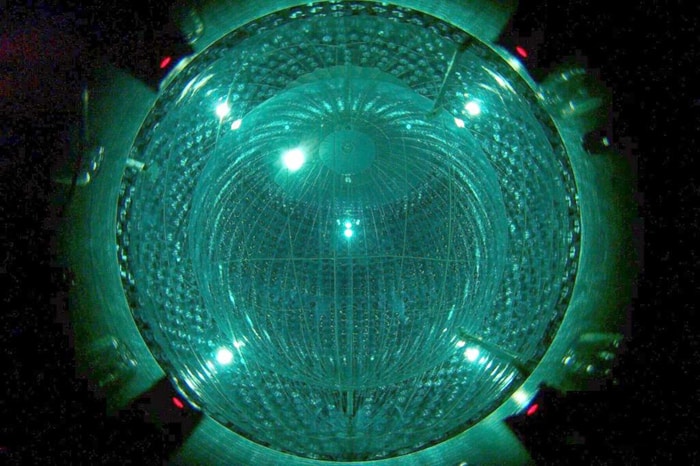
Photograph of the Borexino detector

To the Borexino collaboration, for being the first to detect neutrinos from the main nuclear reaction that powers the Sun.

Nearly all of the energy generated in the Sun involves a chain of nuclear reactions that begins with two protons fusing together to form deuterium along with a positron and a low-energy neutrino. Calculations predict that about 60 billion of these neutrinos pass through a square centimetre on Earth every second, but low-energy neutrinos are particularly difficult to detect and so the theory could not be verified. Now, deep under the Gran Sasso mountain in Italy, some of these neutrinos have been detected by spying the flashes of light that occur when the neutrinos collide with electrons in a giant tank of liquid. The Borexino team was not actually expecting to see these neutrinos, but its detector was so well built that the researchers managed to measure a flux of 66±7 billion neutrinos per square centimetre, confirming the long-established theory of solar fusion.

Laser fusion passes milestone
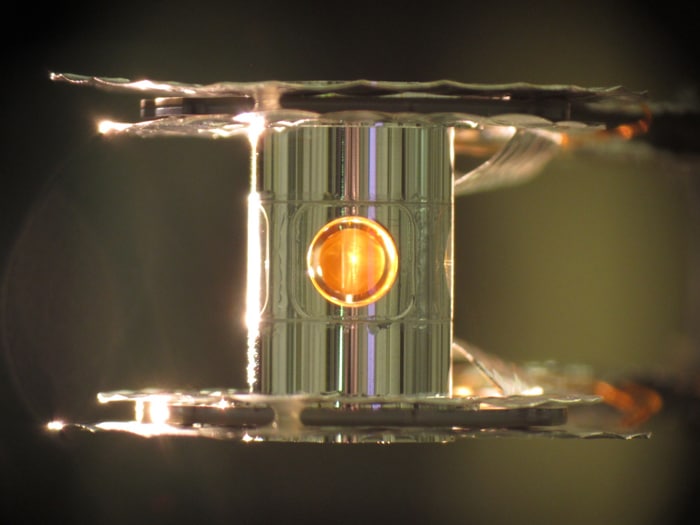
Photograph of the fusion fuel capsule at the National Ignition Facility

To Omar Hurricane and colleagues at the National Ignition Facility (NIF) of the Lawrence Livermore National Laboratory and the Los Alamos National Laboratory in the US, for being the first to obtain a “fuel gain” of greater than one in a laser-driven nuclear-fusion experiment.

Nuclear fusion promises to deliver vast quantities of clean energy, but physicists working on various experiments have made very slow progress towards this goal. Now, Hurricane and colleagues have used NIF’s ultra-powerful laser to crush tiny pellets of deuterium–tritium fuel to produce more energy from fusion reactions than was deposited in the fuel. This comes after a five-year struggle to boost the amount of fusion energy given off in the process. The team focused on achieving a stable compression of the pellets, and on one occasion was able to achieve more than 2.5 times fusion energy out than laser energy in. Much of this energy is in the form of “alpha-particle heating”, which is essential to achieve “ignition”, whereby energy released from fusion causes more fuel to fuse. Although still far from the long-sought-after goal of ignition, the latest results are an important step towards fusion energy.

Electrons’ magnetic interactions isolated at long last

To Shlomi Kotler, Nitzan Akerman, Nir Navon, Yinnon Glickman and Roee Ozeri of the Weizmann Institute of Science in Israel, for being the first to measure the extremely weak magnetic interaction between two single electrons.

Since the 1920s, physicists have known that the electron possesses an intrinsic spin angular momentum and associated magnetic moment. Although researchers have measured the magnetic field of an individual electron, the magnetic interactions between two electrons have proved much more difficult to observe. Magnetic interactions are at their strongest when two electrons are separated by atomic-scale distances, but cannot be measured because other forces dominate the scene. While these other effects weaken as the electrons move further apart, so does the magnetic interaction, which is then lost in noise. Kotler and colleagues overcame these problems by putting two electrons in a long-lasting entangled state, which guarantees a low-noise environment. They were then able to measure the force between the electrons by using a laser to determine whether the electron spins were parallel or antiparallel.

Disorder sharpens optical-fibre images
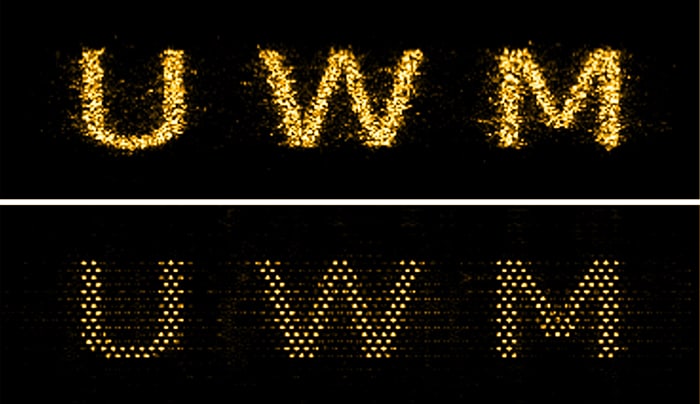
Simulation of an image carried by the disordered optical fibre

To Arash Mafi and colleagues at the University of New Mexico, University of Wisconsin-Milwaukee, Corning Inc. and Clemson University, all in the US, for using the phenomenon of “Anderson localization” to create a better optical fibre for transmitting images.

Disorder in an optical fibre usually blurs transmitted images, but Mafi and colleagues have shown that by putting the right kind of disorder in the right place, the ability of a fibre to transmit sharp images can be enhanced. Indeed, their prototype produced a sharper image than the best available commercial imaging fibres. The technique involves using Anderson localization, whereby light will not propagate through a medium with a certain degree of disorder. The team created a fibre made of 80,000 strands of two different materials that are positioned randomly next to each other. The result is disorder in the directions transverse to the length of the strand and order in the direction that the light propagates.

Data stored in magnetic holograms

To Alexander Khitun and Frederick Gertz at the University of California Riverside in the US, and A Kozhevnikov and Y Filimonov of the Kotel’nikov Institute of Radioengineering and Electronics in Russia, for creating a new type of holographic memory device based on the interference of spin waves.

Holography involves reflecting a beam of light from a 3D object and recording the interference pattern that occurs when it is mixed with an identical beam that did not strike the object. It has the potential to store and retrieve large amounts of information in a very efficient way, but the storage density is limited by the wavelength of the light. The spin waves used in Khitun and colleagues’ magnetic holography device have much shorter wavelengths than visible light, and could therefore be used to store data at higher densities. The prototype device comprises two tiny magnets connected by magnetic wires. Data are saved by sending large-amplitude spin waves through the wires to flip the orientations of the magnets. Data are read by sending smaller-amplitude waves through the device and measuring how they interact with the magnets.

Lasers ignite ‘supernovae’ in the lab
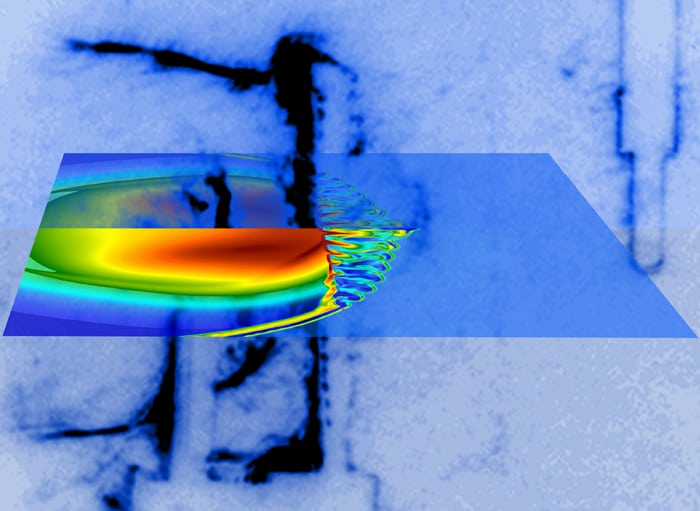
An image of the lab-based 'supernova' created using the lasers

To Gianluca Gregori and Jena Meinecke of the University of Oxford in the UK and an international team, for using one of the world’s most powerful laser facilities to create tiny versions of supernova explosions in the laboratory.

Supernovae are massive stellar explosions that leave behind hot, dense clouds of dust and gas that are often beautiful in appearance. One particular remnant, Cassiopeia A, has long puzzled astronomers because of its irregular knotty structure that suggests the presence of very strong magnetic fields. This supernova was simulated by Gregori, Meinecke and colleagues, who fired three laser beams onto a tiny carbon rod in an argon-filled chamber. The exploding rod creates an asymmetric shock wave that expands outwards through the argon gas, much like a real supernova in space. A plastic grid, which simulated a “lumpy” distribution of gas in the region of the supernova, was placed in the path of the shock wave, and the result was strong magnetic fields similar to those observed in Cassiopeia A. The technique could also be used to simulate a range of astrophysical processes, say the researchers.

Quantum data are compressed for the first time

To Aephraim Steinberg and colleagues at the University of Toronto, Canada, for being the first to demonstrate a quantum analogue of data compression in the lab.

Conventional data-compression schemes cannot be applied to quantum information because they involve measuring the values of the data bits to be compressed – a process that destroys quantum information. In 2010, however, physicists in the Czech Republic worked out that a string of identically prepared quantum bits could be compressed, albeit not as tightly as conventional data. Now, Steinberg and colleagues have done this in the lab, and have squeezed the quantum information carried by three photon-based quantum bits into two. The technique could pave the way for a more effective use of quantum memories – which are not easy to create – and offers a new method of testing quantum logic devices.

Physicists sound-out acoustic tractor beam
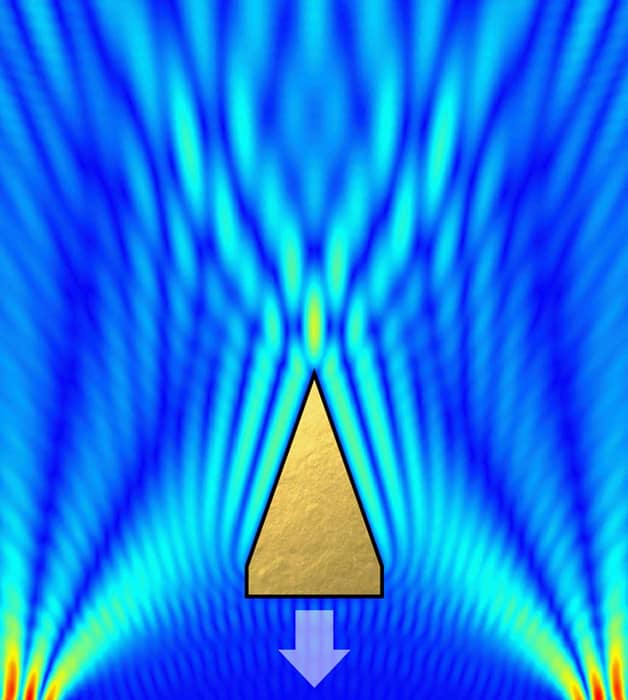
Simulation of the pressure field surrounding a triangular target in an acoustic tractor beam

To Christine Démoré and Mike MacDonald of the University of Dundee in the UK, Patrick Dahl and Gabriel Spalding of Illinois Wesleyan University in the US, and colleagues, for creating the first acoustic “tractor beam” that can pull an object by firing sound waves at it.

A staple of science fiction, a tractor beam seems to defy physics by pulling an object towards the source of an outgoing beam that carries momentum. The acoustic tractor beam built by Démoré, Dahl and colleagues involves firing two beams of ultrasonic waves at an object. The beams have circular wave fronts that curve around the direction of propagation and so carry angular momentum. When the wave front strikes the target, the angular momentum is redirected as regular momentum. Some of this momentum will be redirected in directions such that the result is a net inward force on the object, pulling it towards the source. The ultrasonic beams were created using a commercial array of ultrasound sources, and the technique could have a range of applications in medicine. These include manipulating objects, fluids and tissue inside the body, and delivering encapsulated drugs to the exact location in the body that requires treatment.

European Science Foundation survives elimination vote

Members of the European Science Foundation (ESF) have voted to keep the 40-year-old research organization alive, but with a very different and much-reduced scope. The vote, which took place during the ESF’s annual general assembly at the end of November, confirms that the foundation will no longer fund pan-European research collaborations, but instead will provide services such as peer review.

Set up in 1974 and based in Strasbourg, France, the ESF currently has 66 member organizations – including funding agencies, research institutions and learned societies – from 29 countries. However, many of the national research councils that provide the organization’s funding view the ESF as too expensive, overly complex and unable to compete with an increasingly powerful European Commission. In 2011 they set up a new organization – Science Europe – to promote their interests in Brussels, and at the same time began to wind down many of the ESF’s traditional activities.

Expanded membership

The recent vote saw 51 members in favour and three against a motion to change the ESF’s statutes to allow new kinds of members, such as private organizations, to join. “Technically, it wasn’t a vote on dissolution,” says ESF chief executive Martin Hynes, “but there would have been de facto dissolution had members not voted to approve the changes in statute.” Hynes says that the ESF will now focus on “science services” such as peer-reviewing grant proposals or evaluating research institutes.

Calls for proposals for existing programmes will not be renewed, he says, but one or two current activities will continue, including the operation of several expert panels, such as the Nuclear Physics European Collaboration Committee. Funding will also be stripped back from a high of about €60m a year in 2012 to just €2m this year, with an associated reduction in staff from around 130 to 30.

Financial-viability test

The new structure will come into force at the end of 2015, once the plan has been subjected to a “financial-viability test” in May, and formally approved first by the ESF’s governing council and then by the assembly in November. For Hynes, however, money is not the stumbling block. “The financial viability is pretty well proven,” he says. “The question is whether there will be enough members to carry the organization forward with credibility.” Hynes adds that many of the existing members from Europe’s larger countries will probably leave, but he hopes that other organizations will join, such as the AXA Research Fund. “We would be happy if we had 20 members in the new organization,” he says.

According to Peter Fletcher, head of international relations at the UK’s Science and Technology Facilities Council (STFC), most of the French and German member organizations have already resigned, while the STFC and the other UK research councils are in the process of doing so. Fletcher describes the creation of Science Europe and the new-look ESF as “a positive opportunity for European science”.

Physics World Special Report: India

Physics World India Dec 2104 cover

This year has been one of change for India. In May, some 800 million eligible voters went to the polls in an election that was won by the Bhartiya Janata Party. Led by Narendra Modi, the party went on to form a coalition government called the National Democratic Alliance.

Our Special Report, which you can read free online, kicks off by looking at how science is faring under Modi’s fledgling administration. Indeed, in September, Modi was personally on hand at the Indian Space Research Organisation (ISRO) to laud engineers who had just carefully manoeuvred the Mars Orbiter Mission into position around the red planet – a feat that announced India as a major player in space exploration.

Modi’s personal interest in ISRO will not only please the organization’s chairman K Radhakrishnan, who we interview for the report, but could also be seen as a sign that the new administration is serious about boosting science in the country.

(more…)

Literature of the lab

We are living through a heyday for films tackling physics and astronomy. New, full-length movie dramas about the lives of Stephen Hawking (The Theory of Everything) and Alan Turing (The Imitation Game) have been released. Gravity was a box-office and critical success last year, while the planet-hunting Interstellar movie could well follow in its footsteps. There’s also a new season – the eighth – of the evergreen TV series The Big Bang Theory.

But what about the use of physics in literature? Is it good, bad or indifferent? I decided to check out some recent “physics-lit” to find out.

Destination Geneva

One lab that features in several recent novels is CERN near Geneva. The top-seller here is Angels and Demons (2000), a thriller by Dan Brown. CERN, though, is no more than a prop: it’s the setting for a murder and a theft (of a quarter-gram of antimatter). The tale is compelling, although the writing about CERN is rather pedestrian. “Looming before them was a rectangular, ultramodern structure of glass and steel,” runs a typical sentence.

Another bestseller (according to the adverts) is Robert Sawyer’s Flashforward (1999), which envisions an event, triggered by the Large Hadron Collider (LHC), that makes the world’s entire population black out and have visions of life 21 years in the future. Here, too, CERN’s a prop. There’s a chase in the LHC tunnel, but descriptions are again rather plodding, and you’ll guffaw at the author envisioning physicists being able to discover the Higgs boson (in 2009) simply by noting green lights on the ALICE console.

You’ll find better writing, but an even more outlandish plot, in Robert Harris’s 2011 thriller The Fear Index, whose main character is a former CERN physicist who now works in finance. The book has a few lab scenes and some well-crafted descriptions: “Up ahead, framed by the distant mountains, CERN’s huge rust-coloured wooden globe seemed to rise out of the arable fields like a gigantic anachronism: a 1960s vision of what the future was supposed to look like.” (Actually, the globe was built in the 2000s, though you could say it looks a bit retro.) The lab, Sawyer continues, resembles “an old university in northern England – ugly functional office blocks from the sixties and seventies spread over a big campus, scruffy corridors filled with earnest-looking people, mostly young, talking in front of posters advertising lectures and concerns. It even had the same academic odour of floor polish, body heat and canteen food.”

Different in tone is Catalyzed Fusion by former CERN physicist Francis Farley, whose book’s blurb dubs it “a sizzling romance and a romp with subatomic particles”. Featuring “love, discovery and adventure in the city where nations meet and beams collide”, it culminates in a death caused by a 50 tonne concrete shielding door at the synchrocyclotron – though, for me, the glider scenes above Geneva are the most vivid.

Other fictional labs

Not all lab literature is fiction. The Cuckoo’s Egg, (1989), by Lawrence Berkeley Laboratory astronomer Clifford Stoll, is about his real-life hunt for a spy (the “cuckoo”) who had hacked into an LBL computer and installed a program (the “egg”) that is fed privileges and information. The book provides a genuine sense of LBL, thanks to descriptions of such things as the lack of ceiling tiles, the bicycle ride up and down the steep Cyclotron Road, and the fog-bound, Oz-like San Francisco in the distance. Astonishingly, the book also provides a sense of the Internet, too, as a place – a special, wild arena, where one can communicate instantly with anyone all over the globe yet also be hidden, trackable only from clues in time lags, styles of computer commands, and phone and network tracers.

A Hole in Texas (2004), by Herman Wouk, is a novel about a fictional Higgs finding. It has one brief scene at the abandoned Superconducting Super Collider site in Texas. Despite the fact that Wouk won a Pulitzer prize for another book, the lab description is flat. The protagonists pass by “several huge bleak windowless buildings to a sizeable long low structure stretching off into the fog”. One character says “this brings back memories”, but we never learn them.

Weep for ISABELLE: a Rhapsody in a Minor Key (2003), by former Brookhaven National Laboratory physicist Mel Month, is about the rise and fall of an accelerator at the lab. Subtitled “A Historical Novel”, it unfolds through lengthy ruminations in the heads of the omniscient narrator and in the imagined heads of key (real) actors. But these voices are nearly impossible to distinguish. Not only is there no sense of place in this 600+ page book, but no sense of character either, which makes its prose thick, muddy and featureless. Reading it’s like trying to swim through porridge.

The critical point

Critical Mass (2014) is a satirical novel by “Duronimus Karlof”, which is clearly a pseudonym for someone who’s enough of an insider to make wicked fun of current practices in research, grant-getting and science policy, but also to not want his real name known. I couldn’t put it down, even though it zapped much of what I hold dear, including philosophy of science and California. At one point, contemplating an envisioned laboratory, the protagonist thinks “I liked the notion that our staff would be forced to live in close quarters, where they would not help but share ideas and discuss work out of hours…where the young people would inevitably start to worry about who was sleeping with whom, and where the achievements of Harry working on Project X might spur on Joe who was working on Project Y. The whole set-up seemed ideal to me in every respect.”

This whetted my appetite for more novels that explored the particular hothouse feature of laboratories, whose day-to-day of human experience blurs work and social life so intensely. What literature have I overlooked? E-mail me and I’ll discuss them in a future column.

Asteroids, not comets, gave Earth most of its water

Most of the water that sustains life on Earth probably came from asteroids rather than comets. That is the conclusion of scientists working on the Rosetta space mission, who have measured the levels of hydrogen isotopes in the comet 67P/Churyumov–Gerasimenko. The ratio of deuterium to hydrogen in the comet is much greater than the ratio found on Earth, which suggests that comets supplied Earth with only a small fraction of its water.

Although water blankets 71% of the Earth’s surface, its abundance puzzles scientists. The Earth formed with the other planets in a disc of gas and dust around the newborn Sun. This protoplanetary disc was hot close to the Sun and cold far away. Because the Earth is close to the Sun, it formed in a hot region that should have been fairly dry.

So how did the Earth get its water? Comets had once seemed to be a promising source: they come from the solar system’s frozen outer reaches and harbour ice that vaporizes when they approach the Sun. If comets struck he Earth after its formation, they could have delivered the water that makes up the oceans and our bodies. If this happened, water on comets should have the same isotope composition as water here on Earth. In particular, comets should have the same ratio of deuterium to hydrogen as found on Earth.

Halley’s fluke

In 1986 scientists got a chance to determine the origin of terrestrial water when the best known comet of all – Halley’s Comet – approached the Earth. Surprisingly, the comet’s deuterium to hydrogen ratio was twice the terrestrial ratio. Rather than abandon an attractive theory, however, many scientists dismissed the Halley result as a fluke.

But then in 1996 and 1997, two other bright comets lit up the sky as they passed near to Earth: Hyakutake and Hale–Bopp. Both also had twice the terrestrial deuterium to hydrogen ratio, providing even more evidence that comets did not give the Earth most of its water.

But there was still hope for the comet model. All three comets – Halley, Hyakutake and Hale–Bopp – originated in the Oort cloud, a reservoir of comets far beyond the orbit of Pluto. But some comets come from the Edgeworth–Kuiper belt, which is just past Neptune’s orbit and whose largest members are Pluto and Eris, the latter discovered in 2005. Comets from this reservoir might have terrestrial deuterium levels, but these are usually faint and hard to observe.

In 2010 astronomers succeeded in detecting deuterium in a comet from the Edgeworth–Kuiper belt. Unlike the other comets, this one, named Hartley 2, had a deuterium level matching terrestrial water, reviving the idea that comets delivered water to the Earth.

Just a nice story

“It was a nice story, wasn’t it?” says Kathrin Altwegg, a Rosetta scientist at the University of Bern in Switzerland. “Now with our finding, I guess this idea is going to disappear again.”

In August, and to great fanfare, the European Space Agency’s Rosetta spacecraft arrived at an Edgeworth–Kuiper comet named 67P/Churyumov–Gerasimenko (see “Rosetta rendezvous with comet at long last”).

Today, Altwegg’s team reports that this comet also has high levels of deuterium. In fact, the level is even higher than Halley’s Comet, coming in at 3.4 times the terrestrial level – making it the largest deuterium to hydrogen ratio ever seen in a comet.

Jumbled understanding

“It’s surprisingly high,” says Paul Weissman of the Jet Propulsion Laboratory in Pasadena, California, a Rosetta scientist who was not involved with the new work. “This somewhat jumbles trying to understand where the Earth’s water came from.” Still, Weissman is less ready than Altwegg to assert that comets contributed only a tiny amount of water to the Earth.

At the very least, the finding means that Edgeworth–Kuiper comets span a range of deuterium ratios. Altwegg says that most terrestrial water likely arose from asteroids that hit the Earth. By studying meteorites – most of which come from asteroids – scientists know that asteroids have terrestrial deuterium levels. The Earth was also born with some water as well. Of course, asteroid impacts can be deadly – just ask a dinosaur – but if asteroids did indeed give us most of our water, we might not exist without them.

The research is described in Science.

New technique nails distance to supermassive black hole

The distance from Earth to the black hole lurking at the centre of a distant galaxy has been determined to unprecedented accuracy by astronomers in Denmark, the UK and Japan. As well as giving us a better estimate of the mass of such black holes, the method could also lead to the creation of a new cosmic distance scale, which could give us accurate and independent measurements of how fast the universe is expanding.

At the centre of most galaxies, including the Milky Way, lies a supermassive black hole that is typically 105–109 times more massive than the Sun. As matter is accelerated into the black hole, lots of radiation is emitted, creating an extremely bright object called an active galactic nucleus (AGN). Such supermassive black holes are of great interest to astronomers because their formation is related to the evolution of their surrounding galaxies.

Flickering lights

Deep within an AGN is a relatively compact accretion disc of material that generates ultraviolet (UV) light as additional matter is accelerated into the black hole. Some of this UV light travels directly to Earth, where it can be detected as a flickering signal. But beyond the accretion disc is a gaseous “broad line region” (BLR) and then a dusty torus – and some of the UV light travels towards the torus, where it stimulates the emission of infrared light in a process called reverberation.

Some of this infrared light will travel to Earth and be detected. So, by measuring the time delay between a flicker of the UV light and the same flicker in the infrared, astronomers can calculate how long it takes light to travel across the BLR. The radius of the BLR can then be calculated by multiplying this time by the speed of light.

As the intensity of light emitted by a black hole increases as the square root of this radius, if two AGNs have the same BLR radius, but different intensities, then the brighter object will be closer to Earth. This concept led Darach Watson and colleagues at the University of Copenhagen and the University of Queensland to propose a new way of measuring cosmological distances in 2011 (see “Active galactic nuclei measure the universe”). The pair measured the disc radii and brightness of about 30 AGNs, but the snag is that the technique can only determine which object is closer, not how far away each is from Earth.

Simple trigonometry

To measure absolute – not relative – distances with the method would require an additional observation using a different technique. Now, however, Watson, together with Sebastian Hönig and colleagues at Copenhagen, Southampton and Kyoto Sangyo universities, have managed to measure the absolute distance using a simple relationship familiar to anyone who has studied trigonometry.

The team used the two telescopes of the Keck Observatory in Hawaii to observe the AGN at the centre of NGC 4151 – a galaxy that lies about 63 million light-years from Earth (or 19 megaparsecs). Light from both telescopes, which are a distance of 85 m apart, is fed to an interferometer, which let the team measure the tiny angle between the light arriving from the centre of the AGN and the light arriving from the outer radius of the BLR.

As the radius of the BLR is already known from a reverberation measurement, the distance to the AGN can be calculated by simply dividing the radius by the angle. Darach and colleagues were able to gauge the distance to the AGN to within an uncertainty of about ±2.5 megaparsecs, which is much better than measurements using other techniques.

In principle, once the absolute distance of one AGN is determined in this way, the absolute distances to other AGNs can be worked out simply using their brightness and BLR radii. “I’m really excited about this result because it couples so beautifully to our previous discovery of a way to measure relative distances with active galaxies,” says Watson.

Independent distance scale

The distance to faraway objects is currently determined using a complicated “cosmic distance ladder” that employs several different techniques that apply only over specific distance ranges. The new AGN technique, in contrast, could be used over a wide range of cosmic distances. As Watson explains, this could “avoid all the mess associated with the cosmic distance ladder”, giving astronomers “an entirely separate and totally independent set of cosmic-distance measurement tools using only active galaxies and nothing else”.

This in turn could yield a new and independent measure of the rate at which the universe is expanding, and ultimately an independent estimation of the age of the universe. Knowing the distances to AGNs will also help astronomers gain a better understanding of how these structures and their associated galaxies formed and evolved.

Watson and colleagues have submitted a proposal to do similar measurements on three other AGNs using the Very Large Telescope Interferometer in Chile.

The research is described in Nature.

Laser blast makes pure quantum dots

Quantum dots made of pure selenium can be made by simply firing a laser beam at selenium powder mixed into a glass of water. The easy and inexpensive process was developed by researchers at the University of Texas at San Antonio and Northeastern University in the US, and unlike other techniques, does not involve potentially toxic chemicals. The high-quality nanostructures could be used in two very different applications: as antibacterial agents and as light harvesters in solar cells.

Quantum dots are tiny pieces of semiconductor – such as selenium – that are typically tens of nanometres across. The size of a quantum dot dictates how their charge-carrying electrons and holes interact with light. As a result, they are of great interest to researchers trying to develop photonic technologies and especially solar cells. However, growing quantum dots that are pure and all the same size can be a challenge.

Green and easy

The researchers, led by Gregory Guisbiers in San Antonio, created their pure selenium quantum dots using a technique called pulsed laser ablation in liquids (PLAL), which involves simply firing a pulsed laser beam at a target – in this case selenium powder in water. “Our method is ‘green’ because it does not involve any dangerous solvents, only water, and there are no toxic adducts or by-products, like those often encountered in many wet chemistry processes,” explains Guisbiers. “It is also cheap and easy because we do not need a vacuum chamber or clean room – everything is done in a beaker of water.” The pure nanoparticles produced are also easy to collect and store because they are directly synthesized in solution, he adds.

This is the first time that selenium quantum dots have been synthesized using PLAL at ultraviolet and visible wavelengths, he says. These wavelengths are particularly interesting because they are better at reducing the size of particles compared with light at near-infrared wavelengths. Guisbiers and colleagues also showed that the crystallinity of the nanoparticles created by this technique depends on their size – that is, the smallest particles are crystalline while the largest ones are amorphous.

Antibacterial and anti-cancer

Selenium nanoparticles have antibacterial and anti-cancer properties, and could be used in medicine because the material is biocompatible and already exists in our bodies. However, nanoparticles need to be free of surface contaminants if they are to be employed in a biomedical setting – something that has proved difficult to achieve in the past.

The team, which has already tested its nanoparticles on E. coli, is now looking to see if they are efficient at killing other types of bacteria. “We are particularly interested in other bacteria involved in nosocomial diseases, like the methicillin-resistant Staphylococcus aureus,” Guisbiers says. “I’m told that [hospital-acquired infections] cause roughly 100,000 deaths every year in the US alone because bacteria are becoming more and more resistant to existing antibiotics. What’s more, these so-called super-germs are spreading worldwide, making this a major international health concern.”

The researchers will report their work in an upcoming issue of Laser Physics Letters. The team is also planning to incorporate the pure selenium quantum dots that they made into third-generation solar cells. “Indeed, since the element itself is a p-type semiconductor, when combined with an n-type semiconductor, we can build p–n junctions (the building blocks of all modern-day electronics) at the nanoscale,” adds Guisbiers.

A cabinet of invisible curiosities

Engraving of an 18th century magician in breeches and a powdered wig making objects disappear

“If you could be invisible, what would you do? The chances are that it would have something to do with power, wealth or sex. Perhaps all three.” This statement from Philip Ball’s book Invisible: the Dangerous Allure of the Unseen may sound cynical, but it is probably also accurate. After all, what would you do if you suddenly had a power that, for nearly all of human history, has belonged to the world of the obscure, the occult and the supernatural?

Ball’s book lures you into this world. In reading it, I was reminded of a Victorian museum: every chapter is full of weird and wonderful exhibits. In the first chapter you enter the courtyard of myths and sagas. There, the technology of invisibility is of no concern – gods, after all, can do anything – but the exhibition shows you the human reasons why someone might wish to become invisible. Yes, they are what you would expect: power, wealth and sex, or all three together.

Next comes the dungeon of the dark ages, filled with occult forces that can be mastered with complicated spells and magical ingredients (black cats, mirrors, poisonous plants and the like) if you have acquired the right secret knowledge, the Faustian tome, “with secrets crammed, from Nostradamus’ very hand”. The guardians of this world were the secret societies such as the Rosicrucians and Freemasons who lured their followers away from the path of the plain and obvious. One may be amused or confused by the actions of this dungeon’s inhabitants, but their crude attempts at natural magic were probably the beginning of the dream of mastering the unseen. However inadequate their means were at the time, in some sense they were the precursors of the scientific societies of today.

Once past the dungeon, one enters the chamber of ghosts and fairies – spiritualism was very much en vogue in Victorian times – followed by a large hall filled with the apparatus of invisible rays and waves. Here we find such curiosities as Röntgen’s X-rays, revealing skeletons in living people, and Marconi’s radio waves, carrying voices over vast distances. Sometimes, technology and the desire for the supernatural mixes, for in spiritualistic séances, Victorian ghosts communicate in a code inspired by the Morse code of the telegraph.

The next room is more brightly lit, illustrating the concept of unseen forces and particles forming the foundations of the world as we see it. On one wall, the portrait of Sigmund Freud guides you through a séparé to an antechamber dedicated to psychology and the subconscious, where seeing is not always believing. This is followed by the hall of fame of invisible novel and film characters, in particular H G Wells’ “Invisible Man” and his cousins. Here, too, is some nice physics, explaining how the invisible man disappears. The science of light – optics – has finally found a place in the museum.

The next hall is filled with magnifying glasses and microscopes, revealing the world of the microscopically small – the bizarre, monstrous forms of fleas and other insects that shocked people when they first saw them, but also the invisible world of bacteria and viruses. In making this world visible, scientists discovered the real causes of infectious diseases and could finally come up with effective remedies against them, from disinfectants to antibiotics, much to the benefit of mankind. But fears of the microworld still linger: what if a grey goo of rampant nanobots infects us all?

The last two chapters deal with camouflage, stealth and other forms of modern invisibility technology. Here, Ball points out how much attitudes have changed over time. A microwave cloaking device, for example, would not have impressed a medieval audience at all, as it is clearly visible. All it does is guide invisible electromagnetic microwaves around objects placed inside the device; it is only invisible to the already invisible. Only if you know from science that these invisible waves are as real as the world you see with your own eyes will you find this impressive. The fact that people have indeed been impressed by microwave cloaking shows the extent to which science has entered the public consciousness.

Invisible is filled to the brim with stories, anecdotes and gossip about people whose names you have probably never heard. It may amuse you to learn what both serious people and charlatans have believed in the past and how incredibly they went wrong. But equally, it may depress you, as you may wonder whether we are any wiser these days: “For while man strives he errs”, as Goethe’s Faust has it. For my taste, however, the book focuses too much on the dark, gothic side of invisibility and on the absurd errors of our unfortunate predecessors. Even in the darkest times, amidst the greatest confusion and error, there has been an invisible stream of reason, clarity and wonder that elevates those who follow it above the absurd. It is called science. As Steven Weinberg put it in The First Three Minutes, “The effort to understand the universe is one of the very few things which lifts human life a little above the level of farce and gives it some of the grace of tragedy.” In a book about invisibility, I would have preferred less of the farce and more of the science.

  • 2014 The Bodley Head £25.00hb 336pp

Social physics and antisocial science

Alex “Sandy” Pentland is a computer scientist with an impressive academic record and an even more impressive history of translating academic outputs into business and consultancy. To say he has entrepreneurial flair would seem to be an understatement; his previous book was a bestseller, and his career is sprinkled liberally with consultancies and spin-outs from his research group. His career defies easy categorization, but he calls the work that he does on network analysis and computational social science “social physics”. In his latest book, Social Physics: How Good Ideas Spread – the Lessons from a New Science he outlines his vision of a discipline that has a history of infighting and intellectual land-grabbing.

The term “social physics” was originally coined in the early 1800s by the philosopher Auguste Comte, who hoped that a mechanistic science could help to unravel society’s complexities. When another scholar, the Belgian astronomer Adolphe Quetelet, started using the term for his own brand of mathematical social science, Comte decided he didn’t want to be a social physicist anymore and became the first sociologist instead. Whether this reflects worst on the egos and caprices of physicists or sociologists rather depends on the reader’s existing prejudices.

Since Comte’s day, attempts by political philosophers, mathematicians and computer scientists to create a definitive calculus of human society have failed in a variety of interesting ways, whether from lack of data, poverty of imagination or dogmatism of approach. The people who you might identify as social physicists nowadays would probably say they worked in complexity theory, network science, machine intelligence or another of the technically challenging, frequently data-led approaches sitting at the nexus of statistics, computational modelling and applied maths. It’s not so much a discipline as an enthusiastic club, formed largely of recovering physicists and computer scientists who take a quantitative approach to understanding people.

Pentland’s definition of social physics is certainly within this wheelhouse. His work focuses on the power of social networks – power to influence people to exercise and lose weight, to enable creativity, and to create “cities of tomorrow” in the mould of Jane Jacobs, the 20th-century journalist turned urban-studies activist. Many of Pentland’s studies are based on user-centred data, often gathered from sensors that are worn on the body and are designed to collect information about social interaction. These data include aggregate information, such as how often these individuals meet one another, but also more detailed evidence about conversational turn-taking and duration of speech.

This micro-level information is synthesized into living, breathing, second-by-second social networks in a manner unimaginable by Stanley Milgram when he carried out his field-defining “six degrees of separation” experiment nearly 50 years ago. With a little statistical magic, Pentland’s team at the Massachusetts Institute of Technology has been able to convert these rich data streams into concrete insights into the functioning of social networks, and create recommendations that have helped to transform businesses and public health projects.

While the work they’ve done is impressive and engages wonderfully with the world it seeks to improve, it feels like there are areas where Pentland’s book runs aground. The worlds of data science, “big data”, “smart cities” and the “Internet of Things” are already having huge impacts on the social sciences – sociologist Emma Uprichard referred last year to the “methodological genocide” that is being visited on her subject – and so tying “social physics” to a specific branch of network theory with an added dash of management science or social psychology seems very specific in scope.

Pentland also seems to flounder when it comes to the contentious political issues that working in social science almost inevitably generates. In particular, the ways in which he discounts the concepts of “markets” and “class” seem like a desire to sidestep the thorny issues that characterize divisions between the right and the left. He is prone to techno-Utopianism, and seems to take the view that creating and mediating social networks (perhaps via smartphones or sensing technologies) will solve the problems that plague the modern city. To support this theory, he cites Jacobs’ ideas of community urbanism (themselves partly inspired by the early discussions of complexity science by Warren Weaver), but I would have liked to have seen more of the scholarship that bridges Jacobs’ mid-20th century work and Pentland’s current research. References to this body of work are rather buried in the bibliography, and aren’t really discussed a great deal in the main text. He does, however, give special note to individuals when he discusses the work of his own PhD students – a significant gesture that I suspect many senior academics forget in the white heat of a book deal, and one that makes me rather warm to him as an author.

Some of the ideas that I found most exciting in Pentland’s work were relegated to later sections, such as his Open Personal Data Store, where users would store their personal data (not only biographical but real-time and location based) and decide who has access to it, and at what price. (For example, are the services provided by Facebook worth a certain loss of privacy? How much privacy?) This user-owned model of data could be nothing short of revolutionary. His work in analysing mobile phone data for the whole of Côte d’Ivoire is also fascinating and creates huge opportunities, as well as raising issues around globalism and inequality. This, however, is covered rather briefly.

Social Physics is an engaging and worthwhile read, and a good introduction to some of the ideas fizzing around the discipline. It focuses almost exclusively on Pentland’s own work, but does so in a readable and enthusiastic fashion. On the downside, it left me wanting to hear more of the stories behind the “thousands of hours of sensing” and “hundreds of gigabytes of data” these studies collected. We only really hear Pentland’s success stories, but what happened when things went wrong? What was unexpected? It’s these details and fallibilities that bring research stories to life. This wonderful flavour of science gives us new techniques to understand and tackle social problems, but these techniques raise their own questions – questions that are sometimes too easily dismissed in a zippy “tasting menu” that shows off Pentland’s particular flavour of social physics.

  • 2014 Penguin Press $27.95hb 320pp

Villainous physicists, Hubble’s cat and more

This week we heard about a possible new James Bond film villain and its none other than Stephen Hawking. According to this story in the Telegraph, he feels as if his trademark wheelchair and computerized voice would lend themselves perfectly to the part. On the same note, we saw this interesting feature on the Wired website that looks at the history behind Hawking’s very recognisable voice. Last month, I was lucky enough to attend an early screening of James Marsh’s Hawking biopic The Theory of Everything, which includes a rather touching and funny scene of Hawking testing out his voice for the first time. You can read more about the film in the reviews section of the upcoming January issue of Physics World.

(more…)

Copyright © 2026 by IOP Publishing Ltd and individual contributors