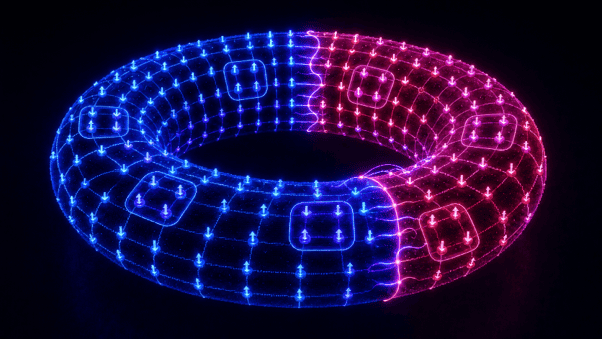
Two-dimensional (2D) materials have attracted a lot of attention in recent years for their excellent electronic, thermal and mechanical properties, as well as their interesting quantum effects. While graphene has gathered the most commercial attention, there are hundreds of 2D materials, all of which have different combinations of properties for different applications. A research team headed up at the University of Chicago has discovered some unusual behaviour in the 2D material Fe5GeTe2.
Some 2D materials exhibit superconductivity properties and charge orders (in which the electrons are confined in a specific arrangement rather than being able to move freely). Charge orders arise from the reshaping of ground states in the electronic bands of a 2D materials to create flat electronic bands. And these flat bands cause the electrons to move very slowly in the lattice, at speeds much slower than expected.
Extremely flat electronic bands can often become incoherent, due to an ultrastrong electronic interaction strength between charge carriers. In research published in Science Advances, Shuolong Yang and colleagues found that Fe5GeTe2 exhibits a charge-ordered state where electrons move both collectively and very slowly, while remaining quantumly coherent.
“I was originally motivated by the fact that Fe5GeTe2 was discovered to host multiple structural phases with nearly the same stoichiometry. Each structural phase is associated with its unique electronic and magnetic phase,” says Yang. “These different structural phases have almost degenerate energies, which means that they can all be stabilized at room temperature.”
According to Yang, this discovery prompted two key research questions: What is the nature of each phase? Can we utilize these nearly energy-degenerate phases to encode information?
Fe5GeTe2 is part of specific class of 2D materials called van der Waals magnets, which could be used to develop new memory technology. The researchers probed the electronic structure and magnetic states of Fe5GeTe2 using angle-resolved photoemission spectroscopy (ARPES). “We were able to surgically probe the electronic band structure of each individual phase region (tens of microns in size) and figure out the physics,” Yang tells Physics World. “This immediately allows us to answer the question of ‘What is the nature of each phase?’”
After discovering that the electronic band was flat in Fe5GeTe2, further studies into the material showed that the charge order in Fe5GeTe2 was caused by the folding of electronic bands in the Brillouin zone within 30 meV of the Fermi level.
“We revealed a so-called Kondo-like phase, so the localized electronic states strongly interact with itinerant states, resulting in very peculiar, quantum coherent flat bands right at the Fermi level which dictates low-temperature transport,” says Yang. “The discovery of an effective Kondo lattice in a ferromagnetic phase [instead of magnetically non-ordered phase] is quite a surprise from a theoretical point of view, which forced us to go back to the drawing board to understand its physics. We think that that our surprising finding originates from a many-body localized state interacting with the conduction electrons.”
Because of the flat bands, the electronic system wants to spontaneously break the space-translation symmetry. It then forms a new superlattice order commensurate with the original lattice. “Our results provide the first experimental evidence that an interaction-driven flat band can itself drive electronic ordering through flat-band nesting, without relying on Moiré or geometrically frustrated flat-band engineering,” Yang explains. He notes that this “peculiar physics” used to be something obtained in delicately designed, twisted 2D materials. This finding, however, provides a new avenue to study complex many-body physics enabled by flat bands in stoichiometric and strongly correlated materials.
There’s the potential that the material’s different magnetic states could encode information for memory systems. This idea is being trialled by the team by using a micro-focused laser to switch between this observed quantum many-body phase and other phases.
“We’re using carefully designed laser pulses of different frequencies to switch between the multiple phases of Fe5GeTe2, including our discovered Kondo-like phase. If successful, we will utilize the many-body physics for some real memory operations,” Yang explains. This follow-on aims to tackle the second stated research question. However, to be practical, it will have to work at room temperature, and these quantum effects have so far only been realised at ultralow temperatures.
“Fundamental work is underway to understand the exact nature of this Kondo-like phase, whether it has any topological properties, and whether it connects to structural defects,” says Yang. “Eventually we want to understand how to microscopically describe such an exotic system.”
China has made astounding scientific progress over the past decade, with the country outperforming all others in the world according to a recent analysis by Nature. Based on data from 2025, its 2026 Research Leaders study puts China ahead of the US (in second), Germany (third) and the UK (fourth).
Across all disciplines, Nature reports that most (51) of the top 100 institutions in the world are in China, with only four in the UK. The picture is slightly different if you judge academic institutions based only on their work in the physical sciences, but China still has 30 of the top 100 institutions, with only seven from the UK.
Professional physicists may not care much for such league tables but they do reveal just how far China has come in recent years. The country’s scientific strength was particularly evident at the fourth International Congress of Basic Science (ICBS) in Beijing, which I recently attended.
Founded in 2023 by the Fields-medal-winning mathematician Shing-Tung Yau, this year’s ICBS ran from 9-21 August at the Beijing Institute of Mathematical Sciences and Applications (BIMSA), of which Yau is president. Its international character is evident from the fact that a total of 50 of its 140 full-time researchers are from outside China.
Awards and honours
Over 800 participants from more than 30 countries attended the congress, which had the theme “Advancing science for humanity”, with my participation supported by the organisers. The programme was huge, featuring over 500 academic sessions covering topics from generative AI reasoning to quantum information.
Meanwhile, Frontiers of Science Awards were given to over 500 researchers from 20 countries who had done work of “excellent and of outstanding scholarly value” over the last 5-10 years in the three fields represented at the ICBS. Authors from many Chinese institutions were among the recipients, underscoring the growing international impact and vitality of China’s basic science research.
Youth focus Student nights wre held at the congress. (Courtesy: ICBS)
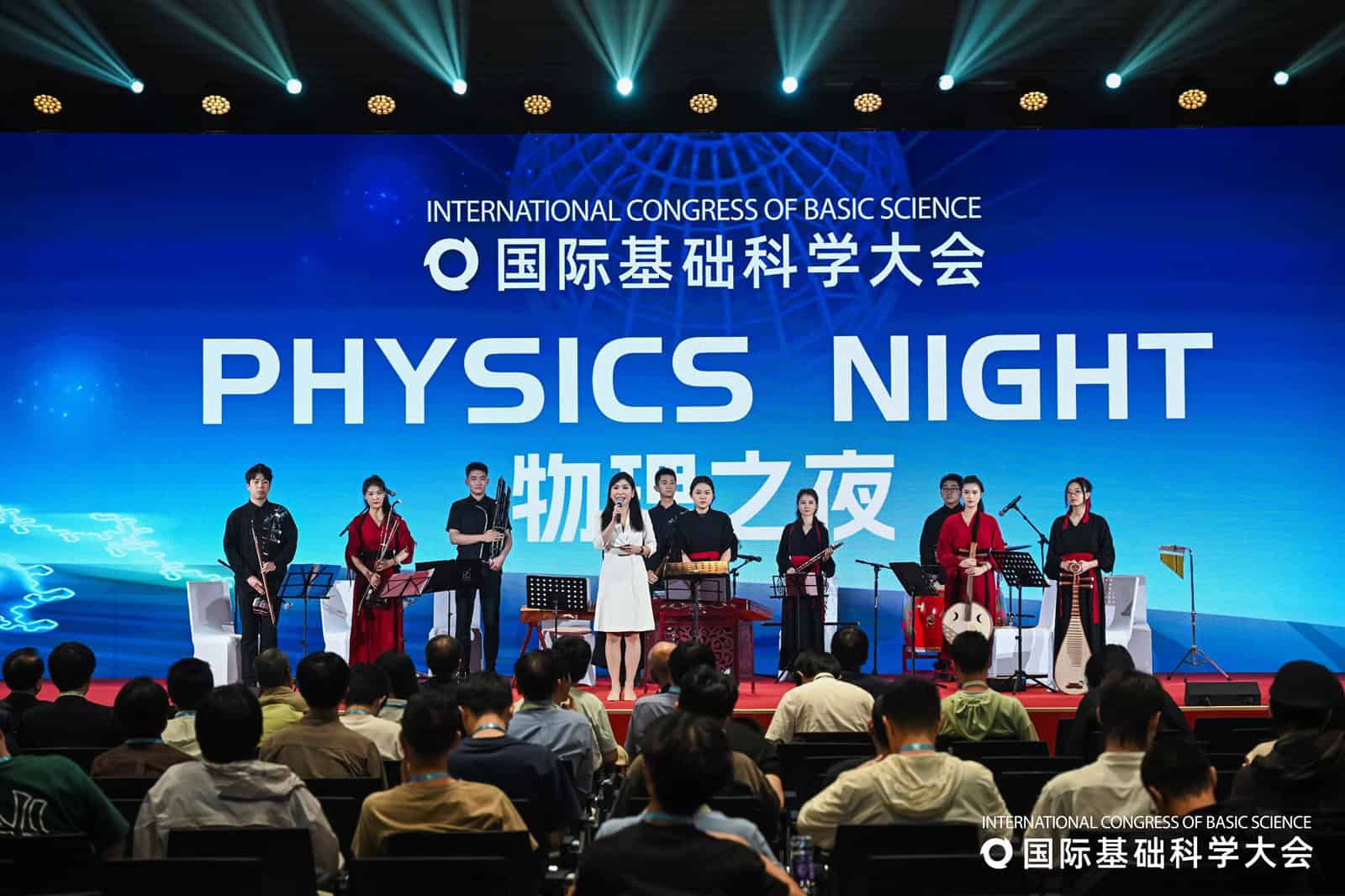
There were 20 plenary sessions, over 400 Frontiers of Science Awardee talks, plus events for entrepreneurs and school and university students. Especially engaging were the “nights of mathematics, physics and engineering”, enlivened by dance amd music performances by students. An exchange meeting was held too for research institutions in Beijing seeking to integrate basic science with frontier technologies
The closing ceremony saw the winners of this year’s ICBS Innovation Fellowships announced. They are all researchers under 50 who work full-time in China and have demonstrated potential in mathematics, physics, information sciences, and other fundamental and interdisciplinary fields. Each receives research funding and can work with a partner institution in China for an agreed period.
AI surges ahead
Artificial intelligence (AI) was one of the major themes of ICBS 2026. Fields medallist Martin Hairer from EPFL Lausanne, for example, said AI won’t end mathematics, but will transform how it’s carried out. It may speed up certain areas while others might fall away.
Caucher Birkar from Tsinghua University – another Fields medallist – pointed out that AI is highly capable in computation, searching for examples, and completing proofs of mathematical lemmas, but it remains difficult for AI to generate truly original ideas.
As for Robert Endre Tarjan, a Turing award laureate from Princeton University, he encouraged young researchers to be curious and commit themselves to long-term scientific exploration. Researchers, he said, can train AI to be a powerful tool for scientific discovery, but they must also develop their own ability to identify meaningful questions and establish independent judgment.
The last word was left to congress chair Shing-Tung Yau, who emphasised that while AI will enhance scientific research, the essence of scientific discovery will always depend on human creativity, imagination and independent thinking.
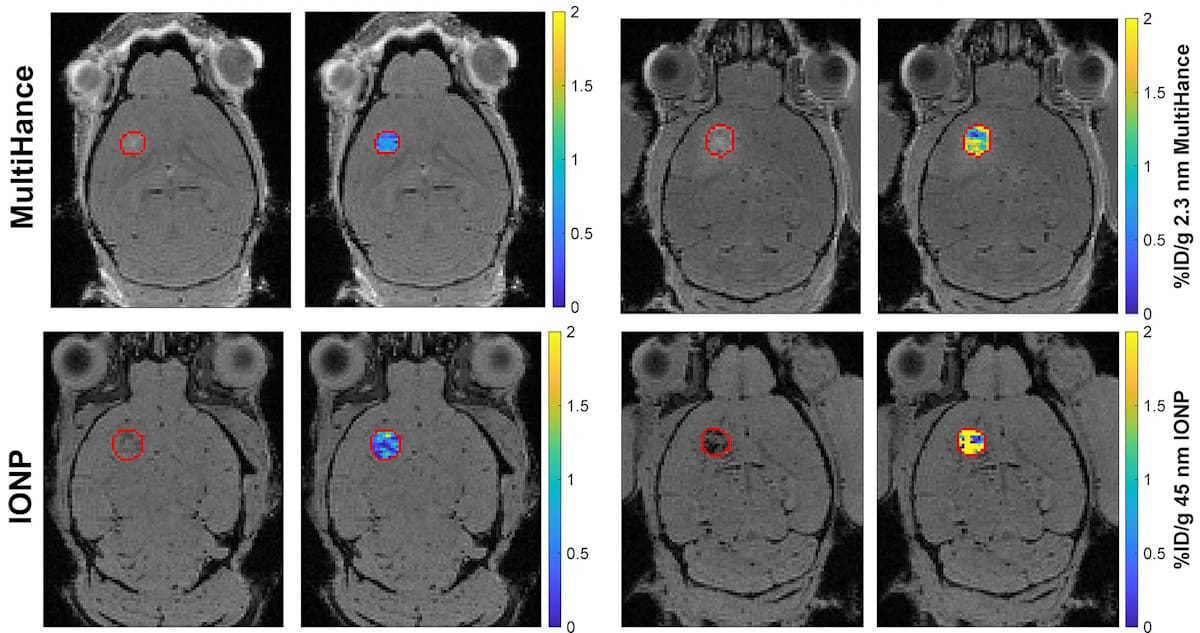
Brain tumour images Representative MR images of baseline (left panels) and FUS-treated (right panels) mouse brains. The top row shows administration of a 2.3 nm contrast agent (MultiHance), the bottom row shows administered iron oxide nanoparticles, 45 nm in size. Each pair of panels shows the anatomic image with the tumour outlined in red on the left, and the corresponding image superimposed with a concentration map showing the amount of nanoparticle retained within the tumour (as a percentage of the injected dose per gram) on the right. (Courtesy: CC BY 4.0/Radiology 10.1148/radiol.251005)
Drug delivery to the brain has been a longstanding challenge in medicine. One option is focused ultrasound (FUS), which can safely disrupt the blood–brain barrier for drug delivery. But how much of a drug gets into the brain depends heavily on its size. A long-standing assumption is that delivery decreases as drug size increases. But by using a clever spin on MRI physics, researcher Matthew Hoch and colleagues from the University of Virginia have shown that “the smaller the better” might not be entirely correct.
The blood–brain barrier is one of biology’s toughest engineering problems. Composed of a dense, tightly sealed layer of cells lining every blood vessel in the brain, the blood–brain barrier only lets nutrients and oxygen through and protects the central nervous system by blocking bloodborne pathogens. In doing so, however, it also blocks the delivery of drugs to the brain. Brain tumours compound this with their own blood–tumour barrier, further hindering drug delivery. For years, researchers have pondered how therapeutics could be delivered past these checkpoints; the answer may simply lie in the use of sound.
The process begins with the injection of gas-filled microbubbles into the bloodstream, where they circulate freely. Exposure to FUS then expands and contracts the volume of these microbubbles, creating a temporary, localized gap that pries the barrier open just long enough for drugs to slip through. Although the technique works, it is unclear how much of a drug actually comes through. In this new study, the team investigate how the size of the drug influences FUS-mediated drug delivery and introduce a novel technique to measure precisely how much drug is delivered.
The measurement problem
Many neurotherapies, with a range of sizes, could benefit from this drug delivery method. But measuring how much of the drug gets past the blood–brain barrier is challenging with current imaging methods. For example, fluorescence imaging is limited by its semi-quantitative nature, while PET scanning suffers from poor spatial resolution.
Standard MRI methods are not only time-consuming, but, in the form of T1-mapping, are typically limited by the size of commercially available contrast agents, which are small in comparison to larger neurotherapeutics used for immunotherapy and gene delivery. Other standard MRI methods sensitive to the presence of iron (T2-mapping) provide an alternative avenue to measure larger agents, but can again be limited by scan time for 3D visualization. Both approaches also have potential to suffer from low sensitivity at low concentrations.
Hoch and his team solve this measurement problem by introducing quantitative susceptibility mapping (QSM), an MRI technique with diverse applications in neuroimaging including evaluation of haemorrhage, iron deposition and calcification. QSM works by exploiting the distortion of local magnetic fields by different materials, a property called magnetic susceptibility. By injecting iron-based nanoparticles that induce measurable, spatially localized shifts in the MRI signal’s phase, QSM can generate a 3D map of magnetic susceptibility. This can then be used to calculate the actual concentration of iron-based nanoparticles within tissues.
By transforming an MRI scanner into a sensitive nanoparticle detector, the researchers present a novel way to quantify drug delivery down to fractions of a percent of the injected dose.
What did they find?
The team tested this approach using four different particles, with a 20-fold range in size. The first was a small gadolinium-based contrast agent, MultiHance (a proxy for small molecule therapeutics), at around 2.3 nm; the other three were iron oxide nanoparticles (IONPs) of 15, 23 and 45 nm, sizes that mirror the dimensions of therapeutic candidates used for immunotherapy and gene therapy.
Using healthy and glioma brain tumour-carrying mice, the researchers used FUS treatment to open the blood–brain barrier and deliver particles of varying sizes. They recorded MRI scans before and after delivery and used QSM to generate a precise measurement of how much of each particle made it into brain tissue.
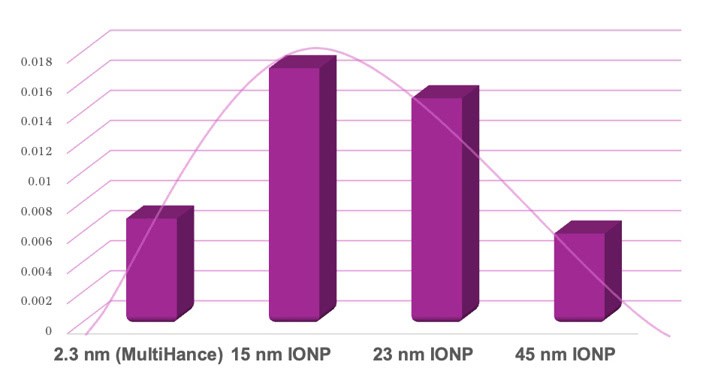
Brain delivery by particle size The amount of drug delivered, as a percentage of the initial injected dose, that has successfully travelled to the brain. (Courtesy: Adapted from Radiology 10.1148/radiol.251005/CC BY 4.0)
The results were unexpected. Drug delivery followed a bell-shaped curve in healthy mice. From the smallest (2.3 nm) particle to the 15 nm IONP, delivery increased 2.6-fold, then at 23 nm, remained steady. Interestingly, at 45 nm, delivery dropped by 2.5-fold compared with the 23 nm nanoparticle, comparable to that of the smallest agent.
This sweet spot, ranging from 15 to 23 nm, demonstrates that smaller isn’t always better. The researchers suspect that this trend in drug delivery is due to a balance between how easily a particle can squeeze through the barrier (so favouring smaller particles) and how long a particle stays in circulation, giving it more time to travel across the barrier (favouring larger particles).
In the mice with brain tumours, where there is an addition of the tumour’s own leaky, disorganized vasculature, the blood–tumour barrier, drug delivery can differ from that to healthy brain. Specifically, this barrier is thought to make drug delivery more difficult than in healthy tissue due to higher tissue pressures and inconsistent blood flow. But the researchers unexpectedly found that FUS boosted delivery of both small and large agents into tumours, with no real difference to the drug delivery levels seen in healthy brain tissue, despite the added presence of the blood–tumour barrier.
“The outcome is exciting because it means that focused ultrasound delivery performance is not expected to diminish in brain tumours,” says senior author Richard J Price in a press statement. “In fact, it may even be enhanced for some types of therapeutics.”
FUS-mediated barrier opening is currently in clinical trials for use in Alzheimer’s disease and glioblastoma, and this research has implications in both drug engineering and treatment planning. By introducing QSM, Hoch and his colleagues have provided a universal, precision technique to quantify contrast agent delivery. Taking existing tools, used for a specific physics measurement problem, and developing them to answer a completely different biological question is no small feat. Here, the researchers present an ingenious intersection of physics and biology, and its potential application in medicine.
The researchers report their findings in Radiology.
When light is absorbed by a semiconductor, it first creates an electron-hole pair before free charges can be generated. The electron and hole can remain bound together in a quasiparticle known as an exciton. This intermediate stage is important because excitons determine how light is absorbed and emitted, and how efficiently a material can convert light into electrical current.
Monolayer tungsten diselenide (WSe₂) is a material that researchers are investigating for use in photodetectors, optical computing and quantum technologies. It is an atom-thick semiconductor that interacts very strongly with light. The excitons formed in WSe₂ are unusually stable, allowing quantum effects to be observed particularly strongly. WSe₂ therefore provides a model system for learning how to control light-generated excitons, knowledge that could eventually lead to more efficient solar cells, photodetectors and low-energy photonic technologies.
A key question in this area of research is what causes the WSe₂ exciton energy to shift to a higher energy (blue shift), a lower energy (red shift) or split into two levels. Two leading explanations are the Optical Stark Effect, in which the laser’s electric field directly modifies the exciton energy, and exciton-exciton interactions, in which excitons alter one another’s energies through many-body interactions.
In this work, the researchers used helicity-resolved transient absorption spectroscopy to show that, while the laser pulse is present, the Optical Stark Effect dominates, causing a blue shift, splitting or a red shift depending on the laser detuning. After the pulse ends, exciton-exciton interactions become dominant, producing a blue shift. By varying the laser detuning and tracking the exciton response on femtosecond timescales, the researchers were able to separate the coherent Optical Stark Effect from the later incoherent exciton-exciton interaction. The work provides a clearer picture of how light and excitons interact on ultrafast timescales, which is important for the design of next-generation optoelectronic devices.
In an antiferromagnet, neighbouring spins prefer to align in opposite directions to minimise their energy. In a geometrically frustrated magnet, this is not always possible; for example, three spins on a triangle cannot all simultaneously be antiparallel to one another. The magnet PdCrO2 contains chromium (Cr) atoms on a triangular lattice, so that the magnetic moments on the Cr atoms cannot point antiparallel to each other. This compound also contains sheets of palladium (Pd) atoms that have very high electrical conductivity. PdCrO2 is therefore a system in which the interaction between magnetism and electronic structure can be studied in a precise way.
Previous studies have shown that the Cr-Cr exchange interaction is highly sensitive to inter-atomic spacing. In consequence, the magnetic ordering wavevector shifts rapidly as uniaxial stress is applied to PdCrO2, distorting the triangular lattice. In this work, the researchers have taken a step further by applying enough stress to qualitatively change the magnetic structure. They use a combination of X-ray diffraction and measurement of the stress-strain relationship to probe the effects on the elastic properties, and elastic neutron scattering to see how the magnetism changes. As the magnetic structure changes, the Young’s modulus changes by around 100 GPa, showing that magnetic interactions have a large effect on the crystal’s mechanical stiffness.
As stress is initially applied to PdCrO2, the magnetic wavevector changes rapidly, reflecting the sensitivity of the Cr-Cr exchange interaction to strain. The main finding of this work is that, under a uniaxial stress of about 0.6 GPa, the magnetism undergoes a first-order transition into a state where the magnetic wavevector is rigid, that is, no longer responds to continued change in lattice strain. The rigidity of this stress-induced magnetic structure is reflected in the elastic properties: the Young’s modulus almost doubles, and the Poisson ratio falls from about 0.7, an exceptionally high value, to about 0.3, which is more typical. This rigidity may be a consequence of nesting: the wavevector of this stress-induced magnetic phase nests the Fermi surface of the Pd sheets. PdCrO2 may therefore provide a system in which the thermodynamics of nesting can be studied with quantitative precision. More broadly, the work demonstrates that uniaxial stress is a powerful tool for tuning frustrated magnetism and accessing new magnetic states.
A critical point is where a material changes phase. For example, water turns to ice below 0°C (273 K) at standard pressure. A quantum critical point occurs at absolute zero (0 K) and, instead of being driven by temperature, is caused by changing another property such as a magnetic field, pressure, or interaction strength. One example is the transition between an ordered magnetic state and a disordered quantum state.
Entanglement entropy is a measure of how much quantum information two parts of a system share. If a system is split into two regions, a low entanglement entropy means that knowing about one half tells you little about the other half, while a high entanglement entropy means that the two halves are strongly connected through quantum mechanics. Entanglement entropy provides important information about quantum phases of matter, quantum critical points, and universal properties of quantum systems. However, calculating entanglement entropy accurately at quantum critical points in two-dimensional quantum systems is very difficult. These systems are commonly described as (2+1)-dimensional because their critical theories involve two spatial dimensions and one time dimension.
AI generated research concept (Courtesy: Justin Tim-Lok Chau/The University of Hong Kong)
In this work, the researchers developed a novel Quantum Monte Carlo algorithm to calculate entanglement entropy more accurately. Quantum Monte Carlo methods use random sampling to study quantum systems that are too complex to solve exactly. The researchers started with a standard quantum magnet model, the transverse-field Ising model, and added extra interactions that allowed them to study different types of phase transitions, including ordinary Ising critical points and a tricritical point that, in (2+1) dimensions, is described by a Gaussian free theory.
The researchers compared the second Rényi entanglement entropies of two specially chosen regions with the same boundary length. This directly cancelled the dominant area-law contribution, allowing the much smaller universal corner term to become the leading signal. They then used the same approach to obtain a precise value for the Ising critical point. The results showed that the Ising and tricritical/Gaussian critical points have different universal entanglement fingerprints, demonstrating that entanglement can distinguish between different types of quantum critical behaviour. More broadly, the work provides a powerful new method for studying entanglement in strongly interacting quantum systems and for testing theoretical predictions in two-dimensional quantum materials.
NASA has successfully launched the $4.3bn Nancy Grace Roman Space Telescope. The observatory took off atop a SpaceX Falcon Heavy rocket from Florida’s Kennedy Space Center at 7.26 a.m. local time on 30 August. The craft will now spend three months travelling to a point in space known as the second Sun–Earth Lagrange point (L2) where it will survey space with a field of view at least 100 times greater than the Hubble Space Telescope.
From L2, which lies about 1.6 million kilometres from Earth, the Nancy Grace Roman Space Telescope will yield insights into dark energy and dark matter, discover and characterize exoplanets, map billions of galaxies, and gain fresh understanding of black holes.
It will do so via a 2.4 m primary mirror that is accompanied by two instruments: a wide-field instrument will obtain images in visible and near-infrared light, while an experimental coronagraph will use masks, prisms and mirrors to cancel out the light from stars to help detect exoplanets.
“Roman will be a discovery machine that will bring us closer than ever before to answering humanity’s most profound questions about our cosmic history,” notes Nicola Fox, associate director for NASA’s Science Mission Directorate.
NASA intends the observatory to operate for at least a decade, with three specific surveys planned for its initial five years. The first will identify tens of thousands of distant supernovae, many more than the 2000 currently known, while a second survey will observe more than a billion galaxies.
Both these sets of measurements, combined with data from other survey telescopes, will be used to improve our understanding of dark energy and its potential role in the speed at which the universe expands. Their observations of gravitational lensing will also allow astronomers to map dark matter.
A third survey, meanwhile, will search the centre of the Milky Way for signs of gravitational microlensing that will reveal more than 2000 otherwise invisible exoplanets.
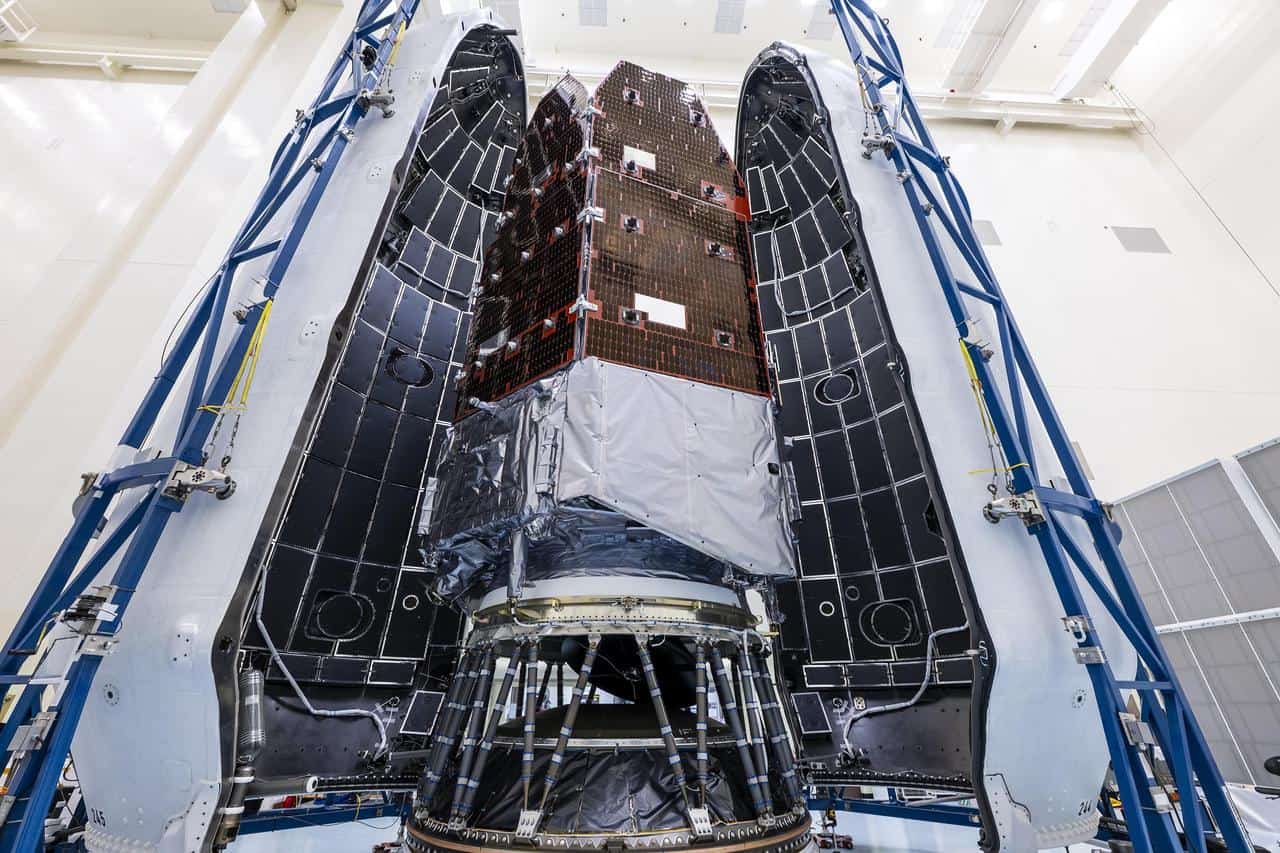
Space surveyor: the observatory will yield insights into dark energy and dark matter, study exoplanets, map billions of galaxies and to gain fresh understanding of black holes. (Courtesy: SpaceX)
Mother Hubble
The observatory was initially known as the Wide-Field Infrared Survey Telescope before it underwent several design changes due to cost pressures. In 2020 it was then renamed after Nancy Grace Roman (1925–2018), who in the early 1960s became NASA’s first chief astronomer and is known as “the mother of the Hubble Space Telescope”.
Yet the Roman observatory won’t replace Hubble or the James Webb Space Telescope, rather it will complement them, providing data from wide areas of the universe that those two instruments will then be able to observe in greater detail.
Indeed, Roman will survey the universe a thousand times faster than the Hubble, creating 1.4 billion terabytes (1.4 zettabytes) of information daily – the highest data rate of any NASA astrophysics mission.
NASA says that machine learning, artificial intelligence and “citizen science” will be used to help sift through the data and flag findings that astronomers will then study.
NASA administrator Jared Isaacman praised the mission as “exactly the kind of success story we want to see”. He noted that it was completed “ahead of schedule and on budget”, adding that it “will demonstrate what is possible when America’s space programme pairs bold ambition with disciplined execution”.
As audiences poured out of London’s Old Vic theatre on a crisp night in January, one theatregoer and their companion were overheard chatting about the second law of thermodynamics. “I wish I knew more about what they were discussing,” one remarked, referring to the characters in Tom Stoppard’s Arcadia. “It’s an unusual play,” the other responded.
Was this curiosity about thermodynamics a sign of confusion, that the production had failed to communicate its ideas clearly for a lay audience? Or had the evening in the theatre inspired a desire for these audience members to dig deeper and learn more about physics through the shared experience of watching a play?
Written in 1993, Arcadia is an early example of an ever-growing number of plays that have at their heart scientific ideas or scientists themselves. Newtonian determinism, chaos and iterated algorithms all crop up in Stoppard’s masterpiece, but Arcadia is a play about much more than just physics or mathematics.
With scenes alternating between a country house in the early 19th century and the present day, Arcadia is also a literary mystery about the poetry of Byron set against academic rivalry. Like all of Stoppard’s work, it’s an agile, clever and entertaining tour de force of ideas, led by characters who are just as concerned with traditional dramatic themes including love, jealousy and flawed ambition.
The Old Vic’s Arcadia was sufficiently popular with audiences that it received a transfer to London’s West End for an extended run in summer 2026. But it was not the only major revival of a classic “science play” in London this year, with Hampstead Theatre staging a new production of Michael Frayn’s Copenhagen.
Arguably no other play about physics has been as popular and successful as Copenhagen since it was first produced at the National Theatre in London 1998. It imagines what might have been discussed when Werner Heisenberg visited Niels Bohr at his home in the Danish capital during the Second World War. It also explores the implications of the meeting for the development of nuclear weapons.
Plays depicting physics or physicists fall into three main types. Some are straightforward biographical representations of physicists – from Lise Meitner to Stephen Hawking. Others focus on the process of “doing” physics. A third kind uses scientific concepts to structure the play itself. Copenhagen is perhaps unique in achieving all these feats at once.
Curtains up
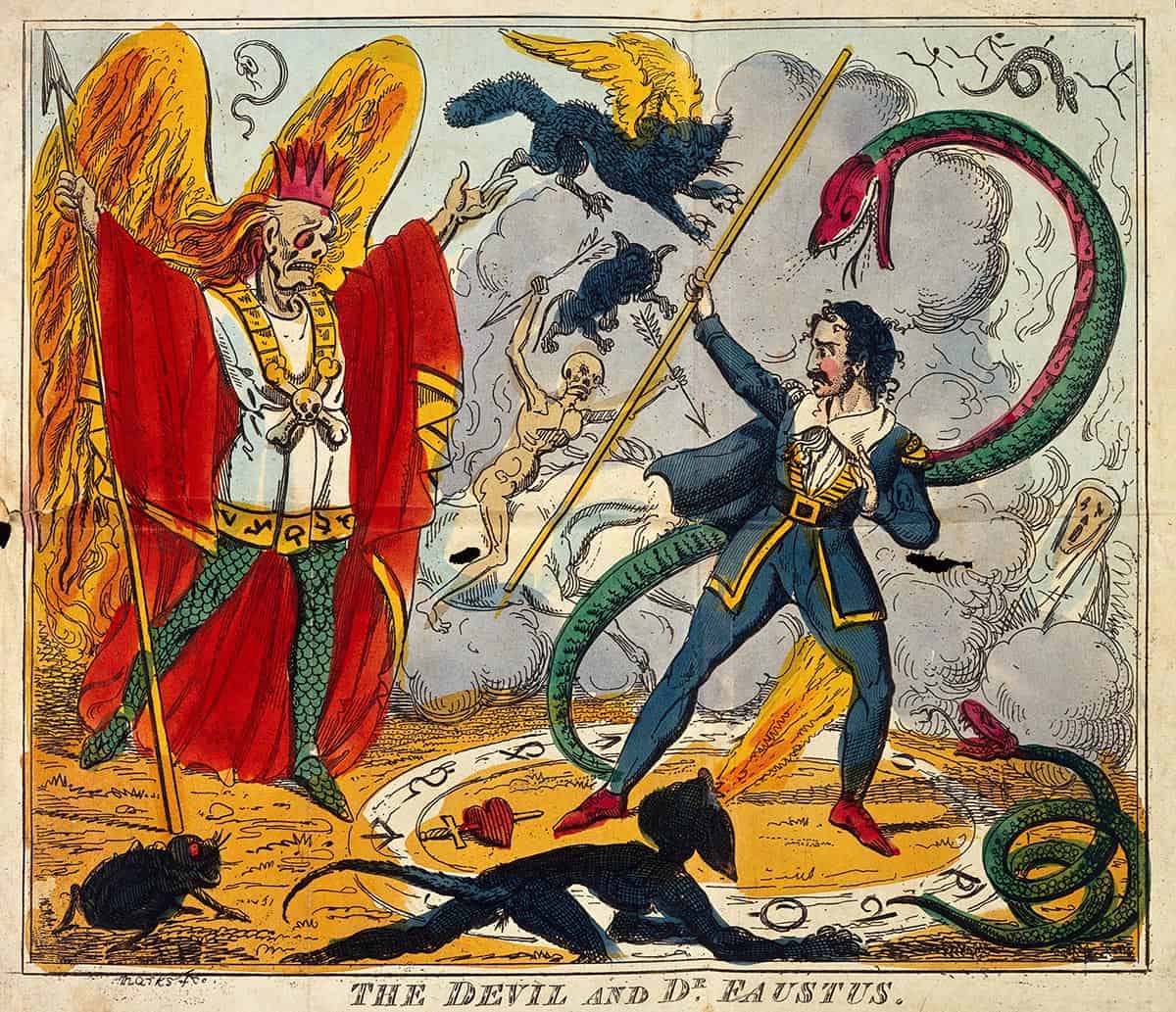
The representation of scientists on stage is not a new phenomenon. The ambitious alchemist and natural philosopher Doctor Faustus, who sold his soul to the devil in Christopher Marlowe’s 16th-century play of the same name, is one early example of a learned character who could be considered a scientist seeking worldly knowledge at a cost.
Strange encounter The Devil and Doctor Faustus Meet is an 1825 illustration of the play Doctor Faustus by Christopher Marlowe, which was one of the earliest stage shows to feature scientific ideas. (Source: Wellcome Collection)
Later, in 1823, there was a highly popular stage adaption of Mary Shelley’s novel Frankenstein. Performed at the English Opera House in London, Presumption; or, the Fate of Frankenstein by Richard Brinsley Peake was what first brought Shelley’s book to public prominence, reigniting suspicions of the motivations of scientists as a potential force for good or evil.
While Frankenstein led the way in the genre of science fiction, which I will not cover here, the notion of the “physics play”, where physics or physicists feature deeply, can be more readily traced to the 20th century. Bertolt Brecht’s A Life of Galileo, written in 1938, is perhaps one of the first clear examples to represent the life and work of a real scientist on stage.
First performed in German in Zurich in 1943, ALife of Galileo presents the audience with an account of a scientist whose life is well documented in the historical record. It depicts scenes from Galileo’s life including his prosecution for heresy by the church for promoting the heliocentric universe.
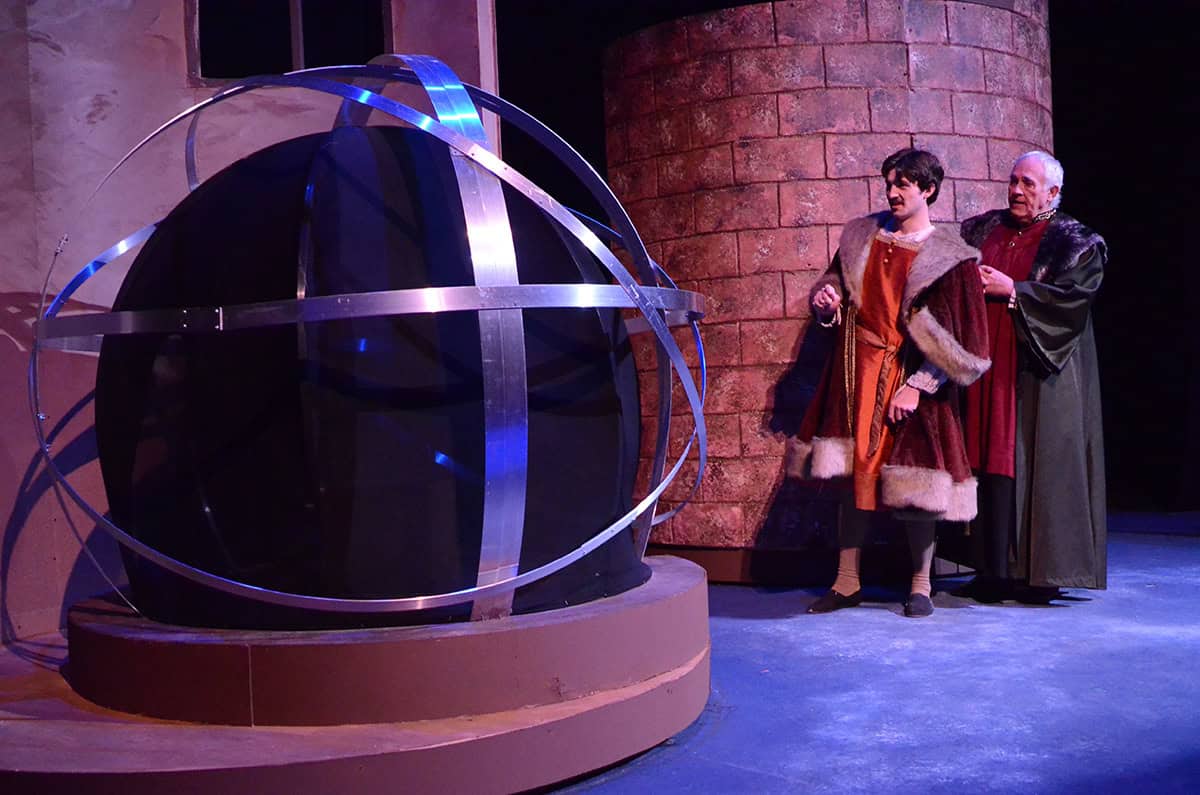
Astronomy in action Dava Sobel’s play And the Sun Stood Still was produced in 2014 by Boulder Ensemble Theatre Company, starring Benjamin Bonenfant (left) as mathematician Georg Rheticus and Jim Hunt (right) as Nicolaus Copernicus. (Photograph by Michael Ensminger. Used with permission)
Since then we’ve seen plenty of other plays about real-life physicists. Also dealing with the heliocentric solar system is acclaimed science writer Dava Sobel’s short 2011 play And the Sun Stood Still (first published in her book A More Perfect Heaven). It concerns an episode in the life of Nicolaus Copernicus, depicting his discussions with mathematician Georg Rheticus when he visited Poland in 1539.
The period of scientific advancement that followed in the 17th century is represented in a number of plays depicting the life of Isaac Newton. A notable example is Craig Baxter’s Let Newton Be!, a verbatim play based on Newton’s own words that was written to celebrate the University of Cambridge’s 800th anniversary in 2009.
It was performed by Menagerie Theatre Company for the first time in 2009 at Trinity College, Cambridge, where Newton had once been a fellow. Three actors simultaneously portray Newton at different points in his life, from boyhood to establishment figure, continually interacting with each other on stage. Baxter aims to give a less conventional perspective on Newton’s life than the usual image of a scientist beneath an apple tree.
Historical heroes Left: Let Newton Be! by Craig Baxter was toured from 2009 to 2011 by Menagerie Theatre Company with a cast that included David Meyer as Isaac Newton in later life. (Courtesy: Menagerie Theatre Company/Jaimie Gramston). Right: Siobhán Nicholas’ play Hanging Hooke, toured by Take the Space from 2008 onwards, starred Chris Barnes as Newton’s scientific rival Robert Hooke. (Photographer Ken Goodson, copyright Take the Space Theatre Company Ltd)
Newton’s contemporary and arch enemy Robert Hooke was also memorably represented by the actor Chris Barnes in Siobhán Nicholas’ 2008 one-man play Hanging Hooke. It was toured by Take the Space theatre company, which Barnes co-founded, to venues across the UK, including a performance at the Royal Society itself.
In a follow-up to Hanging Hooke, Take the Space also represented the contributions to astronomy of Caroline Herschel in the 18th and 19th centuries. Her work, which is arguably less well known than that of her brother William Herschel, appeared in STELLA: a Story of Women, Their Men and Astronomy, also written by Nicholas.
Centre stage
Some episodes in the history of physics are more thoroughly documented then others, lending rich source material for drama. Such is the case in Katherine Moar’s play Farm Hall about the German physicists who were famously held captive in a country house in Cambridgeshire, UK, at the end of the Second World War.
The play features six characters, all of them real scientists, including Heisenberg, Kurt Diebner and the pioneering radiochemist Otto Hahn. Their words were secretly recorded by their British military captors in 1945 in an attempt to find out how close, if at all, the German scientists were to developing a nuclear bomb.
Ethical matter Physicists’ involvement in nuclear weapons has been a rich source of material on the stage, including this 2023 production of Farm Hall by Katherine Moar, at the Jermyn Street Theatre in London. It included Archie Backhouse (left) as Erich Bagge, Forbes Masson (centre) as Otto Hahn and Alan Cox (right) as Werner Heisenberg, who were among six German physicists held captive by the British military after the Second World War to uncover their role, if any, in Germany’s attempt to build nuclear weapons. (Photograph by Alex Brenner. Used with permission)
Moar’s play is one of several that use the Farm Hall transcripts as the basis of a play text, another being Operation Epsilon by US playwright Alan Brody. Originally written in 2013, it received its British premier at the Southwark Playhouse in London in 2023, and examines the ethics of those involved in nuclear weapons programmes.
That theme was also tackled in Christopher Nolan’s blockbuster movie Oppenheimer, which was one of the biggest film successes of recent years. However, J Robert Oppenheimer has been represented on stage too, not least in Tom Morton-Smith’s 2015 play Oppenheimer, in which key figures in the Manhattan nuclear-bomb project were re-enacted in a large-scale production at the Royal Shakespeare Company (RSC). Morton-Smith’s play aimed to capture the scale and scope of a so-called Shakespearean “history play”, with a significant but flawed character at its heart, although this is arguably a tough feat to achieve.
Dramatis personae
In each of the examples above, the physicists portrayed are real people, whose names and work will be familiar from textbooks and the historical record. Other physicists to have been the subject of plays include Jocelyn Bell Burnell, Ludwig Boltzman and Wolfgang Pauli, while Nicole Kidman played DNA-structure pioneer Rosalind Franklin in Anna Ziegler’s Photograph 51.
Physicists as fictional characters and the act of doing physics are also increasingly being represented on stage, with collaboration in big-science projects becoming central
However, physicists as fictional characters and the act of doing physics are also increasingly being represented on stage, with collaboration in big-science projects becoming central. Especially fruitful as source material have been activities at CERN and particularly the Large Hadron Collider (LHC), which gained growing public awareness during the hunt for the Higgs boson in the first two decades of the 21st century.
Playwright Lucy Kirkwood had already published a play with nuclear scientists as characters in The Children in 2016 (currently playing at Lyric Hammersmith). But it was her play Mosquitoes, produced at the National Theatre in 2017, that centred on scientific themes. Many scenes are set at the LHC and its central character, Alice, is a research physicist based in Geneva who has a complex relationship with her sister, Jenny.
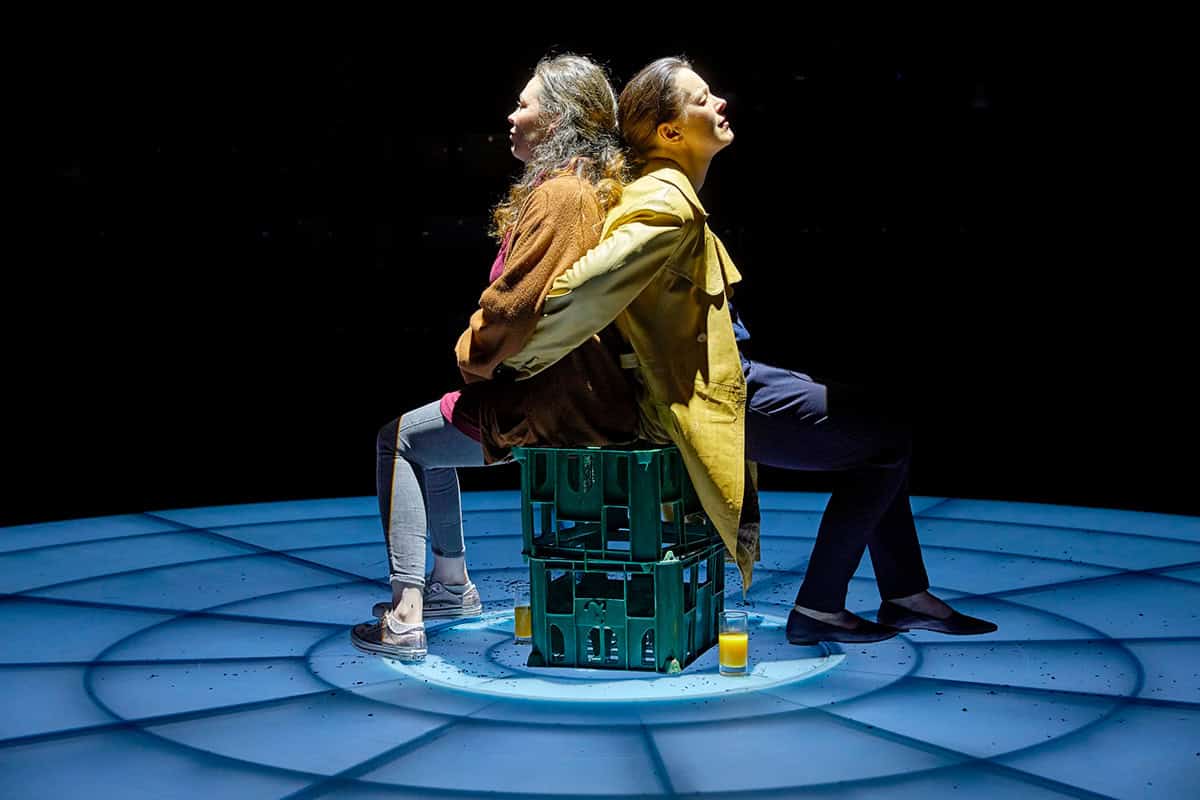
Colliding characters Mosquitoes by Lucy Kirkwood, performed at the National Theatre in 2017, starred Olivia Williams (right) as a physicist working at CERN, and Olivia Colman (left) as her sister. (Courtesy: Brinkhoff & Mogenburg)
The play’s depiction of the two sisters centralizes the process of collaboration that is key to large-scale science research. Olivia Colman and Olivia Williams played the main characters in Mosquitoes in the National Theatre production, which benefited from some funding from the Institute of Physics, which publishes Physics World.
On a smaller scale to Mosquitoes, but also set in the periphery of CERN, is Morton-Smith’s one act play The Earthworks. Set on the eve of the switch on of the LHC, it features two strangers – a journalist and a physicist – who meet in a hotel bar in Geneva and talk about their loves and fears.
The anticipation and magnitude of the imminent new experiment gives the two characters cause to reevaluate their own lives and relationships. Although not widely produced, The Earthworks is an engaging short drama that again normalizes the process of big science in the wider cultural context through theatre.
Structured text
Featuring a physicist as a main character is also key to Constellations by Nick Payne, a playwright who has often included scientific ideas in his work. First performed in 2012 at the Royal Court Theatre, it features a physicist and beekeeper who meet at a picnic and begin a series of scenes replayed over and over again.
Unlike straightforward biographical-style plays, Constellations is a great example of a play that uses a scientific principle as a metaphorical device to help shape the play itself. Its structure is essentially inspired by the “multiverse” interpretation of physics, which implies there may be a potentially infinite number of copies of ourselves in different worlds.
The many iterations of similar scenes in Constellations make it a challenging production for actors – although not necessarily for audiences, provided the acting is good. And having only two characters on stage proved handy during the COVID-19 pandemic, when strict social-distancing rules meant it was helpful to have such a small cast.
In fact, when Constellations was revived in 2021 at the Vaudeville Theatre in London, different pairs of celebrity actors were used in different performances. Pairings included Peter Capaldi with Zoë Wanamaker, and Omari Douglas with Russell Tovey.
Two’s company Constellations by Nick Payne is a two-hander with multiverse themes. In 2021 it was produced at the Vaudeville Theatre with several different casts. Clockwise from top left: Chris O’Dowd and Anna Maxwell Martin; Peter Capaldi and Zoë Wanamaker; Omari Douglas and Russell Tovey; Sheila Atim and Ivanno Jeremiah. (Photographs by Marc Brenner. Used with permission)
“I loved staging Constellations,” says the theatre director Michael Longhurst, who originally worked with Payne on the play. “When a writer does that work to understand the science for us lay audience members and then puts them into a human context in a dramatic setting, then I think there is a real gift.”
Incorporating physics into the structure of a play has also been tackled more than once by Tom Stoppard, who died last year. In Hapgood, his attempt at a spy thriller, quantum physics plays a role in structuring the play by experimenting with quantum uncertainty as a plot device. First performed in 1988, the complexity of the plot proved confusing for audiences and, although revived subsequently, it was one of Stoppard’s less successful plays.
The bewildering twists and turns of Hapgood are in strong contrast to Arcadia, which has proved a far more popular science-themed play from the great playwright. It toys with ideas of determinism and iterated algorithms in a rich drama.
Like many Stoppard plays, audiences appreciate the playfulness of ideas but can at times feel alienated by the complexity of the discourse. Nonetheless, Arcadia is a hugely significant play when it comes to science in theatre and its recent success at the Old Vic and subsequent West End transfer over 33 years later is evidence of its endurance.
It’s worth noting, however, the existence of several plays that appear to have a strong physics connection – but in fact have very little at all. Notable examples include Friedrich Dürrenmatt’s 1962 play The Physicists (which was more of a satire) and Simon Stephens’ 2015 play Heisenberg: the Uncertainty Principle. Stephens was perhaps capitalizing on a growing public awareness of “uncertainty”.
Copenhagen: the definitive physics play
Conversely, you could be forgiven for thinking that a play called Copenhagen would be largely about the Danish city. But Frayn’s drama is one of the most significant examples of a play about and featuring physicists. With just three actors on stage and minimal set or plot, it is perhaps a surprise that Copenhagen could capture the attention of theatre goers for over two hours.
However, the text is a richly researched and thought-provoking drama that successfully achieves several things at once. First, it is a faithful account of the lives and work of Bohr and Heisenberg, insofar as we can know these two Nobel-prize-winning physicists, provoking historically meaningful questions.
Second, it gives an audience a sense of the excitement, frustration and invigoration of the act of doing science through the reminiscences and insights of its characters reflecting on the heyday of the development of quantum theory.
Stars of the stage Michael Frayn’s Copenhagen, which is perhaps the archetypal physics play, was revived in 2026 at Hampstead Theatre. It starred Richard Schiff (left) as Niels Bohr, Damion Molony (centre) as Werner Heisenberg and Alex Kingston as Margrethe Bohr. (Photograph by Marc Brenner. Used with permission)
Third, it successfully embeds concepts of uncertainty and complementarity within the text and structure of the play itself – in a way that other writers have fallen short of achieving. Copenhagen perhaps stands out among all other plays that deal with physics as achieving all three of these things at once, accounting for some of its enduring appeal, not least to physicists.
In a conversation with Physics World earlier this year, Frayn admitted that physicists hadn’t held back in pointing out mistakes. “Some of the physicists who have seen Copenhagen have taken the trouble to write to me and to point out errors I had made in the science, in spite of all my efforts,” he says. “I have as a result made a number of corrections in succeeding productions over the years. I am very grateful to them.”
Copenhagen tackles the historical and moral dimensions of nuclear weapons in a way that is as relevant today as when it was written
The care with which Frayn researched and adapted Copenhagen enables it to tackle the historical and moral dimensions of the development of nuclear weapons in a way that has made it as relevant today as when it was written. The production at Hampstead Theatre in spring 2026 was the latest in a long line of revivals of the play around the world since its first critical and popular success in 1998. In addition to Howard Davies’ 2002 film version, Emma Harding adapted Copenhagen for radio in 2013, featuring Simon Russell Beale, Benedict Cumberbatch and Greta Scacchi.
Curtains down
So were the Old Vic theatregoers wandering down the street after seeing Arcadia enthused or confused by their encounter with thermodynamics in the theatre? Should we celebrate or be sceptical of plays that put physics at their core? There is arguably no reason why physics should have a place in theatre any more or less than any other aspect of human endeavour.
However, as the importance of science becomes more embedded as an essential part of our culture in general, the role for physics in the theatre continues to grow. Current writers such as Moar and Kirkwood will continue to build on the achievements of the old guard such as Frayn and Stoppard, whether that be representing the history of physics, portraying physicists as characters or using science within the structure of a play.
In the rarest of cases all three can be achieved at once and it is intriguing to wonder how long it will be until another play comes along to match the might of Copenhagen as the definitive physics play.
What do you think? What makes a good physics play and what’s your favourite production? Let us know by e-mailing pwld@ioppublishing.org
Water droplets sliding across solid surfaces can acquire electric potentials of thousands of volts and thereby corrode non-conductive surfaces on metals when they discharge. That is the conclusion of researchers in Germany who say that the poorly-understood phenomenon warrants further investigation to help prevent corrosion of vulnerable outdoor equipment and cultural heritage sites.
Metal corrosion by water droplets is a serious economic and safety issue, and prevention begins with the proper understanding of the relevant processes. Conventional wisdom is that most corrosion is caused by a combination of physical abrasion by the motion of the droplets and chemical degradation from natural acids and anthropogenic pollutants in the water. The notion that electrochemistry might play a significant role in corrosion had not been seriously considered, says physical chemist Hans-Jürgen Butt of the Max Planck Institute for Polymer Research in Mainz.
Part of the reason, he believes, is that, until relatively recently, it was thought that the triboelectric effect (electrically charging objects by rubbing them together) did not work in liquids. “If you have a solid and you rub another insulating solid against it you get electron transfer – I think this has been known for more than 2500 years” he says. However, this relies on atomic-scale roughness of the surface to concentrate charge at specific points where bonds can be broken – and fluids cannot, by definition, be rough.
“If you take a water droplet and let it slide there is some mechanical force from surface tension, but that’s much too low,” says Butt. “There is no way you could generate enough energy locally to pick up an electron or to put an electron or an ion from the water onto the surface.” In the past 10 years, however, it has become increasingly clear that sliding droplets do become highly charged.
Sloping surfaces
In their present work Butt and colleagues deposited water droplets onto copper surfaces covered with 60 nm of Teflon. When they dropped droplets straight onto the surface, they observed no corrosion. They then deposited droplets first onto a variety of other sloped insulating surfaces such as plant leaves, PVC construction boards and the perfluorooctadecyltrichlorosilane (PFOTS) hydrophobic coating often used on window glass. The droplets ran down these surfaces and then fell onto the Teflon-coated copper. After around 3000 droplet impacts, atomic force microscopy and confocal microscopy revealed evidence that the droplets had corroded both the coating and the underlying copper.
The researchers believe that the droplets become positively charged as they slide down the sloping surface. As they fall onto the coating, the potential difference between the copper and the underlying copper can exceed 1 kV. This is greater than the dielectric breakdown strength of the coating, causing the droplet to discharge. This damages the coating and leaves the underlying metal vulnerable to further oxidation.
To test their hypothesis, the researchers measured charge movement within the copper surface, showing that negative charge flowed towards droplets dripping off insulating surfaces. They also used high-speed cameras to show that, whereas a drop deposited directly retained its spherical shape before impact, a dripping drop was drawn into a cone shape, producing a tip of positive charge that would increase its corrosive capacity.
Uncertain consequences
The practical implications of this are unclear. “Technical coatings on cars, ships etc. are typically 100 microns and thicker, so the process we describe is probably not of direct relevance,”says Butt. However, the phenomenon could be involved in the degradation of monuments and other outdoor historical objects. “We have evidence that surfaces change their properties when you slide charges over them, but the real consequences are not yet known,” explains Butt.
He says his own group is most clearly focused on understanding the fundamental physics involved. “We still don’t know why the heck there is such a charge separation: it’s energetically unfavourable, it should not happen, but it happens.” he says. “The one effect we describe here is, in a way, pretty trivial – everyone knows that if you have a high potential and it’s somehow grounded there is a breakthrough – but what happens at the surface with this deposited charge is not clear.”
Materials scientist Zhong Lin Wang of Georgia Institute of Technology in Atlanta was one of the first researchers to discover the triboelectric effect in liquids, and helped to develop the triboelectric nanogenerator used to quantify it. “The transferred electrons can be kicked back to the water solution, resulting in chemical reaction at the vicinity surface. This process, called contact-electro-catalysis, was first proposed in 2022, and is now an active field of research in chemistry, materials and environmental science.” He says. “[Butt and colleagues] show that the electrons transferred from the water droplet can ‘break’ the surface coating layer and lead to local oxidation. This is an interesting discovery.”