‘Spectacular’ image shows planet formation in action

The clearest image yet of planets forming around a star has been unveiled by astronomers working on the ALMA array of radio telescopes in Chile. The image shows a series of concentric rings of material surrounding HL Tauri – a very young star that is only about one million years old.

“When we first saw this image, we were astounded at the spectacular level of detail,” says Catherine Vlahakis, ALMA deputy programme scientist. “HL Tauri is no more than a million years old, yet already its disc appears to be full of forming planets. This one image alone will revolutionize theories of planet formation”.

HL Tauri is about 450 light-years away, and is expected to evolve into a “main sequence” star like the Sun. Indeed, the ALMA team believes that HL Tauri provides a glimpse of what our solar system looked like more than four billion years ago, when the Earth and other planets were forming.

Swept-out orbits

Stars form within clouds of gas and dust, and some of this material will end up orbiting the star. Over time, some of this material binds together to form increasingly large pieces of rock and ice, which create a thin disc around the star. Then, material in the disc will join up to create large structures such as asteroids, comets and planets. The HL Tauri system appears to be at the point in its evolution when the nascent planets have acquired enough mass to “sweep out” smaller objects from their orbits, creating the observed structure of rings.

Images with this level of detail have, up to now, been relegated to computer simulations or artist’s impressions
Tim de Zeeuw, director-general of ESO

“These features are almost certainly the result of young planet-like bodies that are being formed in the disc,” says ALMA’s deputy director Stuartt Corder. “This is surprising, since such young stars are not expected to have large planetary bodies capable of producing the structures we see in this image.”

“Most of what we know about planet formation today is based on theory,” explains Tim de Zeeuw, director-general of the European Southern Observatory (ESO), which part-funded ALMA. “Images with this level of detail have, up to now, been relegated to computer simulations or artist’s impressions.”

Spaced-out antennas

The spatial resolution of the image is about five times the distance between the Earth and the Sun, which is better than could be achieved by the Hubble Space Telescope. This high resolution was achieved by spacing the individual ALMA antennas – located in the Atacama Desert – as much as 15 km apart. When connected together, the array functions as a giant radio telescope with a resolution that is much better than an individual antenna.

A 21st-century discourse on quantum mechanics and space–time

Image of Nima Arkani-Hamed

If you fancy a bit of late-night quantum mechanics, make sure that tonight you tune into the live webcast of “Quantum Mechanics and Spacetime in the 21st Century” – a lecture that by physicist Nima Arkani-Hamed as part of the Perimeter Institute’s Public Lecture Series. Arkani-Hamed, who won the inaugural Fundamental Physics Prize in 2012, says that he hasn’t “been this excited about physics in a very long time”. He will talk about how the most recent advances in quantum mechanics shed new light on our understanding of the universe’s fabric of time and space. In the past, Arkani-Hamed has shown how the weakness of gravity, compared with the other fundamental forces of nature, might be explained by the existence of extra dimensions of space. He has also recently been involved in the 2013 documentary Particle Fever, about the search for the Higgs boson.

The webcast will begin at 11.45 p.m. GMT (7 p.m. EST) and you can send questions to Arkani-Hamed by tweeting @Perimeter and using the hashtag #piLIVE. Take a look at a short teaser video for his talk below and tell us what you think about it in the comments section.

Colliding Bose–Einstein condensates vanish from sight

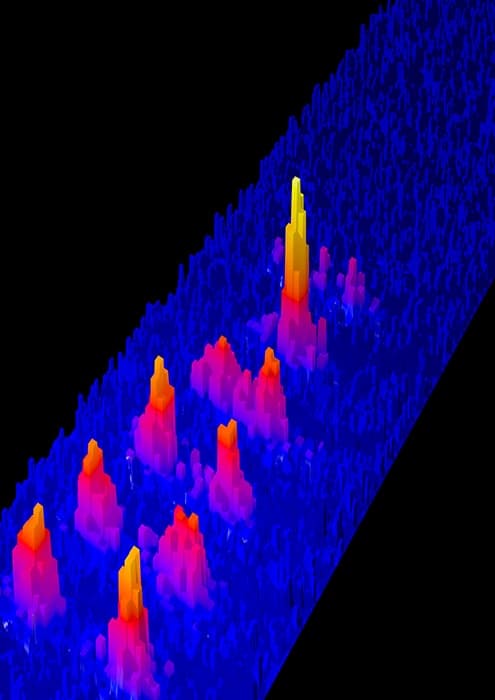
Time sequence of images showing a collision between two matter-wave solitons

Colliding solitons made from Bose–Einstein condensates (BECs) can travel straight through each other and emerge almost unaltered. That is the result of experiments done by physicists in the US, Israel and Australia. Their research provides new insights into how matter waves interact with each other, and could further the development of new techniques in matter-wave interferometry.

Solitons are wave packets that can propagate long distances without breaking up or diminishing. They are best known in optics, but soliton solutions exist for a number of different wave equations. One important example is the 1D nonlinear Schrödinger equation, which can apply to light in nonlinear fibres as well as BECs confined to narrow tubes.

When true solitons collide, they pass straight through each other, keeping their shapes, amplitudes and velocities unchanged. Randy Hulet and colleagues at Rice University in Texas, together with researchers from Tel Aviv University in Israel and Swinburne University in Melbourne, examined whether this would apply to wave packets of matter called bright solitons in a BEC.

Divide and collide

A BEC comprises ultracold atoms all in the same quantum state, and therefore behaving as a single quantum object. In this latest work, the researchers create a BEC of lithium-7 atoms and shape it into a narrow tube using a cylindrically symmetric potential. The BEC is then divided in half using a laser beam, and both halves are further manipulated to form two solitons. Each soliton contains about 28,000 atoms and the pair are separated by about 26 μm.

The dividing laser beam is removed, allowing the two solitons to move towards each other. Crucially, when they meet, they usually pass straight through each other before re-emerging unaltered on the other side. Then the solitons oscillate back and forth in the tube, passing through each other repeatedly. It is neither experimentally feasible nor theoretically possible to determine how any two lithium atoms pass each other. This is because all of the atoms in a single soliton are represented by the same wave function, and are therefore in a superposition of all the possible trajectories through the tube. These paths include passing on top of each other, going around each other or even by tunnelling through each other.

Vanishing trick

Exactly what happens each time the two solitons collide depends on the phase difference between the two wave packets. For example, two solitons that meet when perfectly in phase will interfere constructively and momentarily, producing a denser clump of atoms. Conversely, when two perfectly out-of-phase solitons collide, the atoms momentarily vanish before reappearing again on either side of the collision point. Intermediate phase differences produce results between these two extremes.

While the researchers were unable to control or directly measure the relative phase of the soliton pairs used in the experiment – which was random – they were able to work backwards from their collision observations to understand the effect of a specific phase shift on a collision. First, they used theoretical models to simulate what a collision with a particular phase shift would look like. Then they ran the simulation multiple times, to calculate how the distribution of interactions should look if their calculations of the interactions resulting from each specific phase shift were correct, and compared it with the observed distribution from repeated runs of the experiment. They found generally good agreement between theory and experiment.

Collapse in 3D

However, unexpected things did happen occasionally. For example, the solitons sometimes fused together or collapsed completely when they collided. Such effects, which are not predicted by the 1D nonlinear Schrödinger equation, were far more common when the two solitons met in phase or nearly in phase, producing a high density region in the middle. Hulet explains that the larger and denser the clump becomes, the less well it is described by the 1D equation: “When the density peak is too high,” he says, “the density rises to such a level that it violates the 1D criterion and begins to sample the 3D space, and when it does that it collapses.” In future work, the researchers hope to control the phase difference between the two solitons and the number of particles in each soliton better, and thereby to determine more precisely where the 1D approximation becomes unstable.

Florian Schreck of the University of Amsterdam describes the work as “a clear textbook example, so it will be useful for teaching”. Schreck, who was not involved in the experiment, suggests that a practical application could be matter-wave interferometry – something that is also suggested by Hulet and colleagues. “Perhaps it will be useful to build an atom interferometer using solitons – wave packets that just don’t disperse,” he says.

The research is published in Nature Physics.

Carbon nanotubes make molybdenum disulfide more active

Hydrogen has emerged as a promising renewable energy since it is one of the cleanest fuels and has a large energy capacity. Two-dimensional (2D) molybdenum disulfide (MoS2) nanosheets have potential as substitutes for traditional platinum (Pt) catalysts in the production of hydrogen through the hydrogen evolution reaction (HER). However, the poor electron transport severely limits the application of MoS2 catalysts. Reporting in Nanotechnology, researchers prepare a high-performance catalytic system to overcome this by introducing carbon nanotubes.

Electron transport is a crucial factor that affects the activity of a catalyst. Normally, MoS2 nanosheets contain a mixed metallic 1T phase and semiconducting 2H phase. The latter one constrains the conduction of MoS2 nanosheets.

The complications of carbon

In order to attain a faster charge transport of MoSx-based catalysts, carbon-based nanomaterials are used as conductive networks or supporting templates. However, the preparation of these composite materials contains complicated multiple-steps, either with high temperatures, or the catalytic systems lead to relatively low catalyst loadings.

Electron transport pathways

Researchers from Zhejiang University in China develop a facile method to prepare a high-performance catalytic system comprising 2D MoS2 nanosheets and single-walled carbon nanotubes (SWCNTs) for HER. Because of their excellent conductivity and flexibility, SWCNTs can serve as efficient electron transport pathways in the hybrid catalytic system.

Compared to pure MoS2 counterpart catalysts, the composite system exhibits dramatically enhanced electrocatalytic activity. With a low onset overpotential and a Tafel slope of 40.82 mV/decade, these are among the lowest values for MoS2-based catalysts reported so far.

More information can be found in Nanotechnology 25 465401.

Celebrating the life and work of John Bell

This year marks the 50th anniversary of the publication of a now-famous paper in the journal Physics by the Northern Irish physicist John Bell, in which he proved that making a measurement on one particle could instantaneously affect another particle – even if it’s a long way off.

As our regular columnist Robert P Crease writes in the November issue of Physics World magazine, that kind of instantaneous effect, which proved the concept of entanglement, was not something that Bell was originally keen on. In fact, Bell had actually set out to prove the opposite – that it was possible, using “hidden variables”, to have a theory of physics that could keep things nice and “local”, and so avoid what Einstein had dubbed “spooky action at a distance”.

But Bell reversed his thinking. “I made a phase transition in my mind,” he told Crease shortly before his death in 1990 aged 62.

Yesterday (4 November) marked the 50th anniversary of the day that Bell’s paper arrived at the journal’s offices and today (5 November) sees the opening of an exhibtion at the Naughton Gallery on the campus of Queen’s University Belfast, from which Bell graduated with a first-class degree in mathematical physics in 1949.

Entitled “Action at a distance”, the exhibition runs until 30 November and promises to “explore Bell’s life and the artistic response to his legacy by artists from across the world”. There is also an accompanying series of lectures from Andrew Whitaker, Maire O’Neill, Mauro Paternostro, Artur Ekert and Anton Zeilinger.

(more…)

Have you ever been lost in Hilbert space?

In less than 100 seconds, David Colton attempts to shed light on this seemingly abstract concept of mathematics. He starts by reminding viewers of the principles of vectors within a plane, such as how to calculate their lengths and dot their products. He explains that these concepts developed for two dimensions can extended to infinite dimensions within the realm of Hilbert space.

Colton, who is a researcher at the University of Delaware in the US, explains how this mathematical device was devised by the German mathematician David Hilbert in the early 20th century. It was immediately used by physicists including Erwin Schrödinger in the development of quantum theory. Today, it is widely used by physicists and mathematicians who want to study the solutions of the Schrödinger equation.

Watch more from our 100 Second Science video series.

Watch Deborah Jin’s Newton lecture on ultracold gases


A few weeks ago Deborah Jin was in London to accept the 2014 Isaac Newton Medal and Prize from the Institute of Physics. As is the custom, Jin also delivered the Institute’s Newton Lecture for 2014, which was called “Ultracold gases”. This is an apt title because Jin is an undisputed master in the control and study of gases that have been cooled to temperatures within a whisker of absolute zero.

(more…)

A few long jumps can make an epidemic

As recent events have demonstrated dramatically, one intercontinental aeroplane flight can turn a regional virus outbreak into a global health event. Now, two physicists have used a computer model to show that the precise frequency of such long-distance jumps has a strong influence on the rate at which infections spread. The researchers’ simulations can also describe the spread of invasive species, genetic mutations within a population, and even rumours.

Throughout most of history, diseases, genetic mutations and species have usually spread relatively slowly, because individuals normally move only short distances in their lifetimes. This kind of spreading creates what University of California, Berkeley, physicist Oskar Hallatschek calls “wave-like” or “pancake-like” growth, whereby a population radiates outwards from a central core in a roughly circular fashion. The Black Death of the 1300s, for instance, spread this way, moving across Europe at between 300–600 km per year.

Global hitchhikers

Today, however, a pathogen or potentially invasive plant can easily hitchhike across a city, a continent or even an ocean, in just a day or two. The individual can then seed a new population, which can itself launch additional long-range jumps to new territories. Seeking to predict mathematically how epidemics and invasions spread, scientists have developed computer simulations in which such long-range dispersal events happen continuously but at very low rates.

But Hallatschek and his colleague, physicist Daniel Fisher of Stanford University, realized that for real organisms, these hitchhiking events do not occur continuously but rather in discrete steps, like a aeroplane flight or boat trip. The researchers wanted to know how these rare, random events affect the overall rate of spread of a disease or mutation. “We were shocked that this was not understood,” Hallatschek says. “This was our motivation.”

Home and away

To discover more, the researchers created a model of the world as a 2D grid. A simulation begins with one “infected” individual at a single point on the grid. During one time step, an infected individual has a certain probability of moving and thereby infecting another individual at another point on the grid. In general, an infected individual is more likely to move to a nearby point than to a faraway one. But in different runs of their model, the physicists varied the exact probability distribution of jumps of different distances.

 Our model was purposely made so that it is as simple as possible but still sort of nontrivial, so that we can obtain some relevant insights
Oskar Hallatschek, University of California, Berkeley

The above video shows the time evolution of one such simulation. The epidemic begins in the centre of the grid and spreads out in space. Long-range jumps that mimic events such as air travel are shown to cause new outbreaks of the disease.

Hallatschek and Fisher found that the spreading rate depended sensitively on the probability of a long-distance jump. If this probability was low enough, the spread was slow and pancake-like. At higher probabilities, however, enough individuals seeded new growth far away from the original population that the overall rate of spread increased dramatically, resembling that of a metastasizing cancer.

Travel networks ignored

Hallatschek notes that his team’s model cannot predict the spread of a real disease like Ebola or swine flu. These diseases spread along human travel networks, which make jumps between certain points – from Monrovia to Dallas, for example – far more likely to occur than an equidistant jump from one isolated rural area to another. The researchers’ model also does not contain specific details such as infection and recovery rates that would allow the researchers to predict the spread of a particular disease.

But Hallatschek notes that more complicated models containing such details are no better at forecasting the course of epidemics. Disease spread is idiosyncratic and strongly influenced by random events and initial conditions, which makes it very hard to predict. Opting for a very simple model allowed Hallatschek and Fisher to avoid these problems. “Our model was purposely made so that it is as simple as possible but still sort of non-trivial, so that we can obtain some relevant insights,” Hallatschek says.

“I think it’s an excellent paper,” says Dirk Brockmann, a physicist at Humboldt University Berlin. He applauds Hallatschek and Fisher for combining theory with numerical results to provide broad insight into how diseases, organisms and mutations spread. “The next step would be to see natural systems where you may observe this,” Brockmann says. “It would be great to see if there’s empirical evidence that this sort of thing is going on.”

The research appears in the Proceedings of the National Academy of Sciences.

Fabiola Gianotti will take over as CERN boss

The Italian particle physicist Fabiola Gianotti is to become the 16th director-general of the CERN particle-physics laboratory. Gianotti, 52, was selected today at a meeting of the CERN Council, making her the first woman – and fourth Italian – to hold the position. Gianotti, who will take up the position on 1 January 2016 for a five-year period, says that it will be a “great honour and responsibility” to lead CERN.

Three candidates were shortlisted for the job after being put forward by a search committee, but according to CERN Council president Agnieszka Zalewska it was Gianotti’s “vision for CERN’s future, coupled with her in-depth knowledge of both CERN and the field of experimental particle physics” that led them to pick the Italian. “Fabiola Gianotti is an excellent choice to be my successor, and I am confident that CERN will be in very good hands,” says current CERN boss Rolf-Dieter Heuer, who will step down on 31 December 2015.

‘Outstanding scientist’

Gianotti’s appointment has been welcomed by other physicists too. “I think that Fabiola is an excellent choice,” particle theorist John Ellis from King’s College London and CERN told physicsworld.com. “She is an outstanding scientist and communicator, who has demonstrated her leadership qualities as spokesperson of the ATLAS experiment.” Former CERN director-general Chris Llewellyn Smith, who was head of the lab from 1994 to 1998, says that he is “delighted” by the announcement. “She will do a great job,” he adds.

Gianotti received a PhD in experimental particle physics from the University of Milan in 1989 and then joined CERN, where she became a research physicist in 1994. From 2009 to 2013, she was spokesperson for the ATLAS experiment, during which time she played a key role in the discovery of the Higgs boson. Gianotti was also the public face of the discovery, presenting ATLAS’s results at CERN on 4 July 2012, in what went on to become a historic seminar. The finding led to François Englert and Peter Higgs being awarded the 2013 Nobel Prize for Physics.

United Nations advisor

As well as being on numerous international advisory boards, Gianotti is also a member of the recently established Scientific Advisory Board of the UN Secretary General. In 2012 she was awarded the honour of the “Grande Ufficiale dell’ordine al merito della Repubblica” by the Italian president Giorgio Napolitano, as well as being a co-recipient of the 2012 Special Fundamental Physics Prize. Last year, Gianotti bagged the 2013 Enrico Fermi Prize of the Italian Physical Society and the 2013 Medal of Honour of the Niels Bohr Institute of Copenhagen.

Indeed, Gianotti’s reputation has gone beyond the confines of particle physics. She was ranked fifth in Time magazine’s 2012 Personality of the Year and was included among the “Top 100 most influential women” by Forbes magazine in 2013. One of her first challenges will be to oversee the restart of the LHC, which is due to come back online next year when it will begin to ramp up to an energy of 13 TeV.

How to control magnetic atoms on graphene

The magnetic properties of cobalt atoms lying on the surface of graphene can be controlled by the choice of substrate under the graphene sheet. This unexpected discovery has been made by physicists in Switzerland and could be exploited someday to create extremely dense magnetic memories or even quantum bits (qubits) for quantum-information processing and storage.

Graphene is a sheet of carbon just one atom thick. It has a number of unique electronic and mechanical properties that could be used to create new types of electronic technologies. These include spintronics, which aims to make use of the spin magnetic moment of the electron in circuits that are smaller, faster and more energy efficient than conventional electronics.

Now, Harald Brune and colleagues at the Ecole Polytechnique Fédérale de Lausanne (EPFL) and the Swiss Light Source (SLS) in Villigen have discovered an effect that could be exploited to create spintronics devices based on graphene. “The magnetic properties of transition-metal atoms on graphene were, so far, thought to depend only on the transition metals themselves,” explains Brune. “However, in almost all experiments, we need a substrate on which to grow graphene, and in our new work we show that this substrate greatly influences the magnetic properties of the transition metals that find themselves on top of it.”

Plane confusion

In previous work, Brune and colleagues placed atoms of the transition metal cobalt on a graphene surface that had been grown on a platinum substrate. They found that the cobalt atoms have a magnetization that is in-plane – that is, pointing parallel to the surface of the graphene. However, in this latest work they discovered that when the graphene is grown on a ruthenium substrate, the magnetic moment of cobalt points out-of-plane. They also tried an iridium substrate and found that like platinum, the cobalt moment lies in-plane.

“The substrate thus plays a much more important role than previously thought and calculations, which until now considered graphene as freestanding, need to take this into account,” he says. “Our result also shows that we can actually tailor the magnetic properties of the transition-metal atoms, depending on the substrate they lie on.”

The graphene films were grown on ruthenium and iridium substrates using chemical vapour deposition. The graphene was then given a sparse coating of cobalt atoms using electron-beam evaporation.

Polarized X-rays

The researchers made their measurements on samples at 3.5 K using X-ray absorption spectroscopy (XAS) and X-ray magnetic circular dichroism (XMCD) techniques. XMCD measures the magnetic properties of an atom using circularly polarized X-rays. “If the X-rays are polarized, we can infer whether the magnetic moments of the cobalt atoms lie along the direction of the incoming X-rays or in a direction perpendicular to them, and we can also calculate the size of this magnetic moment,” says Brune. “Applying an external magnetic field allows us to determine how much field is needed to align the magnetic moments of the individual cobalt atoms being probed.”

The team found that the magnetic properties of the cobalt are influenced by the strength of the bond between the carbon atoms in graphene and the substrate atoms. There are strong chemical bonds between the carbon atoms and ruthenium, for example, whereas there are much weaker weak van-der-Waals interactions with iridium and platinum substrates. As a result, the graphene is pulled much closer to the ruthenium substrate than it is to the platinum or iridium. The distance between the graphene and the substrate affects the graphene, which in turn affects the cobalt atoms.

“Put simply, we can imagine that the underlying metal surface transfers part of its electrons to the graphene, or the other way around, and this influences the electronic properties of graphene. In turn, this influences the magnetic properties of the cobalt atoms.”

Long lasting?

If the magnetic states of transition-metal atoms on graphene are found to endure for long times, they could be used to create extremely dense information-storage devices. They could even be used as qubits, although Brune points out that they would have to be operated at extremely low temperatures.

The team says that it is now focusing its attention on identifying single atoms or molecules that have sufficiently long-lasting magnetic states, so that such applications might indeed be possible one day. “Ultimately, we might be able to store one bit of information in the magnetic state of a single transition metal atom,” says Brune. “Currently, magnetic hard disks use 107 atoms per bit.”

The research is described in Physical Review Letters.

Copyright © 2026 by IOP Publishing Ltd and individual contributors