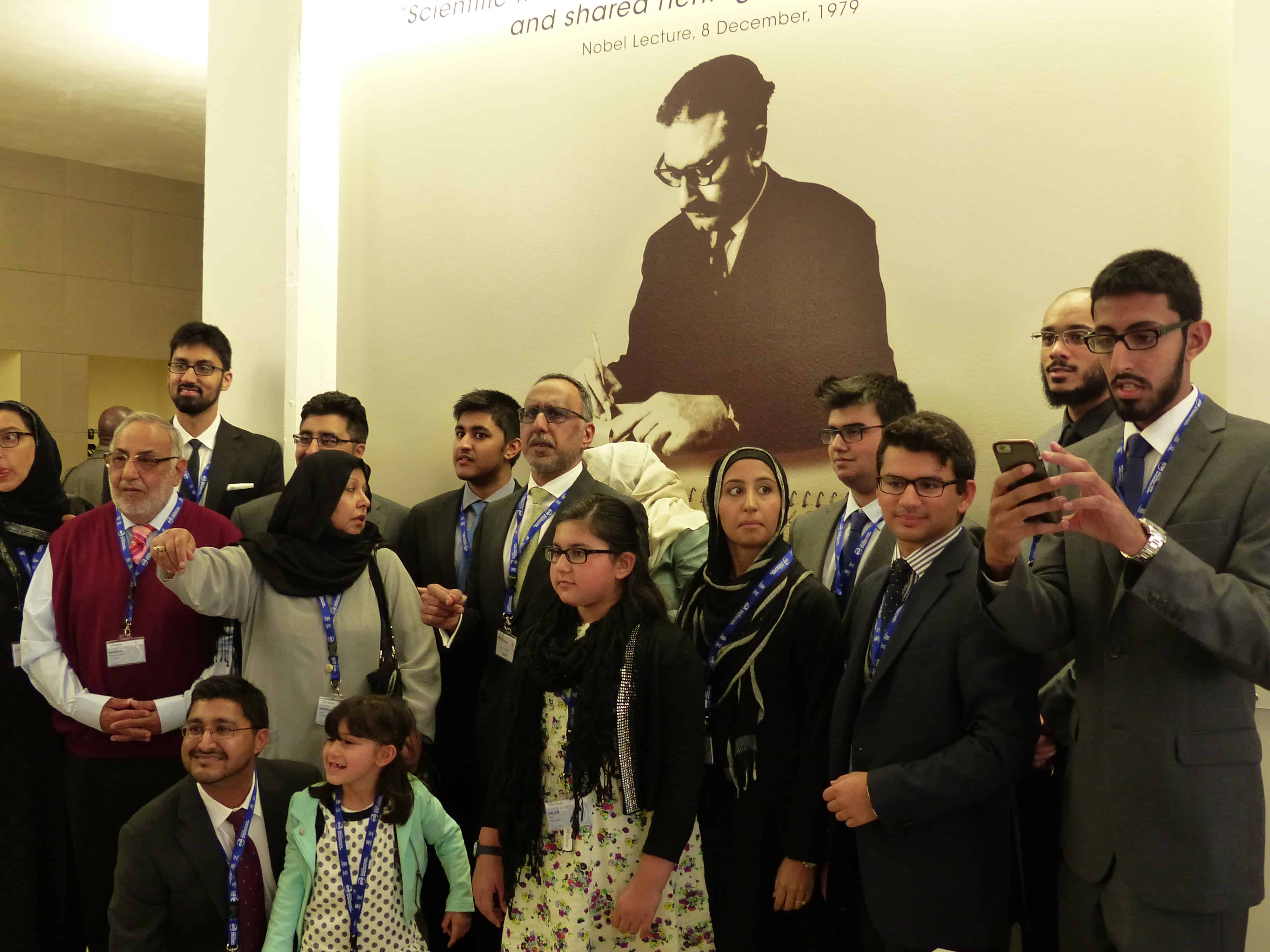
Honouring his achievements – members of Abdus Salam’s family at the International Centre for Theoretical Physics in Trieste.
Matin Durrani in Trieste, Italy
It’s now my third day here at the International Centre for Theoretical Physics (ICTP) in Trieste, which is celebrating its 50th anniversary in grand style. Two days ago we had a marvellous seven-course dinner at Duino Castle, including a hugely spectacular fruit-laden golden-jubilee cake, while yesterday there was a possibly even more sumptuous eight-course dinner hosted by the city that has been home to the centre for half a century.
But pervading all the events has been Abdus Salam, the Pakistani Nobel-prize-winning theoretical physicist who set up the centre in 1964. We know pretty much what Salam did from a scientific point of view, which was celebrated in his 1979 Nobel prize for unifying the weak and electromagnetic forces, but what exactly was he like as a person?
The 2014 Nobel Prize for Physics has been awarded to Isamu Akasaki, Hiroshi Amano and Shuji Nakamura for their development of blue LEDs. The prize is worth SEK 8m (£690,000) and will be shared by the three winners who will receive their medals at a ceremony in Stockholm on 10 December.
Akasaki is a Japanese citizen and works at Meijo University and Nagoya University. Amano is a Japanese citizen and works at Nagoya University. Nakamura is a US citizen and works at University of California, Santa Barbara.
The prize citation honours the trio for “the invention of efficient blue light-emitting diodes which has enabled bright and energy-saving white light sources”. The now ubiquitous LEDs are used in a wide arrange of applications from televisions to sterilizers and do not contain toxic mercury that is found in fluorescent lamps.
Three-colour blues
A source of white light needs LEDs that deliver red, green and blue light. The first red LED was created in the 1950s and researchers then managed to create devices that emitted light at shorter wavelengths, reaching green by the 1960s. However, researchers struggled to create blue light.
In the 1980s Akasaki and Amano working at Nagoya University and Nakamura working at the Nichia Corporation focussed on the compound semiconductor gallium nitride (GaN), which could be ideal for creating blue LEDs because it had a large band-gap energy corresponding to ultraviolet light.
There were many challenges, however, in making useable LEDs based on GaN. One major problem was how to create high-quality crystals of GaN with good optical properties. This was solved independently in the late 1980s and early 1990s by Akasaki and Amano and also by Nakamura. Both teams used metalorganic vapour phase epitaxy (MOVPE) techniques to deposit thin films of high-quality GaN crystals onto substrates.
Doping discovery
Another seemingly insurmountable challenge facing the researchers was how to dope the GaN so it is a p-type semiconductor, which is crucial for creating an LED. Akasaki and Amano noticed that when GaN doped with zinc is placed in an electron microscope, it gives off much more light. This suggested that electron irradiation improved the p-doping – an effect that was later explained by Nakamura.
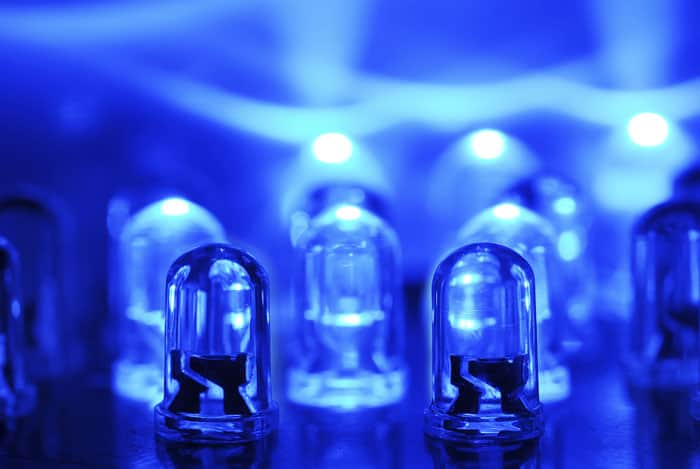
Into the blue. (Courtesy: iStockphoto/demarco-media)
The next step for both teams was to use their high-quality, p-doped GaN along with other GaN-based semiconductors in multilayer “heterojunction” structures. Nakamura was then able to create the first high-brightness blue LED in 1993.
Praising the laureates, the chair of the Nobel committee for physics Per Delsing said “A lot of big companies tried to [develop blue LEDs] and they failed, but these guys persisted and eventually they succeeded.”
Today, GaN-based LEDs are used in back-illuminated liquid-crystal displays in devices ranging from mobile phones to TV screens. LEDs emitting blue and ultraviolet (UV) light have also been used in DVDs, where the shorter wavelength of the light allows higher data-storage densities. Looking into the future, UV-emitting LEDs could be used to create basic yet effective water-purification systems, because UV light can destroy micro-organisms.
Invention or discovery?
Over the past 10 years there have been three other physics Nobel prizes awarded for work with significant commercial potential: giant magnetoresistance in 2007; fibre optics and charged-coupled devices in 2009; and graphene in 2010. While most prizes are associated with more esoteric discoveries, like the Higgs boson, Alfred Nobel decreed in his will that the prize could also be given for an important invention in physics.
“Alfred Nobel would be very happy about this prize,” says Delsing. “[The blue LED] is really something the will benefit most people.”
David Gross from the Kavli Institute for Theoretical Physics at University of California, Santa Barbara, who shared the 2004 Nobel prize for his work on asymptotic freedom, is happy that in recent years both pure and applied research are being recognized. After addressing a meeting in Trieste to mark the 50th anniversary of the International Centre for Theoretical Physics, where he had stressed the importance of blue-sky research, Gross told Physics World that “Every five or six years the prize is awarded to an invention that has conferred a great benefit to humankind, such as the transistor, the laser and fibre optics. I think the existing ratio is just about right.”
Akasaki was born in Chiran, Japan, in 1929. He graduated from Kyoto University in 1952 and received his PhD in 1964 from Nagoya University.
Amano was born in Hamamatsu, Japan, in 1960. He received his PhD in 1989 from Nagoya University.
Nakamura was born in Ikata, Japan, in 1954. He graduated from the University of Tokushima in 1977 with a degree in electronic engineering and obtained a Master’s degree in the same subject two years later. He then joined the Nichia Corporation, a small company located in Tokushima on the island of Shikoku. Nakamura was awarded a PhD in 1994 from University of Tokushima.
I’m fascinated by the interactions between science and culture, which is what led me to the Brooklyn Academy of Music (BAM), which was hosting the US première of a dance piece called Quantum that had previously debuted where it had been created, at CERN. The event was staged in a simple, black-box space, with the audience seated around a square floor in three rows with no proscenium. But it was an upscale black box, with elegant seating upholstered in a blue-and-gold metallic sheen. Four industrial lights were suspended from the ceiling by long cables.
The lights dimmed. When they came back on, six dancers paired in couples jiggled and jerked as if buffeted by Brownian-like forces. The overhead lights began moving in slow, silent circles, making it seem as if the stage itself were in motion. Symmetries appeared in some movements of the dancers, passing from couple to couple, while the music alternately crackled, chimed and sounded like static. The dancers ceased their pairings and began moving as a plasma-like whole. At one point they gathered together to create a sphere with their hands; their movements were shaping an object whose movements began shaping their own. The four overhead lights now began to move independently, making light splotches combine and recombine all over the dancers and floor – and it suddenly dawned on me that this kinetic lighting system, too, was part of the performance. (I hadn’t read the programme carefully beforehand.) The motions of dancers and lights eventually slowed to a halt. The light vanished, once again bathing the black box in darkness. The ensemble of wavelike movements of the particle-like dancers, I thought, had created an artistic whole.
André Schaller, Switzerland’s Ambassador and Consul General in New York, opened the reception afterwards by citing the piece as the product of a “creative collision” between art and science.
Gilles Jobin performing at CERN. (Courtesy: Maximilien Brice/CERN)
I ran into Gilles Jobin, who had choreographed Quantum during an artist’s residency at CERN. I asked him the following question: “If a fellow choreographer who knew nothing about the piece were to watch it, is there anything in the movement or structure of the work that might cause that person to say ‘That choreographer must have spent several months at a physics lab!’?” Gilles paused, then said “No.” The influence of the laboratory environment, he said, was in inspiring him to come up with certain kinds of what he called “movement generators”, or inspirations for the dancers to create their own movements. “For instance, all those symmetries – like ghost symmetries – that I didn’t even know existed!” he said. I asked him why he had chosen the work’s title. “I considered other names,” he said. “Basically, Quantum was just a convenient tag that referred to the context – the CERN laboratory environment – in which I had created the work.”
It was easy to pick out Julius von Bismarck, designer of the kinetic lighting system. His appearance – tall, shaved head, long flowing beard – is as unforgettable as his name. He had also been to CERN, and I asked him how, if at all, the laboratory environment had shaped the work. “Interference,” he said. “I thought a lot about the way light interacts with itself to form patterns. Also chaos – the way patterns can turn slowly to chaos but we still seek patterns in the chaos.”
Carla Scaletti, who composed the music, told me that a physicist working on the ATLAS experiment had provided her with some LHC data files, and that she had used the numbers in those files to control the parameters of her sound.
The six dancers in Jobin’s company were from five different countries; they included Catarina Barbosa from Portugal, the shortest dancer. I asked her if she had felt any difference between performing the work at BAM and at CERN. She told me that there definitely was a difference. The CERN performances were on a stage above the CMS detector, and it definitely felt like a “physics space”. At BAM, she said, it was a “dancer’s space”, more intimate.
For symmetry considerations, I thought I’d end the evening by tracking down the tallest dancer, a Brazilian. But by then the power of the quantum was weakening, I lost track of him, and I headed back to Manhattan.
The strongest evidence yet that Majorana quasiparticles (MQPs) can be found lurking in some solids has been unveiled by physicists in the US. The team used a scanning tunnelling microscope (STM) to locate MQPs at the ends of atomic chains of magnetic iron lying on the surface of a lead superconductor. MQPs have special properties that could make them ideal for use in quantum computers, and this latest breakthrough could lead to practical devices that make use of the quasiparticles.
First predicted by the Italian physicist Ettore Majorana in 1937, the Majorana fermion has zero charge and is its own antiparticle. Unlike conventional fermions such as the electron – which obey Fermi–Dirac statistics – the Majorana fermion obeys “non-Abelian” statistics. This means that quantum information encoded in the particles would be highly resistant to decoherence. Decoherence is the bane of physicists who are trying to develop practical quantum computers, and therefore devices based on Majorana fermions could be used in future quantum-information systems.
Exciting excitations
Although Majorana fermions have never been spotted as free particles, there is growing evidence that collective excitations of electrons – called quasiparticles – in some solids can have the same properties as Majorana fermions. Evidence of such MQPs has already been seen at the interface between a superconductor and a non-superconductor in several different experiments – however none of these studies have been conclusive.
Now, Ali Yazdani and colleagues at Princeton University and the University of Texas at Austin have found further evidence of MQPs at the interface of a superconductor and a magnet. The team looked at magnetic chains of iron atoms on the surface of a superconducting lead crystal that is chilled to 1.4 K. Using a spin-polarized tip on their STM, the researchers were able to show that the iron chain is ferromagnetic. Then, using the STM to measure the energy spectrum of electrons in the chain, they showed that the iron was also behaving as a superconductor – a phenomenon known as the proximity effect.
Swirling electrons
The superconductivity in the iron chain involves paired electrons travelling in helical orbits. This rare type of pairing makes the chain a “topological superconductor”, and MQPs are expected to occur at the end of the chains.
To locate MQPs, the team looked for something called a zero bias peak (ZBP) in the electron energy spectrum of the iron chain. The STM measures the ease with which an electron can be added or removed from the chain by applying a bias voltage between the tip and the chain. However, because the MQPs are a combination of a negative particle and a positive antiparticle, they can only move in and out of the chain when a zero applied voltage – or bias – is applied at the tip.
The team scanned the STM tip along a chain, and found the expected ZBPs at either end. But the ZBP could be due to an unrelated magnetic resonance that can occur in the chains. This was ruled out by repeating the measurement in a weak magnetic field, which stops lead from being a superconductor. The ZBP vanished as expected. If the ZBP was related to a magnetic resonance, it would have been enhanced by the magnetic field, not diminished.
Mobile Majoranas
While the physicists are not alone in seeing ZBPs at the ends of tiny wires, they are the first to be able to rule out the effect of magnetic resonances. Yazdani told physicsworld.com that the team is now studying edges of 2D islands of magnetic atoms on a superconductor for evidence of MQPs. Such MQPs should be able to move along the edge of an island, allowing physicists to further study their properties.
Joel Moore of the University of California Berkeley sees the work as a significant contribution to MQP research: “It goes beyond the previous efforts also seeing zero-bias tunnelling peaks in that it has excellent spatial resolution and a clearly defined system that can probably be reproduced by other groups.”
However, Moore points out that for MQPs to be useful in quantum computers, their non-Abelian nature must be established – something Yazdani and colleagues are also working on at the moment.
The video below shows how the iron chains were made and studied using STM.
In less than 100 seconds, William Symes of Rice University in the US explains how geophysicists use sound to infer structures within the Earth. The basic idea is to fire sound waves into the Earth (or track natural seismic signals) and then measure the distribution of reflected waves at the Earth’s surface and the time it took for them to return. This information can help geophysicists to identify features of interest within the planetary interior.
Of course, it is not quite as simple as that because sound varies in its speed within the Earth depending on the physical properties of the material through which it is passing. Symes explains that geophysicist have teamed up with mathematicians to develop computational models to help them to interpret their echoes.
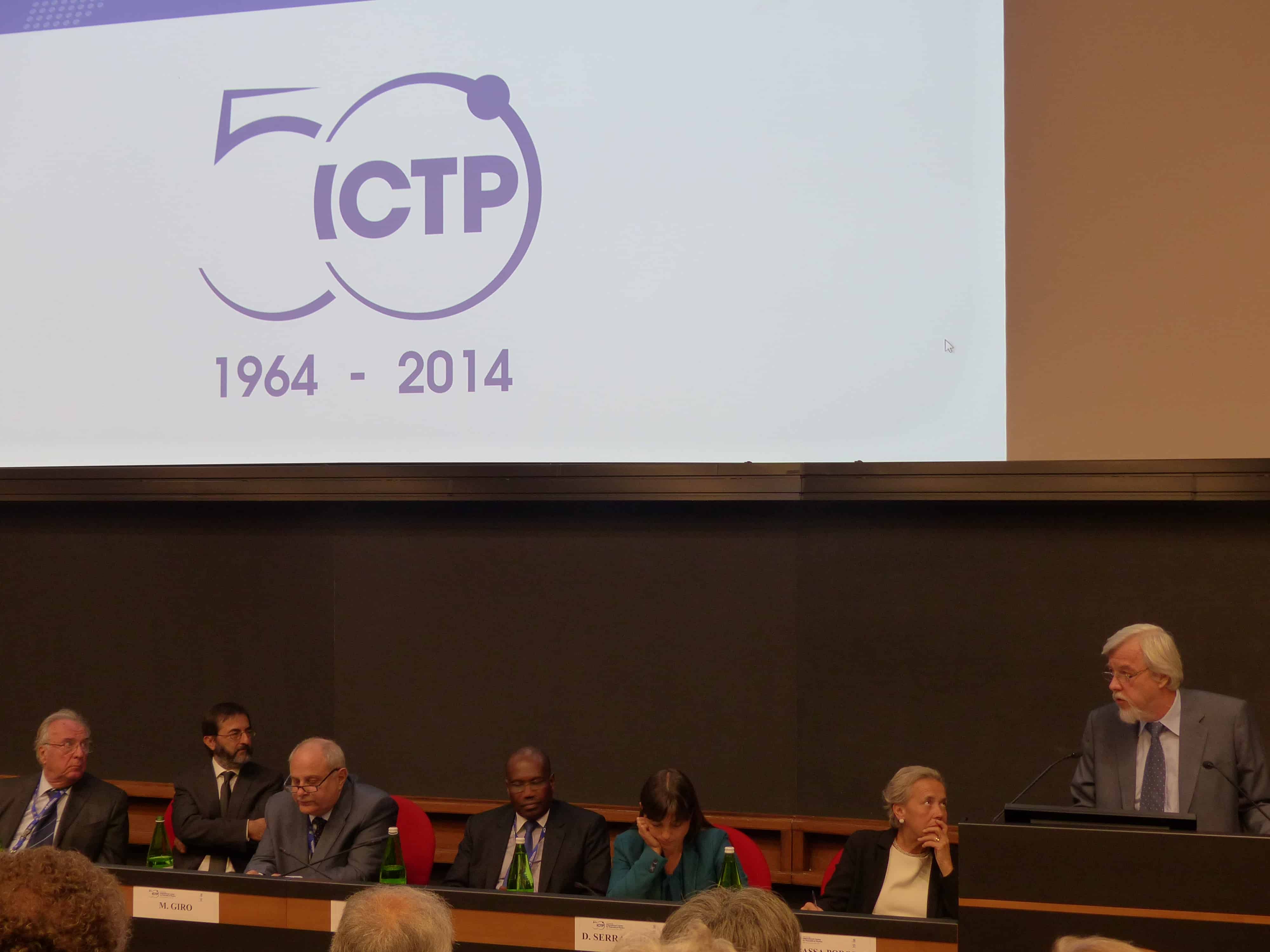
Celebrating Salam – Rolf-Dieter Heuer addresses guests at the opening session of the ICTP’s 50th-anniversary conference.
By Matin Durrani in Trieste, Italy
It was a small touch, but certainly quite surprising.
To kick off the opening session of the 50th-anniversary meeting of the International Centre for Theoretical Physics (ICTP), no-one spoke. Instead, the lights were dimmed until the audience was sitting in total darkness. Then emerged the voice of the ICTP’s founding father – the Pakistani theorist Abdus Salam, who died in 1996 – as a film started rolling on the screen at the front of the lecture hall. This was followed by a series of short video messages from selected physicists from around the world who benefited from the support of the ICTP early in their careers. As one physicist put it, the ICTP was “the launching pad” for their career. “It is a rare opportunity that so many people dream about,” added another.
Golden days: the view from the guesthouse at the International Centre for Theoretical Physics as delegates arrive for a conference to mark its first 50 years.
By Matin Durrani in Trieste, Italy
When the Pakistani physicist Abdus Salam founded the International Centre for Theoretical Physics (ICTP) here in Trieste in 1964, I am sure he would have never quite dared to believe that it would go on to be such a success in helping to further the careers of some of the brightest minds from the developing world. Salam’s dream was for the ICTP to be a focal point for talented theorists from countries seeking to build up their research strengths, bringing such people into contact with leading physicists from front-ranking nations to carry out top-quality collaborative projects.
Now, 50 years after it began, the ICTP is hosting a golden-jubilee conference, where it is quite rightly celebrating all that it has achieved – and looking ahead to the future too.
In this week’s Red Folder, we are looking at all things Nobel-prize-related, as the winner(s) of the 108th Nobel Prize for Physics will be announced in Stockholm next Tuesday.
Kicking off the Nobel round-up is our own infographic that tells you what branch of physics you should take up if you are keen to become a laureate yourself. In case you haven’t seen it already, take a look at it here and work your way through our seven categories that encompass all 107 physics Nobel prizes handed out to date.
Next, watch the video above where the Smithsonian Magazine’s science editor Victoria Jaggard hosts a Google Hangout to discuss the science and scientists predicted to win this year’s award. In it, she talks with Charles Day of Physics Today, Andrew Grant of Science News, Jennifer Ouellette of Cocktail Party Physics and Amanda Yoho of Starts With A Bang!, as they discuss everything from topological conductors to graphene to neutrinos.
The US particle physicist Martin Perl has died at the age of 87. Perl was instrumental in discovering the tau lepton – an elementary particle similar to the electron but 3477 times heavier. The work led him to share the 1995 Nobel Prize for Physics with Frederick Reines, who discovered the neutrino, for their “pioneering experimental contributions to lepton physics”.
Born in New York City on 24 June 1927, Perl originally trained as a chemical engineer, obtaining a degree in the subject at the Brooklyn Polytechnic Institute in 1948. He then went on to work for General Electric, where he was involved in producing electron vacuum tubes. It was there that Perl’s interests turned to physics, and he began to enrol in physics courses at Union College in New York.
In 1955 Perl was awarded a PhD in physics from Columbia University, which he did under the supervision of the 1944 physics Nobel laureate Israel Isaac Rabi. Perl’s thesis applied Rabi’s nuclear-magnetic-resonance technique to measure the nuclear quadrupole moment of sodium. After his PhD, Perl moved into particle physics, heading to the University of Michigan, where he used bubble chambers to study the scattering of pions with nucleons.
The third generation
In 1963 Perl joined the Stanford Linear Accelerator Center (SLAC), and it was there that he carried out his Nobel-prize-winning work in the 1970s. We now know that three generations of leptons and quarks make up the known fundamental matter states in the universe, but in the early 1970s only two generations of leptons were known to exist. The first consists of the electron and its associated neutrino – the electron neutrino (together with their antiparticles) – while the second generation includes the muon and the muon neutrino.
Perl’s discovery opened up the third generation of elementary particles. In 1972 SLAC had just completed the SPEAR electron–positron collider, which could collide electrons and positrons at a then-record energy of 4.8 GeV (later reaching 8 GeV). In conjunction with the magnetic detector – developed at the Lawrence Berkeley National Laboratory – the facility could detect and distinguish between leptons, hadrons and photons.
Using SPEAR between 1974 and 1977, Perl and colleagues observed events in which the electron–positron annihilation produced electron–antimuon or positron–muon pairs with an energy less than the initial energy and with no other particles visible. Perl’s interpretation was that the initial electron–positron pair had annihilated to produce a new lepton–antilepton pair, which Perl dubbed the tau–lepton pair. The tau then decayed into an electron (or muon) plus two undetected neutrinos, while the antitau decayed into an antimuon (or positron) and two neutrinos.
Given that the signal could be explained by other events, some particle physicists were initially sceptical about the discovery. What finally convinced the community that the tau lepton had been discovered was when Perl’s results were later confirmed by the DESY particle-physics lab in Hamburg, Germany, as well as by further experiments at SPEAR.
Perl was active in physics until the end of his life. Indeed, recently he had turned his sights on experiments to understand the nature of dark energy. One such proposal, in 2011, involved dropping caesium atoms through two 1.5 m-long atom interferometers in the hope of detecting any hitherto unknown “dark content of the vacuum”.