Prize-winning physics explored in our infographic. (Courtesy: Paul Matson/IOP Publishing)
At 11.45 a.m. CET (at the earliest) on Tuesday 7 October, the winner(s) of the 108th Nobel Prize for Physics will be announced in Stockholm. Like just about everyone else, I have no information about who will win – although I do have my suspicions (more on those tomorrow).
Predicting the future is never easy, but help is at hand with a new infographic that Physics World has created charting the history of the physics Nobel by discipline. Using the categories that we apply to articles on physicsworld.com, we have split the 107 prizes since 1901 into seven categories. If you click on the image above, you can see the infographic in all its glory.
The most popular discipline with Nobel committees through the ages is nuclear and particle physics, which accounts for nearly one-third of the prizes. As well as dominating the prizes in the 1950s and 1960s, nuclear and particle physics spreads its tentacles from the very first prize – to Wilhelm Röntgen for the discovery of X-rays – to last year’s prize, which went to François Englert and Peter Higgs for predicting a much more esoteric boson.
Interestingly, that very first prize in 1901 flags up an important challenge I faced while categorizing the prizes using contemporary disciplines. You could argue that when Röntgen discovered X-rays, he was doing atomic physics. Indeed, some of those X-rays would have come from atomic processes, while others would have been bremsstrahlung – which I would consider particle physics. However, because Röntgen accelerated electrons into a target and analysed the radiation produced, I decided that it was a particle-physics experiment.
What else can we learn from the infographic? One striking observation is that while today condensed-matter physics is a vast enterprise, it didn’t get a look-in until 1913, when Heike Kamerlingh Onnes won for his low-temperature studies and for producing liquid helium. And unlike nuclear and particle physics, there is no “golden era” of condensed-matter physics, with prizes spread out evenly since 1913.
Astronomy, astrophysics and cosmology arrived on the scene even later: in 1936, in fact, when Victor Hess shared half the prize for his discovery of cosmic rays. Researchers in the field had to wait until 1967 for their next prize, when Hans Bethe won a Nobel gong for his work on stellar nucleosynthesis, although in every decade since then at least one further prize has been awarded to those who study the heavens.
One very interesting trend that gets going around 1980 is that the prizes appear to be alternating between five categories. Does this mean that in the past 35 years or so, Nobel committees have made an effort to spread prizes across disciplines? If that’s the case, the infographic suggest that in 2014 we are due a winner from atomic, molecular and optical physics.
Georges Charpak is the last solo laureate. (Courtesy: CERN)
Turning to the number of laureates per prize (denoted by the thicknesses of the coloured lines and timeline markers), it is clear that shared prizes have become more prevalent since about 1950. Perhaps this is recognition that most science is a collaborative process, or perhaps that physics has become so complicated that a major breakthrough can’t be achieved by one person alone. The last two solo prizes came over two decades ago, when the French physicists Pierre-Gilles de Gennes and Georges Charpak won in 1991 and 1992, respectively.
The category with the highest average number of laureates per prize (2.25) goes to astronomy, astrophysics and cosmology, which could reflect the fact that all but one of the prizes in this field were awarded after 1950, when multiple laureates dominate. Quantum physics and classical physics are both just shy of one laureate per prize, which probably reflects the fact that most of these prizes were awarded before 1950 when the trend of sharing prizes began. Overall, the number of laureates per prize is a little over 1.8.
Finally, the strangest prize that I came across while compiling the infographic is the 1908 award, which went to Gabriel Lippmann “for his method of reproducing colours photographically based on the phenomenon of interference”. Lippman was a French physicist and his photography technique was so difficult to perform that it never made it out of the lab and was quickly overtaken by more practical colour processes. Even the Nobel committee sometimes get their judgements wrong.
NB Astute readers will notice that the infographic does not illustrate the fact that the prize has been shared by three winners in two different ways: three one-third prizes or one half prize and two quarters. We struggled with finding a way of showing this, but in the end decided that this distinction was not important in terms of understanding the temporal trends in disciplines and number of laureates that we are trying to illustrate.
Edward Moses joins the Giant Magellan Telescope Organization (GMTO) today as its first president, after stepping down as a scientific manager at the Lawrence Livermore National Laboratory. Moses had spent the past 15 years overseeing the effort to develop laser-based fusion at Livermore’s National Ignition Facility (NIF), but will now focus on managing the construction of the massive 25.4 m optical telescope on northern Chile’s Las Campanas Peak.
When it comes online about a decade from now, the $880m GMT will have almost 10 times as much light-gathering capacity as any existing instrument. Astronomers will use the telescope for everything from spotting exoplanets and examining the formation of stars and galaxies shortly after the Big Bang to measuring the masses of black holes and exploring dark matter and dark energy. Moses’ appointment comes as the project moves from design to construction, with the first of the instrument’s seven primary 8.4 m mirrors having been completed, and two others being ground and polished. Workers have also cleared more than 40,000 m3 of rock from the Chilean site to make way for construction.
Eye on the sky
Moses takes up his new position 16 months after he left the directorship of NIF to concentrate on Livermore’s photon science directorate. At the time, critics accused him of mismanaging NIF and speculated that he had paid the price for NIF’s failure to hit its target of achieving a self-sustaining fusion reaction by 2012. But those murmurings have seemingly not affected his ability to land new roles. “We looked into how people related to him as staff and many at NIF came close to worshipping [Moses] and would have followed him off the cliff,” says Rocky Kolb – dean of physical sciences at the University of Chicago – who is a member of the GMTO board that recruited Moses. “There’s simply no substitute for experience with large technical projects and we’re convinced that he’s the person to get the telescope into operation.”
Moses intends to draw on his 30-year experience in big-science facilities and other ground-breaking projects, which included having to develop new systems and technologies at NIF that did not exist before the facility started. “To manage that, do the R&D, and integrate it together was the big issue,” says Moses, who promises to take the GMT “from a giant telescope to a great laboratory”. GMTO director Patrick McCarthy adds that Moses brings “an order of magnitude attitude, skill and vision” to the project. “We think this is a transformative moment,” he says.
Press releases are supposed to be attention-grabbing, but occasionally, I come across one that really goes the extra mile. That was the case this morning when – my eyes still a bit bleary, my coffee still un-drunk – I spotted a real doozy in my in-box.
“Are the world’s religions ready for ET?” the headline asked.
Some might regard this question as unimportant. Even if you care about the official views of religious groups (and many people – including some religious people – do not), their opinions about life on other planets are surely less relevant to daily life than their guidelines on, say, human morality. After all, if extraterrestrial life does exist, it is an awfully long way away: the nearest star system to ours, Alpha Centauri, is more than four light-years off, and astronomers do not regard it as a good candidate for habitable planets. So, if extraterrestrial life is ever discovered, the Earth’s religions will have plenty of time to get used to it before it causes them any practical problems down at the local synagogue, mosque, temple or church (“Baptismal Ceremony ET: For alien life forms unable to answer for themselves”).
“I’ll not lie to you. It’s tense here at @esa#WakeUpRosetta,” Tweeted the astronomer and author Stuart Clark at 6.48 p.m. Central European Time.
“Tense? The signal’s late, so it’s past tense,” responded Joel Parker, deputy principal investigator of the ALICE instrument on-board the Rosetta craft.
As a project scientist on the mission, I couldn’t resist adding: “It ain’t past tense till the fat lady sings.”
Clark, Parker and I were among 300 or so scientists, engineers, journalists and other dignitaries to have congregated in the H-building of the European Space Operations Centre (ESOC) at the European Space Agency (ESA) in Darmstadt on 20 January this year. We had gathered to witness the Rosetta “wake-up event”, when the spacecraft was supposed to emerge from a planned 31-month-long hibernation. But what had begun as a relaxed group of colleagues at 6.30 p.m. – the start of the one-hour window when we expected the first signal from the craft to arrive – had gradually evolved into something akin to a room full of parents waiting for their children to return from their first long trip away on their own.
Having worked at ESA since 2005 with project scientist duties on the Cluster and Double Star missions, and as Rosetta project scientist since 2013, I was, of course, very confident that the spacecraft would come out of hibernation at the planned time, as my colleagues were too. Eventually, as expected, the signal duly arrived – but it was to be a nail-biting wait. As Andrea Accomazzo, Rosetta’s flight director, later admitted: “That was the longest hour of my life.”
Audacious and exciting
The idea for Rosetta was born in the mid-1980s during the exciting days of the Giotto mission and its visit to Comet Halley and Comet Grigg–Skjellerup. Giotto provided us with a massive leap in our understanding of comets, measuring for the first time the “nucleus” of a comet – the lumpy main body of the object. The mission showed that comets are some of the darkest objects in the solar system, reflecting barely 2–4% of incoming light. It also revealed that jets of dust and gas spring from the nucleus, feeding the fuzzy outer atmosphere – or “coma” – around it. But although Giotto got quite near – approaching to within 600 km of its quarry – it became clear what we needed to do next, which was to get up close and personal with a comet.
The armada of spacecraft that visited Halley around the time of Giotto was later joined by a number of missions to other comets. But all flew by relatively fast (at speeds of no less than several tens to hundreds of kilometres per second) and remained far away, typically approaching to within no more than several hundred kilometres of their target. Rosetta is unique in that it is the first craft to have made a rendezvous with a comet and is currently riding alongside its prey and will continue to do so through 2015, including perihelion, the comet’s closest approach to the Sun, next summer. If that isn’t enough, we will also deploy a lander – Philae – onto the comet’s surface next month.
But Rosetta is no ordinary project in other respects too. Most planetary-science and exploration missions usually start with astronomers observing their destination remotely – either with the naked eye, or by using ground-based or near-Earth space-based facilities. Robotic craft are then sent to orbit and map the body of interest – and only afterwards do we look to land a craft. The Rosetta mission will instead condense two space-mission steps into one. As Alan Stern, principal investigator of Rosetta’s ALICE instrument, once noted, “We are going to orbit and land on a comet for the first time with the same mission. That’s what makes Rosetta so audacious and exciting!”
Space scientists and astronomers find asteroids and comets intriguing because these small objects are the “leftovers” from when the solar system formed, some 4.5 billion years ago. What makes comets extra interesting is that they were flung out into the frozen outskirts of the solar system in regions known as the Kuiper belt and the Oort cloud. Being in such a chilly environment – about 50 K in the case of the Kuiper belt – the molecular composition of these bodies has hardly changed over time, meaning that they can give us clues as to what the early solar system was like.
We now know that comets are a mixture of dust, rock and frozen gases, containing a number of different molecules, notably water ice. What is more, there are indications that the isotopic make-up of water in comets – in particular those from the Kuiper belt with “short” orbits of less than 200 years – is very similar to that found on Earth, meaning that comets could have brought water to our planet. They are also laden with organic molecules, which are the building blocks of amino acids, and the ingredient for life. So by studying the physical and chemical make-up of these bodies, we can obtain information about where in the early solar system it was made, the journey it subsequently took and its connection to the evolution of the planets themselves. The elemental make-up of comets even gives us clues about the creation of the Sun itself.
From dream to reality
The Rosetta mission was approved way back in November 1993 as a “cornerstone” mission of ESA’s Horizons 2000 Science programme – the other three craft getting the nod being the XMM orbiting X-ray observatory, the SOHO solar-observation craft and the Cluster mission to study the Earth’s magnetosphere. The original idea for Rosetta was for the spacecraft to take a sample of a comet and return it to laboratories here on Earth. But as this plan was deemed far too expensive, the next best option was pursued – to send a laboratory to the comet instead.
The mission is named after the famous Rosetta stone, which – along with an obelisk found in a temple on an island in the Nile called Philae – led to the deciphering of Egyptian hieroglyphics almost 200 years ago. The Rosetta mission, by providing an unprecedented characterization of a comet, will take us on a similarly exciting journey back in time, but even further into the past – to the beginning of our solar system in fact. In doing so, we hope to unlock the mysteries of how our solar system formed and how it developed into what we see today.
Rosetta will characterize the comet’s nucleus in full, measuring its mass and gravitational field, and obtaining data on its physical, chemical, mineralogical and isotopic make-up. The mission will also probe the morphology of the comet’s surface. Rosetta will in particular be able to examine the development of cometary activity and the processes in the surface layer of the nucleus and coma, looking at how the stream of particles from the Sun, known as the solar wind, interacts with that region. With a mass of almost three tonnes at launch, the spacecraft and lander have specific instruments to address these scientific objectives, with an impressive payload of remote-sensing and in situ experiments.
Originally scheduled for take-off in January 2003, Rosetta was initially delayed due to a failure of the Ariane launch vehicle in 2002 before eventually blasting off on 2 March 2004 on an Ariane 5 G+ rocket from Europe’s spaceport in Kourou, French Guiana. As a result of the delay, the mission’s original destination – Comet 46P/Wirtanen – had to be abandoned, with Comet 67P/Churyumov–Gerasimenko being selected instead as the Rosetta target. This particular comet, which is larger than the original target and equally as interesting from a scientific point of view, was discovered in 1969 by researchers Klim Churyumov and Svetlana Gerasimenko, with the “67” indicating that it was the 67th short-period (P) comet to have been discovered – Comet Halley/1P having been the first. Rosetta’s new target 67P takes about six and a half years to orbit the Sun, getting to within 180 million kilometres of the Sun at its closest approach and being 840 million kilometres away at its furthest point. Space-based measurements of the comet suggest that it is about 4.5 km long, roughly 3–4 km across and rotates once every 12 hours.
The long and winding road
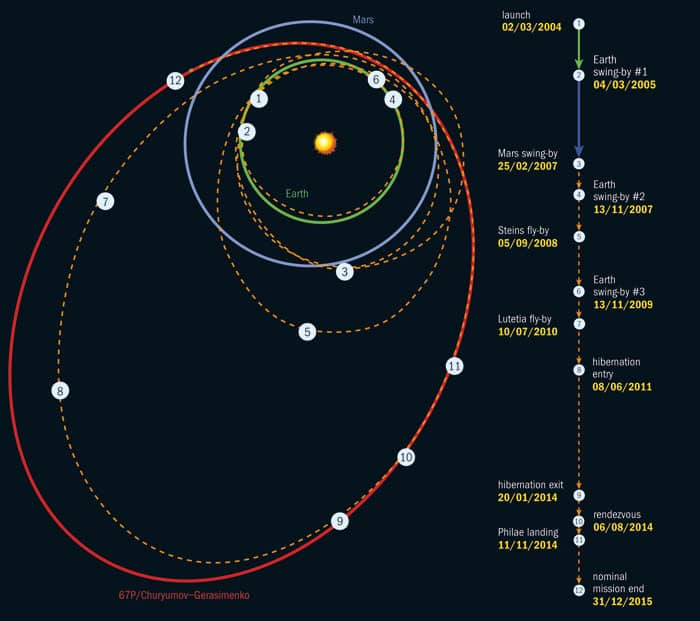
After Rosetta took off in 2004, it exploited the gravity of the Earth and Mars to get out onto a perfect orbit to chase down Comet 67P (see figure 1). Over the following 10 years, it has flown past the Earth three times and once past Mars, with scientists using each of these fly-bys to test the craft and its instruments as well as carry out a variety of observations. For example, in one of the Earth fly-bys, Rosetta’s plasma instruments saw strange modes of waves of unknown origin near the Earth. When these observations were combined with those from ESA’s Cluster mission, which was located in the solar wind at the same time, space scientists concluded that the waves were driven by specific magnetic- and electric-field configurations in the solar wind interacting with near-Earth space.
1 Ten years in the making After blasting off from French Guiana in March 2004, Rosetta’s long journey to Comet 67P/Churyumov–Gerasimenko has included several fly-bys of the Earth and Mars. Shown here are the orbits of the Earth (green), Mars (blue) and Comet 67P (red), as well as the path of Rosetta itself (orange).
Meanwhile, in a subsequent Earth fly-by, measurements taken by Rosetta’s Visual, Infrared and Thermal Imaging Spectrometer were compared with data from Earth-observing satellites, including ESA’s Envisat craft, to get important information about how to optimize Rosetta operations near the comet. (In effect, we were checking the response of Rosetta’s instruments, calibrating them against the many measurements made with existing Earth-observation satellites to see how well Rosetta’s kit was doing.)
During Rosetta’s decade-long journey to Comet 67P, its trajectory has also brought the craft near to two other small bodies in the solar system – Asteroid 2867 Steins in September 2008 and Asteroid 21 Lutetia in July 2010. These planned encounters addressed one of the prime goals of the mission, which was to obtain accurate measurements of the size of these small bodies and characterize their surface features, such as the number of impact craters, which can indicate how old the asteroid is. As a result of these fly-bys, the Steins asteroid was found to be diamond in shape, with dimensions of 6.67 × 5.81 × 4.47 km. The unusual shape is thought to be caused by the so-called Yarkovsky–O’Keefe–Radzievskii–Paddack (or “YORP”) effect, whereby visible photons from the Sun get absorbed by an asteroid and then re-radiated at infrared wavelengths, taking momentum from the body and altering its rotation rate. In this case, the change in rate made some material move towards the equator of Steins, resulting in the diamond shape. In fact, this was the first time the YORP effect had been seen in an object in the “main” asteroid belt lying between the orbits of Mars and Jupiter.
As for Lutetia, it was found to have dimensions of 132 × 101 × 76 km and to have a density of 3400 kg m–3 – one of the highest of any known asteroid – implying that it must contain a lot of iron. In spite of this, we do not think that the asteroid has a solid, dense iron core as is the case for the terrestrial, or “rocky”, planets Mercury, Earth, Venus and Mars. The observation can only be explained if the asteroid was subjected to some internal heating early in its history, but did not melt completely and so did not end up with a well-defined iron core. That would be why the surface is relatively “primordial” (in other words, it is young and has not changed much over time), which would not be possible if a full molten phase had existed.
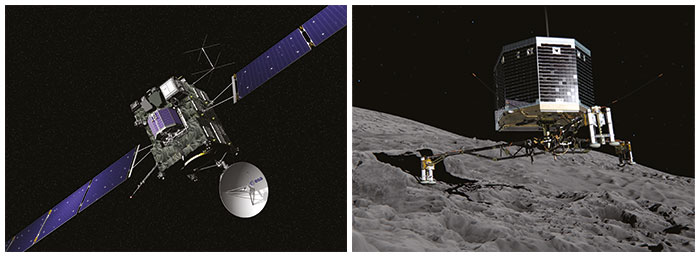
Moment of truth Artist’s impressions of Rosetta (left) and its Philae lander as it touches down on the surface of Comet 67P/Churyumov–Gerasimenko (right) – a nerve-wracking event that will take place for real later next month. (Courtesy: ESA/J Huart (left) and ESA/ATG Medialab (right))
In June 2011, nearly a year after the Lutetia fly-by, Rosetta was out to about 668,000 km from the Sun. But not having enough power to operate the spacecraft safely, we put it into a slow spin to keep it stable. A command to enter “hibernation mode” was then released. Rosetta was moving further and further away from the Sun, which meant that it was approaching a point where there was simply not enough power to supply the platform, even with its massive solar arrays. With such low power, we could only maintain a few essential components, such as heaters and the computer, which would be used to wake the craft back up in January 2014. It is worth noting, in passing, that Rosetta has travelled further from the Sun than any other solar-powered spacecraft in history.
The last radio-frequency pulse from the spacecraft was detected at about 14:12:00 Coordinated Universal Time (UTC) on 8 June 2011 and when no further signal after that was identified, Rosetta’s successful entry into hibernation was confirmed. Fred Jansen – Rosetta’s mission manager and the person responsible for the entire project – has likened hibernation to putting your TV on standby, although waking up the craft is not exactly the same as switching your TV back on. “Instead of us pressing the remote control to take it out of standby, we are relying on an internal alarm clock to trigger the spacecraft to come out of hibernation,” he says.
Wake up and then some
And so on 20 January 2014 – after 957 days in hibernation and having passed through the leg of its orbit that took it furthest from the Sun – Rosetta was finally on its return journey to the inner solar system. Once it had got to within 807,224,610 km of the Earth, we knew that the craft would have enough solar power available to wake up and start the main phase of operation. Many people around the world were waiting in anticipation for the next step in Rosetta’s voyage, not least the members of the mission’s instrument and operations teams, who had worked for decades to get to this stage. The craft’s internal alarm clock was due to begin the wake-up process at 10:00 UTC, taking Rosetta out of its standby mode and triggering a number of on-board activities, including the craft warming itself up, switching on various critical components and orienting itself towards Earth. Once all this had happened, the signal – taking into account the 45-minute journey to travel to Earth – was expected to reach all those gathered in the H-building at the ESOC in Darmstadt between 6.30 p.m. and 7.30 p.m. local time.
As 6.30 p.m. came and went, the mood was jovial. Gerhard Schwehm – the previous Rosetta mission manager and a current project scientist – was of the strong belief that the signal would come at 6.45 p.m. and I even queried if he actually had an app on his phone to simulate a signal. But as the minutes ticked by, the relaxed attitude of many of us began to dissolve into apprehension. Our levels of adrenaline and worry began to rise. Having spent the day surrounded by journalists constantly asking us how we were feeling, this was the hour where emotions would finally show.
The longest hour Members of the Rosetta Flight Control team celebrate in the main control room of the European Space Agency’s space-operations centre in Darmstadt as they witness the arrival of the craft’s carrier signal on 20 January 2014 after a torturous wait. Shown are head of ESA operations Paolo Ferri (left of centre) and Rosetta operations manager Andrea Accomazzo (right of centre, with right arm in air). (Courtesy: ESA/J Mai)
The room went silent, interspersed with only an occasional murmur, all faces fixed on a noisy, fuzzy line on our computer screens.
Then, shortly after 7.10 p.m. I overheard a colleague comment on signal strength and some of us started to lean forward to inspect the line more closely.
“Was that…?” asked Markus Bauer, ESA’s science and robotic exploration communications officer, as he and I looked at each other. “Did you see that?”
Holger Sierks – a principal investigator of Rosetta’s OSIRIS camera – seemed to nod, as did Parker and Schwehm. Then the clear spike continued for more than a couple of frames and an ecstatic Andrea Accomazzo punched the air in delight.
“Hello, world!” came the Tweet from the official @ESA_Rosetta account. We were back in business.
To anyone considering that this episode was staged, it honestly was not. And I can assure you that I have never hugged so many scientific colleagues in such a short period of time before.
Rosetta had done it, but that was only the start. Since that January day, we have started mapping and characterizing the comet to consolidate our knowledge of how to orbit it and to find out how best (and, crucially, where) to deploy the Philae lander – the very first time anyone has tried to carry out such an outlandish feat. The landing is set to take place on 11 November and there is sure to be more drama and excitement in store. Compared with the wake up, the landing will be even more nerve-wracking – it will not be a gut-wrenching few minutes, but a torturous few hours.
The main phase of the mission is now in full swing, and it is down to us to do the science we have promised. ESA staff and instrument scientists have been busy since May finalizing operations so that we can get the most out of Rosetta before its mission ends in December 2015. By then, we will have witnessed one of the most unique and amazing rides of all time – escorting Comet 67P/Churyumov–Gerasimenko through its closest approach to the Sun, seeing how it changes from a rather inert frozen object to something interacting fully with the power of the Sun, with ice subliming (changing directly from ice to gas) and lifting the dusty material from the surface of the nucleus with it. This is a process that generates the dust and gas tails, and that is at its strongest when a comet is at its nearest point to the Sun. We are set to get a ringside seat to watch this process grow, peak and then start to wane. In doing so, we will have become intimate – as never before – with an object we barely know, and understand even less about.
A new way to crush tiny amounts of matter in the hope of one day exploiting nuclear fusion for energy generation has been demonstrated by Matthew Gomez and colleagues at the Sandia National Laboratories in the US. The researchers used an enormous magnetic field produced by the lab’s Z Pulsed Power Facility (dubbed the”Z-machine”), together with a secondary field and a very brief laser pulse to implode a tube of deuterium fuel. This raised the fuel’s temperature to some 35 million degrees and produced lots of neutrons – a signature of fusion.
The technique is a new twist on inertial confinement, which uses extremely powerful laser beams to squeeze tiny capsules containing the hydrogen isotopes deuterium and tritium. This creates 100-million-degree “hotspots” in which the deuterium and tritium nuclei fuse, giving off large amounts of energy. This is the approach used by researchers at the $3.5bn National Ignition Facility (NIF) in the US, who have so far failed to achieve ignition. This is the point at which heat from fusion reactions causes more nuclei to fuse and more energy is given off by the target than is put in by the lasers.
Insulating magnetic field
To try to improve the implosions, some physicists have surrounded the target in an insulating magnetic field, with the aim of retaining more of the heat and particles produced by fusion. Three years ago, researchers using the OMEGA laser at the University of Rochester in the US used axial (cylindrical) fields to halve the amount of heat lost when imploding spherical targets. A spherical field cannot be used because it requires a conductor running through the target, which would contaminate the implosion.
In the latest research, Gomez and colleagues have used cylindrical targets, and instead of using a laser they have taken a new approach known as “magnetized linear inertial fusion” (MagLIF). This converts the Z-machine’s considerable electrical energy directly into kinetic energy. Deuterium is placed inside a cylindrical beryllium “liner” that is 7.5 mm tall and just less than 5 mm in diameter. Coils above and below the liner generate a 10 T axial magnetic field for a few thousandths of a second. This insulates the fuel while a 19 MA current pulse rips through the Z-machine and creates a 5000 T magnetic field that squeezes the liner and with it the fuel. The current pulse rises in 100 ns, and just before it reaches its peak, a much shorter pulse from a green laser is fired into the liner, pre-heating the fuel and raising its final temperature and pressure.
Hot neutrons
According to the team, this violent compression created “fusion-relevant conditions”: a temperature of about 35 million degrees and the production of about 1012 neutrons. These results imply an energy output of only about 1 J, but Gomez says that a deuterium–tritium fuel would produce around 300 J. The team also measured significant deuterium–tritium fusion, which is a by-product of the main deuterium–deuterium reactions. This, the researchers say, shows that the compression of the liner boosted the insulating magnetic field, making it better at confining tritium nuclei. “That is important,” Gomez says, “because as the target implosion progresses and the temperature goes up, you need a stronger magnetic field to confine the particles.”
Gomez’s colleague Steve Slutz outlined the MagLIF concept in 2010. He showed how the liner could be imploded at 70 km s–1 – much slower than NIF’s 300 km s–1 – and still produce temperatures and pressures high enough for fusion to occur. He calculated that with the Z-machine operating at its maximum of 27 MA and the liner filled with a deuterium–tritium mix, the fusion reaction would yield about the same energy as is delivered to the fuel – some 100 kJ.
Costly upgrade needed
Gomez acknowledges, however, that it will be some time before MagLIF enables ignition. He estimates that it will require a roughly 3000-fold increase in the current deuterium–tritium energy output – to around 1 MJ – which would entail at least doubling the Z-machine’s maximum current. That, he says, can only be done if the device is overhauled, at a cost of “hundreds of millions, if not a billion dollars” – a project that in the present economic climate he admits is “hard to sell”, and which, he says, is unlikely to switch on for at least a decade.
David Hammer, a plasma physicist at Cornell University in the US, who was not involved in the latest research, agrees that MagLIF is at an early stage. He estimates that another two years or more of experiments will be needed to test the feasibility of the concept, but nevertheless describes the initial results as “remarkably positive”. He points out that the pre-heating laser appears to have deposited less energy in the fuel than was expected, but believes that the insulating magnetic field is doing a pretty good job.
“This is the major physics success of these experiments,” he says, “and causes us all to be excited about follow-up experiments with better laser coupling.”
Two papers describing the experiment and the underlying theory will be published in a forthcoming issue of Physical Review Letters.
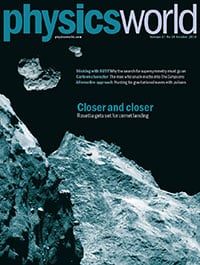
There’s some great material in the October issue of Physics World, which is out now in print and digital formats. Highlights include a look at Europe’s Rosetta mission, which is set to land a probe on a comet for the very first time, an analysis of whether pulsars could be used to detect gravitational waves, and a great feature by University of Maryland physicist James Gates, who insists that although CERN’s Large Hadron Collider has so far seen no signs of supersymmetry, the search for SUSY must go on.
Another great article in the issue is by my colleague Margaret Harris, who is Physics World‘s careers editor. She’s written an in-depth study of what we’re dubbing the “STEM shortage paradox”. This is the curious fact that many employers in the UK say they are struggling to find enough good people with science, engineering, technology and maths (STEM) backgrounds, whereas at the same time lots of physics graduates are finding it hard to get jobs. So is there a really a “STEM shortage”, or do STEM graduates have the wrong skills, aren’t good enough or want to work in other fields? In the video above, Margaret outlines her motivations for writing the article.
If you’re a member of the Institute of Physics (IOP), you can now enjoy immediate access to the new issue with the digital edition of the magazine. If you’re not yet in the IOP, you can join now to get full access to Physics World as well as many other member benefits.
For the record, here’s a run-down of other highlights of the October issue.
• A dangerous distraction – Seismologists are at odds over whether probabilistic forecasting of major earthquakes should be used to try and save lives, as Edwin Cartlidge reports
• Argentina shakes up physics education – Argentinians often view physics as a subject disconnected from the real world. But various initiatives are now seeking to modernize how the subject is taught using new technologies and by building bridges between academia and industry, as James Dacey finds out
• Lessons from Palestine – With the Middle East in turmoil, Kate Shaw says that we need to provide more support to physicists in the region
• Celebrating the mind – Robert P Crease celebrates the profound contributions of the
“recreational mathematician” Martin Gardner, who would have turned 100 this October
• Rendezvous with a comet – After making a successful rendezvous with Comet 67P/Churyumov–Gerasimenko earlier this year, Europe’s Rosetta craft is now riding alongside this celestial body and next month is set to land a probe on its surface. Matt Taylor describes the excitement of this unique project and the scientific insights that it hopes to achieve
• Sticking with SUSY – When CERN’s Large Hadron Collider failed to uncover evidence of new “superpartner” particles during its first run, some claimed that the theory that predicts them – known as supersymmetry, or SUSY – should be abandoned. S James Gates, Jr, however, argues that giving up on SUSY now would be like concluding that giant sequoia trees do not exist after surveying only the east coast of North America, and that there is more at stake than meets the eye
• Hunting gravitational waves with pulsars – With the first direct detection of gravitational waves at the top of many physicists’ wish list, Louise Mayor describes how radio astronomers are hoping to reveal these ripples in space–time by pointing their telescopes at an array of distant pulsars
• Unearthing Newton’s papers – Matin Durrani reviews The Newton Papers: the Strange and True Odyssey of Isaac Newton’s Manuscripts by Sarah Dry
• Stalin’s scientists – Asif Siddiqi reviews Buried Glory: Portraits of Soviet Scientists by Istvan Hargittai
• The STEM shortage paradox – The UK is believed to suffer from a shortage of scientists and engineers, yet unemployment rates for new graduates in these fields are high. Does that mean the skills shortage doesn’t exist, asks Margaret Harris
• Theories of quantum levity – Simon Singh on the man who snuck physics into The Simpsons
Maksimovic: the Story of Bruno Pontecorvo, the 2013 documentary written by Italian theoretical physicist Giuseppe Mussardo, tells the tale of one of the most mysterious physicists of the 20th century. Pontecorvo’s defection to the Soviet Union during the Cold War created a political stir across Europe and the US, thanks to his nuclear expertise. The film traces the tumultuous path from his arrival in Rome in 1931 to join Enrico Fermi, to his fleeing Italy and moving from the US to Canada to the UK before finally going to the Soviet Union in 1950, where he lived until his death in 1993.
Although his disappearance is well documented, Pontecorvo’s true motives are still unclear: was he a spy giving away atomic secrets to Russia or was he truly a loyal socialist? The film includes a variety of historical footage, interviews with many of Pontecorvo’s fellow scientists as well as his son Gil Pontecorvo and also some dramatized scenes of a journalist interviewing a middle-aged Pontecorvo. The documentary is engaging and flows well, but some might find it distracting that the main narrative is in English and the recreated scenes are in Italian, while most of the interviews are in different European languages.
Spectacular eruption: Volcanic eruptions can have massive effects on the climate. (Courtesy: iStock/AZ68)
1816 has gone down in history as the “year without a summer”. In Geneva, the unseasonably cold and rainy weather left Mary Shelley with plenty of time to write Frankenstein. In England, unusual atmospheric conditions produced some spectacular sunsets, inspiring the artist J M W Turner’s groundbreaking landscapes. But for many, 1816 and the years that followed were unmitigated disasters, with widespread crop failures leading to famine, disease and political unrest.
The cause of all this suffering was Tambora, a volcano on the Indonesian island of Sumbawa that had erupted a few months earlier. As Gillen D’Arcy-Wood explains in his book Tambora: the Eruption that Changed the World, the 1815 Tambora eruption sent huge quantities of volcanic ash and aerosols high into the atmosphere. Together with lingering detritus from a smaller volcanic event that occurred in 1809, this debris scattered short-wave solar radiation back into space, reducing average temperatures throughout the 1810s and unleashing numerous associated climate calamities.
D’Arcy Wood is an environmental historian, meaning that his chief concerns are the effects that the eruption aftermath had on society, but he quotes knowledgeably from the technical literature on volcanic activity and digs into why a relatively modest increase in atmospheric dust could produce such disruptive and widespread effects. The result is a fascinating and thorough book that brings this long-ago event to life.
2014 Princeton University Press £19.95/$29.95hb 312pp
“Help us with our science. Please turn off all phones and electronic devices.”
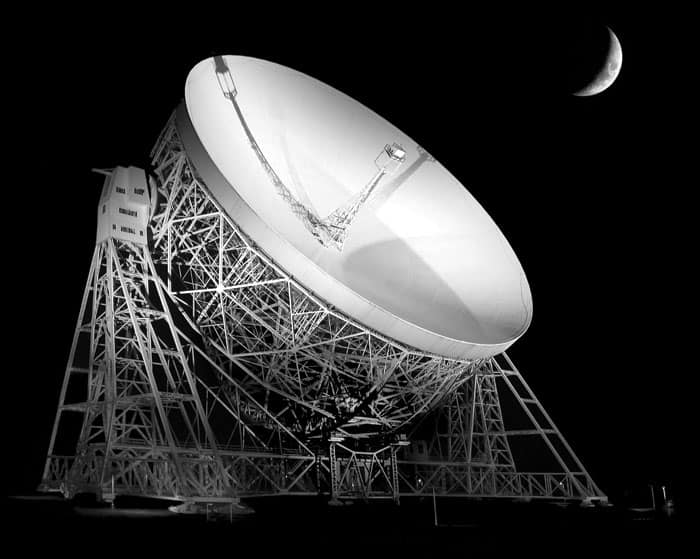
That is the firm command that greets visitors when they arrive at the iconic Jodrell Bank Observatory in Cheshire, UK. But you don’t need a notice warning you of the potential problems from your phone’s radio signal to know that you have reached Jodrell Bank. Even before getting to the site itself, it would be hard to miss the 76 m diameter Lovell Radio Telescope – a giant white dish towering above the flat Cheshire Plain.
Radio telescopes have been used at Jodrell Bank for nearly 60 years to study celestial objects, as well as to track rockets, satellites and space probes. But astronomers at the observatory now have a new goal in mind. Using the Lovell Telescope – and others like it around the world – they are hoping to make the first ever direct detection of gravitational waves.
Gravity – the longest ranged of the four fundamental forces – has been shaping our universe since the first atoms were created. It is responsible for everything from determining the large-scale structure of the galaxies to the formation and movements of the planets and the stars. Gravity is also what sends us flying down ski slopes and, occasionally, falling flat on our faces.
But despite our familiarity with the gravitational force, its modus operandi has never been experimentally confirmed. According to Albert Einstein’s general theory of relativity, gravitational waves are effectively ripples in space–time that travel as a wave. However, none have yet been directly detected.
Elusive though gravitational waves may be, there are currently major efforts aimed at directly detecting them. The most familiar method is to use giant L-shaped laser interferometers such as the Laser Interferometer Gravitational-wave Observatory (LIGO) in the US and VIRGO in Italy. These experiments are designed to detect tiny changes in the interference patterns created by laser beams sent down pairs of kilometres-long pipes positioned at right angles to each other. These changes would occur in the presence of a gravitational wave in which space would alternately expand and contract, causing the path lengths of the laser beams to change. But despite the LIGO and VIRGO collaborations joining forces in June to publish a combined assessment of five years’ worth of data from 2005 to 2010 in a paper authored by more than 900 physicists, no sign of a gravitational wave was reported (Phys. Rev. Lett.113 011102).
Just looking The Lovell Telescope at Jodrell Bank Observatory in the UK is one of several looking for signs of gravitational waves. (Courtesy: Ian Morison, Jodrell Bank Observatory)
However, an alternative type of experiment – being conducted by a much smaller group of researchers – is also in the running in the hunt for gravitational waves. First dreamt up in the 1970s, it involves pointing radio telescopes at distant objects known as pulsars. For many years this technique was not a viable option because the necessary technology was not yet available. But recent developments – in particular the increased processing power of computers – now place the method as a contender to make a direct detection of gravitational waves. And with a Nobel prize potentially up for grabs to whoever spots one first, the heat is now definitely on.
Stellar timekeepers
Pulsars are spinning neutron stars that are created when a star explodes as a supernova to leave behind what are the second-most compact objects in our universe after black holes – in fact, a teaspoon of neutron-star matter weighs a staggering 100 million tonnes. Rotating at a rate of up to hundreds of times per second, a pulsar emits a beam of particles and light – including strong radio waves – out of each of its magnetic poles, with the magnetic axis usually precessing around the rotation axis such that each beam sweeps out a conical path in the sky. If a pulsar is orientated such that the solar system lies on this conical path, we can use radio telescopes to detect a “blip” of signal each time its beam comes our way. In fact, this regular signal, which we see at a number of different wavelengths, is our only evidence that pulsars exist.
Some of the fastest pulsars that rotate once every few milliseconds are particularly useful tools because the arrival times of the pulses at our telescopes are so reliably regular that they can be used as extremely precise clocks, even rivalling some atomic clocks. “People put two and two together and said, hey, these precise clocks could in theory be used to try and detect gravitational waves,” explains Ben Stappers, a pulsar astronomer at Jodrell Bank.
The idea is that if a gravitational wave passes between the pulsar and us, it would alternately stretch and compress the distance that a pulse of light from the pulsar has to travel before it reaches our telescopes. As light moves at a constant speed, the pulses would take a longer, or shorter amount of time, respectively, to travel to us, resulting in those blips arriving later, or earlier, than if there were no gravitational wave at all. The tiny changes in the relative arrival times of the pulses from several pulsars – known collectively as a pulsar timing array – would therefore firmly reveal the presence of a gravitational wave. Or so the thinking goes.
Leaping ahead
As is often the case in physics, looking for gravitational waves is easier the more data you have, which is why researchers from five radio telescopes in Europe have joined forces to share their data in a collaboration called the European Pulsar Timing Array (EPTA). The joint effort involves the Lovell Telescope at Jodrell Bank, as well as radio telescopes in France, Germany, Italy and the Netherlands, which together look at 40 pulsars visible from the Northern hemisphere.
Even more beneficial than this data sharing is a sub-project of the EPTA called the Large European Array for Pulsars (LEAP), led by astrophysicist Michael Kramer of the Max Planck Institute for Radio Astronomy in Germany. While the EPTA involves the five telescopes taking their own data at completely different times, in LEAP the same telescopes take simultaneous measurements of the 22 best-quality pulsars in the EPTA’s repertoire. While making observations at the same time might seem like an obvious thing to do, it is easier said than done. “Observation time is expensive, and in order to combine and orchestrate such large telescopes at such big distances, you need to have a very serious reason to do so,” says Sotirios Sanidas, a postdoc working on the LEAP project at Jodrell Bank. But because gravitational-wave hunting is such a worthy goal, the LEAP team has managed to secure a simultaneous 24-hour slot on all five telescopes once a month.
With five telescopes rather than one, the main benefit of LEAP is that it simulates a much bigger telescope with a diameter of about 200 m, which is equivalent to the largest radio telescopes currently on Earth. But the team has not engineered this large effective diameter in order to take a better-resolved picture – in fact, it is impossible to image pulsars because they are so small and distant. Instead, pulsar astronomers are interested solely in how much light they can capture.
If an increased collection area were the only motivation for combining five telescopes, you might wonder why radio astronomers do not just build their telescopes next to each other in a single field. The reason is that radio telescopes are prone to picking up interference from Earth-based sources, such as radar, which is best mitigated if the telescopes are so far apart that they are unaffected by the same sources. So, if one of the telescopes is affected by some terrestrial source, the noise from this signal would not “correlate” with the signals from the other four telescopes, identifying it as a local anomaly that can be removed.
On the spectrum
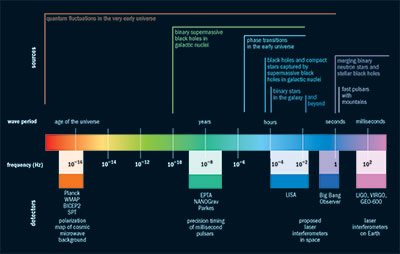
Just like electromagnetic waves, gravitational waves sit on a very broad spectrum (figure 1). Their wavelengths range from hundreds of thousands of kilometres at their smallest, right up to, incredibly, a single wavelength spanning our entire cosmos – with a wave period of the age of the universe. Different types of experiment are hunting for waves in specific parts of this spectrum, from the laser interferometers at the small-wavelength end, through precision timing of pulsars at intermediate scales, to experiments that measure the cosmic microwave background in large areas of the sky (see figure 1). So while there is competition to make the first direct detection of a gravitational wave, each technique has its own territory within the spectrum. “These methods probe different physical environments, so they’re actually highly complementary to each other,” says Stappers.
1 The gravitational-wave spectrum Gravitational waves are anticipated to have a range of different wavelengths and sit on a broad spectrum, analogous to electromagnetic waves. The spectrum spans all the way from wavelengths so long that a single one of them would span the entire universe, with a wave period the same as the age of the universe (left), to smaller wavelengths of hundreds of thousands of kilometres with wave periods of only milliseconds (right). Shown above the spectrum are possible sources for gravitational waves, with the experiments aiming to make detections, and the methods they use, below.
Pulsar astronomers are looking for gravitational waves that have a wavelength of longer than a light-year. In other words, a full period of the wave would take at least a year to pass by a point in space; for half of that year, the wave would stretch space in a particular direction, and for the other half it would compress it along that same direction. Wave periods of precisely a year are avoided because if a signal were detected that repeats once a year, it would be hard to rule out some unknown effect related to the Earth’s annual orbit around the Sun.
For millisecond pulsars, which rotate a few hundred times a minute, a 15 minute observation yields about half a million pulses. When these data are summed, or “folded”, they form an average pulse profile for that pulsar. It is best to measure rapidly rotating objects – i.e. those with narrow pulse profiles – that are also bright radio sources, so that a high signal-to-noise ratio can be achieved. Then, any shift in the curve’s position – corresponding to pulses arriving earlier or later than expected, possibly owing to the presence of a gravitational wave – can be measured to high precision.
The wide range of wavelengths of gravitational waves comes from the fact that they are created via very different phenomena. The prime targets for VIRGO and LIGO are “burst sources”, which arise from short-lived events, such as when two neutron stars or black holes merge. But when several waves from different sources meet and overlap, something called a “stochastic” gravitational-wave background is created. “Stochastic just means you can’t resolve the specific frequency of an individual source of gravitational waves,” Stappers explains. “You just know that there’s lots of gravitational-wave sources, effectively adding up to what you might call noise.” It is, Stappers says, like seeing a choppy swimming pool in which individual waves cannot be distinguished from one another.
What pulsar astronomers expect to see in particular is the stochastic gravitational-wave background created when today’s galaxies were formed. These galaxies are thought to have grown via the “hierarchical” model of galaxy formation, in which smaller galaxies merge to form bigger ones. Every galaxy is thought to have a supermassive black hole at its centre, and once a galaxy merger starts these black holes are expected to orbit each other – emitting gravitational waves that still resound today – before joining to become one even more massive black hole.
A coherent argument
Detecting gravitational waves would not be possible by observing only one or two pulsars because some unknown effect – such as a change in the pulsar’s interior – might affect the rate at which the pulsars spin. In fact, at least three pulsars are needed to rule out the possibility that something is changing in the pulsars themselves. “With an individual pulsar you can only ever place a limit on the presence of gravitational waves,” says Stappers, “because you can’t be sure that any variations in the arrival times are due to gravitational waves.”
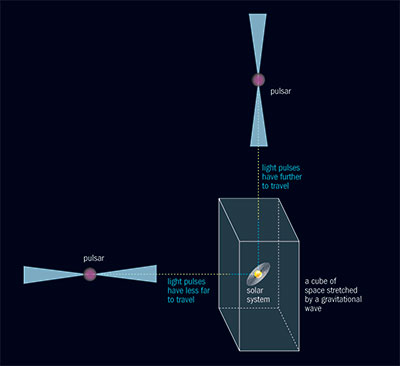
2 Probing ripples in space–time with pulsars Thousands of light-years from Earth, in the Milky Way galaxy, spinning neutron stars known as pulsars emit beams of particles and light – particularly radio waves – from their magnetic poles. The fastest pulsars spin hundreds of times per second, and those whose beam happens to illuminate the Earth once per rotation can be used as incredibly reliable timekeepers. If a gravitational wave – a ripple in space–time – passes through the Earth’s neighbourhood, it would stretch a cube of space into the shape shown. In the figure, pulses of light arriving from the left would therefore have less distance to travel than normal and would arrive earlier than expected, while the pulses from the top would have further to travel and would arrive later than expected. This is the method by which pulsar astronomers are observing the times of arrival of pulses of radio light from pulsars in an attempt to detect gravitational waves. Note that light travelling through an integer number of wavelengths travels the same distance overall as if that space were unaffected by a gravitational wave. It is only the non-integer part of a gravitational wave that the light passes through that would affect the light’s arrival time.
And in terms of building up a strong signal, the more pulsars you monitor, the better. But even if you observe as many as, say, 40 pulsars, quantity alone would not suffice. If some of the pulses arrived early, some late and some as expected, how could you translate that into anything meaningful about gravitational waves?
Key to the hoped-for detection is an idea developed by Ronald Hellings and George Downs at NASA’s Jet Propulsion Laboratory in 1983, later applied to millisecond pulsars by Ralph Foster and Donald Backer in 1990. The thinking is that if a gravitational wave distorts space–time in our vicinity, we would expect pulses from pulsars in certain, diametrically opposite areas of the sky to arrive slightly later than expected, and pulses from some perpendicular direction to arrive slightly earlier than expected (figure 2).
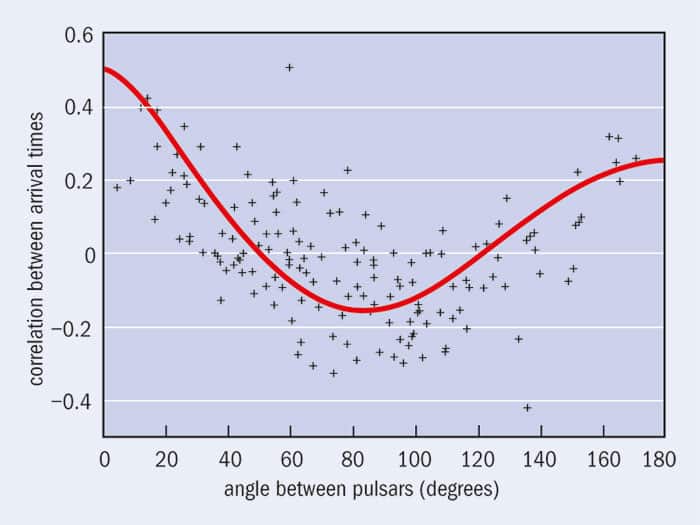
For each pulsar, radio astronomers therefore determine how much earlier or later the pulses arrive than expected. Then, for each pair of pulsars, they calculate the level of correlation between these “timing residuals” – in other words, by how much the pair’s arrival times differ. This parameter is then plotted against the angle on the sky between the two pulsars and if these points fall on the “Hellings–Downs curve” (figure 3) it would indicate the detection of a gravitational wave. For a confident fit to this curve, multiple pulsars are needed, spread out across the sky as much as possible. “Only gravitational waves are able to create such a correlation between the times of arrival of the pulses and the positions in the sky,” says Sanidas.
3 The key curve For pulsar astronomers hoping to find gravitational waves, their data will need to fit to this “Hellings–Downs curve” in a statistically significant way before they can claim a detection. Data fitting to this curve would mean that the arrival times of pulses from the same or diametrically opposite part of the sky are highly correlated, i.e. they both arrive earlier, or both arrive later, than expected, whereas pulses from perpendicular directions are anti-correlated. The points plotted on this curve are not real experimental data, but are calculated from simulated gravitational waves. No version of this plot featuring real data has yet been published.
To claim a detection, the pulsar data would have to show a statistically significant clustering around the Hellings–Downs curve. But, so far, none of the pulsar groups have seen any correlation in their data – just noise. A detection could only be claimed once this random positioning of points starts to cluster around such a curve. However, this would be a gradual process with the points moving slowly over time from noise to a good fit.
Towards detection
Getting more data from pulsars is obviously the name of the game, which is why pulsar astronomers are eagerly awaiting construction of a massive new international facility – the Square Kilometre Array (SKA). Set to be located in southern Africa and Australia, the SKA will involve thousands of radio telescopes being built with a combined collecting area of approximately 1 km2, gathering much better – and much more – pulsar data. But with the first phase of the SKA not ready until 2023, the focus for now is on combining data to detect gravitational waves as soon as possible, which is why the EPTA has joined up with the Parkes Observatory in Australia and the North American Nanohertz Observatory for Gravitational Waves (NANOGrav) to form the International Pulsar Timing Array (IPTA). According to Stappers, the collaboration is on the cusp of releasing its first data set consisting of the published data over the last year and a half or so.
The key factors in speeding up a detection are the number of pulsars, the number of years over which observations take place and the precision with which the pulses are timed. “What people have been doing for the last six, seven, eight years is continually improving the observing systems and finding new ways to combine our data to try and improve our sensitivity,” says Stappers. “In Australia they did a lot of pioneering work on this and really chased this hard for the first time. They really inspired people to ‘take it on’, as it were.”
As for when a detection might happen, a paper last year by NANOGrav physicist Xavier Siemens and colleagues predicts that a detection is possible within 10 years, and could happen as early as 2016 (Class. Quantum Grav.30 224015). In another paper last year, EPTA researcher Alberto Sesana made an improved calculation of the gravitational-wave background expected to be caused by supermassive black-hole binaries (MNRAS433 L1). “The result is that we expect the gravitational-wave signal from supermassive black-hole binaries might be stronger than we were expecting,” says Sanidas. “So we’re really positive that within the next couple of years we will make the first detection of the stochastic gravitational-wave background for supermassive black-hole binaries.”
Indirect evidence
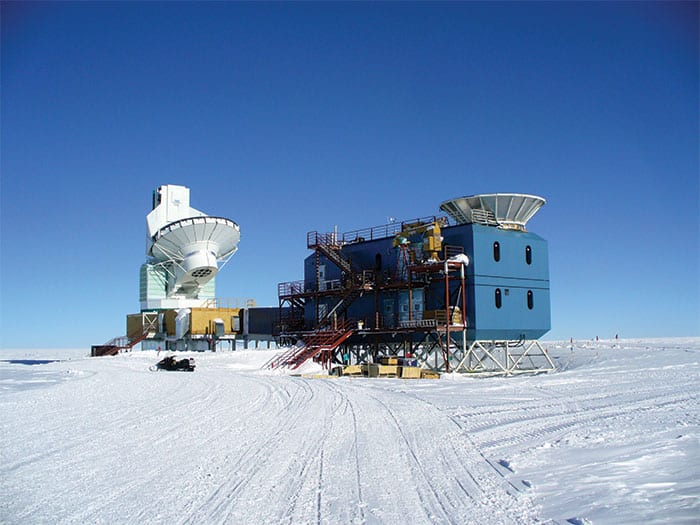
Controversial claim The team behind the BICEP2 telescope (right of image) said in March that it had detected the polarization signature that is expected of gravitational waves, but results from the Planck collaboration suggest otherwise. (Courtesy: CC BY-SA-3.0/Amble)
Although gravitational waves have not yet been detected directly, indirect evidence of their existence has been around for decades. The first such evidence came following the discovery in 1974 by Russell Hulse and Joseph Taylor of the University of Massachusetts Amherst of a “binary” pulsar, consisting of a pulsar and a companion neutron star orbiting a common centre of mass. Their analysis of the pulsar’s orbit showed that it is gradually getting smaller as it emits energy in the form of gravitational waves, which won them the 1993 Nobel Prize for Physics. Last year, more indirect evidence came from the South Pole Telescope, which observed a subtle twist in the light that makes up the cosmic microwave background (CMB) – the radiation left over from the Big Bang that still permeates our universe. This twist indicates that gravitational waves were formed when the early universe is thought to have expanded very rapidly in the period known as “inflation”.
In March this year, this finding was backed up by astronomers at the Background Imaging of Cosmic Extragalactic Polarization (BICEP2) telescope, also located at the South Pole, who announced that they had detected these primordial gravitational waves because they had seen the polarization signature these waves are expected to have left behind in the CMB. This result was published in Physical Review Letters in June (112 241101), but many in the cosmology community remained unconvinced because it did not agree completely with results from the Planck satellite – a space telescope that measures the CMB in detail. Shortly before Physics World went to press, the Planck collaboration released yet more results, which suggest that the entire BICEP2 signal is down to the team not having properly accounted for the effect of dust in our galaxy on the light they’re measuring, rather than to any signal from the early universe.
The BICEP2 results, which hit the headlines back in March, did not dampen the enthusiasm of the pulsar community, which is interested in studying gravitational waves that originate from a completely different source and sit in a different part of the gravitational-wave spectrum (see figure 1). In fact, Ben Stappers, a pulsar astronomer at the Jodrell Bank Observatory in Cheshire, UK, said that it made them even more excited. “The first evidence that gravitational waves existed came from the so-called Hulse–Taylor binary pulsar,” he says, “and here is possibly more evidence that gravitational waves are a reality, and so it just encourages us to speed up our ability to make a detection ourselves.”
Radio’s rivals
The advanced generation of LIGO and VIRGO laser interferometers are due to come online in 2015 and 2016, respectively, so the pressure is on for the pulsar-timing community to make a detection soon, especially with a Nobel prize possibly up for grabs.
But the IPTA has other goals too, beyond just detecting gravitational waves – it is, for example, working on what’s called a pulsar-based timescale, which would involve seeing if it is possible to generate a measure of time using just pulsars. “That’s interesting because if there is anything specific about the Earth that affects how we measure time, then we’ll be able to check that,” says Stappers. But with a first detection will come another exciting possibility – that researchers can actually start doing gravitational-wave astronomy.
A US government agency has launched a new $30m programme to support alternative approaches to generating energy from nuclear fusion. The initiative has been created by the Advanced Research Projects Agency – Energy (ARPA-E), which falls under the auspices of the Department of Energy (DOE). In August, the DOE invited researchers to “develop and demonstrate low-cost tools to aid in the development of fusion power”. Research teams need to outline their proposals by 14 October with three-year grants ranging from $250,000 to $10m up for grabs.
Fusion researchers have welcomed the new programme, which comes as fusion research in the US faces severe budget constraints. As one of seven partners in the €16bn ITER fusion project, the country has to provide 9% of the reactor’s components – at a cost of $3.9bn – despite a flat overall national fusion budget, which has put a squeeze on domestic fusion facilities. Next year’s budget is also far from certain after the White House recommended static spending, the House of Representatives called for an increase and the Senate even voted to kill the US contribution to ITER.
Budget casualty
One of the casualties of this ongoing budget squeeze was a DOE project called High Energy Density Plasma (HEDP), which was cancelled in 2013. This programme had supported projects lying between the low-density, long-duration approach of magnetically confined fusion – like ITER – and the very fast, very high density of inertial-confinement fusion, as carried out at the US’s National Ignition Facility. The demise of HEDP ended projects at several US national laboratories that used electrical pulses, magnetic fields, lasers and even high explosives to achieve fusion.
The new programme from ARPA-E will tap into this middle ground, focusing both on “targets” (methods for containing plasmas) and “drivers” (systems for heating and compressing plasmas). “I have long advocated that the parameter space in-between conventional [magnetic-fusion and inertial-fusion] regimes is clearly where the advantages of [both] can be combined, while eliminating some of the disadvantages,” says plasma physicist Glen Wurden of the Los Alamos National Laboratory in New Mexico, who works on magnetized plasmas.
“Members of the HEDP fusion community, especially those previously working in the area of magneto-inertial fusion before the funding was cut, were thrilled to finally see the ARPA-E funding opportunity announced,” he adds.





 For the record, here’s a run-down of other highlights of the October issue.