A space cowboy’s tale

“I wanted to make a film about an old space cowboy.” These words from director Mark Craig – spoken to an audience at Sheffield Doc/Fest just before the film’s world premiere on 8 June – are a good introduction to The Last Man on the Moon, which examines the Apollo era through the story of Eugene “Gene” Cernan. In 1972 Cernan commanded NASA’s final lunar mission, Apollo 17, and thus became the last person to set foot on the Moon – so far.

In directing The Last Man on the Moon, Craig was in an unusual position as a filmmaker. Thanks to NASA’s extensive archives, he could take his pick of footage. Yet it is clear after just a few seconds that Craig’s film is not just another documentary about space history. Aware that the Moon landings have already been covered in numerous books, films and documentaries, the British director has chosen instead to make a more cinematic work, aimed at capturing the era’s optimistic spirit and the bravado of the pilots. To do this, he combines archive footage with computer-generated imagery (CGI), interleaved with a stylized video profile of Cernan in the present day and even a smattering of cartoons.

There is, of course, a well-worn argument against mixing archive footage and CGI, which is that doing so tends to blur the line between fact and fiction. Those who prefer crystal clarity on the origin of what they are watching may experience a few uncomfortable moments in The Last Man on the Moon. But in this case, such blurriness seems like a price worth paying for the sake of narrative and continuity. This is a story about the spirit of adventure, and about our twilight cowboy looking back on the exploits of his younger self. In accommodating his reminiscences, it seems appropriate for the film to glide smoothly between the past and the present. One could also argue that CGI brings a stunning stillness to space, and may offer a more accurate vision of what astronauts actually see than could be achieved with grainy archive footage.

The tone of the film is set in the first scene. We are at a rodeo in Texas, and the film cuts between the sporting spectacle and close-ups of Cernan in his Stetson hat as he admires the bravery of the men being hurled around on the backs of the bulls. These images are interrupted by complementary footage of an astronaut being rapidly spun around in a flight simulator, as Cernan’s expression reveals that his mind has drifted back to his former life. “I look up there and I might just reflect for a half a minute or so. I can take myself there at the speed of thought,” Cernan informs us via voiceover as we now see him staring at a fire on his ranch.

Lines like these suggest that Craig is on to something when he describes Cernan as the “most eloquent” of the Apollo astronauts alive today. It is also worth noting that the film’s screenplay is based on a book of the same name that Cernan co-wrote in 2000 with Don Davis. That book, however, was just one of the more recent stages of the public-relations marathon that Cernan has been on since he hung up his spacesuit. The space cowboy has spent years giving public lectures and meeting dignitaries around the world, and he clearly thrives on it. But the pleasure and privilege of going to space has also brought its darker moments, and Craig does not shy away from depicting some of them in his documentary. For instance, we hear Cernan and his first wife Barbara Cernan Baker reflecting on the breakdown of their marriage during one period of excessive touring. We also see him talking candidly with his daughter from that marriage about how he wasn’t always there for her when he should have been.

Cernan’s inability to balance family life with being a celebrity spaceman is echoed by the experiences of the other astronauts who appear in the film. Richard “Dick” Gordon, who flew as command-module pilot of Apollo 12, sums it up well when he says “I like to think we worked hard and played hard.” Indeed, parts of the documentary could have been lifted straight from the film Top Gun, particularly the scene in which Cernan (speaking in the present day) starts to compare the way you should treat an aeroplane to the way you should treat a “good woman”.

For some viewers, episodes like this may stray a little too far into “boys and their toys” territory. But on the other hand, becoming an astronaut in the Apollo era was not something that a mild-mannered, moderate human being would have done, and in this respect the film perfectly captures the arrogance of the elite young male pilots who made up the early astronaut corps. And as in Top Gun, these apparently bulletproof youths experienced some spectacular tragedies. Cernan’s first space flight, on the Gemini 9 mission, came after the two primary crew members were killed in a training flight crash. The film also revisits the horror of the fire that destroyed the Apollo 1 rocket on the launch pad, killing the three astronauts – Virgil “Gus” Grissom, Edward White and Roger Chaffee – on board.

Cernan and his then-wife had been particularly close to the Chaffees, living on the same street. Cernan Butler explains that in some ways, staying at home was just as difficult as going to space, and the film gives viewers a genuine sense of the responsibility and anguish that she and others felt. While this is not the first time that astronauts’ wives have been profiled (see, for example, The Astronaut Wives Club by Lily Koppel), their inclusion here again shows that they were much more than foils for their husbands’ bravery. The film also briefly acknowledges some of the wider social unrest that was sweeping across the US in the late 1960s due to the Vietnam War and the civil rights movement. “The country was in a mess,” says Cernan. “But this was going on out there somewhere. Maybe we were a little cocooned in this big world of ours.”

By the end of the film we are left in no doubt that despite all the attention and public appearances, our space cowboy is at his happiest when he is away from the madness of the world, either on the Moon or on his?ranch. It is this frankness in Cernan’s story that really lifted The Last Man on the Moon far above my expectations. I had anticipated a well-crafted historical piece with CGI, and indeed, I have now filed away a few more NASA nuggets for the science round of my next pub quiz.

Far more importantly, though, I found myself getting caught up in the adventure of this cowboy’s lifetime. As the film draws to a close, we see Cernan back at the ranch enjoying a leisurely horse ride with his buddy Fred “Baldy” Baldwin, whom he has known since his time as a naval aviator. The pair agree that they won’t be riding too fast today and Cernan says to his friend, “Hey Baldy, are you ready to admit that we ain’t got what we used to got?” Only age, it seems, has finally humbled this cowboy.
Web life: Science Salsa

So what is the site about?

Like many of the websites that appear in this column, Science Salsa is a blog about science and science communication. The twist is that this site likes to serve up its science in Spanish as well as in English, and it is, accordingly, divided into sections for “red salsa” (English-language posts) and “salsa verde” (Spanish-language posts). There is also a small section for bilingual posts under the label “Christmas/Navidad salsa”.

Who is behind it?

Science Salsa is the work of Ivan Fernando Gonzalez, a biophysicist who was born in Colombia and now lives in the US. Since 2012 he has been pursuing a career in science communication: in addition to the Science Salsa blog, he also curates a bilingual pair of Facebook pages called “Science Salsa” and “Salsa de Ciencia” and maintains a page of resources for non-English science communication on his personal website, www.ivanfgonzalez.com.

What are some of the topics covered?

Several recent posts in the “red salsa” section of Science Salsa describe what (and who) gets left out when science is communicated only in English. While Gonzalez acknowledges that English is the current “lingua franca” of science (and that this has many benefits for international collaborations), he also points out that native English speakers make up only 6% of the world’s population, and proficiency among second-language speakers is patchy. For example, someone who can read scientific papers in English may not feel confident enough to give a talk in the language.

Who is it aimed at?

Some of what Gonzalez blogs about relates specifically to science communication in the US, a country with an English-speaking majority and a sizeable Spanish-speaking minority. However, the information and advice in many posts could apply equally well to other languages and contexts. People who teach physics or do science outreach in areas with a high percentage of non-native English speakers will find plenty to relate to in the post on “The seven things you should know about non-English science communication”. Current physics students with an interest in science communication or outreach careers will also appreciate Gonzalez’ posts about his “learning curve” in the field.

Can you give me a sample quote? I like red salsa.

From a July 2013 post about threats to Peru’s Jicamarca Radio Observatory (ROJ): “During the early days of space exploration, the US National Bureau of Standards required a facility to explore the ionosphere from the Earth’s surface. They needed a unique extended flat location near the magnetic equator, with moderate weather year-long, isolated from lateral radiation, and close enough to a major city to get the material and human resources needed for its construction and maintenance. They found the ideal place in the coastal mountains of the Peruvian desert…Unfortunately, [the ROJ’s] location near Lima is getting to be a problem [because a private trash management company has claims on it]…this observatory is an invaluable scientific resource that needs to be?protected.”

Yo prefiero la salsa verde. ¡Dame un ejemplo!

Bueno, si puede entenderlo, aquí hay una cita en español, de noviembre 2013: “En mis trece años en los Estados Unidos mi Inglés ha mejorado bastante, pero el idioma es una barrera que se carga perpetuamente en el ambiente profesional, como cuando se pierden segundos valiosos en una presentación o conversación, tratando de buscar la palabra correcta en el idioma que aprendiste como adulto. Aún más, durante la revisión de un artículo para publicación que hice en el pasado para una revista científica, recuerdo que uno de los factores más frustrantes de la revisión fue el Inglés tan pobre de los autores, que hacía casi imposible evaluar la validez de la ciencia que trataban de explicar.”

India’s Mangalyaan satellite successfully in orbit around Mars

India has become the first nation to successfully put a satellite into orbit around Mars on its first attempt. Launched by the Indian Space Research Organisation (ISRO), the Mangalyaan (or “Mars craft”) Mars Orbiter began circling the red planet today. The mission is one of the cheapest interplanetary space missions ever launched, and puts India on a par with the US, Russia and the European Space Agency, which have also sent spacecraft to Mars.

Powering into orbit

“The odds were stacked against us. Of 51 missions attempted in the world, only 21 have succeeded. We have prevailed,” says Indian prime minister Narendra Modi, who was at the ISOR Telemetry, Tracking and Command Network in Bangalore today.

The craft’s main engine – a 440 Newton Liquid Apogee Motor (LAM) – which has been in standby mode for most of its 300 day journey, was awoken and tested for four minutes on Monday to tweak the spacecraft’s trajectory by 2.18 m/s and set it on course to its pre-planned orbit. This morning, the satellite used the LAM as well as eight smaller engines to put itself into orbit. It is now circling Mars in an orbit whose nearest point to Mars is at 421.7 km and farthest point is at 76,993.6 km, such that it will take Mangalyaan about 73 hours to complete one orbit.

The Mars Orbiter Mission was launched on 5 November last year from the Satish Dhawan Space Centre in Sriharikota, Andhra Pradesh, on the country’s east coast. After travelling 670 million kilometres, Mangalyaan is now set to study the surface features, morphology, mineralogy and Martian atmosphere to better understand the climate, geology, origin, evolution and sustainability of life on the planet. The team hopes that the mission will help answer one of the big questions about Mars: did the planet ever have a biosphere or even an environment in which life could have evolved?

Cheap and cheerful

Costing just $74m, Mangalyaan is the least expensive mission of its type to succeed. In comparison, NASA’s Maven mission – launched 13 days after Mangalyaan and due to arrive at Mars on Monday – cost a hefty $671m. Indeed, as the Indian prime minister pointed out in a speech, the ISRO orbiter cost less than the blockbuster $100m Hollywood film Gravity.

In the coming weeks, ISRO will put Mangalyaan through its paces, thoroughly testing it and then beginning its systematic observation of the planet. The 1350 kg craft carries five scientific payloads, including a multi-spectral camera and spectrometers, as well as a highly sensitive methane sensor to assess if gas in the Martian atmosphere is of “biological or geological origin”. For example, Mangalyaan’s Lyman-Alpha Photometer will measure the relative abundance of deuterium and hydrogen from Lyman-alpha emissions in the upper atmosphere, allowing researchers to estimate the amount of water loss to outer space. The methane sensor on board will look for traces of the methane in the atmosphere and map its sources, if any are found.

The sound man

As an acoustical physicist at the University of Salford, Trevor Cox spends much of his time developing ways to minimize distortions and other unwanted effects in concert halls and recording studios. A few years ago, however, an “acoustic epiphany” in a Victorian sewer, of all places, opened his mind – and his ears – to the beauty and wonder of less-conventional soundscapes. Since then, Cox has been on “scientific odyssey of sound” that has included trips to the singing sands of the Mojave Desert, a Cold War listening post and a vast underground oil tank that holds the Guinness World Record for the longest echo.

In this podcast, you’ll hear Cox describing some of these “sonic wonderlands” to Physics World‘s reviews editor Margaret Harris, who visited him in Salford to learn more about the science of unusual sounds – and to experience a few of these sounds first-hand.

Behind the scenes at CERN's TEDx event

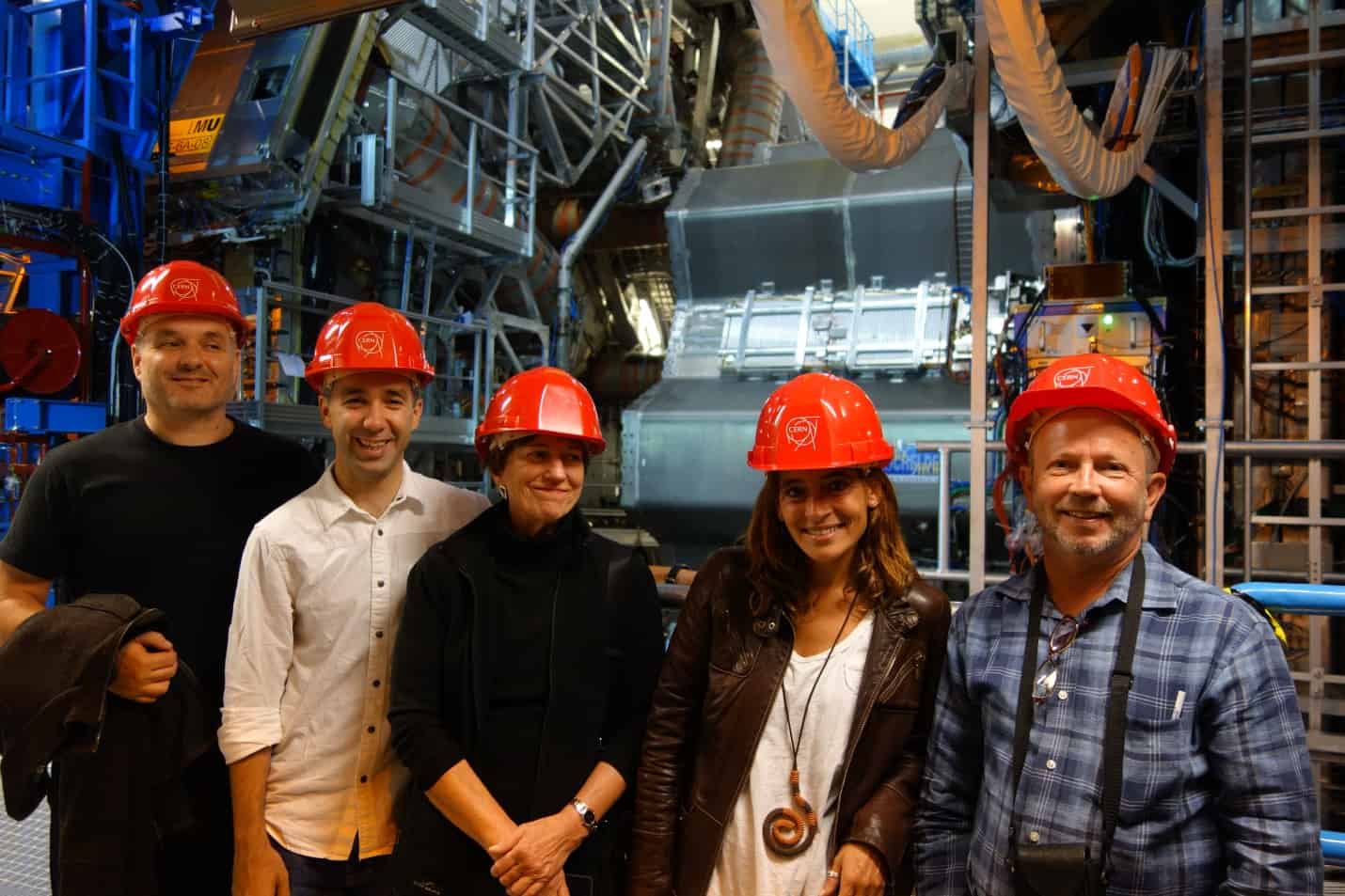
Bob Crease (at right) with pals at ATLAS shortly before his TEDx talk in September 2014

By Robert P Crease in CERN, Geneva

On Tuesday morning I addressed 1300 empty chairs.

I was the first of several presenters yesterday at a dress rehearsal for the TEDxCERN event, which takes place this afternoon, Wednesday 24 September. The rehearsal was held in a huge tent specially constructed for this event, and for CERN’s 60th-anniversary celebrations next week. The programme will be broadcast live today starting at 1.30 p.m. CEST (GMT+2).

It isn’t easy, I discovered, to grab the attention of empty chairs. I stumbled over sentences and forgot to click my slides. Occasionally I felt on automatic pilot, and had the eerie experience of hearing myself speak with a half-second delay, as if I were listening to myself from the back of my head. I went a minute over time and also discovered a typo in a slide that I had viewed approximately a zillion times before. I was relieved to find I wasn’t the only one; some of those who followed, too, tripped over delivery or had trouble with slides.

(more…)

The birthday party goes on at CERN

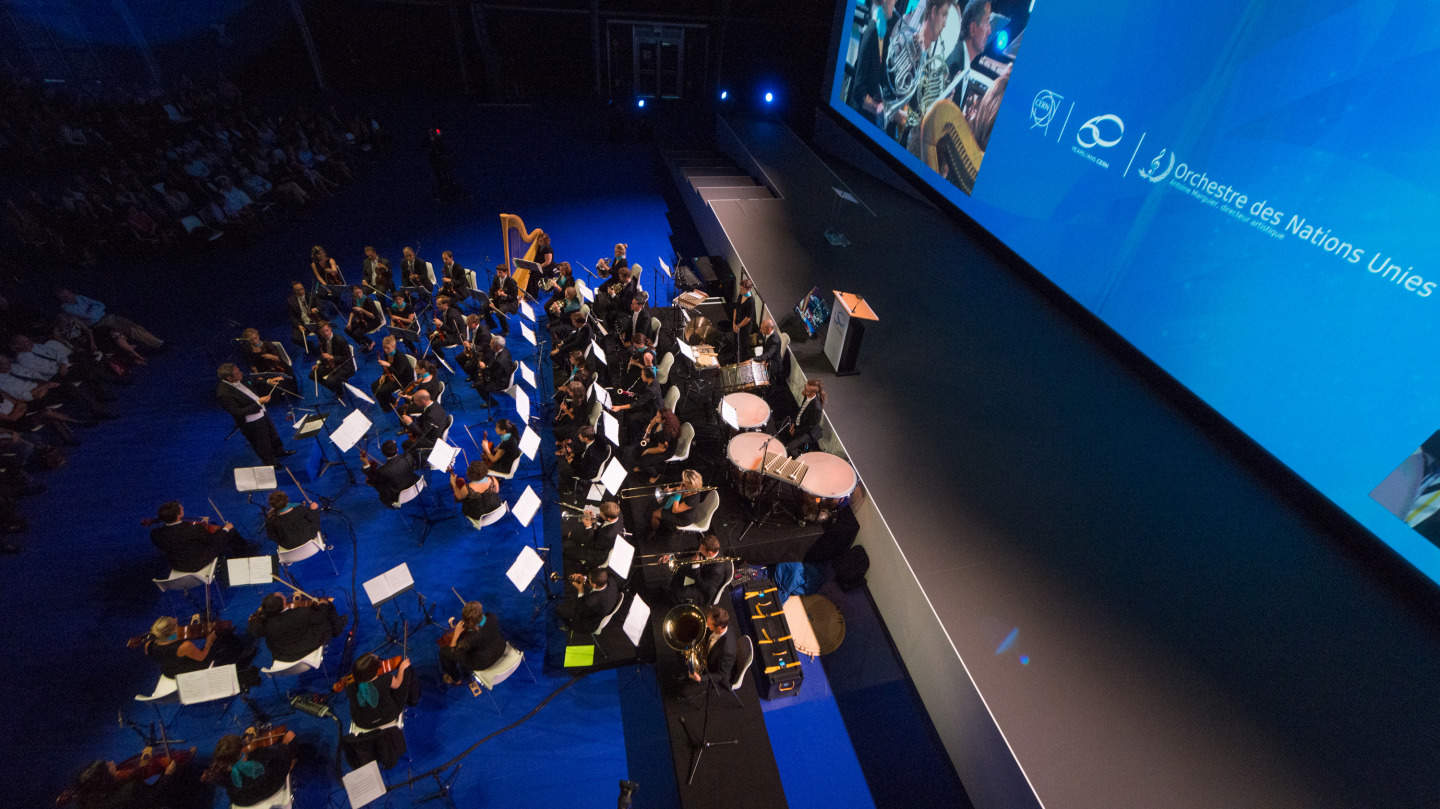
UN Symphony Orchestra perform at CERN

All this week the people at CERN and in its member states will be celebrating 60 years of particle physics at the world-famous lab in Geneva. There is something for everyone to enjoy and here are a few highlights that we have picked out

(more…)

Nuclear spins control electrical currents

An international team of physicists has shown that information stored in the nuclear spins of hydrogen isotopes in an organic LED (OLED) can be read out by measuring the electrical current through the device. Unlike previous schemes that only work at ultracold temperatures, this is the first to operate at room temperature, and therefore could be used to create extremely dense and highly energy-efficient memory devices.

With the growing demand for ever smaller, more powerful electronic devices, physicists are trying to develop more efficient semiconductors and higher-density data-storage devices. Motivated by the fact that traditional silicon semiconductors are susceptible to significant energy losses via waste heat, scientists are investigating the use of organic semiconductors. These are organic thin films placed between two conductors and they promise to be more energy efficient than silicon semiconductors. Furthermore, the availability of many different types of organic thin film could help physicists to optimize the efficiency of these devices.

Chip and spin

Conventional memory chips store data in the form of electrical charge. Moving this charge around the chip generates a lot of waste heat that must be dissipated, which makes it difficult to miniaturize components and also reduces battery life. An alternative approach is to store information in the spins of electrons or atomic nuclei – with spin-up corresponding to “1” and spin-down to “0”, for example. This could result in memories that are much denser and more energy efficient than the devices used today.

Atomic nuclei are particularly attractive for storing data because their spins tend to be well shielded from the surrounding environment. This means that they could achieve storage times of several minutes, which is billions of times longer than is possible with electrons. The challenge, however, is how to read and write data to these tiny elements.

Now, Christoph Boehme and colleagues at the University of Utah, along with John Lupton of the University of Regensburg and researchers at the University of Queensland, have shown that the flow of electrical current in an OLED can be modulated by controlling the spins of hydrogen isotopes in the device. “Electrical current in an organic semiconductor device is strongly influenced by the nuclear spins of hydrogen, which is abundant in organic materials,” explains Lupton. The team has shown that the current flowing through a plastic polymer OLED can be tuned precisely, suggesting that inexpensive OLEDs can be used as efficient semiconductors.

Just like MRI

Boehme and his team applied a small magnetic field to their test OLED, which creates an energy difference between the orientations of the nuclear spins of protons and deuterium (both hydrogen isotopes). The researchers then used radio-frequency signals to alter the directions of the spins of the protons and deuterium nuclei – a process that is also done during a nuclear magnetic resonance (NMR) experiment.

The changes to the nuclear spins affect the spins of nearby electrons, and this results in changes to the electrical current. The magnetic forces between the nuclear and electron spins are millions of times smaller than the electrical forces needed to cause a similar change in current. This suggests that the effect could be used to create energy-efficient semiconductor memories.

This recent work follows on from research done in 2010, when Boehme and colleagues showed that the technique could be used to control current in a device made from phosphorus-doped silicon. However, this was only possible in the presence of strong magnetic fields and at temperatures within a few degrees of absolute zero. Such conditions are impractical for commercial devices, but the OLED-based device needs neither ultracold temperatures nor high magnetic fields.

Time to relax

“In organic semiconductors, the spin-relaxation time does not change significantly with temperature,” explains Lupton. “In contrast, the spin-relaxation time in phosphorus-doped silicon increases significantly when the temperature is lowered; so in phosphorus-doped silicon, the experiments had to be carried out at low temperatures and high magnetic fields.”

The team believes that its technique should also work with other nuclei with non-zero spin, with some limitations. “Since protons and deuterium are both hydrogen isotopes, they can be interchanged in the synthesis without changing the chemical structure of the polymer, which may not be possible with other types of nuclei,” Lupton explains. “Tritium, the third hydrogen isotope, is radioactive, so would not be much good in experiments.”

The research is described in Science.

BICEP2 gravitational wave result bites the dust thanks to new Planck data

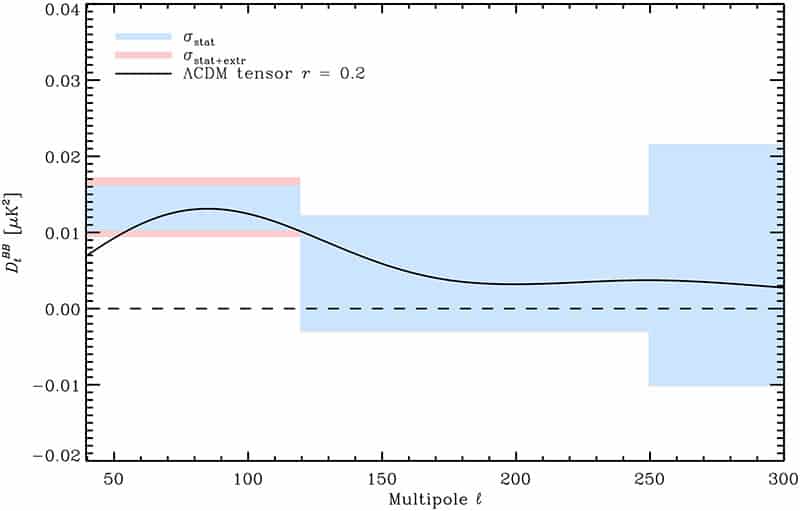
Astronomers working on the Background Imaging of Cosmic Extragalactic Polarization (BICEP2) telescope at the South Pole hit the headlines earlier this year when they claimed to have seen the first evidence for the primordial “B-mode” polarization of the cosmic microwave background (CMB). But a new analysis of polarized dust emission in our galaxy, carried out by the Planck collaboration, has shown that the part of the sky observed by BICEP2 has much more dust than originally anticipated.

The B-modes observed by the BICEP telescope are therefore most likely to be “local” galactic contamination rather than an imprint left behind by the rapid “inflation” of the early universe – the extremely rapid expansion that cosmologists believe our universe underwent a mere 10–35 s after the Big Bang. While the new analysis does not completely rule out BICEP2’s original claim just yet, it does establish that the dust emission is nearly as big as the entire BICEP2 signal.

Extraordinary claims

The BICEP2 team initially claimed its measurement was at a statistical certainty of 7σ – well above the 5σ gold standard for a discovery in physics. Many scientists hailed the result as the initial proof for inflation, but not everyone was convinced and other researchers soon pointed out that the BICEP2 team might have seriously underestimated the contribution of dust in our galaxy in their signal.

A foreground, such as the dust that BICEP2 may have detected, could consist of any emissions that could be confused with primordial CMB photons since they were last scattered at the “epoch of recombination”, when neutral atoms first formed and the decoupling of matter and radiation allowed photons to travel freely across the universe. When carrying out large-scale surveys of the CMB, researchers need to account for two important sources of electromagnetic emissions in our galaxy – synchrotron radiation from electrons moving in the galactic magnetic field and polarized emission from dust – to ensure that they do not mimic the signal they are searching for.

Plot showing overlap of the Planck dust data and the BICEP2 signal

While the BICEP2 researchers claimed to have ruled out known contamination from synchrotron radiation and dust at a statistical significance of about 2σ by cross-correlating what they saw with preliminary results from the Planck data available last year, we now know that their estimate was too low. Another criticism is that the method the team used to check its signal against that of the dust was not robust. Furthermore, BICEP2 only makes its measurements at a single frequency of 150 GHz.

Dusty doubts

Neil Turok, director of the Perimeter Institute of Theoretical Physics in Canada, who has been a vocal critic of the BICEP2 result from the start, says that the experiment itself “has many limitations, the main one being that it is only at one frequency”. BICEP2 could not therefore check if its signal is also seen at other frequencies, which it would have to be if it were a truly cosmological effect. Indeed, Turok says that BICEP2’s measurements in themselves were sound; it was the collaboration’s claims of having found the smoking gun for inflation that were excessive and unnecessary.

Peter Coles, an astrophysicist at the University of Sussex in the UK, who has also been sceptical of the BICEP2 findings, is unsurprised by the new Planck analysis. “There’s been quite a lot of circumstantial evidence accumulating that the polarized emission from galactic dust is more significant and more complicated than cosmologists had expected,” he says. “My feeling, though, is galactic astronomers always felt this was going to be the case.”

Following BICEP2’s announcement in March, Subir Sarkar – a particle theorist at the University of Oxford and the Niels Bohr Institute in Copenhagen – claimed to have found evidence of emissions from magnetized dust in local structures of dust in our galaxy. These “radio loops” could generate a previously unknown polarized signal, casting further doubt on the BICEP2 finding. According to Sarkar and colleagues, this previously unrecognised foreground at microwave frequencies is present at high galactic latitudes and could easily be misinterpreted as a B-mode polarization signal.

Jumping through loops

In light of the new Planck data, Sarkar is convinced that a loop structure, which crosses the BICEP2 observation region, may be the main culprit. “Planck data have confirmed that there is indeed such an emission from the Milky Way. This radiation is polarized and can plausibly account for the high polarization fraction of 20% required in the BICEP2 observation region,” says Sarkar. He adds that further detailed cross-correlation studies of Planck and BICEP2 data will be required for a definitive answer.

The Planck and BICEP2 collaborations are now joining forces to examine all of their data, to suss out any possible signal that may have originated from primordial gravitational waves. Their joint results should be available by the end of the year and should set the debate straight on BICEP2’s observation.

“A joint BICEP2/Planck analysis will have the benefit of complementarity between Planck’s much better frequency coverage and all-sky mapping capability versus BICEP2’s higher sensitivity, so it remains possible that a primordial gravitational wave signal can be extracted from the data through this combination,“ says Coles. “It will be difficult, though, and if I had to bet I’d probably guess that it will end with no detection.”

“To get the required sensitivity, sky coverage and frequency range will probably require a dedicated satellite mission,” says Coles and currently proposed missions such as LiteBIRD and COrE may fit the bill. However, Planck’s current observations also found certain patches of the sky that are cleaner and more devoid of dust than that studied by BICEP2. “So perhaps the existing ground-based polarization experiments, such as the South Pole Telescope or Atacama Cosmology Telescope, might have a chance if they are deployed to those regions,” says Coles. Observations made by these experiments, in conjunction with Planck, will hopefully settle the debate on gravitational waves within the next three to five years.

A pre-print of the new Planck result is available on the arXiv server.

A TEDx train wreck?

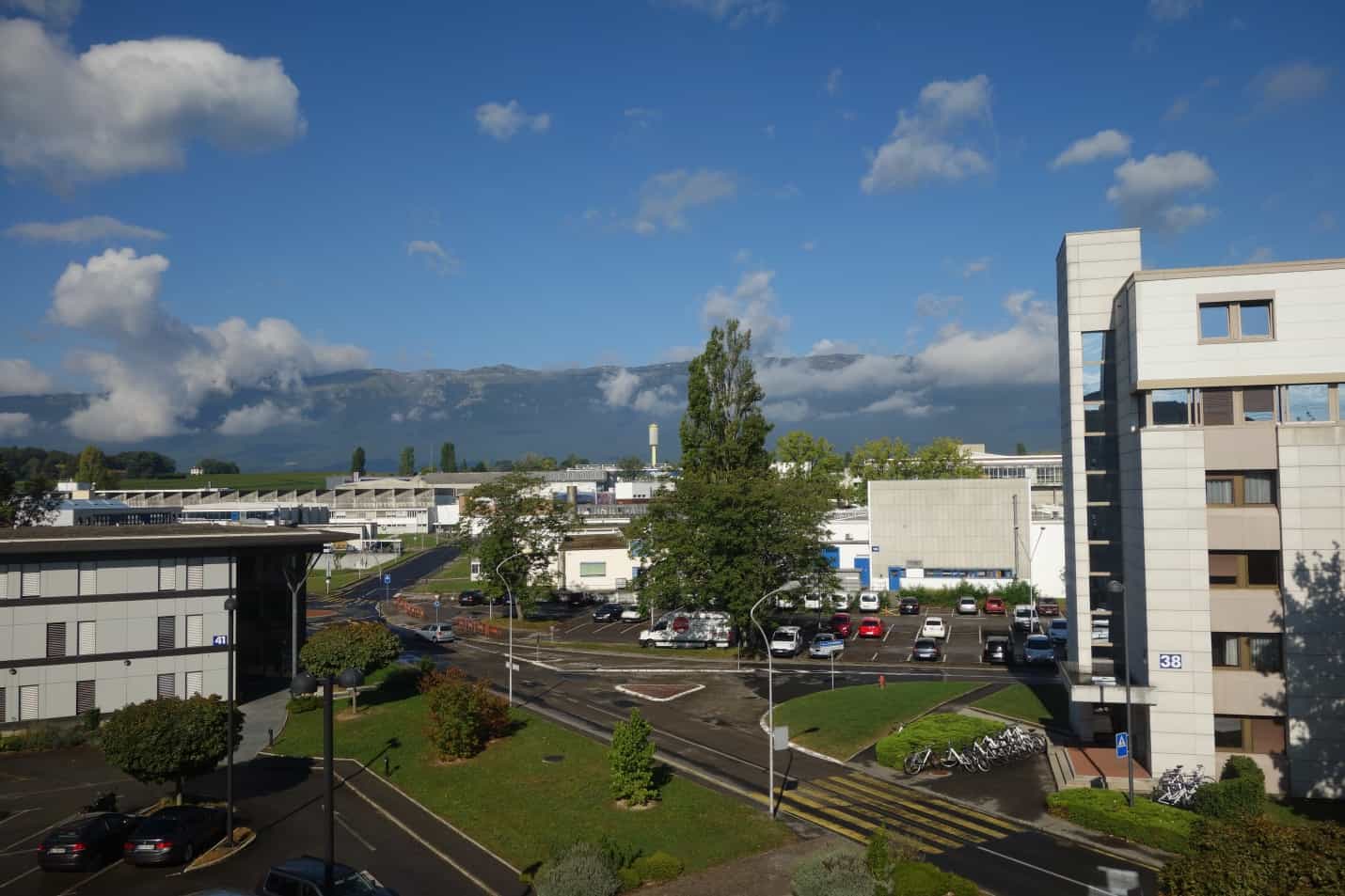
Photo of CERN as seen by Robert P Crease from his bedroom windown in September 2014

By Robert P Crease in CERN, Geneva

On Sunday morning I arrived at CERN to find workers putting finishing touches on a huge tent where the lab will host its TEDx event on Wednesday, and its 60th anniversary festivities next week.

“TED”, which stands for Technology, Entertainment, Design, is a non-profit organization that promotes talks on what it calls “ideas worth spreading”; the “x” denotes an independent event organized in that spirit. This is the second TEDxCERN – the first took place last year – and it’s hosted by Brian Cox. More than 1000 people will watch 14 speakers, three performances and three animations; tens of thousands more viewers are expected online.

James Gillies, CERN’s head of communication, invited me to be a speaker. The subject this year, he said, was how science could better engage with major social challenges. He said that my May Physics World column “Why don’t they listen?” – on why scientists have difficulty getting politicians’ ears – had “hit the nail on the head”, and asked if I’d be interested in discussing the idea.

A week at CERN? A great excuse to implore colleagues take over my classes? Sure! All I had to do, I thought, was talk my way through some extended version of the column.

(more…)

A scientific pyramid scheme, symmetry through the ages, why physics students are ‘standing a little taller’ and more

Pyramid model of a Sierpinski tree

Just this week six people were convicted in Bristol of crimes related to running a pyramid scheme. This involves taking money from lots of new investors and giving it to a smaller number of investors who signed up earlier – until the pyramid collapses. Is the current model for training scientists a pyramid scheme of sorts? That is the claim in a piece on the US’s National Public Radio (NPR) website written by Richard Harris.

(more…)

Copyright © 2026 by IOP Publishing Ltd and individual contributors