A long-running debate about the distance to the Pleiades cluster of stars has been resolved, claims a team of radio astronomers in the US. The researchers conclude that the cluster is almost exactly as far away as originally thought. This contradicts analyses of data from the Hipparcos satellite cluster, which suggested that the cluster is 13 parsecs closer than astronomical models predict. The astronomer who made those Hipparcos calculations, however, is standing by the original results, claiming that there are errors and unjustified assumptions in the new research.
The Pleiades is the star cluster most obvious to the naked eye in the night sky, and has been known since antiquity. In modern astronomy, the distance to the Pleiades is used to calibrate the cosmic-distance ladder, allowing the distances to star clusters and galaxies that are further away to be inferred. For this reason, it is important to know this distance precisely, and multiple calculations of it have been made using various methods.
The generally accepted distance was about 134 parsecs (about 437 light-years) until, in 1999, Floor van Leeuwen of the Institute of Astronomy in Cambridge, UK, used data from the European Space Agency’s Hipparcos satellite to produce what was the most precise calculation to date. The result was obtained with trigonometric parallax, using the apparent shift in the position of the target star relative to distant “fixed” stars as the Earth orbits the Sun. This is independent of any stellar models, depending only on the fundamental laws of geometry.
Controversial analysis
Van Leeuven arrived at a distance of about 120 parsecs. He refined his analysis in 2009, reaching a similar conclusion. This figure was highly controversial as the potential theoretical implications of such an unexpected discovery were huge, putting into question the amount of helium in the stars making up the Pleiades and even suggesting that hitherto unknown physics governs the early lives of stars.
In the new research, Carl Melis of the University of California, San Diego and colleagues at several other US institutions did their own trigonometric-parallax measurement of five selected stars in the Pleiades cluster using very long baseline radio interferometry. In this technique, measurements are made by linked radio antennas spread across the world, giving the total resolution of a telescope the size of the Earth. The researchers found that the distances of all five stars were in broad agreement with the original figure, with the lowest value being 134.8 parsecs and the highest being 138.4.
Melis says that, taken together with all the other measurements of the distance to the Pleiades cluster that back current theoretical models, these measurements demonstrate conclusively that the Hipparcos data were erroneous. “We’ve already come to that conclusion,” says Melis. “This is just reiterating it, and really hitting the hammer on the head of the nail and driving it into the coffin.”
Not convinced
Van Leeuwen, however, is not convinced. Hipparcos catalogued more than 100,000 stars, including multiple clusters like the Pleiades, and found answers in line with predictions for the others. The distance to the Pleiades was calculated from separate measurements of more than 50 stars, and Van Leeuwen says that, for that distance to be incorrect, Hipparcos would have needed to give wrong answers in these specific measurements. He adds that there is no convincing explanation for how this could have occurred.
He questions several technical details of the new measurements, such as the fact that the proper motions (the velocities relative to the Sun) of the Pleiades stars vary widely, whereas the proper motions of the stars within a cluster should be almost the same. “As soon as you bring the proper motions in line with each other,” he says, “all the parallaxes will change.” He also says that the Hipparcos figure can be explained. “There is no new physics needed,” he says. “The only thing that’s needed is a re-assessment of the depths of the convection layers in these stars, which have conveniently been assumed to be fixed and constant during the main sequence phase.”
Waiting on Gaia
In 2013 ESA launched Gaia, a successor to Hipparcos with much higher specifications, such as higher-sensitivity cameras, that will measure the parallaxes of thousands of stars in the Pleiades cluster. The design principles are conceptually similar, which leads Melis and colleagues to suggest that the unidentified error they believe distorted the Hipparcos measurements of the Pleiades could also affect Gaia. Nevertheless, Melis suspects that “the Gaia measurement is not going to be the same as the Hipparcos measurement…Hopefully then the Hipparcos community is going to have to face the fact that Hipparcos did not produce the correct result.”
Damage to nuclear-reactor components caused by neutron irradiation across several years can be simulated with ion beams in just a few days. That is the finding of researchers in the US, who have used ions to create the same fabric of tiny structural defects found in long-running reactors. The new technique could help engineers anticipate problems arising in existing facilities and inform the development of more robust reactor designs for the future.
Neutron irradiation can have significant effects on the structure of materials used in nuclear reactors. Individual atoms can be displaced and larger defects can build up over time, weakening or even deforming the material. Understanding the nature and extent of this damage is important to ensure safe reactor operation.
One approach is to place samples in test reactors that can produce damage at a faster rate than their working counterparts. However, these facilities are expensive to operate and can still take decades to produce the required levels of damage.
Ions instead
An alternative solution lies in replicating neutron damage with a different type of irradiation: ion beams. Building on decades of research, Gary Was of the University of Michigan and colleagues have unveiled the first working emulation of neutron damage using ion beams. “The amount of damage that is created with an ion is very dependent on its energy,” Was explains. “It turns out that the damage spectrum from 5 MeV ions is pretty close to that from fission neutrons.”
The team demonstrated the concept by trying to recreate damage seen in a steel duct that for seven years had surrounded the fuel assembly in a nuclear reactor on the Hanford Site in Washington. Microstructural damage to the duct had already been studied extensively by researchers from the Los Alamos National Laboratory using atom probe microscopy, electron microscopy and other techniques.
Atoms on the move
Using a sample made from metal from the same batch that was used to manufacture the original duct, Was and colleagues followed a two-stage analysis procedure at the Michigan Ion Beam Laboratory. First, a beam of helium ions is used to insert helium nuclei into the sample. This simulates the in-reactor production of helium by neutrons. The second stage involves heating the sample to 460 °C and subjecting it to a beam of iron ions. The sample itself is mostly iron as well, and the introduction of these ions simulates atomic displacements within the material without introducing any new elements.
One possible drawback of using ions is that unlike neutrons, which easily penetrate deep into materials and cause damage throughout, ion beams only scratch the surface of a sample. This means that the effects of ion-beam irradiation are confined to within a micron of the surface of the sample. However, the researchers explain that this creates more than enough damage for analysis.
The irradiation process lasts four days and creates the same fabric of damage seen in the original duct. Defects seen in both the sample and duct ranged from 1–20 nm in size and came in a variety of forms. These include dislocation loops, voids and precipitates – the latter being tiny regions containing a different structure than that of the surrounding material.
Translatable technique
According to Was, the method is already “quite translatable to other materials” and, in the future, the researchers hope to adapt it so that they can simulate a range of irradiation environments and reactor operational histories. In addition to assessing potential issues arising in existing reactors, the researchers hope that their method could help inform the development of the next generation of reactor designs. These plants will likely have more intense radiation environments than today’s facilities, and this will require components that are capable of withstanding higher levels of irradiation damage.
“The use of ion beams to mimic the irradiation damage produced in a reactor is a vital tool to developing a better understanding of how materials are affected by high-irradiation doses,” comments Philipp Frankel, a materials scientist at the University of Manchester. He adds that the work demonstrates exactly the type of validation studies need to provide confidence in these techniques.
Karl Whittle – a nuclear materials researcher from the University of Sheffield – agrees, but says that care must be taken when comparing the damage caused by different types of irradiation. Regardless, further work in this area, he says, would make it possible “to examine the long-term effects of damage, and develop mechanisms for mitigation of [its effects]”.
Vacuum technology is big business these days, with companies in the sector producing advanced scientific equipment that is vital not only for academic research, but also for manufacturers in other industrial sectors.
In fact, one giant of the vacuum industry – Swedish firm Atlas Copco – bought its UK rival Edwards Vacuum for an eye-watering $1.5bn last year.
If you want to find out more about why Atlas Copco forked out so much cash, don’t miss the latest Physics World focus issue on vacuum technology, which includes an interview with Geert Follens, president of Atlas Copco’s newly created vacuum-solutions division. In the interview, Follens discusses the takeover in more detail and explains why he expects further strong growth in the vacuum market.
Elsewhere in the issue, you can read about a European Union project uniting academia and industry to improve vacuum metrology for production environments. Such efforts are vital even in the drinks industry, where the Van Pur brewery in Poland, for example, uses equipment from KHS Plasmax to coat the inside of bottles with an ultrathin layer of glass using plasma impulse chemical vapour deposition under vacuum.
For a few weeks two summers ago, a courgette blogged its experiences aboard the International Space Station (ISS) (“Diary of a Space Zucchini”). One morning, the vegetable – dubbed Space Zucchini – described a thin sliver of atmosphere as “like a rainbow, but only of shades of blue” that filled the gap between Earth and space with “electrifying diaphanous beauty”. Another day it (the blogger’s gender is unclear) characterized a spacesuit as an astronaut’s version of a seed pod.
Seeing its neighbour Sunflower grow with lopsided seeds, Space Zucchini later remarked, “We are living on a frontier and things are different here.” Other of the vegetable’s blog entries concerned the birth of a younger sibling, whose development Space Zucchini found indicative of unsuspected truths about plant growth, including the lack of need for gravitational signals in aspects of the process. “On the frontier,” it noted solemnly, “even a baby sprout can teach us something new.”
Who knew that vegetables – well, a courgette’s technically a fruit – were so literate? In fact, this one’s even done a poignant reading over National Public Radio. But apart from being a bit of fun, the activities of Space Zucchini – and its rumoured alias, the astronaut Don Pettit – gave me ideas for new ways to talk about the scientific process.
Life of an “uber-geek”
I decided to get in touch with Pettit, who told me that he is an “uber-geek” whose thoughts turn to science at the slightest provocation. “I’ll be having a quiet, intimate moment with my wife,” he confessed, “catch a drop of water sliding down a glass out of the corner of my eye – and suddenly I’m thinking about surface tension! In the kitchen, I’ll collapse a plastic bag and wonder why it crinkles, or wonder why some powder I’ve spilt fans out.”
Pettit, who is a chemical engineer by training, became an astronaut in 1997. While carrying out experiments on board the ISS in 2002 he realized that, in the weird environment of space, our normal intuitions about simple things like bubbles, flames, liquids and spinning objects don’t necessarily apply. “The explanations are not in the back of a book,” he says. “You have to figure them out.”
Realizing that all it takes to “think up cool things [is to] have a bit of geek in you”, Pettit began to make videos in the ISS of his coolest ideas. In fact, by his third excursion to the ISS, which ran from December 2011 to July 2012, Pettit had amassed about 100 hours of video footage. NASA gave the material to the American Physical Society, which began editing the videos into approximately six-minute segments. There are 14 so far, which together have received some five million hits to date, and Pettit says he has enough footage for a further 45.
Lava lamps in zero g
In one video, Pettit is shown getting a droplet of water to orbit about a knitting needle, then coaxing several droplets to spiral crazily up and down the needle “like flies at a picnic”. Another video has him winging yo-yo tricks that are impossible on Earth. He also watches spinning objects, such as cylinders and bottles, oscillate between rotational and translational motion. “It’s not new physics,” Pettit says, “but it’s astounding to see.”
Elsewhere, Pettit puts a globe of water on a speaker and uses tone generators to create sine and square standing waves. “After playing with that for a while,” Pettit told me, “I thought, ‘What happens when you play music?’.” He fashioned a didgeridoo – an Aboriginal instrument – from the ISS’s vacuum cleaner hose, donned a tank top that he’d cut from an ISS crew shirt to look more like a musician, and used the instrument to create more waves on the water, pointing out their spacing, resonance frequencies and so forth.
“You can look at it as an art form or as a physics exercise,” he said. “One of my colleagues described it as a zero-gravity equivalent of a lava lamp.”
Pettit’s wit and enthusiasm make the videos far more exciting than the scripted and boring fare usually issued by NASA’s publicity machine. After NASA officials asked him to do something about pendulums – which of course don’t move in space – he started thinking what he could do that was pendulum-like. On his last flight, Pettit took into orbit a weak spring about a metre long and made from it a very thin wire. Using the spring like a pendulum in the weightless environment of space, Pettit demonstrated principles of simple-harmonic oscillation by clamping the spring at either end and fixing a mass in the middle. The frequency it vibrates at depends on the spring constant, and adding more mass makes it oscillate more slowly.
Pettit is back in line for another flight but no date has been set. “I have lots of new ideas for when I return,” he says.
The critical point
Pettit’s blogs, videos and other clips on YouTube show the marvels that can be produced when the gravitational field is switched off and other phenomena – such as surface tension, electromagnetism and sound waves – dominate instead. But his work (and all the talk about courgettes) also got me thinking about resemblances between a laboratory and a garden.
Like a lab, a garden is a special environment where unusual conditions make it possible to grow things that do not appear, or do so rarely, in the wild. Similarly, a laboratory’s special environment allows us to stage new kinds of events, be they subatomic particles or sunflower sprouts. The fact that these events may only take place in laboratories does not mean that they are unworldly. It’s just the other way around: the special laboratory environments make these events part of our world – and their mere existence helps us understand the wild better.
Physicists working on the Borexino experiment in Italy have successfully detected neutrinos from the main nuclear reaction that powers the Sun. The number of neutrinos observed by the international team agrees with theoretical predictions, suggesting that scientists do understand what is going on inside our star.
“It’s terrific,” says Wick Haxton of the University of California, Berkeley, a solar-neutrino expert who was not involved in the experiment. “It’s been a long, long, long time coming.”
Each second, the Sun converts 600 million tonnes of hydrogen into helium, and 99% of the energy generated arises from the so-called proton–proton chain. And 99.76% of the time, this chain starts when two protons form deuterium (hydrogen-2) by coming close enough together that one becomes a neutron, emitting a positron and a low-energy neutrino. It is this low-energy neutrino that physicists have now detected. Once this reaction occurs, two more quickly follow: a proton converts the newly minted deuterium into helium-3, which in most cases joins another helium-3 nucleus to yield helium-4 and two protons.
Unexpected measurement
Neutrinos normally pass through matter unimpeded and are therefore very difficult to detect. However, the neutrinos from this reaction in the Sun are especially elusive because of their low energy. “It’s a measurement that we weren’t really expected to do,” says Andrea Pocar, a physicist at the University of Massachusetts at Amherst who is part of the Borexino experiment.
The Borexino detector is a large sphere containing a benzene-like liquid that is located deep beneath a mountain at the Gran Sasso National Laboratory to shield the experiment from cosmic rays. Occasionally, a neutrino will collide with an electron in the liquid and the recoiling electron will create a flash of ultraviolet light that can then be detected.
Pocar told physicsworld.com that the main experimental challenge is in the liquid itself. It contains carbon, some of which is radioactive carbon-14 that also emits electrons. To minimize this problem, the scientists derive the liquid from petroleum so ancient that most of the troublesome carbon isotope has already decayed.
It’s a very direct confirmation that what we have been saying about the Sun is correct
Andrea Pocar, University of Massachusetts at Amherst
The standard solar model predicts that 60 billion neutrinos from the Sun’s main nuclear reaction pass through a square centimetre on Earth each second; the scientists measure an actual flux of 66±7 billion neutrinos. “It’s a very direct confirmation that what we have been saying about the Sun is correct,” Pocar says.
Neutrino experiments have not always been so kind to solar theory. In fact, the first detected solar neutrinos, which arise from a rare nuclear reaction involving boron-8, showed a deficit when compared with theory. This was resolved when physicists showed that electron neutrinos – the type the Sun produces – can change into other types, which previous experiments did not detect.
Wild proposals
Stan Woosley, an astronomer at the University of California, Santa Cruz, recalls those times. “There were all sorts of desperate things going on to try to understand why the neutrinos weren’t what was expected,” he says, mentioning one wild proposal that suggested that the Sun had a black hole at its heart. “People used to taunt those of us who did stellar evolution: ‘How can you believe anything you do when you can’t even understand our own star?’.” Woosley, who is not involved in the Borexino experiments, therefore finds the new result “really gratifying”.
While the Borexino result will bring some solace to solar physicists, a new controversy has erupted. A decade ago, some astronomers claimed that the Sun has far less carbon, nitrogen and oxygen than had been thought. Fortunately, 1% of the Sun’s energy arises not from the proton–proton chain but instead from the CNO cycle, in which carbon, nitrogen and oxygen nuclei catalyse the hydrogen-to-helium reaction. These reactions spawn neutrinos, too, and the more carbon, nitrogen and oxygen the Sun has, the more of these neutrinos there should be.
But CNO neutrinos are so rare that no-one has yet detected them. Will Borexino succeed? “I’ll call it 50/50,” Pocar says.
The scientists have published their work in Nature.
Google the word “quantum” and take a look at what comes up.
In addition to the obvious news articles about the latest developments in the field and the Wikipedia entries on quantum mechanics, you’ll undoubtedly come across a heap of other, seemingly random, stories.
So while it seems that everyone is talking about quantum something or other, how much do we really understand this notoriously difficult subject? More to the point, how much do science journalists, like me, really know about the subject? I write stories about quantum mechanics from time to time for Physics World and the subject can, I assure you, be fiendish and quite mind-bending.
In its fifth assessment report published last year, the Intergovernmental Panel on Climate Change identified atmospheric aerosols and their influence on clouds as the largest source of uncertainty in current climate models. Hundreds of these tiny particles – ranging from a few nanometres to a few micrometres across – are present in every cubic centimetre of atmosphere, with higher concentrations in urban environments. In addition to cooling the climate by reflecting or absorbing solar radiation, atmospheric aerosols also provide the seeds for all cloud droplets. Some cloud seeds enter the atmosphere directly from dust or sea spray, but around half are produced indirectly by the nucleation of trace vapours to form tiny molecular clusters that grow under condensation.
This process is poorly understood, but an experiment called CLOUD at CERN, the particle-physics laboratory in Geneva, is now providing scientists with some unique perspectives on it. At its heart is a electropolished stainless-steel cylinder – with a volume of roughly 26 m3 – in which researchers recreate a portion of the atmosphere under precisely controlled conditions. Earlier this year, the 50-strong CLOUD collaboration reported its latest results, revealing that biogenic vapours emitted by trees have a significant impact on the formation of aerosols and clouds that helps cool the planet.
“The reason why it has taken so long to understand the vapours responsible for new particle formation is that they are present in minute amounts near one molecule per trillion air molecules,” explains CLOUD spokesperson Jasper Kirkby of CERN. “Reaching this level of cleanliness and control is at the limit of current technology, and CERN’s expertise in materials, gas systems and ultra-high-vacuum technologies has been crucial,” he says.
Cosmic origins
CLOUD, which stands for Cosmics Leaving Outdoor Droplets, is designed to explore the link between galactic cosmic rays and cloud formation. First proposed in the 1970s, the idea is that charged particles that strike the Earth’s atmosphere produce ions that help new aerosol particles nucleate. To mimic such processes the CLOUD chamber is bombarded by beams of charged pions from CERN’s Proton Synchrotron.
A bespoke gas system and strict use of clean materials in the chamber lets the CLOUD researchers get much lower concentrations of contaminants than in previous experiments. Indeed, the team even produces its own synthetic air from cryogenic liquid oxygen and nitrogen, since natural air cannot be purified sufficiently. The temperature of the chamber can be varied between +30 °C and –70 °C and kept steady to within 0.01 °C, allowing researchers to reproduce any region of the troposphere. In order to simulate sunlight, which is necessary for photolytic reactions, the chamber is fitted with ultraviolet lamps linked to a quartz fibre-optic system and 250 optical-fibre vacuum feedthroughs.
In 2011 CLOUD reported its first results, revealing that trace sulphuric-acid and ammonia vapours at high altitudes can rapidly cause clusters to nucleate and become the seeds for clouds. The results also showed that ionization from cosmic rays can make nucleation occur up to 10 times faster. On the other hand, the data showed that these vapours could only account for 1000th of the rate of actual aerosol formation observed at low altitudes (Nature476 429).
Two years later, the collaboration showed that amines – derivatives of ammonia – in concentrations of a few parts per trillion can stabilize sulphuric-acid particles and better reproduce the observed particle formation rates (Nature502 359). Yet unlike sulphuric acid, which enters the atmosphere mainly through coal-fired power plants, amines are only found close to primary sources such as farms. This suggested that additional vapours must be at work.
Biogenic source
CLOUD’s latest results show that sulphuric-acid aerosols do indeed have a significant influence on the formation of clouds, but only if they are stabilized by volatile biogenic vapours emitted by trees (Science344 717). These vapours, which give pine forests their characteristic smell, are rapidly oxidized in the atmosphere to produce low-volatility vapours that participate in the formation of new aerosol particles. When the researchers modelled the global impact of the new process, they were able to account for the observed seasonal variations in atmospheric aerosol concentrations for the first time.
According to Ian Ford, a condensed-matter theorist at University College London who is not involved in the experiment, the result represents a significant step forward in climate science. “CLOUD is one of the best experimental rigs in the world and the wide range of atmospheric conditions that it covers means that we can now better parameterize the impact of aerosols and clouds in global climate models,” he says.
The CLOUD team is now studying how nucleation rates vary under different conditions, vapour concentrations and particle-beam intensities, and the experiment will run for 10 more years. “We are confident that it will settle the link between cosmic rays and cloud formation, while also reducing uncertainties in anthropogenic aerosol-cloud changes,” says Kirkby.
Many of us are unaware of the extent to which the international system of units (SI) touches our everyday lives, and this is especially true for pressure. Highly accurate, traceable measurements of pressure and vacuum conditions are vital in many manufacturing processes including that of semiconductor chips, where precise pressure measurements can improve control over features at the nanometre level. The routing of air traffic is another critical application: the minimum separation between aircraft as they approach busy airspace currently is about 600 m, but better pressure measurements could allow this distance to be cut in half – thereby reducing congestion and saving fuel.
Although pressure is one of the most widely measured units in everyday processes – and is key to vacuum science and technology – the standards that underpin it are very old. The SI unit for pressure, the pascal, is realized by mercury manometers that date back more than 300 years and we have now reached a point where the accuracy of such standards cannot be improved further. The same is true of temperature, the most widely measured unit, where the fundamental SI unit – the kelvin – is defined by the triple point of water.
A five-year project at the National Institute of Standards and Technology (NIST) in Gaithersburg, Maryland, US, aims to fundamentally change the way that the pascal is realized and disseminated. Based on ultra-precise measurements of the refractive index of gases using optical interferometry, it will raise pressure standards to the level of other SI units based on fundamental constants and also offer a brand new way to redefine the kelvin.
Mercury falling
The story of barometric pressure and early vacuum measurements is the story of mercury manometers, which were invented in 1643 by Italian physicist and mathematician Evangelista Torricelli. Some of the earliest barometric measurements were made by taking liquid in a glass–mercury manometer up a mountain and periodically observing the height of the mercury column along the way: the higher the altitude, the lower the mercury column height, indicating a lower barometric pressure. Named in Torricelli’s honour, the torr (equal to 133.322 Pa) is nominally equal to 1 mm of mercury-column height and the unit is still in common use today on many vacuum gauges.
Since Torricelli’s day, improvements in the mercury manometer have been incremental, based on resolving column heights with greater precision and accuracy. The lowest pressure uncertainties today come from a device called the ultrasonic interferometer manometer developed at NIST in 1975, which uses pulsed ultrasound to determine column heights in a 3 m-tall mercury liquid-column manometer to within 10 nm. But we have now reached the limit of such improvements. Furthermore, mercury’s status as a neurotoxin and environmental hazard has led to a ban on the purchase of mercury products. Government laboratories, national laboratories and corporations have therefore been forced to get rid of their mercury manometers, and as a result have seen their pressure-measurement capabilities downgraded. However, NIST still maintains its three mercury manometers as the national standard for the US – and will continue to do so until a high-accuracy, mercury-free alternative has been developed.
We have reached the limits of improvements based on mercury manometers
Since reference manometers are not portable (the NIST device is 3 m high and contains 250 kg of mercury), a parallel goal is to build a pressure standard that can deliver pressure measurements directly to the community. Several years ago, NIST researchers took an intermediate step towards this goal by developing a mercury-free “transfer standard package” (TSP) that enables high-quality measurements of NIST’s mercury manometers to be transferred to industry, academia and national standards laboratories around the world. This device allows reliable pressure measurements ranging from high vacuum (10–2 Pa) to atmospheric conditions (105 Pa), where improper use or incorrect calibration of gauges can cost time and money. But even though it provides a bloodline that links vacuum gauges directly to the SI system, the TSP still requires NIST to maintain and operate a 3 m-high mercury manometer. Our new project aims to replace not only the mercury manometer, but also the TSP, and do it at higher accuracy with an even more compact device.
Pressure by refractive index
In search of a better, mercury-free way to realize pressure – and one based on fundamental physics rather than a physical object – NIST has embarked on an entirely new optical pressure standard that links the pascal to quantum calculations of helium’s refractive index. Pressure and vacuum standards based on refractive index will significantly cut measurement uncertainties and improve accuracy in the aerospace, energy and advanced manufacturing sectors by between three- and 10-fold.
The refractive index of a gas depends on its density, which is a function of temperature and pressure. Quantum mechanics tells us the exact relationship between these variables, and calculations for atomic helium will allow us to relate pressure, temperature and refractive index with an accuracy significantly better than one part in 106. By measuring temperature and refractive index to high accuracy, we can determine the pressure and turn the device into a primary pressure standard based on the atomic properties of helium. Conversely, if pressure can be measured accurately using alternative means, then thermodynamic temperature can be determined by measuring the refractive index.
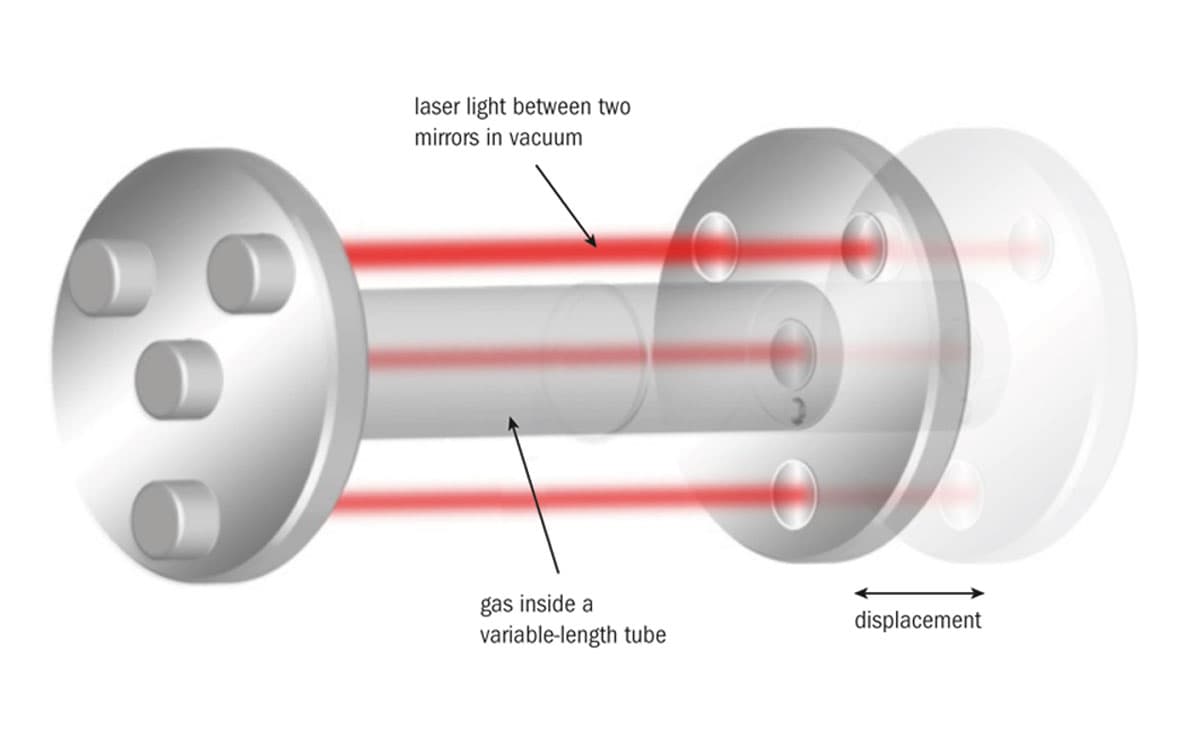
The key to making this approach worthwhile is to measure refractive index with much higher accuracy than has previously been achievable, which is possible using laser interferometry. When measuring a length using laser interferometry, the presence of a gas such as helium causes the distance to look a little bit longer than would be observed in vacuum. If we were able to compare two identical lengths in helium and in vacuum, the apparent difference would therefore allow us to determine the refractive index. The challenge facing NIST is that this difference must be measured with an accuracy of a few picometres – about 1% of a typical atomic diameter. Although picometre precision is relatively straightforward using a Fabry–Pérot interferometer, in which light bounces back and forth many times in an optical cavity, we face the challenge of generating identical displacements in two optical cavities (one in vacuum and one in helium) both with picometre accuracy.
Picometre precision Conceptual picture of the VLOC apparatus: a displacement of the end-piece on the right changes the lengths of the four optical cavities by equal amounts and the difference between the four cavities represents a measure of the refractivity of helium. Knowing the temperature, a new primary pressure standard can therefore be realized. (Courtesy: NIST)
To this end, NIST is developing a variable-length optical cavity (VLOC) comprising four individual cavities: a central cavity in helium gas surrounded by three cavities in vacuum (see figure). The mirrors at each end of the apparatus are built on highly stable bases such that the displacement of one mirrored end-piece generates equal displacements in both the outer and inner interferometers. The reason for having three interferometers in vacuum is that it allows measurement and control of angular tilts as the end-piece is translated, which is necessary to avoid Abbe errors.
Building such a primary pressure standard at NIST is all well and good, but we also have to find a way to transfer its superior accuracy to locations outside the standards lab. We are therefore also developing a less complex fixed-length optical cavity (FLOC), which will offer enhanced sensitivity over the current TSP in a greatly simplified and more portable package. The transportable FLOC standard, a prototype of which is currently being built, will use nitrogen as a working medium because it has a higher refractivity than helium and is 100 times less sensitive to contaminants. Fixed-length cavities are attractive as pressure standards because they can be made from materials with small temporal instabilities, and will deliver an immediate improvement by a factor of three in pressure-measurement uncertainties over existing commercial technologies for vacuum pressures down to 1 Pa. NIST plans to employ the FLOC and VLOC as optical pressure and vacuum standards for pressures up to 360 kPa, which will allow us to replace all mercury-based pressure standards within the next 5–10 years.
Branching out
The five-year-long project is currently in its second year. The design phase has been completed, custom parts are currently being fabricated and NIST plans to have a fully working prototype by the summer of 2015. Over the next three years, we will complete the VLOC and refine the quantum-mechanical calculations of helium’s refractive index. This will also allow us to measure the refractive index of nitrogen to a level sufficient to make the FLOC a standalone pressure and vacuum standard. Finally, the optical standard will be compared with the existing NIST mercury manometers to close the final chapter on Torricelli’s mercury pressure standard.
Since the new optical pressure standard does not require the long central column that mercury manometers do, there is essentially no limit to how small the device can get. While the first generation of FLOCs will be 15 cm in length (which is already 20 times smaller than NIST’s mercury manometer), future versions may become still smaller and more compact to deliver better pressure measurements directly to the pressure and vacuum community. Even more exciting is that the unit for pressure will be quantum-based. Manometers have a direct link back to the SI through high-accuracy measurements of elemental mercury’s density that is traceable to the kilogram. However, the new standard will no longer be linked to the kilogram, which is an artefact-based standard, but based on the refractive index of helium and on fundamental constants that are the same every-where in the universe.
The same technology can be used to determine thermodynamic temperature with uncertainties below what has been previously achieved, providing a definition of the kelvin that is independent of water’s triple point. The NIST project also applies to dimensional metrology using laser interferometry, for which accuracy can be limited by uncertainty in the refractive index of air. With the FLOC cavity being open to the environment, it provides in situ measurements of the local refractive index and therefore allows real-time wavelength corrections to be made with a projected uncertainty at the level of three parts in 109 when measuring large distances, say on a factory floor.
NIST’s new mercury-free optical pressure standard will benefit science, industry and defence applications, as well as secondary-measurement services. Indeed, the FLOC and VLOC devices will ultimately eliminate mercury from all NIST primary pressure standards and at other labs and industrial facilities. We expect the optical pressure standard to become a commercial device used across academia and industry at a fraction of the cost of a commercial pressure standard, while being cheaper to maintain and having a larger pressure range and lower uncertainty.
In the past few decades, synchrotron light sources have significantly advanced our knowledge of the structure and properties of materials. Based on electrons travelling around large storage rings, synchrotrons produce high-brilliance radiation ranging from the infrared to hard X-ray region of the spectrum. By tapping off this radiation and sending it along numerous beamlines that fan out tangentially from the storage ring, many different and unique experiments can be carried out simultaneously. In addition to advanced X-ray crystallography and imaging methods, synchrotrons allow scientists to link the atomic-scale structure of materials with their macroscopic properties and increasingly are able to characterize working devices such as solar cells in their native states.
Driving synchrotron science forward is the quest for ever-smaller beam “emittance” – a measure of the lateral spread of the electron beam. This results in a brighter and more collimated X-ray output, allowing the study of smaller features and faster processes. Around 50 synchrotrons of varying sizes and capabilities are in operation worldwide, and some of the top facilities are planning upgrades based on storage rings with very low emittance. The Advanced Photon Source (APS) in the US, the European Synchrotron Radiation Facility (ESRF) in France, and SPring-8 in Japan are all proposing ambitious upgrades, while other labs are building entirely new machines – namely MAX IV in Sweden and Sirius in Brazil.
Sirius will replace Brazil’s existing, second-generation synchrotron with one of the brightest X-ray sources on the planet. Boasting a very low emittance of 0.28 nm rad, it will also be the first third-generation light source in Latin America. Ground works for the new facility are complete and construction is scheduled to start at the end of this year, with engineering teams already deeply engaged in the design, prototyping and R&D of the machine’s subsystems. Commissioning is planned to start in mid-2016 and the first beam for users in mid-2017, which is a tight schedule.
Distributed environment
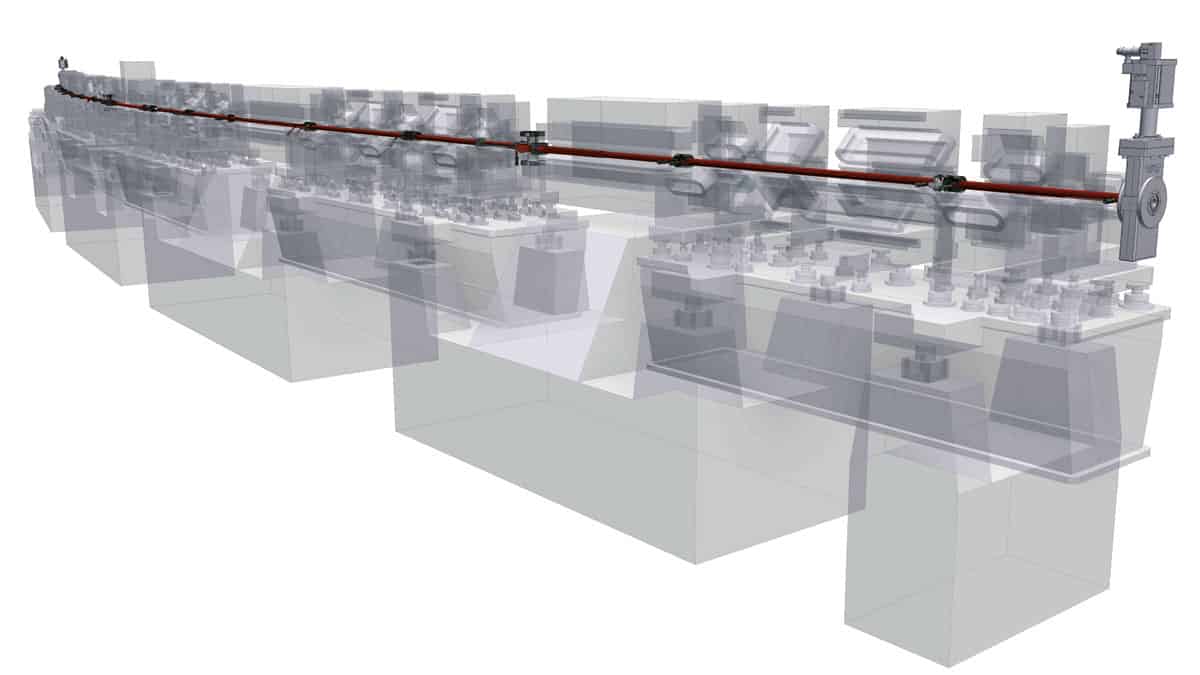
In all synchrotron light sources, an ultrahigh-vacuum environment is essential in order to accelerate electrons and extract the radiation that they produce. The most demanding component of such a facility is the storage ring, which must operate at pressures bellow 10–9 mbar to minimize beam-gas scattering and other effects that reduce the lifetime of the electron beam. Since the cross section of the vacuum chamber is very small compared with its length (the Sirius storage ring will have a circumference of 518 m and a chamber diameter of 24 mm, for instance), these machines tend to be pumped in a discrete or distributed manner.
Most modern storage rings use discrete pumping, whereby hundreds of pumps are installed at intervals of around 1.5 m or less, which requires vacuum chambers with good conductance and sufficient longitudinal space in which to place the pumps. But this approach goes completely against the design of next-generation synchrotrons, which in order to reduce beam emittance will guide electrons more gradually around the ring. Technically, Sirius is based on a “multi-bend achromat” design that involves many small-aperture magnets and leaves little space for other components. In total, the storage ring will comprise 20 “five-bend cells” and 20 straight sections.
Distributed pumping based on non-evaporable getter (NEG) technology offers a more effective option for such a compact “lattice”. NEG coatings, which were developed by the CERN particle-physics lab, are based on thin films that coat the inner surfaces of a vacuum chamber and have a chemical affinity for gas molecules. CERN has used the technology extensively in the beam pipes of the Large Hadron Collider, which requires extreme vacuum conditions. Today, NEG coatings are a proven industrialized technology used in many other settings. The first synchrotron to extensively use NEG coatings was France’s national light source Soleil, with 56% of the machine exploiting the technology. Sirius and MAX IV will be the first synchrotron light sources to base vacuum pumping of the storage ring mainly on NEG coatings, with more than 95% of the vacuum chambers being coated.
Fine thread The Sirius vacuum chamber, inside which electrons will circulate while emitting synchrotron radiation, has to weave its way through a highly compact arrangement of magnets and other components (grey) and needs complex chamber shapes and more than 450 individual sections. (Courtesy: LNLS)
The Sirius challenge
The highly compact lattice of the Sirius storage ring leaves very little space for components and therefore requires narrow vacuum chambers, which are harder to pump. Another challenge is that the vacuum chambers and components must provide a continuous electrical path to minimize the impedance of the machine, which can affect beam stability by introducing electromagnetic wake fields. The most common materials used in third-generation light sources are stainless steel and aluminium, but we have chosen to build the Sirius vacuum chamber from oxygen-free silver bearing (OFS) copper. The higher electrical conductivity of this material minimizes the machine’s impedance, while its improved thermal conductivity makes it better at absorbing unused synchrotron radiation. OFS copper also has a higher annealing temperature, which is convenient for NEG coatings because vacuum chambers need to be heated to a temperature of at least 200 °C to activate the coating. Most of the Sirius storage ring vacuum chambers will have a circular cross section with an inner diameter of 24 mm and a wall thickness of 1 mm.
Since the chambers also have to absorb unused synchrotron radiation, narrow copper cooling pipes will be attached to their outer side. But the machine’s compact lattice means that other sections of the storage ring – especially where the X-rays are siphoned off and sent down various beamlines towards experimental targets – demand more complex chambers. This makes the NEG coating extremely challenging. Sirius will have around 450 chambers in total, and even the circular cross-section chambers inside the multipole and bending magnets (where there is no need to extract radiation for the beamlines) do not have a simple manufacturing process.
Three joining processes will be needed to manufacture every single chamber to ensure that the copper does not become annealed and distorted. Vacuum brazing will be used to join short copper adapters to the stainless-steel vacuum flanges, while tungsten inert gas (TIG) welding will be used to weld these components to the copper vacuum chambers. A robotized TIG welding station gives us precise control and is suitable for complex geometries, but neither TIG welding nor vacuum brazing are suitable for attaching the copper cooling pipes to the vacuum chambers because of the potential for distortion or annealing, respectively. Here, vacuum soldering at a temperature of about 330 °C is being developed to produce joints for thermal contact.
NEG coatings
Since all the Sirius vacuum chambers will have small vacuum conductance, on account of their narrow cross section, NEG coatings are paramount. The host lab of Sirius, the Brazilian Light Source Laboratory (LNLS), has signed a licence agreement with CERN to use the coating technology and also has its own NEG coating facility to produce the Sirius vacuum chambers. Built last year by the LNLS engineering teams at a cost of around R$300,000 (about £80,000), this is one of the few places in the world where NEG coatings can be produced according to standards determined by CERN – offering the ability to coat vacuum chambers up to 3.2 m long and 450 mm in diameter (see image at top of article).
To ensure that the NEG coatings have good adhesion and pumping properties, the surfaces of the vacuum chambers must be completely free of contaminants. We therefore developed a special cleaning process based on a recirculation system where only the inner surfaces of the vacuum chambers are exposed to the etching solutions, which also reduces workers’ exposure to harmful substances. Although NEG coatings for the simple circular vacuum chambers are currently in their final design stages, the coating procedure for the complex vacuum chambers is still under development.
Following the NEG coating process, the vacuum chambers will be filled with nitrogen and stored in batches according to their assembly in the storage ring. Since the coatings must be activated by heating them in situ (in a procedure called a bake-out), Sirius requires lots of bellows to accommodate the chamber’s expansion and this can lead to a higher machine impedance. Also, the heating tapes wrapped around the chambers to heat them up must be very thin for those chambers inside the multipole and dipole magnets. For this reason, we have developed a customizable thin polyimide heating tape in conjunction with Brazilian company EXA-M Instrumentação do Nordeste, which is one of the first successful examples of LNLS’s partnership with Brazilian companies to build Sirius.
Global ambition
Further Brazilian firms are being encouraged to take part in Sirius, and collaborations between LNLS and other laboratories are in progress. One involves CERN, where there is a mutual interest between our vacuum teams in studying the behaviour of surfaces exposed to synchrotron radiation. These studies will allow a better understanding of the Sirius vacuum chambers as well as an opportunity for CERN to better understand the proposed new surface technologies for the LHC chambers.
Sirius will soon be one of the world’s brightest synchrotrons, opening new frontiers for research across materials science and also serving as a stepping stone to a diffraction-limited storage ring – a so-called ultimate synchrotron. The design is pushing synchrotron technology to the limit, especially concerning the different and unique concepts proposed for the vacuum system. All of the vacuum chambers and components must be designed and manufactured according to tight requirements, not just in terms of vacuum-system specifications but also to maximize the scientific performance of Sirius.
There are still many challenges to overcome with the Sirius vacuum system, such as the manufacture and NEG-coating of the complex-shape chambers. But once operational, Sirius will provide research from Brazil and the rest of Latin America with the opportunity to develop cutting-edge science in many fields and put nations from this region on the scientific map.
Ultrasound refers to a type of vibrational wave that has frequencies above those detectable by the human ear. The most familiar application of ultrasound is perhaps medical imaging, where these high-frequency sound waves are used to scan unborn babies. But Bruce Drinkwater and the researchers in his lab are more interested in developing new applications of ultrasound beyond its traditional uses.
One example is using ultrasound to levitate small objects. In the podcast, Drinkwater explains the physics of this eye-catching phenomenon, in which objects up to a centimetre in size can be trapped in the nodes of an ultrasonic standing wave. You can see the procedure in action in the video below, as University of Bristol PhD student Philip Bassindale delicately creates a “pearl necklace” of levitating polystyrene balls.
Drinkwater explains that his research group has scaled this levitation experiment from one dimension to three dimensions to create a cubic lattice. This system can then be tuned so that it acts as a sound filter. Another exciting possibility is to use the principles of this ultrasonic array to create a “hyper-lens” – a lens that has a resolution beyond the standard diffraction limit. Such a device, explains Drinkwater, could be particularly useful for near-surface medical applications such as detecting and mapping skin cancer.
Later in the podcast, Drinkwater recounts a very different application of his lab’s ultrasound equipment. He and his colleagues were asked if they could use ultrasound to probe the internal structure of the Clifton Suspension Bridge – the iconic Bristol landmark designed by Isambard Kingdom Brunel. The bridge-maintenance team was concerned that cracks might be developing in one of the bridge’s principle supporting structures. Listen to the podcast to find out what they discovered.