EXO-200 narrows its search for Majorana neutrinos

The first two years of data from the Enriched Xenon Observatory-200 (EXO-200) have been released by an international collaboration of physicists. The experiment looks for evidence of a process known as “neutrinoless double beta decay”, in a sample of isotopically enriched xenon-136. While the EXO-200 collaboration has not yet found any statistically significant evidence for the decay process, they have put an improved lower limit on the half-life of the decay.

They have also shown that they can efficiently suppress background noise from cosmic rays and radioactive decays. Observing any signs of neutrinoless double beta decay would show that neutrinos are “Majorana fermions” (particles that are their own antiparticles). This would constitute discovering a new class of particles that lies beyond the Standard Model of particle physics and would be a major breakthrough in modern physics.

Produced by a neutron undergoing β decay, neutrinos are chargeless particles that interact with matter via the weak force. Although we now have experimental evidence that neutrinos come in three “flavours” – the electron neutrino, the muon neutrino and the tau neutrino – that each have a different mass, researchers have been unable to nail down the individual masses. However, measurements of neutrinoless double β decay – if it were to occur – could be used to determine the absolute mass of a neutrino.

Double trouble

Neutrinoless double β decay is a special case of the common nuclear β decay process wherein the neutron in an unstable nucleus emits an electron and an antineutrino and becomes a proton. A more exotic version of the process, known as “double β decay”, occurs when a nucleus is forbidden to decay through a single β decay. One way for this double decay to happen is for two ordinary β decays to occur, but with no way of measuring the intermediate state between the two decays and with the final nucleus having a larger binding energy than the original nucleus. Two neutrons in the nucleus would be converted to protons and two electrons, with the emission of two electron antineutrinos – this is known as “two-neutrino double β decay” and is predicted by the Standard Model. Two-neutrino double β decay is very rare, thanks to the exceedingly long half-lives of the double β isotopes, above 1020 years. This is more than a billion times longer than the age of the universe itself. Select isotopes do undergo this type of double β decay however (it was first observed in 1986), including xenon-136, which decays, with the emission of two neutrinos, to barium-136. Indeed, the EXO-200 experiment was the first to observe this decay in xenon-136 in 2011.

But the other type of double β decay – the elusive and currently unseen neutrinoless double β decay – is what the EXO-200 collaboration, along with a host of other experiments worldwide, is looking for. This type of decay would only occur if the neutrino was a Majorana particle, first predicted in the 1930s by the equally enigmatic Italian physicist Ettore Majorana, but so far undetected. As neutrinos have no electrical charge, they could conceivably be their own antiparticle. In this case then, the antineutrino emitted from one of the β decays could be absorbed as a neutrino in the other β decay. This process, as observed from outside the nucleus, would result only in the observation of two electrons being emitted, with no neutrinos at all. The electrons would carry all the energy of the decay, unlike normal double β decay, in which the antineutrinos carry away energy. The experimental signature of this decay process is the detection of two electrons, the sum of whose total energy is equal to the mass difference between the parent and daughter nuclei.

No neutrino?

The EXO-200 experiment looks for this signature using 200 kg of liquid xenon, enriched to 80% of the 136 isotope, and held in a “time-projection chamber”. The chamber is placed within a cryostat system to help keep the xenon at liquid temperature. The cryostat is then shielded with lead and is located deep in the bowels of a disused salt mine, 641 m underground at the Waste Isolation Pilot Plant in Carlsbad, New Mexico, in the US. This remote underground location is crucial to the experiment’s success because it acts as a shield from background radioactive decay and cosmic rays, while the detector is made up of materials that constitute the lowest possible levels of radioactive contamination.

The EXO-200 experiment has been running for two years, allowing the collaboration to place the most stringent bound on the half-life for neutrinoless β decay. The researchers found that it is greater than 1.1 × 1025 years, at the 90% confidence level, improving on their own previous limit of 1.6 × 1025 years. The collaboration says that the high sensitivity of its measurement “holds promise for further running of the EXO-200 detector and future [neutrinoless double β decay] searches with an improved Xe-based experiment, nEXO”. This long lifetime suggests that neutrinos probably have small masses. Most recent experiments have now set limits to the Majorana neutrino mass at 0.2–0.4 eV. The nEXO experiment is a larger detector, with 5000 kg of xenon that is currently being proposed and simulated, and the current EXO-200 data will help refine its future design.

David Waters, a particle physicist at University College London, says that the EXO-200 “is a beautifully executed experiment and one of the most sensitive currently in operation. Although no signal for neutrinoless double β decay has been seen, experiments such as EXO are getting closer and closer to a promising region of parameter space that is suggested by neutrino oscillation experiments”. Waters, who also works on the another such experiment, the Super Neutrino Ettore Majorana Observatory (SuperNEMO) points out, “The next five years will be a very interesting time with several experiments such as EXO, but also others including SNO+ and SuperNEMO in which the UK plays leading roles, having the potential to make a major discovery that would shed light on some very fundamental questions in particle physics.”

The research is described in Nature.
Proton therapy is for the masses

By Hamish Johnston

In the 25th anniversary issue of Physics World, I made the bold assertion that laser acceleration will bring particle therapy to the masses by removing the need for treatment centres to have large and expensive accelerators. Instead, therapeutic beams of protons and other charged particles will be made using compact and relatively inexpensive lasers.

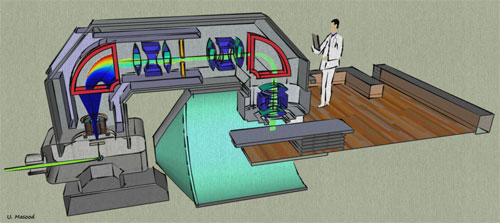
Now, medical physicist Umar Masood and colleagues at the Helmholtz-Zentrum Dresden-Rossendorf (HZDR) and the University of Dresden have published plans for a laser-driven proton-therapy facility.

(more…)

Materials inspired by nature

Materials in nature have undergone millions of years of evolution, so they are often very good indeed at serving their purpose. A research group at Harvard University is taking inspiration from the experience and expertise of nature by developing new materials inspired by biological materials and processes. This video takes you inside the The Aizenberg Biomineralization and Biomimetics Lab based at the university to meet some of the scientists and see the products they are developing.

“Only materials that have exceptional superior properties will survive, and these are the natural structures that we see and study today,” says group leader Joanna Aizenberg. “What I want to do is to create new materials, different materials, not exactly the same as nature has evolved.”

One example of this bio-inspired approach to engineering is a product known as a slippery liquid-infused porous surface, or SLIPS for short. In the film, Aizenberg and her research students explain how SLIPS was inspired by the lubricated surfaces of the Nepenthes pitcher plant, which is slippery in order to trap insects. The SLIPS technology has potential applications such as slippery coatings for pipelines that can transport oil at high speeds and efficiencies.

In this second short film, group member Natalie Koay demonstrates another product known as W-ink. The coating – inspired by the brilliant blue structural colour of the morpho butterfly – can be used in a range of products such as liquid identification in the food and beverage industry, and message encryption. Koay also demonstrates how W-ink could lead to a range of novelty products such as a dipstick for testing the alcoholic strength of a drink.


Capturing science on film

People watching an outdoor screen in Sheffield

By James Dacey, reporting from Sheffield

For the past few days I’ve been back to the place where I grew up: the city of Sheffield in the north of England. It’s famed for its steel production and snooker, but I’ve been in town for what is billed as the world’s most exciting documentary and digital media festival: Sheffield Doc/Fest. There has been an eclectic mix of films and audio documentaries from around the world to enjoy but I’ve been focusing on a strand of the festival dedicated to “Ideas & Science”.

(more…)

Big waves cause trouble for sea ice

Sea ice, already under threat from warming temperatures, could also be at risk from increasing storminess. That is according to scientists, who have measured for the first time how large, storm-generated waves propagate through sea ice in Antarctica.

“Our new data show that large waves in the Southern Ocean – those bigger than 3 m – are able to break sea ice over greater distances than previously believed, and that this process may be the missing science that explains the increase in the Antarctic, and rapid decrease in Arctic, sea-ice extent,” explains Alison Kohout of New Zealand’s National Institute of Water and Atmospheric Research.

As waves move through sea ice they create broken ice floes that are easily deformed by winds and currents. This effectively removes the barrier between the air and ocean, and aids heat transfer.

Linear decline in energy

Scientists used to think that a wave’s energy dropped exponentially once it moved into an area of sea ice. Kohout and colleagues from the National Institute of Water and Atmospheric Research in New Zealand and the University of Newcastle, Australia, found that this was true for small waves, but some of the biggest waves lost their energy more slowly, with the decline almost linear as the wave moved away from the open ocean. As a result, these big waves could break up sea ice hundreds of kilometres from its edge.

According to the researchers, climate models have failed to capture recent changes in sea ice in both polar regions. Including the effects of ocean waves on sea ice could help to solve this problem, they believe.

“Climate models are forecasting increased storminess in the Southern Ocean,” says Kohout. “I was interested in what effects this would have on sea ice.” Larger storm waves are also likely to occur in the Arctic as ice cover decreases, a factor that could accelerate sea-ice retreat further.

Broken ice floes

To come up with their results, the researchers deployed five wave sensors in September 2012 in a marginal ice zone – a region of broken ice floes between the open ocean and sea ice – in Antarctica as part of SIPEX II (the second Sea Ice Physics and Ecosystem Experiment). The sensors, deployed along a 250 km transect, measured wave heights between 60.5° south and 63° south.

“Similar experiments were carried out in the 1970s and 1980s,” says Kohout. “Since then, more affordable and autonomous technology has enabled us to collect more and improved data about large waves.” The earlier experiments took place over a relatively short time frame and in fairly small swells.

Retreat and expansion

Analysis revealed that between 1997 and 2009, during both the ice-growth and ice-decay season, the Antarctic sea-ice edge retreated in areas where the modelled average wave height increased. In regions where the wave height decreased, the sea ice expanded. A 2 m increase in significant wave height over a decade correlated with a sea-ice retreat of 2° latitude. Wave height increased the most over this period in the Amundsen-Bellingshausen Sea, an area that has seen regional sea-ice retreat, and decreased most strongly in the Western Ross Sea, where sea ice has expanded.

So what’s next? “We aim to explain how Antarctic sea ice has been able to increase in some areas yet decrease in others,” says Kohout. “This observed change is in contrast to the predictions from climate models that Antarctic sea ice should have already begun retreating.”

The team reported the results in Nature.

Breaking the diffraction limit

The nanophotonics panel: Jennifer Dionne (left), Satoshi Kawata (middle) and Adarsh Sandhu

By Hamish Johnston

At first glance, visible light and nanotechnology seem incompatible because of the diffraction limit, which dictates that features smaller than about half the wavelength of light cannot be resolved optically. For visible light, the diffraction limit is about 300 nm and this means that there is no point in trying to make conventional optical components that are any smaller.

But that pessimistic outlook has changed over the past decade or so thanks to the development of nanophotonics, which makes use of near-field (or evanescent) light and plasmons to manipulate light on length scales much smaller than the diffraction limit. Today, nanophotonics is being used across a range of disciplines, including biological imaging, telecommunications, solar energy and semiconductor processing.

(more…)

Meeting the last man to walk on the Moon

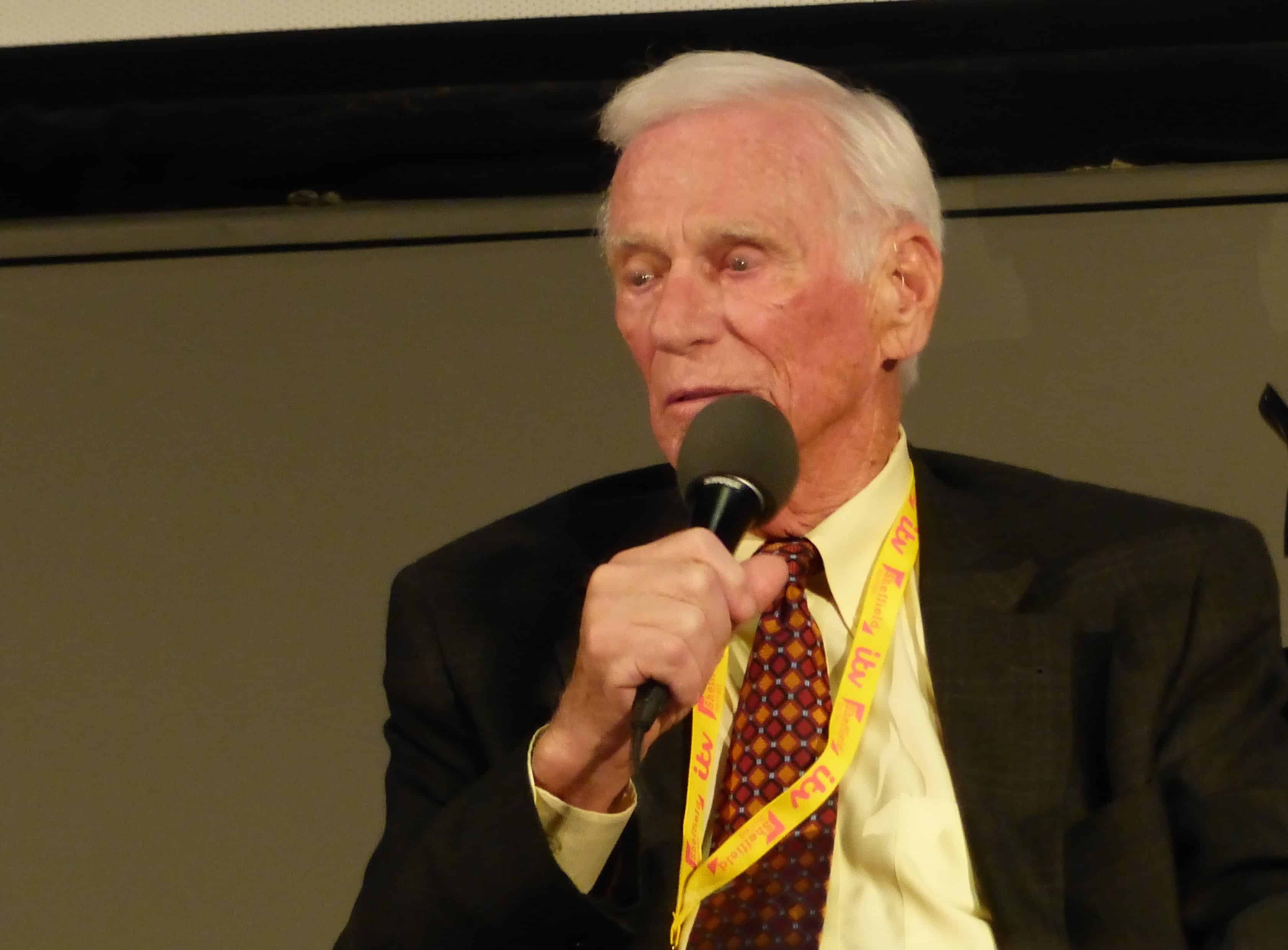
Photo of Eugene Cernan

By James Dacey, reporting from Sheffield

“I wanted to make a film about an old space cowboy” is how British director Mark Craig introduced his new film on Sunday afternoon here at Sheffield Doc/Fest. The Last Man on the Moon takes a fresh look at the the Apollo era through the story of Eugene Cernan, who was the last person to set foot on the lunar surface when he did so in 1972 as commander of Apollo 17.

The documentary interleaves a profile of “Gene” Cernan with NASA archive footage and special effects, focusing on the personal stories of the astronauts and their families. To give you a flavour, the film opens in the present day with close-ups of Cernan’s facial reactions at a rodeo event as he admires the spectacle and the bravery of the men being thrown around on the back of bulls. Later in the film, Cernan recounts his experiences of being rotated rapidly in space during the Gemini 9A and Apollo 10 missions.

Immediately after the showing, Cernan and Craig stayed for a Q&A session and the audience gave an extended standing ovation as the 80-year-old astronaut walked to the front of the auditorium. I was fortunate to catch up with the pair this morning to get some insights into the inspiration for the film and how it was adapted from the book Cernan co-authored in 1999.

(more…)

New invisibility cloak works for diffuse light

A new type of invisibility cloak that hides objects from light in diffusive media such as a cloudy liquid – rather than a clear medium such as air – has been unveiled by physicists in Germany. Based on the same physical principle used in cloaks that shield objects from heat, the device has been created by Robert Schittny and colleagues at the Karlsruhe Institute of Technology. Although applications of the device are limited, the researchers say that it could be used to create aesthetically pleasing yet burglar-proof glass.

Invisibility cloaks work by diverting light around an object in much the same way as water flows around a smooth stone in a gently flowing stream. The problem is that the diverted light takes a longer path than neighbouring beams of light that are not diverted, which means that the associated delay can reveal the presence of the object to an observer. The solution is to build a cloak in which the phase velocity of the diverted light exceeds the speed of light in the surrounding medium. Unfortunately, this can only be done for light over an extremely narrow band of wavelengths – and a broadband cloak would violate Einstein’s special theory of relativity.

The situation is different for light travelling through a diffusive medium such as water containing tiny particles. Instead of moving in a straight line at the speed of light, the light scatters its way through the medium at a much slower effective velocity. Therefore, it is possible to create a broadband cloak in which the diverted light travels substantially faster than light in the surrounding medium.

Core strengths

To make such a cloak, the team combined an opaque core – the object to be cloaked – surrounded by a diffusive shell made of silicone doped with particles that are about 10 μm in diameter. Two cloaks were made and tested: one was spherical and the other cylindrical. Calculations based on Fick’s diffusion equation revealed a simple relationship linking the dimensions of the shell to the diffusivities of the shell and the surrounding medium.

Image of the shells and cores of the two invisibility cloaks

This allowed the team to create ideal spherical and cylindrical cloaks. The cylindrical cloak has an outer radius of about 2 cm and is about 0.4 cm thick. Its “diffusivity” – a measure of how quickly light moves through it – was nearly five times that of the surrounding medium of paint particles dispersed in water. The radius and thickness of the spherical cloak were about the same as the cylindrical shell but the different geometry means that its diffusivity need only be about three times that of the surrounding media.

The team tested its cloaks by placing them in a transparent-walled tank filled with the paint/water mixture. White light is shone through the tank from one side and an image is captured by a digital camera placed on the opposite side. When an uncloaked object is in the tank, its dark shadow is clearly visible. However, when the cloak is put in place, the shadow vanishes.

Although the cloaking is not perfect – some of the region containing the object actually appears slightly brighter than its surroundings – the cloak appears to work across the entire visible spectrum. Sebastien Guenneau of the Fresnel Institute in Marseille, France, who last year joined forces with Schittny to make a thermal cloak that hides an object from heat diffusing through a medium, says that the new research is “very nice work on cloaking for diffusion phenomena”.

Behind bars

While applications for the new cloak are limited, Schittny believes that the technology could be used to hide the presence of unsightly security bars or other structures in frosted glass of the type used in bathroom windows. However, this would not work in conventional frosted glass, which has etched surfaces and is clear in the bulk of the glass. The glass would instead have to be doped with scattering particles much like the silicone used to make the cloak itself.

The cloak is described in Science.

Comedy at CERN, physics in a Buridanian universe and separating sugar from sand

Curtain call at CERN: last year's comedy show was a great success (Courtesy: Comedy Collider)

By Hamish Johnston

Bad Boy of Science” Sam Gregson and colleagues are organizing an evening of physics-related comedy at CERN in Geneva on Friday 13 June. “LHComedy: No Cause for ConCERN” will kick off in the CERN Globe at 19:30 and is billed as “a fantastic and innovative new way of presenting the work going on at CERN and engaging with the public”. The line-up from CERN includes Canadian PhD student Nazim “License to Thrill” Hussain, quantum diarist Aidan “The Mole” Randle-Conde and Cat “Schrödinger” Demetriades. You can watch last year’s comedy extravaganza from CERN here. Others involved in the project are Clara Nellis, Alex Brown, Hugo Day, Claire Lee and Rob Knoops.

(more…)

Lasers ignite ‘supernovae’ in the lab

One of the world’s most powerful laser facilities has been used to create tiny versions of supernova explosions in the laboratory. The goal of the research, which has been done by an international team of physicists, is to gain insight into one of the most energetic and unpredictable events in the universe. The researchers also hope that their experiments could lead to a better understanding of the role played by cosmic turbulence in creating the powerful magnetic fields seen in some atypical supernova remnants, such as Cassiopeia A.

Supernovae are massive stellar explosions that are triggered either when the fuel within a star reignites or its core collapses under extreme gravitational forces. The explosion expels most of the star’s material, which in turn sends out a shock wave that expands over long distances in interstellar space. The shock wave binds most of the ejected stellar material and other dust in its path, creating what is known as a supernova remnant (SNR). While most SNRs have regular, shell-like features, some, such as Cassiopeia A, have irregular and unexplained shapes. The Cassiopeia SNR is about 11,000 light-years from Earth and light from it first reached our planet 300 years ago. Optical images of the explosion reveal irregular “knotty” features, while X-ray and radio observations show the presence of magnetic fields about 100 times stronger than those in the surrounding interstellar medium.

Knotted shock

It is these oddities of Cassiopeia A that caught the attention of plasma physicist Gianluca Gregori of Oxford University and his team of international researchers. Gregori told physicsworld.com that the initial idea for the study came from conversations with astronomers about the problems in understanding the formation of magnetic fields in the universe. “Over a coffee break, we started realizing that perhaps we should try to perform a lab experiment to see if what we think is happening is really happening,” he says.

While the origin of the large magnetic field in the interior of Cassiopeia A is still unknown, one possibility is that the shock wave could have passed through a region of space that is filled with dense clumps or clouds of gas. “In Cassiopeia A, the probable explanation that we proposed is that the irregular feature is caused by the supernova shock being perturbed and fragmented by dense clouds that surrounds the star,” says Gregori.

It may sound surprising that a table-top laboratory experiment that fits inside an average room can be used to study astrophysical objects that are light years across
Gianluca Gregori, Oxford University

To test this idea, Gregori and colleagues decided to recreate a slightly smaller “bang”, devising a laboratory-based method to investigate this turbulence. “It may sound surprising that a table-top laboratory experiment that fits inside an average room can be used to study astrophysical objects that are light-years across,” says Gregori. The researchers used the Vulcan laser facility at the Rutherford Appleton Laboratory to recreate their SNRs. “Our team began by focusing three laser beams onto a carbon-rod target, not much thicker than a strand of hair, in a low-density gas-filled chamber,” says Jena Meinecke, an Oxford University graduate student who headed the experiment. When the rod is heated to a temperature of a few million degrees kelvin, it explodes. This creates an asymmetric shock wave that expands outwards through the argon gas, much like a real supernova in space.

Turbulent flows

In the experiments, the dense gas clumps or clouds that would surround an exploding star were simulated by placing a plastic grid 1 cm from the target. This disturbs the shock front and results in turbulent flow. The shock and the turbulent flow is captured a 300 billionth of a second after the laser shot, using a special imaging technique.

Gregori mentions that the team was lucky in that its meticulously planned experiment worked perfectly in the time available at the Vulcan facility. “Sometimes, even when you prepare for months, you encounter problems. This time all the diagnostics and the team were fantastic,” he exudes, pointing out that access to the laser is fairly competitive.

The researchers found that as the shock wave moved through the grid, turbulence and irregular features began to appear. “We found that the magnetic field is higher with the grid than without it,” says Gregori, explaining that the result “is consistent with both observations and numerical models of a shock wave passing through a ‘clumpy’ medium”. As higher magnetic fields imply a more efficient generation of radio and X-ray photons, the team’s results call into question the currently accepted idea that supernova explosions expand into uniformly distributed interstellar material.

Gregori points out that the research has an impact on more than just SNRs, because the amplification of magnetic field via turbulence applies to many astrophysical systems. “We know that there are magnetic fields, but we don’t know how they got there in the first place. The standard mechanism that is usually invoked is that tiny ‘seed’ fields were produced just after the Big Bang and then those fields were amplified by turbulence.”

The research is published in Nature Physics.

Copyright © 2026 by IOP Publishing Ltd and individual contributors