It’s the depths of winter in Antarctica right now, but in the new issue of Physics World magazine, there’s a chance to feast your eyes on some stunning images of scientific research in the White Continent, taken a few months ago by photojournalist Enrico Sacchetti.
Sacchetti’s photographs are amazing and in the article he explains his experiences of travelling to Antarctica and taking pictures in what is one of the world’s harshest environments.
“As soon as I stepped off the C-130 [plane], the alien nature of Antarctica was truly jolting…Almost completely absent of atmospheric pollution, the air was crystal clear,” Sacchetti writes.
Mathematical block: Michael Faraday became one of the 19th century’s greatest scientists despite his lack of mathematical nous. (Courtesy: iStock/Vasiliki Varvaki)
Mathematical or not
Read this and let it sink in for a moment: Michael Faraday could barely do basic algebra. Advanced mathematics was a closed book to the discoverer of electromagnetic induction and, as Nancy Forbes and Basil Mahon put it in their book Faraday, Maxwell and the Electromagnetic Field, “Ampère’s equations might as well have been written in Egyptian hieroglyphics.” This fact makes his rise to the top of 19th-century physics all the more remarkable – but then, Faraday was a remarkable man. Born to a poor family and sent out to work at 13, he supplemented his meagre formal education with diligent private study. After becoming Humphrey Davy’s assistant at London’s Royal Institution, he rose to be the director of its laboratory. He also taught himself the art of public speaking, giving scientific lectures and demonstrations to the people who flocked to hear him. Given these successes, it is actually a little surprising that he never managed to learn his way around trigonometry or calculus. In any case, Forbes and Mahon argue that Faraday’s lack of mathematical training “led him to derive his theories entirely from experimental observation…[and] gave him a deep-seated intuition into electromagnetic phenomena”. It’s a persuasive argument, but even so, Faraday clearly felt the deficit all his life. In one of the book’s most touching passages, the authors describe Faraday’s joy at receiving a paper entitled “On Faraday’s lines of force”, in which a young James Clerk Maxwell began to put the older scientist’s ideas on firmer mathematical ground. In a cordial reply to Maxwell, Faraday wrote, “I was at first almost frightened when I saw the mathematical force made to bear on the subject, and then wondered to see that the subject stood it so well.” This is not a complete biography of either Faraday or Maxwell, but it is a good introduction to both, with plenty of insights into their characters.
2014 Prometheus Books $25.95hb 300pp
Finding the Higgs
Particle physicists are sometimes accused of being arrogant. When they write sentences like “Away from the LHC, other physics was going on,” it’s not hard to see why. To be fair to Jon Butterworth, who unloads that particular gem halfway through his book Smashing Physics, it’s clearly meant as a comic understatement. And to be fair to particle physicists generally – well, they’ve had a lot to be arrogant about recently, so why not enjoy it with them? Smashing Physics tells the story of the discovery of the Higgs boson at the aforementioned LHC (Large Hadron Collider) from the perspective of Butterworth, a physicist at University College London and a leading member of the LHC’s ATLAS collaboration. Butterworth has worked on LHC physics for a little over a decade, but in his words, this makes him “a bit of a Johnny-come-lately by experiment standards”, since the LHC was approved in 1997 and its design was discussed officially back in 1984. What the reader gets, therefore, is a history of LHC science that skews heavily towards the present day, with a particular focus on the 36 months between the collider’s late-2009 restart and the July 2012 announcement that the Higgs boson had, at last, been discovered. Like the Higgs hunt itself, Butterworth’s story comes with plenty of detours. Some of these detours concern basic physics. Others cover the politics of working on a large collaboration, battles over UK science funding and, in one case, a memorably surreal night out in Hamburg. It’s a lively account that gets somewhat more insider-ish as it goes along, but readers who are willing to do a bit of work to understand the material will find this a smashing journey.
2014 Headline £20.00hb 304pp
Bombs, guns and trebuchets
Two years after the end of the Second World War, J Robert Oppenheimer told a lecture-room audience that “the physicists have known sin” for their work in developing the atomic bombs dropped on Hiroshima and Nagasaki. In fact, the historical connections between physics and war are very much older. In The Physics of War, retired physicist and science writer Barry Parker sets out to explore these links, deftly interspersing physics explanations with accounts of battles ancient and modern. Unfortunately, reading it is a bit like drinking artificially flavoured cola: fine at first, but with a sour aftertaste. One problem is that the book is highly western-oriented, as shown by the author’s sweeping assertion that “the world” entered the Dark Ages after the fall of Rome in 476 AD and “few advances in science were made” during the 1000 years that followed. This may come as a surprise to scientists (and historians) in, say, China, which is pretty well ignored throughout. But there are actual errors here as well as omissions. The trebuchet was not, as Parker claims, “invented by the Romans”. The pioneering marine engineer and submariner of the American Civil War was called Hunley, not Hurley, and if Archimedes had really been born in 87 BCE, as the book states, that would be impressive, since he died around 212. By the 20th century, the book is on firmer ground. But by then, it’s a little late.
When particle physicist Jon Butterworth and cosmologist Pedro Ferreira took the stage last night at the Bristol Festival of Ideas, they did so as representatives of the two pillars of modern physics. Butterworth, a leading member of the ATLAS collaboration at CERN’s Large Hadron Collider, spoke about the discovery of the Higgs boson and the effort to understand the nature of matter on the quantum level. Ferreira, a theorist at the University of Oxford, focused on Einstein’s general theory of relativity, which describes the behaviour of colossal objects such as galaxies and black holes.
The equations of quantum mechanics and general relativity are famously incompatible, but far from starting a Harry Hill-style confrontation (“FIIIIGHT!”), the advocates of the two theories shared the stage amiably, fielding questions from audience members and talking about their respective new books (Smashing Physics for Butterworth, The Perfect Theory for Ferreira). You can hear Ferreira and Butterworth’s responses to some common (and not-so-common) questions in the clips below.
As the event’s moderator, I got to chat with both speakers beforehand, and in the process I learned something startling. I’d never met Butterworth before, but back in 2009, I reviewed a series of short documentary films called Colliding Particles that featured Butterworth and some of his students. I liked the films and thought they gave viewers a good idea of what it was like to work at CERN, but there was, I noted, “relatively little physics” in them.
Butterworth decided this was a fair point, and he wrote his first ever blog post in response. (Update: He’s also written a post about the Festival of Ideas event.) Less than a year later, his new-found talent as a blogger earned his Life and Physics blog a spot on the Guardian‘snetwork, and the book deal followed from that. So in a rather roundabout way, my little review was the catalyst for an entire book – one in which, Butterworth says, he tried to balance the gossipy, my-life-as-a-scientist stuff with an in-depth look at the physics of hunting the Higgs boson.
For most of us, the life of an astronaut is one of excitement and adventure. Indeed, the mere thought of being a “real live astronaut” brings out the gleeful inner child in many, and photographer Tim Dodd is much the same. After purchasing a Russian high-altitude space suit from an online auction website, Dodd put together a series of photographs titled “A day in the life of Everyday Astronaut”, my favourite of which you can see above. Do take a look at the rest of the excellent series on Dodd’s website and follow him on Instagram for even more of the same.
In other news, famed physicist Stephen Hawking has spent his considerable genius on developing a formula that could help the English football team win this year’s FIFA World Cup. This surprising turn of events took place when Irish bookmaker Paddy Power asked the scientist to look at England's past World Cup performances and draw some conclusions about what conditions were most favourable for an English win. Take a look at this Guardian article to find out what Hawking’s conclusions were…and then hope that the kick-off for each game is at precisely 3 p.m. BST.
Readers based in the UK might be interested in this New Scientist article that looks into the impact on science that anti-EU parties such as the UK Independence Party (UKIP) could have after they were elected in large numbers to the European Parliament. Author Michael Brooks looks at the realities of losing funding from the European Research Council, collapsed international collaborations and an all-around loss of “international competitiveness”.
Phosphorene, a new 2D material that is a crystalline allotrope of phosphorus, could be ideal for making photodetectors that work across a range of wavelengths, from the visible to the near infrared. So say researchers in the Netherlands, who are the first to have studied how field-effect transistors (FETs) made from phosphorene respond to light of different frequencies.
Currently, most 2D materials research is focused on graphene, but the fact that this material lacks a direct electronic band gap between its valence and conduction bands means that scientists are now starting to look at other 2D candidates too. A band gap is essential for electronics applications because it allows a material to switch the flow of electrons on and off.
Transition materials
Among the promising newcomers are the transition metals known as "dichalcogenides" (TMDCs). Such materials have the chemical formula MX2, where M is a transition metal (such as molybdenum or tungsten) and X is a "chalcogen" (such as sulphur, selenium or tellurium) – when they are scaled down from their bulk to monolayers, the materials go from being indirect band-gap semiconductors to direct band-gap semiconductors. This scaling also allows them to efficiently absorb and emit light, making them ideal for use in a variety of optoelectronic devices.
However, there is a problem in that TMDCs respond relatively slowly to light. They also have a large band gap – roughly between 1.5 and 2 eV – and so are only suitable for device applications that work in the visible part of the electromagnetic spectrum. A material with a direct and small band gap, as well as a fast photoresponse, could therefore bridge the gap between graphene (a zero-gap semiconductor) and TMDCs with their large band gaps.
Black layers
Phosphorene, also known as few-layer black phosphorus and which can be obtained by mechanically cleaving black phosphorus crystals (in the same way that graphene layers are mechanically exfoliated from bulk graphite), is one such material. Although researchers have known about bulk black phosphorus since the 1960s, it is only very recently that they have tried to isolate single layers of the material. Just as in graphene, phosphorene atoms are arranged in a hexagonal lattice, but with its direct and small band gap (of 0.3 eV for the bulk material and between 0.33 and 0.81 eV for the device made in this work), phosphorene can quickly switch between insulating and conducting states. The material is still thin enough to confine electrons, however, so that charge flows quickly through the structure – something that leads to the high charge mobilities that are crucial for making ultrafast photodetectors and other electronics devices.
When exposed to visible and near-infrared light, FETs made from phosphorene show a photoresponse that reaches 4.8 mA/W. This is faster than both MoS2- and WS2-based photodetectors. Importantly, the material is also "ambipolar", which means that it can conduct with both electrons and holes, and so can be used to construct p–n. Finally, phosphorene's hole mobility can reach nearly 300 cm2/Vs, which is about three to five times that of MoS2, while silicon's hole mobility is just 100 cm2/Vs.
Light response
The researchers obtained their phosphorene by exfoliating bulk black phosphorus, and then used it to fabricate FETs in the lab. "In contrast to conventional FETs fabricated in the microelectronics industry, our transistors have their conduction channel exposed to allow light to reach the channel. By shining light of different wavelengths onto the channel, we can determine how the transistors respond to this light," says Michele Buscema of Delft University of Technology.
According to the team, the FETs could make good optical sensors and solar cells. Phosphorene is particularly suited to detection applications in the near infrared and so also in night-vision imaging, for example, where TMDCs do not work because of their large band gap. The Delft team is now looking at exploiting the ambipolar behaviour of black phosphorus to build p–n junctions and solar cells.
Two fully functional optical memories on single chips have been fabricated by researchers in Japan. The devices use bistable optical cavities to store the bits, and allow multiple bits to be controlled simultaneously by the same waveguide. The researchers hope that, in future, such a memory could be used for optical logic operations to increase the speed of computation.
Today, optical fibres are the material of choice for transmitting data, thanks to their lower signal attenuation compared with copper wires and their much higher bandwidth. Currently, however, optical signals have to be converted into electronic ones for processing, and then once more, to convert the output back to an optical signal. Such conversions consume energy and time, and fail to utilize the biggest advantage of optical transmission – that photons do not interfere with each other, meaning that several signals with different frequencies can travel down one fibre simultaneously in a process known as "multiplexing". Photonic signals have to be "demultiplexed" before an electronic processor can deal with them, and so optical processors are of interest to many researchers.
Random memories
A key element in any processing unit is the random access memory (RAM), in which data are stored temporarily while the computer runs a program. A modern electronic RAM usually stores each bit of memory as the charge on a capacitor, and various optical equivalents have been proposed. In 2012 Masaya Notomi and colleagues at NTT Laboratories in Kanagawa, Japan, designed a four-bit RAM made from a photonic crystal – a periodic optical nanostructure comprising a network of holes that allows some wavelengths of light to propagate while blocking others. Inside the photonic crystal were four identical cavities that had two possible refractive indices – a pulse of light at the cavity's resonant frequency would allow a switch between the two indices, while light at a different frequency would reveal the cavity's state without disturbing it. By designating the two states as 0 and 1, the researchers created a readable and rewritable memory. However, each of the cavities had to be controlled by a separate waveguide.
Now, the same researchers have made the cavities much smaller and non-identical, allowing them to introduce multiplexing. They created two different types of optical RAM – one made from silicon and the other from indium phosphide and indium gallium arsenide phosphide. In each RAM, multiple cavities were arranged lengthways, with a single waveguide passing all of them. The researchers used computer modelling to work out exactly how to move specific holes in the photonic crystal such that each cavity had a slightly different resonant frequency. They were then able to send a "write" pulse down the waveguide containing the frequencies of whichever bits they wanted to switch and only those cavities would respond.
Stable lifetimes?
The silicon RAM contained 105 working cavities, with all the resonant wavelengths falling between 1540 nm and 1570 nm, at an average spacing of just 0.23 nm, all of which was fabricated on a silicon crystal just 1 mm long. Unfortunately, the cavity states were stable for less than 10 ns – too short for a viable optical memory. However, the lifetime of the bits in the indium-phosphide-based RAM was, in principle, infinite. Because indium phosphides are less well established in industry than silicon, the technology for manufacturing indium-phosphide components is less precise, and so Notomi and colleagues could only produce a 28-bit memory. However, they believe this provides a better blueprint for future research. "Our final goal is to produce better indium-phosphide systems by improving the fabrication accuracy," says Notomi.
Martin Hill of the University of Western Australia in Crawley describes the paper as "a nice piece of work on a difficult area of photonics". But he also points out that, at present, the switching speed of the optical cavities is lower than the switching speed of electrical transistors, and says that before the device becomes useful as a product, the researchers need a way of making the switching frequencies more predictable and reproducible.
Physics may aim for simplicity, yet the world it describes is a mess. There is disorder wherever we look, from an ice cube melting to the eventual fate of the cosmos. Of course, physicists are well aware of that untidiness and have long used the concept of "entropy" as a measure of disorder. One of the pillars of physical science, entropy can be used to calculate the efficiency of heat engines, the direction of chemical reactions and how information is generated. It even offers an explanation for why time flows forwards, not backwards.
Our definition of entropy is expressed by one of the most famous formulae in physics, and dates back over a century to the work of the Austrian physicist Ludwig Boltzmann and the American chemist J Willard Gibbs. For more than 20 years, however, the Greek-born physicist Constantino Tsallis, who is based at the Brazilian Centre for Physics Research (CBPF) in Rio de Janeiro, has been arguing that entropy is in need of some refinement. The situation, according to Tsallis, is rather like Newtonian mechanics – a theory that works perfectly until speeds approach that of light, at which point Einstein's special theory of relativity must take over.
Likewise, says Tsallis, entropy – as defined by Boltzmann and Gibbs – works perfectly, but only within certain limits. If a system is out of equilibrium or its component states depend strongly on one another, he believes an alternative definition should take over. Known as "Tsallis entropy" or "non-additive entropy", it was first proposed by Tsallis himself in a 1988 paper (J. Stat. Phys.52 479) that has gone on to become the most cited article written by a scientist (or group of scientists) based in Brazil. So far it has clocked more than 3200 citations, according to the Thomson Reuters Web of Science.
To many who study statistical mechanics, Tsallis entropy makes for a much broader view of how disorder arises in macroscopic systems. "Tsallis entropy provides a remarkable breakthrough in statistical mechanics, thermodynamics and related areas," says applied mathematician Thanasis Fokas at the University of Cambridge in the UK. In fact, Fokas goes as far as saying that subsequent work motivated by Tsallis's discovery has been "a new paradigm in theoretical physics".
Tsallis entropy has, though, been divisive, with a significant number of physicists believing he has not uncovered anything more general at all. But the voices of these detractors are fast being lost in the crowd of support, with Tsallis's original paper being applied to everything from magnetic resonance imaging to particle physics. So are these applications exploiting a truly revolutionary theory? Or to put it another way: is Tsallis to Boltzmann and Gibbs what Einstein was to Newton?
Old concept
Entropy as a physical property was introduced by the German physicist Rudolf Clausius in the mid-1860s to explain the maximum energy available for useful work in heat engines. Clausius was also the first to restate the second law of thermodynamics in terms of entropy, by saying that the entropy, or disorder, of an isolated system will always increase, and that the entropy of the universe will tend to a maximum. It was not until the work of Boltzmann in the late 1870s, however, that entropy became clearly defined according to the famous formula S = kB ln W. Here S is entropy, kBW is the number of microstates available to a system – in other words, the number of ways in which a system can be arranged on a microscopic level.
Boltzmann's formula – so famous that it is carved on his gravestone in Vienna (as S = k log W) – shows that entropy increases logarithmically with the number of microstates. It also tends to class entropy as an "extensive" property – that is, a property, like volume or mass, whose value is proportional to the amount of matter in a system. Double the size of a system, for instance, and the entropy ought to double too – unlike an "intensive" property such as temperature, which remains the same no matter how large or small the system.
One example of entropy being extensive is a spread of N coins. Each coin has two states that can occur with equal probability – heads or tails – meaning that the total number of states for the coins, W, is 2N. That number can be entered into Boltzmann's formula, but, given that an exponent inside a logarithm can be moved to the front of the same logarithm as a multiplier, the expression simplifies to S = NkB ln 2. In other words, the entropy is proportional to N, the number of coins, or matter, in the system; by Boltzmann's definition, it is extensive.
Boltzmann's formula is not, though, the final word on entropy. A more general Boltzmann–Gibbs formula is used to describe systems containing microstates that have different probabilities of occurring. In a piece of metal placed in a magnetic field, for example, the spins of the electrons inside are more likely to align parallel than antiparallel to the field lines. In this scenario, where one state (parallel alignment) has a much higher probability of occurring than the other (anti-parallel alignment), the entropy is lower than in a system of equally likely states; in other words, the alignment imposed by the magnetic field has made the system more ordered. Nonetheless, the entropy here is still extensive: double the electrons, double the entropy.
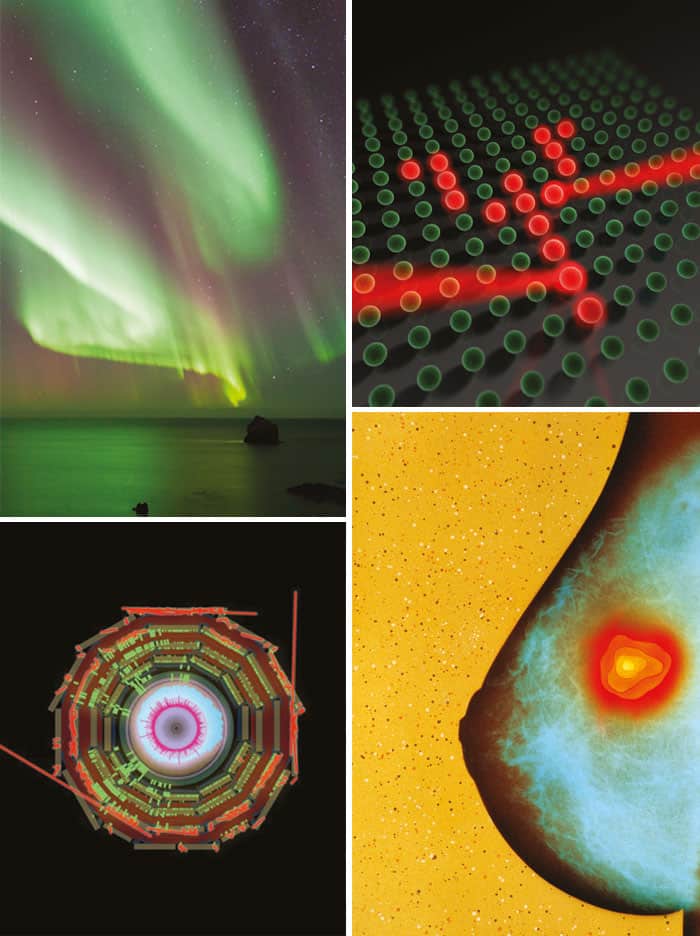
Wide benefits Tsallis entropy has been used to describe (clockwise from top left): fluctuations of the magnetic field in the solar wind; cold atoms in optical lattices; signs of breast cancer in mammograms; and particle debris generated at the Large Hadron Collider. (Courtesy: From top left: iStock/SERG_AURORA; I Bloch, MPQ; Chris Bjornberg/Science Photo Library; CERN/CMS Collaboration)
Unfortunately, it is not always possible to keep entropy extensive when calculating it with the Boltzmann–Gibbs formula, says Tsallis, and this, in his view, is the crucial point. He believes that entropy is extensive not just some of the time, but all of the time; indeed, he believes that entropy's extensivity is mandated by the laws of thermodynamics. Calculations must always keep entropy extensive, he says – and if they ever suggest otherwise, those calculations must change. "Thermodynamics, in the opinion of nearly every physicist, is the only theory that will never be withdrawn," Tsallis insists. "The demands of thermodynamics must be taken very seriously. So if Boltzmann–Gibbs entropy does not do the job, you must change it so it does do the job." For Tsallis, thermodynamics is a pillar of physics and must not be tampered with at any cost.
As to why thermodynamics restricts entropy to being extensive, he says, there are two main arguments. One is a complex technical argument from large deviations theory, a subset of probability theory. But another, simpler, argument is based on intuition. Thermodynamic functions depend on one or more variables, which for most systems can be either intensive or extensive. However, it is possible to switch a function that depends on an intensive variable to a version that depends on a corresponding extensive variable, and also vice versa, by using a mathematical "Legendre transformation". For instance, a Legendre transformation can switch a function for energy that depends on temperature to one that depends on entropy – and since temperature is an intensive variable, this implies that entropy must be correspondingly extensive. "The Legendre transformation is the basic mathematical ingredient that makes thermodynamics work," says Tsallis. "And you quickly see that entropy must be in the extensive class."
Systems in which the Boltzmann–Gibbs formula does not keep entropy extensive include those that are out of equilibrium, or where the probability of a certain microstate occurring depends strongly on the occurrence of another microstate – in other words, when the elements of a system are "strongly correlated".
As an example of such correlation in statistics, Tsallis gives linguistics. Take four words almost at random, for example "one", "many", "child" and "children", and you might expect to find, via probability theory, 4 x 4 = 16 possibilities for two-word phrases. As it happens, many of these possibilities are not permitted – you cannot say "one children" or "child many". There are, in fact, only two syntactically correct possibilities: "one child" and "many children". Grammar produces strong correlations between certain words, and so greatly reduces the number of allowed possibilities, or entropy.
There are other obvious examples in the physical world of strong correlations affecting entropy. In the presence of a whirlpool, for instance, water mole-cules do not take any path, but only those that give the overall resemblance of a vortex, because the mole-cules' motions are correlated. And it turns out that in any system with strong correlations, the number of possible microstates, W, no longer increases exponentially with the number of elements, N, as it does in the coin example where W = 2N; instead, it might, say, follow a power of N such as W = N2.
This is a problem for the Boltzmann–Gibbs expression of entropy, says Tsallis, because mathematically N can no longer be taken outside the logarithm as a multiplier. The formula is now written as S = kB ln N2, which simplifies to S = 2kB ln N. In other words, entropy is no longer proportional to N; it is forced to be non-extensive. "If you keep using Boltzmann–Gibbs entropy, you are going to violate extensivity," says Tsallis. "And I don't want that."
A cloudy idea
None of this was clear to Tsallis back in 1985. At that time he was at a meeting in Mexico City about statistical mechanics, when the study of fractals was becoming fashionable. Fractals are shapes that can be broken down into parts, each of which retains the statistical character of the whole, and are found throughout nature in, for example, lightning bolts, clouds, coastlines and snowflakes. Look closely at one of the arms of a snowflake, for instance, and it is possible to discern features that resemble the snowflake's overall shape.
A mathematical generalization of a fractal is a "multifractal", which describes such hierarchical structures using probabilities raised to a power, q (that is, pq). Tsallis describes how, during a coffee break at the meeting in Mexico City, he stayed behind in a room where another professor was explaining this concept to a student. "I couldn't hear them," he recalls, "but I knew they were talking about multifractals because of their writing on the blackboard – probability to the power q. And suddenly it came to my mind that that could be used to generalize Boltzmann–Gibbs entropy."
Tsallis believes he instantly thought of entropy because the famous Boltzmann–Gibbs formula was always somewhere in his mind, "as it is for every statistical mechanist in the world". But having written down a new formula, he did not know what, if anything, he had discovered. For two years he mulled over its implications, until a workshop in Maceió, Brazil, where he discussed it with two physicist colleagues, Evaldo Curado of CBPF and Hans Herrmann, who is now at ETH Zurich in Switzerland. "They were very stimulating, both of them," Tsallis says.
From the discussion with Curado and Herrmann as well as with others around that time, Tsallis realized that his expression for entropy could be used to preserve the property's extensive nature in cases when the Boltzmann–Gibbs formula makes it non-extensive – that is, in systems with strong correlations. Leaving Maceió, on a plane back to Rio, he performed calculations to convince himself that his formula worked, and then looked upon it with admiration. "I found it very cute, very pretty," he recalls.
Making sense of disorder Constantino Tsallis feels that our conventional understanding of entropy, as developed by Ludwig Boltzmann and J Willard Gibbs, works only within certain limits and that for systems that are out of equilibrium or host to strong correlations his alternative definition should take over. (Courtesy: Centro Brasiliero de Pesquisas Físicas)
The new expression, called by him non-additive entropy and by others Tsallis entropy, derives its merit from the exponent, q, of the probability (see "Tsallis entropy defined" below). When the correlations in a system are weak or non-existent, q tends to one and the expression reduces to the standard Boltzmann–Gibbs formula. However, when the correlations in a system are strong, q becomes more or less than one to "bias" the probabilities of certain microstates occurring. The parameter q, which is now called the Tsallis index by proponents of the theory, is therefore a way of characterizing a system's correlations – particularly how strong they are.
Three years after his formulation of non-additive entropy, in 1988, Tsallis published his Journal of Statistical Physics paper on the topic. For five years, few scientists outside Brazil were aware of it, but then its popularity skyrocketed – possibly due to research showing how non-additive entropy could be used in astrophysics to describe the distribution functions of self-gravitating gaseous-sphere models, known as stellar polytropes. Since then it has been used to describe, for example, fluctuations of the magnetic field in the solar wind, cold atoms in optical lattices, and particle debris generated at both the Large Hadron Collider at CERN in Switzerland and at the Relativistic Heavy Ion Collider at the Brookhaven National Laboratory in the US. In these cases, unlike Boltzmann–Gibbs entropy, Tsallis entropy is claimed to describe much more accurately the distribution of elements in the microstates; in the case of the LHC, these elements are the momenta of hadrons. More recently, Tsallis entropy has been the basis for a swathe of medical physics applications.
Defenders and detractors
Many people – notably the US physicist Murray Gell-Mann, who won the 1969 Nobel Prize for Physics for his theoretical work on elementary particles – agree that Tsallis entropy is a true generalization of Boltzmann–Gibbs entropy. But there are many detractors too, among whom the principal charge is that the Tsallis index q is a mere "fitting parameter" for systems that are not well enough understood.
Naturally, Tsallis disagrees. If the fitting-parameter accusation were true, he says, it would not be possible to obtain q from first principles – as he did in 2008, together with quantum physicist Filippo Caruso, who was then at the Scuola Normale Superiore di Pisa in Italy. Tsallis and Caruso showed that q could be calculated from first principles for part of a long, 1D chain of particle spins in a transverse magnetic field at absolute zero. The value of q, which was not equal to one, reflected the fact that quantum effects forced some of the spins to form strong correlations (Phys. Rev. E78 021102).
This calculation required a knowledge of the exact microscopic dynamics, which is not, however, always possible. In situations where the dynamics are not known, says Tsallis, then q indeed has to be obtained from fitting experimental data, but he claims that doing so is no different to how other accepted theories are employed in practice.
As an example, Tsallis cites the orbit of Mars, which could be calculated from first principles – but only if both the distribution of all the other planets at a given moment, and the initial conditions of masses and velocities, were all known. Clearly, he says, that is impossible. "For the specific orbit, astronomers collect a lot of data with their telescopes, and then fit that data with the elliptic form that comes out of Newton's law [of gravitation], and then you have the specific orbit of Mars," he adds. "Well, here, it's totally analogous. In principle, we would always like to be able to calculate q purely from mechanics, but it's very hard, so q often has to be obtained from fitting."
Mathematical physicist Henrik Jensen at Imperial College London takes a more nuanced view. He says that, for many years, proponents of Tsallis statistics did in fact make their case by calling attention to its greater ability to fit to data. But this, he says, is no longer true. "In the last couple of years work...has demonstrated that one might arrive at Tsallis statistics from very general assumptions about how complex correlated systems behave," he adds.
That the Tsallis index is merely a fitting parameter is not the only criticism, however. In 2003 physicist Michael Nauenberg at the University of California, Santa Cruz claimed that Tsallis statistics is, for various technical reasons, incompatible with the zeroth law of thermodynamics, which states that two systems at different temperatures placed in thermal contact will reach thermal equilibrium at some intermediary temperature (Phys. Rev. E67 036114). "Boltzmann–Gibbs statistics leads to this law, but Tsallis statistics violates it," says Nauenberg. Why that should be the case is a rather technical argument, but he claims that if a thermometer were made from a substance whose entropy could only be described with Tsallis statistics, it would not be able to measure the temperature of ordinary matter.
"Tsallis statistics is a purely ad hoc generalization of Boltzmann–Gibbs statistics," Nauenberg continues. "But since the appearance of Tsallis's paper, applications of the new statistics have been made, without any justification whatsoever, to virtually every system under the Sun. As a fitting technique it may have some merits, but it is not a valid generalization of Boltzmann–Gibbs statistics."
Eugene Stanley, a statistical and econophysicist at Boston University in the US, believes Nauenberg's criticism is misplaced. He says that the zeroth law of thermodynamics is an "important and quite subtle" point that is still being explored for systems with strong correlations. "I suspect that many people don't have a clear idea about a very deep question such as the extended validity of the zeroth principle of thermodynamics. Up to now, everything seems consistent with the possibility that the zeroth principle also holds for [Tsallis] systems, which violate Boltzmann–Gibbs statistical mechanics."
Certainly, not everyone is convinced by the new theory of entropy, and the debates look set to continue. But on the wall of his office, Tsallis has posters of both Einstein and Boltzmann – perhaps in the subconscious hope that he will one day be known for overturning conventional statistical mechanics, as Einstein's special theory of relativity overturned classical mechanics.
"Any physicist is supposed to know that classical mechanics works only when the masses are not too small and not too fast," says Tsallis. "If they're very small, you have to use quantum mechanics, and if they're very fast, you have to use relativity." But with statistical physics being one of the pillars of contemporary physics – and an obligatory subject in physics degree courses all over the world – he feels that students should be taught its limitations. "They should learn where Boltzmann–Gibbs statistics works, and where it doesn't."
If Tsallis's ideas hold sway, that equation on Boltzmann's gravestone may soon need updating.
Tsallis entropy defined
Standard Boltzmann entropy, where the probabilities of all microstates are equal, is given by the classic equation S = kB lnW, where S is entropy, kB is the Boltzmann constant and W is the total number of microstates in the system.
If the system has lots of different microstates, i, each with its own probability pi of occurring, this equation can be written as the Boltzmann–Gibbs entropy S = –kBpi lnpi.
Tsallis entropy, Sq, is claimed to be useful in cases where there are strong correlations between the different microstates in a system. It is defined as
where q is a measure of how strong the correlations are. The value of q is either more or less than one in such systems – effectively to bias the probabilities of certain microstates occurring – but in the limit where q approaches 1, Tsallis entropy reduces to the usual Boltzmann–Gibbs entropy. The parameter q is called the Tsallis index by proponents of the theory.
Medical applications of Tsallis entropy
In recent years, one of the most active fields in which Tsallis statistics has been applied is medical physics. In 2010, for instance, medical physicist Luiz Murta-Junior and colleagues at the University of São Paulo in Brazil applied Tsallis statistics to magnetic resonance imaging (MRI), to help them to delineate different types of tissue in the brain. A loss in the brain's grey matter, for example, can be the cause of neurodegenerative diseases such as multiple sclerosis, which is why doctors turn to MRI to see how much grey matter there is relative to other tissues.
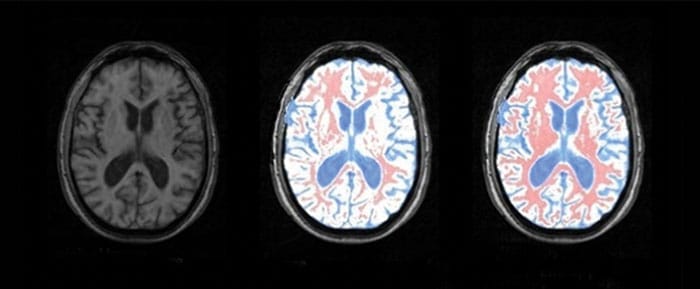
In any MRI scan, different tissues appear as different shades of grey, but each of these shades is actually made up from pixels with a range of different luminosities. The trick therefore is to work out the top and bottom thresholds in luminosity for each tissue – for instance, grey matter may contain pixels with luminosities between 20 and 90 on an eight-bit scale. This range corresponds to a certain value of entropy, since the greater the spread of luminosity values the greater the "disorder". If there are just two different tissues in an MRI scan – grey matter and white matter – a scientist can analyse the image to determine the distribution of each tissue using an algorithm that adjusts two entropy variables until their total is a maximum.
Obvious benefits A functional magnetic resonance imaging scan of a brain (left) that has been analysed first with conventional statistics (middle) and then with Tsallis entropy (right), which more clearly reveals different kinds of brain tissue.(CC-BY Braz. J. Med. Biol. Res.)
An algorithm based on Boltzmann–Gibbs entropy, and typical extensions of it, can do this. But according to Murta-Junior and colleagues, Boltzmann–Gibbs entropy does not allow for long-range correlations between pixels, which can arise in regions with complex, fractal-like shapes. The São Paulo researchers therefore turned to Tsallis entropy, and found that it could delineate grey matter from white matter and cerebrospinal fluid much more precisely (Braz. J. Med. Biol. Res.43 77). "By accurately segmenting tissues in the brain, neurologists can diagnose the loss of grey matter earlier, and patients can be treated sooner with much better results," says Murta-Junior.
In the same year as the São Paulo group's research, electrical engineers at the Indian Institute of Technology Kanpur used Tsallis statistics to improve the detection in mammograms of mineral deposits known as microcalcifications, which are sometimes a sign of breast cancer. And in 2012 computer scientists at the Changchun University of Science and Technology in China again used Tsallis entropy with MRI, this time as an aid for image-guided surgery. This suggests that the debates about the fundamental validity of Tsallis statistics are scarcely deterring those wishing to make use of it.
A solid-state supercapacitor that works under great stresses and vibrations has been developed by researchers from the US. Unlike traditional supercapacitors, the new design does not delaminate under stress and could lead to a variety of practical applications, from more-efficient devices to renewable-energy storage.
Unlike batteries – which work through chemical reactions – supercapacitors store energy in the form of electrically charged ions, which are assembled on the surfaces of porous electrodes. Supercapacitors also have numerous benefits: they can charge and discharge in minutes – unlike batteries, which take hours – and have a much longer lifespan, lasting for millions of cycles rather than thousands. Their drawback, however, comes in their reduced storage capacity – to hold a given charge, most supercapacitors need to be much larger and heavier than an equivalent lithium-ion battery.
Heavy-weight storage
One idea to overcome this limitation lies in creating supercapacitors that act as both energy storage and structural support. By doubling up the otherwise "dead weight" of structural materials, the rapid-charging, long-lasting nature of supercapacitors could be utilized without needing an internally distinct power source. This concept of a "structural supercapacitor" could have many potential applications – for example, a laptop where the case acts as a battery, renewable energy stored within the walls of a house, or even a rapidly charging electric car that stores power in its own chassis. To be used as such a structural device, the supercapacitor would need to work under considerable stresses and vibrations. Traditional supercapacitors are ill-suited to this task – being layered, their electrodes and electrolytes are prone to separate when such forces are applied.
Load bearing The engineers suspended a heavy laptop from the supercapacitor to demonstrate its strength. (Courtesy: Vanderbilt Nanomaterials and Energy Devices Laboratory)
To overcome this problem, a team of researchers, led by Cary Pint from Vanderbilt University in Tennessee, has engineered a supercapacitor with better-integrated layers. The design features electrodes made from silicon wafers, the inner sides of which are electrochemically etched to create a surface covered in nano-sized pores. These are then coated with a protective, ultra-thin layer of carbon, before being vacuum-squeezed together around an ion-conducting polymer. This electrolyte seeps into the silicon's nanopores, setting into a strong mechanical bond, which does not come apart easily.
When tested, the researchers found that the design offers an energy density of up to 10 W h/kg and operates perfectly, even under stresses of 44 psi and vibrational accelerations over 80 g – the latter of which is greater than the forces acting within working jet engines. While designs for structural supercapacitors have been reported previously (mostly based around the use of carbon fibres) the team's design is capable of 3 to 4 orders of magnitude more charge storage – comparable, in fact, with (regular) commercial supercapacitors. Pint points out that the design showed that its "performance is not compromised while we operate the device under compression, shearing, tensile stretching, high-amplitude vibrations, and impact forces". He adds that the manufacturing process is simpler than in traditional supercapacitors and involves minimal cost, with both the component materials and the production process being relatively cheap. Furthermore, the constituent parts are both bio-friendly and non-flammable, thereby removing some of the safety concerns traditionally associated with lithium-ion batteries.
"The study is also a nice contribution to the larger area of research on mechanically robust electrodes for electrochemical energy-storage systems," says Vadym Mochalin, a nanomaterial expert at Drexel University in Philadelphia, who was not involved in the research. "[This] will likely inspire similar designs for lithium-ion batteries, micro-supercapacitors on chip, sensors, and other devices."
What does it mean to be a scientist from an ethnic minority background? Is it harder to get career breaks and to reach the top of a field? Can your background actually be a source of inspiration? Is it even useful to anyone to be discussing these questions?
These are among the issues touched upon in a new series of video interviews with 10 British scientists with minority ethnic heritage. The interviews were conducted by researchers at the British Library as part of a larger audio history project commissioned by the Royal Society called Inspiring Scientists: Diversity in British Science. You can watch all 10 interviews on the Royal Society website.
Particle physicist Roberto Battiston has been appointed president of the cash-strapped and demoralized Italian Space Agency (ASI). Previous agency boss Enrico Saggese quit the post in February following the start of corruption investigations against him and the organization has since been in the hands of a temporary commissioner. Battiston, a professor at the University of Trento, will try to restore confidence in the organization but will need to find a way of funding Italy's contribution to the European Space Agency (ESA) while at the same time financing major domestic missions.
Saggese, an electronic engineer, resigned after police raided his office and home together with those of six other people suspected of involvement in bribery; prosecutors having opened investigations into a number of contracts awarded by ASI, as well as looking into a €1m holiday supposedly paid for with agency money and several dubious consultancies. Saggese told the then research minister Maria Chiara Carrozza that he was completely "extraneous" to the allegations and that he had stepped down "in the interest of ASI's international prestige".
Aerospace relaunch
The government appointed law professor Aldo Sandulli to lead the agency while the search for a new president got under way. Carrozza set up a three-person committee, coordinated by materials physicist Fabio Beltram, to produce a shortlist of candidates. The committee received 55 applications for the job, from which it drew up a list of five names, which, in addition to Battiston, included that of one-time ASI president Giovanni Bignami. On 16 May, new research minister Stefania Giannini announced her choice. Describing Battiston as "an excellent physicist", Giannini said in a press release that his appointment would allow "the relaunch of the aerospace industry, which has an incalculable strategic value for our country".
Spending his early career working on particle accelerators, Battiston carried out research that, among other things, contributed to the discovery of the W and Z bosons. For much of the last 20 years, in contrast, he has been using the knowledge gained with accelerators to develop space-based detectors for precision studies of cosmic rays. In particular, he has been deputy principal investigator for the Alpha Magnetic Spectrometer (AMS), a $2bn instrument attached to the International Space Station that is designed to search for dark matter by measuring fluxes of high-energy electrons and positrons.
Battiston, who moved to the University of Trento from the University of Perugia in 2012 to set up a new institute dedicated to astroparticle physics and technology, should be joined at ASI by a new board of directors within the next few weeks. His term as president is due to last for four years and can be renewed for a further four.
Budget management
Battiston feels that the technical and management experience that he has gained with the AMS project, which involves 600 physicists from 56 institutes from around the world, will stand him in good stead when it comes to his new position. But he recognizes that being in charge of a 240-strong research institute will not be easy. "I am satisfied to have been chosen," he says, "but that satisfaction is mixed with a sense of how demanding the task will be." Indeed, Battiston will have his work cut out in trying to manage the agency's funding. The annual budget provided by the research ministry remains at €503m, having fallen from €570m in 2011. Of that, some €400m goes to ESA, which means that only around €100m a year remains for domestic activities.
Battiston told news agency Adnkronos that ASI's funding is currently "unbalanced" and that a greater share of it should be dedicated to national projects. "It is not that the ESA programmes don't give an industrial and scientific return to our country," he is quoted as saying, "but Italy must also have its own strategic autonomy."
ASI watchers say that there are not currently enough funds to launch the second generation of Italy's COSMO-SkyMed, a group of satellites that provide Earth observation for both military and civilian purposes. In addition, they say that the agency will struggle to contribute its share of the costs needed to develop a new Ariane 6 rocket launcher as well as develop a new version of the Vega launcher.