LCDs enter the fast lane

Liquid crystals, used in many devices such as laptop computers and TV screens, are popular because they modulate light in response to switching by an electric current, but the millisecond speed at which they switch can prove to be quite sluggish. However, physicists in the US now report observing a more subtle kind of switching that takes place on nanosecond timescales, a phenomenon that might be exploited in displays of the future, they say.

Liquid crystals owe their light-manipulating abilities to the fact that they are neither wholly liquid nor wholly solid but a cross between the two. They consist of rod-shaped molecules that are free to move, as in a liquid, but oriented in particular directions, as in a solid. The kinds of liquid crystals that are exploited in displays, called nematics, consist of layers of molecules with an average orientation, or director, that changes very slightly from one layer to the next. This is done by exposing the material to an electric field that, in turn, affects the material’s optical properties.

Twist and turn

A typical liquid-crystal display (LCD) consists of a slab of liquid crystal that is sandwiched between a pair of electrodes and two flat pieces of glass. Each piece of glass has a series of tiny grooves etched into its inner surface that align the molecules of the liquid crystal and a light-polarizing filter attached to its outer surface. With the two sets of grooves at right angles to one another and the electric current off, the orientation of the molecular layers twists through 90° across the thickness of the slab. And if the filters are aligned with their respective grooves, then any light entering the display will pass through unimpeded.

However, with the current switched on, the layers untwist and the polarization axis of the light reaching the lower piece of glass is perpendicular to that of the second filter. So, the light is blocked and the display now appears dark. There are different ways to then exploit this principle in displays but in the simplest devices images are built up through a suitable patterning of the electrodes, which breaks the display up into discrete units.

Unfortunately, existing LCDs are slow. The time needed for the molecules to untwist can be made very short since it is proportional to the square of the electric field. But their re-twisting is slow because it is determined by material properties of the liquid crystal, such as its elasticity, rather than the size of the electric field.

Quick switch

Oleg Lavrentovich and colleagues at Kent State University in Ohio have now demonstrated a smaller but quicker effect. The molecules in a nematic liquid crystal do not line up perfectly with one another, resulting in a finite distribution of orientations around that of the director. The magnitude of this variation affects the phase of light passing through the liquid crystal and as a result its intensity. Since an applied electric field changes that magnitude, it also changes the amount of light passing through. Physicists have known for decades that such an effect ought to exist. What Lavrentovich and co-workers have done is to prove experimentally that it does exist and that it takes place over much shorter timescales than the relaxation of molecular reorientation in conventional LCDs.

The researchers shone a helium–neon laser beam at a liquid crystal placed between two polarizing filters and subject it to a series of sharp voltage pulses. They found that the voltage pulses moved in step with changes in the intensity of the light reaching a detector on the far side of the liquid crystal. They observed the delay between the two to be minuscule – of no more than about 30 nanoseconds – both when the voltage was switched on and when it was switched off.

Team member Sergij Shiyanovskii explains that the lightning-quick response time even when the voltage is switched off is down to the fact that changes to the variation in molecular orientation do not depend on macroscopic properties of the liquid crystal, as is the case in conventional LCDs, but on an effect that (very slightly) changes the orientation of each molecule simultaneously.

Speedy display

According to Shiyanovskii, this effect might lead to improved LCD displays. He points out that current top-of-the-range LCD TV screens have refresh rates of 240 Hz, which is high enough for most kinds of viewing (although slower than competing plasma technology). However, to reach these speeds the red, green and blue components of each pixel must be switched at the same time and therefore laid out separately on the screen. Much faster switching times, he says, would allow colours to be switched one after another, using the same pixel, so tripling the screen’s resolution.

Another potential benefit of this work could be improved fibre-optic and free-space communications. The electro-optic properties of liquid crystals are exploited to both split and steer beams of light running along fibres, so being able to switch them more quickly would allow higher data rates along such fibres, says Shiyanovskii.

However, while the newly demonstrated effect is very quick, it is also very small – having led to fractional changes in intensity during the experiment of just a few per cent. The researchers are therefore trying to enhance it. Shiyanovskii points out that in their experiment, he and his colleagues used an off-the-shelf liquid crystal – CCN-47 – because it was simple and cheap to use. More tailor-made materials, he believes, should lead to a larger and therefore more exploitable effect.

The research is published in Physical Review Letters.
Is the universe saddle shaped?

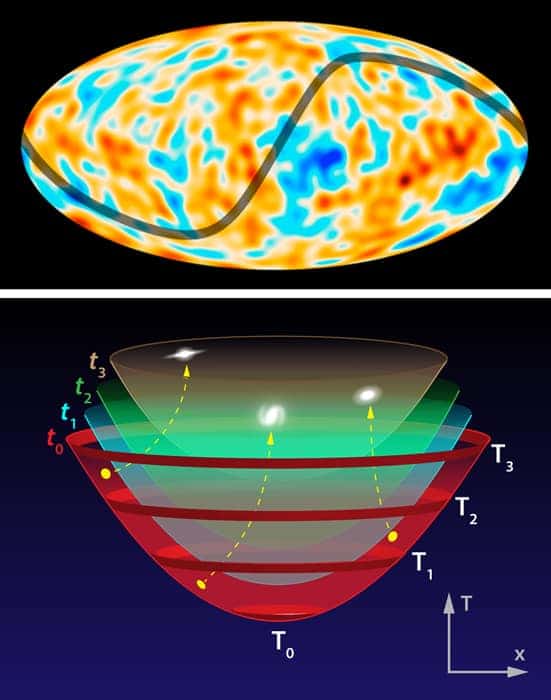
Image of the CMB fluctuations (top) and illustration depicting the birth of our bubble universe

The geometry of the universe is “open” or negatively curved like a saddle, according to a new model proposed by researchers in Europe who have studied anomalies in the cosmic microwave background radiation. The anomalies were first detected by NASA’s Wilkinson Microwave Anisotropy Probe (WMAP) in 2004 and were confirmed earlier this year by the European Space Agency’s Planck space mission.

Cosmologists believe that when the universe was very young – a mere 10–35 s after the Big Bang – it underwent a period of extremely rapid expansion known as “inflation”. About 380,000 years after the Big Bang, the cosmic microwave background (CMB) – the thermal remnant of the Big Bang – came into being. Physicists had expected the temperature of the CMB to be the same everywhere but for almost 10 years, evidence of a puzzling CMB anomaly has grown. It is becoming clear that the experimentally observed temperature fluctuations in the two hemispheres of the sky are slightly different. This means that the density of matter and energy seems to vary more strongly on one side of the sky than on the other.

Large-scale asymmetry

When first spotted by WMAP, this “hemispheric asymmetry” was met with doubt until the Planck mission independently confirmed it. The observations show that while the average temperature is the same in both hemispheres, the fluctuations are about 10% larger on one side compared with the other. While the statistical significance of the anomaly is debatable, the fact that both WMAP and Planck have detected it means that it needs to be thoroughly investigated.

“There seems to be a preferred direction in space…such that the hot spots are hotter and the cold spots are colder on one side of the sky. While it might be a statistical fluke, there might also be something more going on,” says Andrew Liddle, a physicist at the University of Edinburgh. Liddle explains that the CMB dataset is a complex one and that “the eye gets drawn to one unusual thing and you focus on it…so the anomalies and our observations of them have many caveats”.

In 2008 a team of researchers from the California Institute of Technology in the US came up with a physical model that could explain the existence of the asymmetry in terms of a very large-scale variation in the density of the universe that is observable on a particular distance scale – one which is slightly larger than the size of the observable universe.

Inflationary theories

The team’s model works by using a slightly modified version of the current theory for inflation – this assumes that inflation was caused by quantum fluctuations or a quantum scalar field known as the “inflaton”. Instead, the modified theory includes an additional scalar field that comes into play in the form of the “curvaton”. In this case, the inflaton would control the density parameter for the expanding universe and ensure that it remains homogenous, while the curvaton generates curvature perturbations. It is these perturbations that explain the CMB asymmetry. The problem with this theory was that the researchers had no explanation for where the curvaton fluctuation would arise from.

Now, Liddle and his colleague Marina Cortês at the Lawrence Berkeley National Laboratory in the US have published a paper where they say curvaton fluctuation could be intrinsically linked to the geometry of our universe. In particular, they assume that our universe could have an “open” or negative geometry. There are three possible geometries for the universe – open, closed or flat – that occur depending on the density of the universe. In a flat universe, the density is exactly equal to the critical density – the average density of matter required for the universe to just halt its expansion – and so its geometry would be like a sheet of paper and infinite in its extent. An open universe, on the other hand, would mean the density of the universe is less than the critical density. It can be visualized as having a saddle-like negative geometry, where parallel lines would diverge.

Curved horizons

Current observational evidence suggests that ours is a flat universe. “But the measurements still allow for a universe where the density is one-third of the critical density and the universe is still within 1% of being flat,” explains Liddle. This is the crux of the researchers’ argument: it may be possible that the universe appears flat but is really curved with a characteristic radius on a very large scale. This “superhorizon curvature radius” determines the wavelength of the asymmetry-generating curvaton fluctuation. This radius does extend beyond our observable horizon but by no more than an order of magnitude. “So, if the universe is within 1% of being flat, then the curvature scale is three times as big as the observable scale, but there could be some physical processes related to it that could be measured,” according to Liddle.

Pop the bubble

The researchers then point out that their curvaton fluctuations could pop up in another set of “open inflation” theories, first proposed in the 1990s, that suggest that our observable universe forms like a bubble in a larger universe. In this theory our bubble universe is born thanks to a quantum-tunnelling event from a low-energy state and is trapped in what Liddle describes as a “false vacuum state” (click on figure above). The walls of such a bubble would expand at a velocity approaching that of light. “So, on the inside it would look to us as if we were in an open universe that is homogenous and isotropic,” says Liddle, further explaining that inside the bubble, the concept of time is different from outside. “The amount of inflation inside the bubble would determine how ‘flat’ it will be…Will it be dominated by dark matter?…Will it suffer a heat death?”

There may be many other such bubble universes within the larger universe, but our bubble would almost never interact with them and neither would we be able to see out of our “opaque bubble” explains Liddle. But, the initial event that induced the birth of our bubble universe would also cause fluctuations in the bubble wall, which in turn imprint themselves on the curvaton fluctuations.

Liddle and Cortês are clear that their theory is currently “highly speculative” and that current data might even rule it out. But Liddle feels that data from the Planck mission (more will be released next year) and new data from the upcoming Euclid mission might test their model. While the researchers will never be able to probe the larger universe, they might successfully measure the geometry of our bubble universe and show its “openness” in the years to come.

The research is published in Physical Review Letters.

Former physicist Angela Merkel seeks third term as German chancellor

On Sunday millions of Germans will cast their votes in a federal election that will determine Germany’s chancellor for the next four years. First elected chancellor in 2005 and re-elected in 2009, physicist Angela Merkel will be expecting strong support from scientists and educators, feeling that she has done plenty during the past eight years to keep them happy. Recent polls put Merkel’s centre-right CDU/CSU union in the lead with around 40% of the vote.

Merkel originally studied physics at the University of Leipzig from 1973 to 1978 before completing her doctoral thesis on the reactions of hydrocarbons in 1986. She entered politics after the Berlin Wall fell in 1989 and has supported science during her eight years as chancellor. According to the research and education ministry, federal funding for R&D has rocketed by about 60% during that period – from €9bn in 2005 to €14.5bn now. The ministry also says that federal spending on education rose by 70% to €7.3bn in the seven years to 2012 compared with a 30% rise from €3.3bn from 1995 to 2005.

Thomas Mannel, a theoretical particle physicist at the University of Siegen, says that one of Merkel’s most significant contributions is her support for the Excellence Initiative, which is designed to produce internationally recognized universities in Germany that can match rivals in the UK and US. Merkel launched the programme in 2007 with €1.9bn for the first five years and it was renewed in 2012.

Germany now has 11 Ivy-League-style universities receiving top-up funding. “The positive side is that it was real money for the universities,” Mannel says. “The negative side is that the university landscape is changing because of this and students tend to go to the ‘excellence’ universities.”

Doing more

Condensed-matter physicist Kurt Binder from Johannes Gutenberg University Mainz sees Merkel’s “most important achievement” as the Pact for Research and Education. The pact, agreed between the federal government and Germany’s 16 states, provides annual funding increases of 5% from 2011 through 2015 for the Fraunhofer Society, the Helmholtz Association, the Max Planck Society, the Leibniz Association and the German Research Association. “This exceeds inflation and improved the situation of these institutions,” Binder says.

Since Merkel has a PhD in physics, I would have expected a more active role in favour of science and education

Kurt Binder from Johannes Gutenberg University Mainz

However, Binder believes that Merkel should do more to improve all universities in Germany, not just those in the top tier. The problem is that universities are primarily funded by the federal state in which they are located, but many are in financial trouble. “Since Merkel has a PhD in physics, I would have expected a more active role in favour of science and education,” Binder says. “She acts more or less like other ordinary politicians: the next election is the only thing that counts.”

Binder adds that Merkel’s re-election would not necessarily be “something good” for science and education, but fears worse damage if the Social Democrats and the Greens formed a coalition government. Mannel agrees, thinking ongoing stable funding is more likely under Merkel. “The chances for such a scenario are better if she were to be re-elected,” he says.

One issue that has been conspicuously absent during the election campaign is Merkel’s decision in 2011 to close down Germany’s 17 nuclear reactors by 2022. That decision – taken in the wake of Japan’s Fukushima nuclear accident – was generally supported across the political spectrum and by most Germans, who strongly support renewable energy sources. What might happen after the election as 2022 approaches is uncertain. But any government that reverses the decision would risk the wrath of voters.

A Bohemian rhapsody on string theory

By Matin Durrani

I’ve lost count of the number of times someone has had the seemingly bright idea of remaking a well-known song, altering the lyrics so they’re about some “cool” aspect of science, and then unleashing a cataclysmically awful video to the rest of the world, with the original song mangled to death.

So I braced myself before playing this new a capella version of Queen’s “Bohemian Rhapsody”, entitled “Bohemian Gravity”. It is sung and performed by Tim Blais – a student in theoretical physics at McGill University in Canada, who recently completed his Master’s thesis under Alex Maloney.

(more…)

Dramatizing science

Don’t you hate those plays and shows, supposedly about science, in which the scientists are endearing geeks or quirky geniuses – and science itself never actually steps onstage? I do. So one day last autumn, when my morning’s e-mail trove included the announcement of a playwriting competition for “10-minute plays with a substantial science component”, I bolted upright. It was sponsored by the Simons Center for Geometry and Physics at Stony Brook University. I have been writing about science for three decades, and covered some dramatic tales. Knocking out a script? Piece of cake!

Several stories that have interested me over the years involve the collision between science and politics. In 1954, for example, some residents of the Marshall Islands – which was then officially a US “Trust Territory” – had been accidentally exposed to fallout following a bomb test. Two decades later, controversies arose about their medical treatment, with scientists and doctors saying one thing about life-and-death matters, and activists and politicians another. I wrote an essay about the episode 10 years ago for a book called Science and Other Cultures, but felt that I had not fully explored what had happened. I also continued to feel disturbed at the breakdown of trust between the activists and the scientists, with the activists viewing the scientists as uncaring, and the scientists regarding the activists as dishonest.

I’d always felt that turning this story into a play would let me work out why each group felt the way it did about the other. But I kept putting it off. I’d never written a play before, didn’t really know how, and my professional commitments were always on “overload”. So when the e-mail from the Simons Center popped up, I thought: “Now or never!”

Tough work

Actually, writing a 10-minute play was incredibly hard. After a few frustrating attempts I consulted a friend, the playwright Jeffrey Sweet. He warned me that playwriting was unlike any writing I had done before. “The basic unit of theatre is not the word but the actor,” he said, handing me lists of plays to watch on DVD for their structure and teaching me some tricks. “Don’t spell everything out; make the audience work,” he added. “If you say ‘2 + 3 = 5’, people shrug. If you say ‘2 + n = 5’, their immediate impulse is to fill it in. Keep the audience active.”

Sweet’s handbook about playwriting, The Dramatist’s Toolkit, says little about science plays, and I asked if these were especially difficult to write. He nodded. There are several obstacles, he said. One is that theatre is about observing people interacting in social situations. But the core even of collaborative science is thinking – and, as he put it, “you can’t observe thought”. This makes it hard to dramatize science.

Another problem, Sweet said, is that scientists speak to one another in “high-context communication” that assumes a shared background and expertise and uses jargon. But when scientists talk to reporters, lawyers or others with whom they share little, they use “low-context communication”, which is different in tone as it involves a lot of explaining. As a result, scientists onstage are only believable if their dialogue with each other is high-context, but only understandable to an audience if their dialogue is low-context. This tempts poor writers to commit the basic mistake of having people who should be speaking high-context speak to each other low-context, saying things that each person knows the other person already knows.

Sweet’s advice made me see that, in many ways, crafting a play is like mounting an experiment. In both an experiment and a play, a series of actions trigger each other. The experimental craft, like the playwright’s, involves knowing how to create and connect these actions. Just as at the start of an experiment, we do not know what the end result will be – that’s why we perform experiments! – so at the start of a play we in the audience do not know how it will turn out (unless we’ve seen or read the play already). But looking backwards from the end of a good experiment or play, we can appreciate the logic and even inevitability of the chain of events. In an experiment the actions are physical events, while in a play they consist mainly of people talking. And, like any good physics experiment, a play can point to some deeper truth, albeit about human nature rather than nature itself.

This insight didn’t make playwriting any easier. Thanks to Sweet’s coaching, reading more books about playwriting – David Ball’s Backwards and Forwards was helpful – and a lot of other reading and DVD-watching, I rethought and revised the play. I worked on it almost every day for two months, and entitled it Trust Territory. To my surprise – I was competing with 26 other playwrights – it won first prize. In April the four winning plays were given a “staged reading”, where the parts were read by students and professors. (You can watch this reading of Trust Territory online at http://ow.ly/mXFtP.)

The critical point

Several websites exist to help new playwrights of all kinds, the most useful of which I found to be http://playsubmissionshelper.com/blog. The Alfred P Sloan Foundation also works with the Ensemble Studio Theatre to encourage science plays, challenging artists “to create credible and compelling work exploring the worlds of science and technology and to challenge existing stereotypes of scientists and engineers in the popular imagination” (http://ow.ly/mPaOu).

So the next time you groan at a lousy play about science, don’t get mad – try it yourself!

Molecules line up in laser grid


Physicists in the US have stored ultracold molecules in an optical lattice for the first time. The molecules – which interact with one another at a distance and not just at short range – could be used to study phenomena such as quantum magnetism, the researchers say.

When a system is cooled to a temperature very close to absolute zero, the underlying behaviour of its component parts is less erratic and it becomes possible to study their pure, quantum-mechanical interactions. For some three decades, physicists have studied ultracold atoms for this reason. However, many materials in nature are based on molecules, not atoms, and so physicists have been keen to study ultracold molecules too.

Unfortunately, cooling molecules is not straightforward. Unlike atoms, molecules have several ways of moving internally – such as vibrating and rotating – and this can all-too-easily hinder the cooling process. For instance, lasers are often used to cool atoms: an atom scatters a photon from a laser and in doing so loses energy. But try this with a molecule and the molecule might slip into an internal energy state that is “dark” to the laser, meaning that it cannot scatter photons – and cool – anymore.

Magnetic tuning

An alternative to cooling molecules directly is to cool a gas of atoms first and then encourage those atoms to bond into molecules. This was the route taken in 2008 by Deborah Jin and Jun Ye at the University of Colorado at Boulder and colleagues, who started with a cold gas of potassium and rubidium atoms. The researchers used a magnetic field to carefully tune the atoms into a certain state such that the atoms would form molecules when they collided with one another. The result was a gas of potassium–rubidium molecules at a temperature of just a few hundred nanokelvin and a density of one trillion molecules per cubic centimetre.

Now, Jin, Ye and colleagues at JILA – a joint institute of the University of Colorado at Boulder and the National Institute of Standards and Technology (NIST) – have gone one step further by trapping the ultracold potassium–rubidium molecules in an optical lattice. An optical lattice is made from laser beams that overlap to form a grid of potential wells in which atoms or molecules can sit. By trapping their molecules in an optical lattice, the researchers allow the dynamics of the molecules to be dominated by internal motion, rather than by side-to-side, translational motion.

Coupling spins

Thanks to their ability to rotate and their polar nature, the molecules can – in analogy with electrons – have two different “spin” states: up and down. By applying a microwave field to the optical lattice, the team could couple the spins of two distant (not neighbouring) molecules, so that a flip of one of the molecules caused the flip of another. Such long-range spin interactions underly quantum magnetism, which is responsible for the magnetism of everyday materials such as iron and may also play a role in superfluidity and high-temperature superconductivity.

Physicist Immanuel Bloch of the Max-Planck Institute of Quantum Optics in Garching, Germany, says the results are “very nice”, and praises the researchers for having shown that ultracold molecules can interact over a long range. “This is a very promising new route for realizing spin-models in ultracold quantum gases,” he adds.

Theorist Roman Krems of the University of British Columbia in Vancouver, Canada, calls the development a breakthrough. “This experiment paves the way for the design of quantum simulators of condensed-matter models,” he says.

The research is published online today in Nature.

Inflatable antenna could send tiny satellites beyond Earth orbit

A new type of inflatable antenna has been designed for CubeSats – the miniaturized spacecraft that have reduced the cost of putting scientific equipment into Earth orbit. The antenna was created by researchers in the US, who believe that their invention could lead to CubeSats being used for interplanetary missions.

CubeSats are roughly the size of a shoebox and have masses between 1.4–4 kg. Given their small size, they can often piggyback on the launches of larger space missions. As a result, the cost of getting a CubeSat into space is a fraction of that for traditional satellites and opens the door to wider participation in space-based research.

However, there are currently some significant limitations with CubeSats, including limited communication capabilities with ground stations. This problem arises because large, far-ranging satellite dishes cannot be fitted to these tiny craft. Instead, CubeSats have so far been equipped with smaller, less-powerful systems with limited range. This is one of the reasons why CubeSat missions to date have been restricted to low orbits: 300–1000 km above the surface of the Earth.

Sublimating powder

The idea proposed in this new research is to fit CubeSats with a small balloon-like device that expands into a larger antenna once the craft is in space. The device is constructed from a 50.8-μm-thick film made from Mylar, which can be folded into a 10 cm3 volume within the CubeSat before launch. Once in space, the reduced pressure causes a small amount of benzoic-acid powder that is stored within the device to sublimate, which releases gas that inflates the device into an antenna with a width of 1 m.

The group behind the inflatable design is led by Alessandra Babuscia, who is currently based at NASA’s Jet Propulsion Laboratory (JPL) in California and who launched the project while working at the Massachusetts Institute of Technology (MIT). Babuscia told physicsworld.com that the project was inspired by an informal conversation that she had with a colleague about the idea of sending a CubeSat to an asteroid. “There are lots of talks these days at conferences about the possibility of making CubeSats interplanetary,” she says.

Photograph of the research team behind this inflatable antenna

If this research does lead to a viable technology, it would not be the first time that an inflatable antenna has been used for space missions. However, the specific challenge this time was to devise a mechanism for inflating the antenna that did not rely on the bulky systems of pressure valves used in previous versions. The sublimation route employed by Babuscia and her group was inspired in part by NASA’s Project Echo in the late 1950s, which used a sublimation process for two balloon satellites that were launched in the 1960s.

To see whether the antenna does indeed inflate to the predicted form, the group tested the device in a vacuum chamber at MIT, where the researchers lowered the pressure to just above that experienced in space. They also did computer simulations showing that a cylindrical version of the device performed slightly better than a conical one. The simulations show that the device transmits data 10 times faster – and seven times farther – than existing CubeSat antennas. Babuscia says that at this performance, a CubeSat could communicate with Earth from at least the distance of the Moon.

Threat of micrometeorites

The research also explored some of the challenges with using the antenna as part of a CubeSat mission, which includes addressing the threat of micrometeorites. By including a slight excess of sublimating powder, the antenna can continue to re-inflate itself in the event of small punctures caused by collisions with space debris. The researchers use meteorite flux data from the Space Environment Information System (SPENVIS) to estimate that even with small leaks, the antennas can remain inflated for several years.

The next stage of the research is to run further tests, including a more detailed examination of the electromagnetic properties of the antenna by testing it in an anechoic chamber. “We need to repeat and do more tests, especially to test the reaction of the system to collisions with bigger particles,” says Babuscia. The radiation characteristics of the antenna have been tested but results will be not be revealed until an upcoming paper to be presented at IEEE Aerospace Conference in March 2014.

The inflatable-antenna concept proposed in this research has caught the interest of Pierpaolo Pergola, an aerospace engineer from the University of Pisa in Italy. “I think that the concept is definitely robust and interesting but more complete-system analyses are required before having an off-the-shelf CubeSat subsystem,” he says. In August, Pergalo published a paper detailing a proposed mission to the near-Earth asteroid Cruithne, which involved the use of CubeSats. Pergalo believes that one of the potential hazards that needs to be investigated further is the increased atmospheric drag in low Earth orbit, which could affect the trajectory of the craft.

The antennas are described in the proceedings Aerospace Conference, 2013 IEEE.

What can superconductivity do for the environment?

By Hamish Johnston

When I think of superconductivity, applications that could improve the environment don’t usually come to mind. Perhaps that’s because superconductors only work at very low temperatures and lots of energy is needed to cool them. However, a review article just published in the IOP Publishing journal Superconductor Science and Technology points out some interesting environmental applications.

(more…)

Experiment probes strength of the weak interaction

An international collaboration has made the first determination of the proton’s “weak charge” – a quantity that is related to the strength of the weak interaction. The Q-weak experimental collaboration, working at Jefferson Lab in Newport News, Virginia, says that the small number of data analysed so far agree with predictions of the Standard Model of particle physics but that it believes a full analysis could still reveal the existence of “new physics”.

All the fundamental forces in nature have a strength that is determined by a certain particle parameter. For instance, the strength of gravity is determined by particle mass, while the strength of electromagnetism is determined by electric charge. Similarly, the strength of the weak force, which governs radioactive decay, is determined by a property known as weak charge. In fact, physicists have known that the electric and weak charges are related to one another since the late 1960s, when the electromagnetic and weak forces were unified into a single electroweak theory, which forms part of the Standard Model of particle physics.

Precise measurements of weak charge go back several decades, when the property was determined for caesium-133 nuclei. More recently, in 2004, physicists at the Stanford Linear Accelerator Center in California measured the weak charge of the electron and found it to be consistent with the Standard Model prediction of slightly greater than zero. The weak charges of the electron and proton are particularly interesting because the particles are relatively simple systems. This simplicity is important when it comes to interpreting any measured deviations from Standard Model predictions.

Challenging measurement

In the past, measuring the proton’s weak charge has been considered almost too challenging to perform. One problem is that the proton is not a point-like particle – it is made up of three quarks. As a result, theorists have needed to make sure that they fully understand the contributions from its internal structure. But another problem is experimental: the measurement requires an incredibly powerful and stable electron beam in which all of the electron spins are polarized in the same direction. This beam must be fired at a proton so that deviations in scattering for different polarizations as subtle as a few parts in a billion can be recorded.

Such challenges have now been met by the Q-weak experimental collaboration. Using the particle accelerator at Jefferson Lab, the researchers sent a beam of spin-polarized electrons into a sample of liquid hydrogen – essentially, a flask of protons – so that the electrons scattered off at small glancing angles could be measured. Theory says that the proton’s weak charge has a subtle influence on the rate at which the electrons are scattered. This effect is also dependent on the spin of the electrons; so by flipping the electron spin and recording the change in scattering rate, the researchers were able to determine the weak charge of the proton.

The Standard Model predicts very precisely that the weak charge of the proton ought to be almost zero. This is what the Q-weak collaboration measured – but having analysed just 4% of the data. “Look at this primarily as the first determination of the weak charge of the proton, not as our final test of the Standard Model,” says Roger Carlini, a spokesperson for the collaboration. He expects a more definitive result in about a year. “The jury is still out!” he adds.

Surprises lurking in the data

Indeed, Carlini is open to the suggestion that physics beyond the Standard Model could still show up in the final results as he and his colleagues analyse the rest of the data. Such new physics might be particles that are far heavier than anything that is currently known. For instance, heavier particles are predicted in supersymmetry, a theory that partners all the current elementary particles with a host of more massive “sparticles”. They are also predicted by so-called grand unification theories, which aim to unify the strong force with electroweak theory.

If beyond-the-Standard-Model physics has so far been eluding us in this stealthy way, the weak-charge measurements might provide the first indications that it is there
Michael Ramsey-Musolf, University of Massachusetts-Amherst

Carlini admits that any evidence of new physics in a more thorough measurement of the proton’s weak charge will not be direct, as it might be for instance at the Large Hadron Collider (LHC) at CERN in Geneva, Switzerland. “If you see new physics in an LHC experiment, you have it in the bag, so to speak,” he says. But he adds that the LHC can still run out of energy before it detects anything – a handicap that is not suffered by a “precision frontier” experiment such as Q-weak. “We don’t have to build higher and higher energy accelerators, just conduct more and more precise measurements. Which in the end may be easier,” he says.

Indeed, theorist Michael Ramsey-Musolf at the University of Massachusetts-Amherst believes that certain parts of theories, including supersymmetry, would never show up at the LHC but have the potential to show up in weak-charge measurements. “If beyond-the-Standard-Model physics has so far been eluding us in this stealthy way, the weak-charge measurements might provide the first indications that it is there,” he says.

Theorist Victor Flambaum at the University of New South Wales in Sydney, Australia, agrees that the measurements will provide an important test of supersymmetry and grand unification theories. “The Jefferson Lab measurement of the proton’s weak charge is a great achievement,” he adds.

The research is due to be published in Physical Review Letters. A preprint can be found at arXiv:1307.5275.

Voyager 1: a peer-reviewed day to remember

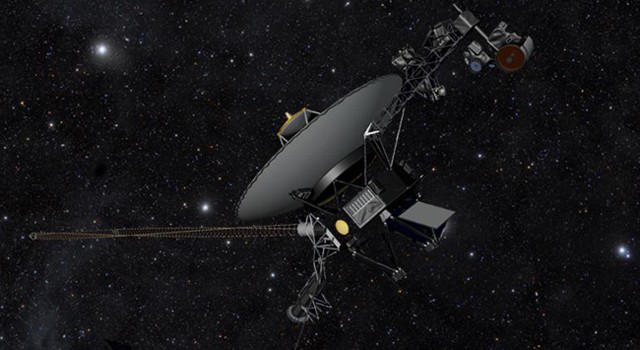
Voyager 1 has left the solar system (Courtesy: NASA/JPL-Caltech)

By Hamish Johnston

Yesterday a paper appeared in Science that makes the case that the Voyager 1 spacecraft has left the solar system. The response from the press and commenters has been to declare this a day to remember. Indeed, some have likened it to 20 July 1969 when Neil Armstrong first stepped on the Moon.

(more…)

Copyright © 2026 by IOP Publishing Ltd and individual contributors